
Healthcare of the Transgender Patient and The Powers








![after slide 53 Issues 71] MTF[was Testosterone In MTF who have undergone full gender](https://slidetodoc.com/presentation_image_h/ee051f0a17f58be6db11f0d982555052/image-63.jpg "after slide 53 Issues 71] MTF[was Testosterone In MTF who have undergone full gender")









- Slides: 136
Healthcare of the Transgender Patient and The Powers Method of Hormonal Transitioning v 5. 4 v 6. 0 Dr. William Powers D. O. AAHIVMS Facebook. com/Dr. Will. Powers. Family. Medicine. com © 2017 -2019 - Dr. William Powers Optimized for MS Office 2016 PPT (Presented in high contrast for the visually impaired)
Lecture Goals & Objectives 01 Understanding gender dysphoria and the transgender patient 02 Preventative medicine for transgender people 03 Understanding the process of basic hormonal transitioning Preventative medicine for transgender people
Please Note This lecture is designed to be presented to physicians / medical providers in the context that they will be providing medical or HRT care to transgender people. If it has ended up in your hands, and you are not one of those, please keep this perspective in mind! Also, it is based on the experience of an American doctor using American formulary options. There are many drugs in many other countries which aren’t available choices for us, and therefore are not remarked on here or in very limited detail. Additionally, language is used in this Power. Point which is medical in nature. It contains the statements of major medical groups or publications. This language may not be sensitive to the very people this presentation is about. That being said, it cannot be edited without misquoting the source, so please be mindful of this as well. In short, not all the words here are mine. Some are quoted from other sources.
Please Note Transgender Medicine is an evolving field. No major medical society has standards of care yet for transgender people (Such as the AOA, AMA, ACOG, etc) Some of the information presented here is based on my own personal observations with my own patients. I see approximately 10 -15 transgender patients daily, and have somewhere around 1500 in my practice. I therefore have derived some information not yet published or independently verified/peer reviewed. This is information based on my personal experience and not trial data. For this, I annotate these findings with this symbol: (P)
Acknowledgements I’ve been able to make great advancements in this field over the years due to the assistance and research of the transgender community on itself, as well as the contributions of certain online communities. I would not have thriving practice I do today without the help of the following people. This list is certainly not all encompassing, as some people prefer to remain anonymous: Sigrid Svartvatn – For her biochemistry research regarding estrone. Beverly Cosgrove and Juno Krahn– For their research into the usage of progesterone as an AA and the risks of Spironolactone and her informal publications on both as well as estrogen monotherapy Redditor /u/Alyw 234237 (Aly W. ) who has aggregated a tremendous amount of clinical and research data and routinely publishes it freely without paywall for the benefit of anyone who wishes to read it.
How Do Transgender People View Hormone Providers?
How Do Transgender People View Hormone Providers?
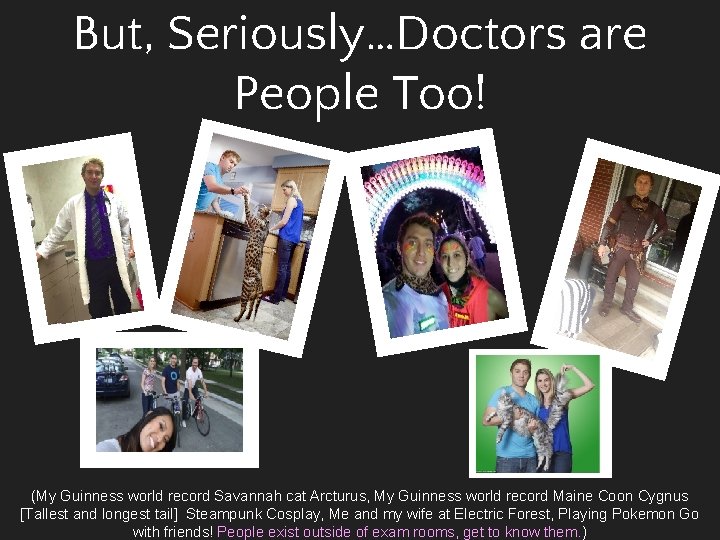
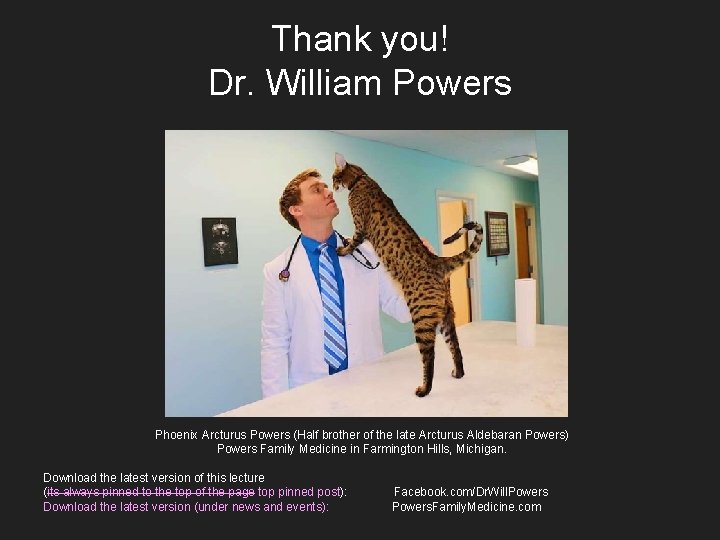
But, Seriously…Doctors are People Too! (My Guinness world record Savannah cat Arcturus, My Guinness world record Maine Coon Cygnus [Tallest and longest tail] Steampunk Cosplay, Me and my wife at Electric Forest, Playing Pokemon Go with friends! People exist outside of exam rooms, get to know them. )
My Practice My practice is highly unusual. I decided to theme it around things I enjoy, and it is filled with video game artwork and x-rays of video game controllers. It has exotic hybrid therapy cats (hypoallergenic early generation Bengal and Savannahs), and is an exceptionally warm and inviting place for a doctors office. About 70% of my patients are transgender, and I’ve seen probably close to 2000 different transgender people over the past 7 years. It is completely non-traditional, and patients seem to love that.
So Why Doesn’t Every Doctor Treat Transgender Patients?
Why Is It So Scary Not Treat Transgender Patients? Personal beliefs (ability to provide this care, religious reasons, etc. ) There are no major long standing American medical board organizations representing medical specialties with transgender standards of care. (AMA, AOA, ACOG, ABIM etc. ) We live in a litigious society (Nobody wants to get sued for doing an “unapproved therapy”)
So Why Do It? > Ethics – Autonomy > Suicidality (41% attempt suicide by age 30) Risk is reduced by more than half with hormone therapy Intervenable factors associated with suicide risk in transgender persons: a respondent driven sampling study in Ontario, Canada BMC Public Health, 2015
Why Do People Have Gender Dysphoria? The following are correlated with an increase in the incidence of gender dysphoria: > > > DES Exposure Congenital Adrenal Hyperplasia Aromatase Excess (or deficiency) Klinefelter Syndrome XXY De La Chapelle Syndrome (XX, male phenotype, +SRY) PCOS Androgen Insensitivity Syndrome Exposure to Prenatal Estrogen/Androgens Psychological disorders (ASD/Others) Endocrine receptor sensitivity variance (CAG repeat) Neuroanatomical structural variance (Sources for these available in the footnotes of the downloadable form of this presentation. )
Why Do People Have Gender Dysphoria? I include, “Abuse History” as I have a singular patient who describes themselves as non-binary and prefers gender neutral pronouns. This patient has a personal history of childhood sexual, physical, and emotional abuse. They describe the idea of being “Female” as something vulnerable and that can be harmed. They dislike identifying in this way, and choose non-binary instead as their preferred gender expression. I include this not to imply that many transgender people have gender dysphoria due to abuse, but that it’s possible a small fraction do. Patients should be asked about a history of abuse whether they are transgender or not. In my entire practice, this lone patient is the only example of childhood abuse being self reported as linked to gender dysphoria.
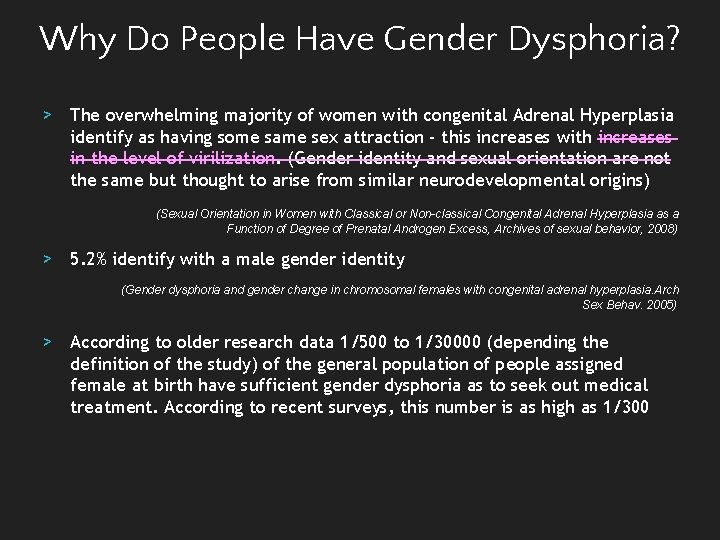
Why Do People Have Gender Dysphoria? > The overwhelming majority of women with congenital Adrenal Hyperplasia identify as having some same sex attraction - this increases with increases in the level of virilization. (Gender identity and sexual orientation are not the same but thought to arise from similar neurodevelopmental origins) (Sexual Orientation in Women with Classical or Non-classical Congenital Adrenal Hyperplasia as a Function of Degree of Prenatal Androgen Excess, Archives of sexual behavior, 2008) > 5. 2% identify with a male gender identity (Gender dysphoria and gender change in chromosomal females with congenital adrenal hyperplasia. Arch Sex Behav. 2005) > According to older research data 1/500 to 1/30000 (depending the definition of the study) of the general population of people assigned female at birth have sufficient gender dysphoria as to seek out medical treatment. According to recent surveys, this number is as high as 1/300
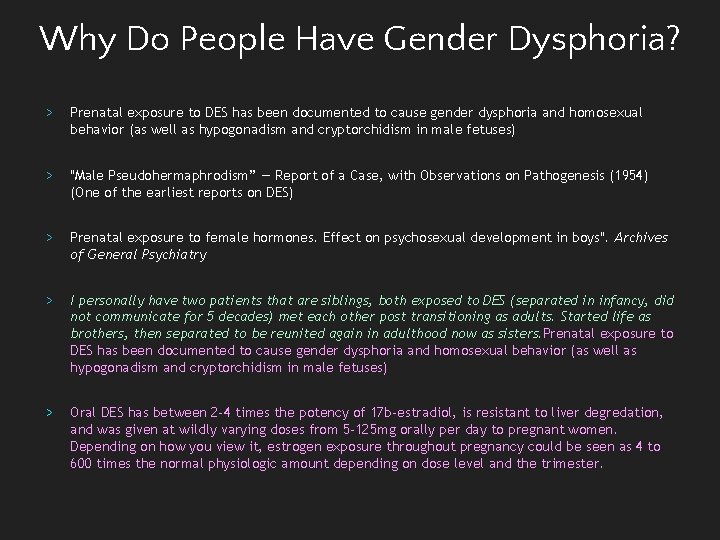
Why Do People Have Gender Dysphoria? > Prenatal exposure to DES has been documented to cause gender dysphoria and homosexual behavior (as well as hypogonadism and cryptorchidism in male fetuses) > "Male Pseudohermaphrodism” — Report of a Case, with Observations on Pathogenesis (1954) (One of the earliest reports on DES) > Prenatal exposure to female hormones. Effect on psychosexual development in boys". Archives of General Psychiatry > I personally have two patients that are siblings, both exposed to DES (separated in infancy, did not communicate for 5 decades) met each other post transitioning as adults. Started life as brothers, then separated to be reunited again in adulthood now as sisters. Prenatal exposure to DES has been documented to cause gender dysphoria and homosexual behavior (as well as hypogonadism and cryptorchidism in male fetuses) > Oral DES has between 2 -4 times the potency of 17 b-estradiol, is resistant to liver degredation, and was given at wildly varying doses from 5 -125 mg orally per day to pregnant women. Depending on how you view it, estrogen exposure throughout pregnancy could be seen as 4 to 600 times the normal physiologic amount depending on dose level and the trimester.
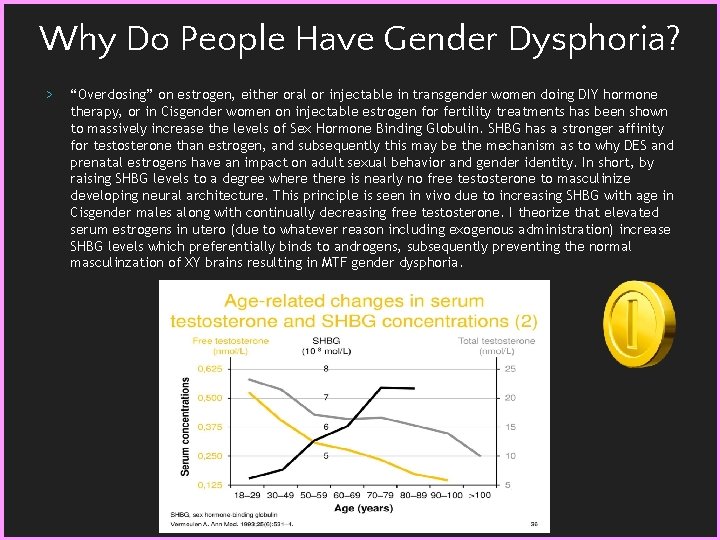
Why Do People Have Gender Dysphoria? > “Overdosing” on estrogen, either oral or injectable in transgender women doing DIY hormone therapy, or in Cisgender women on injectable estrogen for fertility treatments has been shown to massively increase the levels of Sex Hormone Binding Globulin. SHBG has a stronger affinity for testosterone than estrogen, and subsequently this may be the mechanism as to why DES and prenatal estrogens have an impact on adult sexual behavior and gender identity. In short, by raising SHBG levels to a degree where there is nearly no free testosterone to masculinize developing neural architecture. This principle is seen in vivo due to increasing SHBG with age in Cisgender males along with continually decreasing free testosterone. I theorize that elevated serum estrogens in utero (due to whatever reason including exogenous administration) increase SHBG levels which preferentially binds to androgens, subsequently preventing the normal masculinzation of XY brains resulting in MTF gender dysphoria.
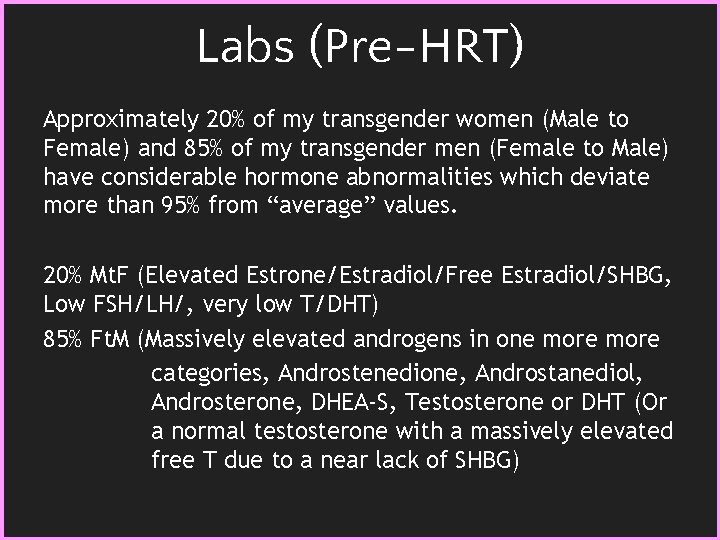
Labs (Pre-HRT) Approximately 20% of my transgender women (Male to Female) and 85% of my transgender men (Female to Male) have considerable hormone abnormalities which deviate more than 95% from “average” values. 20% Mt. F (Elevated Estrone/Estradiol/Free Estradiol/SHBG, Low FSH/LH/, very low T/DHT) 85% Ft. M (Massively elevated androgens in one more categories, Androstenedione, Androstanediol, Androsterone, DHEA-S, Testosterone or DHT (Or a normal testosterone with a massively elevated free T due to a near lack of SHBG)
Multiple neuroimaging studies have demonstrated anatomical variation in the brains of transgender people that are consistent with their preferred gender BEFORE the usage of any exogenous hormones. > Regional gray matter variation in male-to-female transsexualism (Neuroimage 2009) > The microstructure of white matter in male to female transsexuals before cross-sex hormonal treatment. A DTI study (Journal of Psychiatric Research Feb 2011) MTF > White matter microstructure in female to male transsexuals before cross-sex hormonal treatment. A diffusion tensor imaging study (Journal of Psychiatric Research Feb 2011) FTM > Structural Connectivity Networks of Transgender People (Cereb Cortex 2015)
Even more amazing HRT itself can actually cause structural changes in the brain, particularly in areas involved in processing the “self”. Kilpatrick, L. A. , Holmberg, M. , Manzouri, A. , & Savic, I. (2019). Cross sex hormone treatment is linked with a reversal of cerebral patterns associated with gender dysphoria to the baseline of cisgender controls. European Journal of Neuroscience. doi: 10. 1111/ejn. 14420 ABSTRACT Transgender persons experience incongruence between their gender identity and birthassigned sex. The resulting gender dysphoria (GD), is frequently treated with cross-sex hormones. However, very little is known about how this treatment affects the brain of individuals with GD , nor do we know the neurobiology of GD. We recently suggested that disconnection of fronto-parietal networks involved in own-body self-referential processing could be a plausible mechanism, and that the anatomical correlate could be a thickening of the mesial prefrontal and precuneus cortex, which is unrelated to sex. Here, we investigate how cross-sex hormone treatment affects cerebral tissue in persons with GD, and how potential changes are related to self-body perception. Longitudinal MRI measurements of cortical thickness (Cth) were carried out in 40 transgender men (Tr. M), 24 transgender women (Tr. W), and 19 controls. Cth increased in the mesial temporal and insular cortices with testosterone treatment in Tr. M, whereas anti-androgen and estrogen treatment in Tr. W caused widespread cortical thinning. However, after correction for treatment-related changes in total grey and white matter volumes (increase with testosterone; decrease with anti-androgen and estrogen), significant Cth decreases were observed in the mesial prefrontal and parietal cortices, in both Tr. M and Tr. W (vs controls) - regions showing greater pretreatment Cth than in controls. The own body – self congruence ratings increased with treatment, and correlated with a left parietal cortical thinning. These data confirm our hypothesis that GD may be associated with specific anatomical features in own-body/self-processing circuits that reverse to the pattern of cisgender controls after cross-sex hormone treatment.
A Mental Illness? • As I’ve demonstrated here, in a large portion of my patients there is some underlying genetic, endocrine, or fetal exposure factor in the development of their gender dysphoria. Gender dysphoria occurs in the general population on average at approximately 1/3 of the rate of green eyes or red hair (0. 3% vs 1%). Uncommon but not rare. More recent surveys of teens have revealed dysphoria rates as high as 2% • MRI imaging studies have confirmed the structural differences present in dysphoric brains. • In short, gender dysphoria is not a psychiatric illness. It is the phenotypic expression of multiple underlying factors which results in permanent structural changes to the affected person’s neural architecture. • The ethical quandary is do we consider gender dysphoria a “medical problem”? If so, is having an MC 1 R gene mutation that makes you a red-head a problem? You certainly would require more sunscreen, but is it a medical diagnosis? • I once thought that the vast majority of transgender patients would elect to take a theoretical single pill which would suddenly eliminate all their dysphoria and make them happily cisgender (Cisgender means not transgender) rather than transition. I did a poll of my patients on this exact topic, and the response was interesting. Only 30% of over 300 respondents would take the pill. The rest spoke heavily against it. In particular, it seemed those early in transition were more likely to elect to take it, though patients finished transitioning were highly against it.
Why not take the magic anti-gender dysphoria pill? § “I would never accept a pill to make me "happy" with my assigned at birth gender. This would effectively be personality death, the person who existed after taking that pill would no longer be me. I am a woman and that is a very important part of who I am and how my experiences have been shaped. Now if you offered me a magic "perfect immediate transition" button I'd press that in a heartbeat. ” § “My gender dysphoria was late onset. The necessity of transition and the fear of transition were very real. I am fortunate to be able to withstand the significant loss and successfully transition MTF. Some are not so fortunate. They may turn to many things to relieve their discomfort. Some commit suicide. Having contemplated that myself, I can appreciate their desperation. If there was a way to live happily without all the pain and loss, I would have done it in a heartbeat. For me, the magic pill was transition, and it was a very bitter pill to swallow. ” § “In simple terms, should you have asked me that question at any point prior to transitioning, my answer unequivocally would have been “YES!”. I would have taken that pill even before you gave me water to wash it down. . . speaking from where I stand now, despite the high price I have paid to get to where I am today, I don’t know whether I would take that pill. Something tells me I would pass on it. I have grown in so many ways and learned so much from all this that, I simply cannot imagine my life any other way. I even have trouble imagining what “being cis” would mean for me. ” § In short, many transgender people view their gender identity as core to the very person that they are. As a result, erasing that would be akin a lobotomy or conversion therapy, medical malfeasance where we attempt to eradicate a core part of who someone is in an attempt to make them align with what society expects of them.
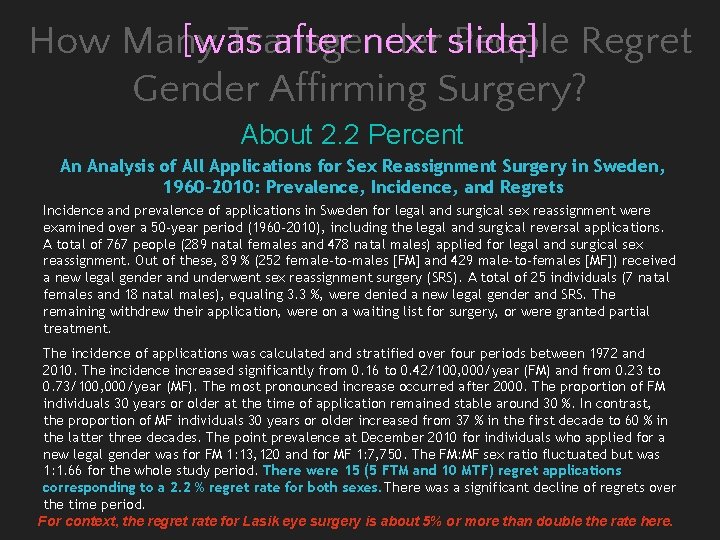
How Many [was Transgender after next slide] People Regret Gender Affirming Surgery? About 2. 2 Percent An Analysis of All Applications for Sex Reassignment Surgery in Sweden, 1960 -2010: Prevalence, Incidence, and Regrets Incidence and prevalence of applications in Sweden for legal and surgical sex reassignment were examined over a 50 -year period (1960 -2010), including the legal and surgical reversal applications. A total of 767 people (289 natal females and 478 natal males) applied for legal and surgical sex reassignment. Out of these, 89 % (252 female-to-males [FM] and 429 male-to-females [MF]) received a new legal gender and underwent sex reassignment surgery (SRS). A total of 25 individuals (7 natal females and 18 natal males), equaling 3. 3 %, were denied a new legal gender and SRS. The remaining withdrew their application, were on a waiting list for surgery, or were granted partial treatment. The incidence of applications was calculated and stratified over four periods between 1972 and 2010. The incidence increased significantly from 0. 16 to 0. 42/100, 000/year (FM) and from 0. 23 to 0. 73/100, 000/year (MF). The most pronounced increase occurred after 2000. The proportion of FM individuals 30 years or older at the time of application remained stable around 30 %. In contrast, the proportion of MF individuals 30 years or older increased from 37 % in the first decade to 60 % in the latter three decades. The point prevalence at December 2010 for individuals who applied for a new legal gender was for FM 1: 13, 120 and for MF 1: 7, 750. The FM: MF sex ratio fluctuated but was 1: 1. 66 for the whole study period. There were 15 (5 FTM and 10 MTF) regret applications corresponding to a 2. 2 % regret rate for both sexes. There was a significant decline of regrets over the time period. For context, the regret rate for Lasik eye surgery is about 5% or more than double the rate here.
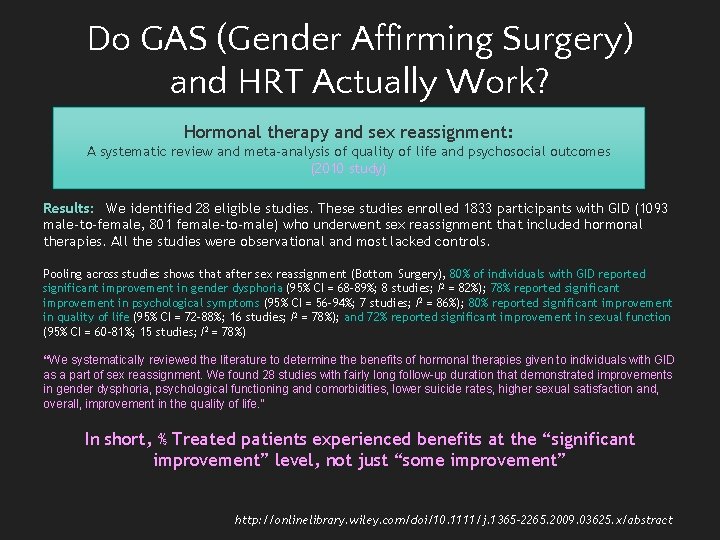
Do GAS (Gender Affirming Surgery) and HRT Actually Work? Hormonal therapy and sex reassignment: A systematic review and meta-analysis of quality of life and psychosocial outcomes (2010 study) Results: We identified 28 eligible studies. These studies enrolled 1833 participants with GID (1093 male-to-female, 801 female-to-male) who underwent sex reassignment that included hormonal therapies. All the studies were observational and most lacked controls. Pooling across studies shows that after sex reassignment (Bottom Surgery), 80% of individuals with GID reported significant improvement in gender dysphoria (95% CI = 68– 89%; 8 studies; I 2 = 82%); 78% reported significant improvement in psychological symptoms (95% CI = 56– 94%; 7 studies; I 2 = 86%); 80% reported significant improvement in quality of life (95% CI = 72– 88%; 16 studies; I 2 = 78%); and 72% reported significant improvement in sexual function (95% CI = 60– 81%; 15 studies; I 2 = 78%) “We systematically reviewed the literature to determine the benefits of hormonal therapies given to individuals with GID as a part of sex reassignment. We found 28 studies with fairly long follow-up duration that demonstrated improvements in gender dysphoria, psychological functioning and comorbidities, lower suicide rates, higher sexual satisfaction and, overall, improvement in the quality of life. ” In short, ⅘ Treated patients experienced benefits at the “significant improvement” level, not just “some improvement” http: //onlinelibrary. wiley. com/doi/10. 1111/j. 1365 -2265. 2009. 03625. x/abstract
Part 2: Transitioning - Why, How, Why, And Sometimes Why Not.
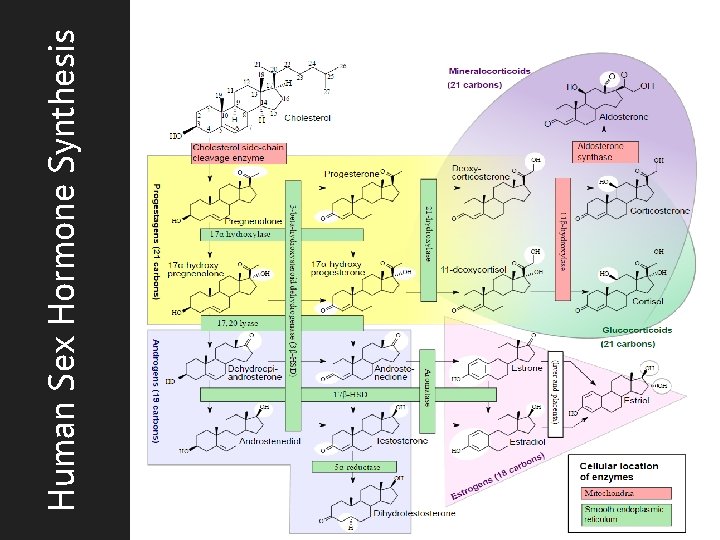
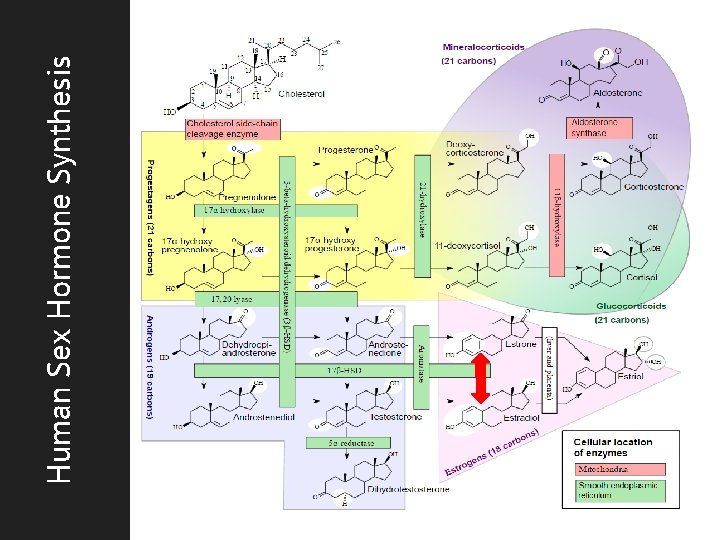
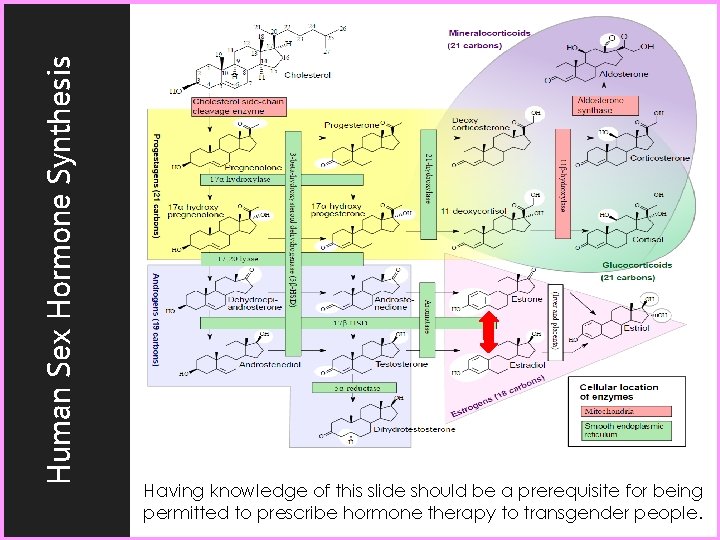
Human Sex Hormone Synthesis
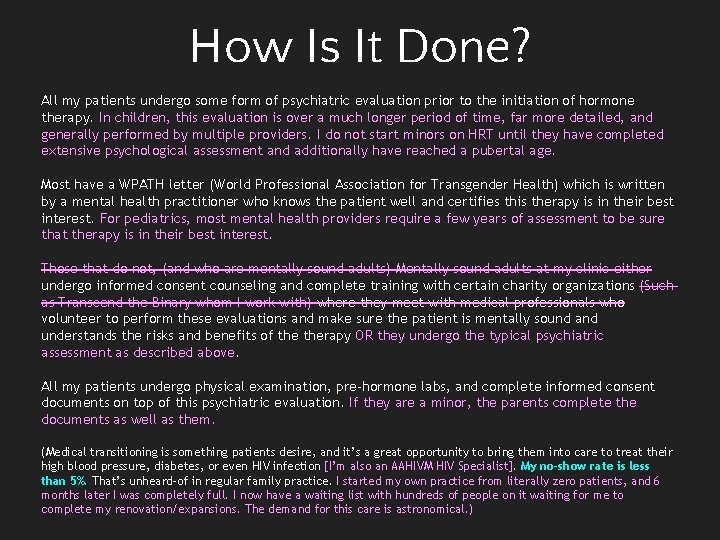
How Is It Done? All my patients undergo some form of psychiatric evaluation prior to the initiation of hormone therapy. In children, this evaluation is over a much longer period of time, far more detailed, and generally performed by multiple providers. I do not start minors on HRT until they have completed extensive psychological assessment and additionally have reached a pubertal age. Most have a WPATH letter (World Professional Association for Transgender Health) which is written by a mental health practitioner who knows the patient well and certifies this therapy is in their best interest. For pediatrics, most mental health providers require a few years of assessment to be sure that therapy is in their best interest. Those that do not, (and who are mentally sound adults) Mentally sound adults at my clinic either undergo informed consent counseling and complete training with certain charity organizations (Such as Transcend the Binary whom I work with) where they meet with medical professionals who volunteer to perform these evaluations and make sure the patient is mentally sound and understands the risks and benefits of therapy OR they undergo the typical psychiatric assessment as described above. All my patients undergo physical examination, pre-hormone labs, and complete informed consent documents on top of this psychiatric evaluation. If they are a minor, the parents complete the documents as well as them. (Medical transitioning is something patients desire, and it’s a great opportunity to bring them into care to treat their high blood pressure, diabetes, or even HIV infection [I’m also an AAHIVM HIV Specialist]. My no-show rate is less than 5%. That’s unheard-of in regular family practice. I started my own practice from literally zero patients, and 6 months later I was completely full. I now have a waiting list with hundreds of people on it waiting for me to complete my renovation/expansions. The demand for this care is astronomical. )
§ § § § § Informed Consent Informed consent protocol is allowing the patient themselves to decide what they want to do with their own body. They are informed of all of the potential risks and benefits of therapy. They are evaluated to make sure they are mentally capable of giving informed consent. Do they truly understand the risks? Are they of sound mind and mentally well enough to make important medical decisions. (I require this evaluation to be done by someone who is not me in order to preserve my own ethical position. I directly fiscally benefit from having more patients, so I shouldn’t be the person doing this evaluation). In nearly all cases, the answer to this is yes, and the patient can sign certain forms specifying the risks/benefits and their understanding of this. I have however prevented some patients over the years from doing informed consent as my examination of them caused me to feel that they were not mentally competent or were acutely mentally ill. This can stand in place of formal counseling and a WPATH letter as a requirement for the initiation of therapy. Informed consent is a relatively new protocol, but has been gaining momentum over the past 5 years with it becoming considerably more accepted by providers. Informed consent is also the ONLY way some patients can get access to care when they are fiscally incapable to pay out of pocket for years of counseling sessions to obtain a WPATH letter. I accept informed consent in my practice. If patients can tattoo their whole body, drink alcohol, smoke, or engage in high risk activities like skydiving, I feel they can make decisions about their own body and health as long as they are able to rationalize the risks and make a true informed consent decision. I feel as a board certified Family Physician I am at least capable of determining if they are “incapable” of giving informed consent, but I rely on other mental health providers to demonstrate they are fully capable of it.
§ § § § Example of a patient I denied IC Autogynephilia is defined as, “a male's propensity to be sexually aroused by the thought of himself as a female” The term was coined by Ray Blanchard Ph. D, a sex researcher. His work is extremely controversial in the transgender community, as effectively he labels all transgender women not as having gender dysphoria, but rather that they are sexually aroused by the idea of themselves as female and therefore this is the primary motivation for transition. Much like the work of Sigmund Freud, many of his theories have been empirically disproven (neural imaging studies for example), however, that does not mean the concept of Autogynephilia does not exist as a real paraphilia or fetish that can occur in humans. In my now almost 7 years of treating transgender patients, I have seen this paraphilia only once in a person requesting Mt. F therapy. It is not very common, and it does not represent even a small fraction of the people who present to my office with the complaint of gender dysphoria. I however remark on it here in this lecture so that other providers are aware that it does in fact exist: Patient X was a 58 year old male with history of bipolar disorder who presented to my office as a new patient. They were clearly in an acute manic state with many delusions being described on examination. They showed me a photograph of their “girlfriend” who was a Russian Instagram model standing in front of a Lamborghini with about a quarter million followers. The patient was on state medicaid and living in poverty. Nearly all her posts were in Russian, and this patient did not speak Russian. He assured me this was his live in girlfriend, and that she was mostly sexually attracted to women. He told me that “all women want now is to be with other women, all the women in the world are lesbians, and in order for me to have sex with my girlfriend, I need to become a woman too”. He told me that he wished to have “the largest breasts possible, I want them to be huge!” but that, “I need to still keep my penis big, and for it to get erect and keep on working well okay? ”. He told me that unless I gave him hormones and helped him do this, he would never have sex again. He told me that when he masturbated, “I think about playing with my own breasts while wearing a dress and it helps me get off”. I sent patient X to psychiatry immediately, I also referred them to a local sex therapist. I called ahead to psychiatry and let them know he was coming and explained the situation. I prescribed a low dose of olanzapine to begin some treatment but this level of mental illness was far out of my skillset. Psychiatry assured me they would handle the case properly. Unfortunately, he was lost to follow up, his phone number that he gave on intake invalid and we were without any means of contacting him thereafter. I cite this example in this presentation to highlight that this particular patient is a rare presentation, was not transgender, did not experience gender dysphoria, and was suffering from a paraphilia, bipolar mania and delusions.
Female to Male > Child FTM – Leuprolein (Lupron) A Gn. RH analogue is used in some cases to delay puberty until the correct time to initiate hormone therapy. We NEVER give hormones to pre-pubertal children. We arrest puberty to allow for more cognitive development and persistence of dysphoria to be determined. Once psychiatry has decided the appropriate course of therapy (HRT or normal puberty) we simply discontinue the medication and puberty can begin. (Histrelin implant can also be used instead of Lupron). I prescribe Leupron 3 month depo ped. I also only treat teenagers or those who have started puberty, anyone younger is send to Peds endo. The dosage is calculated on weight and is available in monthly or q 3 month injections. I tend to use monthly as I notice less LH/FSH breakthrough (they should be near zero on lupron) > Lupron can also used to stop menstruation in Trans Men who continue having breakthrough periods despite Testosterone Therapy. (which is very rare). It is however expensive for this purpose, and I currently use Anastrazole (Aromatase Inhibitor) for this purpose (or in FTM with endometriosis) when Lupron is not approved by insurance coverage. Progesterone injection can also be used for this purpose, as well as Mirena IUD, though with less effectiveness and the drawbacks of progesterone exposure. Anastrozole is not my first choice, but it is what I most commonly use as I rarely get Lupron approved through insurances. > Adult FTM – Testosterone in all its forms. Generally about 80 -120 mg weekly when given via IM injection. There also testosterone secreting implants, topical testosterone, and even Oral testosterone (Undecanoate) which is only available outside of the US. > Testosterone OTC precursors (DHEA, ect) should generally be avoided. In a person with XX chromosomes or one desiring transition from a feminine to masculine phenotype these are often metabolized into estrogens due to higher aromatase levels and actually work against the desired changes that the patient seeks. Estrogen levels need to be monitored while on Testosterone as some patients heavily aromatize their injected dose to Estrogens and therefore require an aromatase inhibitor.
FTM/MTF Height Modulation § Due to societal norms, many transgender men will fall considerably below the average height for cisgender men in their respective countries. § I do my best to help this by delaying the initiation of testosterone therapy in these patients while simultaneously using lupron (or in some cases anastrozole). § While it is true that sex hormones trigger a “puberty growth spurt”, the spurt is typically followed by the rapid closure of growth plates and therefore an arresting of further height gains. § I had two guinness world record cats. One was the tallest cat to ever live, and he was neutered at only 12 weeks old (the minimum). Sex hormones are known to close growth plates, and subsequently, neutered animals grow taller due to the growth plates remaining open longer. § As a result, I try to wait until age 15 -16 to start FTM patients on testosterone at the earliest, and prefer to keep them blocked longer if possible on lupron to allow for longer bone development before plate closure. Once they are an inch or two away from their desired height, or, once there is radiological evidence of plate closure, I initiate therapy without further delay. § I do the reverse in MTF teens, pulsing them with high dose estradiol (enough to put serum E 2 around 300 pg/ml) at the start of therapy in an effort to arrest further height development if they do not desire it. Long bone development can easily be checked with bone age x-rays viewing the growth plates and determining their open/closed status. Once this is achieved, estrogen levels can be decreased to more physiologically appropriate levels for early tanner stages. § It should be noted that this is an “ideal” situation. Some patients cannot be delayed in this way for a multitude of reasons, care should always be calibrated to the individual patient. Some patients may not desire height modulation. Alternatives in the Treatment of Short Stature https: //www. sciencedirect. com/science/article/abs/pii/S 006531011730004 X Effect of neutering and breed on femoral and tibial physeal closure times in male and female domestic cats. https: //www. ncbi. nlm. nih. gov/pubmed/24027051
Female to Male Testosterone therapy results in rather rapid changes but can take years to realize their full potential. Permanent: Temporary: > Increased musculature and decreased body fat (semi-permanent) > Increased libido > Redistribution of body fat > The development of facial and body hair > Cessation of ovulation and menstruation > Deepening of the voice > > Male-pattern baldness (in some individuals) (treatable) Further muscle development (especially upper body) > Increased sweat and changes in body odor > Enlargement of the clitoris > Prominence of veins and coarser skin > Growth spurt and closure of growth plates if given before the end of puberty > Acne (especially in the first few years of therapy if patient converts T to DHT swiftly) > Breast atrophy – possible shrinking and/or softening of breasts > Alterations in blood lipids (cholesterol and triglycerides) > Increased red blood cell count
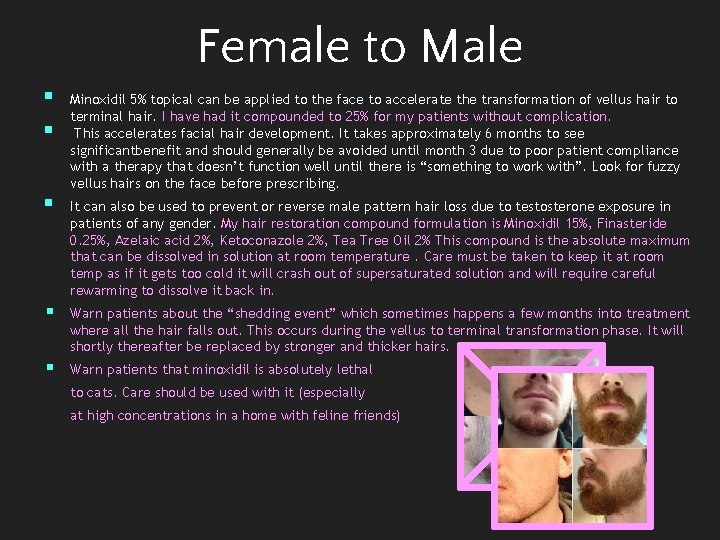
Female to Male § § § Minoxidil 5% topical can be applied to the face to accelerate the transformation of vellus hair to terminal hair. I have had it compounded to 25% for my patients without complication. This accelerates facial hair development. It takes approximately 6 months to see significantbenefit and should generally be avoided until month 3 due to poor patient compliance with a therapy that doesn’t function well until there is “something to work with”. Look for fuzzy vellus hairs on the face before prescribing. It can also be used to prevent or reverse male pattern hair loss due to testosterone exposure in patients of any gender. My hair restoration compound formulation is Minoxidil 15%, Finasteride 0. 25%, Azelaic acid 2%, Ketoconazole 2%, Tea Tree Oil 2% This compound is the absolute maximum that can be dissolved in solution at room temperature. Care must be taken to keep it at room temp as if it gets too cold it will crash out of supersaturated solution and will require careful rewarming to dissolve it back in. § Warn patients about the “shedding event” which sometimes happens a few months into treatment where all the hair falls out. This occurs during the vellus to terminal transformation phase. It will shortly thereafter be replaced by stronger and thicker hairs. § Warn patients that minoxidil is absolutely lethal to cats. Care should be used with it (especially at high concentrations in a home with feline friends)
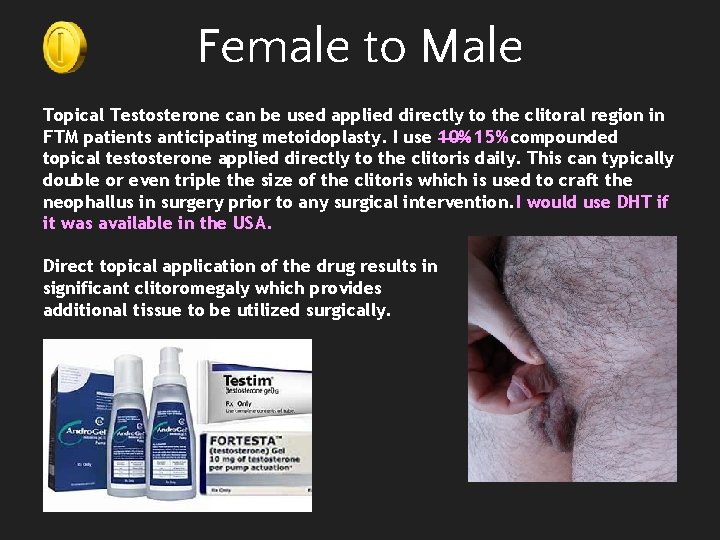
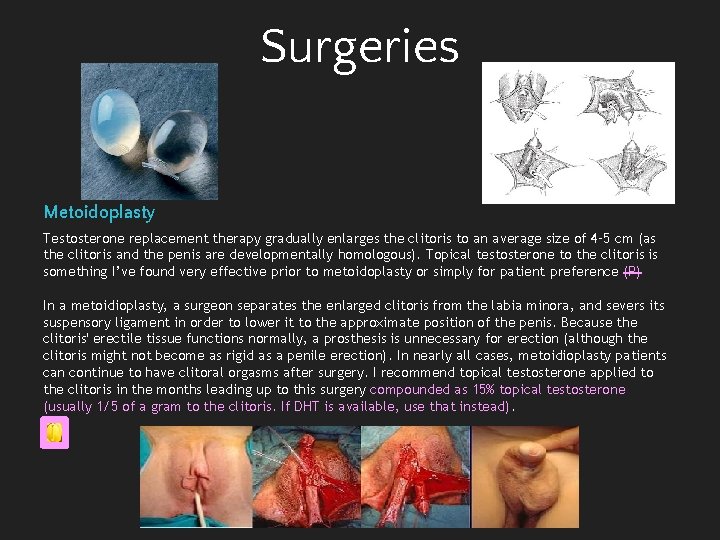
Female to Male Topical Testosterone can be used applied directly to the clitoral region in FTM patients anticipating metoidoplasty. I use 10% 15% compounded topical testosterone applied directly to the clitoris daily. This can typically double or even triple the size of the clitoris which is used to craft the neophallus in surgery prior to any surgical intervention. I would use DHT if it was available in the USA. Direct topical application of the drug results in significant clitoromegaly which provides additional tissue to be utilized surgically.
FTM Voice Issues § Some patients experience difficulties with achieving a “passable” male voice. Often, I find these patients do not struggle with Acne related to T usage, and end up with a voice somewhat stuck in the “pubertal teen boy” range. § When I have run labs on these patients, they tend to have consdierably lower DHT levels than the normal Cisgender male range (14 -77 ng/dl). They often have DHT’s under 10 ng/dl, and usually under 5 ng/dl. § Anecdotally, I have noted superior voice progress in youtube videos from patients in countries where topical DHT is commonly used such as the UK. I have also noted superior voice progress in patients with higher DHT levels (with the tradeoff of acne). § For my patients with a high DHT suffering from acne, I treat the acne with antibiotics and retinols until their voice has reached an acceptable level of progress for the patient to be satisfied. At this point, if the acne is not completely under control, I will add a 5 -alpha-reducase inhibitor drug to their regimen, typically finasteride. § Care must be noted with finasteride, as 5 -alpha-reductase inhibitors can deplete allopregnenalone in the brain, which has been implicated as a cause of depression and the recently documented “post-finasteride syndrome” (to add one more anecdote, I have had success in treating PFS in patients suffering from it utilizing rectal bioidentical progesterone 200 mg at bedtime, even in trans men). § DHT is not available in the United States in any formulation since 2009. For patients with a very low DHT and poor voice progression, I lack much beyond vocal surgery to improve their vocal tone to their desired levels. I am currently testing Zinc, DHEA, and Creatine supplements (none of which are risky in the slightest) on patients stuck in this situation to see if I can increase their DHT levels naturally. All have been documented to do so in mammals, though human data is limited. If these fail, tribulus, diosgenin and tongkat ali are all plant derived supplements which are on my “to consider” list though I generally prefer to avoid herbal medicine due to interaction risk and the risk of putting hundreds of chemicals into a person when ultimately I’m looking to see the effect of a single one.
Male to Female > Child MTF – Lupron is again used to delay or arrest puberty until hormones can be started at the appropriate time. (Histrelin implants again can be used but are expensive if uninsured or if insurance will not cover). Lupron is almost always covered. Again, be cognizant of the height effects of long term puberty delay. > MTF- A multitude of hormones and blockers can be used depending on the patient. There is significant debate about the “optimal” treatment. I’m not a huge proponent of blockers and attempt to get my patients regulated without using them or using a minimal amount. In the USA, I can almost never get GNRH agonists approved for MTF adults, and so I have to rely on other agents. However, they provide an excellent option for patients if approved by insurance, and sometimes can be continued past age 18 if a patient has them approved as a child and then is “grandfathered in” with the insurance as they progress into adulthood. However, on my particular mode of therapy, they are unnecessary past tanner stage 3 development.
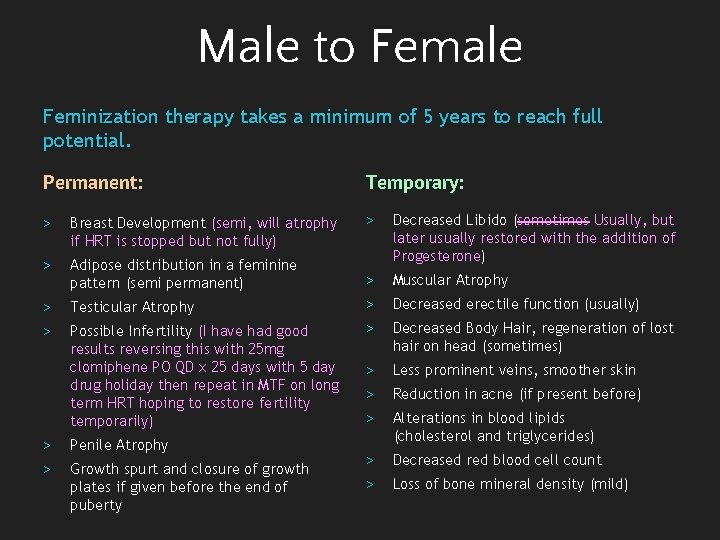
Male to Female Feminization therapy takes a minimum of 5 years to reach full potential. Permanent: Temporary: > Breast Development (semi, will atrophy if HRT is stopped but not fully) > > Adipose distribution in a feminine pattern (semi permanent) Decreased Libido (sometimes Usually, but later usually restored with the addition of Progesterone) > Muscular Atrophy > Testicular Atrophy > Decreased erectile function (usually) > Possible Infertility (I have had good results reversing this with 25 mg clomiphene PO QD x 25 days with 5 day drug holiday then repeat in MTF on long term HRT hoping to restore fertility temporarily) > Decreased Body Hair, regeneration of lost hair on head (sometimes) > Less prominent veins, smoother skin > Reduction in acne (if present before) > Alterations in blood lipids (cholesterol and triglycerides) > Decreased red blood cell count > Loss of bone mineral density (mild) > Penile Atrophy > Growth spurt and closure of growth plates if given before the end of puberty
Human Sex Hormone Synthesis
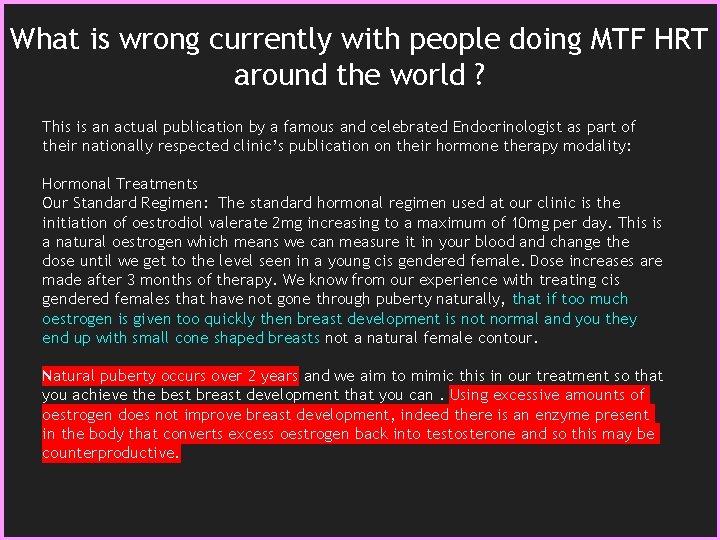
What is wrong currently with people doing MTF HRT around the world ? This is an actual publication by a famous and celebrated Endocrinologist as part of their nationally respected clinic’s publication on their hormone therapy modality: Hormonal Treatments Our Standard Regimen: The standard hormonal regimen used at our clinic is the initiation of oestrodiol valerate 2 mg increasing to a maximum of 10 mg per day. This is a natural oestrogen which means we can measure it in your blood and change the dose until we get to the level seen in a young cis gendered female. Dose increases are made after 3 months of therapy. We know from our experience with treating cis gendered females that have not gone through puberty naturally, that if too much oestrogen is given too quickly then breast development is not normal and you they end up with small cone shaped breasts not a natural female contour. Natural puberty occurs over 2 years and we aim to mimic this in our treatment so that you achieve the best breast development that you can. Using excessive amounts of oestrogen does not improve breast development, indeed there is an enzyme present in the body that converts excess oestrogen back into testosterone and so this may be counterproductive.
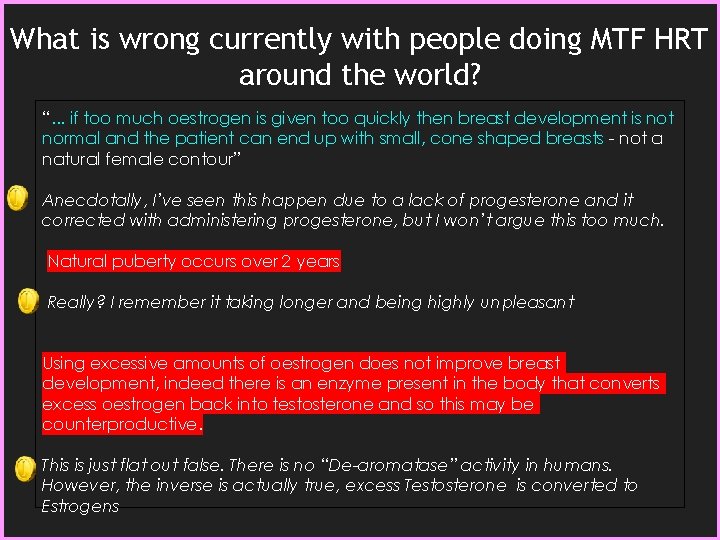
What is wrong currently with people doing MTF HRT around the world? “. . . if too much oestrogen is given too quickly then breast development is not normal and the patient can end up with small, cone shaped breasts - not a natural female contour” Anecdotally, I’ve seen this happen due to a lack of progesterone and it corrected with administering progesterone, but I won’t argue this too much. Natural puberty occurs over 2 years Really? I remember it taking longer and being highly unpleasant Using excessive amounts of oestrogen does not improve breast development, indeed there is an enzyme present in the body that converts excess oestrogen back into testosterone and so this may be counterproductive. This is just flat out false. There is no “De-aromatase” activity in humans. However, the inverse is actually true, excess Testosterone is converted to Estrogens
Why should we trust these people? If the very people we rely on to write the guidelines we reference to our patients telling them why we do what we do clearly do not understand the basics of human physiology and how human sex hormone synthesis works, why would we listen to them? I propose that we do not, and I offer a new way instead of treating these patients. I ask that my colleagues review this publication, fact check my references and biochemistry, and if you are unsatisfied with what you find, please, let me know so that I might make amendments. But I ask that for now, until I complete my formal publications on these topics, that you accept what I present here as scientifically justifiable and biochemically sound based on the evidence and citations I present alongside what I claim.
Human Sex Hormone Synthesis Having knowledge of this slide should be a prerequisite for being permitted to prescribe hormone therapy to transgender people.
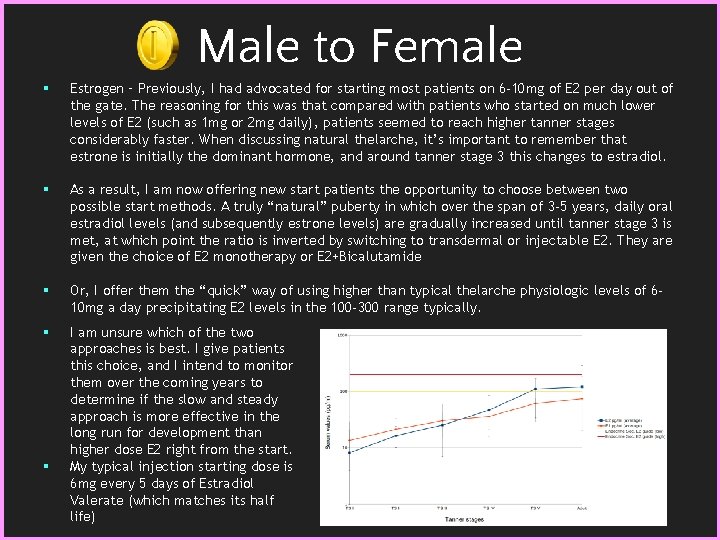
Male to Female § Estrogen – Previously, I had advocated for starting most patients on 6 -10 mg of E 2 per day out of the gate. The reasoning for this was that compared with patients who started on much lower levels of E 2 (such as 1 mg or 2 mg daily), patients seemed to reach higher tanner stages considerably faster. When discussing natural thelarche, it’s important to remember that estrone is initially the dominant hormone, and around tanner stage 3 this changes to estradiol. § As a result, I am now offering new start patients the opportunity to choose between two possible start methods. A truly “natural” puberty in which over the span of 3 -5 years, daily oral estradiol levels (and subsequently estrone levels) are gradually increased until tanner stage 3 is met, at which point the ratio is inverted by switching to transdermal or injectable E 2. They are given the choice of E 2 monotherapy or E 2+Bicalutamide § Or, I offer them the “quick” way of using higher than typical thelarche physiologic levels of 610 mg a day precipitating E 2 levels in the 100 -300 range typically. § I am unsure which of the two approaches is best. I give patients this choice, and I intend to monitor them over the coming years to determine if the slow and steady approach is more effective in the long run for development than higher dose E 2 right from the start. My typical injection starting dose is 6 mg every 5 days of Estradiol Valerate (which matches its half life) §
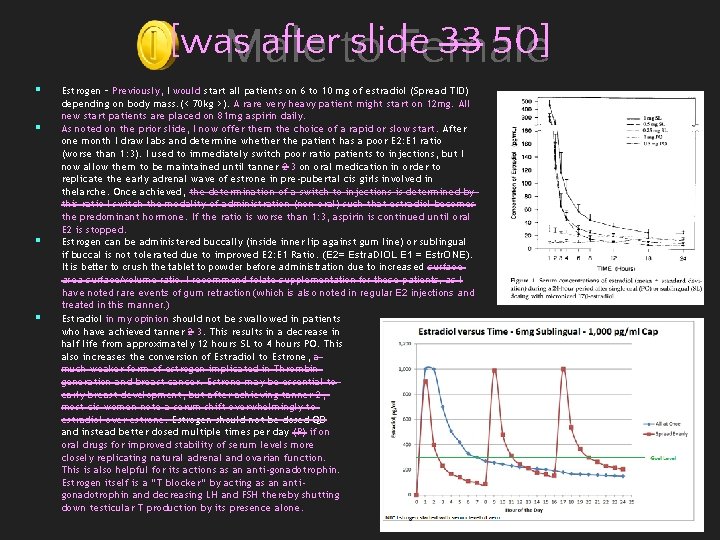
[was afterto slide 33 50] Male Female § § § Estrogen – Previously, I would start all patients on 6 to 10 mg of estradiol (Spread TID) depending on body mass. (< 70 kg >). A rare very heavy patient might start on 12 mg. All new start patients are placed on 81 mg aspirin daily. As noted on the prior slide, I now offer them the choice of a rapid or slow start. After one month I draw labs and determine whether the patient has a poor E 2: E 1 ratio (worse than 1: 3). I used to immediately switch poor ratio patients to injections, but I now allow them to be maintained until tanner 2 3 on oral medication in order to replicate the early adrenal wave of estrone in pre-pubertal cis girls involved in thelarche. Once achieved, the determination of a switch to injections is determined by this ratio I switch the modality of administration (non oral) such that estradiol becomes the predominant hormone. If the ratio is worse than 1: 3, aspirin is continued until oral E 2 is stopped. Estrogen can be administered buccally (inside inner lip against gum line) or sublingual if buccal is not tolerated due to improved E 2: E 1 Ratio. (E 2= Estra. DIOL E 1 = Estr. ONE). It is better to crush the tablet to powder before administration due to increased surface area surface/volume ratio. I recommend folate supplementation for these patients, as I have noted rare events of gum retraction (which is also noted in regular E 2 injections and treated in this manner. ) Estradiol in my opinion should not be swallowed in patients who have achieved tanner 2 3. This results in a decrease in half life from approximately 12 hours SL to 4 hours PO. This also increases the conversion of Estradiol to Estrone, a much weaker form of estrogen implicated in Thrombin generation and breast cancer. Estrone may be essential to early breast development, but after achieving tanner 2, most cis-women note a serum shift overwhelmingly to estradiol over estrone. Estrogen should not be dosed QD and instead better dosed multiple times per day (P) if on oral drugs for improved stability of serum levels more closely replicating natural adrenal and ovarian function. This is also helpful for its actions as an anti-gonadotrophin. Estrogen itself is a “T blocker” by acting as an antigonadotrophin and decreasing LH and FSH thereby shutting down testicular T production by its presence alone.
[was after slide 34] Transdermal / Implants So what about transdermal estrogen or implants? > I rarely use transdermal estrogen patches or gel except in patients who have poor e 1: e 2 ratios but cannot or refuse to tolerate injectable estrogen. When I do prescribe them, I tend to use the week duration patches at 0. 1 mg per patch, typically 2 -3 patches simultaneously to achieve injection level effects. These sometimes just simply don’t work, and patients aren’t able to achieve decent levels on them. I compound estradiol and progresterone creams for some of these patients, but again, even at high concentrations (10% E 2/E 3 and 20% Progesterone) penetration is poor and levels are inferior to injections or implants. I am currently testing adding DMSO to my formulations to increase tissue penetration and therefore bioavailability. > Estrogen pellets are a kind of implant (similar to testosterone testopel) which can be obtained from compounding pharmacies and placed in the gluteal area in a small surgery done in the office. They last 4 -6 months on average. I rarely do them as these patients have to be maintained on HRT for life, and over 30 years that’s almost 100 surgical procedures. However, some patients do really want them and I am willing to do it in certain cases have done it if requested by a patient. I use Anazao in Florida as my compounding pharmacy for this. They will ship out of state.
[was after 36 56] Case Study: The slide Estrone Problem An example MTF patient who is 10 years on HRT with oral estrogen Estradiol 78 pg/ml Estrone 2100 pg/ml total estrogen 2210 pg/ml Their prior doctor had only been checking an estradiol level per WPATH guidelines. This ranged from 80 pg/ml to 150 pg/ml on most labs with a few outlying labs with estradiol levels 200 -300 pg/ml. They were frustrated with a lack of progress and became my new patient. The above labs were resulted from tests on Day Zero at the establishing appointment. This patient was switched to injectable formulation. Their E 2 was targeted for 300 pg/ml 4 months after correction of the ratio, the patient physically looked quite different and has noted increased feminization facially as well as much better breast development and adipose redistribution. They reported a bilateral increase in cup size, and their facial features looked considerably more feminized. Estradiol levels were approximately 150 -250 pg/ml 150 -300 pg/ml on injections when levels were checked over the following year. Full disclosure, this was my real patient. After discovering this seemingly “rare” syndrome I have discovered it present in approx 1/3 1/2 of my transgender women. On average Ratios are 1: 3 without the mutation and as high as 1: 50 with it. I have subsequently corrected approx. 100 hundreds of these patients with amazing incredible results. [see existing slides 39 -40 53 -54 for the following and more] I will be publishing my findings as soon as I’m confident about the effect that HIV boosters such as norvir and cobicistat have on this enzyme. (They seem to make this problem worse) [/end] I have patients flying to my clinic from the other side of the world (Malaysia, Sweden, Russia, Australia) just to get these tests and treatment performed. Anecdotally the internet is awash in stories of people who asked their own doctors for these labs and their physicians were horrified to see insanely high E 1 levels, switched the patient to injections, and they noted massive improvement in feminization progress after otherwise being stalled.
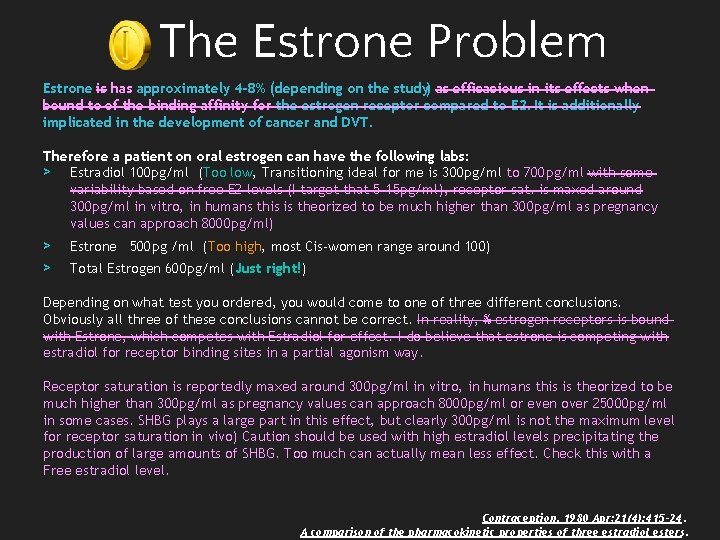
The Estrone Problem Estrone is has approximately 4 -8% (depending on the study) as efficacious in its effects when bound to of the binding affinity for the estrogen receptor compared to E 2. It is additionally implicated in the development of cancer and DVT. Therefore a patient on oral estrogen can have the following labs: > Estradiol 100 pg/ml (Too low, Transitioning ideal for me is 300 pg/ml to 700 pg/ml with some variability based on free E 2 levels (I target that 5 -15 pg/ml), receptor sat. is maxed around 300 pg/ml in vitro, in humans this is theorized to be much higher than 300 pg/ml as pregnancy values can approach 8000 pg/ml) > > Estrone 500 pg /ml (Too high, most Cis-women range around 100) Total Estrogen 600 pg/ml (Just right!) Depending on what test you ordered, you would come to one of three different conclusions. Obviously all three of these conclusions cannot be correct. In reality, ⅚ estrogen receptors is bound with Estrone, which competes with Estradiol for effect. I do believe that estrone is competing with estradiol for receptor binding sites in a partial agonism way. Receptor saturation is reportedly maxed around 300 pg/ml in vitro, in humans this is theorized to be much higher than 300 pg/ml as pregnancy values can approach 8000 pg/ml or even over 25000 pg/ml in some cases. SHBG plays a large part in this effect, but clearly 300 pg/ml is not the maximum level for receptor saturation in vivo) Caution should be used with high estradiol levels precipitating the production of large amounts of SHBG. Too much can actually mean less effect. Check this with a Free estradiol level. Contraception. 1980 Apr; 21(4): 415 -24. A comparison of the pharmacokinetic properties of three estradiol esters.
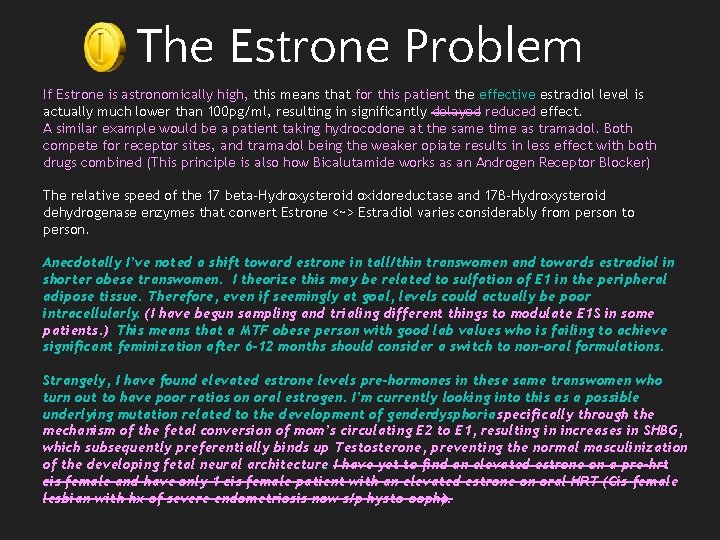
The Estrone Problem If Estrone is astronomically high, this means that for this patient the effective estradiol level is actually much lower than 100 pg/ml, resulting in significantly delayed reduced effect. A similar example would be a patient taking hydrocodone at the same time as tramadol. Both compete for receptor sites, and tramadol being the weaker opiate results in less effect with both drugs combined (This principle is also how Bicalutamide works as an Androgen Receptor Blocker) The relative speed of the 17 beta-Hydroxysteroid oxidoreductase and 17β-Hydroxysteroid dehydrogenase enzymes that convert Estrone <~> Estradiol varies considerably from person to person. Anecdotally I’ve noted a shift toward estrone in tall/thin transwomen and towards estradiol in shorter obese transwomen. I theorize this may be related to sulfation of E 1 in the peripheral adipose tissue. Therefore, even if seemingly at goal, levels could actually be poor intracellularly. (I have begun sampling and trialing different things to modulate E 1 S in some patients. ) This means that a MTF obese person with good lab values who is failing to achieve significant feminization after 6 -12 months should consider a switch to non-oral formulations. Strangely, I have found elevated estrone levels pre-hormones in these same transwomen who turn out to have poor ratios on oral estrogen. I’m currently looking into this as a possible underlying mutation related to the development of genderdysphoria specifically through the mechanism of the fetal conversion of mom’s circulating E 2 to E 1, resulting in increases in SHBG, which subsequently preferentially binds up Testosterone, preventing the normal masculinization of the developing fetal neural architecture. I have yet to find an elevated estrone on a pre-hrt cis female and have only 1 cis female patient with an elevated estrone on oral HRT (Cis-female lesbian with hx of severe endometriosis now s/p hysto-oopho ).
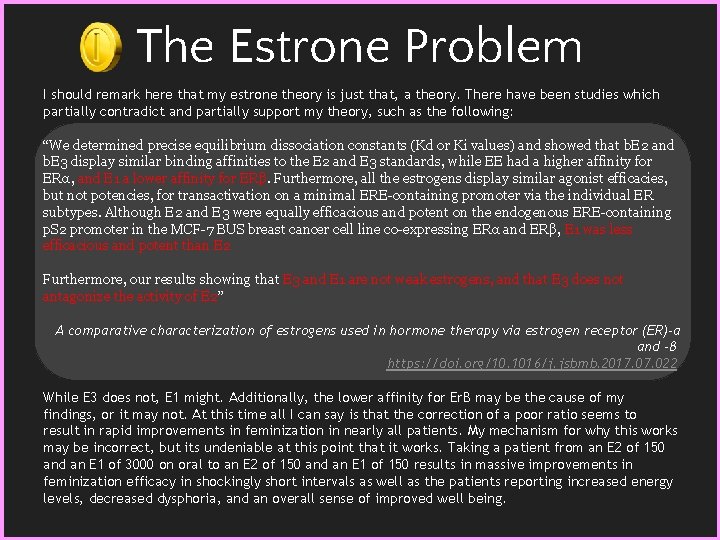
The Estrone Problem I should remark here that my estrone theory is just that, a theory. There have been studies which partially contradict and partially support my theory, such as the following: “We determined precise equilibrium dissociation constants (Kd or Ki values) and showed that b. E 2 and b. E 3 display similar binding affinities to the E 2 and E 3 standards, while EE had a higher affinity for ERα, and E 1 a lower affinity for ERβ. Furthermore, all the estrogens display similar agonist efficacies, but not potencies, for transactivation on a minimal ERE-containing promoter via the individual ER subtypes. Although E 2 and E 3 were equally efficacious and potent on the endogenous ERE-containing p. S 2 promoter in the MCF-7 BUS breast cancer cell line co-expressing ERα and ERβ, E 1 was less efficacious and potent than E 2 Furthermore, our results showing that E 3 and E 1 are not weak estrogens, and that E 3 does not antagonize the activity of E 2” A comparative characterization of estrogens used in hormone therapy via estrogen receptor (ER)-α and -β https: //doi. org/10. 1016/j. jsbmb. 2017. 022 While E 3 does not, E 1 might. Additionally, the lower affinity for Er. B may be the cause of my findings, or it may not. At this time all I can say is that the correction of a poor ratio seems to result in rapid improvements in feminization in nearly all patients. My mechanism for why this works may be incorrect, but its undeniable at this point that it works. Taking a patient from an E 2 of 150 and an E 1 of 3000 on oral to an E 2 of 150 and an E 1 of 150 results in massive improvements in feminization efficacy in shockingly short intervals as well as the patients reporting increased energy levels, decreased dysphoria, and an overall sense of improved well being.
The Estrone Problem While previously I have spoken completely against estrone and been very outspoken about the risks and dangers it causes, I am currently exploring whether or not it may be important in early breast bud formation and for the late in transition progression from tanner 4 to tanner 5. Estrone levels are higher in cis-girls early in development (alongside dhea), and rise before the onset of estradiol. This estrone originates primarily in the adrenal glands and is present from Tanner 1 -2 1 -3 as the primary hormone, at which point E 2 takes over and becomes dominant. The ratio between the two inverting between Tanner 3 and Tanner 4. Anecdotally, I have had patients seemingly reach “maximal” development on a maxed out dose of injectable estrogen, and adding back a single dose of oral estradiol daily alongside injections seems to resume breast development. This effect seems to occur more often in those who started with a poor estrone/estradiol ratio. I theorize this may be related to peripheral sulfation of the estrone in the breast tissue itself, and that lab measurements of the serum levels would not likely be useful. Regardless, this is currently the cutting edge of what I am exploring, and I anticipate a publication on it from me in 2019 at some point. I’m not sure when, it’ll be ready when its done. At this time I will be starting all new MTF patients naïve to HRT on oral pills at first for at least 6 -12 months as to replicate this early estrone rise in breast bud formation. Once tanner 2 3 is achieved, they will be transferred to injectable estrogen to shift the E 1: E 2 ratio in favor of E 2 via evading first pass metabolism of estradiol by the liver. (Except for those patients on sublingual E 2 who have E 1: E 2 ratios better than 3: 1 and wish to remain on this formulation, 1: 1 or lower is ideal) As noted previously, I am also offering all new patients the opportunity to “slow start” and take estrogen with the intent of truly replicating the timeframe and hormonal levels of natural Thelarche. As of yet, I have had three patients accept the offer. I’m unsure whether or not many years of low level e 2 therapy to replicate those early puberty years in Cis females would produce better end stage development or not. I am also unsure if with the presence of normal Cis-male levels of testosterone if development is possible at all. I do offer Bicalutamide to these patients as well, and 2/3 chose to take it. One patient is taking 2 mg E 2 orally a day for a year, and increasing by 2 mg per day yearly for 5 years.
This Is Not New! As early as 2005 it was known that varied routes of administration could affect the way in which estrogen medications are absorbed and processed. In detail, this study also delineates the significantly weaker effects of estrone, considering it only 4% as efficacious for the receptor compared to estradiol. Climacteric. 2005 Aug; 8 Suppl 1: 3 -63. Pharmacology of estrogens and progestogens: influence of different routes of administration. Kuhl H 1. “"Estrone is a weak estrogen which has only 4% of the estrogenic activity of estradiol…“” Climacteric. 2005 Aug; 8 Suppl 1: 3 -63. Pharmacology of estrogens and progestogens: influence of different routes of administration. Kuhl H 1.
Estrone is[was also probably bad other ways: after slide 40 in 54] > Association of serum estrone levels with estrogen receptor-positive breast cancer risk in postmenopausal Japanese women. (Clin Cancer Res. 2003 Jun; 9(6): 2229 -33. ) > Relationship of serum estrogens and estrogen metabolites to postmenopausal breast cancer risk: a nested case-control study (Breast Cancer Research 2013) > Estrone sulfate promotes human breast cancer cell replication and nuclear uptake of estradiol in MCF-7 cell cultures (Experimental Cancer 1993) > The effect of estrone on thrombin generation may explain the different thrombotic risk between oral and transdermal hormone replacement therapy. (J Thromb Haemost. 2010 Aug; 8(8): 1736 -44. doi: 10. 1111/j. 1538 -7836. 2010. 03953. x. Epub 2010 Jun 14. ) > Clinical relevance of hypercoagulability and possible hypofibrinolysis associated with estrone and estriol. Microsc Res Tech. 2017 Jul; 80(7): 697 -703. doi: 10. 1002/jemt. 22854. Epub 2017 Mar 1. Note, these are associations, not definitive proof, as there are many confounding variables. However there is a mounting level of evidence against estrone compared with estriol and estradiol in regards to thrombotic and cancer risk.
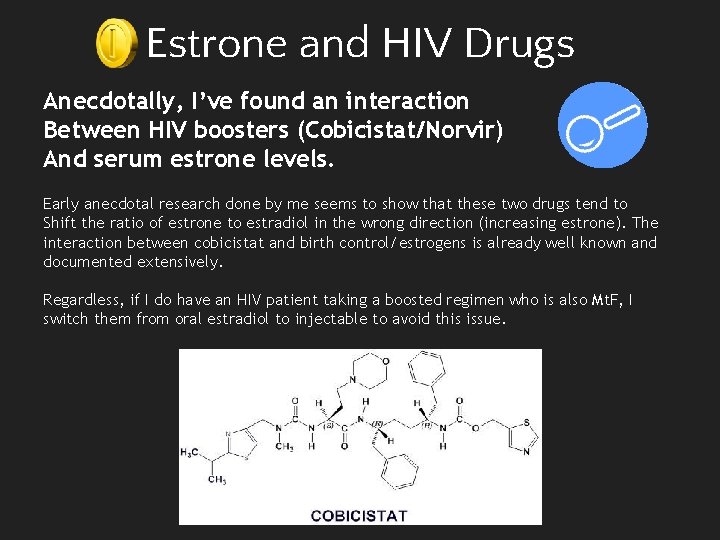
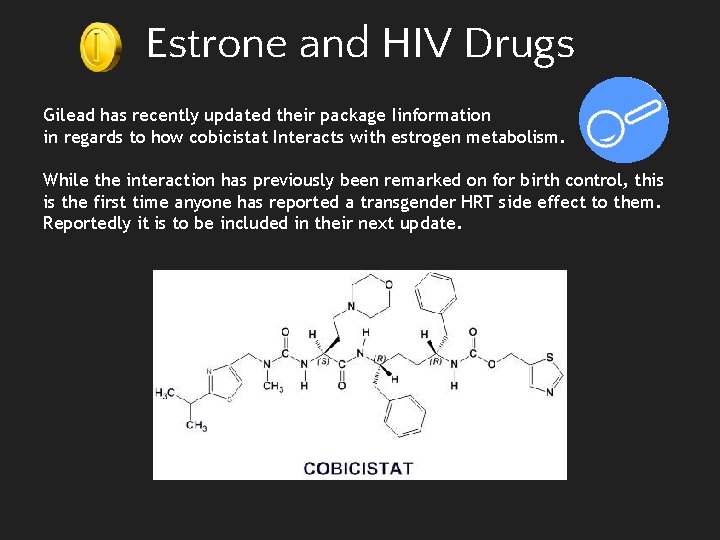
Estrone and HIV Drugs Anecdotally, I’ve found an interaction Between HIV boosters (Cobicistat/Norvir) And serum estrone levels. Early anecdotal research done by me seems to show that these two drugs tend to Shift the ratio of estrone to estradiol in the wrong direction (increasing estrone). The interaction between cobicistat and birth control/estrogens is already well known and documented extensively. Regardless, if I do have an HIV patient taking a boosted regimen who is also Mt. F, I switch them from oral estradiol to injectable to avoid this issue.
Estrone and HIV Drugs Gilead has recently updated their package Iinformation in regards to how cobicistat Interacts with estrogen metabolism. While the interaction has previously been remarked on for birth control, this is the first time anyone has reported a transgender HRT side effect to them. Reportedly it is to be included in their next update.
“Unstalling” Patients I am also exploring a phenomenon I noted in which patients who have reached maximal development on injectable estrogen (who have ratios that are dominated by estradiol) about 50% of the time will re-initiate development with the addition of only 2 mg of oral estradiol at bedtime. This effect seems to occur more often in those who started with a poor estrone/estradiol ratio. I have noted that in patients on long term injection therapy who have stalled in progression, those that have an Estrone Sulfate (E 1 S) level less than 5000 pg/ml seem to report increases in progression and breast tenderness when this E 2 oral dose (swallowed) is taken, and those over 5000 pg/ml seem to not. Half of patients respond, half do not. Some of my possible explanations involve Estrone Sulfatase activity in peripheral cells (a repleted estrone reservoir) or possibly the dimerization of E 1 -E 2 activating receptor sites), or even upregulation of ERa (Estrogen Receptor alpha) expression in nuclear membranes secondary to the presence of estrone increasing sensitivity to the currently present estradiol. Its also possible that E 1 S transactivation of the receptor is part of the picture. Or maybe a mix of all of these. Honestly, I don’t know the real mechanism for this. I just know that in half of people, seemingly those with an E 1 S under 5000 pg/ml, it seems to really work. I have also noted that in some patients, a “two weeks on” “two weeks off” methodology of the administration of this oral dose seems to be more effective. Estrone sulfate and dehydroepiandrosterone sulfate: Transactivation of the estrogen androgen receptor https: //doi. org/10. 1016/j. steroids. 2015. 11. 009 New Developments in Intracrinology of Human Breast Cancer: Estrogen Sulfatase and Sulfotransferase https: //nyaspubs. onlinelibrary. wiley. com/doi/abs/10. 1111/j. 1749 -6632. 2008. 03683. x
[was after slide. Estrone 35 45]Theory 1 My Neurodevelopmental My Theory: Absorption of Mom’s estradiol in utero and its rapid conversion to estrone results in the buildup of an estrone reservoir which thereby diectly exerts effect on the developing neural architecture (through feminization) despite normal serum estradiol levels. I believe this happens due to 17 B-Hydroxysteroid. Dehydrogenase 2 polymorphisms resulting in a shunting of E 2 to E 1. If a transwoman as an adult has an estradiol of 100 pg/ml and estrone of 2500 pg/ml, clearly even normal pregnancy levels of E 2 (which can reach 25000 pg/ml) could produce very high levels of E 1 This would also be consistent with “normal” hormones in the developing child despite the verbal expression of gender dysphoria, which is typically found. The bizarrely high estrone levels would not be clearly exhibited again until a supply of circulating estradiol was again provided. However, due to the exposure of the fetus’ brain to these very high levels of estrogen during pregnancy OR the lack of Androgenic effect mediated by high SHBG, the neural architecture is effectively laid down “pink” instead of “blue” and these changes seem to be irreversible. Or, as is sometimes theorized due to the condition CAIS, the default configuration of human brains is “pink” and this must be “painted over” by testosterone to differentiate to “blue”.
“My” Other Neurodevelopmental Estrone Theory My Theory: Absorption of Mom’s estradiol in utero and its rapid conversion to estrone results in the buildup of an estrone reservoir which thereby exerts effect on the developing neural architecture indirectly by increasing sex hormone binding globulin levels to such a threshold that all available testosterone is bound and not free. (Same mechanism as DES exposure) As a result, the brain would assume the “default” configuration of female as it never underwent the normal masculinization of the neural architecture. This would also be consistent with “normal” hormones in the developing child despite the verbal expression of gender dysphoria, which is typically found. The bizarrely high estrone levels would not be clearly exhibited again until a supply of circulating estradiol was again provided. However, due to the exposure of the fetus’ brain to these very high levels of estrone during pregnancy, the neural architecture is effectively laid down “pink” instead of “blue” and these changes seem to be irreversible. I can’t claim this idea as entirely my own. A very brilliant transgender woman who comments on Reddit shared it with me in a similar construction in regards to DES exposure I thought it was truly genius and applicable to my Estrone mutation patients and have adopted the mechanism as part of my set of possible explanations for this phenomenon.
Blockers > Blockers – In a transwoman who has not had an orchiectomy performed (testicle removal) it is occasionally necessary to block the effects of testosterone with medications other than estradiol/progesterone to achieve the desired feminization. Utilizing the Powers method, the patient is eventually able to be on nothing but female bioidentical hormones without any blockers and not having had an orchiectomy performed. I need hormone blockers for exactly 0% of my transgender women on injectable estrogen and progesterone. > Some patients are able to achieve sufficient reductions in androgens over time with the usage of E 2 alone. A greater percentage can do this with the combination of E 2 and Progesterone, which has some GNRH effect) To be clear, Estrogen itself has antigonadotrophin effects. > Most of my patients are completely controlled on the usage of only injectable estradiol and progesterone. I have sometimes been able to get a patient totally off blockers using oral estrogen and progesterone to control their testosterone. Injectable estrogen paired with (typically rectal QHS administered) bioidentical progesterone will easily suppress LH and FSH to zero. > I find that the antigonadotrophin effects and LH/FSH suppression benefits of progesterone (bioidentical micronized) are maximized when the progesterone is used as a suppository. This helps offset its short half life by causing its slow absorption in the distal rectum where it also does not drain to portal circulation but rather to systemic circulation, avoiding first pass metabolism.
Powers Method Flowchart This slide is held for version 6. 1, which will include an updated flowchart for my methods to simplify it for exactly what to do at what stage for other clinicians.
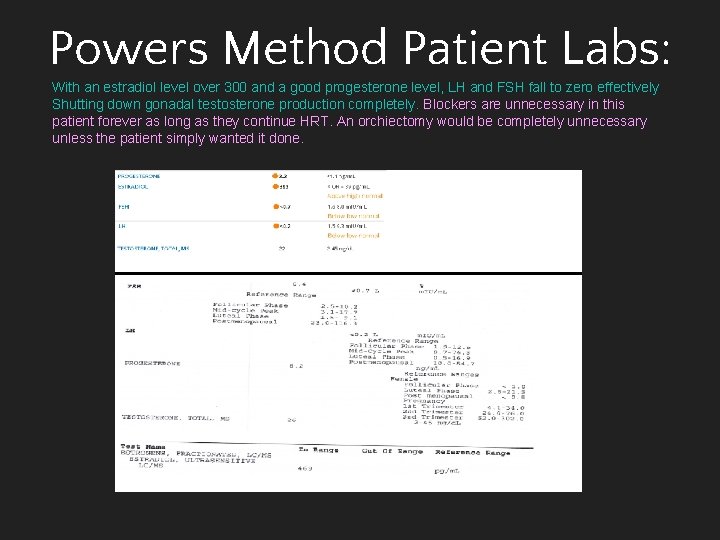
Powers Method Patient Labs: With an estradiol level over 300 and a good progesterone level, LH and FSH fall to zero effectively Shutting down gonadal testosterone production completely. Blockers are unnecessary in this patient forever as long as they continue HRT. An orchiectomy would be completely unnecessary unless the patient simply wanted it done.
Spironolactone § § § In patients who choose to use blockers, or whom cannot achieve androgen reduction with E and P alone, the most typical and baseline drug is aldactone (spironolactone) which is a potassium sparing diuretic. It’s very important to monitor the patient for elevated potassium levels and renal function as these can be (extremely rare) but fatal side effects via arrhythmia. I will no longer prescribe Spironolactone. The evidence against it continues to get worse annually. Patients hate taking it. Most feel miserable on it and have “spiro brain” that seems to resolve with its cessation. It works as both an androgen receptor blocker and additionally decreases T production. Its known to cause tumors in mice, and the diuretic effect of it causes polyuria/nocturia which disrupts sleeping patterns. It is however the blocker of choice of most doctors due to it being included in the core WPATH guidelines since the beginning. § Anecdotally I’ve found issues with depression, visceral adiposity (long term) and other problems with Spiro is proven to increase serum cortisol levels which is likely the mechanism for the visceral adiposity. However, many studies have contradicted my findings in regards to this. § Predictive Markers for Mammoplasty and a Comparison of Side Effect Profiles in Transwomen Taking Various Hormonal Regimens § https: //academic. oup. com/jcem/article/97/12/4422/2536439 § The above study showed that patients who had a regimen that included spironolactone were significantly more likely to seek surgical breast augmentation. Further studies are needed to determine if it truly does interfere with full breast development. § That being said, all the patients on which I have been unable to grow hardly any breasts whatsoever took high dose spiro 200 -400 mg daily for years before I saw them as patients. There is a theory that high dose spironolactone effectively closes the “Growth plate” of the breast preventing later development or causing tubular breast formation which I have seen far too often in this patient group.
Blockers > In my patients, LH and FSH fall to nearly zero due to estrogen (and later progesterone) acting as anti-gonadotrophins making blockers mostly unnecessary past tanner 3. > I target testosterone levels based on desire for erectile function. If desired, T targeted for 50 ng/dl, if not, 15 ng/dl. Do not bring T to absolute zero, as this can have cognitive side effects. (P) > That being said, Cisgender women have testosterone, typically 5 -50 ng/dl. In my patients, I find levels typically range 10 -30 ng/dl which is T coming from adrenal production. > Again, I no longer use any actual blockers except for bicalutamide simply due to the lack of need for them with proper Estrogen/Progesterone usage. > > WPATH recommends T 30 -100 ng/dl and E 2 < 200 pg/ml I disagree with WPATH as cis females routinely spike E 2 levels for a week or so in the 300 -600 pg/ml range and nobody has ever seen catamenial increases in thrombotic events. My patients feel better at these levels and I have never had a single complication in nearly 7 years. Pregnancy levels can exceed 25000 pg/ml. Clearly taking someone from 200 to 300 pg/ml will not be an alarming change of physiology.
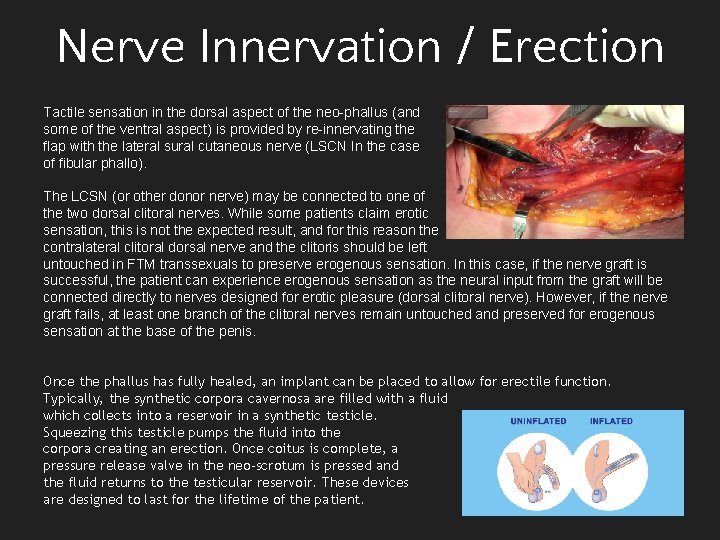
after slide 53 Issues 71] MTF[was Testosterone In MTF who have undergone full gender affirming surgery, orchiectomy, or who have had a successful androgen blockade, sometimes testosterone will drop to or near zero. They simply cannot generate enough T via the adrenals to be in normal female ranges. These patients report fatigue, decreased libido, and in pre-surgical patients, issues with penile atrophy and erectile function. The skin can become “glassy” and fragile, prone to tearing and fissuring. The corpora tend to not atrophy as much as the skin, resulting in “Sausage packed too tightly in a casing” sort of problem when erections do occur which is quite painful. I have found that weekly or bi-weekly topical administration of testosterone to the penis in pre-surgical patients can restore the tissue and increase erectile function. This is sometimes helpful in phimosis caused by atrophy or skin fragility of the penis. I now ALWAYS prescribe it in the months leading up to surgical gender assignment due to the benefits it has on the tissues being utilized to perform the surgery (easier to make penile tissue into a vaginal canal when you have more to work with). This can be done without increasing systemic levels or causing re-masculinization if you use my compounded formulation, which is 1 gram of compounded 0. 5% topical testosterone topically to the penis and scrotum once weekly. It tends to raise T levels about 10 -20 ng/dl with weekly administration. Even in post-surgery patients, the benefit of low dose testosterone on well being, bone density, and other factors is not to be ignored. Consider its usage in select patients, or in patients with limited vaginal depth as the increased elasticity of the tissue makes a difference. I had a patient recently with excruciating pain with dilation. Topical administration of T to the dilator used for dilation eliminated 95% of the pain of dilation within 2 weeks with twice weekly administration. Don’t prescribe topical estrogen to the genitals of transgender women, it doesn’t work and it’s a terrible recommendation. Use low dose compounded topical T, its probably the thing I’m most proud of dreaming up and using in the past 7 years. It works wonders.
Other Blockers 5 -a-reductase inhibitors – Finasteride/Dutasteride, Originally designed to treat prostate cancer, these drugs can often bring DHT levels to near zero. However, this often causes decreased libido and erectile dysfunction in Transwomen. They also have cognitive effects and depression as a side effect. Due to being 5 AR drugs, they deplete allopregnanolone in the brain which is a proposed mechanism for their induction of depression. This neurosteroid is particularly relevant in the treatment of post-partum depression, in which “Brexanolone” a synthetic allopregnanolone is given via IV for treatment. If this occurs, I’ve had luck with using rectal progesterone to reverse the negative effects in both cis and trans people. Fin/Dutasteride can be used topically with minoxidil for hair regrowth. There is ZERO reason to use a 5 ARI drug in a patient with a low T and low DHT. (Rarely, adrenal production of DHT occurs to a significant level in orchidectomized patients who have a 5 AR mutation or decrease of function of its degradation enzymes) If a patient has a T of 10 ng/dl, there is hardly any T to prevent converting to DHT, and therefore, little benefit in exposing the patient to the side effects of these drugs. Do not use them unless T is not at goal and patient is unable to achieve T suppression due to other extenuating circumstances. I almost NEVER prescribe these drugs. 5 ARI drugs do not lower testosterone, only prevent its conversion to DHT. I will only prescribe them at a low dose and if the patient has severe hair loss or severe acne, and only briefly to help prevent further issues while controlling T via other means. I would never keep a patient on them long term, cis or trans. I sometimes use them cautiously longer term in Trans men with hair loss or acne. I do however compound them topically as part of my hair regrowth cocktail as 0. 25% finasteride. If you lack access to a compounding pharmacy, dutasteride comes in capsules and is a liquid that can be mixed with OTC rogaine.
Other Blockers > Non-steroidal antiandrogens- Flutamide is the most common. It is quite effective, but its use generally avoided except in extreme cases due to hepatotoxicity. I prefer Bicalutamide as it is cheaper and causes less hepatic issues. It is my first line drug when I need to use a blocker, which is only occasionally in patients who want them that haven’t reached Tanner stage 3. > Bicalutamide does not lower T levels (it actually increases them!), it simply blocks the receptor, causes gynecomastia/elevated estradiol when used in monotherapy due to peripheral aromatization of circulating androgens (this happens to cis men on bicalutamide for prostate cancer) as well as possible receptor sensitization/upgregulation. It can be expensive, but good. RX. com typically has a good coupon for under $20 a month. Bicalutamide can be used in the place of other blockers to control T, or to do a “test withdrawal” when blockers are pulled to see if T will stay down on the usage of Estradiol and Progesterone alone without exposing the patient to the risk of re-masculinization in the event that T does spike back up without blockade. I often do this for a month when stopping someone’s spironolactone who has just established with me. Bicalutamide acts as a backup in the event things don’t go as planned. Start the Bicalutamide at least a 2 -3 weeks before stopping blockers due to its long half life and time to reach steady state concentration, its half life is on average 6 days, and so it takes 30 days to hit maximum effect. (P) > In the hundreds of patients I have placed on Bicalutamide, I have never seen a hepatic transaminase elevation even once. I really do think it has been given a bad name due to its cousin Flutamide’s behavior. (P)
Other Blockers > Steroidal antiandrogens – Cyproterone and Megestrol Acetate – Cyproterone is not available in the USA, and is known for causing increased prolactin and galactorrhea (milk production). Despite it being quite effective, as I practice in the USA, I will not address it in this lecture, but it is commonly used worldwide. Do not miss a prolactinoma because you assume the elevated prolactin is due to the drug. There is also a developing association between the usage of the drug and benign meningiomas. > Megestrol is not commonly used due to weight gain and other side effects. Sometimes Megestrol is used deliberately to this effect in transwomen with cachexia/low BMI. I do commonly do this for patients who aren’t achieving sufficient feminization due to having such a low body fat percentage. Its anti-androgen benefits are a pleasant side effect in that case. I also use mirtazapine for this purpose though it has no anti-androgenic effects. Megestrol Acetate is dosed 20 -40 mg po up to four times daily. Start low, work your way up. > Others – Cimetidine (Tagamet) an OTC antacid. This is a weak anti-androgen at high doses. It has significant drug interaction problems. It is rarely prescribed but commonly used by Transgender DIY (Do it yourself) patients. Be aware that it's out there and that it has significant Cytochrome P 450 interactions as some patients may be taking it OTC without telling you or without thinking its relevant. It also seems to interact in some way with the 17 Hydroxylase enzyme family, but I have little anecdotal data to offer on it as I have not encountered any patients starting or stopping it for its intended usage while on HRT and I cannot justify its usage over ranitidine for H 2 blockade. I have encountered it a bit more in the past few months due to the Ranitidine recall. Data on that pending.
Progesterone as a blocker Progesterones and Progestins Medroxyprogesterone (provera) This hormone is commonly debated in the community. I am on the Pro-Progesterone team. I’ve personally seen huge benefits (from bioidentical progesterone only) Cheap, synthetic, doesn’t seem to provide anti-cancer benefit. I generally avoid this. Anecdotally patients say they feel depressed on it. Usual dose is 5 mg SL BID I give my patients the choice about using P but I do advise it. I have personally noted greatest benefit when used by slender transwomen with a narrow chest, as it seems to provide a modest benefit to breast development. In trans women who develop “cone” shaped breasts, progesterone tends to round them to allow for progression from tanner 4 to tanner 5 development. (P) I’m well aware this point is heavily debated, so take it with two grains of salt, but I have seen it work many times. Additional hormones carry additional risk, and so this decision is up to the provider and patient. Progesterone does slightly increase the probability of a thrombotic event, but additionally very slightly reduces the risk of breast cancer. (Provera does not) Progesterone also has moderate anti-androgen benefits due to its effects in blocking gonadotrophins. This effect is amplified when the capsule is used as a suppository at bedtime rather than oral (Similar to lupron). I see levels 10 -15 x those when dosed orally when taken rectally at bedtime. Minor gaba agonist so it has anxiolytic effects. I titrate to around 12 -24 ng/ml. Usual dose is 200 mg SL or rectal QHS. I’ve been using rectal dosing and found superior levels to SL or Oral. Typically triples hormone level with the switch from oral to suppository. Half life is short so lab must be drawn within 12 -24 hours of dosing if you want an accurate measurement. (P) It does wonders for restoring the libido of a patient without one whose testosterone is fully suppressed. Sometimes puncturing the capsule with a pin or needle before rectal dosing improves absorption. Micronized Oral Progesterone (bioidentical) Topical Progesterone I have this compounded for my patients, they apply 200 mg to alternating breasts daily and once weekly to the face for adipose redistribution and facial feminization. I’ve had OVERWHELMINGLY positive results with this, but it's quite expensive to compound. Same dose as oral (1 gram of 20% topical T applied daily). Never covered by insurance. About $60 monthly to compound. Used safely in post-menopausal women for decades. Consider adding DMSO to the mix to improve penetration.
Why doesn’t WPATH like Progesterone? : Progestins With the exception of cyproterone, the inclusion of progestins in feminizing hormone therapy is controversial (Oriel, 2000). Because progestins play a role in mammary development on a cellular level, some clinicians believe that these agents are necessary for full breast development (Basson & Prior, 1998; Oriel, 2000). However, a clinical comparison of feminization regimens with and without progestins found that the addition of progestins neither enhanced breast growth nor lowered serum levels of free testosterone (Meyer III et al. , 1986). There are concerns regarding potential adverse effects of progestins, including depression, weight gain, and lipid changes (Meyer III et al. , 1986; Tangpricha et al. , 2003). Progestins (especially medroxyprogesterone) are also suspected to increase breast cancer risk and cardiovascular risk in women (Rossouw et al. , 2002). Micronized progesterone may be better tolerated and have a more favorable impact on the lipid profile than medroxyprogesterone does (de Lignières, 1999; Fitzpatrick, Pace, & Wiita, 2000) I have personally seen patients stuck at tanner 4 for decades progress to tanner 5 with the usage of progesterone, even temporarily. Additionally, I have found that the usage of bioidentical progesterone when administered in a way that avoids portal circulation DOES lower serum testosterone levels by blocking lowering FSH and LH function. However, I ONLY prescribe bioidentical progesterone. I. E. Prometrium rectal capsule dosing or the very rare patient who injects progesterone. If they do choose to use injections, I recommend this being done daily or every other day due to the short half life. I have found rectal progesterone noninferior anecdotally to injectable, but some patients still prefer it. Some of the increased breast fullness of progesterone is temporary. Discontinuation will result in some loss, but not all of the gains from it. Ductal maturation is a more permanent effect.
Support For Natural Progesterone: In clinical trials and randomized controlled trials evaluating micronized progesterone, mentioned in Prometrium's product monograph , not one single case of thrombosis or altered coagulation factors is mentioned. Climacteric. 2012 Apr; 15 Suppl 1: 11 -7 "Micronized progesterone has also been shown not to increase the risk of venous thromboembolism" Menopause. 2010 Nov-Dec; 17(6): 1122 -7 "recent data have shown that norpregnane derivatives but not micronized progesterone increase venous thromboembolism risk among transdermal estrogens users. " "there was no significant change in APC sensitivity among women who used transdermal estrogens combined with micronized progesterone compared with nonusers. " Climacteric. 2013 Aug; 16 Suppl 1: 69 -78. “it appears that transdermal estradiol alone or combined with natural progesterone does not increase thrombotic risk. ” Journal of the Gay and Lesbian Medical Association, Vol. 4, No. 4, 2000 “progesterone does not carry the risk of thromboembolism, prolactinoma, and myocardial infarction. ” Climacteric. 2003 Dec; 6(4): 293 -301. That second to last one really supports my estrone theory in that the cause of the thrombotic events associated with estrogen therapy are caused by estrone and other metabolites but not the 17 -bestradiol itself. Transdermal therapy avoids hepatic first pass like injections do.
Support For Natural Progesterone: “In both peripheral and cerebral vasculature, synthetic progestins caused endothelial disruption, accumulation of monocytes in the vessel wall, platelet activation and clot formation, which are early events in atherosclerosis, inflammation and thrombosis. Natural progesterone or estrogens did not show such toxicity. ” Maturitas. 2015 Mar 9. “When taken with oral or transdermal estrogens, no significant association of venous thromboembolism (VTE) with concomitant micronized progesterone” Maturitas. 2011 Dec; 70(4): 354 -60. "With respect to the different pharmacological classes of progestogens, there is evidence for a deleterious effect of medroxyprogesterone acetate on VTE risk. In addition, observational studies showed that norpregnane derivatives were significantly associated with an increased VTE risk whereas micronized progesterone could be safe with respect to thrombotic risk. " Climacteric. 2013 Aug; 16 Suppl 1: 69 -78. “The French E 3 N cohort study found that the association of estrogen – progestin combinations with breast cancer risk varied significantly according to the type of progestin: the relative risk was 1. 00 (95% CI 0. 83 – 1. 22) for estrogen –progesterone” Gynecol Endocrinol. 2017 Feb; 33(2): 87 -92. “A systematic review and meta-analysis. ” “A total of 14 studies were included in our study. ” “(…) the breast cancer risk varies according to the type of progestogen. Estradiol therapy combined with medroxyprogesterone, norethisterone and levonorgestrel related to an increased risk of breast cancer, estradiol therapy combined with dydrogesterone and progesterone carries no risk. ” Gynecol Endocrinol. 2017 Feb; 33(2): 87 -92.
Breast Asymmetry Progesterone I have two cases of patients with Asymmetrical breasts using the topical Progesterone only on the smaller breast to create unilateral hypertrophy. Both cases reported increased bilateral breast size (likely due to systemic absorption), but some improvement in the discordance between the two breasts. After discontinuation of the topical progesterone, both patients felt the breasts were permanently improved. This is very much a (P) an “anecdata” case. I need more data and patient examples before I can firmly support topical bioidentical Progesterone for this indication. That being said, N=2 for now.
Are you being safe? > Patients need continuous follow up with their doctor with lab monitoring and physical examinations at regular interviews both during the transition process and in the post-transition maintenance period. (CBC, CMP, Lipids, Levels, Ect) > I cannot stress this enough. Just because someone has ‘been fine for years’ does not mean that some other change in their health has not occurred and could affect these hormones or their metabolism. Additionally this population has a high level of mental illness and is at risk for depression/suicidality. PHQ 2 or 9 at EVERY visit. > In addition, Transgender patients need special attention in regards to preventative medicine (addressed later in the lecture)
Surgeries Metoidoplasty Testosterone replacement therapy gradually enlarges the clitoris to an average size of 4– 5 cm (as the clitoris and the penis are developmentally homologous). Topical testosterone to the clitoris is something I’ve found very effective prior to metoidoplasty or simply for patient preference (P) In a metoidioplasty, a surgeon separates the enlarged clitoris from the labia minora, and severs its suspensory ligament in order to lower it to the approximate position of the penis. Because the clitoris' erectile tissue functions normally, a prosthesis is unnecessary for erection (although the clitoris might not become as rigid as a penile erection). In nearly all cases, metoidioplasty patients can continue to have clitoral orgasms after surgery. I recommend topical testosterone applied to the clitoris in the months leading up to this surgery compounded as 15% topical testosterone (usually 1/5 of a gram to the clitoris. If DHT is available, use that instead).
Surgeries - Phalloplasty: In a phalloplasty, the surgeon fabricates a neopenis by grafting tissue from a donor site. There are generally 4 common variants of this graft, which are often from the forearm, leg, abdomen, and pubic tissue. Following the creation of the neopenis, a second surgery is held to implant an erectile prosthesis. The results of this surgery are considerably better cosmetically than that of metoidoplasty in regards to appearance and size, though the patient is left with a typically large scar from skin grafting and orgasmic ability is variable. However, its very rare that the patient lacks tactile sensation. The clitoris is buried at the base of the penis, and a vaginectomy and urethral re-routing is performed to make the penis capable of urination while standing. Anteriolateral Thigh Phalloplasty
Types of Phalloplasty (Credit to Phallo. net for information and images in this section. ) Phalloplasty: ALT Free Flap Phalloplasty uses an ALT flap that is completely detached from the donor site. Blood supply must be re-established by microsurgically connecting the arteries and veins of the flap and recipient site. Pedicled ALT Phalloplasty uses an ALT flap that is left attached to the donor site at one end, while the other end is rotated to the recipient site, preserving blood supply. Microsurgical connection of blood supply is therefore not required, lowering costs and more importantly, reducing the risks of flap failure and necrosis. Advantages of ALT Phalloplasty: • Less obvious donor site, concealable with clothing; • Decreased surgical time with Pedicled ALT; • Good sensation; • Good potential for urethroplasty; • Good skin color match; • Larger girth than RFF Phalloplasty; • Some natural rigidity. Disadvantages of ALT Phalloplasty: • More difficult in patients with thicker skin and more subcutaneous thigh fat; • In some patients, girth can be excessive; • Less predictable perforator layout adds complexity; • Sensation is reportedly less than RFF Phalloplasty (Monstrey et al. , 2008); • Reportedly higher urethral complication rate vs. RFF Phallplasty (Ascha et al. , 2017).
Types of Phalloplasty Radial Forearm Flap: Radial forearm flap is the most common type of FTM phalloplasty. The donor site is thin and supple allowing the flap to be easily tubed and shaped into a penis, and the relatively hairless skin provides erogenous sensation and allows urethral reconstruction in a single stage. The radial forearm donor site can be closed using a split thickness unmeshed skin graft harvested from the thigh or a full thickness graft from the buttocks. A Foley catheter is left in place for at least 2 weeks to reduce the risk of stricture and fistula formation while the neo-urethra is healing Aesthetics can be refined with glansplasty: the creation of a corona using a local flap and full thickness skin graft. Tattooing of the corona to match the color of the areola can be done 3 months before sensation returns. Erectile function can be achieved using a penile prosthesis inserted at a second procedure 10 to 12 months later after tactile sensation has been restored. Disadvantages: Donor site can be difficult to conceal. Possible complications: Partial skin graft loss, decreased sensitivity, swelling, less range of hand motion (resolved with hand therapy), decreased grip strength.
Less Common Phalloplasties: Musculocutaneous latissimus dorsi (MLD) flap: utilizes part of a back muscle and includes the thoracodorsal vessels and nerve. The blood supply is connected to the femoral artery and saphenous vein or the deep inferior epigastric artery and vein, while the nerve is connected to the ilioinguinal nerve. Only a thin strip of muscle around the pedicle is harvested. The scar is a long, mostly linear scar that runs from under the arm, slightly curved, down to the lower back. In most cases, the donor site can be closed primarily with the incision; sometimes a split thickness skin graft is needed. This technique yields a penis that is 13 -16 cm in length and 10 -12 cm in girth. Free Fibula Flap: Dr. Sadove et al were the first surgical team to use the free fibula flap for phalloplasty in 1992. Free fibula flap (FFF) phalloplasty is a good alternative to the radial forearm phalloplasty for patients who do not want a forearm scar. FFF phalloplasty presents several benefits: Less prominent scarring, Natural rigidity of the free fibula flap, Length of the flap's vascular pedicle.
Nerve Innervation / Erection Tactile sensation in the dorsal aspect of the neo-phallus (and some of the ventral aspect) is provided by re-innervating the flap with the lateral sural cutaneous nerve (LSCN In the case of fibular phallo). The LCSN (or other donor nerve) may be connected to one of the two dorsal clitoral nerves. While some patients claim erotic sensation, this is not the expected result, and for this reason the contralateral clitoral dorsal nerve and the clitoris should be left untouched in FTM transsexuals to preserve erogenous sensation. In this case, if the nerve graft is successful, the patient can experience erogenous sensation as the neural input from the graft will be connected directly to nerves designed for erotic pleasure (dorsal clitoral nerve). However, if the nerve graft fails, at least one branch of the clitoral nerves remain untouched and preserved for erogenous sensation at the base of the penis. Once the phallus has fully healed, an implant can be placed to allow for erectile function. Typically, the synthetic corpora cavernosa are filled with a fluid which collects into a reservoir in a synthetic testicle. Squeezing this testicle pumps the fluid into the corpora creating an erection. Once coitus is complete, a pressure release valve in the neo-scrotum is pressed and the fluid returns to the testicular reservoir. These devices are designed to last for the lifetime of the patient.
Surgeries - Penis Transplant: This surgery is currently only performed on Cis-gendered men who have lost their penis due to cancer or an accident. It has been successfully performed only a few times, and is still in the experimental stage. It has been postulated that in the future, it may be performed on trans-men. Recently deceased rabbit penises have been skeletonized in an acid bath, then treated with donor stem cells from another rabbit. This grows a new MHC matched penis on the donor scaffold which has been successfully transplanted. The transplanted male rabbits functioned well enough to impregnate female rabbits with their donor penis with no rejection. This may become a viable option for Trans-Men in the future. However, it need be noted that this person would have to take anti-rejection medications for life to preserve the transplanted organ if it was not generated from scaffold and their own stem cells.
Surgeries - Top Surgery § Trans men with moderate to large breasts usually require a formal bilateral mastectomy with grafting and reconstruction of the nippleareola. This will result in two horizontal scars on the lower edge of the pectoralis muscle, but allows for easier resizing of the nipple and placement in a typically male position. This is known as “Double incision”. § For trans men with smaller breasts, a peri-areolar or "keyhole" procedure may be done where the mastectomy is performed through an incision made around the areola. This avoids the larger scars of a traditional mastectomy, but the nipples may be larger and may not be in a perfectly male orientation on the chest wall. In addition, there is less denervation (damage to the nerves supplying the skin) of the chest wall with a peri-areolar mastectomy, and less time is required for sensation to return. § As the scars from these surgeries are very “telling” on a patient who otherwise be undetectable as transgender in society (passing), many patients are very dysphoric about them. I recommend topical silicone lubricant/sheets on the scars immediately post op, and eventual retinol therapy once sufficiently healed. Sunscreen and sun avoidance is essential in the first two years. Laser resurfacing can also be performed to help erase the scarring. § Surgeon recommendations available in the footnotes of the downloadable form of this presentation.
Surgeries - Vaginoplasty > Penile Inversion Vaginoplasty – Orchiectomy is performed (testicles are removed), and the skin of foreskin and penis is usually inverted, as a flap preserving blood and nerve supplies (a technique pioneered by Sir Harold Gillies in 1951), to form a fully sensitive vagina (vaginoplasty). A clitoris fully supplied with nerve endings (innervated) can be formed from part of the glans of the penis. If the patient has been circumcised (removal of the foreskin), or if the surgeon's technique uses more skin in the formation of the labia minora, the pubic hair follicles are removed from some of the scrotal tissue, which is then incorporated by the surgeon within the vagina. Other scrotal tissue forms the labia majora. > In extreme cases of shortage of skin, or when a vaginoplasty has failed, a vaginal lining can be created from skin grafts from the thighs or hips, or a section of colon may be grafted in (colovaginoplasty). This is generally avoided as a starting surgery due to its propensity for cancer development compared to the stratified squamous epithelium of penile skin.
Surgeries - Vaginoplasty Other forms of vaginoplasty do exist beyond the standard penile inversion. Colovaginoplasty – The usage of colonic mucosa (a segment of the colon is taken to create a neovagina). This requires little to no post-op dilation, but has higher complication rates, and additionally is more susceptible to the development of cancer due to the cell type involved and its vulnerability to HPV infection. Requires Pap tests for life. Peritoneal Pullthrough Technique – The usage of peritoneum to create a neovagina. It “sweats” and is much more similar to actual vaginal mucosa due to the cell type which differs from the stratified squamous epithelium of the PI technique. Relatively new technique, limited surgeons performing it. Dr. Jess Ting and Dr. Heidi Wittenberg are the pioneers of it that I’m most familiar with. I’ve seen excellent outcomes. Combined Penile Inversion / Peritoneal Pullthrough – The name describes it well. Performed by Dr. Rachel Bluebond-Lagner at NYU. I’ve seen excellent results from it. Scrotal and Penile inversion – Dr. Chettawut in Thaliand uses this sort of technique. Scrotal tissue is part of the neovaginal canal wall. Plain Penile Inversion – Dr. Christine Mc. Ginn (for more slender patients) and Dr. Marci Bowers (for heavier built patients) have produced the best results I’ve seen for my patients in the USA based on their own unique styles. Dr. Suporn in Thailand is also tremendously skilled and has produced many great outcomes for my patients.
Other Surgeries Facial Feminization Surgery Breast Augmentation Fairly straightforward, changes are made in the contouring of the face by shaving down or augmenting certain areas to “undo” prior effects caused by masculinizing endogenous hormones. (this is rarely done in the reverse for Transmen who seek a more masculine face but have not achieved this after years of Testosterone therapy). There are many variant types; the most ideal for a particular person is dependent on their anatomy prior to surgery. Voice Feminization Surgery Accomplished by fillers, fat transplant or implant. One of the most common “DIY” surgeries done illicitly with non-medical silicone that results in dangerous complications. Slang term is a “Pumping Party” Historically a surgery of ‘last resort’. This surgery while sometimes effective has the extreme risk factor of making the voice actually deeper, permanently hoarse, or unable to function at all. There is however a new technique from a Korean Surgeon Dr. Kim gaining popularity with good safety data. Minimally invasive voice feminization surgery is becoming more common and may be an option for select patients. Dr Haben and Dr. Spiegel are excellent US Providers. Tracheal Shave A procedure to reduce the “Adam's apple” cartilage in the neck. Buttock Augmentation Orchiectomy Very simply, the removal of the testicles. This makes androgen blockade unnecessary.
Is it Safe? Should we treat transgender patients with surgery and hormones?
Lili Elbe “The Danish Girl” Born December 28, 1882 – Died September 13, 1931. > Lili Elbe was the first known patient to undergo gender affirming surgery, it is suspected that she was intersex. > Elbe received a uterine transplant in the era prior to anti-rejection drugs and died secondary to Sepsis related to organ rejection. (this was omitted from the film of the same name) > The desperation of transgender patients is real. Some will do potentially life threatening things to obtain hormones and treatment including illicit procedures and medications of unknown efficacy.
The Moral of the Story…
What Bad Things Can Happen? > > > Cancer Heart Attack Stroke > > > Clotting Disorders Liver Failure Kidney Failure > > > Osteoporosis (fractures) Seizures And more…. But…. don’t these things happen to cis-gendered people every day? Of course! However, those are “naturally-occurring events” and are not “caused” by therapy (or the physician directly for that matter). Again, due to this, physicians are often against the prescription of these hormones and blockers due to the risk.
How often does it go bad? In 5 years and 1500 patients I’ve never had a single major adverse event (Stroke, MI, DVT) I do however have a very specific rule I abide by which is “No synthetics”. I will only prescribe bio-identical hormones. That’s it. Nothing else. I do credit this to my low complication rate. I personally believe that the only cogs that should be put into the machine are ones designed for it. Synthetic estrogens and progesterone compounds are known for having higher complication/dvt rates. In short, if the cog doesn’t fit properly, the machine won't run as well as it once did. Methods that avoid first pass metabolism also have lower complication rates. So far I have three “adverse events” in my patient pool. All of these are mild striae formation on the axillae/breasts due to extremely rapid and prolific growth in patients who had a corrected estrone ratio or who initiated progesterone therapy. None of these patients were upset about this problem, though I am cautious moving forward about rapid growth.
Is it Worth it? > I personally inform every patient I start on hormones of these risks > Gender Dysphoria occurs on a spectrum ▪ ▪ > For some people, it is so severe as to put them at very high risk of suicide. For other people, that dysphoria might be mild, and might manifest itself in more subtle ways. Not every Transgender person needs or wants HRT or Gender Affirming Surgery. It is always a Risk/Benefit ratio decision. Being transgender does not necessitate using hormones or having surgery.
Part 3: Transgender Preventative Medicine and Office Policies
How Can I Help? We are ALWAYS looking for knowledgeable healthcare providers to help provide care for transgender patients. I would be thrilled to have 50 new competitors. The Trans healthcare system is utterly overwhelmed with demand. My office will survive, but many Transgender patients will not. If you have even one transgender patient, even if you won’t ever prescribe hormones, pay attention here!
Getting Connected to Care World Professional Association for Transgender Health § Find a provider (allows searches by specialty and location, This is where I started learning!) § (Read the WPATH Standards of Care, free PDF) § I no longer follow these guidelines, but they are a good starting place for someone with zero knowledge who wants an easy flowchart to follow. Trans. Health § Health clinics (Canada, United States, England) UCSF Guidelines https: //transhealth. ucsf. edu § Connect (AZ, CA, DC, FL, IL, LA, MD, MA, NM, NY, PA, VA, WA) § I use a lot of the preventative health UCSF guidelines Health Professionals Advancing LGBT Equality
Establishing a Safe and Sensitive Practice > Educate yourself on LGBT issues > Assess the office environment and be sensitive to your patient’s experience as they enter your office > Have Relevant and appropriate health information and brochures including: ▪ ▪ > Cancer/HIV/AIDS Screenings Signs and Posters Safe sex ▪ ▪ HIV/AIDS Pr. EP Advertise your practice as LGBT friendly
Establishing a Safe and Sensitive Practice > Train all staff to use culturally appropriate and genderinclusive language! > Develop and implement appropriate intake and assessment forms (Using a blank space on a form that people can fill in is always better than checking a box) > Provide ongoing training to staff to address basic health issues that affect LGBTQ patients > Resource list and referral for LGBTQ health concerns
Safe Zones Written and posted policies, including non discrimination, diversity, and non-harassment policies that explicitly include gay, lesbian, bisexual, queer sexual orientation AND gender identity Gender identity is NOT protected in Michigan and is cause to terminate someone from employment
Intake Forms Medical providers should have a place for patients to safely and confidentially identify themselves as transgender Ideally forms should have these fill-in questions: ▪ Gender Identity ▪ Assigned Sex at Birth ▪ Preferred Pronouns In practice, simply As a general rule, leaving a blank to fill in rather than giving two checkbox options using checkboxes is a better option.
Intake Forms Good Form Sex at birth plus space to identify additional risk factors or HRT usage Bad Form Gender and not sex listed. No other available qualifying space listed.
Basic Concepts [was Sex → Sexual Orientation → Gender Identity → Gender Expression, but reordered to match figure] > Gender Identity > Gender Expression > Sex (assigned at birth) > Sexual Orientation What is my gender? Male? Female? Something else? How do I express that gender? How do I dress or speak or move? What is between this baby’s legs? What are its sex chromosomes? Male? Female? Inbetween? Intersex? Sexually attracted to men, women, both, neither, all genders? (This can be further fractured into sexual orientation vs romantic/emotional orientation)
Insurance > Policies often exclude treatments for transgender health care needs > Some policies are beginning to offer transgender-inclusive plans (Starbucks as an employer is incredible for transgender people) > Insurance coding often provides certain procedures for individuals of one or the other sex ▪ > Example: A transman is enrolled in his insurance plan as a male – he develops fibroids that require hysterectomy -- insurance will deny coverage as this procedure is only for females. Patient is legally male and underwent legal gender change 15 years ago. This may require that the physicians and staff contact insurance processors to insist on coverage of medically necessary treatments
Gender Fluidity Being Transgender does not mean that you are assigned a label or category or that you wish to conform to the gender binary. Many people, especially younger urban transgender people, are embracing identity terms like genderqueer, genderfluid, bi-gender, tri-gender, etc. (I don’t know all of these, and when I learn a new one, I just ask what they mean by their identity term) Image Source: CNN News
Transgender Etiquette 01 Always call a person by their chosen name and preferred pronoun! 02 If you do mess up a person’s preferred pronouns or name, apologize briefly and move on! 03 Odds are you are not the first person to ever mis-gender this person. You likely won’t be the last. Someday someone might misgender you. People make mistakes, and that’s okay as long as you recognize it. Apologize, correct your mistake, and continue. This is always the most appropriate response. 04 Respectfully ask someone how they would like to be addressed if you are not sure! 05 Ask appropriate questions! Such as “Which pronouns do you prefer? “How would you like to be referred to, in terms of gender? ” Make sure the question you ask is appropriate and not just for your own curiosity!
Transgender Etiquette Medical [was after slide 84 for 103] Providers > Do recognize that patients will still continue to need screening labs/procedures relevant to their biological sex. ▪ Trans men will need a pap every 3 years and a mammogram if they have not had top surgery and are of an appropriate age/risk profile. ▪ Trans women will need a PSA if they complain of nocturia or have a strong family history of prostate cancer.
Transgender Broken Arm Syndrome As a provider, do ask about family life/support if the patient’s complaint is relevant (Ex: depression/anxiety) Don’t assume that because someone is transgender every complaint is somehow related. Transgender people get sick, can have high blood pressure, and get the flu. Rarely is this relevant to their gender or HRT. Transgender people are surprisingly…people! People get sick. (AKA Transgender Broken Arm Syndrome, the idea that if someone breaks their arm, it’s due to hormone use or related to being transgender. )
How to be an Awesome Ally and Provider 01 Remember the etiquette tips! 02 Be mindful of transgender people in office or waiting room 03 Don’t police public restrooms – provide a carry letter for transgender patients who would benefit from one! 04 Don’t ask about a transgender person’s genitals unless it is DIRECTLY relevant to the care or treatment they are seeking from you! 05 Never treat transgender people as if they are being risky with their health! 06 Remember, being transgender is not a ‘choice’ 07 Remember that the medical treatment a transgender person may seek is not “cosmetic” or superfluous!
How to be an Awesome Ally and Provider HOMEWORK INSURANCE Be willing to do your homework! (I openly admit I’m still learning every day how to be a better trans provider) Be sensitive that most transgender medical needs are not covered by insurance HIPPOCRATIC OATH AWARENESS Never deny a trans person urgent care or treatment because of your personal beliefs. You are entitled to your own beliefs, but bound by the hippocratic oath as well. COURTESY Treat transgender people with the courtesy and respect you would like to be treated with. Be aware that transgender people may have a name or other info on records that may be incongruent with appearance or preferred name and pronoun. Be aware that over 50% of transgender youth will attempt suicide by age 20 at least once. (41% for all transgender people) ▪ Success rate is about 20% for transgender patients who attempt suicide. ▪ Gender dysphoria has the highest suicide rate of any diagnosis. (Alcoholism, schizophrenia and major depression have a rate of about 15%)
How to be an Awesome Ally and Provider § Become an active ally for lesbian, gay, bi and trans people in your community. § Call out trans-phobic remarks and jokes. § Resist the urge to place others into a male box or female box. Gender stereotypes suck for everyone, not just trans people! Some transwomen can be masculine, some transmen can be feminine, just like cis-men and cis-women. § You’ve likely assumed your lecturer as a Cis-Het-Male. If you did, why did you assign me this stereotype? Remember that stereotypes can be applied to majorities as well as minorities. Stereotyping patients is a good way to miss a diagnosis or harm them. § Learn the WPATH (or UCSF) guidelines and offer informed consent transgender care to your patients. (WPATH. org)
Part 4: Preventative Medicine
Preventative Medicine > While there are guidelines, they are issued by smaller groups and there is no large nationally accepted list of guidelines. The UCSF guidelines are considered the most accepted and generally the ones used by most providers. They are given below. The language used in these guidelines isn’t quite PC, so know that they weren’t written by me. > In the event that there is an unusual situation or the clinician seeks further guidance, preventative medicine should be applied as it would be applied by the usual guidelines to a patient whose body has the organs to which those guidelines apply. If the patient no longer has those organs, these screenings are no longer needed. Be forewarned, it gets pretty dry after this slide, so buckle up. That being said, this is extremely important information, so do your best to keep your brain focused for 28 more slides!
Transwomen, Past/Current Hormone Use > > Breast cancer screening mammography in patients >50 yrs with additional risk factors ▪ e. g. , estrogen and progestin use >5 yrs, positive family history, BMI > 35 ▪ (In my practice I mammogram anyone over 35 on hormones for at least 2 years, or any age who has been on hormones for 10 years, we use doses vastly higher than natural estrogens) Prostate: PSA is falsely low in androgen-deficient setting, even in presence of cancer; only consider PSA screening in high risk patients. ▪ > Use a digital rectal exam to evaluate the prostate in all transwomen. (Grade C) Pap smears in penile inversion neovaginas are NOT indicated ▪ Neovagina is lined with keratinized epithelium and cannot be evaluated with a Pap smear. ▪ Perform periodic visual inspection with a speculum, looking for genital warts, erosions, and other lesions. ▪ If STI is suspected, do a culture swab, not PCR. ▪ Neovaginal walls are usually skin, not mucosa; when it is mucosa, it is urethral or colon mucosa. TLDR: Pap smear if neovagina is made of colon. PSA’s only in high risk. Mammogram at 50. (I do 35 or 10 years on HRT or based on fam history)
Transmen, Past or Current Hormone Use Breast Cancer Annual chest wall/axillary exam; mammography as for natal females. Not needed following chest reconstruction, but consider if only a reduction was performed. Cervical Cancer Following total hysterectomy. If prior history of high-grade cervical dysplasia and/or cervical cancer, do annual Pap smear of vaginal cuff until 3 normal tests are documented, then continue Pap every 2 -3 years. Cervical Cancer (if ovaries were removed, but uterus/cervix remain intact) Follow Pap guidelines for natal females; May defer if no history of genital sexual activity; Inform pathologist of current or prior testosterone use (cervical atrophy can mimic dysplasia). Uterine Cancer Evaluate spontaneous vaginal bleeding in the absence of a mitigating factor (missed testosterone doses, excessive testosterone dosing leading to increased estrogen levels, weight changes, thyroid disorders, etc. ) as for post-menopausal natal females; consider hysterectomy if fertility is not an issue, patient is > 40 years, and health will not be adversely affected by surgery. If no hysterectomy: follow current published recommended guidelines for natal females. (Grade C) Follow standard screening recommendations for other cancers. TLDR: If they still have the organ, screen per natal female rules.
Cardiovascular Disease > Transgender people who have not used cross-sex hormones require the same screening criteria as persons of their natal sex. Aggressively screen and treat for known cardiovascular risk factors. Consider daily aspirin therapy in patients at high risk for CAD. > Transwomen planning to start feminizing hormones within 1 -3 years: try to bring BP to ≤ 130/90, and bring LDL cholesterol to ≤ 135 > Transwomen currently taking estrogen: ▪ CAD/Cerebro-vascular disease: closely monitor for cardiac events or symptoms, especially during the first 1 -2 years of hormone therapy; in patient at high risk (including pre-existing CAD) use transdermal estrogen, reduce estrogen dose, and omit progestin from the regimen. (Grade A, C) ▪ Hypertension: monitor blood pressure every 1 -3 months: goal BP ≤ 130/90; consider using spironolactone as part of antihypertensive regimen. ▪ Lipids: annual fasting lipid profile; treat high cholesterol to LDL goal of to ≤ 135 mg/d. L (3. 5 mmol/L) for low-moderate risk patients, and to ≤ 96 mg/d. L (2. 5 mmol/L) for high risk patients. TLDR: Screen p natal s ex, con er sider that ho increas rmones e CAD Maybe risk. screen extra a s a resul t.
Cardiovascular Disease > Transmen not currently taking testosterone: screen and treat hyperlipidemia as with non-transgender patients. > Transmen planning to start masculinizing hormones within 1 -3 years: try to bring systolic pressure 130/90, and bring LDL to ≤ 135 > Transmen currently taking testosterone: Same as for transwomen taking estrogen, except with respect to lipids. Annual fasting lipid profile; if hyperlipidemia, avoid supra-physiologic testosterone levels; daily topical or weekly IM testosterone regimens are preferable to biweekly IM injection. LDL goal of to ≤ 135 mg/d. L (3. 5 mmol/L) for low-moderate risk patients, and to ≤ 96 mg/d. L (2. 5 mmol/L) for high risk patients.
Diabetes Mellitus > Transwomen currently taking estrogen: consider annual fasting glucose test, esp. if family history of diabetes and/or > 12 pounds weight gain. ▪ ho eople w p r e d n Transge sed cross-sex e tu have no require the sam es persons s a hormon a i r e g crit screenin tal sex. na of their ▪ Consider glucose tolerance testing and/or A 1 C test if evidence of impaired glucose tolerance without diabetes. Treat diabetes according to guidelines for non -transgender patients; if medications are indicated, include insulin sensitizing agent. Consider decreasing estrogen if glucose is difficult to control or patient is unable to lose weight. (Grade C) § Transmen currently taking testosterone: screen and treat as with cisgender patients. Consider screening (by patient history) for polycystic ovarian syndrome (PCOS); diabetes screening is indicated if PCOS is present. PCOS is common in Trans-Men as are other virilizi. Qng disorders.
Diet and Lifestyle ▪ Transmen who have not had top surgery may intentionally carry extra weight to obscure breast and hip appearance. Some transmen with larger breasts may be hesitant to exercise due to physical discomfort or feeling uncomfortable in tight-fitting athletic apparel. Conversely, some transmen may not realize the increased metabolic demands when taking testosterone. Patients having difficulty gaining weight or muscle mass, with fatigue or anxiety should be screened for dietary protein, calorie and micronutrient/vitamin deficits. Appropriate intake should be adjusted to appropriate male age/activity levels. ▪ Transwomen may have eating disorders such as anorexia or may intentionally take in fewer calories than necessary in order to maintain a slight build. Some transwomen might feel that exercise is a more masculine trait and therefore avoid it. Remind transwomen that exercise does not have to involve bodybuilding and that many non-transgender women exercise regularly. TLDR: Being transgender is not a license to not eat well or not exercise. Bodies still need to be treated well!
Clothing § Transgender Men often will wear a “binder”. A type of inverse corset that crushes down the breast tissue. These can be extremely tight and cause significant MSK pathology. § I developed the “Powers binder test” where I will place my hand with 4 fingers aligned under the axilla at around the 5 th to the 8 th ribs on the lateral aspect of the body. If I can keep them aligned in a row, this binder is not too tight. If they collapse onto each other, it needs to be refitted. Invariably whenever a patient fails this test they also report chest pain, respiratory difficulties or other complications from wearing it. § Transgender Men will also “pack” wearing penile prostheses. This can literally be a sock, or something more complicated like a “Stand to Pee” or STP packer. Be sure to ask if they are being properly cleaned and cared for as they are placed directly against the external vagina and are notorious for causing UTI/Candidiasis/BV § The most complicated form of STP is a 4 -1 used for “Packing, pleasure, peeing and playing” which has internals to allow it to become erect as well as to urinate.
Clothing Transgender Women early in transition will sometimes wear “forms” which are silicone or other shaped forms which are worn under clothing to give their body a more feminine shape. Breast forms are often very exaggerated and large and therefore heavy. This can cause significant problems with back pain and other related MSK issues to to a constantly changing center of gravity when worn intermittently by the patient.
Mental Health > Screen for depression, anxiety, bipolar disorder or history of trauma. Refer, if needed, to a mental health provider who is capable of assessing and treating transgender people without denying their gender identity. TLDR: Being transgender isn’t a mental illness, but transgender people have mental illness more than the general population (as historically have many “second class citizens” or groups heavily discriminated against). Make sure you refer them to a welcoming provider.
Musculoskeletal Health > Transgender people who have not used crosssex hormones require the same screening criteria as persons of their natal sex. > All trans patients who take cross-sex hormones and/or have had or anticipate gonadectomy are recommended to take supplemental calcium and vitamin D in accordance with current osteoporosis prevention guidelines to help maintain bone density. ▪ Note that this may be applied to transmen at ages younger than typical starting age for osteoporosis prevention treatment due to the unknown effect of testosterone on bone density. (Grade B, C)
Musculoskeletal Health § Transwomen currently taking estrogen: Exercise may help maintain muscle tone. § Transwomen, pre-orchiectomy, regardless of hormone use: To prevent osteoporosis, recommend calcium and vitamin D supplementation. § Transwomen, post-orchiectomy: To prevent osteoporosis either maintain estrogen therapy or consider combination of calcium/vitamin D supplementation and bisphonate; consider bone density screening for agonadal patients who have been off estrogen for over 5 years. (Grade A, B, C) § Transmen currently taking testosterone: To avoid tendon rupture in transmen involved in strength training, increase weight load gradually, with an emphasis on repetitions rather than weight. Emphasize stretching. TLDR: Got estrogen? Need D and Calcium. Got Testosterone? Stretch and bulk gradually!
Musculoskeletal Health > Transmen taking testosterone > 5 -10 years, no oophorectomy: To prevent osteoporosis, consider bone density screening if over age 50, earlier if additional risk factors are present ▪ The recommend supplemental calcium and vitamin D in accordance with current osteoporosis prevention guidelines to help maintain bone density. > Transmen, past or present testosterone use, post-oophorectomy (or total hysterectomy): Continue testosterone therapy to reduce risk of bone density loss; if contraindications to testosterone therapy, consider bisphonate. Consider bone density screening if over age 60 and taking testosterone for less than 5 -10 years ▪ If taking testosterone for over 5 -10 years, consider at age 50+, earlier if additional risk factors for osteoporosis; recommend supplemental calcium and vitamin D in accordance with current osteoporosis prevention guidelines to help maintain bone density. Note that this may be applied to transmen at ages younger than typical starting age for osteoporosis prevention treatment due to the unknown effect of testosterone on bone density. (Grade A, B, C)
Pulmonary Screening § Screen for asthma, COPD, Tuberculosis § Encourage smoking cessation § Low dose CT scan for lung cancer screening in smokers with a long PH § Presence of these conditions may preclude surgical interventions § Starting HRT is a great way to motivate someone to quit smoking
Sexual Health Take a detailed sexual history: > Inquire about past and current sexual contacts/total numbers and gender(s) of partners (Men women or both? ) (Top/Bottom/Both? ) > Check for sexual orientation changes - ask if patient is aware that sexual orientation may change as they change their gender presentation or as hormonal changes occur. > Check HIV exposure risk, test, and treat or put on Pr. EP if indicated. > Contraception, condom and barrier use/frequency > STI history > Sexual abuse history > Potentially risky sex practices (e. g. , Unsafe BDSM, etc. ). > Self-destructive behaviors may indicate need for mental health referral Do not assume the sexual orientation of transgender patients! Furthermore, it can change over time with HRT!
HIV and Hepatitis B/C Screening/Prevention > If ongoing risk behaviors for sexual or blood-borne transmission (e. g. , unprotected penile-vaginal or penile-anal intercourse, history of prior STIs, sharing needles for injection of hormones or illicit drugs), consider HIV and Hepatitis B/C screening every 6 -12 months; otherwise if no risk factors noted consider HIV and Hepatitis B/C screening at least once during lifetime. ▪ Treat STIs according to recommended guidelines for non-transgender patients; offer Hepatitis B vaccination if patient is not already immune. > HIV is not a contraindication or precaution for any transgender treatment. Treatment with hormones is frequently an incentive for patients to address their HIV disease. Use this opportunity to bring them into care and reduce the viral load of the community. ▪ Providers of care for transgender people should enhance their HIV expertise, and vice versa.
Considerations for Both Transwomen and Transmen > If patient reports ongoing risk factors (recurrent STIs, unprotected sex with a partner who might be at risk, unprotected anal/vaginal sex with more than one partner, psychosocial cofactors relating to unsafe sex), screen every 6 months for gonorrhea, chlamydia, and syphilis. ▪ Treat all patients with STIs and their partners according to recommended guidelines. > Internal genital exam should be based on patient's past and recent sexual history and comfort with exam, and discussion of the risks and benefit of the procedure. ▪ Use a gloved finger and/or an appropriate-sized speculum.
Silicone Injections § Some transgender women may seek or have sought injections of free silicone oil into their hips, buttock, thighs, breasts, lips, or face. § This may be performed by unscrupulous practitioners and may have happened abroad. Additionally, some laypersons may hold "pumping parties" where transwomen are injected using in some cases industrial grade silicone oil using minimal or absent sterile techniques. § Risks associated with these procedures include local and systemic infection, embolization, painful granuloma formation, and a systemic inflammatory syndrome that can be fatal. § Transwomen should be screened for prior or risk of future silicone injections and counseled appropriately.
Substance Use Assess substance abuse Screen for past and present use of tobacco, alcohol, and other drugs Refer, if needed, to a transgender-competent chemical dependency program
Thyroid Screening > Maintain a high index of suspicion for thyroid disorders and screen appropriately. > Use of cross-sex hormone replacement with or without gonadectomy may cause overall endocrine imbalances.
Vaccinations Assess whether vaccinations are up to date Most recommended vaccinations are not sex-specific and therefore are the same as for any patient Both transwomen and transmen who have sex with men may have increased risk of Hepatitis A/B and Meningococcal C Discuss vaccinations
Homelessness > Assess the patient’s living situation at every visit. > Ask deliberate questions, “Where are you living? ”, “Who do you live with? ”, “Do you feel safe at home? ”. > Transgender people (particularly transgender youth) are at the highest risk factor of any demographic for homelesness. ▪ National Transgender Discrimination Survey revealed a 19% homelessness rate
HIV/AIDS > HIV screening should be offered per guidelines based on Exposures/risks. ▪ With a past recorded negative result it is completely reasonable to offer HIV screening with a history of any possible new exposure. ▪ It should also be offered at annual physicals. > Transgender women have the highest HIV rates in the country. ▪ A 2009 report from the NIH found that nearly 1/3 of transgender Americans had HIV, and a large percentage of this shift is due to transgender women of color who sadly have an HIV positivity rate of 56%.
Truvada/Pr. EP § Truvada, or Pre-exposure prophylaxis is a new therapy aimed at reducing the rate of new infections of HIV in high risk populations when taken every day as part of a complete HIV infection prevention plan. § Truvada through mathematical modeling demonstrates a 99. 9% reduction in hiv infection rate in a population exposed to HIV who have a 100% compliance rate. In animal testing where it was given by forced gavage, SIV infection was blocked 100% in test subject animals. § In real life studies (Real patients are never perfectly compliant with daily dosing) it demonstrated a 92% reduction in the IPREX trial. § The drug requires renal and hepatic monitoring (CMP) every 3 months as well as HIV testing every 3 months to ensure continued negativity. STD testing should also be performed if indicated at the Q 3 month visits § Recently, a new version of the drug without the minor concerns of bone density loss and Cr. CL limitations has been released for Pr. EP. Its known as Descovy, and is also a Gilead product. This drug can be prescribed by a family practice provider in any clinic and does not require any special certifications. Literally any licensed doctor or mid level provider can prescribe it!
For Those Who Prescribe HRT If you’re going to prescribe hormones, prescribe them effectively. Do not allow someone to spend years stuck halfway in their transition because of gentle dosing of hormones. This is unethical.
Make Good Use Of The Time You Get Current Age Weeks left to live on average 20 25 30 35 40 45 50 55 60 65 70 75 80 years years years years old old old old 3016 weeks 2756 weeks 2496 weeks 2236 weeks 1976 weeks 1716 weeks 1456 weeks 1196 weeks 936 weeks 676 weeks 416 weeks 156 weeks You’re in the BONUS ROUND
About Me Biography B. S. U Pittsburgh 2007 – Neuroscience U Carlos III de Madrid – W. Euro Language / Spanish Lake Erie College of Osteopathic Med – 2013 Residency – FM – DWCHA 2016 Boarded in Family Med, AAHIVMS HIV Specialist, Specializing Focus in LGBT Care, Transgender Medicine. Organizations Powers Family Medicine 23700 Orchard Lake Road Suite E Farmington Hills, MI, 48336 Doctor. Powers@Powersfamilymedicine. com Questions@Powersfamilymedicine. com P: 248 -482 -6222 F: 248 -987 -2958
Fire Safety On November 12 th 2017 I awoke to smoke alarms. My living room was a raging inferno. I couldn’t get to where our one fire extinguisher was in time. It was unfortunately on another floor. I spent as much time as I could in the blaze trying to find my cats. Ultimately I was dragged from the property by the Fire Dept, and taken to the hospital in rough shape. My 3 cats did not survive, and my wife and I lost literally everything we ever had owned in our entire lives on that day. It took me 15 months to fully recover from my injuries and return to work. I’m still not right, and I probably never will be. Our lives are still disrupted from this as of Jan 1 st 2020, and we remain living in a tiny rental while our home is rebuilt. Please let me take this opportunity to let you know that it could happen to you. A massage chair decided to spontaneously burst into flames (plugged in but off). Any number of electronic devices in your home could catch fire and take away everything you hold dear. Prepare accordingly beyond smoke alarms. Multiple fire extinguishers on all floors. Practice fire drills in your home. I also recommend “fire masks” purchasable from gotimegear. com. I had one that I had bought 8 years earlier and wore it that day as I searched for the cats in the blaze. It saved my life. We lost our world record cats Arcturus and Cygnus, our lovely Bengal Sirius, and everything we ever owned but our lives. Be prepared.
Thank you! Dr. William Powers Phoenix Arcturus Powers (Half brother of the late Arcturus Aldebaran Powers) Powers Family Medicine in Farmington Hills, Michigan. Download the latest version of this lecture (its always pinned to the top of the page top pinned post): Facebook. com/Dr. Will. Powers Download the latest version (under news and events): Powers. Family. Medicine. com