
Healthcare Models An Overview The U S System
- Slides: 22
Healthcare Models An Overview
The U. S. System – A Paradox of Success …. . Louise Brown was an accountant with a 25 -year history of diabetes. Her physician taught her to monitor her glucose at home, and her nutritionist helped her follow a diabetic diet. Her diabetes was brought under good control. Diabetic retinopathy was discovered at yearly eye examinations, and periodic laser treatments of her retina prevented loss of vision. Ms. Brown lived to the age of 83, a success story of the US health care system. Angela Martini grew up in an inner-city housing project, never had a chance for a good education, became pregnant as a teenager, and has been on public assistance while caring for her four children. Her Medicaid coverage allows her to see her family physician for yearly physical examinations. A breast examination located a suspicious lesion, which was found to be cancer on biopsy. She was referred to a surgical breast specialist, underwent a mastectomy, was treated with tamoxifen, and has been healthy for the past 15 years Contoso Pharmaceuticals
…Deprivation… • James Jackson’s Medicaid benefits were terminated because of state cutbacks. At age 34, he developed abdominal pain but did not seek care for 10 days because he had no insurance and feared the cost of treatment. He began to vomit, became weak, and was finally taken to an emergency department by his cousin. The physician diagnosed a perforated ulcer with peritonitis and septic shock. The illness had gone on too long; Mr. Jackson died on the operating table. Had he received prompt medical attention, his illness would likely have been cured. • Betty Yee was a 68 -year-old woman with angina, high blood pressure, and diabetes. Her total bill for medications, which were only partly covered under her Medicare plan, came to $200 per month. She was unable to afford the medications, her blood pressure went out of control, and she suffered a stroke. Ms. Yee’s final lonely years were spent in a nursing home; she was paralyzed on her right side and unable to speak. Contoso Pharmaceuticals
…and Excess • At age 66, Daniel Taylor noticed that he was getting up to urinate twice each night. It did not bother him much. His family physician sent him to a urologist, who found that his prostate was enlarged (though with no signs of cancer) and recommended surgery. Mr. Taylor did not want surgery. He had a friend with the same symptoms whose urologist had said that surgery was not needed. Since Mr. Taylor never questioned physicians, he went ahead with the procedure anyway. After the surgery, he became incontinent of urine. • Consuelo Gonzalez had a minor pain in her back, which was completely relieved by over-the-counter acetaminophen. She went to the physician just to make sure the pain was nothing serious, and it was not. The physician gave Ms. Gonzalez a stronger medicine, indomethacin, to take 3 times a day. The indomethacin caused a bleeding ulcer requiring a 9 -day hospital stay at a cost of $24, 000 to her health insurer. Contoso Pharmaceuticals
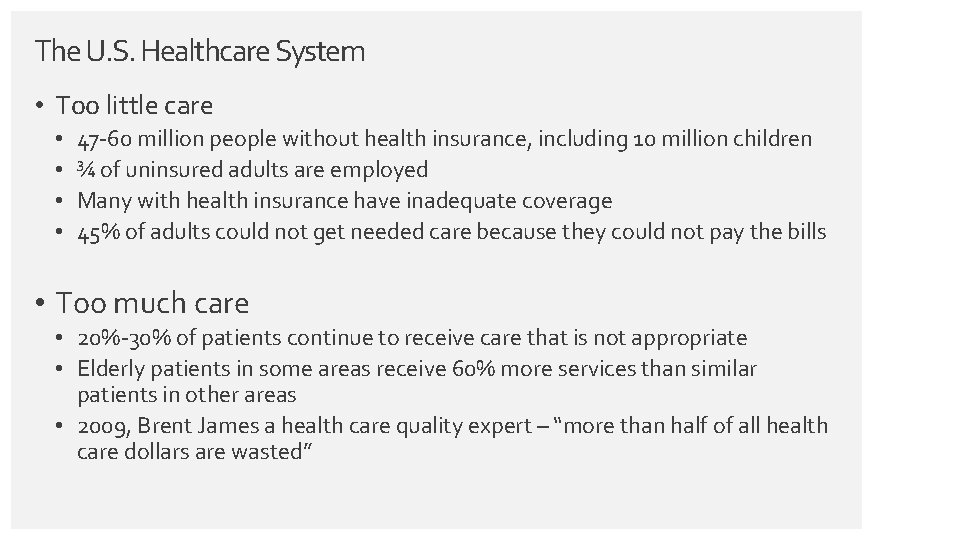
The U. S. Healthcare System • Too little care • • 47 -60 million people without health insurance, including 10 million children ¾ of uninsured adults are employed Many with health insurance have inadequate coverage 45% of adults could not get needed care because they could not pay the bills • Too much care • 20%-30% of patients continue to receive care that is not appropriate • Elderly patients in some areas receive 60% more services than similar patients in other areas • 2009, Brent James a health care quality expert – “more than half of all health care dollars are wasted” Contoso Pharmaceuticals
Paying for Health Care Contoso Pharmaceuticals
How do we pay? • Health care is not free. Someone must pay. But how? • Different healthcare payment models have been designed across the globe. Contoso Pharmaceuticals
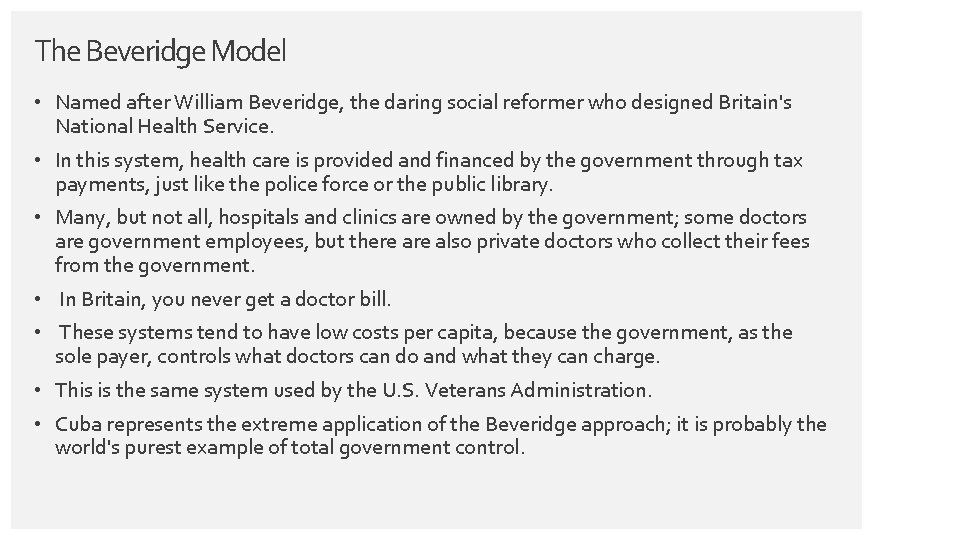
The Beveridge Model • Named after William Beveridge, the daring social reformer who designed Britain's National Health Service. • In this system, health care is provided and financed by the government through tax payments, just like the police force or the public library. • Many, but not all, hospitals and clinics are owned by the government; some doctors are government employees, but there also private doctors who collect their fees from the government. • In Britain, you never get a doctor bill. • These systems tend to have low costs per capita, because the government, as the sole payer, controls what doctors can do and what they can charge. • This is the same system used by the U. S. Veterans Administration. • Cuba represents the extreme application of the Beveridge approach; it is probably the world's purest example of total government control. Contoso Pharmaceuticals
The Bismarck Model • Named for the Prussian Chancellor Otto von Bismarck, who invented the welfare state as part of the unification of Germany in the 19 th century. • Despite its European heritage, this system of providing health care would look fairly familiar to Americans. It uses an insurance system -- the insurers are called "sickness funds" -- usually financed jointly by employers and employees through payroll deduction. • Unlike the U. S. insurance industry, though, Bismarck-type health insurance plans have to cover everybody, and they don't make a profit. • Doctors and hospitals tend to be private in Bismarck countries • Although this is a multi-payer model -- Germany has about 240 different funds -- tight regulation gives government much of the cost-control clout that the single-payer Beveridge Model provides. Contoso Pharmaceuticals
The National Insurance Model • This system has elements of both Beveridge and Bismarck. • It uses private-sector providers, but payment comes from a government-run insurance program that every citizen pays into. Since there's no need for marketing, no financial motive to deny claims and no profit, these universal insurance programs tend to be cheaper and much simpler administratively than American-style for-profit insurance. • The single payer tends to have considerable market power to negotiate for lower prices; Canada's system, for example, has negotiated such low prices from pharmaceutical companies that Americans have spurned their own drug stores to buy pills north of the border. • National Health Insurance plans also control costs by limiting the medical services they will pay for, or by making patients wait to be treated. • The classic NHI system is found in Canada, but some newly industrialized countries have also adopted the NHI model. • The Canadian system is the model for Medicare in the U. S. Contoso Pharmaceuticals
The Out-of-Pocket Model • Only the developed, industrialized countries -- perhaps 40 of the world's 200 countries -- have established health care systems. Most of the nations on the planet are too poor and too disorganized to provide any kind of mass medical care. The basic rule in such countries is that the rich get medical care; the poor stay sick or die. • In rural regions of Africa, India, China and South America, hundreds of millions of people go their whole lives without ever seeing a doctor. • They may have access, though, to a village healer using home-brewed remedies that may or not be effective against disease. In the poor world, patients can sometimes scratch together enough money to pay a doctor bill; otherwise, they pay in potatoes or goat's milk or child care or whatever else they may have to give. (Barter) • If they have nothing, they don't get medical care. Contoso Pharmaceuticals
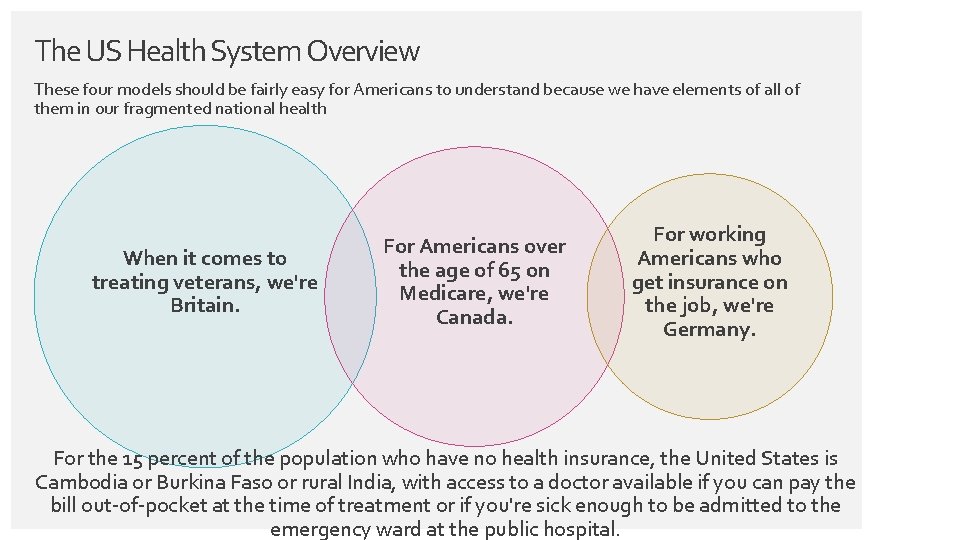
The US Health System Overview These four models should be fairly easy for Americans to understand because we have elements of all of them in our fragmented national health When it comes to treating veterans, we're Britain. For Americans over the age of 65 on Medicare, we're Canada. For working Americans who get insurance on the job, we're Germany. For the 15 percent of the population who have no health insurance, the United States is Cambodia or Burkina Faso or rural India, with access to a doctor available if you can pay the Contoso Pharmaceuticals bill out-of-pocket at the time of treatment or if you're sick enough to be admitted to the emergency ward at the public hospital.
Healthcare Chaos • The United States is unlike every other country because it maintains so many separate systems for separate classes of people. • All the other countries have settled on one model for everybody. • This is much simpler than the U. S. system; it's fairer and cheaper, too. Contoso Pharmaceuticals page 13
Paying for Health Care Contoso Pharmaceuticals
Past Trends • In 2004, medical costs in the US increased at a rate of 7. 9%, nearly four times that of growth in wages and over three times the rate of inflation. • Healthcare costs are projected to increase • 2015 20% of GDP or 1/5 th the total economy • US economy has not grown at the same rate as healthcare spending Contoso Pharmaceuticals
Why Such Health Care Cost Growth in US? • 6 major factors AGING POPULATION INCREASING PRESCRIPTION DRUG COSTS INCREASING COSTS OF TECHONOLOGY/UTILIZATION INCREASED ADMINISTRATIVE RATES NON-PROFIT TO FOR-PROFIT HEALTHCARE PROVIDERS INCREASE IN THE NUMBER OF UNDER-INSURED AND UNINSURED INDIVIDUALS Contoso Pharmaceuticals
AGING POPULATION • Last 50 years (as of 2004) life expectancy increase from 68 – 78 • Chronic diseases • 40% of short-term hospital stays • 25% of prescription drug use • 58% of all health expenditures • “baby boomers” • 1/5 enrolled in Medicare Contoso Pharmaceuticals
Increasing Prescription Drug Cost • Fast growing category of health spending • Cost to develop new drugs have risen • Drugs tend to be more expensive because government does not set prices or regulate profits of drug companies • Direct marketing to general population = increased usage • 91% of senior citizen take drugs regularly • 2006 – Medicare part D Contoso Pharmaceuticals
Rates of Technology Usage • Expensive new technologies • 22% increase in healthcare costs • Mostly radiologic imaging services • New technology, even if it costs less, is used more • Direct marketing to US consumers Contoso Pharmaceuticals
Increasing Administrative Costs • In the U. S. approximately 25 -30% of healthcare costs are designated for the administrative side of healthcare • 27% or US healthcare workers do “mostly paperwork” Contoso Pharmaceuticals
Number of under/un-insured • Stephan Ayres • Health Care in the United States • The USA is “the only country in the developed world, except for South Africa, that does not provide healthcare for all its citizens” • 16% of pop • Larger states, larger percents • Turn to ER; delay seeking treatments • 70% of uninsured Americans cite cost as the main reason they do not have insurance Contoso Pharmaceuticals
Why is the US so HIGH in COSTS • More MRI and CT scanners, physicians, and hospital beds person • High ratio of specialists to primary care physicians • New technologies Contoso Pharmaceuticals