
Healthcare Delivery Systems Improvement Project Karen Jimenez Gudino
- Slides: 16
Healthcare Delivery Systems Improvement Project Karen Jimenez Gudino 4/27/16 1
Overview of Patient Care Delivery System Cardiac/ Telemetry unit Focus: Performance Results related to use of personal protective equipment by floor staff 2
Microsystem Model: Leadership “Leaders maintain constancy of purpose, establish clear goals and expectations, and foster a respectful culture. Leaders take time to build knowledge, review and reflect, and take action about microsystems and the larger organization” (Johnson, 2003). Democratic – staffs are comfortable putting insights about hospital improvements Charge Nurse – supervise and provide assistance to the staff during the shift. Unit Nurse manager- establish goals, ensure that staff have up to date skills and provide feedbacks to the staff Clinical Nurse leader- ensure that the unit functions smoothly Institute for Healthcare Improvement. (2016). Leadership. Retrieved from http: //www. ihi. org/Topics/Leadership/Pages/default. aspx Marquis, B. L. , & Huston, C. J. (2015). Leadership roles and management functions in nursing, (8 th ed. ). Philadelphia: Wolters 3
Microsystem Mode Organizational Culture and Support “Organizational culture is a system of symbols and interactions unique to each organization. It is the ways of thinking behaving, and believing that members of unit have in common. ” (Marquis & Huston, 2014) Cardiac/ Telemetry unit o Very open, nurse supportive of each other o Morale boost o Front desk workers Marquis, B. L. , & Huston, C. J. (2012). Leadership Roles and Management Functions in Nursing; Theory and Application. (7 th ed, pp. 268. ). Philadelphia: Wolters Kluwer Health/Lippincott Williams & Wilkins. 4
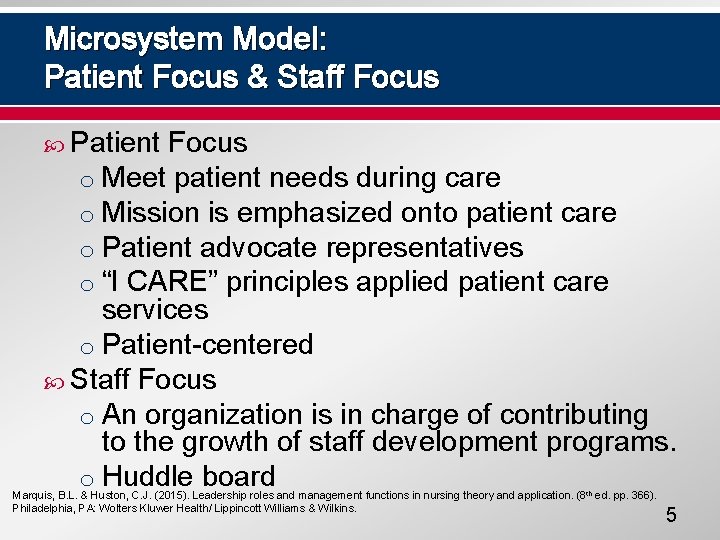
Microsystem Model: Patient Focus & Staff Focus Patient Focus o Meet patient needs during care o Mission is emphasized onto patient care o Patient advocate representatives o “I CARE” principles applied patient care services o Patient-centered Staff Focus o An organization is in charge of contributing to the growth of staff development programs. o Huddle board Marquis, B. L. & Huston, C. J. (2015). Leadership roles and management functions in nursing theory and application. (8 th ed. pp. 366). Philadelphia, PA: Wolters Kluwer Health/ Lippincott Williams & Wilkins. 5
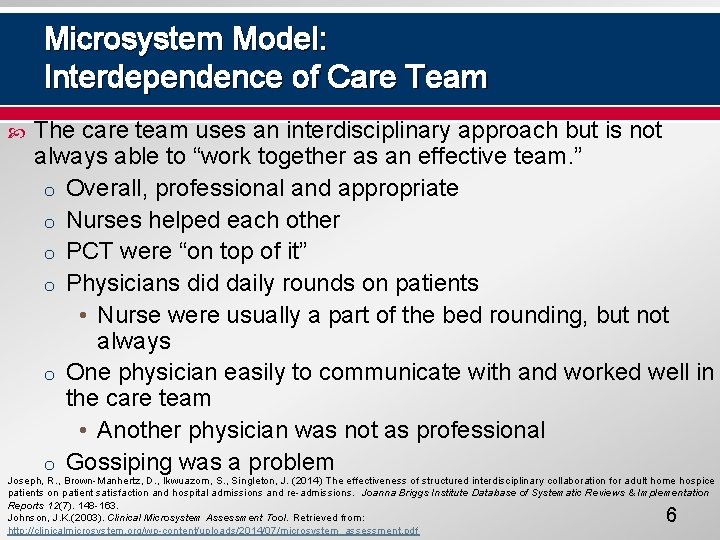
Microsystem Model: Interdependence of Care Team The care team uses an interdisciplinary approach but is not always able to “work together as an effective team. ” o Overall, professional and appropriate o Nurses helped each other o PCT were “on top of it” o Physicians did daily rounds on patients • Nurse were usually a part of the bed rounding, but not always o One physician easily to communicate with and worked well in the care team • Another physician was not as professional o Gossiping was a problem Joseph, R. , Brown-Manhertz, D. , Ikwuazom, S. , Singleton, J. (2014) The effectiveness of structured interdisciplinary collaboration for adult home hospice patients on patient satisfaction and hospital admissions and re-admissions. Joanna Briggs Institute Database of Systematic Reviews & Implementation Reports 12(7). 148 -163. Johnson, J. K. (2003). Clinical Microsystem Assessment Tool. Retrieved from: http: //clinicalmicrosystem. org/wp-content/uploads/2014/07/microsystem_assessment. pdf 6
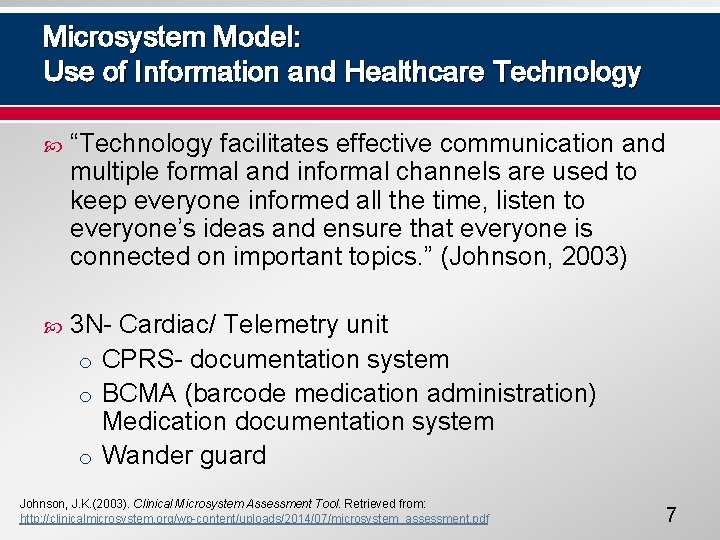
Microsystem Model: Use of Information and Healthcare Technology “Technology facilitates effective communication and multiple formal and informal channels are used to keep everyone informed all the time, listen to everyone’s ideas and ensure that everyone is connected on important topics. ” (Johnson, 2003) 3 N- Cardiac/ Telemetry unit o CPRS- documentation system o BCMA (barcode medication administration) Medication documentation system o Wander guard Johnson, J. K. (2003). Clinical Microsystem Assessment Tool. Retrieved from: http: //clinicalmicrosystem. org/wp-content/uploads/2014/07/microsystem_assessment. pdf 7
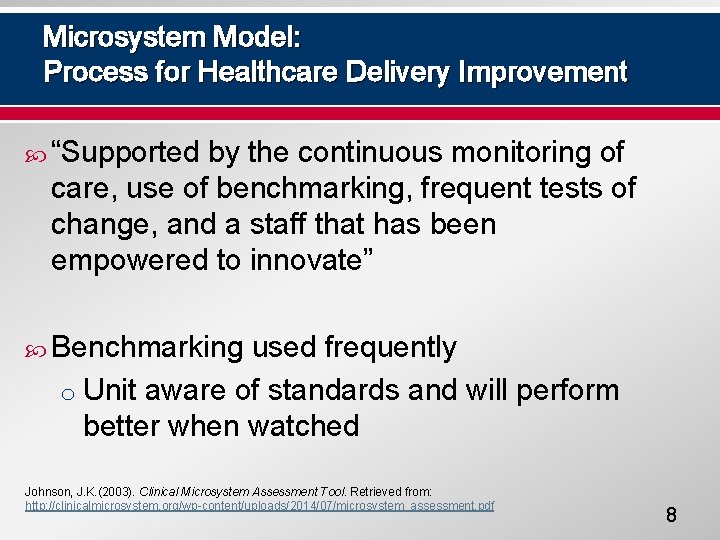
Microsystem Model: Process for Healthcare Delivery Improvement “Supported by the continuous monitoring of care, use of benchmarking, frequent tests of change, and a staff that has been empowered to innovate” Benchmarking used frequently o Unit aware of standards and will perform better when watched Johnson, J. K. (2003). Clinical Microsystem Assessment Tool. Retrieved from: http: //clinicalmicrosystem. org/wp-content/uploads/2014/07/microsystem_assessment. pdf 8
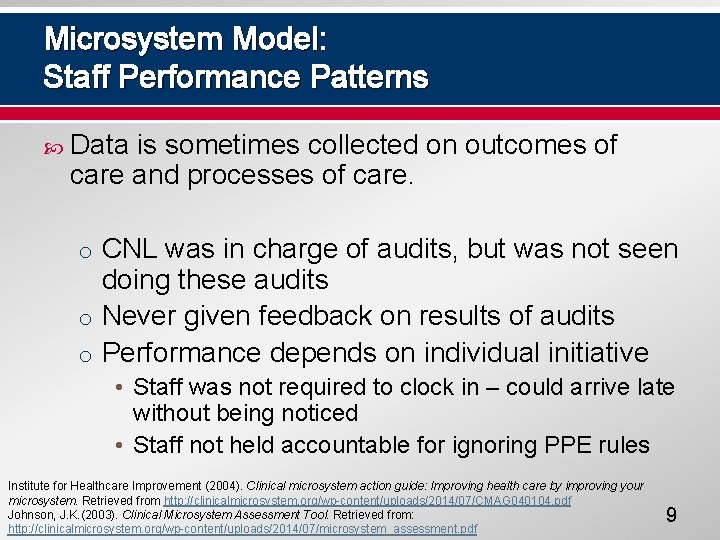
Microsystem Model: Staff Performance Patterns Data is sometimes collected on outcomes of care and processes of care. o CNL was in charge of audits, but was not seen doing these audits o Never given feedback on results of audits o Performance depends on individual initiative • Staff was not required to clock in – could arrive late without being noticed • Staff not held accountable for ignoring PPE rules Institute for Healthcare Improvement (2004). Clinical microsystem action guide: Improving health care by improving your microsystem. Retrieved from http: //clinicalmicrosystem. org/wp-content/uploads/2014/07/CMAG 040104. pdf Johnson, J. K. (2003). Clinical Microsystem Assessment Tool. Retrieved from: http: //clinicalmicrosystem. org/wp-content/uploads/2014/07/microsystem_assessment. pdf 9
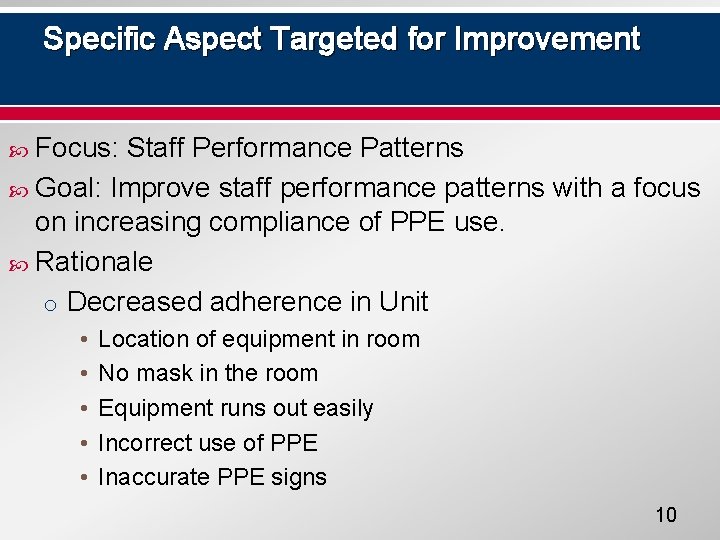
Specific Aspect Targeted for Improvement Focus: Staff Performance Patterns Goal: Improve staff performance patterns with a focus on increasing compliance of PPE use. Rationale o Decreased adherence in Unit • • • Location of equipment in room No mask in the room Equipment runs out easily Incorrect use of PPE Inaccurate PPE signs 10
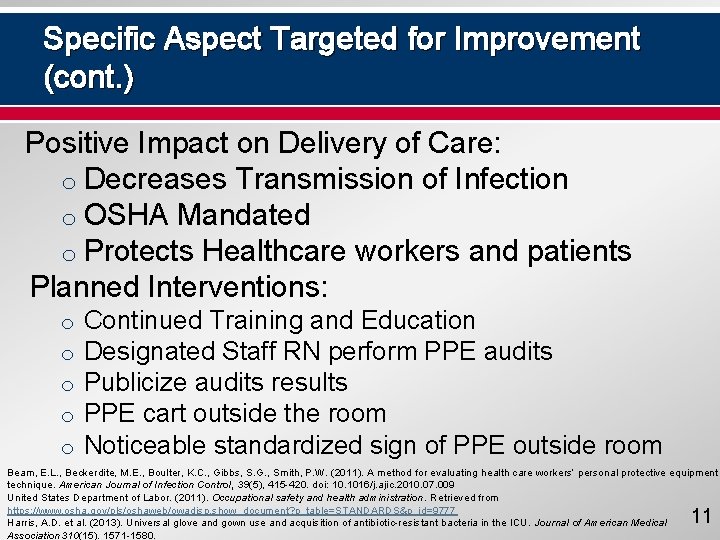
Specific Aspect Targeted for Improvement (cont. ) Positive Impact on Delivery of Care: o Decreases Transmission of Infection o OSHA Mandated o Protects Healthcare workers and patients Planned Interventions: o o o Continued Training and Education Designated Staff RN perform PPE audits Publicize audits results PPE cart outside the room Noticeable standardized sign of PPE outside room Beam, E. L. , Beckerdite, M. E. , Boulter, K. C. , Gibbs, S. G. , Smith, P. W. (2011). A method for evaluating health care workers’ personal protective equipment technique. American Journal of Infection Control, 39(5), 415 -420. doi: 10. 1016/j. ajic. 2010. 07. 009 United States Department of Labor. (2011). Occupational safety and health administration. Retrieved from https: //www. osha. gov/pls/oshaweb/owadisp. show_document? p_table=STANDARDS&p_id=9777 Harris, A. D. et al. (2013). Universal glove and gown use and acquisition of antibiotic-resistant bacteria in the ICU. Journal of American Medical Association 310(15). 1571 -1580. 11
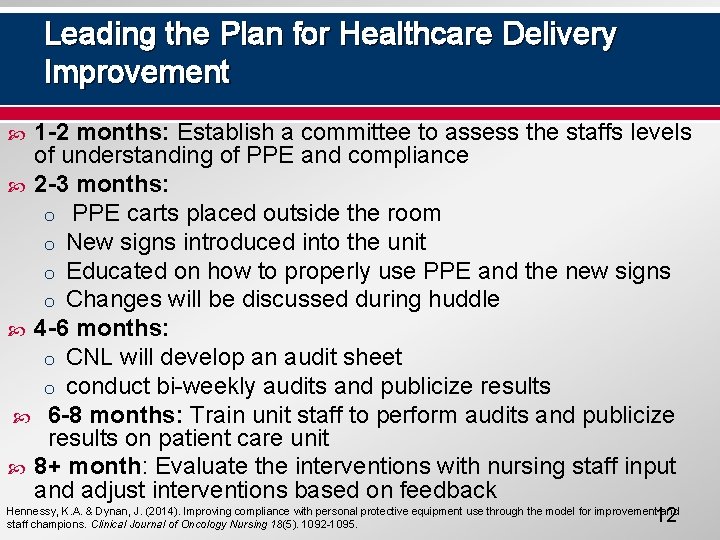
Leading the Plan for Healthcare Delivery Improvement 1 -2 months: Establish a committee to assess the staffs levels of understanding of PPE and compliance 2 -3 months: o PPE carts placed outside the room o New signs introduced into the unit o Educated on how to properly use PPE and the new signs o Changes will be discussed during huddle 4 -6 months: o CNL will develop an audit sheet o conduct bi-weekly audits and publicize results 6 -8 months: Train unit staff to perform audits and publicize results on patient care unit 8+ month: Evaluate the interventions with nursing staff input and adjust interventions based on feedback 12 Hennessy, K. A. & Dynan, J. (2014). Improving compliance with personal protective equipment use through the model for improvement and staff champions. Clinical Journal of Oncology Nursing 18(5). 1092 -1095.
Questions? !? 13
References Hennessy, K. A. & Dynan, J. (2014). Improving compliance with personal protective equipment use through the model for improvement and staff champions. Clinical Journal of Oncology Nursing 18(5). 1092 -1095 Harris, A. D. et al. (2013). Universal glove and gown use and acquisition of antibiotic-resistant bacteria in the ICU. Journal of American Medical Association 310(15). 1571 -1580. Institute for Healthcare Improvement (2004). Clinical microsystem action guide: Improving health care by improving your microsystem. Retrieved from http: //clinicalmicrosystem. org/wpcontent/uploads/2014/07/CMAG 040104. pdf Institute for Healthcare Improvement. (2016). Leadership. Retrieved from http: //www. ihi. org/Topics/Leadership/Pages/default. aspx 14
References Johnson, J. K. (2003). Clinical Microsystem Assessment Tool. Retrieved from: http: //clinicalmicrosystem. org/wpcontent/uploads/2014/07/microsystem_assessment. pdf Joseph, R. , Brown-Manhertz, D. , Ikwuazom, S. , Singleton, J. (2014) The effectiveness of structured interdisciplinary collaboration for adult home hospice patients on patient satisfaction and hospital admissions and re-admissions. Joanna Briggs Institute Database of Systematic Reviews & Implementation Reports 12(7). 148 -163. Marquis, B. L. , & Huston, C. J. (2012). Leadership Roles and Management Functions in Nursing; Theory and Application. (7 th ed. ). Philadelphia: Wolters Kluwer Health/Lippincott Williams & Wilkins. Marquis, B. L. , & Huston, C. J. (2015). Leadership roles and management functions in nursing, (8 th ed. ). Philadelphia: Wolters Kluwer Health/Lippincott Williams & Wilkins. 15
References United States Department of Labor. (2011). Occupational safety and health administration. Retrieved from https: //www. osha. gov/pls/oshaweb/owadisp. sho w_document? p_table=STANDARDS&p_id=9777 United States Department of Labor. (2011). Occupational safety and health administration. Retrieved from: https: //www. osha. gov/pls/oshaweb/owadisp. sho w_document? p_table=STANDARDS&p_id=9794 16