
Health Workforce Trends and Challenges in North Carolina

- Slides: 19
Health Workforce Trends and Challenges in North Carolina and the United States Erin P. Fraher, Ph. D, MPP Assistant Professor, Department of Family Medicine Director, Program on Health Workforce Research & Policy Cecil G. Sheps Center for Health Services Research, UNC-CH UNC Family Medicine Alumni Weekend April 13, 2017
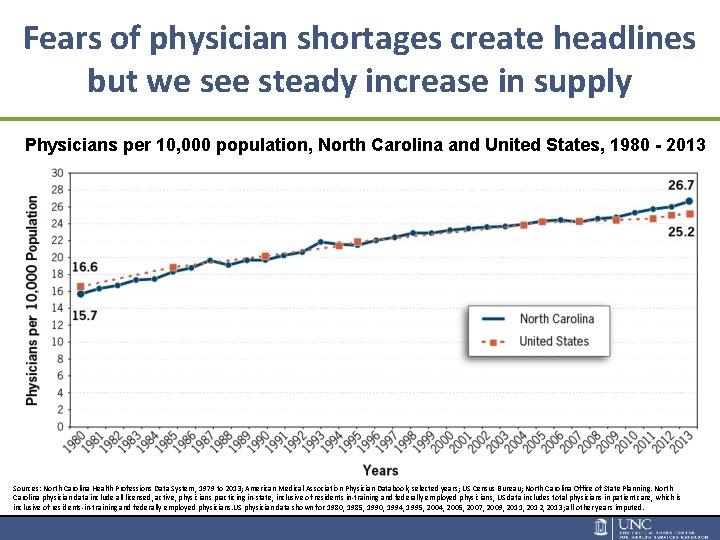
Fears of physician shortages create headlines but we see steady increase in supply Physicians per 10, 000 population, North Carolina and United States, 1980 - 2013 Sources: North Carolina Health Professions Data System, 1979 to 2013; American Medical Association Physician Databook, selected years; US Census Bureau; North Carolina Office of State Planning. North Carolina physician data include all licensed, active, physicians practicing in-state, inclusive of residents in-training and federally employed physicians, US data includes total physicians in patient care, which is inclusive of residents-in-training and federally employed physicians. US physician data shown for 1980, 1985, 1990, 1994, 1995, 2004, 2005, 2007, 2009, 2011, 2012, 2013; all other years imputed.
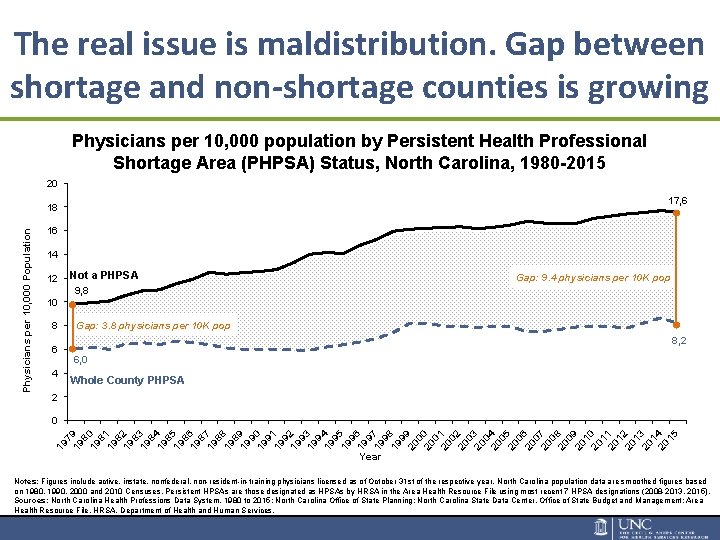
The real issue is maldistribution. Gap between shortage and non-shortage counties is growing Physicians per 10, 000 population by Persistent Health Professional Shortage Area (PHPSA) Status, North Carolina, 1980 -2015 20 17, 6 Physicians per 10, 000 Population 18 16 14 Not a PHPSA 9, 8 12 Gap: 9. 4 physicians per 10 K pop 10 Gap: 3. 8 physicians per 10 K pop 8 8, 2 6 6, 0 4 Whole County PHPSA 2 19 7 19 9 8 19 0 8 19 1 8 19 2 8 19 3 8 19 4 8 19 5 8 19 6 8 19 7 8 19 8 8 19 9 9 19 0 9 19 1 9 19 2 9 19 3 9 19 4 9 19 5 9 19 6 9 19 7 9 19 8 9 20 9 0 20 0 0 20 1 0 20 2 0 20 3 0 20 4 0 20 5 0 20 6 0 20 7 0 20 8 0 20 9 1 20 0 1 20 1 1 20 2 1 20 3 1 20 4 15 0 Year Notes: Figures include active, instate, nonfederal, non-resident-in-training physicians licensed as of October 31 st of the respective year. North Carolina population data are smoothed figures based on 1980, 1990, 2000 and 2010 Censuses. Persistent HPSAs are those designated as HPSAs by HRSA in the Area Health Resource File using most recent 7 HPSA designations (2008 -2013, 2015). Sources: North Carolina Health Professions Data System, 1980 to 2015; North Carolina Office of State Planning; North Carolina State Data Center, Office of State Budget and Management; Area Health Resource File, HRSA, Department of Health and Human Services.
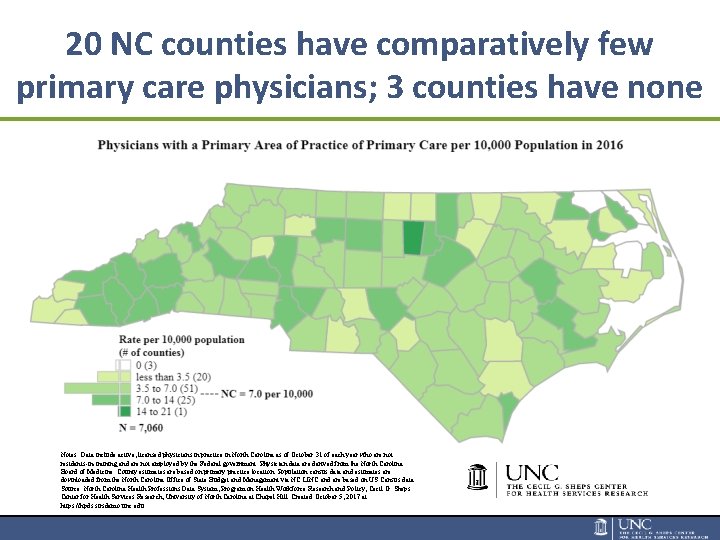
20 NC counties have comparatively few primary care physicians; 3 counties have none Notes: Data include active, licensed physicians in practice in North Carolina as of October 31 of each year who are not residents-in-training and are not employed by the Federal government. Physician data are derived from the North Carolina Board of Medicine. County estimates are based on primary practice location. Population census data and estimates are downloaded from the North Carolina Office of State Budget and Management via NC LINC and are based on US Census data. Source: North Carolina Health Professions Data System, Program on Health Workforce Research and Policy, Cecil G. Sheps Center for Health Services Research, University of North Carolina at Chapel Hill. Created October 5, 2017 at https: //hpds. sirsdemo. unc. edu.
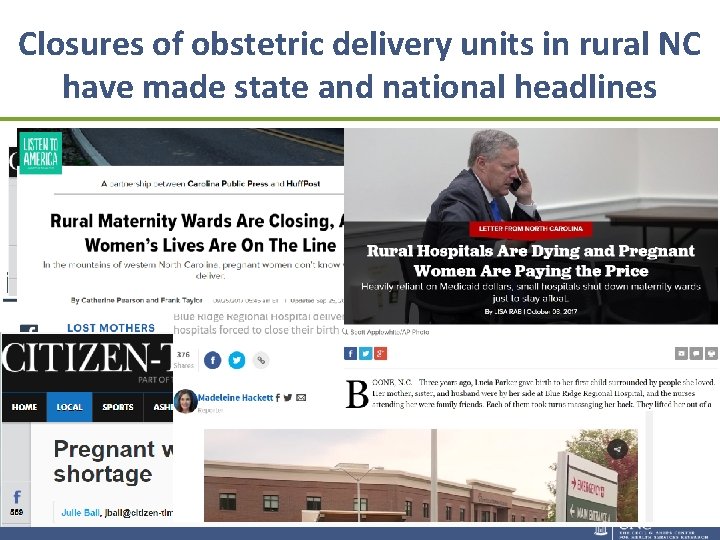
Closures of obstetric delivery units in rural NC have made state and national headlines
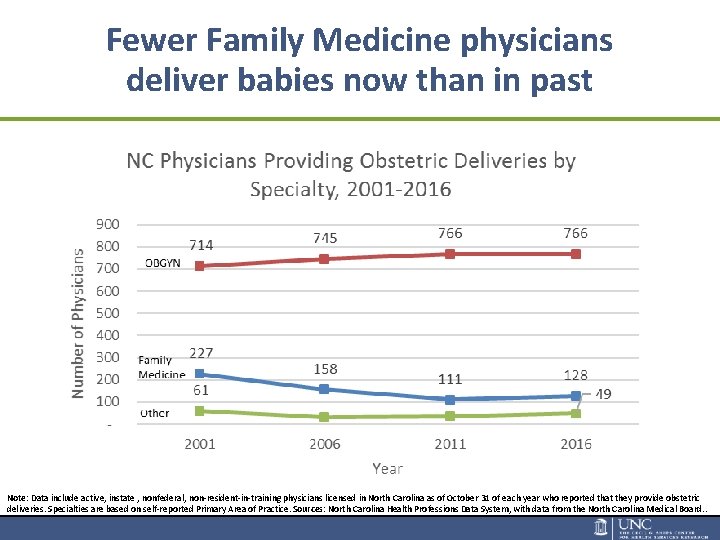
Fewer Family Medicine physicians deliver babies now than in past OBGYN Family Medicine Note: Data include active, instate , nonfederal, non-resident-in-training physicians licensed in North Carolina as of October 31 of each year who reported that they provide obstetric deliveries. Specialties are based on self-reported Primary Area of Practice. Sources: North Carolina Health Professions Data System, with data from the North Carolina Medical Board. .
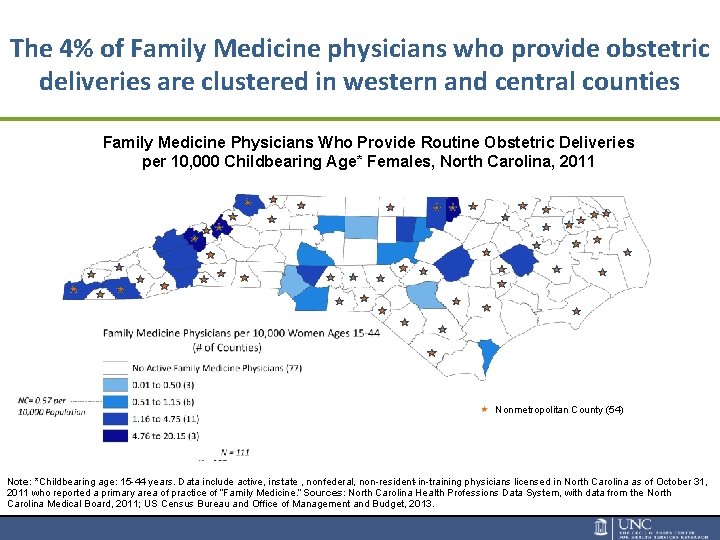
The 4% of Family Medicine physicians who provide obstetric deliveries are clustered in western and central counties Family Medicine Physicians Who Provide Routine Obstetric Deliveries per 10, 000 Childbearing Age* Females, North Carolina, 2011 Nonmetropolitan County (54) Note: *Childbearing age: 15 -44 years. Data include active, instate , nonfederal, non-resident-in-training physicians licensed in North Carolina as of October 31, 2011 who reported a primary area of practice of “Family Medicine. ” Sources: North Carolina Health Professions Data System, with data from the North Carolina Medical Board, 2011; US Census Bureau and Office of Management and Budget, 2013.
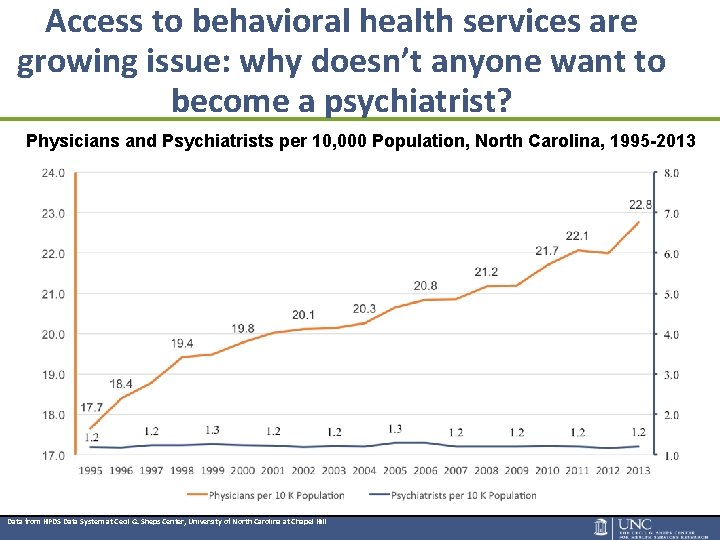
Access to behavioral health services are growing issue: why doesn’t anyone want to become a psychiatrist? Physicians and Psychiatrists per 10, 000 Population, North Carolina, 1995 -2013 Data from HPDS Data System at Cecil G. Sheps Center, University of North Carolina at Chapel Hill
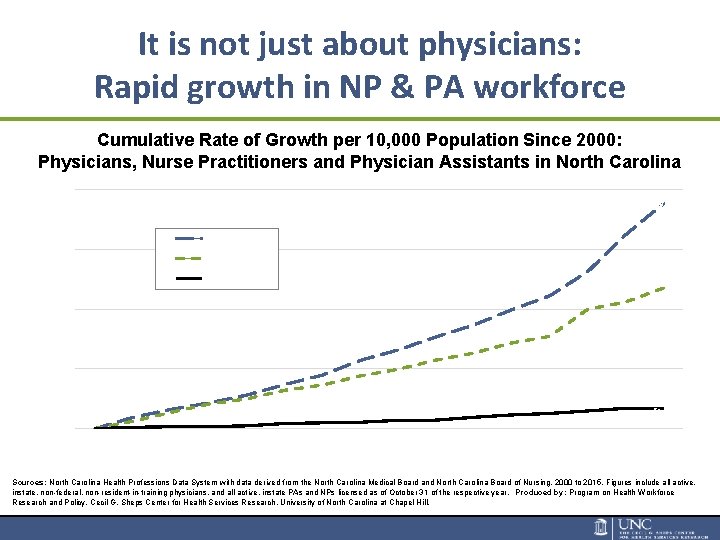
It is not just about physicians: Rapid growth in NP & PA workforce Cumulative Rate of Growth per 10, 000 Population Since 2000: Physicians, Nurse Practitioners and Physician Assistants in North Carolina Percent Growth Since 2000 200 [VALUE]% NPs PAs Physicians 150 [VALUE]% 100 50 [VALUE]% 0 2001 2002 2003 2004 2005 2006 2007 2008 Year 2009 2010 2011 2012 2013 2014 2015 Sources: North Carolina Health Professions Data System with data derived from the North Carolina Medical Board and North Carolina Board of Nursing, 2000 to 2015. Figures include all active, instate, non-federal, non-resident-in-training physicians, and all active, instate PAs and NPs licensed as of October 31 of the respective year. Produced by: Program on Health Workforce Research and Policy, Cecil G. Sheps Center for Health Services Research, University of North Carolina at Chapel Hill.
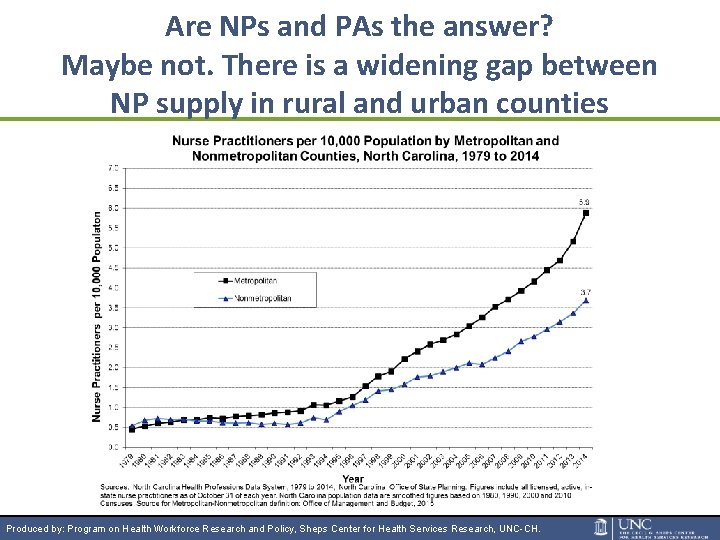
Are NPs and PAs the answer? Maybe not. There is a widening gap between NP supply in rural and urban counties Nurse Practitioners per 10, 000 by Metropolitan and Nonmetropolitan Counties, North Carolina, 1979 to 2014 Produced by: Program on Health Workforce Research and Policy, Sheps Center for Health Services Research, UNC-CH.
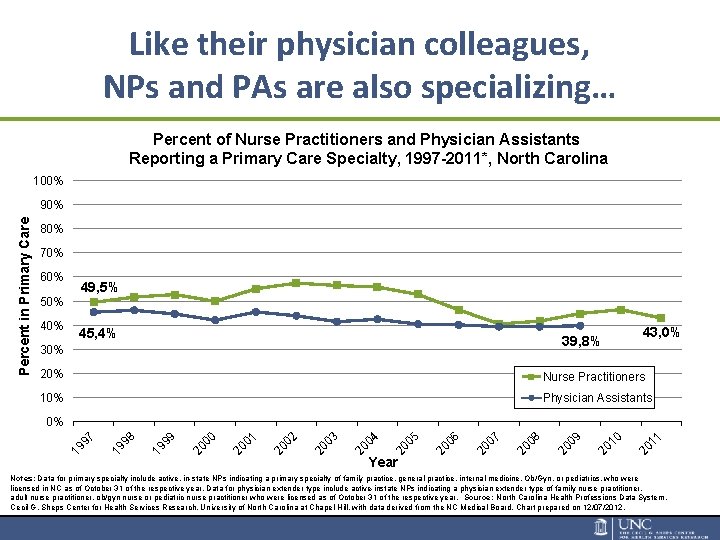
Like their physician colleagues, NPs and PAs are also specializing… Percent of Nurse Practitioners and Physician Assistants Reporting a Primary Care Specialty, 1997 -2011*, North Carolina 100% Percent in Primary Care 90% 80% 70% 60% 49, 5% 50% 45, 4% 39, 8% 30% 43, 0% 20% Nurse Practitioners 10% Physician Assistants 11 20 10 20 09 20 08 20 07 06 20 Year 20 05 20 04 20 03 20 02 20 01 20 00 20 99 19 98 19 19 97 0% Notes: Data for primary specialty include active, in-state NPs indicating a primary specialty of family practice, general practice, internal medicine, Ob/Gyn, or pediatrics, who were licensed in NC as of October 31 of the respective year. Data for physician extender type include active-instate NPs indicating a physician extender type of family nurse practitioner, adult nurse practitioner, ob/gyn nurse or pediatric nurse practitioner who were licensed as of October 31 of the respective year. Source: North Carolina Health Professions Data System, Cecil G. Sheps Center for Health Services Research, University of North Carolina at Chapel Hill, with data derived from the NC Medical Board. Chart prepared on 12/07/2012.
Policy makers say: “Let’s make more doctors! We’ll expand medical school enrollment. ” It’s not going to address maldistribution
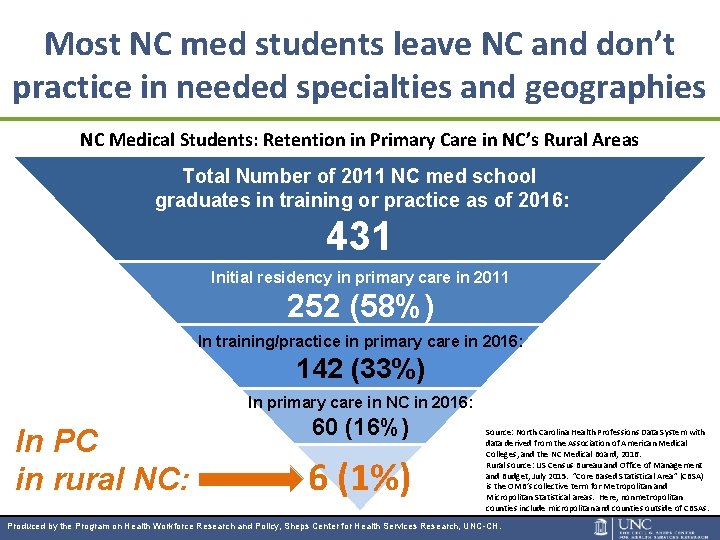
Most NC med students leave NC and don’t practice in needed specialties and geographies NC Medical Students: Retention in Primary Care in NC’s Rural Areas Total Number of 2011 NC med school graduates in training or practice as of 2016: 431 Initial residency in primary care in 2011 252 (58%) In training/practice in primary care in 2016: 142 (33%) In primary care in NC in 2016: In PC in rural NC: 60 (16%) 6 (1%) Source: North Carolina Health Professions Data System with data derived from the Association of American Medical Colleges, and the NC Medical Board, 2016. Rural source: US Census Bureau and Office of Management and Budget, July 2015. ”Core Based Statistical Area” (CBSA) is the OMB’s collective term for Metropolitan and Micropolitan Statistical areas. Here, nonmetropolitan counties include micropolitan and counties outside of CBSAs. Produced by the Program on Health Workforce Research and Policy, Sheps Center for Health Services Research, UNC-CH.
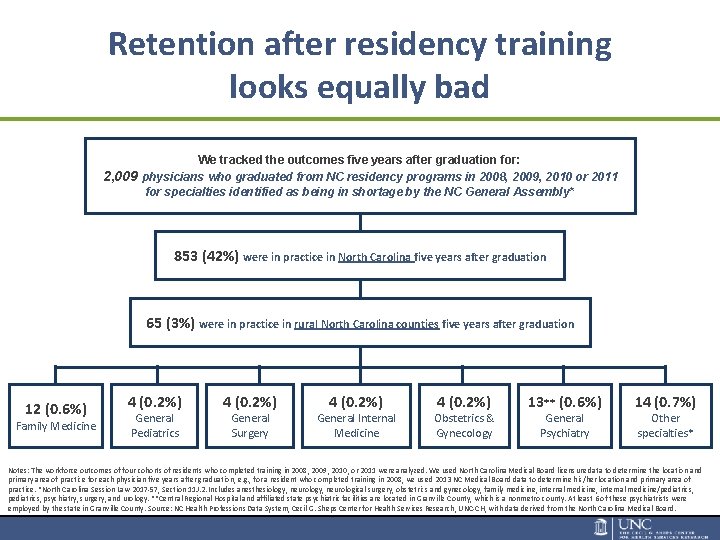
Retention after residency training looks equally bad We tracked the outcomes five years after graduation for: 2, 009 physicians who graduated from NC residency programs in 2008, 2009, 2010 or 2011 for specialties identified as being in shortage by the NC General Assembly* 853 (42%) were in practice in North Carolina five years after graduation 65 (3%) were in practice in rural North Carolina counties five years after graduation 12 (0. 6%) Family Medicine 4 (0. 2%) General Pediatrics 4 (0. 2%) General Surgery 4 (0. 2%) General Internal Medicine 4 (0. 2%) Obstetrics & Gynecology 13** (0. 6%) General Psychiatry 14 (0. 7%) Other specialties* Notes: The workforce outcomes of four cohorts of residents who completed training in 2008, 2009, 2010, or 2011 were analyzed. We used North Carolina Medical Board licensure data to determine the location and primary area of practice for each physician five years after graduation, e. g. , for a resident who completed training in 2008, we used 2013 NC Medical Board data to determine his/her location and primary area of practice. *North Carolina Session Law 2017 -57, Section 11 J. 2. Includes anesthesiology, neurological surgery, obstetrics and gynecology, family medicine, internal medicine/pediatrics, psychiatry, surgery, and urology. **Central Regional Hospital and affiliated state psychiatric facilities are located in Granville County, which is a nonmetro county. At least 6 of these psychiatrists were employed by the state in Granville County. Source: NC Health Professions Data System, Cecil G. Sheps Center for Health Services Research, UNC-CH, with data derived from the North Carolina Medical Board.
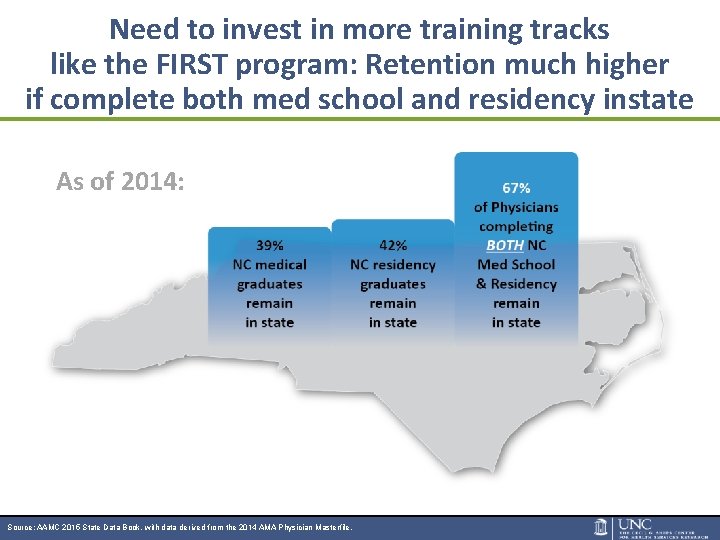
Need to invest in more training tracks like the FIRST program: Retention much higher if complete both med school and residency instate As of 2014: Source: AAMC 2015 State Data Book, with data derived from the 2014 AMA Physician Masterfile.
Sort of interested in workforce? Have a play with our data visualizations
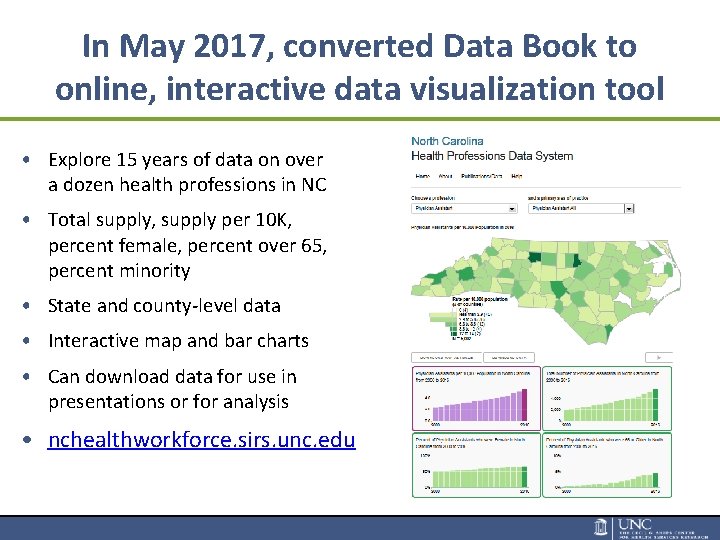
In May 2017, converted Data Book to online, interactive data visualization tool • Explore 15 years of data on over a dozen health professions in NC • Total supply, supply per 10 K, percent female, percent over 65, percent minority • State and county-level data • Interactive map and bar charts • Can download data for use in presentations or for analysis • nchealthworkforce. sirs. unc. edu
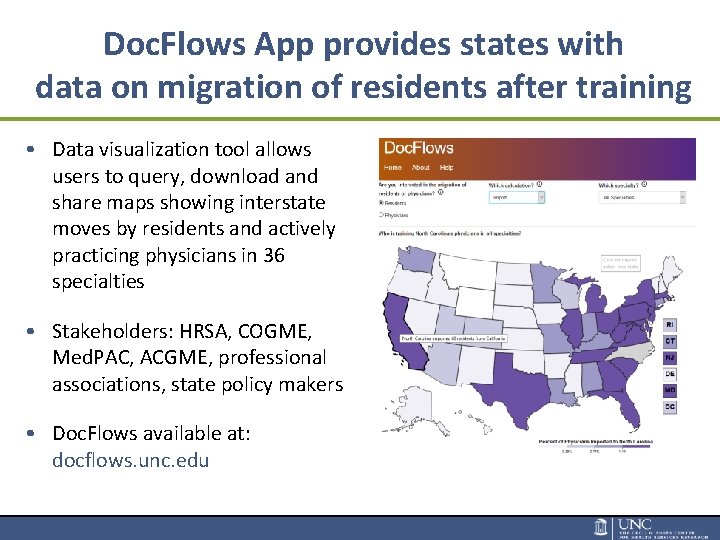
Doc. Flows App provides states with data on migration of residents after training • Data visualization tool allows users to query, download and share maps showing interstate moves by residents and actively practicing physicians in 36 specialties • Stakeholders: HRSA, COGME, Med. PAC, ACGME, professional associations, state policy makers • Doc. Flows available at: docflows. unc. edu
Questions? Want to know more? Erin Fraher (919) 966 -5012 erin_fraher@unc. edu Director Program on Health Workforce Research and Policy, and the North Carolina Health Professions Data System http: //www. healthworkforce. unc. edu http: //www. shepscenter. unc. edu/hp