
Health Workforce System and Performance Metrics Lecture 4


- Slides: 27
Health Workforce System and Performance Metrics Lecture 4
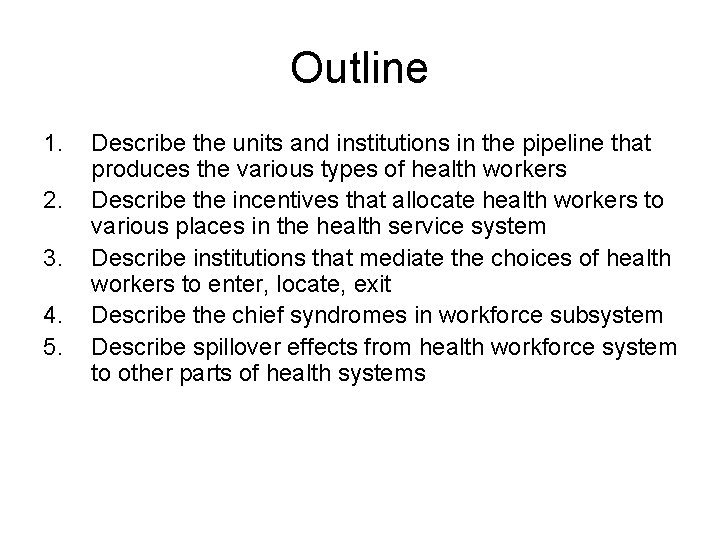
Outline 1. 2. 3. 4. 5. Describe the units and institutions in the pipeline that produces the various types of health workers Describe the incentives that allocate health workers to various places in the health service system Describe institutions that mediate the choices of health workers to enter, locate, exit Describe the chief syndromes in workforce subsystem Describe spillover effects from health workforce system to other parts of health systems
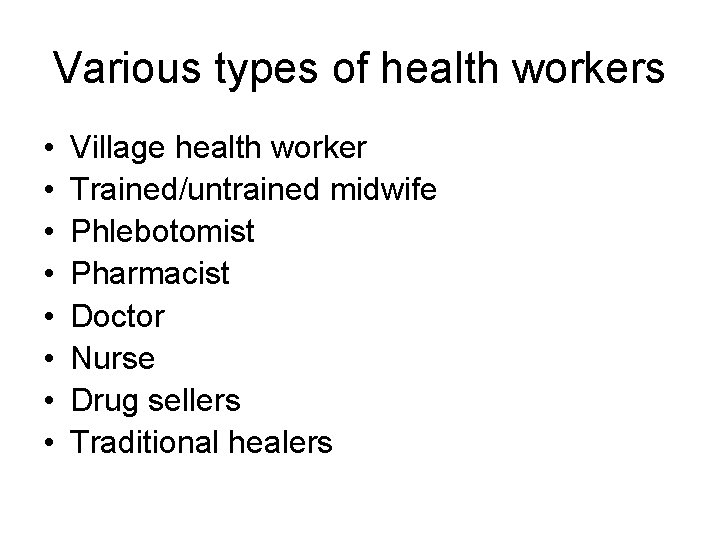
Various types of health workers • • Village health worker Trained/untrained midwife Phlebotomist Pharmacist Doctor Nurse Drug sellers Traditional healers
Part 1: Conceptual Framework: The Pipeline
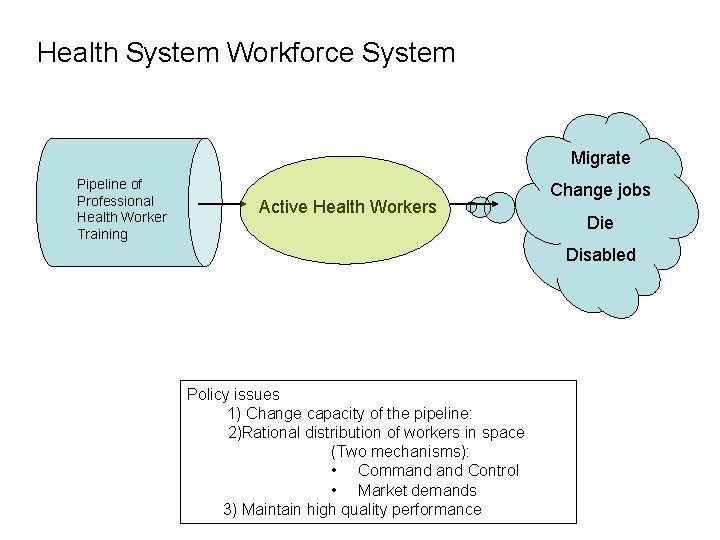
Health System Workforce System Migrate Pipeline of Professional Health Worker Training Active Health Workers Change jobs Die Disabled Policy issues 1) Change capacity of the pipeline: 2)Rational distribution of workers in space (Two mechanisms): • Command Control • Market demands 3) Maintain high quality performance
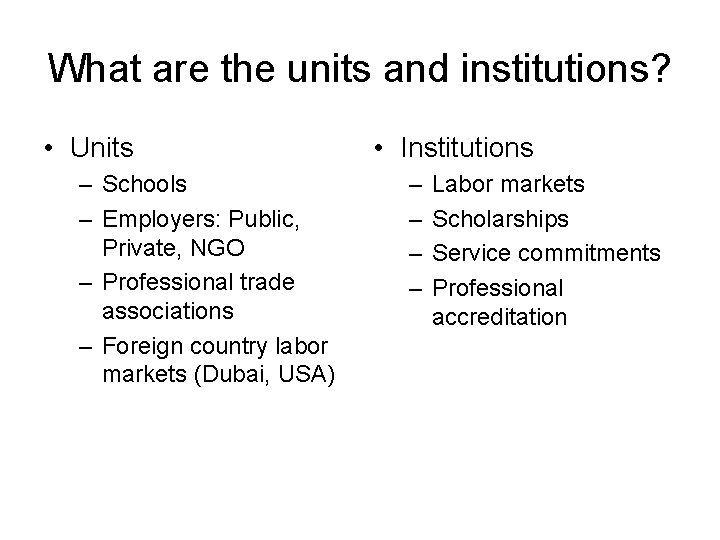
What are the units and institutions? • Units – Schools – Employers: Public, Private, NGO – Professional trade associations – Foreign country labor markets (Dubai, USA) • Institutions – – Labor markets Scholarships Service commitments Professional accreditation
Pipeline • Pipeline of several years; workers get distributed throughout the country at the exit of the pipeline – Professional training and ‘Non-professional’ from being on the job • How do they exit? – Migrate, change jobs, die, disabled • Policies to increase retention – Restrict migration, improve health worker safety, improve pay • Policies to change capacity of the pipeline – More trainees coming out
Other considerations • Besides size of pipeline 1)Rational distribution in space for reach: 2 mechanisms • Government command control: • Market – Many end up in urban hospitals to serve urban elites 2) Maintain high quality performance • Mix of health workers – MD and MBBS physicians should be scarcest because most costly to produce – Nurses and trained ancillary workers are less costly sources of primary care
Politics • Physician groups universally entertain policies to impede the scope of practice of less trained health providers – Physician unions say, “Public health is endangered because less well-trained providers might miss diagnoses and fail to refer” – Others say, “Public health is endangered by shortages of service providers and over-priced physician fees. ” • What do you think?
Retention • How do they exit? – Migrate, change jobs, die, disabled • Migration and job change – Not only because of low wages – Often migrate because of morale and a desire to practice profession better • Death and disability – Needle-stick injuries are a leading occupational risk – Hepatitis, HIV • Safety measures that are not being used • Biohazard containers, safety needles
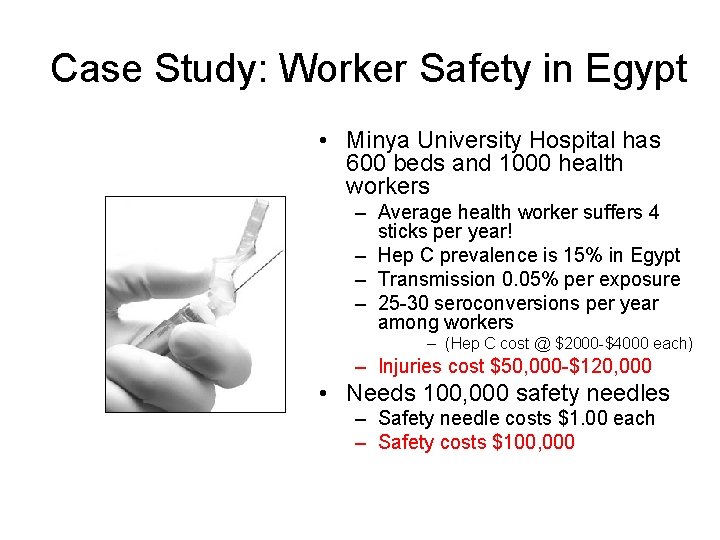
Case Study: Worker Safety in Egypt • Minya University Hospital has 600 beds and 1000 health workers – Average health worker suffers 4 sticks per year! – Hep C prevalence is 15% in Egypt – Transmission 0. 05% per exposure – 25 -30 seroconversions per year among workers – (Hep C cost @ $2000 -$4000 each) – Injuries cost $50, 000 -$120, 000 • Needs 100, 000 safety needles – Safety needle costs $1. 00 each – Safety costs $100, 000
Migration • Strategies: coercive regulation; service commitments • Poaching by high-income countries to meet their own needs: how does it end? – Migrating for financial reasons: • Lack of good health insurance financing to stimulate demand make livelihoods more secure • Tight bond between problems of manpower and financing
Questions for students • What does training cost? Who bears the costs? • Long- and short-term costs – Government – Opportunity cost: individuals could be working in industry but deferring gratification; return on investment • Envision what would be the ideal way: – If you were in charge, where would you put health workers? And why?
Part 2: Syndromes in Health Workforce
Syndrome 1: Worker Shortage • Definition: Worker shortage occurs when there are too few of all types of health workers relative to the population • Etiology: Pipeline too small and/or exit rates to high • Implications: • There is an imbalance between pills, procedures and time with the provider now: more pills, less time with provider – Too many unsupervised pills and procedures, • Problem in malaria (too short of a course taken, wrong drug) • TB (drug resistance later) • Medical care adapts poorly to this shortage and quality is impaired
Diagnosing Worker Shortage • Diagnostic question is not whethere is shortage, it is asking where the shortage is most severe. • Information Systems: – Centrally maintained staffing lists (often out of date) – Worker wage data (underutilized) • Earnings in private markets are higher in shortage areas – Household surveys can suggest utilization patterns
Managing Worker Shortage • Understand incentives of workers – Wages – Professional morale – Safety • International strategies – Tax poaching • Countries that poach health workers need to pay replacement costs – Offering attractions for returning health workers based on incentives
Syndrome 2: Worker imbalance • Definition: Worker imbalance occurs when the cadres of workers emerging from training is illsuited to the health needs of a population – Typical imbalance is an insistence that MD or MBBS providers be the only possible source of primary care • Neglects important role of community health workers (CHW) and ru practitioner • Barefoot doctor strategy can play an important strategic role – Insisting on MDs accentuates worker shortages
Diagnosing Worker Imbalance • Key role of information systems – Supply shortages, surpluses – Information drawn from direct inspection of last mile • Qualitative evidence – Need patient reports on satisfaction and aspects of care • Case study: Peons (janitors) in Nepal – Anthropologist finds that the peons were delivering primary care – Health providers out at training or in private practice – Invisible to central information system
Managing Worker Imbalance • Push and Pull Factors in the Pipeline – Push • Open more training institutions for worker types that are in scarcity • Provide scholarships tied to service commitments • Use military sector to develop professionals – Pull • Stabilize key professions like lab technicians and nurses by supporting trade associations • Make key professions more woman friendly – Offer child care packages – Retraining for housewives who have been on leave from the workforce
Syndrome 3: Spatial maldistribution • Definition: Spatial maldistribution occurs when health workforce is not located in accordance with disease burden – Can manifest as local area shortage OR as local area surplus of health workers – Typically a rural: urban disparity – All sorts of economic activity, health services, included are more costly to organize in rural areas
Diagnosing Spatial Maldistribution • Household survey data on utilization and travel time • Market data on prices of health services
Managing Spatial Maldistribution • Command control – Use service commitment obligations to place health workers in shortage areas – Build facilities – Pay workers low maintenance wages and expect them to practice part time in private sector • Market solutions – Find private providers in shortage areas and work with them to improve their quality of care – Demand side financing • Vouchers plus quality certifications
Part 3: Spillovers with Other Areas
Origins of Workforce Imbalances • Households – With low levels of sophistication households have an unenlightened willingness to pay for preventive services and diagnostic tests – Too much interest in medications and injections – Fundamental effects on pull factors in the pipeline • Finance – Insurance systems exert immense pull factor on pipeline – Underdeveloped insurance in rural areas makes livelihoods unsustainable • Information systems – Essential to help managers diagnose and address problems
Impacts of Workforce Problems • Finance – Low actuarial and accounting workforce inhibits development of financial protection system • Health Service Delivery – Workforce shortages and imbalances play into balance between private/public also affects “reach” – Workforce alters quality of care and impact
Summary • Workforce is produced by a pipeline and exits from migration, job change, death and disability • Labor markets, global and local, affect workforce • Workforce syndromes include shortage, imbalance, and spatial maldistribution • Problems with workforce are linked to problems in household health demand, finance, and information systems