
Health Unit 2 COMPONENTS OF PHYSICAL FITNESS Fitness
- Slides: 27
Health Unit 2 COMPONENTS OF PHYSICAL FITNESS
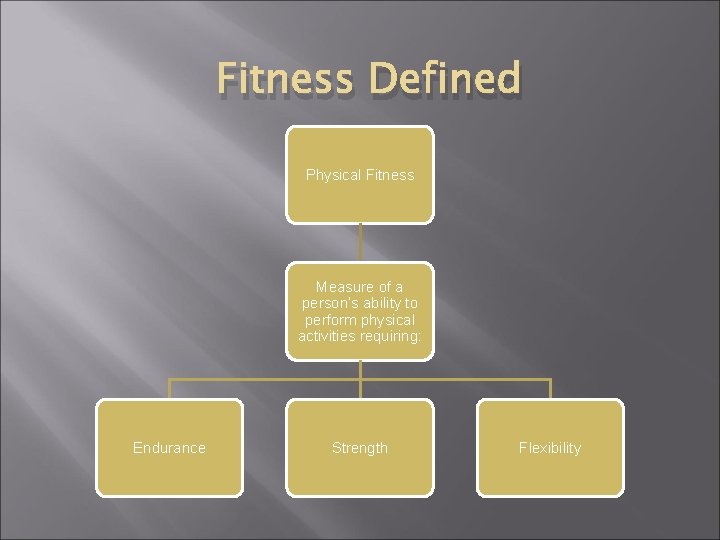
Fitness Defined Physical Fitness Measure of a person’s ability to perform physical activities requiring: Endurance Strength Flexibility
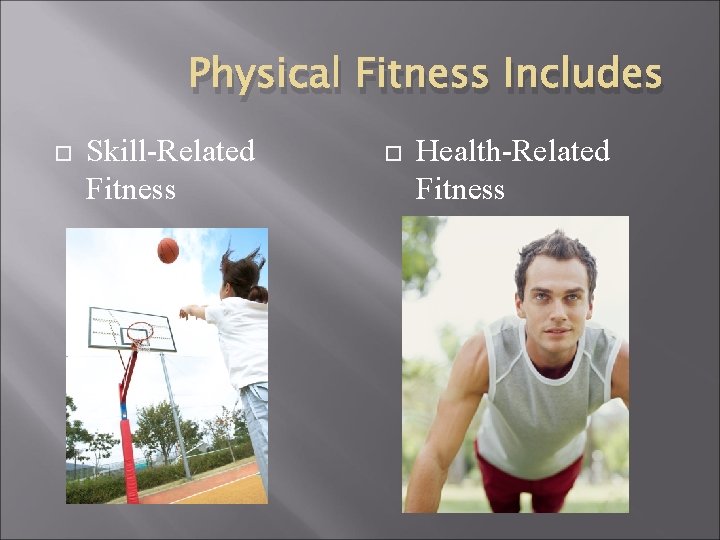
Physical Fitness Includes Skill-Related Fitness Health-Related Fitness
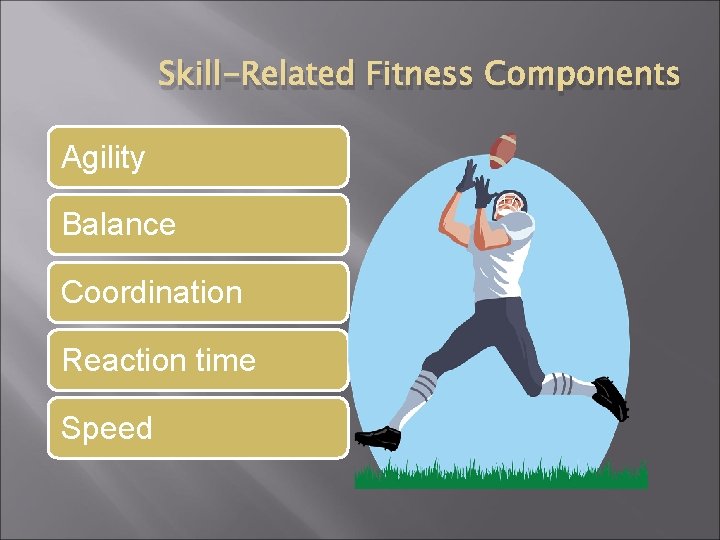
Skill-Related Fitness Components Agility Balance Coordination Reaction time Speed
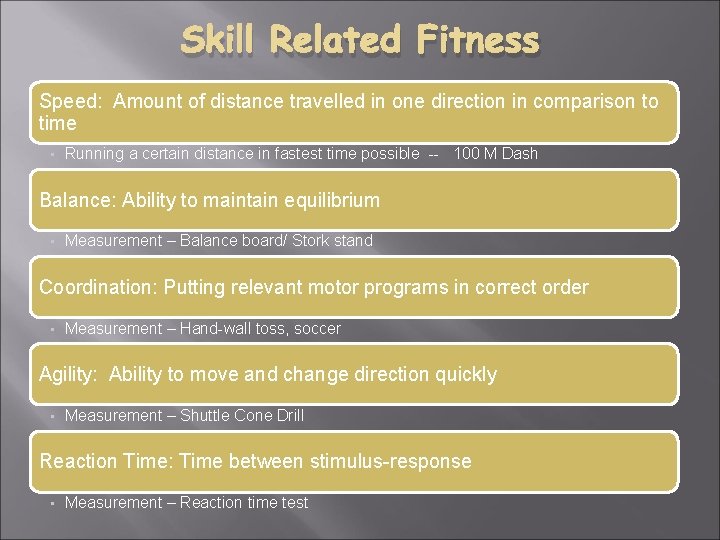
Skill Related Fitness Speed: Amount of distance travelled in one direction in comparison to time • Running a certain distance in fastest time possible -- 100 M Dash Balance: Ability to maintain equilibrium • Measurement – Balance board/ Stork stand Coordination: Putting relevant motor programs in correct order • Measurement – Hand-wall toss, soccer Agility: Ability to move and change direction quickly • Measurement – Shuttle Cone Drill Reaction Time: Time between stimulus-response • Measurement – Reaction time test
5 COMPONENTS OF HEALTHRELATED FITNESS 1. 2. 3. 4. 5. Muscular strength Muscular endurance Cardiovascular endurance Flexibility Body composition
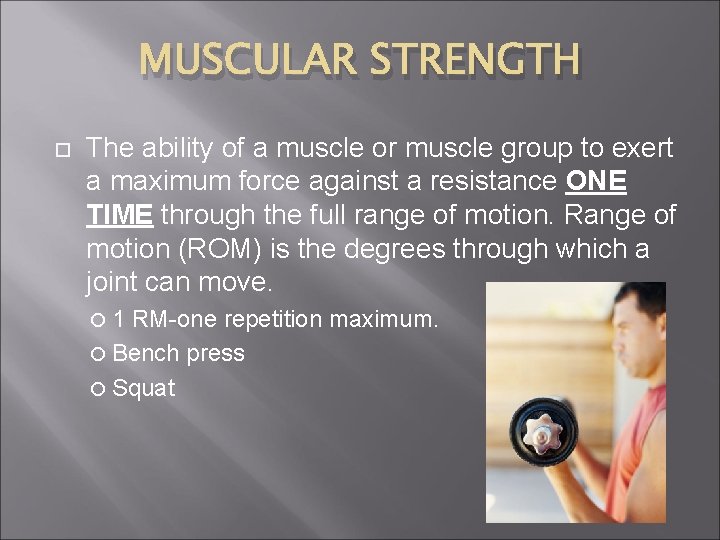
MUSCULAR STRENGTH The ability of a muscle or muscle group to exert a maximum force against a resistance ONE TIME through the full range of motion. Range of motion (ROM) is the degrees through which a joint can move. 1 RM-one repetition maximum. Bench press Squat
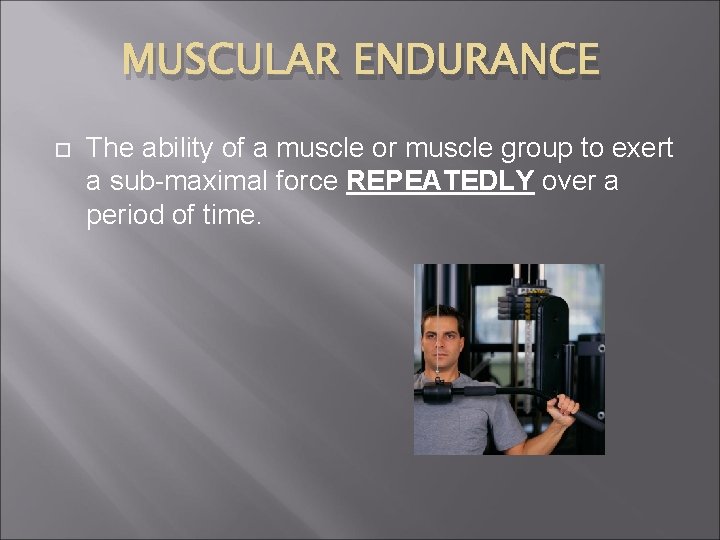
MUSCULAR ENDURANCE The ability of a muscle or muscle group to exert a sub-maximal force REPEATEDLY over a period of time.
Strength vs. Endurance To improve strength, lift heavier weights than you are used to. To improve muscle endurance, lift more times, not more weight.
CARDIOVASCULAR ENDURANCE The ability to perform large muscle moderate to high intensity exercise for PROLONGED PERIODS keeping your heart rate in the heart rate target zone: 220 - age x 70% to 85% The target heart rate zone for a 17 year old is 142 -173 beats per minute.
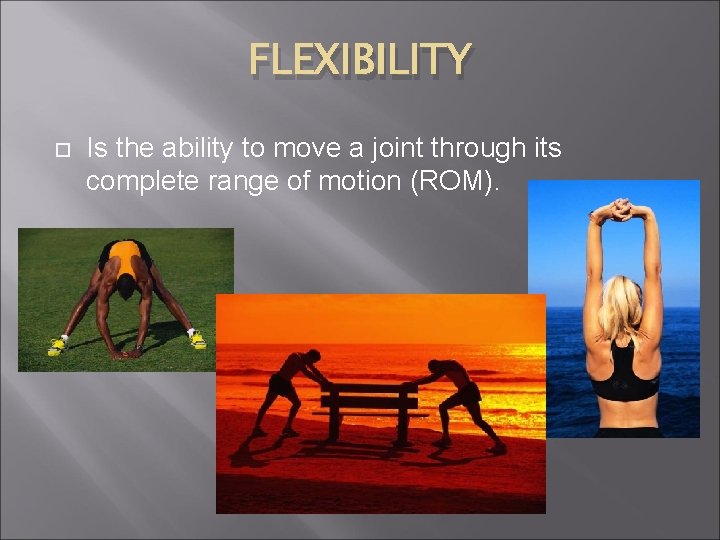
FLEXIBILITY Is the ability to move a joint through its complete range of motion (ROM).
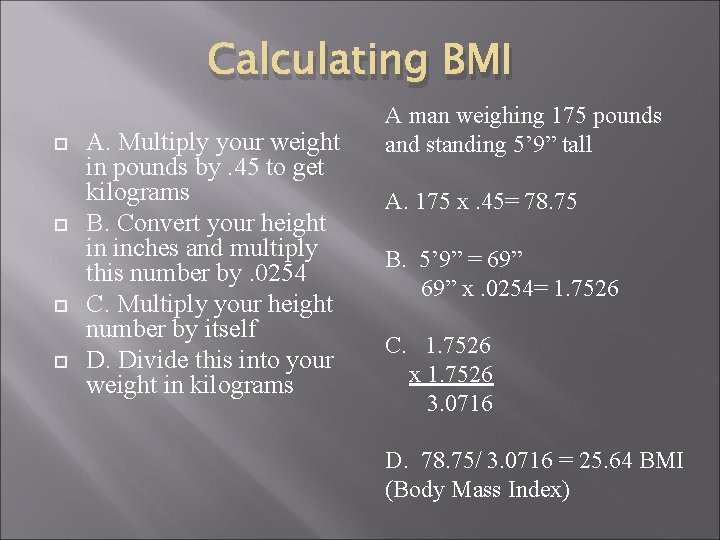
BODY COMPOSITION Is the amount of lean body mass (bone, muscle, organs and body fluids) compared with the amount of body fat. ADULT MALE 15%-18% ADULT FEMALE 22%-25% BMI = Body Mass Index It is an indirect measure of body composition based on height and weight.
Calculating BMI A. Multiply your weight in pounds by. 45 to get kilograms B. Convert your height in inches and multiply this number by. 0254 C. Multiply your height number by itself D. Divide this into your weight in kilograms A man weighing 175 pounds and standing 5’ 9” tall A. 175 x. 45= 78. 75 B. 5’ 9” = 69” x. 0254= 1. 7526 C. 1. 7526 x 1. 7526 3. 0716 D. 78. 75/ 3. 0716 = 25. 64 BMI (Body Mass Index)
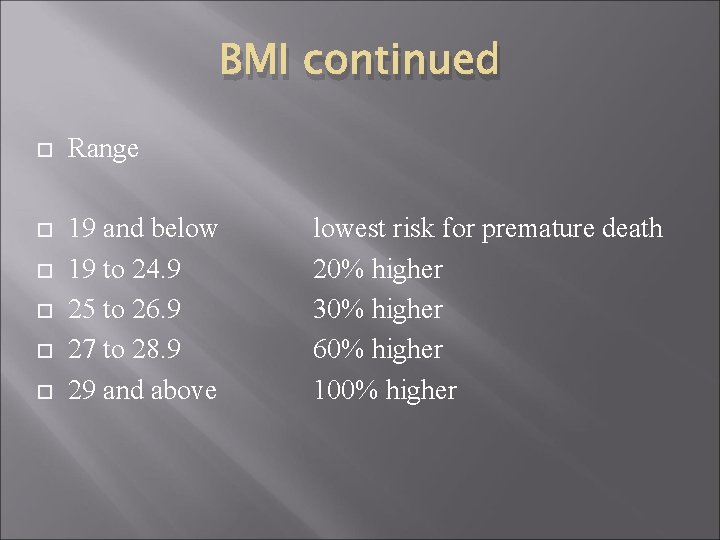
BMI continued Range 19 and below 19 to 24. 9 25 to 26. 9 27 to 28. 9 29 and above lowest risk for premature death 20% higher 30% higher 60% higher 100% higher
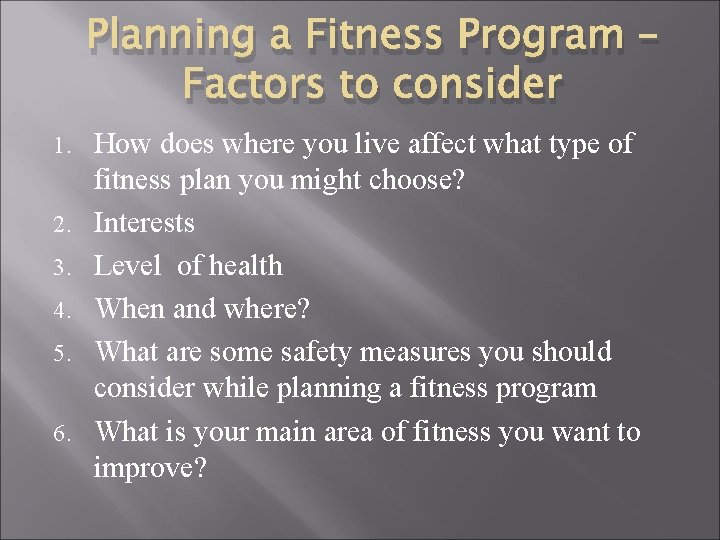
Planning a Fitness Program – Factors to consider 1. 2. 3. 4. 5. 6. How does where you live affect what type of fitness plan you might choose? Interests Level of health When and where? What are some safety measures you should consider while planning a fitness program What is your main area of fitness you want to improve?
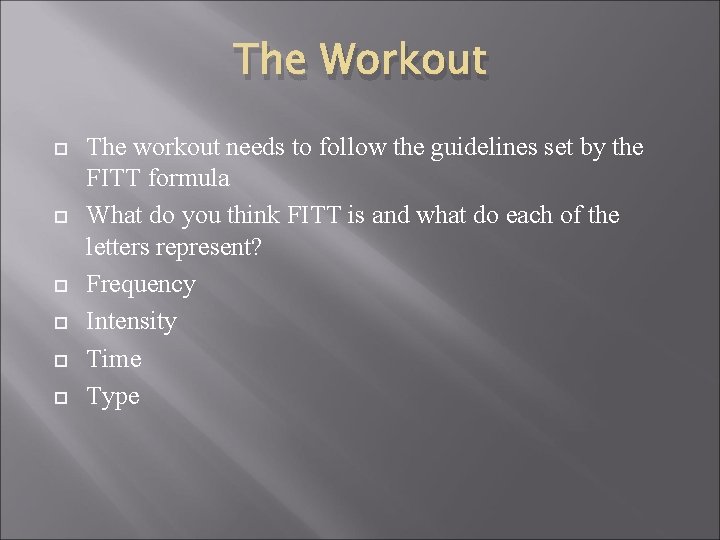
The Workout The workout needs to follow the guidelines set by the FITT formula What do you think FITT is and what do each of the letters represent? Frequency Intensity Time Type
Frequency How often you will exercise? After any form of exercise is performed your body completes a process of rebuilding and repairing. Determining the frequency of exercise is important in order to find a balance that provides just enough stress for the body to adapt and also allows enough rest time for healing. (Principle of Reversibility and Adaptation)
Intensity Maintain your heart rate in the Target Heart Rate Zone is determined by your fitness level and your age. Low fitness individuals will attain results training at 50% to 70% of their maximum heart rate as their Target Heart Rate Zone. Higher fitness individuals will train at 70% to 85% of their maximum heart rate as their Target Heart Rate Zone. 220 - 40 = 180 beats per minute (Maximum Heart Rate) A Low Fitness Person’s target heart rate would be 90 to 126. They should keep their heart rate between 90 and 126 beats per minute for the required time of the exercise. A Higher Fitness Person’s target heart rate would be 126 to 162. They should keep their heart rate between 126 to 162 beats per minute for the required time of the exercise. Is the only way to measure intensity in a workout?
Knowing your heart rate is important for three reasons: 1. It assures you are training at the right intensity to gain benefit from the exercise. 2. It also assures you are exercising at a safe intensity. 3. It can tell you the amount of time you exercised in your target heart rate zone.
Type What type of exercise will you be doing? Will an exercise session be primarily cardiovascular, resistance training or a combination of both?
Time How long will each individual session last? This will vary based on two other factors – what are they? intensity and type How does target heart rate factor into this area?
Basics of an Exercise Program Overload Progression Specificity
OVERLOAD PRINCIPLE States that a body system must perform at a level beyond normal in order to adapt and improve physiological function and fitness.
PROGRESSION A gradual increase in the level of exercise that is manipulated by increasing frequency, intensity, or time, or a combination of all three components. Should all three areas mentioned above be changed or increased at the same time? Can you increase two areas at the same time?
SPECIFICITY Particular exercises and activities improve particular areas of health-related fitness. Think of three examples and write them down in your notes.
Principles of Exercise Adaptation body adapts to exercise level. Principle of Reversibility use/disuse-use it or lose it-2 weeks Principle of Overuse overdo causing chronic injuries or undue fatigue
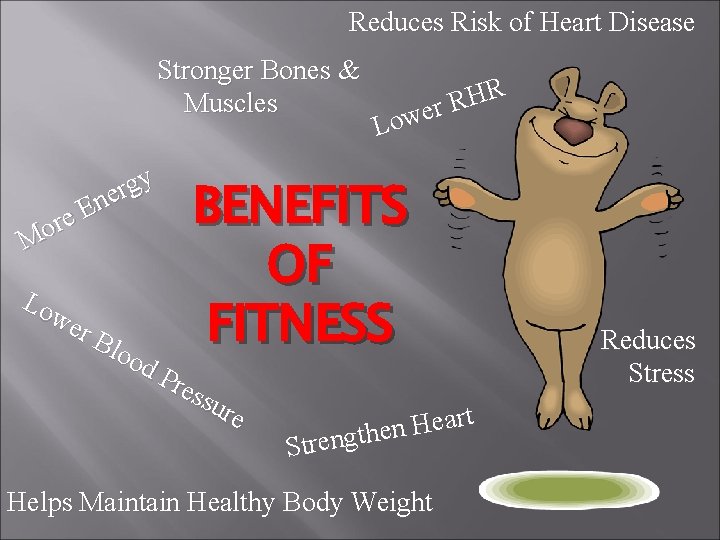
Reduces Risk of Heart Disease Stronger Bones & Muscles re o M y g r e En R H R er w o L BENEFITS OF FITNESS Lo we r. B loo d. P res sur e t r a e H n he t g n e r t S Helps Maintain Healthy Body Weight Reduces Stress