
Health Technology Assessment and Rare Disease Justice Leads
- Slides: 40
Health Technology Assessment and Rare Disease Justice Leads to Access Albert Farrugia Vice President Global Access PPTA www. pptaglobal. org
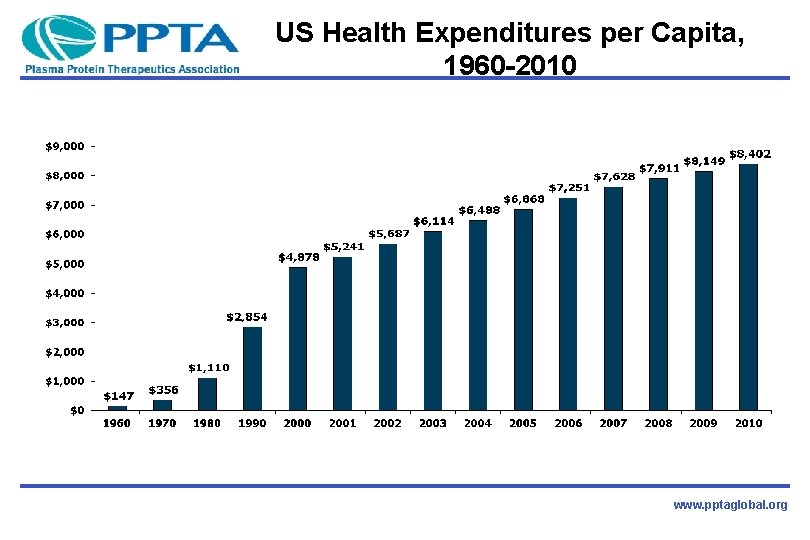
US Health Expenditures per Capita, 1960 -2010 www. pptaglobal. org
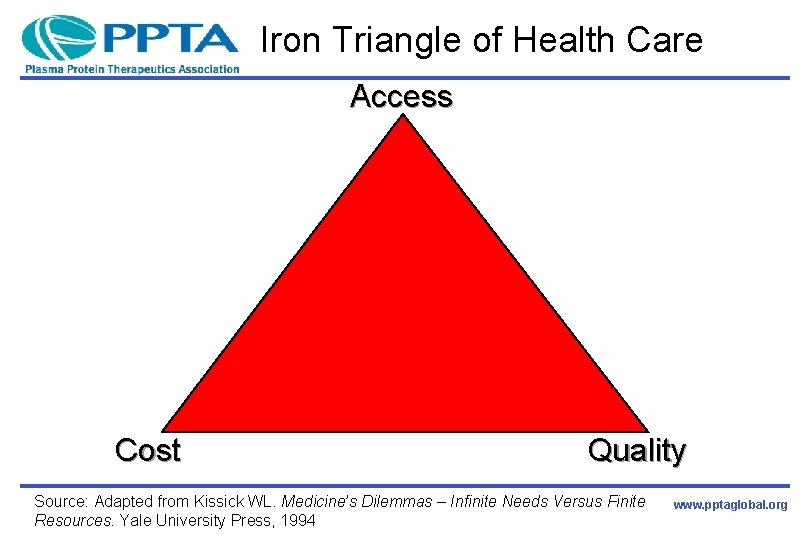
Iron Triangle of Health Care Access Cost Quality Source: Adapted from Kissick WL. Medicine’s Dilemmas – Infinite Needs Versus Finite Resources. Yale University Press, 1994 www. pptaglobal. org
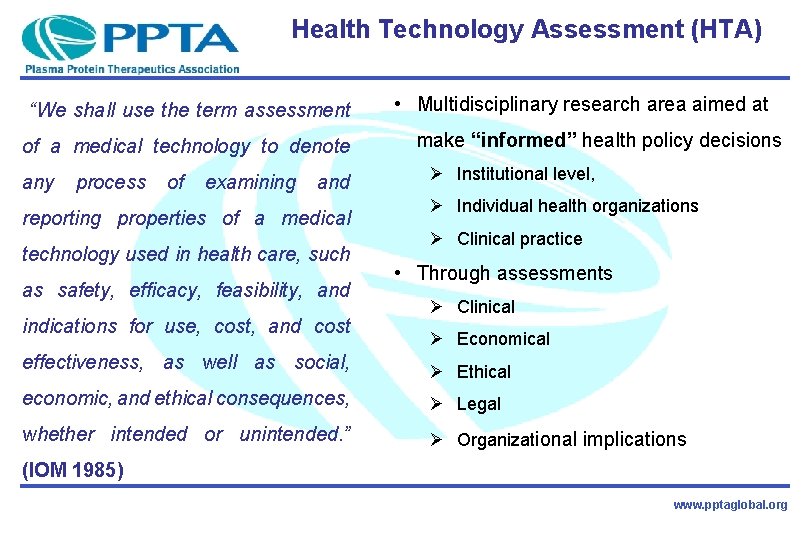
Health Technology Assessment (HTA) “We shall use the term assessment of a medical technology to denote any process of examining and reporting properties of a medical technology used in health care, such as safety, efficacy, feasibility, and indications for use, cost, and cost • Multidisciplinary research area aimed at make “informed” health policy decisions Ø Institutional level, Ø Individual health organizations Ø Clinical practice • Through assessments Ø Clinical Ø Economical effectiveness, as well as social, Ø Ethical economic, and ethical consequences, Ø Legal whether intended or unintended. ” Ø Organizational implications (IOM 1985) www. pptaglobal. org
Health Technology Assessment (HTA) • The goal of HTA is to inform the development of safe and effective health policies that are patient focused and seek to achieve best value as defined by decision makers. • HTA underpins decisions such as: • Should treatment A be reimbursed in a national healthcare system? • For which patients should it be provided? • For how long should patients receive the treatment? www. pptaglobal. org
Health Technology Assessment (HTA) • Although the scientific assessment of the available data may be similar, the way in which a technology is appraised (that is, how the assessment is used to devise recommendations on its value in healthcare) may vary from country to country. • As a result, different decisions are taken about which technologies should be provided, leading to variation in access to treatments. • In socialized systems – cost effectiveness analysis (but increasingly applied by insurers etc) • In USA, comparative effectiveness research (CER) and patient centered outcomes research (PCOR) www. pptaglobal. org
Choices and decision making in medical care • • Evidence – RCTs – Systematic reviews Cost effectiveness – Total medical costs – Role of Decision Analysis www. pptaglobal. org
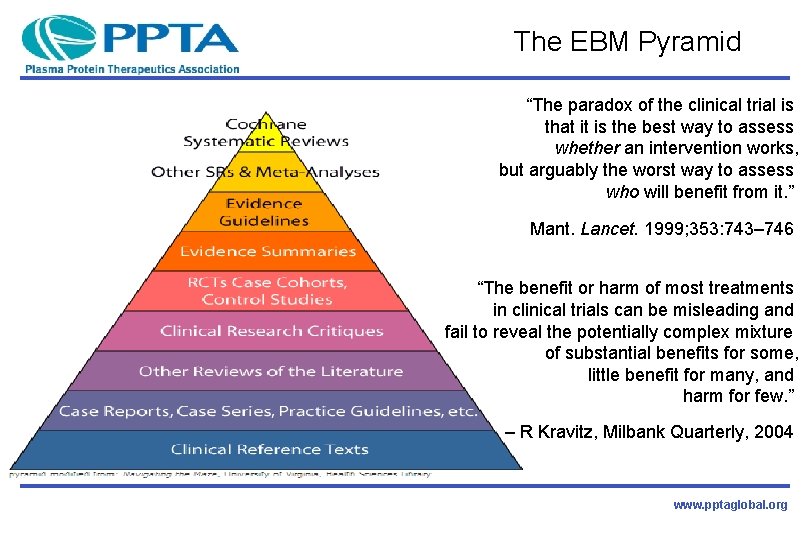
The EBM Pyramid “The paradox of the clinical trial is that it is the best way to assess whether an intervention works, but arguably the worst way to assess who will benefit from it. ” Mant. Lancet. 1999; 353: 743– 746 “The benefit or harm of most treatments in clinical trials can be misleading and fail to reveal the potentially complex mixture of substantial benefits for some, little benefit for many, and harm for few. ” – R Kravitz, Milbank Quarterly, 2004 www. pptaglobal. org
Why is HTA important for patients? • HTA can provide information to support a range of decisions, for example: • Health authorities thinking of putting in place primary or secondary prevention programmes, such as screening programmes; • Health care payers deciding which technologies (e. g. , operations, drugs) should be paid for; • Health care organisations deciding whether to exclude or implement new technologies such as modern types of radiotherapy; • Health care companies producing new products that may need to demonstrate a level of benefit for the product to justify thewww. pptaglobal. org cost.
Societal Perspective? • “The principal objective of the National Health Service ought to be to maximize the aggregate improvement in the health status of the whole community. ” Anthony J. Culyer (1997) • “The underlying premise of CEA in health problems is that for any given level of resources available, society (or the decisionmaking jurisdiction involved) wishes to maximize the total aggregate health benefit conferred. ” 3 M. C. Weinstein and W. B. Stason (1977) www. pptaglobal. org
In praise of “There are three criteria which must be fulfilled if a medicine should be reimbursed: • The human value principle; which underlines the respect for equality of all human beings and the integrity of every individual. • The need and solidarity principle; which says that those in greatest need take precedence when it comes to reimbursing pharmaceuticals. In other words, people with more severe diseases are prioritised over people with less severe conditions. • The cost-effectiveness principle; which states that the cost for using a medicine should be reasonable from a medical, humanitarian and social-economic perspective. ” www. pptaglobal. org Swedish Pharmaceutical Benefits Board 2007
HTA for PPTs and rare diseases • Nothing to fear • Use ALL the evidence • Reject dogma • Involve patients www. pptaglobal. org
Cost-Effectiveness Analysis • Health outcomes are expressed as quality-adjusted life-years (QALYs) • The QALY is defined as a Year in Perfect Health • The QALY is estimated from • – The Benefit from a treatment – The Time during which the benefit occurs (for chronic disorders this is Life) The cost of a QALY is then estimated www. pptaglobal. org
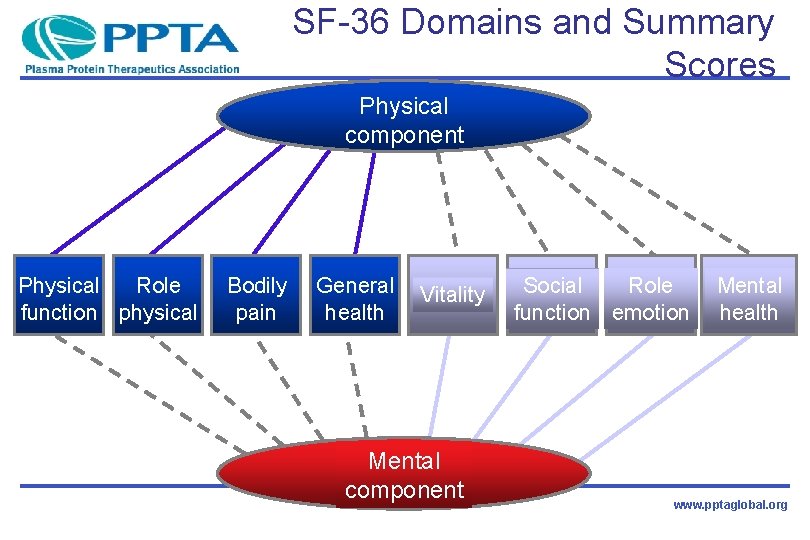
Quality of Life • HTA includes health related quality of life (Qo. L) • All aspects of health that are directly experienced by the person • physical functioning, • social and role functioning, • mental health, • general health perceptions. www. pptaglobal. org
Patients are CRUCIAL in HTA • Qo. L used to estimate the Quality Adjusted Life Year (QALY) • Obtaining the cost of QALYs is what HTA is about • To estimate Qo. L – We need patient input www. pptaglobal. org
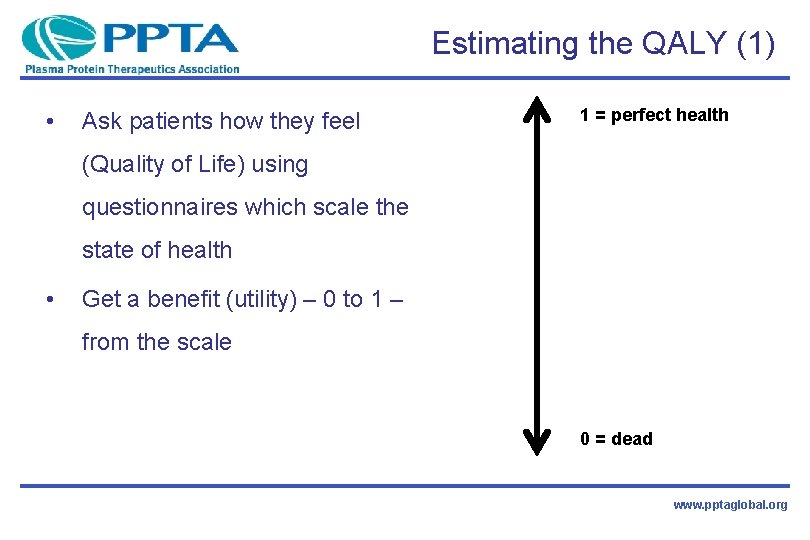
Estimating the QALY (1) • Ask patients how they feel 1 = perfect health (Quality of Life) using questionnaires which scale the state of health • Get a benefit (utility) – 0 to 1 – from the scale 0 = dead www. pptaglobal. org
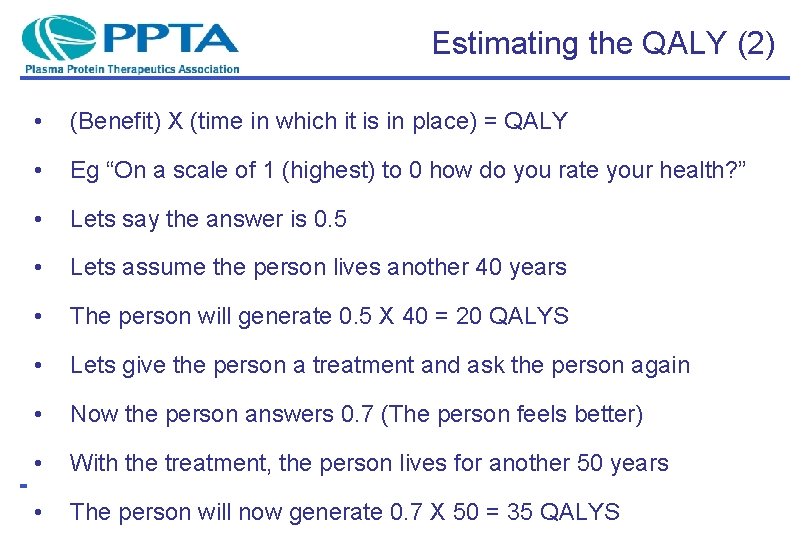
Estimating the QALY (2) • (Benefit) X (time in which it is in place) = QALY • Eg “On a scale of 1 (highest) to 0 how do you rate your health? ” • Lets say the answer is 0. 5 • Lets assume the person lives another 40 years • The person will generate 0. 5 X 40 = 20 QALYS • Lets give the person a treatment and ask the person again • Now the person answers 0. 7 (The person feels better) • With the treatment, the person lives for another 50 years • The person will now generate 0. 7 X 50 = 35 QALYS www. pptaglobal. org
Why is the QALY important? • Estimating the number of QALYs is what is done in HTA • In CER, QALYs are compared • Interventions which yield more QALYs are favored (hopefully) www. pptaglobal. org
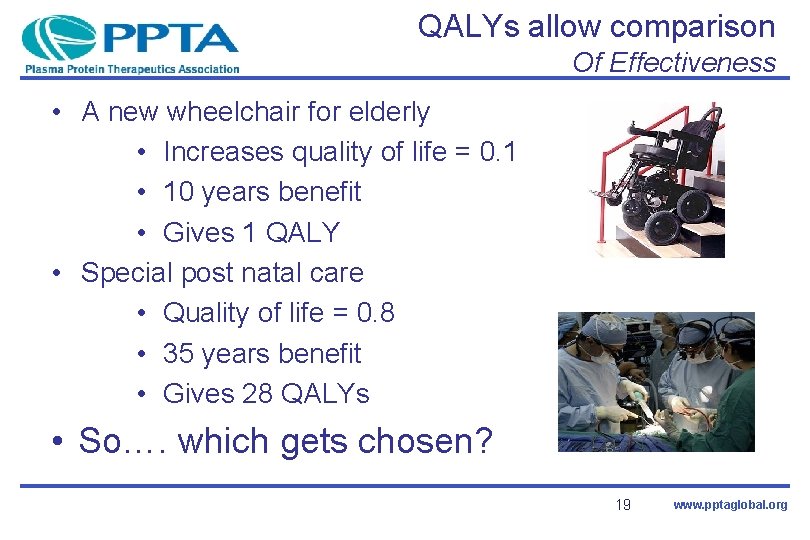
QALYs allow comparison Of Effectiveness • A new wheelchair for elderly • Increases quality of life = 0. 1 • 10 years benefit • Gives 1 QALY • Special post natal care • Quality of life = 0. 8 • 35 years benefit • Gives 28 QALYs • So…. which gets chosen? 19 www. pptaglobal. org
Why is the QALY important? • Estimating the number of QALYs is what is done in HTA • In CEA, the COST/QALY is used to rank health interventions www. pptaglobal. org
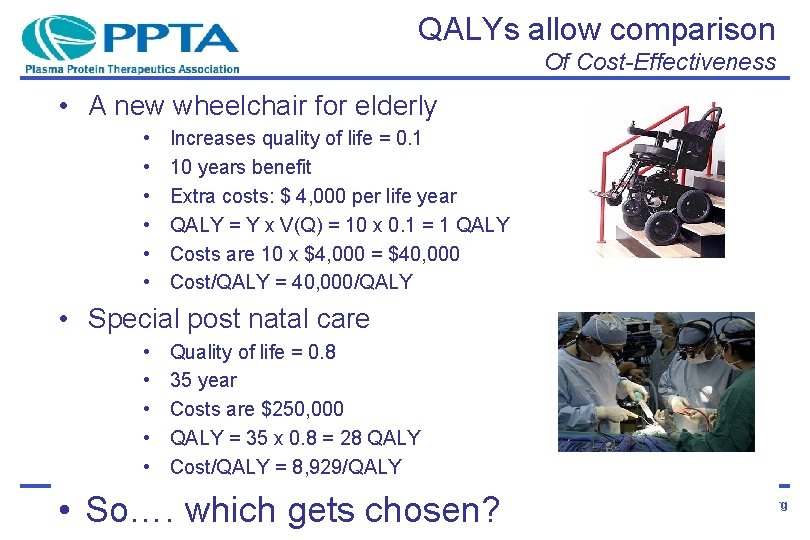
QALYs allow comparison Of Cost-Effectiveness • A new wheelchair for elderly • • • Increases quality of life = 0. 1 10 years benefit Extra costs: $ 4, 000 per life year QALY = Y x V(Q) = 10 x 0. 1 = 1 QALY Costs are 10 x $4, 000 = $40, 000 Cost/QALY = 40, 000/QALY • Special post natal care • • • Quality of life = 0. 8 35 year Costs are $250, 000 QALY = 35 x 0. 8 = 28 QALY Cost/QALY = 8, 929/QALY • So…. which gets chosen? www. pptaglobal. org
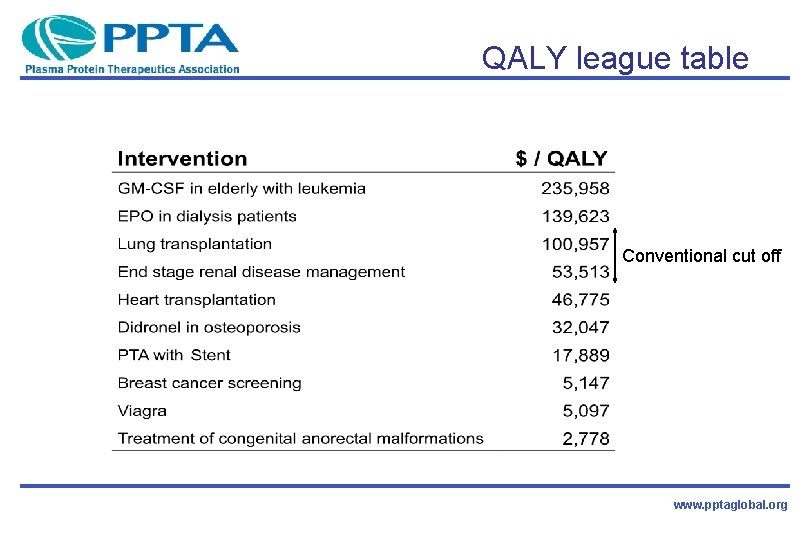
QALY league table Conventional cut off www. pptaglobal. org
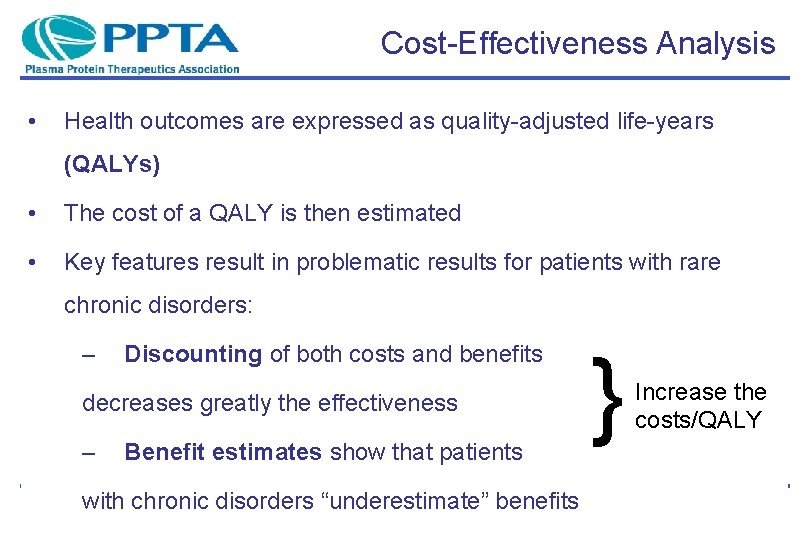
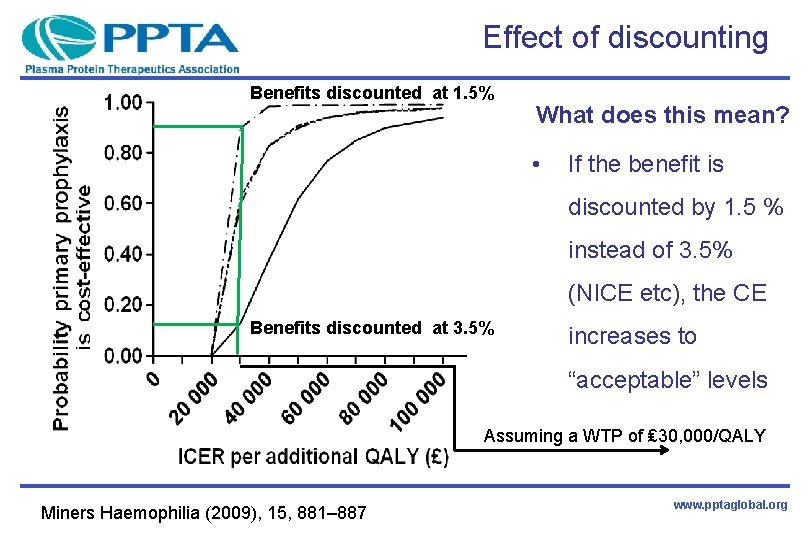
Cost-Effectiveness Analysis • Health outcomes are expressed as quality-adjusted life-years (QALYs) • The cost of a QALY is then estimated • Key features result in problematic results for patients with rare chronic disorders: – Discounting of both costs and benefits decreases greatly the effectiveness – Benefit estimates show that patients with chronic disorders “underestimate” benefits } Increase the costs/QALY www. pptaglobal. org
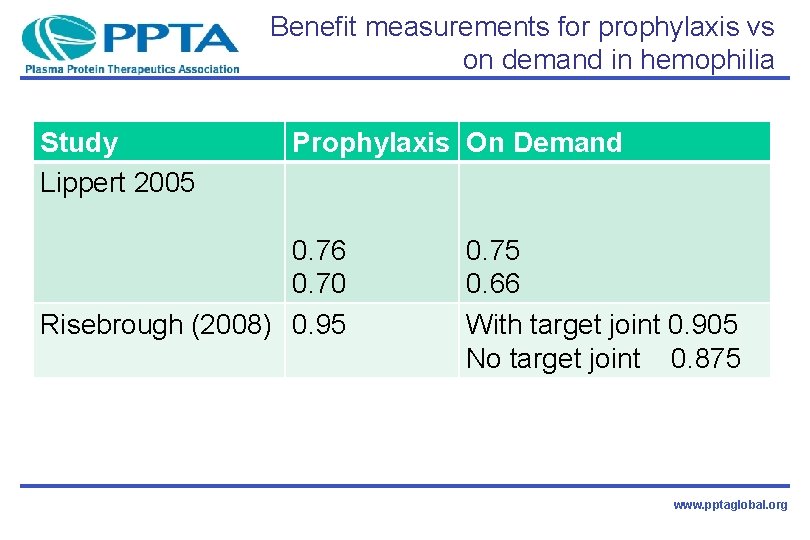
Benefit measurements for prophylaxis vs on demand in hemophilia Study Lippert 2005 Prophylaxis On Demand 0. 76 0. 70 Risebrough (2008) 0. 95 0. 75 0. 66 With target joint 0. 905 No target joint 0. 875 www. pptaglobal. org
SF-36 Domains and Summary Scores Physical component Physical Role function physical Bodily pain General health Vitality Mental component Social Role function emotion Mental health www. pptaglobal. org
Effect of discounting Benefits discounted at 1. 5% What does this mean? • If the benefit is discounted by 1. 5 % instead of 3. 5% (NICE etc), the CE Benefits discounted at 3. 5% increases to “acceptable” levels Assuming a WTP of ₤ 30, 000/QALY Miners Haemophilia (2009), 15, 881– 887 www. pptaglobal. org
How things can go wrong An example with 1 AT Augmentation www. pptaglobal. org
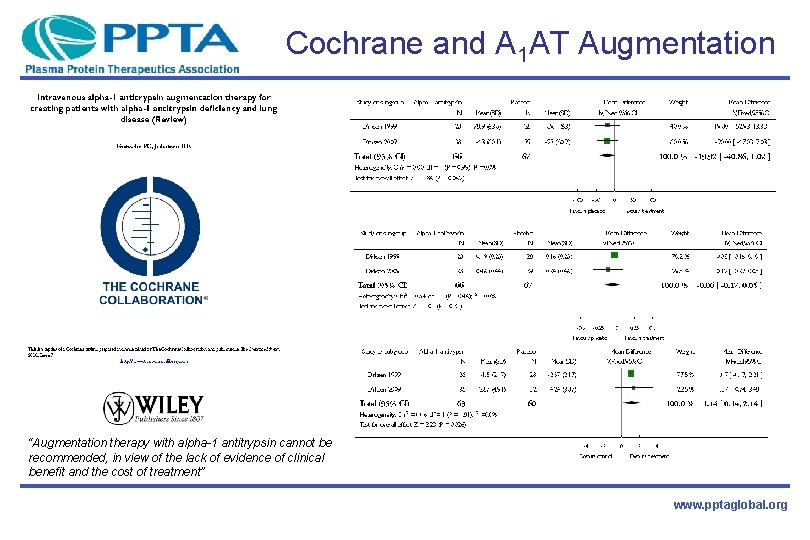
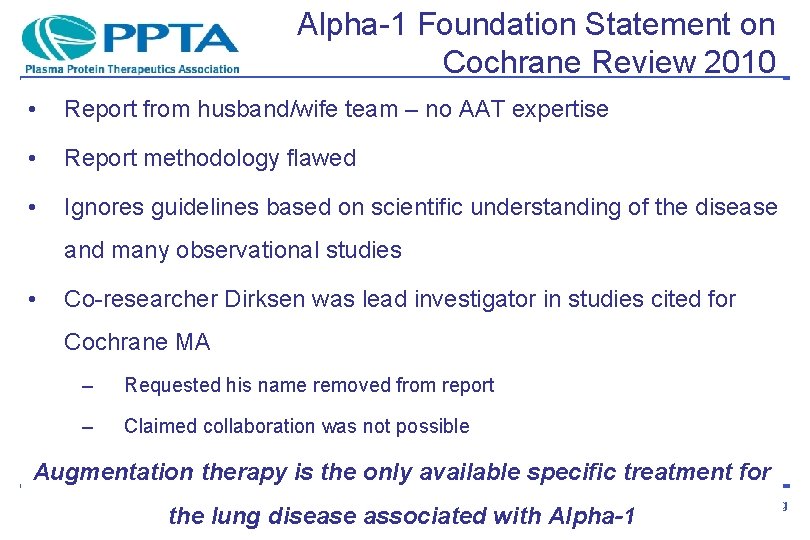
Cochrane and A 1 AT Augmentation “Augmentation therapy with alpha-1 antitrypsin cannot be recommended, in view of the lack of evidence of clinical benefit and the cost of treatment” www. pptaglobal. org
Alpha-1 Foundation Statement on Cochrane Review 2010 • Report from husband/wife team – no AAT expertise • Report methodology flawed • Ignores guidelines based on scientific understanding of the disease and many observational studies • Co-researcher Dirksen was lead investigator in studies cited for Cochrane MA – Requested his name removed from report – Claimed collaboration was not possible Augmentation therapy is the only available specific treatment for the lung disease associated with Alpha-1 www. pptaglobal. org
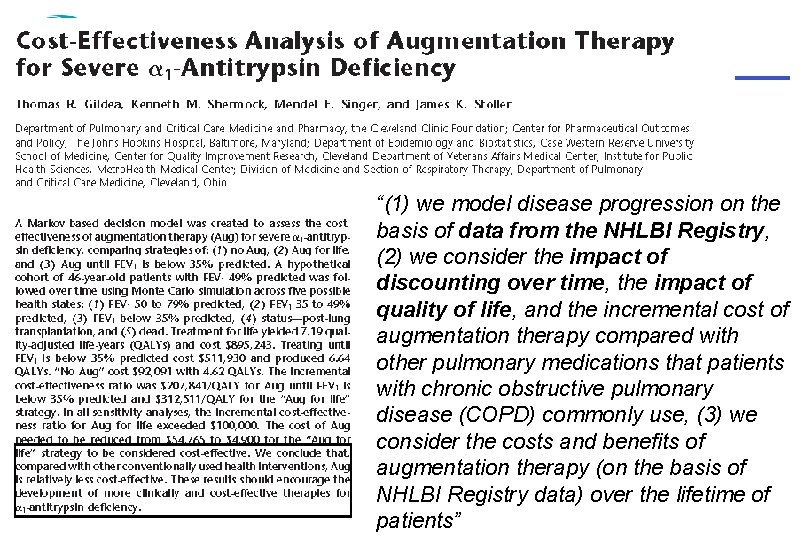
“(1) we model disease progression on the basis of data from the NHLBI Registry, (2) we consider the impact of discounting over time, the impact of quality of life, and the incremental cost of augmentation therapy compared with other pulmonary medications that patients with chronic obstructive pulmonary disease (COPD) commonly use, (3) we consider the costs and benefits of augmentation therapy (on the basis of NHLBI Registry data) over the www. pptaglobal. org lifetime of patients”
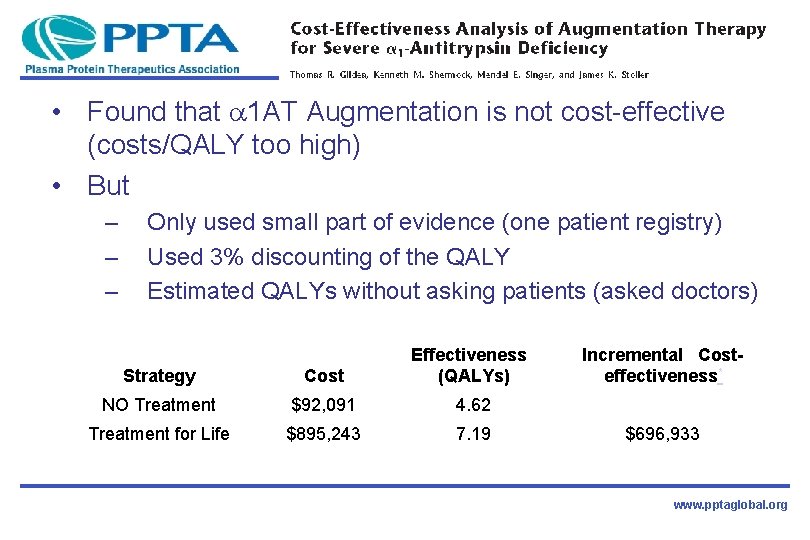
• Found that 1 AT Augmentation is not cost-effective (costs/QALY too high) • But – – – Only used small part of evidence (one patient registry) Used 3% discounting of the QALY Estimated QALYs without asking patients (asked doctors) Strategy Cost Effectiveness (QALYs) NO Treatment $92, 091 4. 62 Treatment for Life $895, 243 7. 19 Incremental Costeffectiveness* $696, 933 www. pptaglobal. org
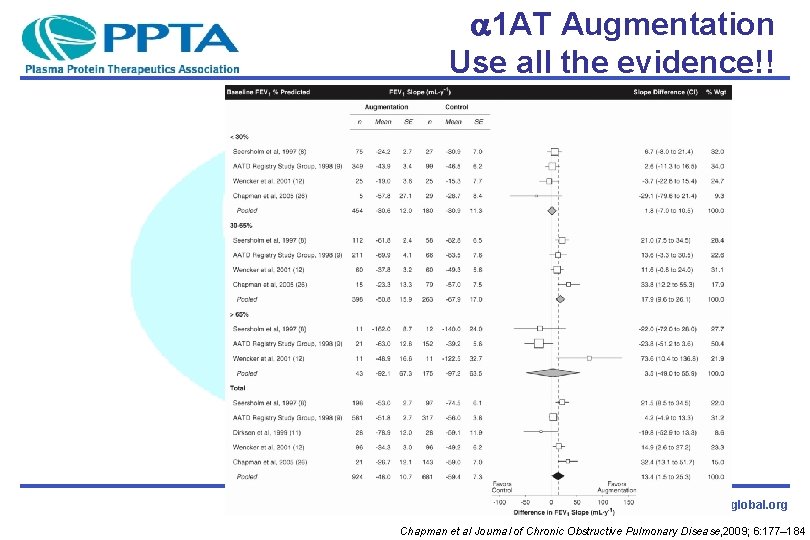
1 AT Augmentation Use all the evidence!! www. pptaglobal. org Chapman et al Journal of Chronic Obstructive Pulmonary Disease, 2009; 6: 177– 184
Making things right Prophylaxis for life in hemophilia A www. pptaglobal. org
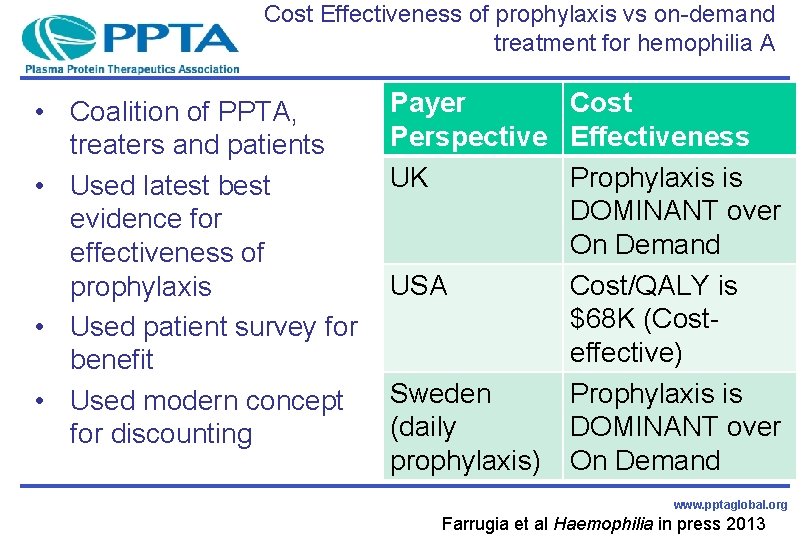
Cost Effectiveness of prophylaxis vs on-demand treatment for hemophilia A • Coalition of PPTA, treaters and patients • Used latest best evidence for effectiveness of prophylaxis • Used patient survey for benefit • Used modern concept for discounting Payer Cost Perspective Effectiveness UK Prophylaxis is DOMINANT over On Demand USA Cost/QALY is $68 K (Costeffective) Sweden Prophylaxis is (daily DOMINANT over prophylaxis) On Demand www. pptaglobal. org Farrugia et al Haemophilia in press 2013
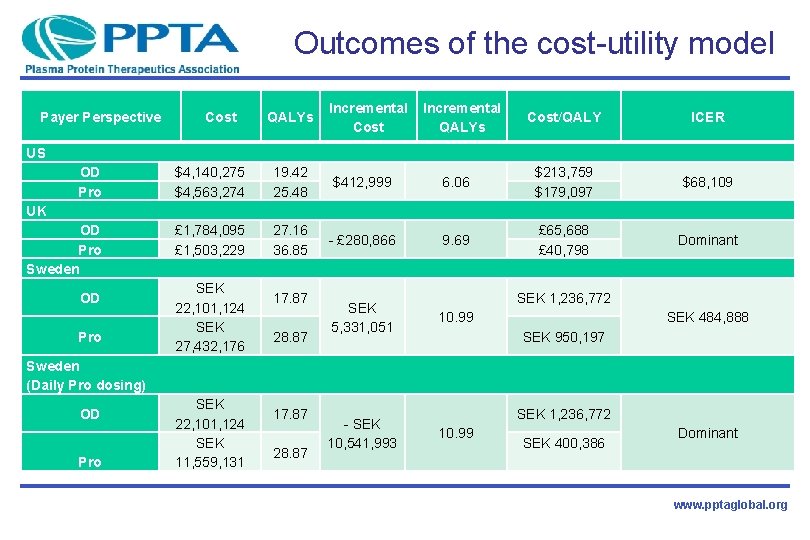
Outcomes of the cost-utility model Payer Perspective Cost QALYs Incremental Cost Incremental QALYs Cost/QALY ICER US OD Pro $4, 140, 275 $4, 563, 274 19. 42 25. 48 $412, 999 6. 06 $213, 759 $179, 097 $68, 109 OD Pro Sweden £ 1, 784, 095 £ 1, 503, 229 27. 16 36. 85 - £ 280, 866 9. 69 £ 65, 688 £ 40, 798 Dominant UK OD Pro SEK 22, 101, 124 SEK 27, 432, 176 17. 87 28. 87 SEK 5, 331, 051 SEK 1, 236, 772 10. 99 SEK 484, 888 SEK 950, 197 Sweden (Daily Pro dosing) OD Pro SEK 22, 101, 124 SEK 11, 559, 131 17. 87 28. 87 - SEK 10, 541, 993 SEK 1, 236, 772 10. 99 SEK 400, 386 Dominant www. pptaglobal. org
www. pptaglobal. org
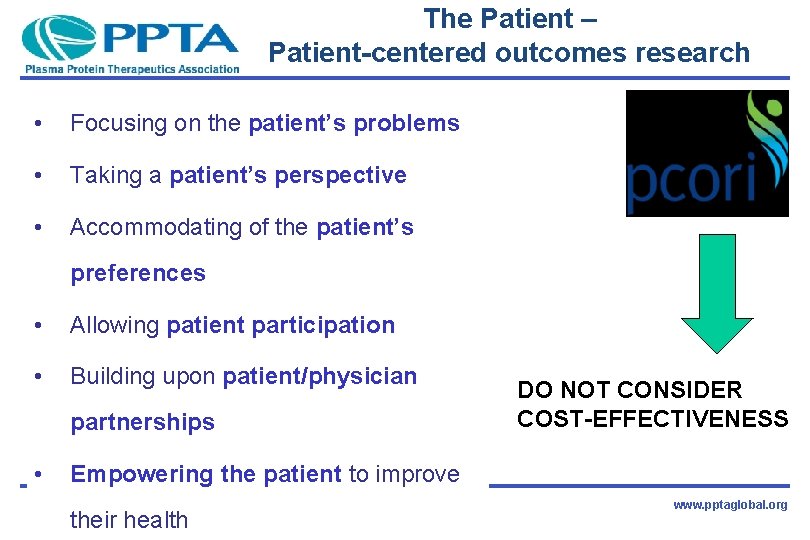
The Patient – Patient-centered outcomes research • Focusing on the patient’s problems • Taking a patient’s perspective • Accommodating of the patient’s preferences • Allowing patient participation • Building upon patient/physician partnerships • DO NOT CONSIDER COST-EFFECTIVENESS Empowering the patient to improve their health www. pptaglobal. org
In continued praise of Sometimes the good effects of a medicine are so great they easily compensate for all costs. Then the treatment is considered as cost saving. But we do not make such high demands in order to consider if the use of a medicine is cost-effective. That people get well, do not experience pain and can live a more normal life through using a medicine is important enough for society to be willing to pay for it. www. pptaglobal. org
Conclusion Ø HTA is here to stay Ø ‘Nothing about us without us’ Ø Find ways to contribute Ø Remember ‘distress is not enough’ Ø Patient involvement means a two way process Ø We need PATIENTS to influence QOL data www. pptaglobal. org
“and there shall be no more death, neither sorrow, nor crying, neither shall there be any more pain: for the former things are passed away” Revelations Ch 21 www. pptaglobal. org