
Health systems requirements for viral hepatitis elimination Are

- Slides: 30
Health systems requirements for viral hepatitis elimination: Are we 'Flying Blind' in our efforts? Prof Jeffrey V. Lazarus [Jeffrey. Lazarus@isglobal. org] CHIP, Rigshospitalet, University of Copenhagen, WHO Collaborating Centre on HIV and Viral Hepatitis Associate Researcher, ISGlobal, Hospital Clínic, University of Barcelona 1 - Lisbon Addictions 2017 @JVLazarus
Disclosures • Grants and personal fees from Abb. Vie, Gilead Sciences, MSD – not for today’s event • Research grants from non-governmental organisations including the European Liver Patients Association and the World Hepatitis Alliance • Previously employed by international agencies: Global Fund, World Health Organization 2 - Lisbon Addictions 2017 @JVLazarus
A question to ponder… Translating good biomedical tools into good health outcomes for people who inject drugs living with hepatitis C – what will it take? 3 - Lisbon Addictions 2017 @JVLazarus
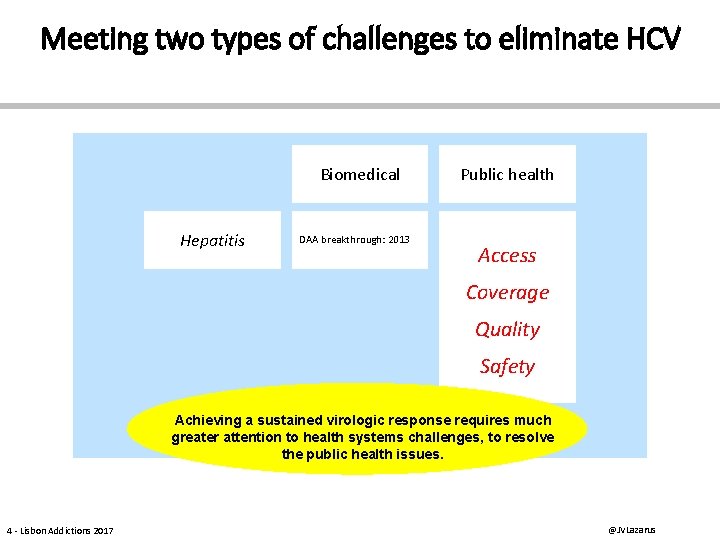
Meeting two types of challenges to eliminate HCV Biomedical Hepatitis DAA breakthrough: 2013 Public health Access Coverage Quality Safety Achieving a sustained virologic response requires much greater attention to health systems challenges, to resolve the public health issues. 4 - Lisbon Addictions 2017 @JVLazarus
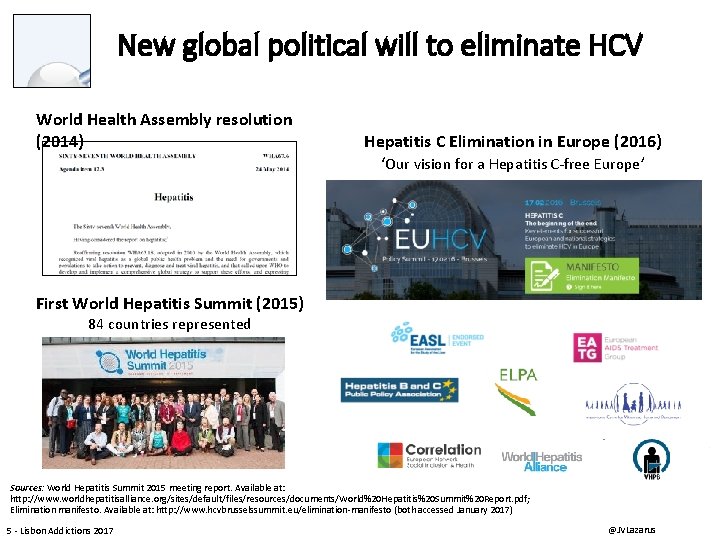
New global political will to eliminate HCV World Health Assembly resolution (2014) Hepatitis C Elimination in Europe (2016) ‘Our vision for a Hepatitis C-free Europe’ First World Hepatitis Summit (2015) 84 countries represented Sources: World Hepatitis Summit 2015 meeting report. Available at: http: //www. worldhepatitisalliance. org/sites/default/files/resources/documents/World%20 Hepatitis%20 Summit%20 Report. pdf; Elimination manifesto. Available at: http: //www. hcvbrusselssummit. eu/elimination-manifesto (both accessed January 2017) 5 - Lisbon Addictions 2017 @JVLazarus
WHO Global Health Sector Strategy on Viral Hepatitis 2016– 2021 28 May 2016: The first of its kind, WHO publishes a global strategy aiming for elimination of viral hepatitis as a public health threat by 2030 Source: WHO Global Health Sector Strategy on viral hepatitis. Available at: http: //apps. who. int/gb/ebwha/pdf_files/WHA 69/A 69_32 -en. pdf? ua=1 (Accessed August 2016) 6 - Lisbon Addictions 2017 @JVLazarus
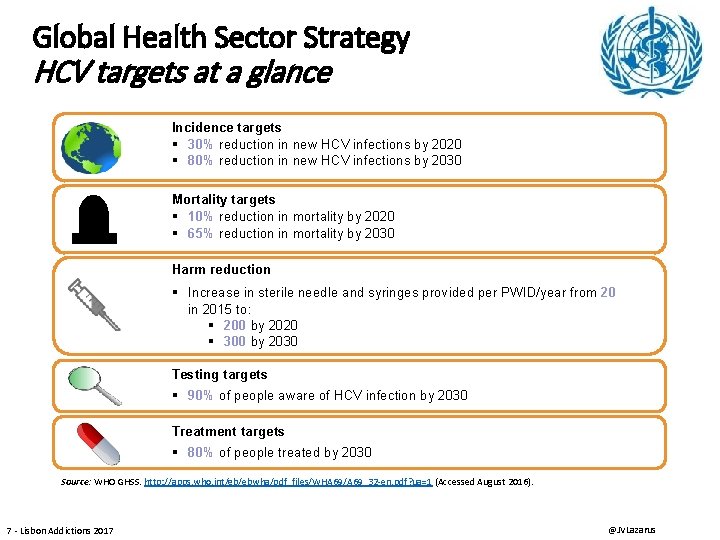
Global Health Sector Strategy HCV targets at a glance Incidence targets § 30% reduction in new HCV infections by 2020 § 80% reduction in new HCV infections by 2030 Mortality targets § 10% reduction in mortality by 2020 § 65% reduction in mortality by 2030 Harm reduction § Increase in sterile needle and syringes provided per PWID/year from 20 in 2015 to: § 200 by 2020 § 300 by 2030 Testing targets § 90% of people aware of HCV infection by 2030 Treatment targets § 80% of people treated by 2030 Source: WHO GHSS. http: //apps. who. int/gb/ebwha/pdf_files/WHA 69/A 69_32 -en. pdf? ua=1 (Accessed August 2016). 7 - Lisbon Addictions 2017 @JVLazarus
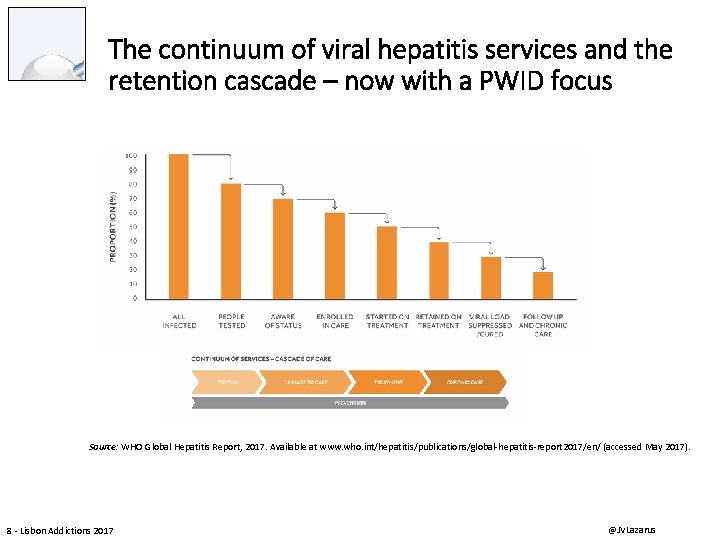
The continuum of viral hepatitis services and the retention cascade – now with a PWID focus Source: WHO Global Hepatitis Report, 2017. Available at www. who. int/hepatitis/publications/global-hepatitis-report 2017/en/ (accessed May 2017). 8 - Lisbon Addictions 2017 @JVLazarus
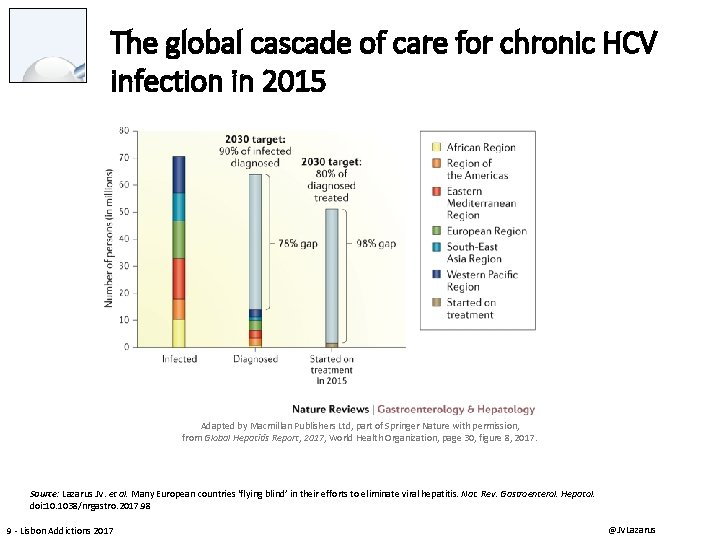
The global cascade of care for chronic HCV infection in 2015 Adapted by Macmillan Publishers Ltd, part of Springer Nature with permission, from Global Hepatitis Report, 2017, World Health Organization, page 30, figure 8, 2017. Source: Lazarus JV. et al. Many European countries ‘flying blind’ in their efforts to eliminate viral hepatitis. Nat. Rev. Gastroenterol. Hepatol. doi: 10. 1038/nrgastro. 2017. 98 9 - Lisbon Addictions 2017 @JVLazarus
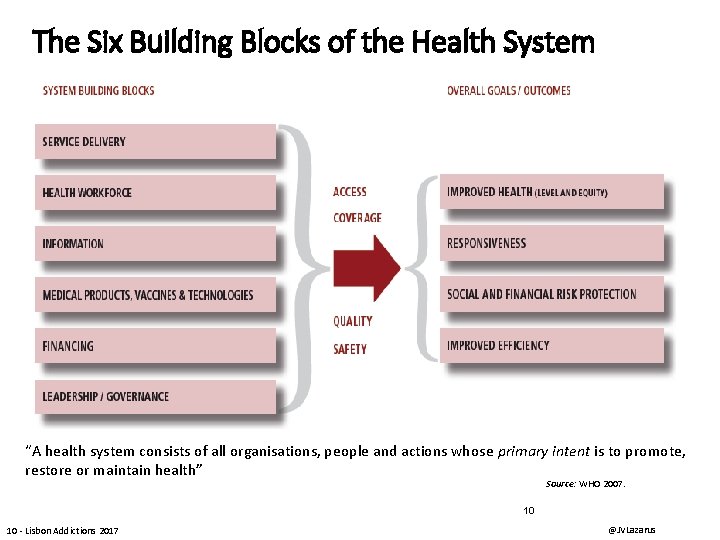
The Six Building Blocks of the Health System “A health system consists of all organisations, people and actions whose primary intent is to promote, restore or maintain health” Source: WHO 2007. 10 10 - Lisbon Addictions 2017 @JVLazarus
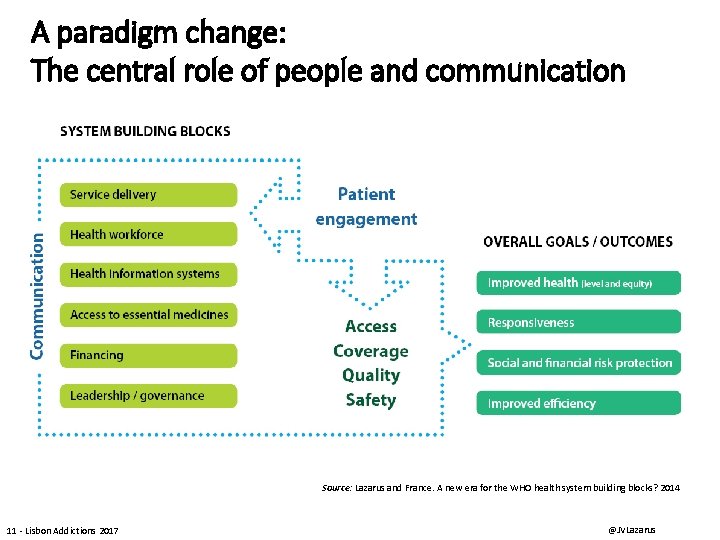
A paradigm change: The central role of people and communication Source: Lazarus and France. A new era for the WHO health system building blocks? 2014 11 - Lisbon Addictions 2017 @JVLazarus
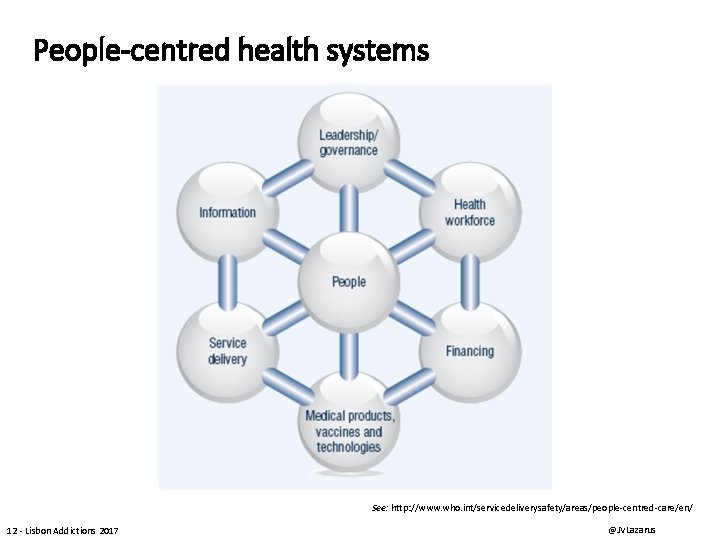
People-centred health systems See: http: //www. who. int/servicedeliverysafety/areas/people-centred-care/en/ 12 - Lisbon Addictions 2017 @JVLazarus
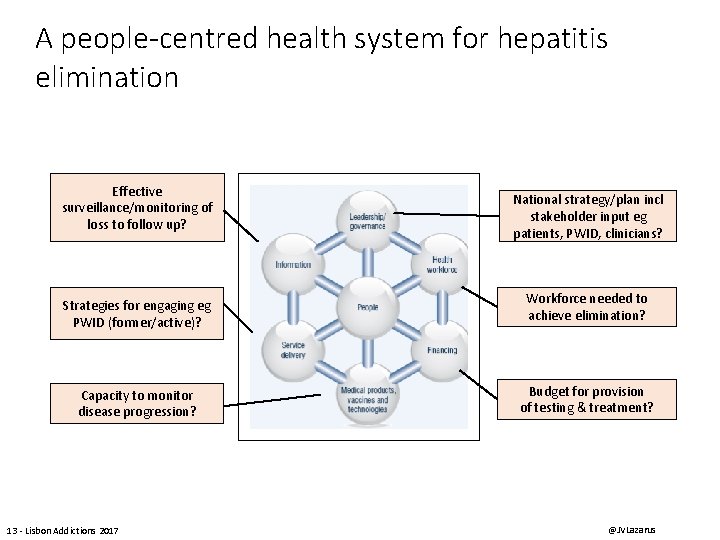
A people-centred health system for hepatitis elimination Effective surveillance/monitoring of loss to follow up? National strategy/plan incl stakeholder input eg patients, PWID, clinicians? Strategies for engaging eg PWID (former/active)? Workforce needed to achieve elimination? Capacity to monitor disease progression? Budget for provision of testing & treatment? 13 - Lisbon Addictions 2017 @JVLazarus
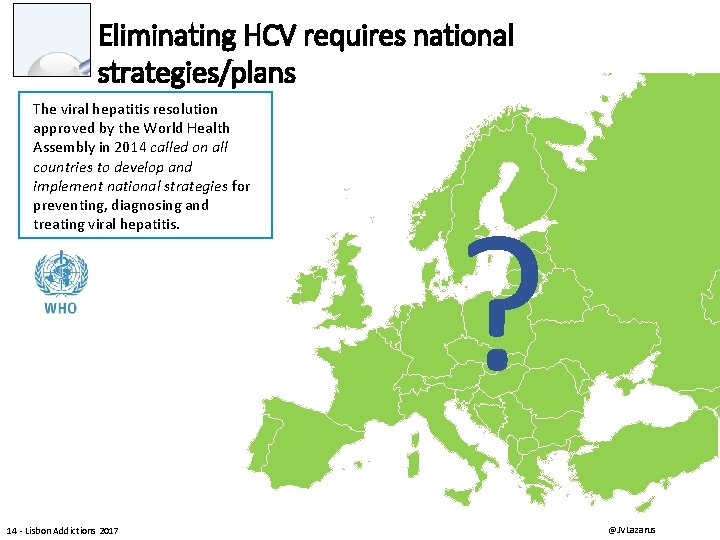
Eliminating HCV requires national strategies/plans The viral hepatitis resolution approved by the World Health Assembly in 2014 called on all countries to develop and implement national strategies for preventing, diagnosing and treating viral hepatitis. 14 - Lisbon Addictions 2017 ? @JVLazarus
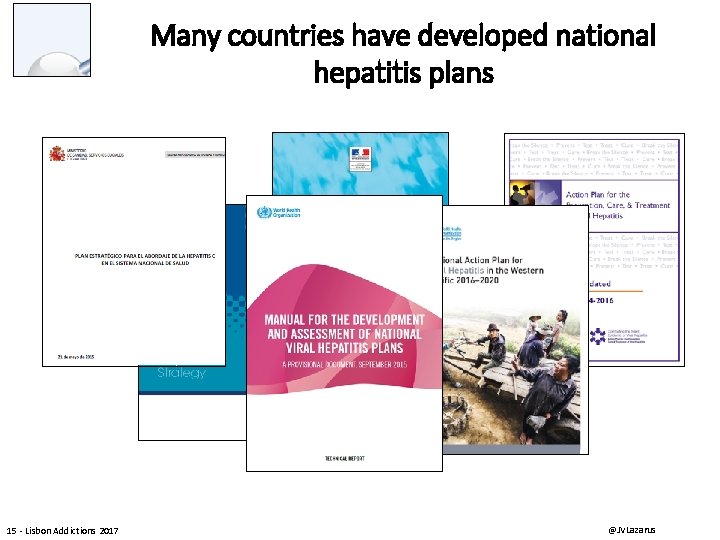
Many countries have developed national hepatitis plans 15 - Lisbon Addictions 2017 @JVLazarus
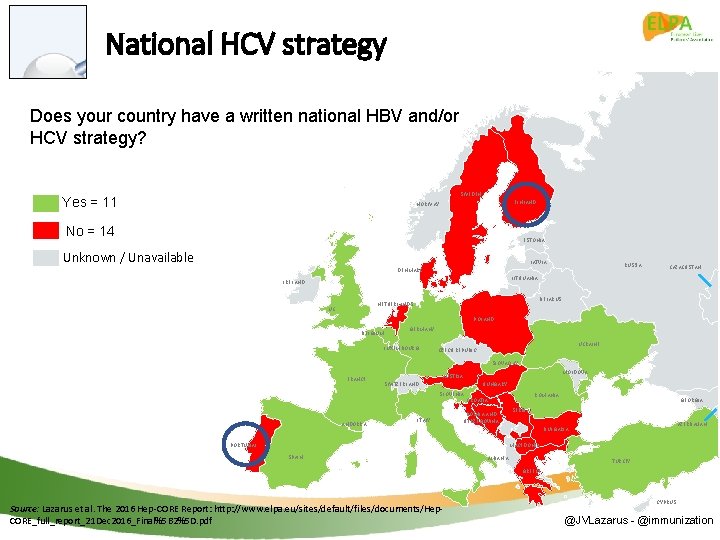
National HCV strategy Does your country have a written national HBV and/or HCV strategy? SWEDEN Yes = 11 FINLAND NORWAY No = 14 ESTONIA Unknown / Unavailable LATVIA RUSSIA DENMARK KAZAKHSTAN LITHUANIA IRELAND BELARUS NETHERLANDS UK POLAND BELGIUM GERMANY LUXEMBOURG UKRAINE CZECH REPUBIC SLOVAKIAY FRANCE MOLDOVA AUSTRIA SWITZERLAND HUNGARY SLOVENIA ANDORRA ITALY ROMANIA CROATIA BOSNIA AND HERZEGOVINA GEORGIA SERBIA AZERBAIJAN BULGARIA MACEDONIA PORTUGAL SPAIN ALBANIA TURKEY GREECE Source: Lazarus et al. The 2016 Hep-CORE Report: http: //www. elpa. eu/sites/default/files/documents/Hep. CORE_full_report_21 Dec 2016_Final%5 B 2%5 D. pdf 16 - Lisbon Addictions 2017 CYPRUS @JVLazarus - @immunization @JVLazarus
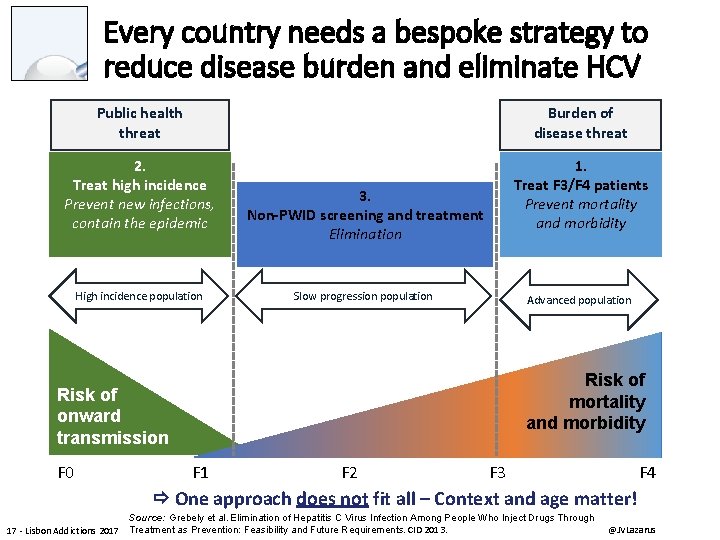
Every country needs a bespoke strategy to reduce disease burden and eliminate HCV Public health threat Burden of disease threat 2. Treat high incidence Prevent new infections, contain the epidemic 1. Treat F 3/F 4 patients Prevent mortality and morbidity High incidence population 3. Non-PWID screening and treatment Elimination Slow progression population Advanced population Risk of mortality and morbidity Risk of onward transmission F 0 F 1 F 2 F 3 F 4 One approach does not fit all – Context and age matter! 17 - Lisbon Addictions 2017 Source: Grebely et al. Elimination of Hepatitis C Virus Infection Among People Who Inject Drugs Through Treatment as Prevention: Feasibility and Future Requirements. CID 2013. @JVLazarus
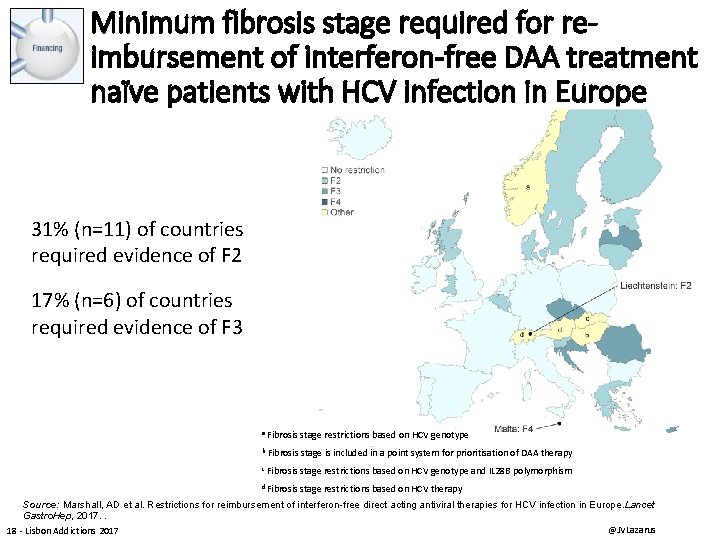
Minimum fibrosis stage required for reimbursement of interferon-free DAA treatment naïve patients with HCV infection in Europe 31% (n=11) of countries required evidence of F 2 17% (n=6) of countries required evidence of F 3 a Fibrosis stage restrictions based on HCV genotype b Fibrosis stage is included in a point system for prioritisation of DAA therapy c Fibrosis stage restrictions based on HCV genotype and IL 28 B polymorphism d Fibrosis stage restrictions based on HCV therapy Source: Marshall, AD et al. Restrictions for reimbursement of interferon-free direct acting antiviral therapies for HCV infection in Europe. Lancet Gastro. Hep, 2017. . @JVLazarus 18 - Lisbon Addictions 2017
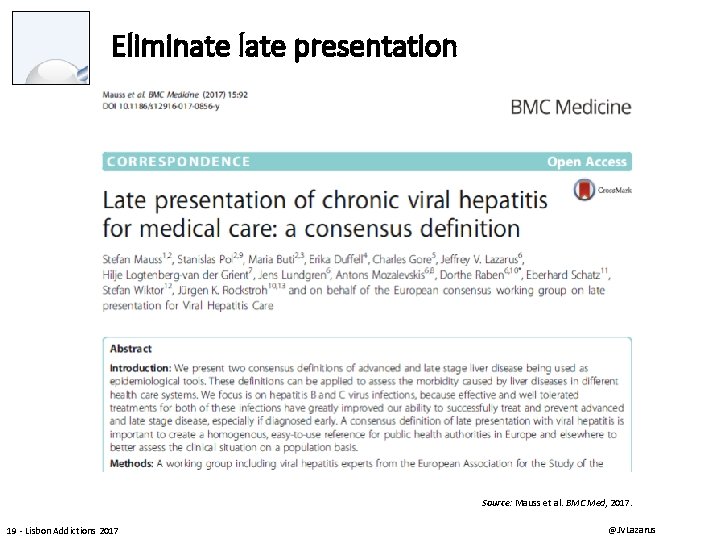
Eliminate late presentation Source: Mauss et al. BMC Med, 2017. 19 - Lisbon Addictions 2017 @JVLazarus
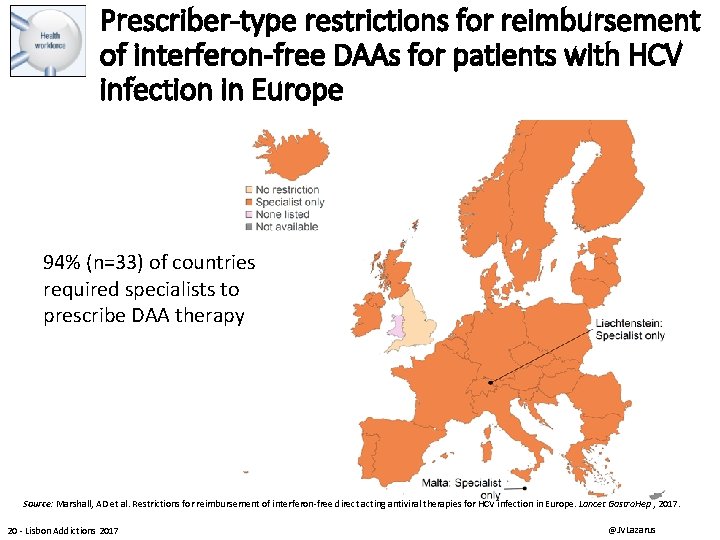
Prescriber-type restrictions for reimbursement of interferon-free DAAs for patients with HCV infection in Europe 94% (n=33) of countries required specialists to prescribe DAA therapy Source: Marshall, AD et al. Restrictions for reimbursement of interferon-free direct acting antiviral therapies for HCV infection in Europe. Lancet Gastro. Hep , 2017. 20 - Lisbon Addictions 2017 @JVLazarus
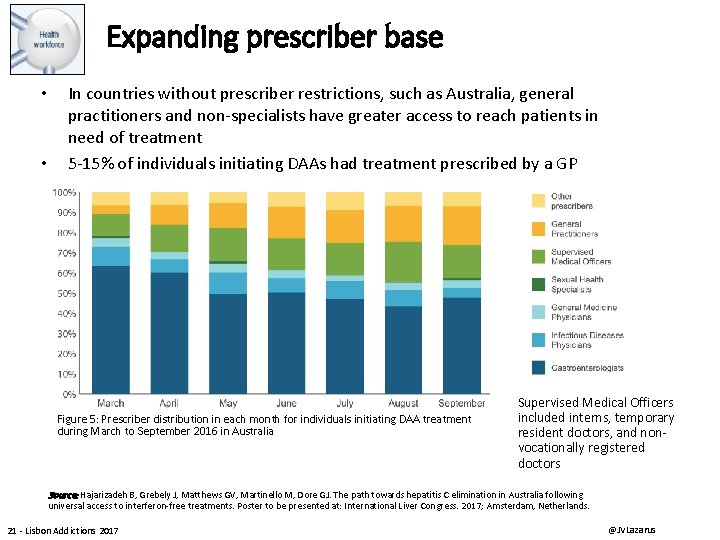
Expanding prescriber base • • In countries without prescriber restrictions, such as Australia, general practitioners and non-specialists have greater access to reach patients in need of treatment 5 -15% of individuals initiating DAAs had treatment prescribed by a GP Figure 5: Prescriber distribution in each month for individuals initiating DAA treatment during March to September 2016 in Australia Supervised Medical Officers included interns, temporary resident doctors, and nonvocationally registered doctors Source: Hajarizadeh B, Grebely J, Matthews GV, Martinello M, Dore GJ. The path towards hepatitis C elimination in Australia following universal access to interferon-free treatments. Poster to be presented at: International Liver Congress. 2017; Amsterdam, Netherlands. 21 - Lisbon Addictions 2017 @JVLazarus
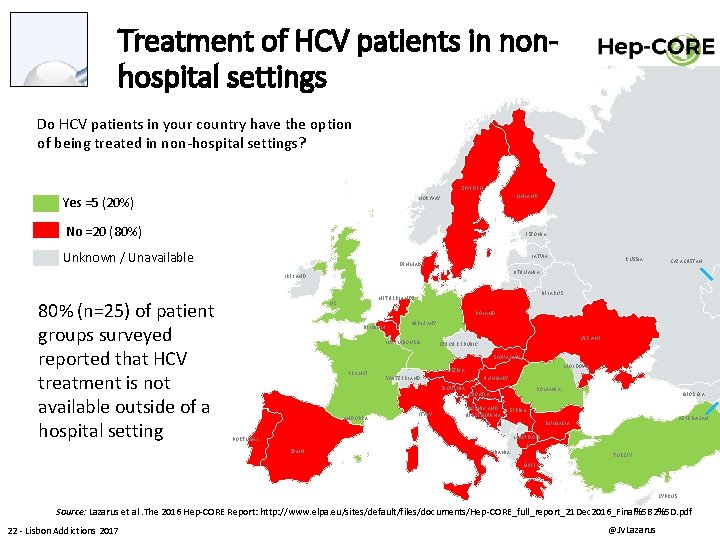
Treatment of HCV patients in nonhospital settings Do HCV patients in your country have the option of being treated in non-hospital settings? SWEDEN Yes =5 (20%) FINLAND NORWAY No =20 (80%) ESTONIA Unknown / Unavailable LATVIA KAZAKHSTAN LITHUANIA IRELAND 80% (n=25) of patient groups surveyed reported that HCV treatment is not available outside of a hospital setting RUSSIA DENMARK BELARUS NETHERLANDS UK POLAND BELGIUM GERMANY LUXEMBOURG UKRAINE CZECH REPUBIC SLOVAKIAY FRANCE MOLDOVA AUSTRIA SWITZERLAND HUNGARY SLOVENIA ANDORRA ITALY ROMANIA CROATIA BOSNIA AND HERZEGOVINA SERBIA AZERBAIJAN BULGARIA PORTUGAL SPAIN GEORGIA ALBANIA MACEDONI A TURKEY GREECE CYPRUS Source: Lazarus et al. The 2016 Hep-CORE Report: http: //www. elpa. eu/sites/default/files/documents/Hep-CORE_full_report_21 Dec 2016_Final%5 B 2%5 D. pdf 22 - Lisbon Addictions 2017 @JVLazarus
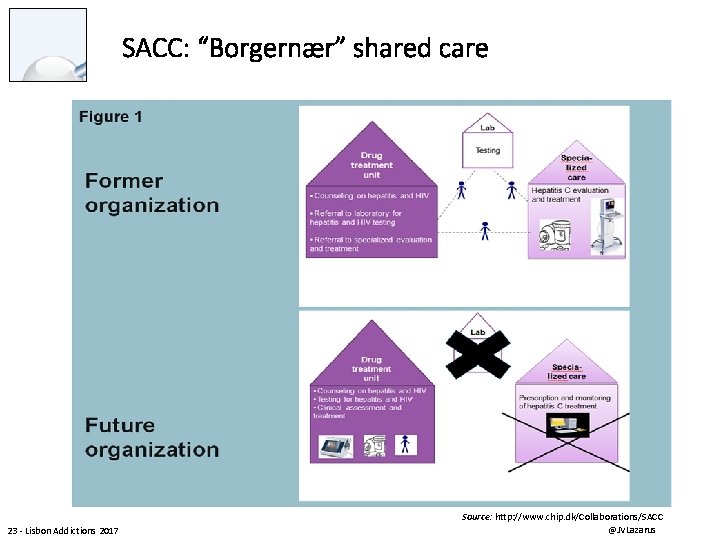
SACC: “Borgernær” shared care 23 - Lisbon Addictions 2017 Source: http: //www. chip. dk/Collaborations/SACC @JVLazarus
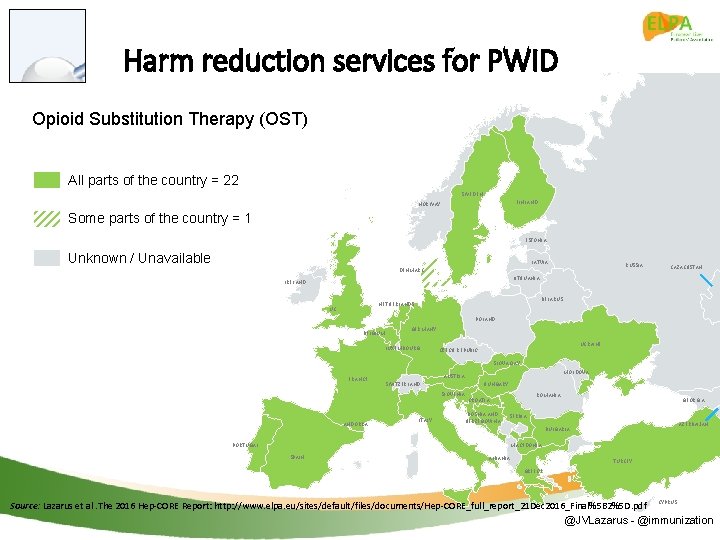
Harm reduction services for PWID Opioid Substitution Therapy (OST) All parts of the country = 22 SWEDEN FINLAND NORWAY Some parts of the country = 1 ESTONIA Unknown / Unavailable LATVIA RUSSIA DENMARK KAZAKHSTAN LITHUANIA IRELAND BELARUS NETHERLANDS UK POLAND BELGIUM GERMANY LUXEMBOURG UKRAINE CZECH REPUBIC SLOVAKIAY FRANCE MOLDOVA AUSTRIA SWITZERLAND HUNGARY SLOVENIA ANDORRA ITALY ROMANIA CROATIA BOSNIA AND HERZEGOVINA GEORGIA SERBIA AZERBAIJAN BULGARIA MACEDONIA PORTUGAL SPAIN ALBANIA TURKEY GREECE Source: Lazarus et al. The 2016 Hep-CORE Report: http: //www. elpa. eu/sites/default/files/documents/Hep-CORE_full_report_21 Dec 2016_Final%5 B 2%5 D. pdf 24 - Lisbon Addictions 2017 CYPRUS @JVLazarus - @immunization @JVLazarus
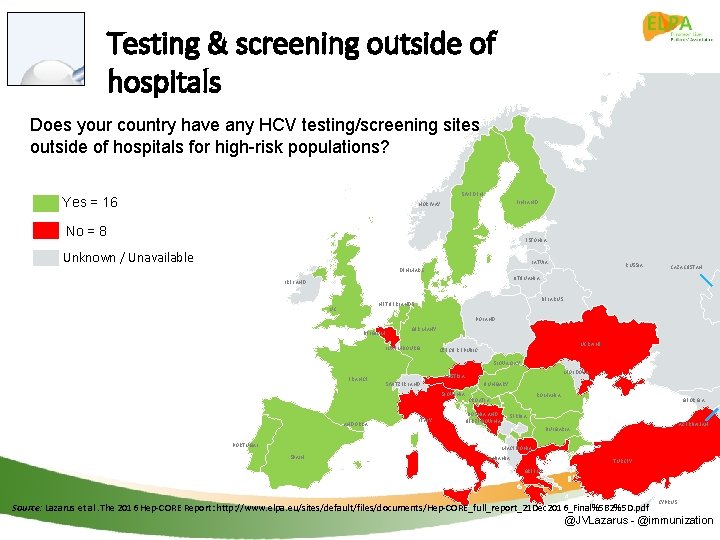
Testing & screening outside of hospitals Does your country have any HCV testing/screening sites outside of hospitals for high-risk populations? SWEDEN Yes = 16 FINLAND NORWAY No = 8 ESTONIA Unknown / Unavailable LATVIA RUSSIA DENMARK KAZAKHSTAN LITHUANIA IRELAND BELARUS NETHERLANDS UK POLAND BELGIUM GERMANY LUXEMBOURG UKRAINE CZECH REPUBIC SLOVAKIAY FRANCE MOLDOVA AUSTRIA SWITZERLAND HUNGARY SLOVENIA ANDORRA PORTUGAL ITALY ROMANIA CROATIA BOSNIA AND HERZEGOVINA GEORGIA SERBIA AZERBAIJAN BULGARIA MACEDONIA SPAIN ALBANIA TURKEY GREECE Source: Lazarus et al. The 2016 Hep-CORE Report: http: //www. elpa. eu/sites/default/files/documents/Hep-CORE_full_report_21 Dec 2016_Final%5 B 2%5 D. pdf 25 - Lisbon Addictions 2017 CYPRUS @JVLazarus - @immunization @JVLazarus
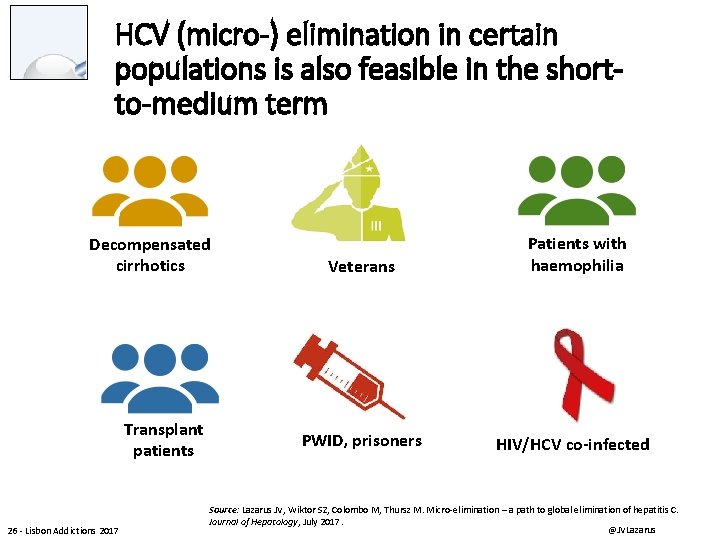
HCV (micro-) elimination in certain populations is also feasible in the shortto-medium term Decompensated cirrhotics Transplant patients 26 - Lisbon Addictions 2017 Veterans Patients with haemophilia PWID, prisoners HIV/HCV co-infected Source: Lazarus JV, Wiktor SZ, Colombo M, Thursz M. Micro-elimination – a path to global elimination of hepatitis C. Journal of Hepatology, July 2017. @JVLazarus
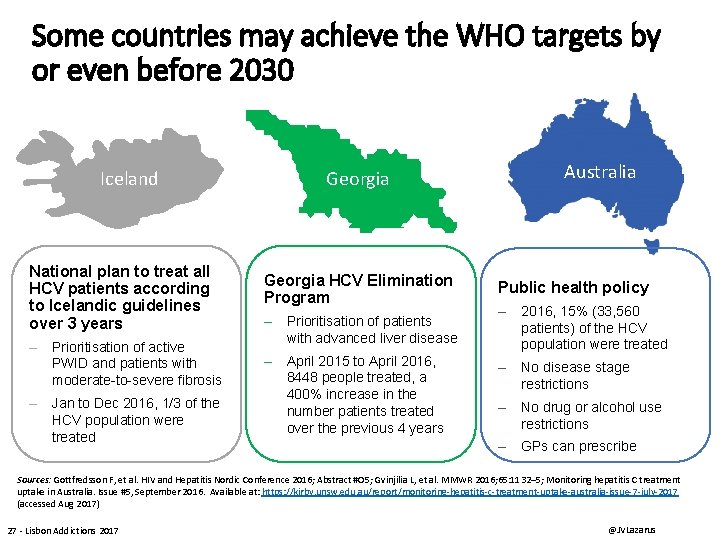
Some countries may achieve the WHO targets by or even before 2030 Iceland National plan to treat all HCV patients according to Icelandic guidelines over 3 years – Prioritisation of active PWID and patients with moderate-to-severe fibrosis – Jan to Dec 2016, 1/3 of the HCV population were treated Australia Georgia HCV Elimination Program – Prioritisation of patients with advanced liver disease – April 2015 to April 2016, 8448 people treated, a 400% increase in the number patients treated over the previous 4 years Public health policy – 2016, 15% (33, 560 patients) of the HCV population were treated – No disease stage restrictions – No drug or alcohol use restrictions – GPs can prescribe Sources: Gottfredsson F, et al. HIV and Hepatitis Nordic Conference 2016; Abstract #O 5; Gvinjilia L, et al. MMWR 2016; 65: 1132– 5; Monitoring hepatitis C treatment uptake in Australia. Issue #5, September 2016. Available at: https: //kirby. unsw. edu. au/report/monitoring-hepatitis-c-treatment-uptake-australia-issue-7 -july-2017 (accessed Aug 2017) 27 - Lisbon Addictions 2017 @JVLazarus
6 th Lisbon Addictions 2025 Est. 1869 26 October 2025 Price € 3. 50 --BREAKING NEWS-X is the first country to eliminate hepatitis C among people who inject drugs 28 - Lisbon Addictions 2017 @JVLazarus
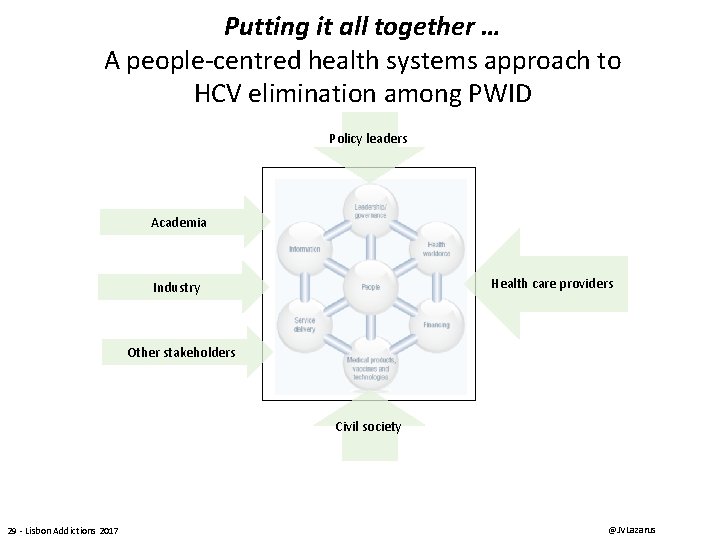
Putting it all together … A people-centred health systems approach to HCV elimination among PWID Policy leaders Academia Health care providers Industry Other stakeholders Civil society 29 - Lisbon Addictions 2017 @JVLazarus
Acknowledgements Hep-CORE study countries / ELPA members All authors of all cited studies in particular: Alison Marshall, Jason Grebely, Stine Nielsen, Evan Cunningham and Samya R. Stumo, Kelly Safreed. Harmon from the Hep-CORE team Austria Belgium Bosnia & Herzegovina Bulgaria Croatia Denmark Egypt Finland France Germany Greece Hungary Israel Italy Macedonia Netherlands Poland Portugal Romania Serbia Slovakia Slovenia Spain Sweden Turkey Ukraine United Kingdom Hep-CORE study group Charles Gore (World Hepatitis Alliance) Hande Harmanci (WHO) Magdalena Harris (LSHTM) Greet Hendrickx (Viral Hepatitis Prevention Board) Marie Jauffret-Roustide (Paris Descartes University) Achim Kautz (ELPA) Mojca Matičič (University Medical Centre Ljubljana) Luís Mendão (Grupo de Ativistas em Tratamentos (GAT)) Antons Mozalevskis (WHO Euro) Raquel Peck (World Hepatitis Alliance) Tatjana Reic (ELPA) Eberhard Schatz (Correlation Network) Kaarlo Simojoki (A-Clinic Foundation, Finland) Joan Tallada (European AIDS Treatment Group) Hep-CORE funding to ELPA was provided by Abb. Vie, Gilead Sciences, MSD. Contact: Jeffrey. Lazarus@isglobal. org 30 - Lisbon Addictions 2017 @JVLazarus