
Health Social Care Level 3 Extended Certificate Year








- Slides: 43
Health & Social Care Level 3 Extended Certificate Year 12 Floret Qui Laborat
Qualification Structure • This is an option course, leading to a BTEC National Level 3 Extended Certificate – equivalent to one A Level, a two year programme. • You will have the opportunity, through applied learning to develop the core specialist knowledge, skills and understanding required, for working in the health and social care sector. • You will have two teachers, teaching you different units but this is planned and organised. • You will have 9 hours a week of lessons and independent study through homework tasks. Floret Qui Laborat
Qualification Structure There are 3 mandatory units that you will be covering. These are; • Unit 1 – Human Lifespan Development (exam) • Unit 2 – Working in HSC (exam) • Unit 5 – Meeting Needs (course work) There is 1 optional unit that you will be covering • Unit 14 – Physiological disorders and their care (course work) Floret Qui Laborat
Course Work Units • The internally assessed units, assignments, all work in the same way. • You will be taught the subject content and make notes in lesson, you will need to make notes in your exercise book. • After all the subject content has been delivered by your teacher, you will be issued with an assignment brief to complete based on the topic areas covered. Floret Qui Laborat
Course Work Units • Once you are working on the assignment, your teacher is there to guide you but can’t give any more assistance on how to complete the unit, it will be your responsibility. • You will have a hand-in date for each assignment • You must hand in work on that date, always • I’ll repeat that, you MUST meet all deadlines Floret Qui Laborat
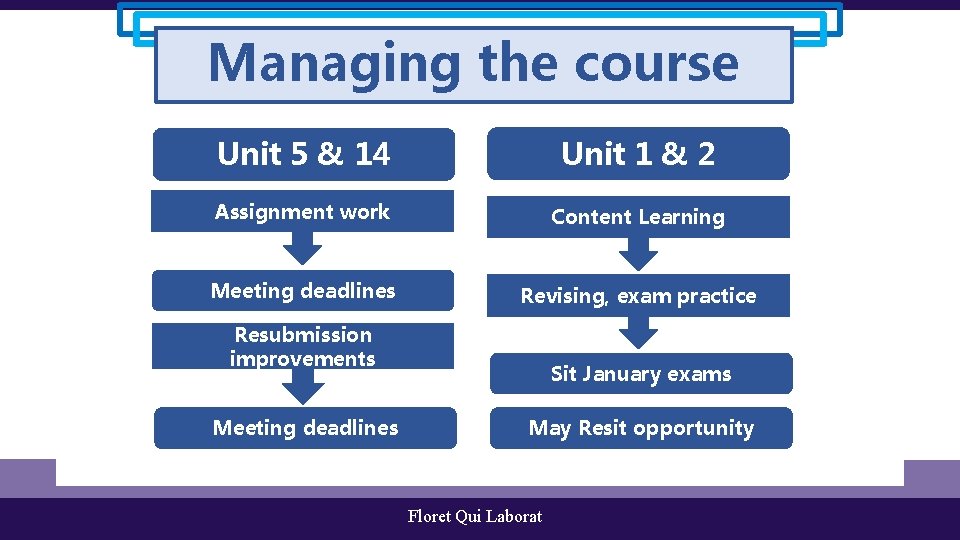
Managing the course Unit 5 & 14 Unit 1 & 2 Assignment work Content Learning Meeting deadlines Revising, exam practice Resubmission improvements Meeting deadlines Sit January exams May Resit opportunity Floret Qui Laborat
Course Work Units • The teacher who has delivered the unit will then assess your assignment work and give you feedback, on whether or not you have met the assessment criteria, for Pass, Merit and Distinction • If you have attempted a P, M or D, but not quite met the criteria then you may have the opportunity to resubmit your improvements • You must meet this second deadline. Floret Qui Laborat
Exam Assessed Units • The content will be delivered and you will make notes in your Revision book. • There will be mock exams to get you ready • You MUST revise and try your absolute best • It’s best to avoid the need for a re-sit so get your best grade, first time Floret Qui Laborat
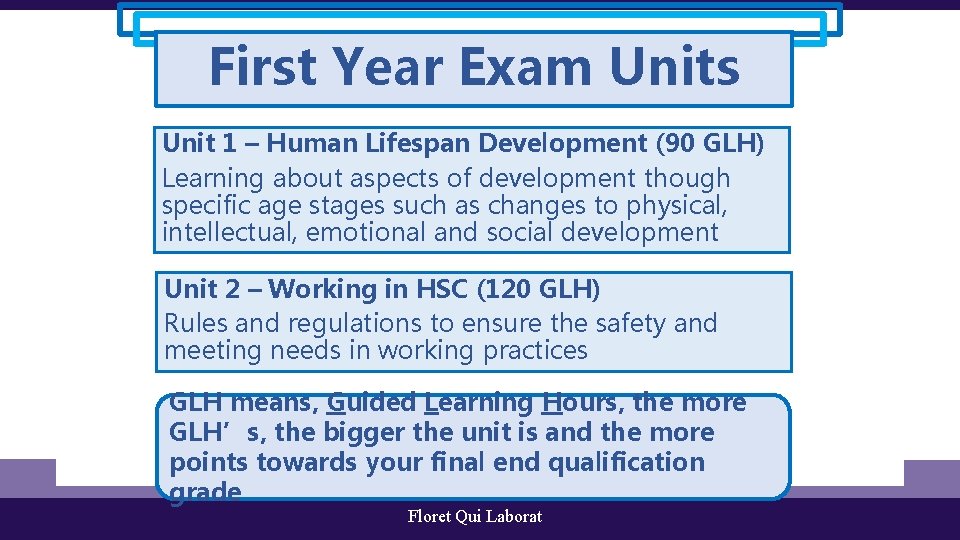
First Year Exam Units Unit 1 – Human Lifespan Development (90 GLH) Learning about aspects of development though specific age stages such as changes to physical, intellectual, emotional and social development Unit 2 – Working in HSC (120 GLH) Rules and regulations to ensure the safety and meeting needs in working practices GLH means, Guided Learning Hours, the more GLH’s, the bigger the unit is and the more points towards your final end qualification grade Floret Qui Laborat
Course work Assessed Units Unit 5 – Meeting Individuals Care and support needs (90 GLH) You will learn a range of theories and apply this knowledge to two case studies Unit 14 – Physiological Disorders and their conditions (60 GLH) Exploring a range of conditions and the care that is appropriate for each. Floret Qui Laborat
Student Responsibility 1) You will need writing pens and coloured pens, colouring pens, come to lessons prepared. 2) It is a good idea to have your cloud storage set up to save your work on and get into the practice of emailing your work completed at home to your teacher, so you are never left with missing course work. You will be a sixth form student so there also behaviour expectations too! Floret Qui Laborat
Get organised Floret Qui Laborat
Student Homework • You will have pieces of homework to complete for each unit to broaden your understanding of the course work topics • Some homework tasks will be extended research which will then be shared with the class, you may asked to present this to your peers • Homework tasks will always have a deadline • You will have revision tasks to complete or exam answers, to practice Floret Qui Laborat
Be organised; Homework Floret Qui Laborat
After Level 3, what’s next? • This BTEC Level 3 qualification is intended for learners who want to progress into health and social care Level 3 or 4 Apprenticeships OR • Who want to progress onto university as a postgraduate to meet the career requirements, a Degree for a particular job role aspiration OR • Who want to progress straight into employment Floret Qui Laborat
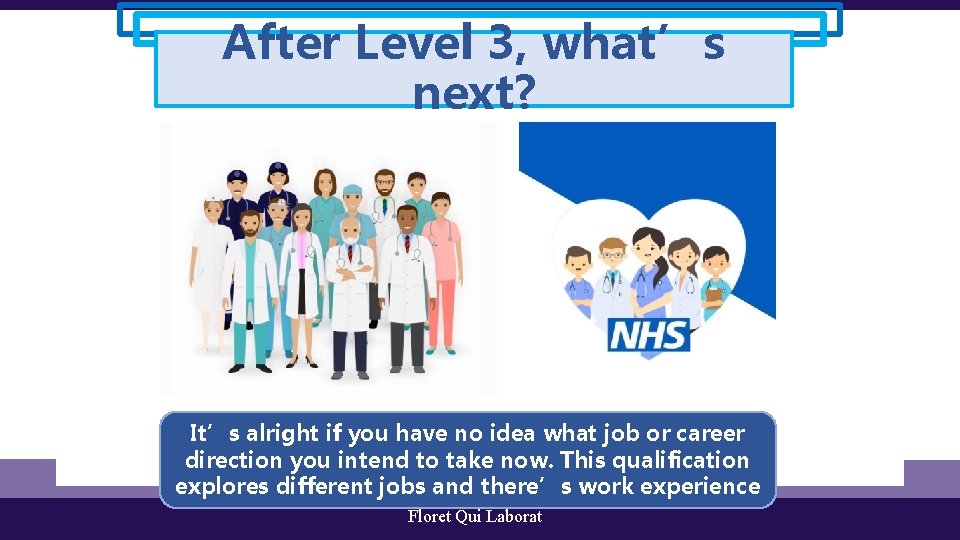
After Level 3, what’s next? It’s alright if you have no idea what job or career direction you intend to take now. This qualification explores different jobs and there’s work experience Floret Qui Laborat
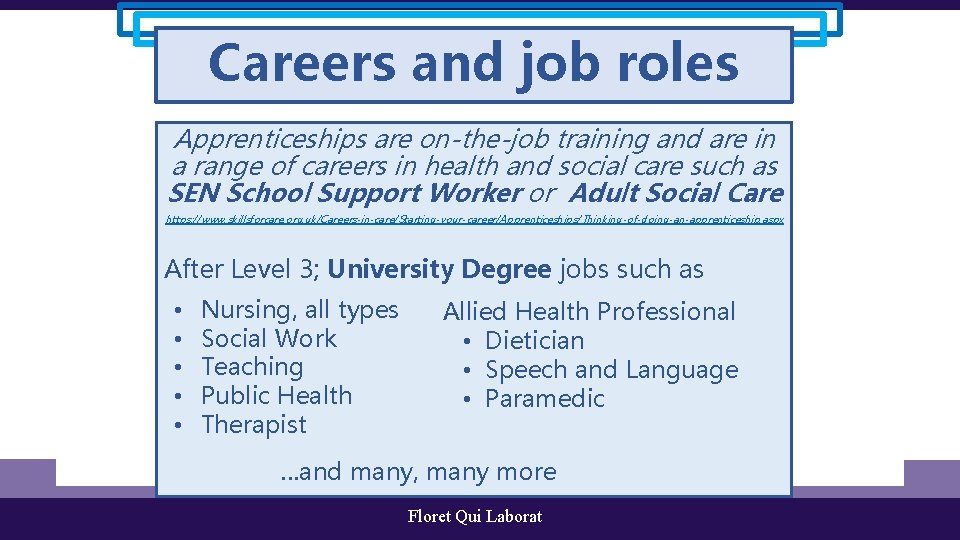
Careers and job roles Apprenticeships are on-the-job training and are in a range of careers in health and social care such as SEN School Support Worker or Adult Social Care https: //www. skillsforcare. org. uk/Careers-in-care/Starting-your-career/Apprenticeships/Thinking-of-doing-an-apprenticeship. aspx After Level 3; University Degree jobs such as • • • Nursing, all types Social Work Teaching Public Health Therapist Allied Health Professional • Dietician • Speech and Language • Paramedic …and many, many more Floret Qui Laborat
Teachers Emails… Curriculum Area Lead HSC Miss Mackey SMackey@neneparkacademy. org Floret Qui Laborat
Task; Why do you want to study Health & Social Care? Complete a written piece explaining why you think you want to study Health & Social Care Floret Qui Laborat
Session AIMS ØTo Introduce students to the effects of basic Nutrition and the different food groups. ØPrepare students to be able to record a personal food diary. Floret Qui Laborat
Objectives By the end of this session students will be able to: • • • List the basic seven food groups. Identify food sources for each of the seven food groups Describe the importance of each food group. Floret Qui Laborat
What Is Nutrition? Nutrition is the process of how the body intakes and utilises foods and nutrients vital to health in promoting growth, maintenance and reproduction cells. • What we eat and drink affects our health. • There are seven essential food groups our body needs. Floret Qui Laborat
Activity 1 - Knowledge Probe List as many of the seven essential food groups as you can on the post it notes provided? You have thirty seconds End www. A 6 training. co. uk
The Seven Essential Food Groups • Protein • Carbohydrates - Complex Carbohydrates - Simple Carbohydrates • Fats - Saturated Fats - Unsaturated Fats • Water • Fibre • Vitamins • Minerals Floret Qui Laborat
Activity 2 Food Groups Word Search Floret Qui Laborat
Objectives By the end of this session students will be able to: • • • List the basic seven food groups. Identify food sources for each of the seven food groups Describe the effects and importance of each food group.
Protein • The digestive system breaks down protein in foods we eat • Absorbed into the bloodstream for growth and repair (White blood cells) • Recommended Dietary Intake = 15% • Increase to 30% for high muscular strength and endurance training • 1 gram of protein = 4 calories Floret Qui Laborat
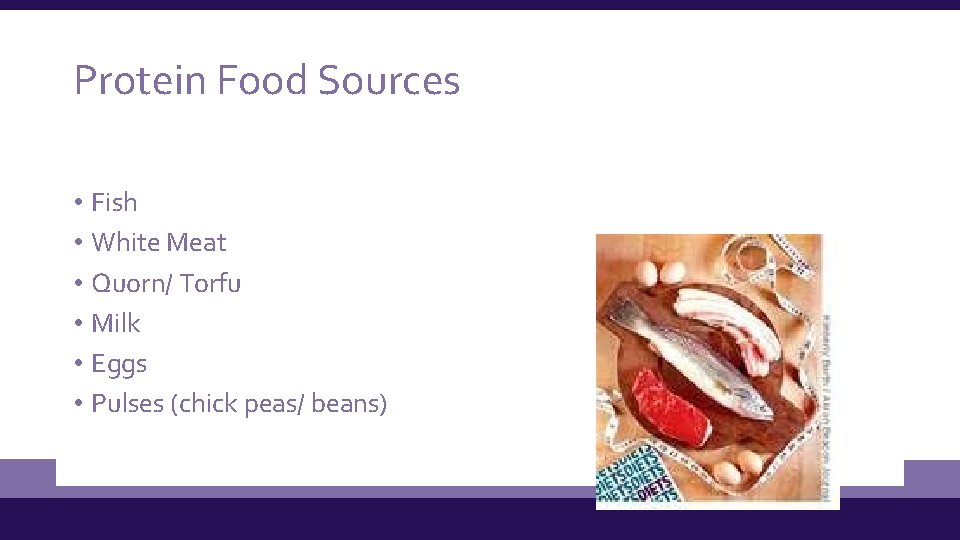
Protein Food Sources • Fish • White Meat • Quorn/ Torfu • Milk • Eggs • Pulses (chick peas/ beans)
Carbohydrates • Divided into complex carbohydrates and simple carbohydrates (sugars = glucose) • The digestive system absorbs carbohydrates into transports them to cells throughout the body • Provides cells with power/ energy: Simple carbohydrates = instance energy release Complex carbohydrates = slow energy release • Excess sugar is stored in the liver • When liver stores are full, it is stored at fat
Carbohydrates • When exercising for short periods, liver stored will be used for energy. • When exercising for long periods, fat will be used for energy. • Recommended Dietary Intake = 55% • Increased to 60 -70% for high cardiovascular training • 1 gram of Carbohydrates = 4 Calories Floret Qui Laborat
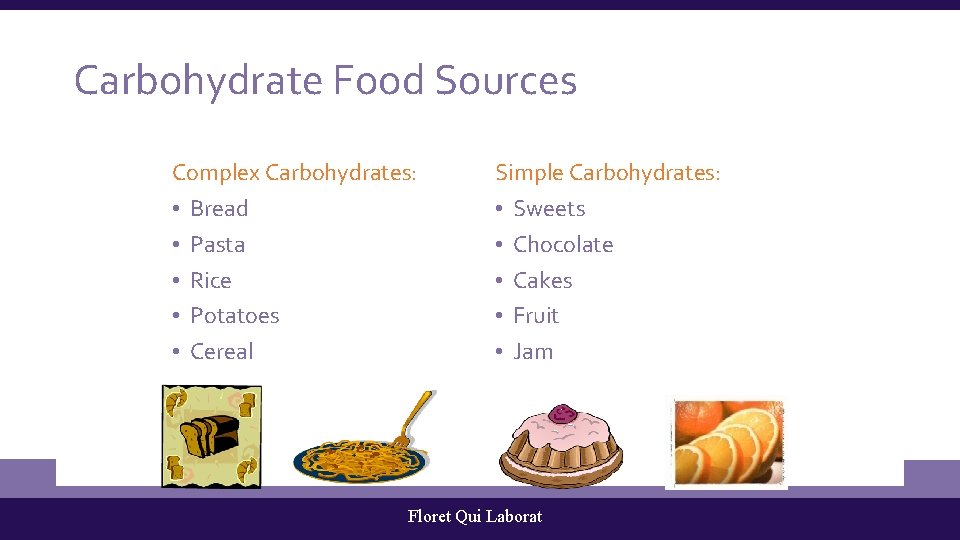
Carbohydrate Food Sources Complex Carbohydrates: • Bread • Pasta • Rice • Potatoes • Cereal Simple Carbohydrates: • Sweets • Chocolate • Cakes • Fruit • Jam Floret Qui Laborat
Fats • Fats are essential for insulation and to protect vital organs • Major source of energy in the body - broken down and used in muscles for fuel • Excess fat is stored • Fats can be divided into saturated fat and unsaturated fat • Saturated fats can come from animal or vegetable products clog the arteries • Unsaturated fats come from plants, seeds or fish - help lower cholesterol Floret Qui Laborat
Fats • When exercising for long periods, fat will be used for energy. • Recommended Dietary Intake = 30% 40 -50 g • Reduced to 15 -30% when training • 1 Gram of fat = 9 Calories Floret Qui Laborat
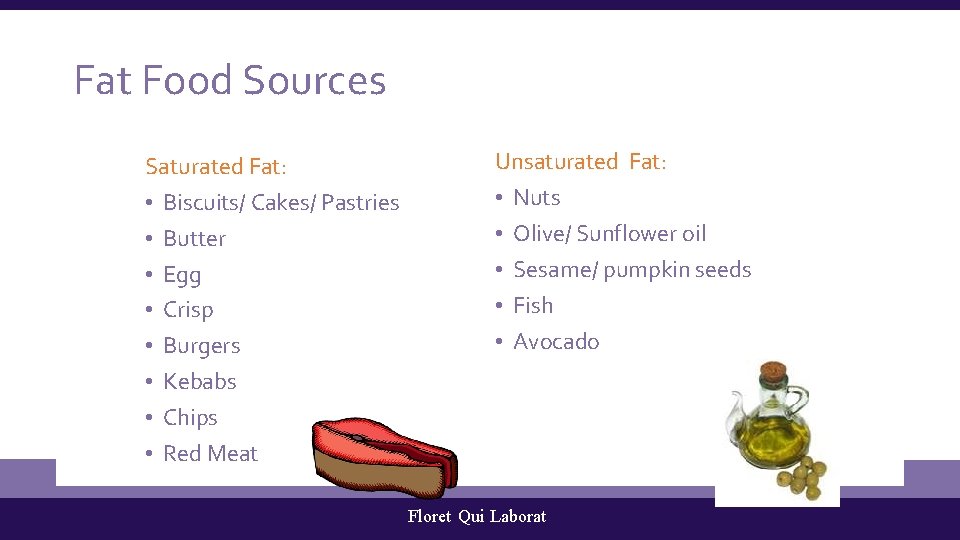
Fat Food Sources Saturated Fat: • Biscuits/ Cakes/ Pastries • Butter • Egg • Crisp • Burgers • Kebabs • Chips • Red Meat Unsaturated Fat: • Nuts • Olive/ Sunflower oil • Sesame/ pumpkin seeds • Fish • Avocado Floret Qui Laborat
Water • 80% of the body is Water • Water is lost through respiration, sweating and urine • Approximately one litre per day is lost • Dehydration can reduce attention span and cause headaches/ Irritability • During exercise can cause dizzy spells, reduced performance and fainting • Recommended Daily Intake = 8 glasses/ 2 litres Page 86 Floret Qui Laborat
Fibre • Fibre is absorbed in the digestive system to get rid of waste products • Absorbs water to make waste disposal more efficient • Protect against high cholesterol heart disease and bowel cancer • Suggested Recommendations = 18 -30 g daily or 1/3 of dietary intake Floret Qui Laborat
Fibre Food Sources • Lentils • Brown rice, bread and pasta • Fruit and Vegetables • Beans (Kidney beans, chick peas) • Whole Grain cereals Floret Qui Laborat
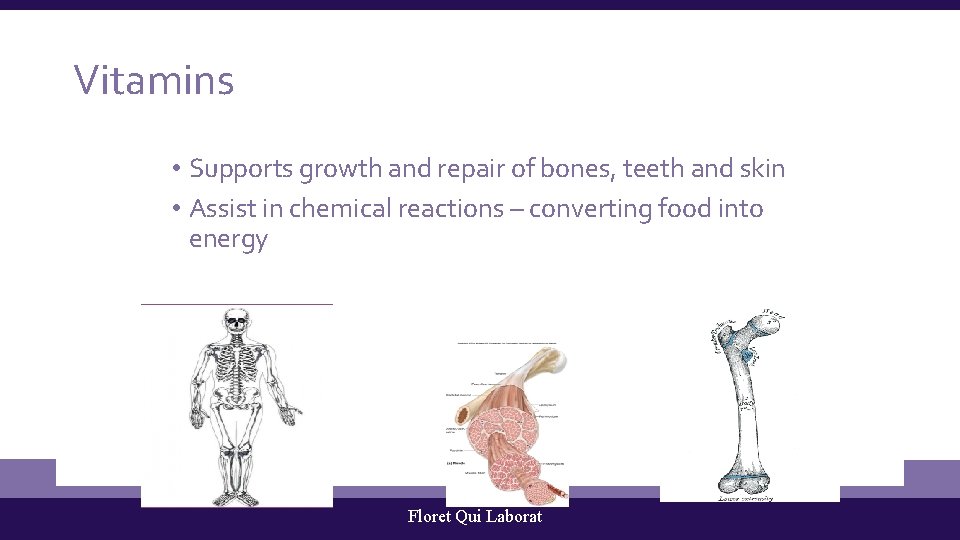
Vitamins • Supports growth and repair of bones, teeth and skin • Assist in chemical reactions – converting food into energy Floret Qui Laborat
Vitamins Vitamin A - Maintains health of the eye Sources – Carrots, sweet potato and spinach Vitamin B(s) - Converts food sources to energy and maintains digestion Sources – Variety of Carbohydrates, fats and proteins Vitamin C – Growth and repair of skin, bones, teeth. Helps immune system fight infections and viruses Sources – Fruit and Vegetable (Oranges and Lemons) Vitamin D – Absorbs calcium to maintain healthy bones and joints. Sources – Sunlight, fish, milk and egg yolk. Floret Qui Laborat
Minerals • Growth and repair of skin, bones, teeth and production of tissues/ muscle fibres • Assist in chemical reactions - transportation of fats and absorption of vitamins Floret Qui Laborat
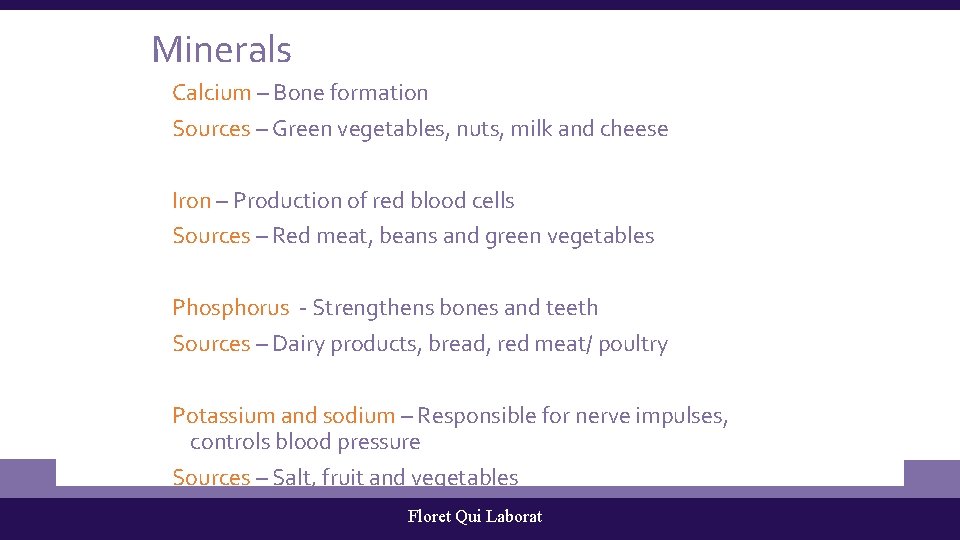
Minerals Calcium – Bone formation Sources – Green vegetables, nuts, milk and cheese Iron – Production of red blood cells Sources – Red meat, beans and green vegetables Phosphorus - Strengthens bones and teeth Sources – Dairy products, bread, red meat/ poultry Potassium and sodium – Responsible for nerve impulses, controls blood pressure Sources – Salt, fruit and vegetables Floret Qui Laborat
Objectives By the end of this session students will be able to: • • • List the basic seven food groups. Identify food sources for each of the seven food groups Describe the effects and importance of each food group.
Objectives By the end of this session students will be able to: • • • List the basic seven food groups. Identify food sources for each of the seven food groups Describe the effects and importance of each food group.