
HEALTH SKILLS THE FOUNDATION CHAPTER 2 CHAPTER OBJECTIVES
HEALTH SKILLS: THE FOUNDATION CHAPTER 2
CHAPTER OBJECTIVES In this chapter, you will Learn About… The six-step decision-making process and the skills involved in setting goals. The importance of healthy communication. The effects of positive and negative stress and strategies for managing stress. Additional health skills that will be beneficial throughout life.
LESSON OBJECTIVES In this lesson, you will Learn About… How decisions affect your health and the health of others. Ways to make healthy, responsible decisions. The benefits of setting health goals.
VOCABULARY DECISION MAKING VALUES EVALUATE GOAL SETTING
DECISIONS & GOALS Decision-making skills will help you make the best choices and find healthy solutions to problems. Goal-setting skills will help you take control of your life and give it purpose and direction. It’s also important to develop strategies for setting long -term personal and health-related goals. Decision making and goal setting are two important health-related skills. When it comes to health, even a decision that may seem small can have great significance.
DECISION MAKING Decision-making, the process of making a choice or finding a solution, involves a series of six steps: 1. 2. 3. 4. 5. 6. State the situation. List the options. Weigh the possible outcomes. Consider values, beliefs and ideals that guide the way a person lives. Make a decision and act. Evaluate the decision. **Create foldable ** M&M Madness
MAKE A DECISION AND ACT H (Healthful) Will it contribute to my health? E (Ethical) Does it show respect for myself and others? L (Legal) Is someone my age allowed by law to do this? P (Parent Approval) Would your parents approve?
EVALUATE YOUR DECISION To evaluate, determine the value of something, your decision, ask yourself the following questions: What was the outcome of my decision? Was it what I expected? How did my decision make me feel about myself? How did my decision affect others? How did my decision affect each side of my health triangle? What did I learn? Would I make the same decision again?
WHY SET GOALS? Goal setting is the process of working toward something you want to accomplish. Setting goals will help you focus on the behaviors you want to change. Goals that you set for one area of your life often lead to the achievement of goals in other areas. Achieving a goal requires planning and effort, and it can give you a great sense of accomplishment and pride. Recall a time in your life when you set a goal and how you felt when you achieved them.
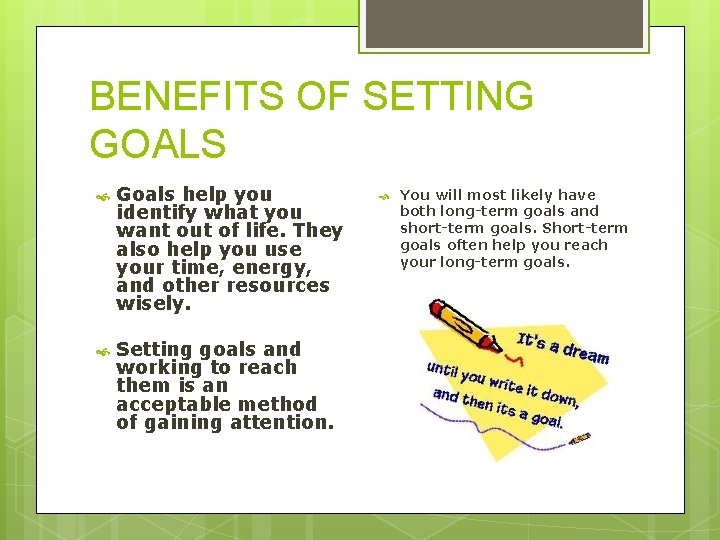
BENEFITS OF SETTING GOALS Goals help you identify what you want out of life. They also help you use your time, energy, and other resources wisely. Setting goals and working to reach them is an acceptable method of gaining attention. You will most likely have both long-term goals and short-term goals. Short-term goals often help you reach your long-term goals.
SHORT TERM GOALS Short-term goals are goals that you want to achieve in the next few days or weeks. Some short-term goals are stepping stones to longterm goals. Examples: Long term goal- run a 5 k. Short term goal - run several times a weeks, gradually increasing your distance and time
LONG TERM GOALS Some goals take several weeks, months, or even years to achieve. They take time, planning, and dedication. Shortterm goals will help you meet these longterm goals. Example: Go on a trip next summer Make the Varsity team as a Freshman Play sport in college Play Professional sport
GOAL SETTING PROCESS A good way to ensure that you reach the goals you set for yourself is to make a plan. 1. 2. 3. 4. 5. Identify a specific goal and write it down. List the steps you will take to reach your goal. Get help and support from others. Set up checkpoints to evaluate your progress. Give yourself a reward once you have achieved your goal. **You are going to choose one of your goals and follow these steps to help you reach your goal
REVIEW 1. The process of working toward something you want to accomplish. Goal setting 2. What are the benefits of setting goals? Goals help you identify what you want out of life and help you use your time, energy, and other resources wisely. Your peers may admire your success and be inspired and you may receive positive attention and recognition from others. 3. What are some goals that you could set to improve your level of health? Brushing your teeth after every meal, eating nutritious foods, wearing your bicycle helmet when they ride your bike, looking both ways before you cross the street, exercise regularly, sleep 8 -10 hrs. a night
COMMUNICATION SKILLS In this lesson, you will Learn About… How body language can help you communicate. Why “I” statements are more effective than “you” statements. How to improve your speaking skills. How to use refusal skills.

VOCABULARY INTERPERSONAL BODY COMMUNICATION LANGUAGE MIXED MESSAGES EYE CONTACT ACTIVE LISTENING FEEDBACK REFUSAL SKILLS
HOW WELL DO YOU COMMUNICATE? Interpersonal communication, the exchange of thoughts, feelings, and beliefs between two or more people, is an important skill because you use it in all of your relationships. Effective interpersonal communication involves: Body language Careful word choice Speaking and listening skills Some people are better communicators than others. They have the ability to get their message across, listen to what others have to say, and keep the lines of communication open. Like other skills, interpersonal communication can be learned and practiced. Think of someone who is a good communicator. Why do you think this person is so good at this skill? ** Some Call it Art Activity
BODY LANGUAGE Interpersonal communication involves more than words. It is important for speakers and listeners to be aware of body language, form of nonverbal communication. Sometimes your body language does not match your words. This is a mixed message, when your words say one thing but your body language says another, and can cause confusion. Your body helps to communicate your thoughts and feelings. For example, a raised eyebrow might reflect curiosity, surprise, or interest. Some forms of body language such as smiling and nodding encourage communication. Others, such as frowning and crossing arms tightly, discourage communication.

I MESSAGES An “I” message is a statement in which a person uses the pronoun “I” to express an opinion or statement. Using “I” messages is a very effective way to communicate. 1. 2. 3. It states the situation and how you feel about the situation. It offers an explanation for your feelings. It states what you need. “You” statements often place blame on the other person and often cause hurt and angry feelings. A well-crafted “I” statement is a powerful communication tool.

SPEAKING SKILLS Good communication involves speaking clearly and carefully. Here are some speaking skills to practice: Use “I” messages. 2. Make clear, simple statements. 3. Be honest with thoughts and feelings. 4. Use appropriate body language, including eye contact, direct visual contact with another person’s eyes. 1. **”I Message” Activity Interpersonal communication involves both giving and receiving messages. Speaking is the giving part.
LISTENING SKILLS A speaker’s message has meaning only if the listener receives it. Good communication involves active listening, hearing, thinking about, and responding to the other person’s message. Here are some listening skills to practice: n n Use appropriate body language. Use conversation encouragers. Mirror thoughts and feelings— this may include offering feedback, a response by the listener to what the speaker has said. Ask questions. Good listening skills are just as important to interpersonal communication as speaking skills. Active listening means hearing, thinking about, and responding to the other person’s message. Who practices good listening skills in here?
REFUSAL SKILLS Refusal skills are communication strategies that help you say no effectively. An easy way to remember refusal skills is to think of the word STOP. Say no in a firm voice. Tell why not. Offer other ideas. Promptly leave. Using refusal skills will help you be true to yourself. Other people will respect you for being honest about your needs and wants. It is important to use both verbal and nonverbal communication when utilizing refusal skills. Examples you might use when utilizing refusal skills (arms crossed, defiant stance, and so on. )
REVIEW 1. Involves the exchange of thoughts, feelings, and beliefs between two or more people. Interpersonal communication 2. What is meant by active listening? Active listening means hearing, thinking about, and responding to the other person’s message. 3. Think of someone you would consider an excellent communicator. Identify the skills that person uses to communicate well.
MANAGING STRESS In this lesson, you will Learn About… The causes of stress. How your body responds to stress. Positive ways to manage stress in your life.
VOCABULARY Stress Adrenaline Eustress Fatigue Distress Stressor Skills Time Management Fight-or-flight Response Management
WHAT IS STRESS? The teen years are a time of many changes. Because of such changes, many teens experience stress, your body’s response to change. Positive stress, called eustress, is an exciting feeling and can make life pleasurable. Negative stress, called distress, must be managed to maintain a healthy lifestyle. Stress is not necessarily bad. Eustress can help you reach your goals and motivate you to do your best. Distress might give you an upset stomach or cause you to lose sleep.
WHAT CAUSES STRESS? Anything that causes stress is a stressor. Stressors range from everyday annoyances to serious problems. Here are some common stressors for teens: Somewhat Extremely Stressful Going to a new school Being sick Death of a pet Failing classes at school
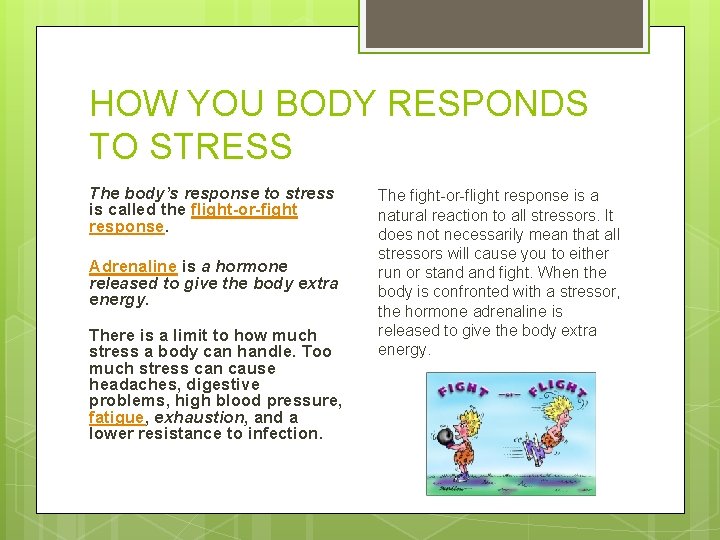
HOW YOU BODY RESPONDS TO STRESS The body’s response to stress is called the flight-or-fight response. Adrenaline is a hormone released to give the body extra energy. There is a limit to how much stress a body can handle. Too much stress can cause headaches, digestive problems, high blood pressure, fatigue, exhaustion, and a lower resistance to infection. The fight-or-flight response is a natural reaction to all stressors. It does not necessarily mean that all stressors will cause you to either run or stand fight. When the body is confronted with a stressor, the hormone adrenaline is released to give the body extra energy.
WAYS TO MANAGE STRESS One of the basic ways to manage stress is to follow a healthy lifestyle. More specifically, you can manage stress by using stress management skills, ways to deal with and overcome problems: n n Knowing how and when to relax Keeping a positive outlook Being physically active Managing your time
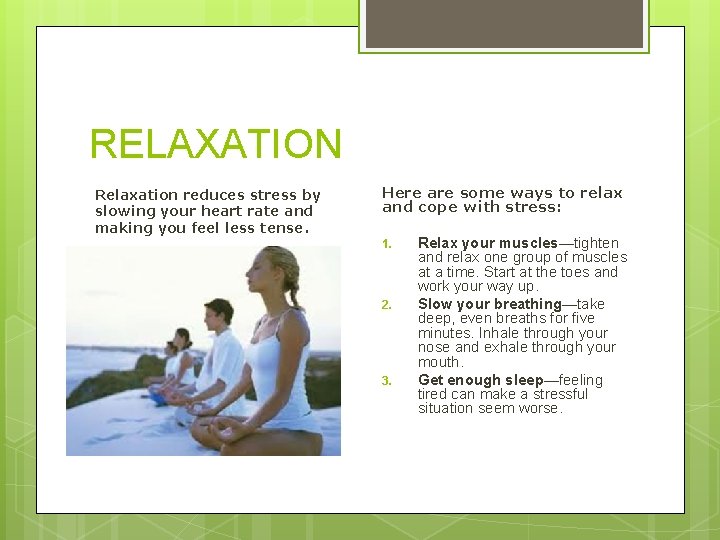
RELAXATION Relaxation reduces stress by slowing your heart rate and making you feel less tense. Here are some ways to relax and cope with stress: 1. 2. 3. Relax your muscles—tighten and relax one group of muscles at a time. Start at the toes and work your way up. Slow your breathing—take deep, even breaths for five minutes. Inhale through your nose and exhale through your mouth. Get enough sleep—feeling tired can make a stressful situation seem worse.
KEEP A POSITIVE OUTLOOK Stress can make you feel depressed, anxious, or afraid. Keep a positive outlook; under stress, it’s easy to lose sight of the important things. Try these tips to keep a positive outlook: • • • Think positively—tell yourself that you will do a good job and it will likely come true. Keep your sense of humor—a good laugh is a great stress reliever. Have some fun—take a little time to do something enjoyable and relaxing, such as listening to a favorite CD or watching a funny movie.
PHYSICAL ACTIVITY One of the healthiest ways to manage stress. Physical activity causes physical and emotional changes that can offset the effects of stress and give you a more positive outlook. Benefits of Physical Activity: Improved heart function: heart rate and blood pressure stay steady Better mood: your brain releases chemicals to make you feel happier (endorphins) Increased oxygen supply: you can think more clearly Improved appearance: when you look better, you feel better.
MANAGING YOUR TIME Learning time management, using your time wisely, skills can help you reduce stress and get more done. Managing your time involves figuring out which activities are most important to you. When you have a task to finish, stay focused. Avoid distractions such as phone calls and visitors until you are ready to take a break.
REVIEW 1. The process by which the body prepares to deal with a stressor. Fight-or-flight response 2. Name 4 skills that can help you deal with stress. Relaxation, keeping a positive outlook, being physically active, and time management are all skills that will help you deal with stress. 3. List 2 possible effects of stress on personal and family health. Stress can make you physically ill, anxious, depressed, or tired. It may cause you to become irritable or angry with family members.

DEVELOPING OTHER HEALTH SKILLS In this lesson, you will Learn About… Ways to get the health information you need. Behaviors that enhance the way you look and feel. Internal and external influences on your health.
VOCABULARY Support System Environment

HEALTH SKILLS: AN OVERVIEW Health skills are practices that help you maintain, protect, and improve your health. They are also called life skills. Accessing Information Self-Management Analyzing Influences Interpersonal Communication Practicing Healthful Behaviors Stress Management Communication Skills Refusal Skills Conflict Resolution Skills Decision Making/Goal Setting Advocacy
ACCESSING INFORMATION Sources for reliable health information include parents, teachers, counselors, school nurses, other trusted adults, library, print & broadcast media, internet, community resources. Always use critical-thinking skills to interpret media messages about health information. This skill involves finding accurate and reliable health information and using health resources. Although you can obtain information from a variety of sources, not all of it is accurate or reliable. Some information is misleading or even completely false.
PRACTICING HEALTH BEHAVIORS Practicing healthful behaviors means developing lifelong habits that increase your level of health and protect you from illness and injury. • Making health a habit—Making health a priority and establishing good habits are key elements for good health. • Building a support system, network of people available to help when needed —Create a support system from parents and other relatives, teachers, counselors, health care providers, and religious leaders.

ANALYZING INFLUENCES INTERNAL: knowledge Like & dislikes Values Desires Curiosity Fears EXTERNAL: Family Friends & peers Environment, sum total of your surroundings Culture Federal, state & local laws Media & technology Role models
REVIEW 1. Give four sources where you may find printed and published health information. Library, print media, internet, & community resources 2. What are six types of internal influences on your health? Your knowledge, likes and dislikes, values, desires, curiosity, and fears. 3. How does your physical environment influence your health? Living spaces, pollution, the weather, available recreational facilities, crime rate, available health care, etc.
- Slides: 41