
Health Sciences 20 1 1 History of Medicine


- Slides: 16
Health Sciences 20 1. 1 - History of Medicine
History of Health Care � Why is this important? � Did you know some treatments today were also used in ancient times? ◦ People used herbs and plants as both food and medicine ◦ A common example of this is morphine � Let’s see how ancient discoveries have shaped the health care you receive today.
Ancient Times � In more primitive times, the common belief was that disease and illness were caused by evil spirits and demons. � Religion played an important role in health care, as sickness was seen as a punishment. ◦ Religious rites were used to eliminate evil spirits and restore health. � The human body was a mystery as most religions did not allow dissection of the body.
Ancient Cultures and Medicine � Egyptians ◦ The first people to record health records – but most people could not read. � Chinese ◦ Held a strong belief in holistic health methods – which stress treating the entire patient – mind, body, and soul. � Greeks ◦ Hippocrates, the “Father of Medicine, ” helped prove that disease is caused by natural causes. �The Greeks were the first to stress that a good diet and cleanliness would help prevent disease.
The Romans � The Romans realized that disease was connected to filth, bad water, and poor sanitation. ◦ They built sewers for waste, and aqueducts to deliver clean water. ◦ They created laws to keep streets clean and eliminate garbage. ◦ The first hospitals were also established.
Aqueducts
The Dark Ages (400 – 800 AD) � After the fall of the Roman empire, the study of medicine stopped. � Emphasis was placed on saving the soul – the study of medicine was illegal ◦ Prayer and divine intervention were used to treat illness and disease � Average life span was 20 to 30 years
Middle Ages (800 – 1400 AD) � The study of medicine was allowed again � Monks found and translated the writings of Greek and Roman physicians � Medical universities were created in the 9 th century to train doctors how to use this knowledge � Average life span was 20 to 35 years
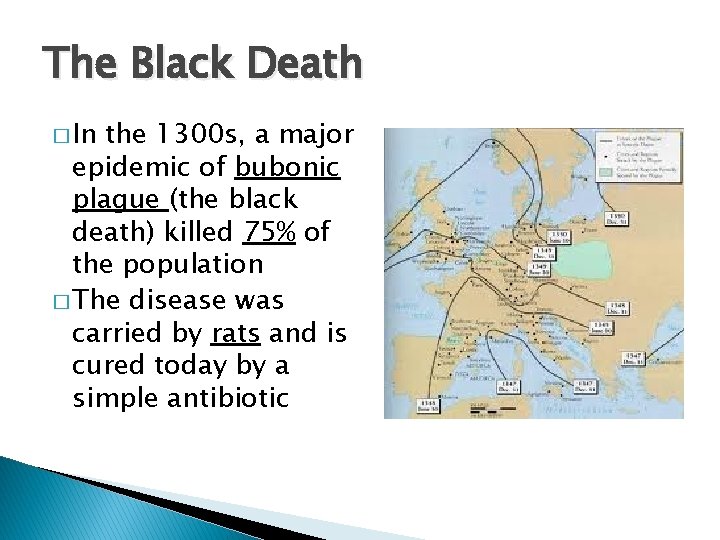
The Black Death � In the 1300 s, a major epidemic of bubonic plague (the black death) killed 75% of the population � The disease was carried by rats and is cured today by a simple antibiotic
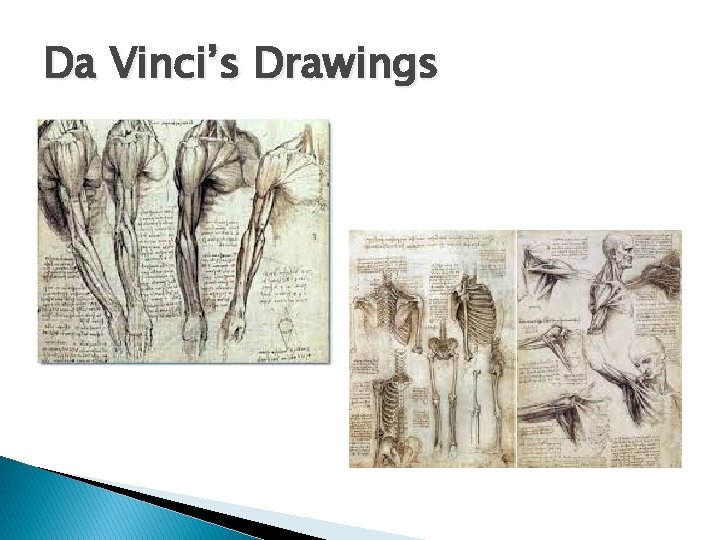
Renaissance (1350 – 1650 AD) � This time is known as the “rebirth of science of medicine. ” � The major source of information was a result of accepting and allowing human dissection ◦ Doctors could now view body organs and see the connection between different systems. ◦ Michelangelo and Leonardo da Vinci were able to draw the body accurately. � Average life span was 30 to 40 years.
Da Vinci’s Drawings
The 16 th, 17 th, and 18 th Centuries � Physicians were learning more and more about the human body � A major development was the invention of the microscope by Anton van Leeuwenhoek ◦ Even though they didn’t know it, physicians were looking at germs that cause disease. � At the end of the 18 th century, Edward Jenner developed a vaccine to prevent smallpox, a deadly disease. � The average life span increased to 40 to 50 years.
The 19 th Century � This was the period known as the Industrial Revolution. Major progress occurred because of the development of machines and access to books. � Physicians began to associate the tiny microorganisms seen in the microscope with diseases. � The average life span increased to 50 to 65 years.
The 20 th Century � This period showed the most rapid growth in health care. � Physicians were able to use new machines such as X-rays to view the body. � Medicines, including antibiotics to fight infections, were developed. � Surgical techniques have provided cures for what were once fatal conditions. � Computers are used in every aspect of health care. � The average life span is 60 to 80 years.
What’s Next? � Research with stem cells and development of cloned cells could lead to treatments that will cure many diseases. � Bioterrorism (the use of microorganisms to infect humans) is a real threat. � New viruses could mutate and cause worldwide epidemics. � The World Health Organization (WHO) is constantly monitoring health problems throughout the world.
Current Event - Syria