
Health safety in hydraulic systems SPEO 0220 Introduction
- Slides: 18
Health & safety in hydraulic systems SPEO 02/20
Introduction In this unit you will be expected to: • explain the main dangers of high pressure systems • explain the main environmental effects of hydraulic fluids • explain effects of human contact with hydraulic fluids
High pressure = stored energy • Hydraulic pressures are typically 140+ bar, 420+ bar being found in some mechanical systems. • Burst hoses and fractured components at these pressures will cause component ejection at explosive forces.
High pressure = stored energy • Pressure should be released and checked (gauge) before working on any pressurised system. • Some systems store pressure in hydraulic accumulators, pressure can be applied even when pumps are stopped and isolated.
High temperature • Skin will scald at 48 o. C and second degree burns will occur after 2 -3 minutes at that temperature. • A correctly operating hydraulic system will operate at approximately 60 o. C, it would take about 1 second at this temperature to produce a 2 nd degree burn. • An incorrectly adjusted or poorly designed system can reach temperatures of 120 o. C. • Burns are not only caused by contact with the working fluid, components such as pumps and valve blocks will also reach high temperatures.
Highly flammable • Traditional hydraulic fluids have a flash point of 150 -300ºC, an ignition source at this temperature will cause fire or explosion. • Auto-ignition can occur between 250 and 400ºC. • High pressure leakage can cause oil spray to travel the length of the nacelle, the ignition source does not need to be near the point of leakage.
Highly flammable • Oil mist in confined spaces carries an additional explosion risk. • Fire resistant (water based) hydraulic fluids have been developed for use in areas where there is a potential fire risk.
Unexpected movement • Raised (operated) equipment may be held in position by trapped hydraulic fluid in the system, after removing pressure from the system and isolating the pump, always operate all control levers in all directions to relieve any trapped fluid. • If equipment requires maintenance in the raised position, mechanical locks must be used to prevent injury.
Unexpected movement • If there is a risk of movement from external pressures (such as wind) mechanical locks must be used to prevent injury. • Remember, hydraulic systems are not only used in the turbine for movement, they are also used to stop movement (brakes, ) isolating pumps and relieving pressures should be done with extreme care.
Oil injection • Fluid pressures of approximately 7 bar will pass through the skin causing subcutaneous injection. • Often, there is very little visible skin damage, however oil will travel through the tissues, affecting a much larger area.
Oil injection • Fluid pressures of approximately 7 bar will pass through the skin causing subcutaneous injection. • Often, there is very little visible skin damage, however oil will travel through the tissues, affecting a much larger area.
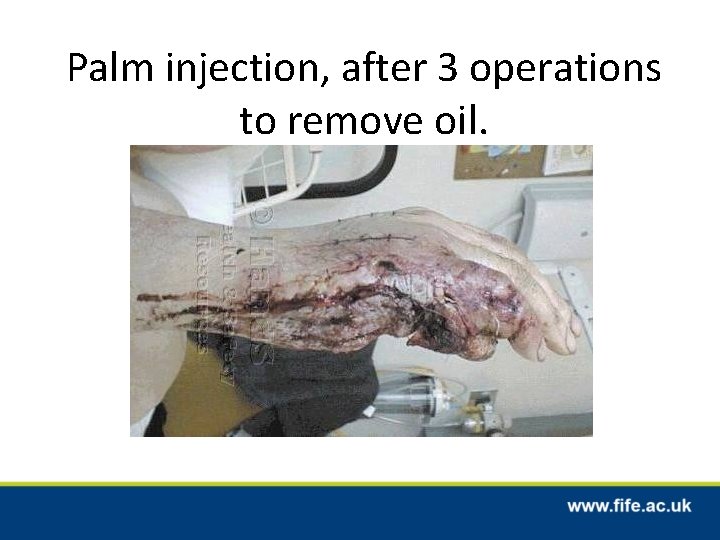
Palm injection, after 3 operations to remove oil.
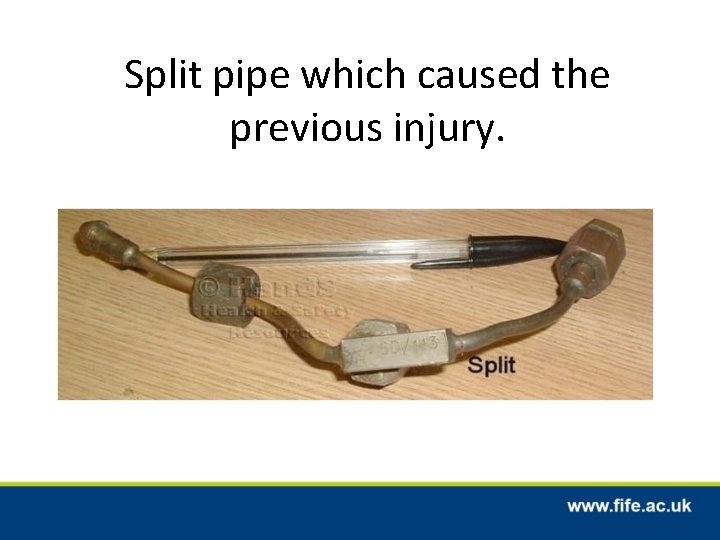
Split pipe which caused the previous injury.
Prolonged exposure • While occasional skin contact is unlikely to cause long term issues, prolonged exposure may cause dry skin, dermatitis or “oil acne. ” • Oil mists can cause respiratory problems if breathed in, long term exposure can result in lung fibrosis. • For very occasional contact, barrier cream should be used, for routine exposure (for example when servicing hydraulic components) suitable gloves should be used (nitrile or neoprene. )
Environmental effects • Spilled hydraulic fluids not only pose a slip risk to the operator, but have significant environmental effects. • The base oils and the chemicals contained within them can be toxic to land based and aquatic organisms. • Many hydraulic oils are not biodegradable (or very slowly biodegradable) so repeated accidental release will have a cumulative effect. • Oil films on water, reduces available light and oxygen, resulting in toxicity and environmental damage.
Safety considerations • Always wear Safety glasses. • Read and obey all safety precautions. • Never direct fluid towards any part of the human body. • Ensure the pressure/safety relief valve is set to the appropriate pressure. • Depressurize all circuits and components when you are finished using them. • Never connect, or activate a pressurized system without direct supervision of a qualified person, and or express permission from a supervising instructor.
Safety considerations • Never place you, another person or any part of a person in the line of action of a hydraulic actuator, or system component. This means that you never point moving parts toward anyone, ever. Treat hydraulic components like loaded guns. • When activating a hydraulic system, be certain that you have examined all the components and you have predicted what will happen when the system is energized. • Check and secure all of the mountings, fittings, piping, tubing, connectors and connections before connecting any hydraulic components or systems to a fluid pump or accumulator.
Safety considerations • Allow only one person near the hydraulic system while it is being activated or deactivated. • Always use a regulator and pressure gauges in your system to monitor systems conditions. • Never over pressurize cylinders, storage tanks, directional valves or other system components. Never exceed the pressure rating of a hydraulic component. • Maximum allowable pressures of all products must be strictly observed. Never design or build a circuit or cause the pressure within a component, to exceed the specified design pressures!