
Health safety and wellbeing in care settings Starter
Health, safety and wellbeing in care settings
Starter activity Jeopardy cards
HOUSEKEEPING Please switch off or silence all phones and do not answer your phone during class time. Please leave the building in an orderly manner if you hear the fire alarm and have not been told that is a test. Please show respect to each other: we are all different, we learn differently and we have different beliefs. Only one person should be speaking at a time. Please drink only water in the classroom. No eating during lessons and that includes chewing gum. Please respect each other's confidentiality. Please be on time for the start lessons and be back on time from breaks and lunches. If you are late back from break or lunch, please sit down in one of the chairs at the side of the class. If I ask a specific person a question, please let them answer. You should all participate as fully as possible. You are responsible for your own learning. Clear away your rubbish (there is a bin in this room) and leave the classroom as we found it.
Tutorial Work that is still to be handed in Work must now be handed in on Mondays not Tuesdays as from Monday 28 th January Views on Adam’s comments Assignment feedback: time will be spent discussing this in the afternoon.
Health, safety and wellbeing in care settings Learning Outcomes: By the end of this session you will be able to: • identify legislation and good practice that relate to moving and handling equipment • list hazardous substances that you will find in health and social care workplaces • give examples of how we actually put the law relating to hazardous substances into practice • summarise fire safety procedures • explain why personal safety is important in health and social care settings • examine the causes and symptoms of stress • describe ways in which we can manage stress
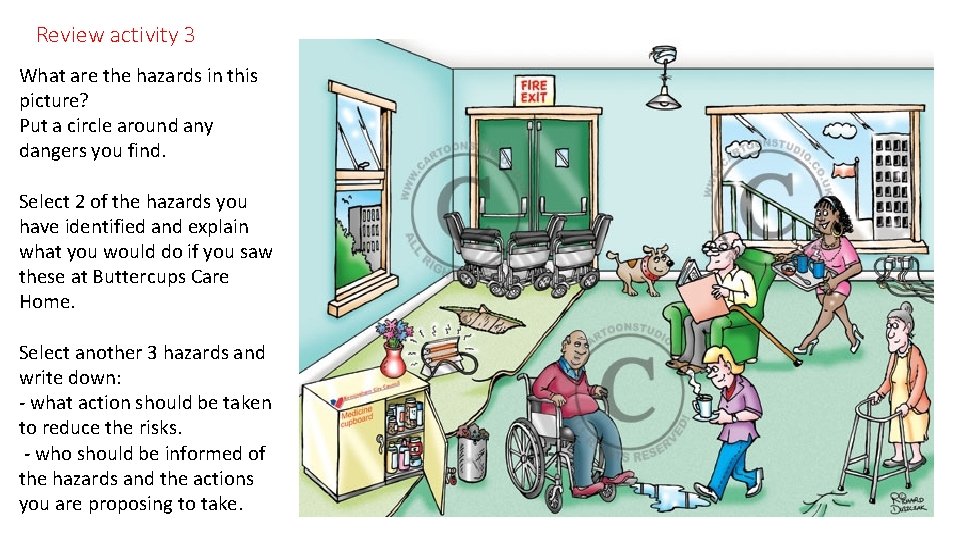
Review activity 3 What are the hazards in this picture? Put a circle around any dangers you find. Select 2 of the hazards you have identified and explain what you would do if you saw these at Buttercups Care Home. Select another 3 hazards and write down: - what action should be taken to reduce the risks. - who should be informed of the hazards and the actions you are proposing to take.
Review activity How many hazards did you find?
Risk assessments – a quick quiz. . ! On your own… 1. In which unit did we first look at the need to carry out risk assessments? (30 seconds) 2. Give 3 reasons why we need to carry out risk assessments. (2 minutes) 3. Imagine you work at Buttercups Care Home: on what kinds of things would you be writing risk assessments? (2 minutes) (1 answer = bronze 2 answers = silver ≥ 3 answers = gold) For those of you who were here last week, you will not be answering these questions - you will be marking another student’s work. As this will be familiar to you, I will give you no guidance as to whether the answers you are marking are right or not…
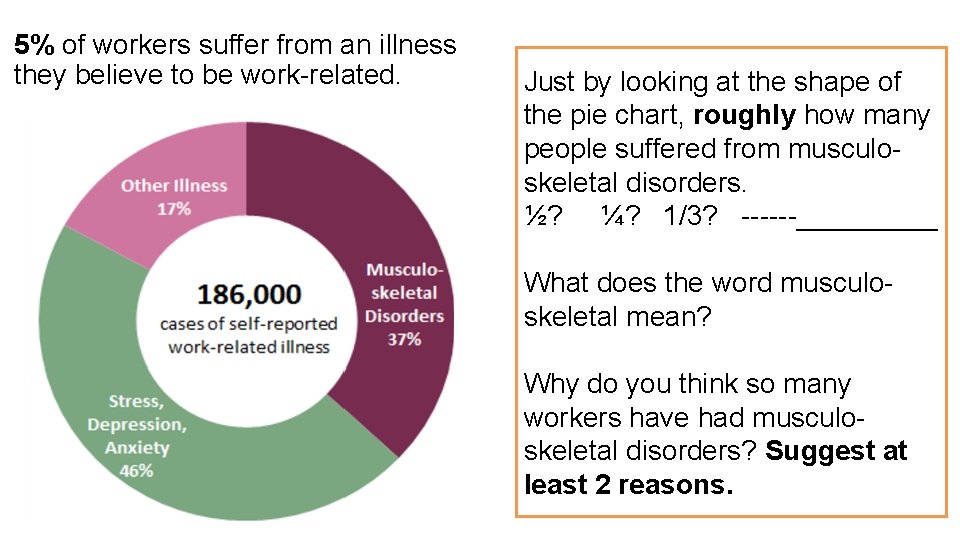
5% of workers suffer from an illness they believe to be work related. Just by looking at the shape of the pie chart, roughly how many people suffered from musculo skeletal disorders. ½? ¼? 1/3? _____ What does the word musculo skeletal mean? Why do you think so many workers have had musculo skeletal disorders? Suggest at least 2 reasons.
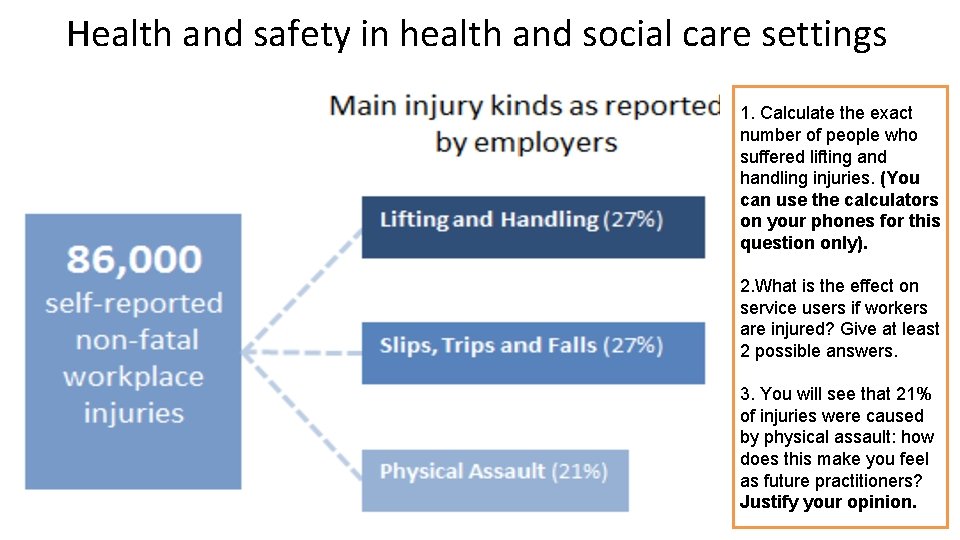
Health and safety in health and social care settings 1. Calculate the exact number of people who suffered lifting and handling injuries. (You can use the calculators on your phones for this question only). 2. What is the effect on service users if workers are injured? Give at least 2 possible answers. 3. You will see that 21% of injuries were caused by physical assault: how does this make you feel as future practitioners? Justify your opinion.
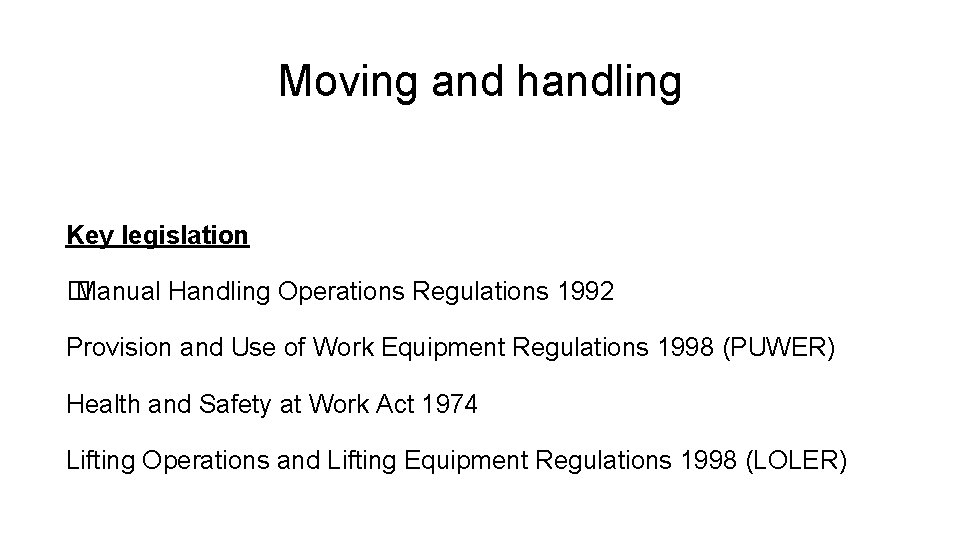
Moving and handling Key legislation � Manual Handling Operations Regulations 1992 Provision and Use of Work Equipment Regulations 1998 (PUWER) Health and Safety at Work Act 1974 Lifting Operations and Lifting Equipment Regulations 1998 (LOLER)
Research activity You will research one of the pieces of legislation on the previous slide. You will summarise that piece of legislation and describe the key details in your own words. You will put into practice the research skills that you have previously learnt. You have 10 minutes only. Manual Handling Operations Regulations 1992 Provision and Use of Work Equipment Regulations 1998 (PUWER) Lifting Operations and Lifting Equipment Regulations 1998 (LOLER)

Manual Handling Operations Regulations 1992 The Regulations define manual handling as: ". . . any transporting or supporting of a load (including the lifting, putting down, pushing, pulling, carrying or moving thereof) by hand or bodily force". The load can be an object, person or animal. The MHOR 1992 set out a clear ranking of measures for dealing with risks from manual handling, these are: first : avoid hazardous manual handling operations so far as is reasonably practicable; second : assess any hazardous manual handling operations that cannot be avoided; and third: reduce the risk of injury so far as is reasonably practicable. (HSE)
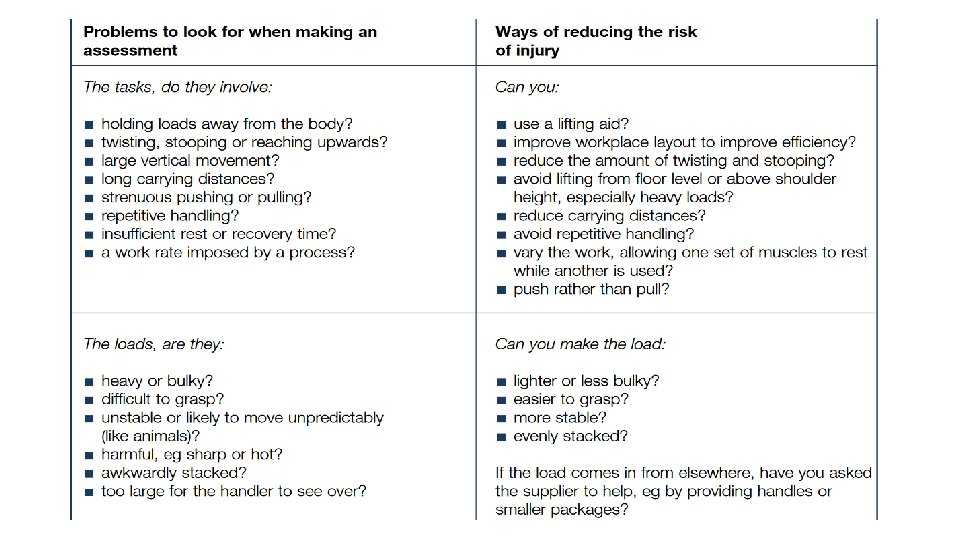
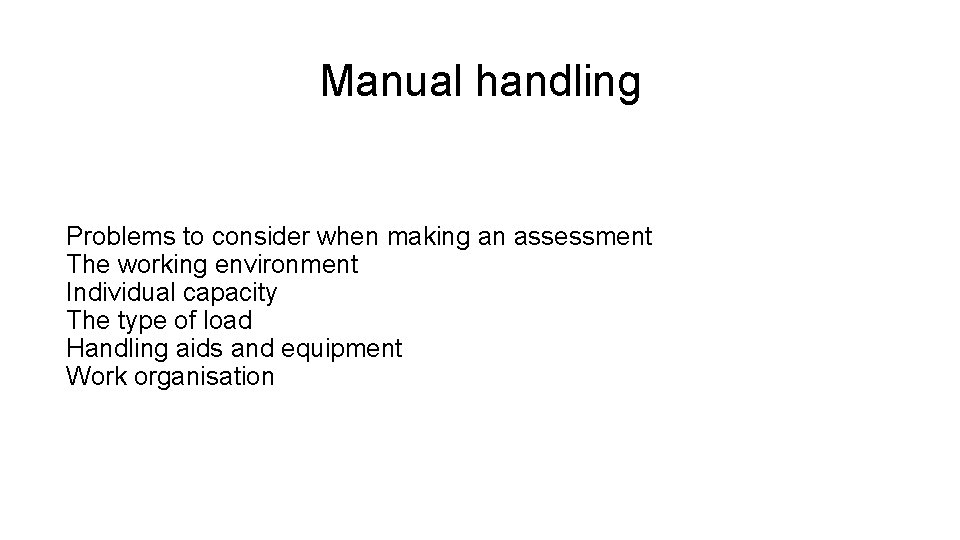
Manual handling Problems to consider when making an assessment The working environment Individual capacity The type of load Handling aids and equipment Work organisation
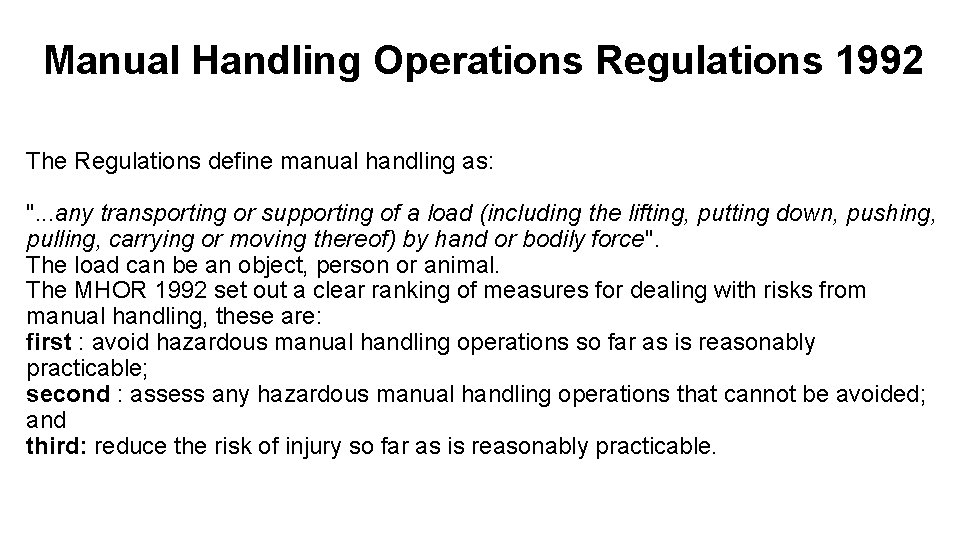
Manual Handling Operations Regulations 1992 The Regulations define manual handling as: ". . . any transporting or supporting of a load (including the lifting, putting down, pushing, pulling, carrying or moving thereof) by hand or bodily force". The load can be an object, person or animal. The MHOR 1992 set out a clear ranking of measures for dealing with risks from manual handling, these are: first : avoid hazardous manual handling operations so far as is reasonably practicable; second : assess any hazardous manual handling operations that cannot be avoided; and third: reduce the risk of injury so far as is reasonably practicable.
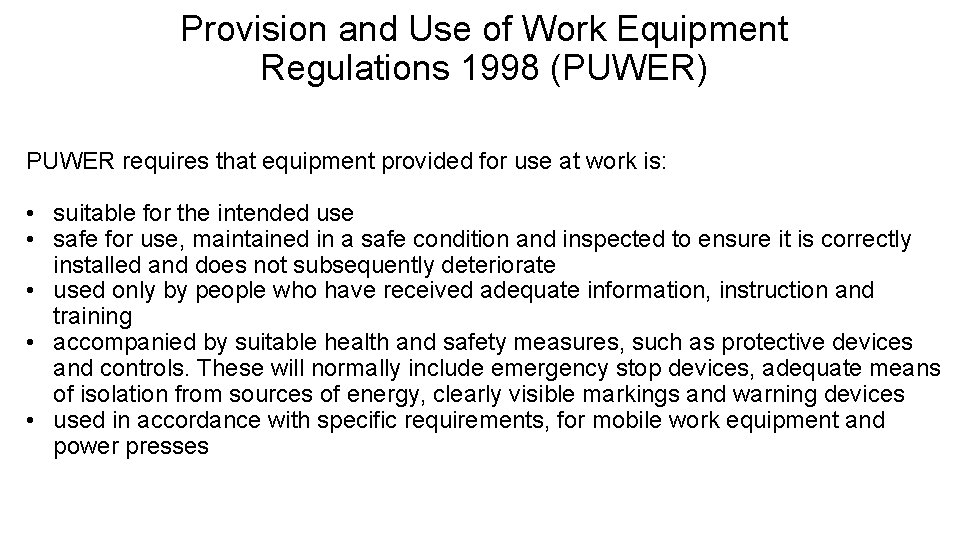
Provision and Use of Work Equipment Regulations 1998 (PUWER) PUWER requires that equipment provided for use at work is: • suitable for the intended use • safe for use, maintained in a safe condition and inspected to ensure it is correctly installed and does not subsequently deteriorate • used only by people who have received adequate information, instruction and training • accompanied by suitable health and safety measures, such as protective devices and controls. These will normally include emergency stop devices, adequate means of isolation from sources of energy, clearly visible markings and warning devices • used in accordance with specific requirements, for mobile work equipment and power presses
Lifting Operations and Lifting Equipment Regulations 1998 (LOLER) All lifting operations involving lifting equipment must be properly planned by a competent person, appropriately supervised and carried out in a safe manner. LOLER also requires that all equipment used for lifting is fit for purpose, appropriate for the task, suitably marked and, in many cases, subject to statutory periodic ‘thorough examination’. Records must be kept of all thorough examinations and any defects found must be reported to both the person responsible for the equipment and the relevant enforcing authority.
Moving and handling – what is important? You work at Buttercups Care Home and have been asked to move a hoist from a resident’s room into a bathroom: What things do you need to consider before you move it? What do you need to do physically in order to move the hoist safely? (5 minutes)
Moving and handling – what is important? Things you will need to consider when looking at your overall moving and handling requirements within the care home include: • • • the type and frequency of moving and handling tasks the range and amount of equipment needed, equipment storage and maintenance staff required for moving and handling, and their competence and training the environment, eg flooring, ramps, lighting, space restrictions etc the specific equipment to be used, including (if applicable) type of bed, bath and chair as well as specific handling equipment, ie type of hoist and sling, sling size and which attachments are to be used
Moving and handling – what is important? Making sure you don’t hurt yourself • Adopt a safe posture – What is a good posture? • Wear flat supportive shoes and non restrictive clothing • Use safe systems • Prepare the environment: make sure the area is safe and remove obstacles • Keep the load close to your body • Are you and the other person/people roughly of the same height? • Are you physically fit?
Hazardous substances What is the law that sets regulations for dealing with hazardous substances? Where did you first come across this law? Write down your answers. (2 minutes…)
Pop quiz, hots! You have 2 minutes to name as many hazardous substances and materials that you might find at Buttercups Care Home. You must all contribute or your answers will not be accepted. Use different coloured pens to write your answers.
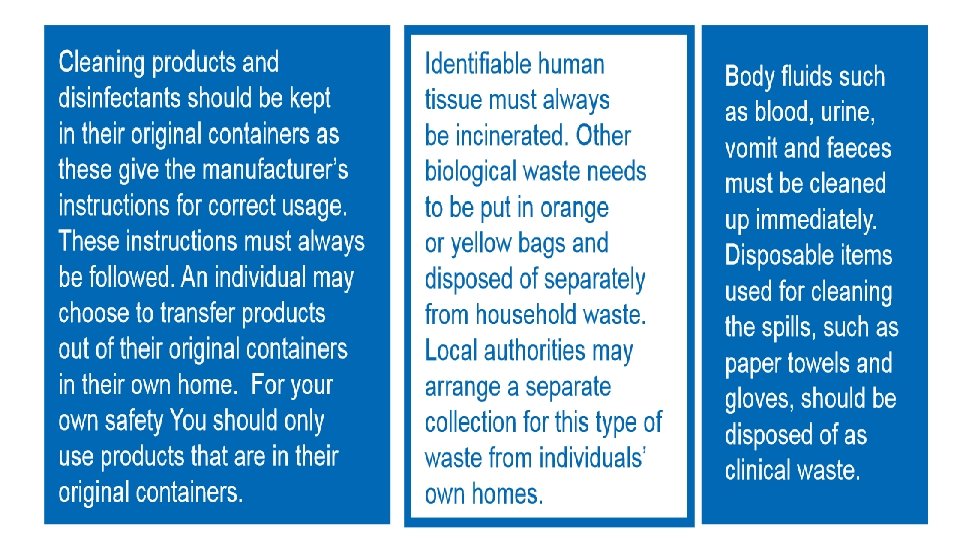
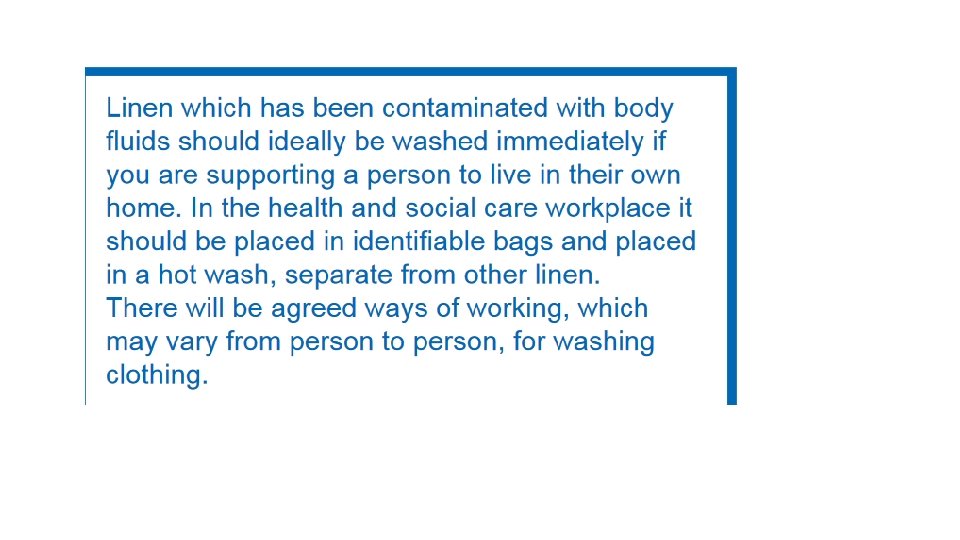
Pop quiz, hots! Hazardous substances in care homes: • cleaning products • Latex • Medicines • Asbestos • cleaning materials • Disinfectants • body fluids • clinical waste such as dressings • contaminated clothes, towels and bed linen
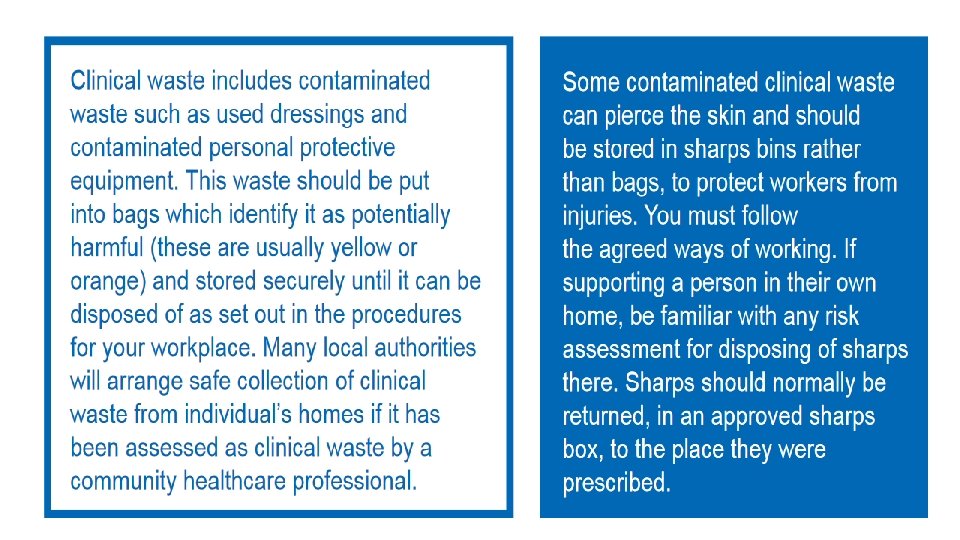
Now that we’ve got hazardous substances, what are we going to do…with them? For all of the hazardous substances you have mentioned, you now need to explain how you will: • Store them safely • Use them safely • Dispose of them safely You will work on your own and then, after 5 minutes, you will share your answers with the rest of the group (3 in total) who will try to add to what you have identified. You will have a further 5 minutes working as a group. If you finish early, try to explain why it is important that substances are used, stored or disposed of safely. Again, write in different coloured pens.
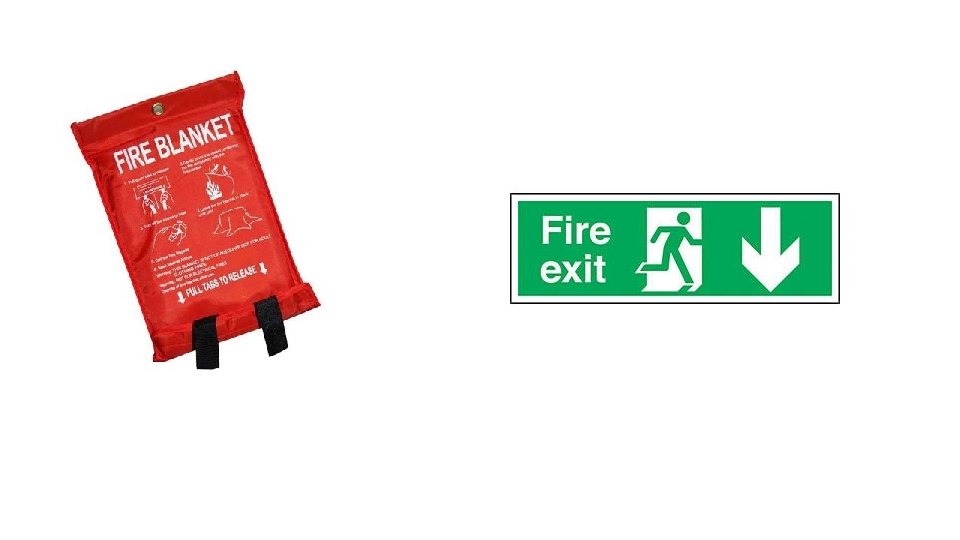
Fire safety Think about this College: What fire prevention measures does it take? What measures does it take to stop fires from spreading? 0 3 = bronze, 4 6 = silver, ≥ 7 = gold
Fire safety activity
Emergency procedures You are working at North Manchester General Hospital and a fire breaks out in the reception area. What should you do? Write down what you would do. Now, working on your own, research what you should do if a fire breaks out at work. You will have 10 minutes. Write down the website(s) you have used. You will present your findings to the class using your own words – so make sure you: 1. understand the information you are about to present 2. are familiar with it so that you can present it confidently – rather than reading from your notes.
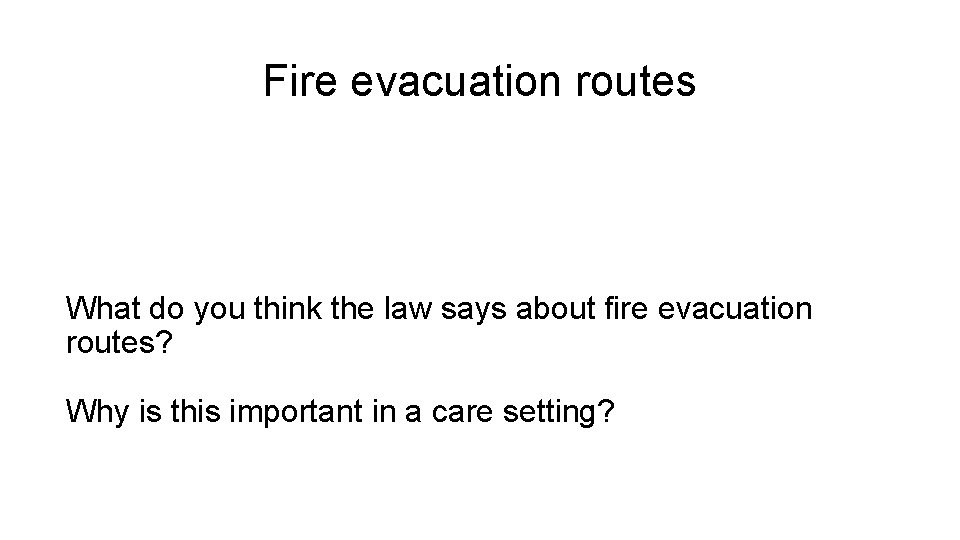
Fire evacuation routes What do you think the law says about fire evacuation routes? Why is this important in a care setting?
Security measures What security measures does this College take?
Security measures Security activity
Personal safety… Quite often, whilst working in health and social care, you will be working on your own. 1. What measures do organisations take to protect workers who are on their own? You must all contribute or your answers will not be accepted. Use different coloured pens to write your answers. Write your answer and pass the answer sheet on to the next person.
Personal safety… Quite often, whilst working in health and social care, you will be working on your own. 1. Why do organisations take these measures? You must all contribute or your answers will not be accepted. Use different coloured pens to write your answers. Write your answer and pass the answer sheet on to the next person.
Stress! Stress is a health and safety matter…but why?
Stress! Stress activities
Managing stress Working in groups of 3, you have 3 minutes to list ways in which care workers can manage stress. You must all contribute or your answers will not be accepted. Use different coloured pens to write your answers. Write your answer and pass the answer sheet on to the next person.
Managing stress Working in groups of 3, you have 3 minutes to list ways in which care workers can get support to help them to manage stress. You must all contribute or your answers will not be accepted. Use different coloured pens to write your answers. Write your answer and pass the answer sheet on to the next person.

Unit assignment – learning objectives 6 -9
Tutorial Work that is still to be handed in: Assignment feedback what are you doing to make sure that you can submit work on time? Attendance
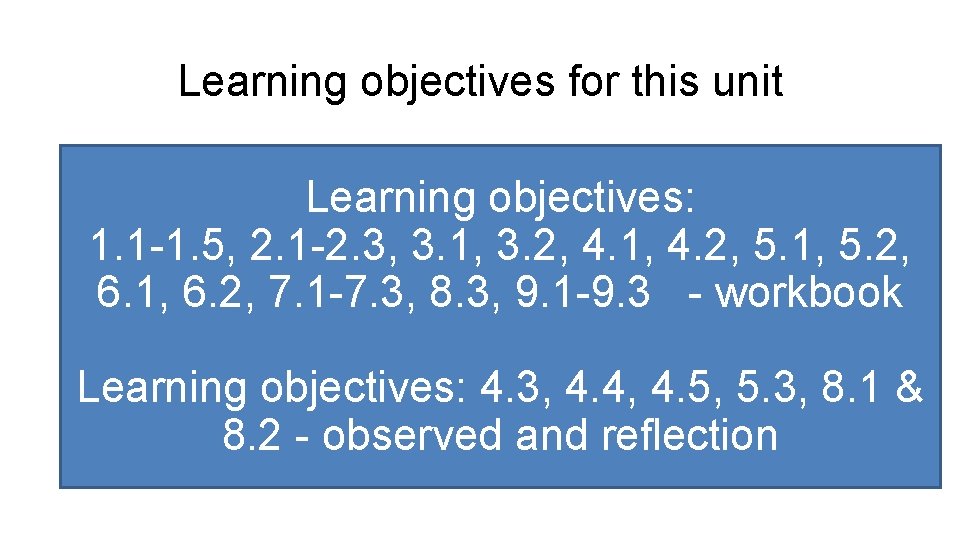
Learning objectives for this unit Learning objectives: 1. 1 1. 5, 2. 1 2. 3, 3. 1, 3. 2, 4. 1, 4. 2, 5. 1, 5. 2, 6. 1, 6. 2, 7. 1 7. 3, 8. 3, 9. 1 9. 3 workbook Learning objectives: 4. 3, 4. 4, 4. 5, 5. 3, 8. 1 & 8. 2 observed and reflection
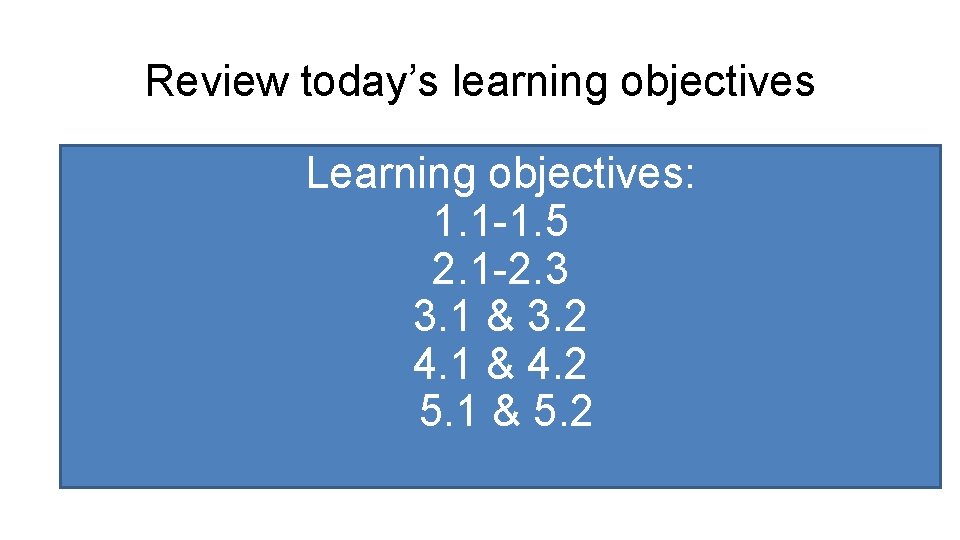
Review today’s learning objectives Learning objectives: 1. 1 1. 5 2. 1 2. 3 3. 1 & 3. 2 4. 1 & 4. 2 5. 1 & 5. 2
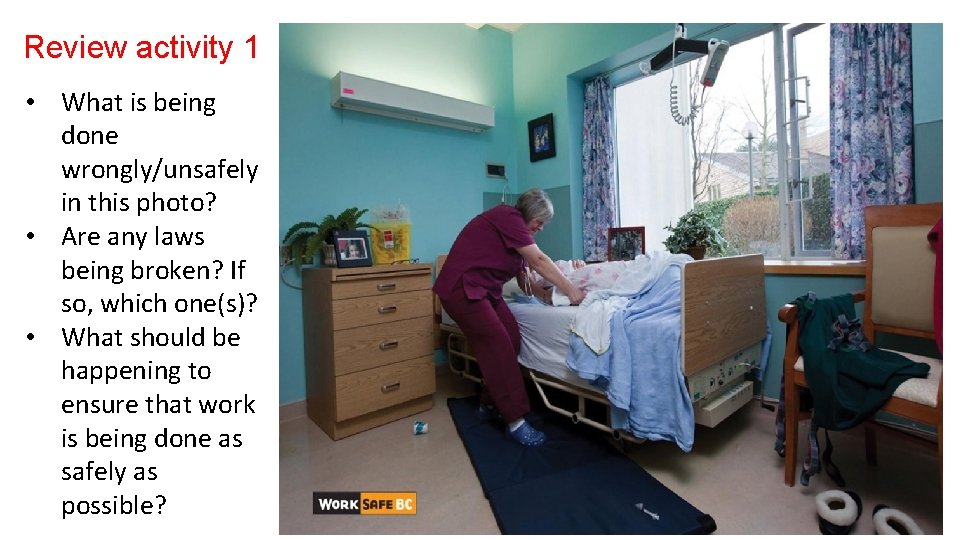
Review activity 1 • What is being done wrongly/unsafely in this photo? • Are any laws being broken? If so, which one(s)? • What should be happening to ensure that work is being done as safely as possible?
Review activity 2 Which laws and regulations tell employers to keep workers safe from assault? What do they say?
Review activity 2 Which laws and regulations tell employers to keep workers safe from assault? And what do they say? Health and Safety at Work Act 1974: Section 2, Part 1: This places a general duty on employers 'so far as is reasonably practicable' to protect the health, safety and welfare at work of all employees. If this is the case, what can/should employers do?
Review activity 2 Which laws and regulations tell employers to keep workers safe from assault? What do they say? The Management of Health and Safety at Work Regulations 1992 The regulations set out responsibilities for carrying out risk assessments and health surveillance in the workplace, as well as putting health and safety arrangements including assistance in place 3. —(1) Every employer shall make a suitable and sufficient assessment of— • (a)the risks to the health and safety of their employees to which they are exposed while they are at work
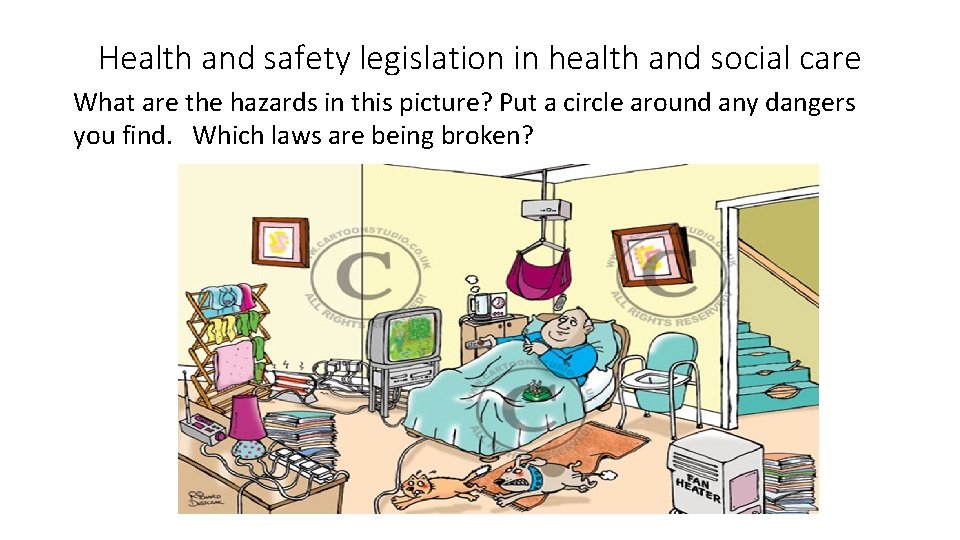
Health and safety legislation in health and social care What are the hazards in this picture? Put a circle around any dangers you find. Which laws are being broken?
Slips, trips and falls • Slips, trips and falls are common cause of work accidents. • Most are a result of poor housekeeping. • Most can be prevented by using a small risk assessment and common sense.
Electricity • Electricity can cause severe injury and death. • You must ensure electrical equipment is kept in good repair and is tested for safety each year. • Ensure your service users are protected from electrical dangers if they are unable to protect themselves.
Statistics on health and safety • There approximately 11, 500 reported accidents each year in the NHS. • These often cause, major injury or more than three days absence from work. • There is at least 1 slip or trip accident every 3 minutes.
How it works… Legislation Statutory guidance documents (eg , Working Together to Safeguard Children’, ‘No Secrets’) Organisational Policies Then you put all this into practice in your workplace
Common themes? • Protection • Balancing health and safety with human rights and dignity • Privacy • Independence • Having one’s need met • Being listened to • Safe services/safe practices • Being prepared • Reducing risks • Openeness and accountability so that others can see that services work safely • Duties on employers to keep staff and services users safe (eg risk assessments)
Health, safety and wellbeing in care settings Learning Outcomes: By the end of this session you will be able to: • identify legislation and good practice that relate to moving and handling equipment • list hazardous substances that you will find in health and social care workplaces • give examples of how we actually put the law relating to hazardous substances into practice • summarise fire safety procedures • explain why personal safety is important in health and social care settings • examine the causes and symptoms of stress • describe ways in which we can manage stress
- Slides: 56