
Health Resources and Services Administration Rural Community Infrastructure

- Slides: 24
Health Resources and Services Administration Rural Community Infrastructure P 3 Roundtable Meeting July 24, 2018 Nick Zucconi Regional Administrator, Office of Regional Operations - Denver Health Resources and Services Administration (HRSA)
Health Resources and Services Administration (HRSA) Overview § Supports more than 90 programs that provide health care to people who are geographically isolated, economically or medically challenged § HRSA does this through grants and cooperative agreements to more than 3, 000 awardees, including community and faithbased organizations, colleges and universities, hospitals, state, local, and tribal governments, and private entities § Every year, HRSA programs serve tens of millions of people, including people living with HIV/AIDS, pregnant women, mothers and their families, and those otherwise unable to access quality health care 2
Health Center Program § Roughly 1, 400 HRSA-supported health centers operate more than 10, 400 service delivery sites across all U. S. states and territories § Nearly 26 million people, or 1 in 12 nationwide, rely on a HRSA-funded health center for affordable, accessible primary health care, including: • 1 in 3 people living in poverty • 1 in 6 rural residents • 1 in 10 children • 330, 000+ veterans • 300, 000 American Indian/Alaska Natives • Primary Care Associations
National Health Service Corps and NURSE Corps § Supports 12, 000+ scholarships and loan repayments in exchange for service in high-need areas • National Health Service Corps (NHSC) currently supports primary care physicians, dentists, physician assistants, nurse practitioners, behavioral health providers, and other primary care providers and health professions students • NURSE Corps currently supports licensed registered nurses and nurse faculty members § NHSC and NURSE Corps clinicians provide care to more than 12 million people nationwide, including over 3. 5 million rural residents 4
HRSA’s Regions 5
Federal Office of Rural Health Policy The Federal Office of Rural Health Policy provides policy support to the Office of Secretary and supports a number of rural health programs, including state offices of rural health, hospital programs, community -based grants, and telehealth grants and technical assistance. https: //www. hrsa. gov/rural-health/index. html 11
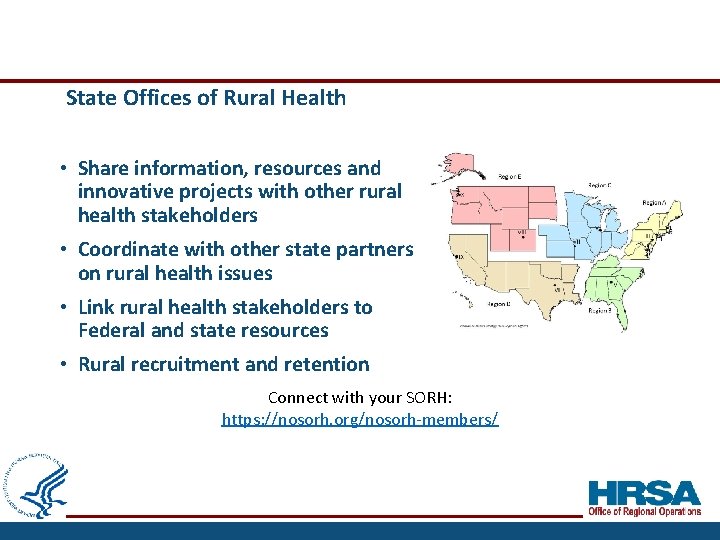
State Offices of Rural Health • Share information, resources and innovative projects with other rural health stakeholders • Coordinate with other state partners on rural health issues • Link rural health stakeholders to Federal and state resources • Rural recruitment and retention Connect with your SORH: https: //nosorh. org/nosorh-members/
Federal Office of Rural Health Policy Rural Hospital Programs § Technical assistance and support to address the unique needs of rural hospitals through programs such as: • Small Rural Hospital Improvement Program • Medicare Rural Hospital Flex Grant (Flex) • 96% of Critical Access Hospitals (CAH) reported at least one Medicare Beneficiary Quality Improvement measure and 65% of CAHs showed improvement in at least one quality measure 8
Rural Community Programs § Provide funding to increase access to care in rural communities and to address their unique health care challenges § § § Rural Health Network Development Planning Program Rural Health Network Development Program Small Health Care Provider Quality Improvement Rural Health Opioid Program Rural Health Care Services Outreach Grant Program 9
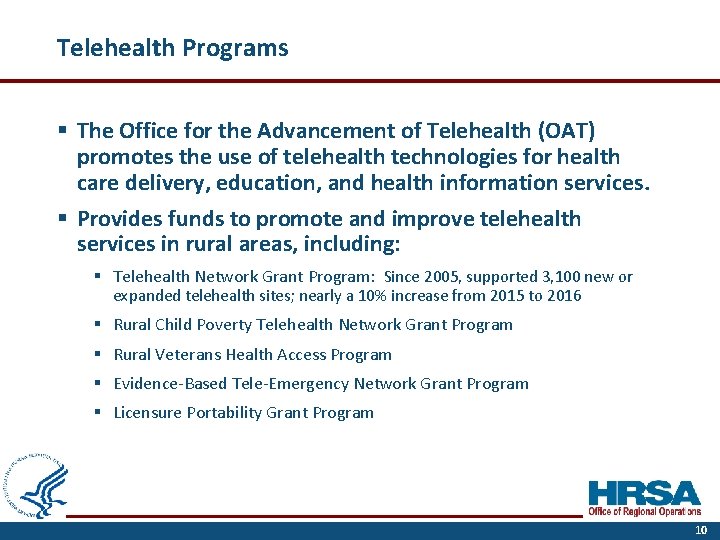
Telehealth Programs § The Office for the Advancement of Telehealth (OAT) promotes the use of telehealth technologies for health care delivery, education, and health information services. § Provides funds to promote and improve telehealth services in rural areas, including: § Telehealth Network Grant Program: Since 2005, supported 3, 100 new or expanded telehealth sites; nearly a 10% increase from 2015 to 2016 § Rural Child Poverty Telehealth Network Grant Program § Rural Veterans Health Access Program § Evidence-Based Tele-Emergency Network Grant Program § Licensure Portability Grant Program 10
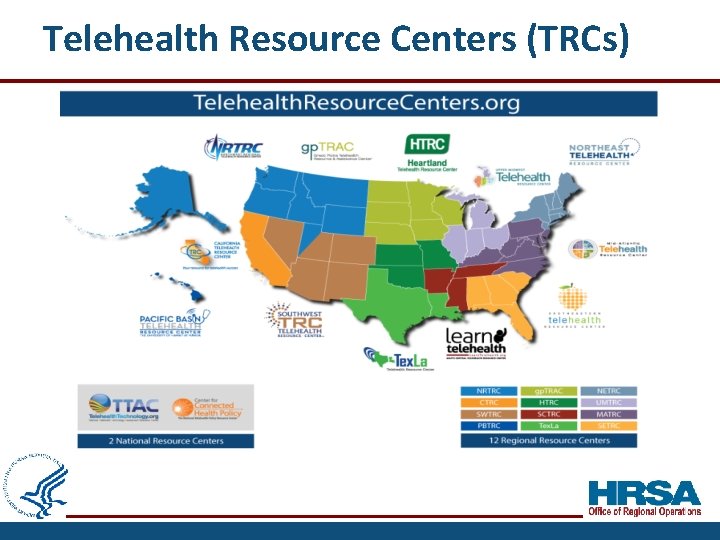
Telehealth Resource Centers (TRCs)
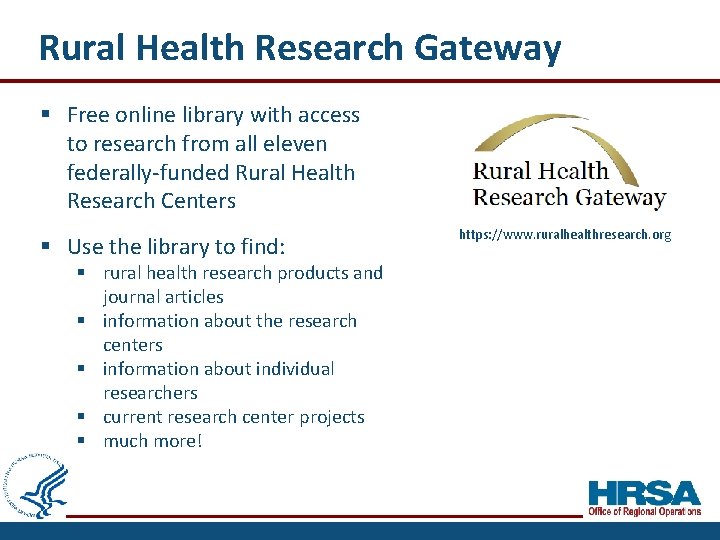
Rural Health Research Gateway § Free online library with access to research from all eleven federally-funded Rural Health Research Centers § Use the library to find: § rural health research products and journal articles § information about the research centers § information about individual researchers § current research center projects § much more! https: //www. ruralhealthresearch. org
Rural Health Grants § FYs 18 and 19 Rural Health Grants 13
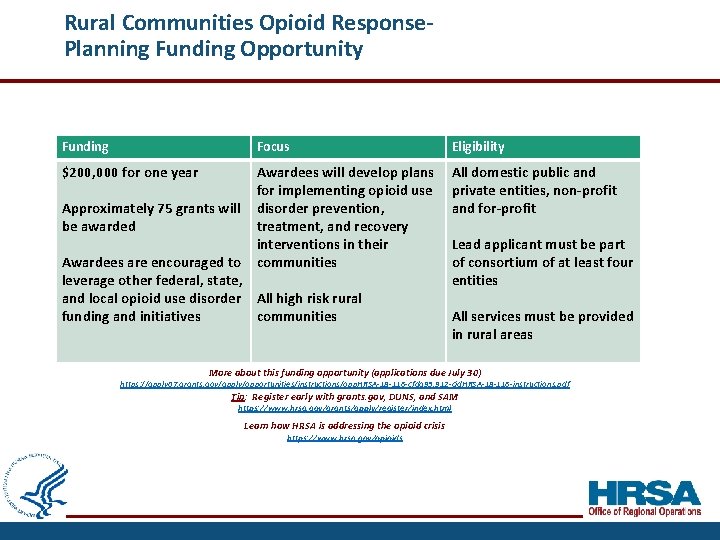
Rural Communities Opioid Response. Planning Funding Opportunity Funding Focus Eligibility $200, 000 for one year Awardees will develop plans for implementing opioid use disorder prevention, treatment, and recovery interventions in their communities All domestic public and private entities, non-profit and for-profit Approximately 75 grants will be awarded Awardees are encouraged to leverage other federal, state, and local opioid use disorder All high risk rural funding and initiatives communities Lead applicant must be part of consortium of at least four entities All services must be provided in rural areas More about this funding opportunity (applications due July 30) https: //apply 07. grants. gov/apply/opportunities/instructions/opp. HRSA-18 -116 -cfda 93. 912 -cid. HRSA-18 -116 -instructions. pdf Tip: Register early with grants. gov, DUNS, and SAM https: //www. hrsa. gov/grants/apply/register/index. html Learn how HRSA is addressing the opioid crisis https: //www. hrsa. gov/opioids 14
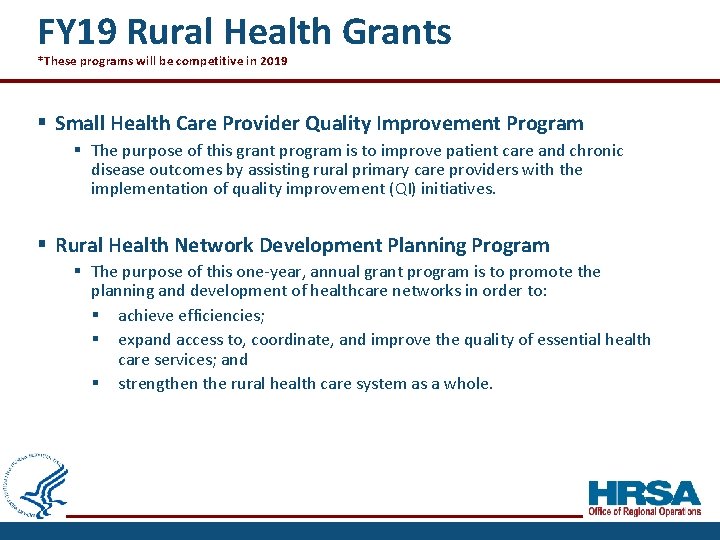
FY 19 Rural Health Grants *These programs will be competitive in 2019 § Small Health Care Provider Quality Improvement Program § The purpose of this grant program is to improve patient care and chronic disease outcomes by assisting rural primary care providers with the implementation of quality improvement (QI) initiatives. § Rural Health Network Development Planning Program § The purpose of this one-year, annual grant program is to promote the planning and development of healthcare networks in order to: § achieve efficiencies; § expand access to, coordinate, and improve the quality of essential health care services; and § strengthen the rural health care system as a whole. 19
Resources and Tools Regarding Capital Needs 16
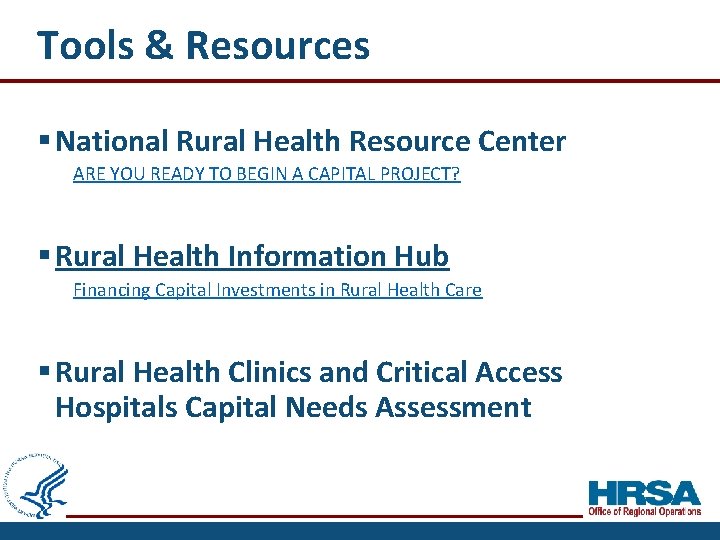
Tools & Resources § National Rural Health Resource Center ARE YOU READY TO BEGIN A CAPITAL PROJECT? § Rural Health Information Hub Financing Capital Investments in Rural Health Care § Rural Health Clinics and Critical Access Hospitals Capital Needs Assessment 19
Tools & Resources § Delta Region Community Health Systems Development Program https: //www. ruralcenter. org/drchsd • Vulnerable Hospitals Toolkit (2016) https: //nosorh. org/wp-content/uploads/2016/11/Vulnerable-Hospital. Toolkit-Excerpt. pdf • Critical Access Hospital Replacement Process: Blueprint and Roadmap (2010) https: //www. ruralcenter. org/sites/default/files/cahreplacementprocess _0. doc 19
More Tools & Resources 19
Rural Health Information Hub (RHIhub) Capital Funding § Capital Funding for Rural Healthcare § major federal grant or loan programs that support capital projects for rural healthcare facilities § foundations that support capital projects for rural healthcare facilities § low-interest loans available to rural facilities § other funding available to finance capital projects § Provides customized assistance § By phone: 1. 800. 270. 1898 § By email: info@ruralhealthinfo. org https: //www. ruralhealthinfo. org/
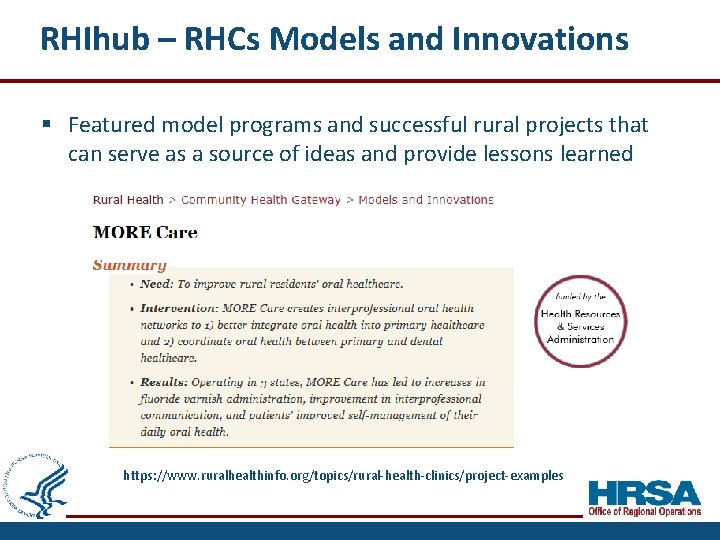
RHIhub – RHCs Models and Innovations § Featured model programs and successful rural projects that can serve as a source of ideas and provide lessons learned https: //www. ruralhealthinfo. org/topics/rural-health-clinics/project-examples
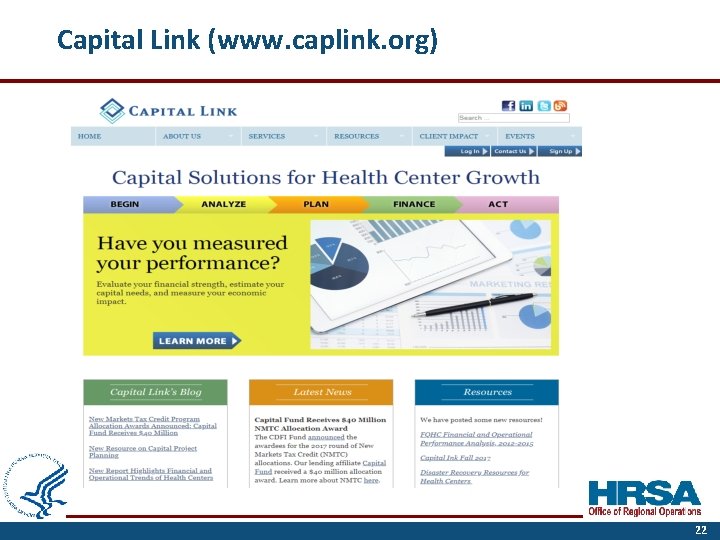
Capital Link (www. caplink. org) 22
Nick Zucconi Regional Administrator HRSA Office of Regional Operations - Denver 303 -844 -7879 nzucconi@hrsa. gov
To learn more about our agency, visit www. HRSA. gov