
Health Psychology Theories of Health Behavior Chapter 3
Health Psychology Theories of Health Behavior Chapter 3 PY 490 - Hudiburg
Theories of Health Behavior z What is a scientific theory? y Statement about causal relationships among abstract constructs whose validity is not conclusively proven x Has application beyond a single situation, event, or thing
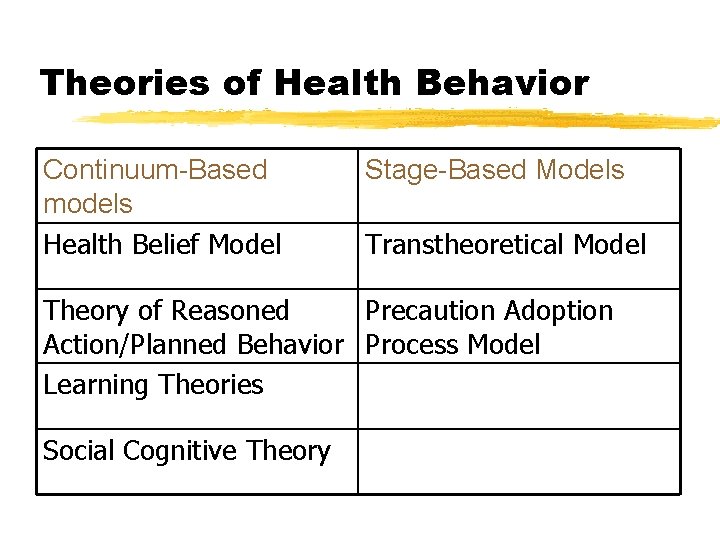
Theories of Health Behavior Continuum-Based models Health Belief Model Stage-Based Models Transtheoretical Model Theory of Reasoned Precaution Adoption Action/Planned Behavior Process Model Learning Theories Social Cognitive Theory
Theories of Health Behavior y. Continuum- and stage-based models differ in their assumptions regarding the contributions of beliefs across persons situations, and, as a result, the nature of the relationships between beliefs and behavior
What are continuum theories of health behavior? z. Identify set of variables zcombine them to predict likelihood the person will engage in given behavior yon a continuum of action likelihood
Health Belief Model
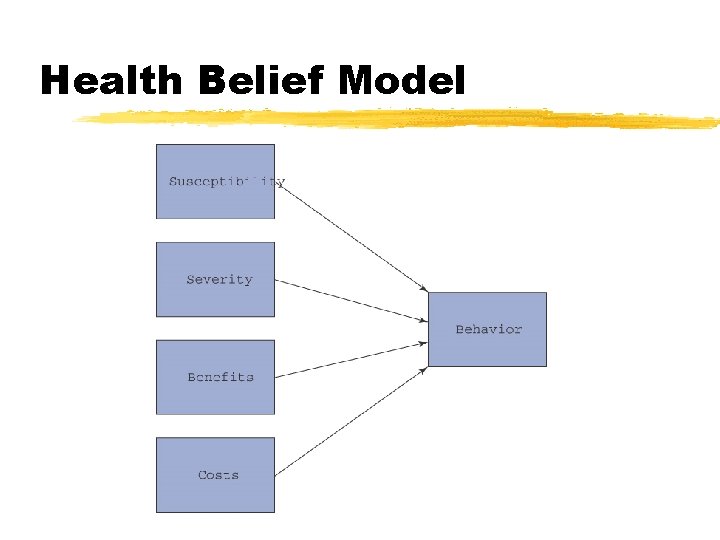
Health Belief Model z. Susceptibility z. Severity z. Benefits - Motivational Cues z. Barriers z. Table 3. 1, p. 62
Susceptibility & Severity z Susceptibility y. How likely one thinks a bad outcome (e. g. , get sick or a disease) is if behavior persists (doesn’t change). z Severity y. The consequence is perceived to be severe as opposed to mild.
Benefits of Behavior z. The alternative behavior will reduce the likelihood of the negative consequence (e. g. , disease). & z. Benefits are perceived to outweigh costs. z. Motivational cues – in Janz & Becker (1984) model revision y. Cues (internal or external) that help convert intentions into behavior
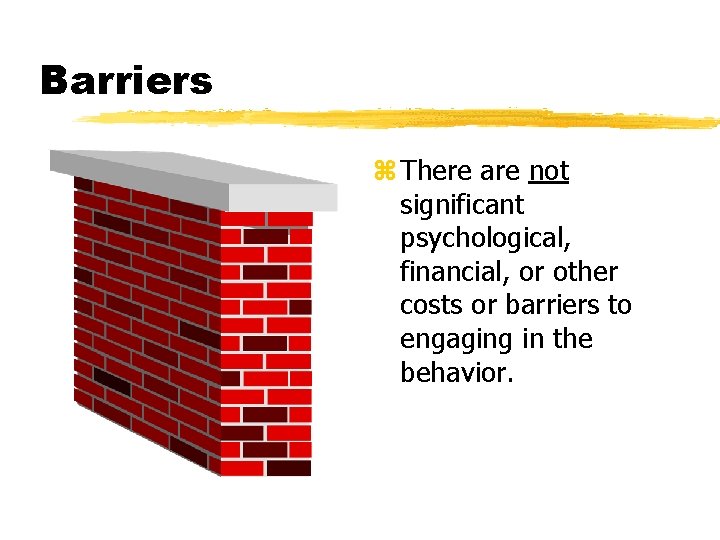
Barriers z There are not significant psychological, financial, or other costs or barriers to engaging in the behavior.
Jane is not likely to continue smoking because… z. She thinks that she might get lung cancer if she continues to smoke (susceptibility). z. She believes that dying from lung cancer is terrible (severity). z. Jane does not find smoking to be very pleasurable (cost/benefits). z. Her friends are supportive of her quitting (absence of barrier)
Jon is likely to continue smoking because z He agrees with the tobacco industry--smoking doesn’t cause lung cancer (susceptibility). z He believes that dying from lung cancer is not any worse than any other way of dying (severity). z Jon feels that smoking relaxes him (cost/benefits). z His friends offer him cigarettes (barrier to quitting)
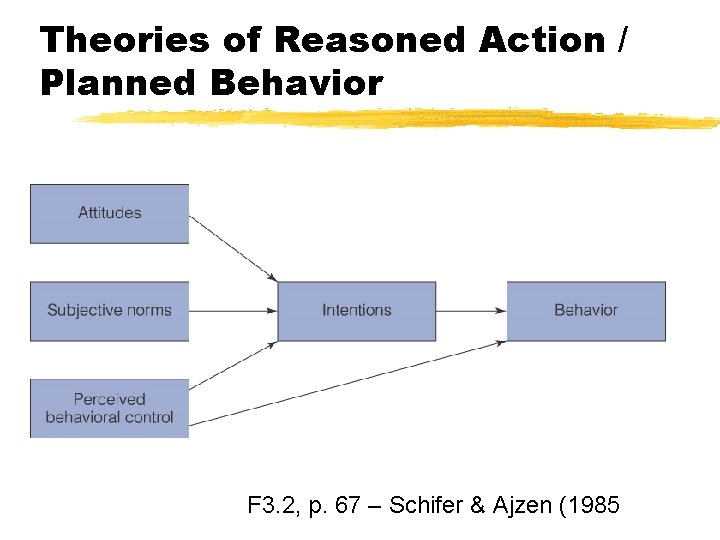
Theories of Reasoned Action / Planned Behavior F 3. 2, p. 67 – Schifer & Ajzen (1985
Theories of Reasoned Action / Planned Behavior z Intentions z Attitudes y. Beliefs (outcome expectancies) y. Values z Subjective norms y. Beliefs (about what others think you should do) y. Motivation to comply z Perceived behavioral control z Table 3. 2, p. 66
Intentions z“Barring unforeseen events, a person will usually act in accordance with his or her intentions” (Ajzen & Fishbein, 1980, p. 5).
Attitudes z. One’s positive or negative evaluation of performing a behavior y. Beliefs: about the consequences of performing the behavior (outcome expectancies) y. Values: appraisal (importance) of the consequences
Subjective Norms z. One’s perception of the social pressures to perform or not perform a behavior. y. Beliefs: about whether specific individuals or groups think one should perform the behavior. y. Motivation to comply with these people.
Someone likely to drink and drive z ATTITUDE: Bob feels more at ease with others when he drinks (beliefs about the consequences and values) z SUBJECTIVE NORM: Bob feels that his colleagues encourage him to drink after work (belief) and he wants them to like him (motivation to comply) z INTENTION: Bob intends (expects) to drink with his colleagues after work and then drive home 1 or more times in the next 30 days (intentions).

Theory of Planned Behavior z Past Behavior y. Always the best predictor of future behavior Behavioral Control z Perceived Behavioral Control/Locus of Control/Self-Efficacy y Intention -> Behavior x. Link is problematic when behavior is not fully under the individual’s control.
Learning Theories z. Assumes that behavior is influenced by learning processes z. Classical Conditioning yunconditioned stimulus (UCS) yunconditioned response (UCR) yneutral stimulus yconditioned stimulus (CS) yconditioned response (CR)
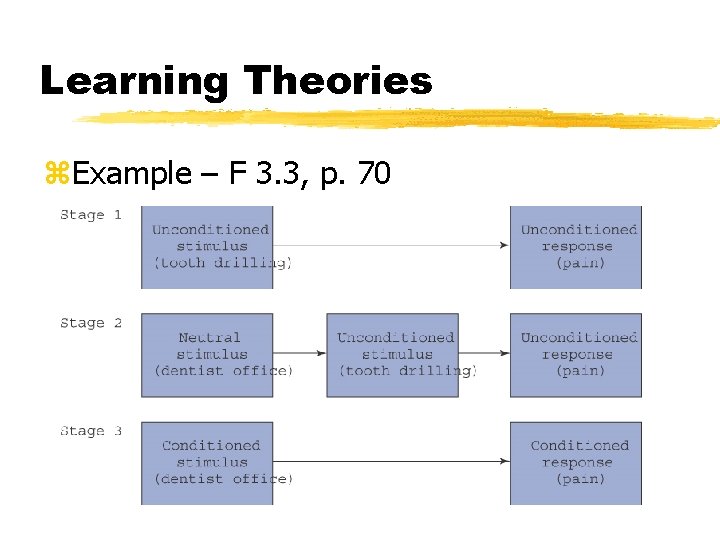
Learning Theories z. Example – F 3. 3, p. 70
Learning Theories z Operant conditioning y. Differential Reinforcement x. Positive reinforcement (rewards) x. Negative reinforcement (avoidance of something bad) y. Punishments x. Positive punishment (aversive stimuli) x. Negative punishment (loss of reward) y. Positive (present something y. Negative (take something away) y. Reinforcement (behavior increases) y. Punishment (behavior decreases ycan occur through observation – Bandura
Social cognitive theory z. From Bandura’s social learning theory z. Direct modeling zsymbolic modeling zself-efficacy zoutcome expectancies – evaluative definitions
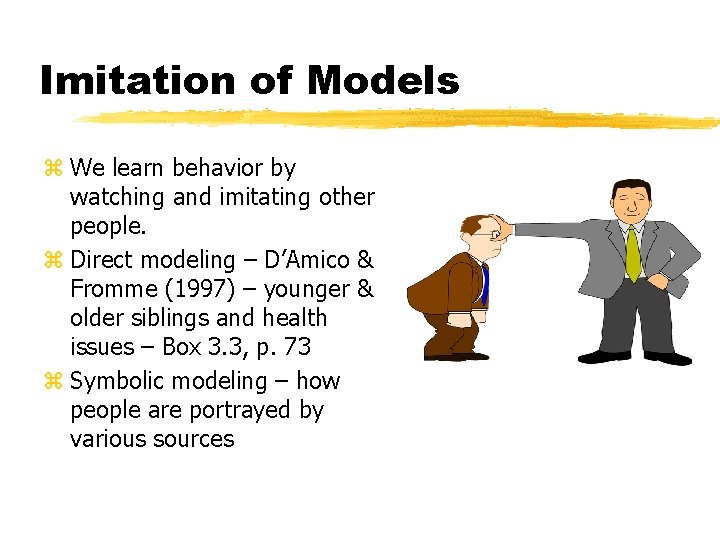
Imitation of Models z We learn behavior by watching and imitating other people. z Direct modeling – D’Amico & Fromme (1997) – younger & older siblings and health issues – Box 3. 3, p. 73 z Symbolic modeling – how people are portrayed by various sources
Self Efficacy z. Perceived ability to perform a task. z. Self efficacy predicts future behavior if there adequate incentives and skills. z. Table 3. 3, p. 75 – sample scale
Exposure and Adoption of Evaluative Definitions z. The more an individual defines a behavior as good or at least justified rather than bad, the more likely they are to engage in it. y. Evaluative definitions xpositive, neutral, negative xnorms, attitudes, orientations
Social cognitive theory z What does it predict? ysmoking cessation yeating nutritious food ylowering cholesterol ybrushing and flossing teeth yusing condoms yexercising regularly z Pain during child birth – Box 3. 4, p. 77 z Building self-efficacy – F 3. 4, p. 76 study

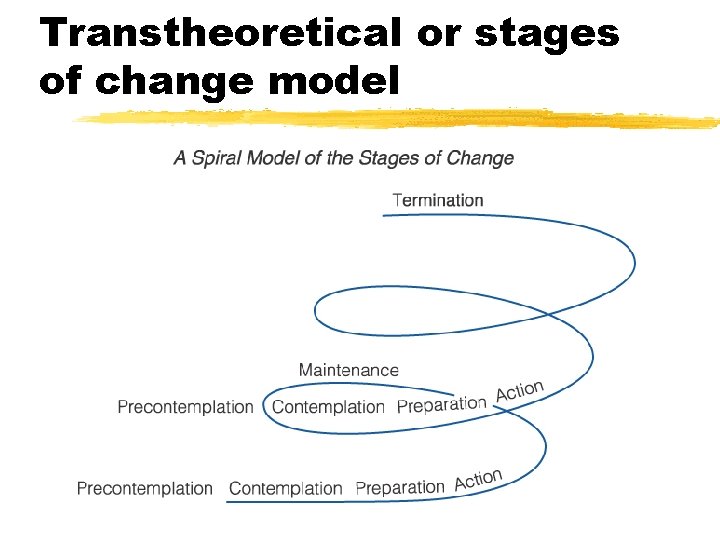
What are stage models of health behavior change? z Set of ordered categories or stages that people go through as they attempt to change their behavior z Stages of Change y“Ordered categories along a continuum of motivational readiness to change a problem behavior” z Transtheorectical z Precaution adoption process model
Transtheoretical Model zprecontemplation stage zpreparation zaction z. Maintenance http: //www. uri. edu/research/cprc/transtheoretical. htm
Transtheoretical or stages of change model
Precontemplation z No intention to change behavior in the foreseeable future (next 6 months). z Includes people who are unaware of the problem plus those who know about the problem but are not considering change. z “I am not thinking about changing my risky sexual behavior within the next 6 months to reduce the risk of getting HIV. ”
Contemplation z People are aware that a problem exists and are seriously thinking about overcoming it but have not yet made a firm commitment to take action. z Intending to change within 6 months; open to feedback and information about how to change. However, ambivalent about the costs and benefits of their behavior. z “I am thinking about changing my risky sexual behavior within the next 6 months to reduce the risk of getting HIV. ”
Preparation z Individual is intending to take action in the next month and has unsuccessfully taken action in the past year (combines intention and behavior criteria). z Actively planning change and already taking some steps toward action such as reducing frequency of problem behavior. z “I am thinking about changing my risky sexual behavior within the next 30 days to reduce the risk of getting HIV. ”
Action z Stage in which individuals modify their behavior, experiences, or environment in order to overcome their problems. Involves overt behavioral changes and requires commitment of time and energy. z e. g. , cessation of smoking has occurred and last cigarette was less than 6 months ago. z “In the last few months I have changed my risky sexual behavior to reduce the risk of getting HIV. ”
Maintenance z People work to prevent relapse and consolidate the gains attained during action. z Sustaining change and resisting temptation to relapse. z Stage extends from 6 months and beyond the initial behavioral change. z “For more than 6 months I have changed my (former) risky sexual behavior to reduce the risk of getting HIV. ”
Transtheoretical Model z. Limitations ycognitive processes may be different for stopping a behavior and starting a new one ythinking about costs and benefits is not a good predictor of moving forward or not yare the stages the right ones?
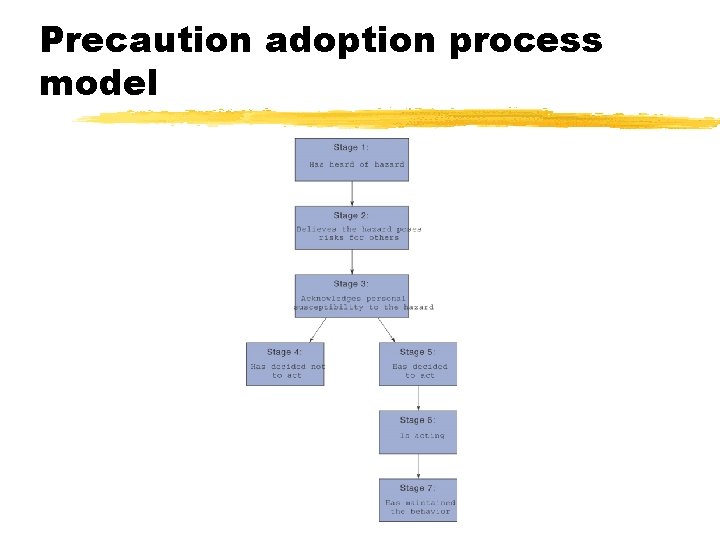
Precaution adoption process model
Precaution Adoption Process Model z. Stage z. Stage 1: 2: 3: 4: 5: 6: 7: Unaware of issue Unengaged by issue Deciding about acting Decided not to act Decided to act Acting Maintenance http: //www. psandman. com/articles/precautn. htm
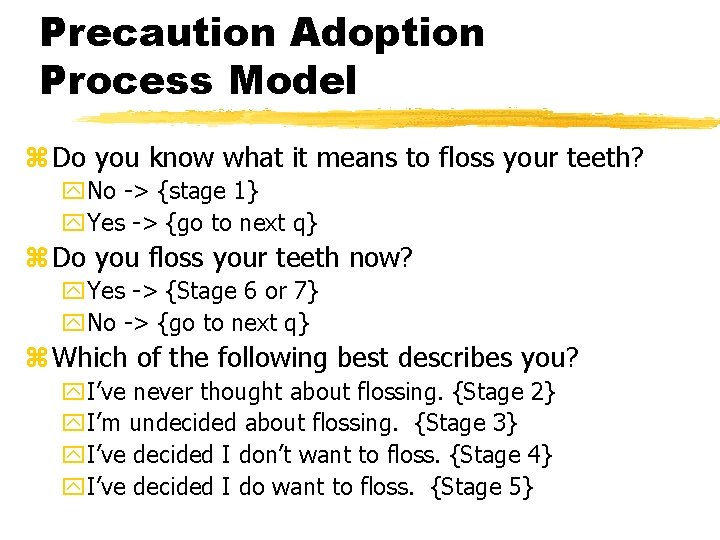
Precaution Adoption Process Model z Do you know what it means to floss your teeth? y. No -> {stage 1} y. Yes -> {go to next q} z Do you floss your teeth now? y. Yes -> {Stage 6 or 7} y. No -> {go to next q} z Which of the following best describes you? y. I’ve never thought about flossing. {Stage 2} y. I’m undecided about flossing. {Stage 3} y. I’ve decided I don’t want to floss. {Stage 4} y. I’ve decided I do want to floss. {Stage 5}
Precaution adoption process model z. Implications ybeing at different stages should be influenced by different types of information yactually engaing in a behavior should be influenced by obstacles and barriers
Issues for consideration z A list of variables is not a model. - Are there other variables that should be included in these models? z How models are evaluated - Reliability and validity of constructs z Context does matter z Are all behaviors rational? – Behavioral Intention – Behavioral Expectation – Behavioral Willingness z Turning intentions into action
- Slides: 41