
Health Professionals Attitudes Toward SelfHarming Patients Emily Prosser
- Slides: 1
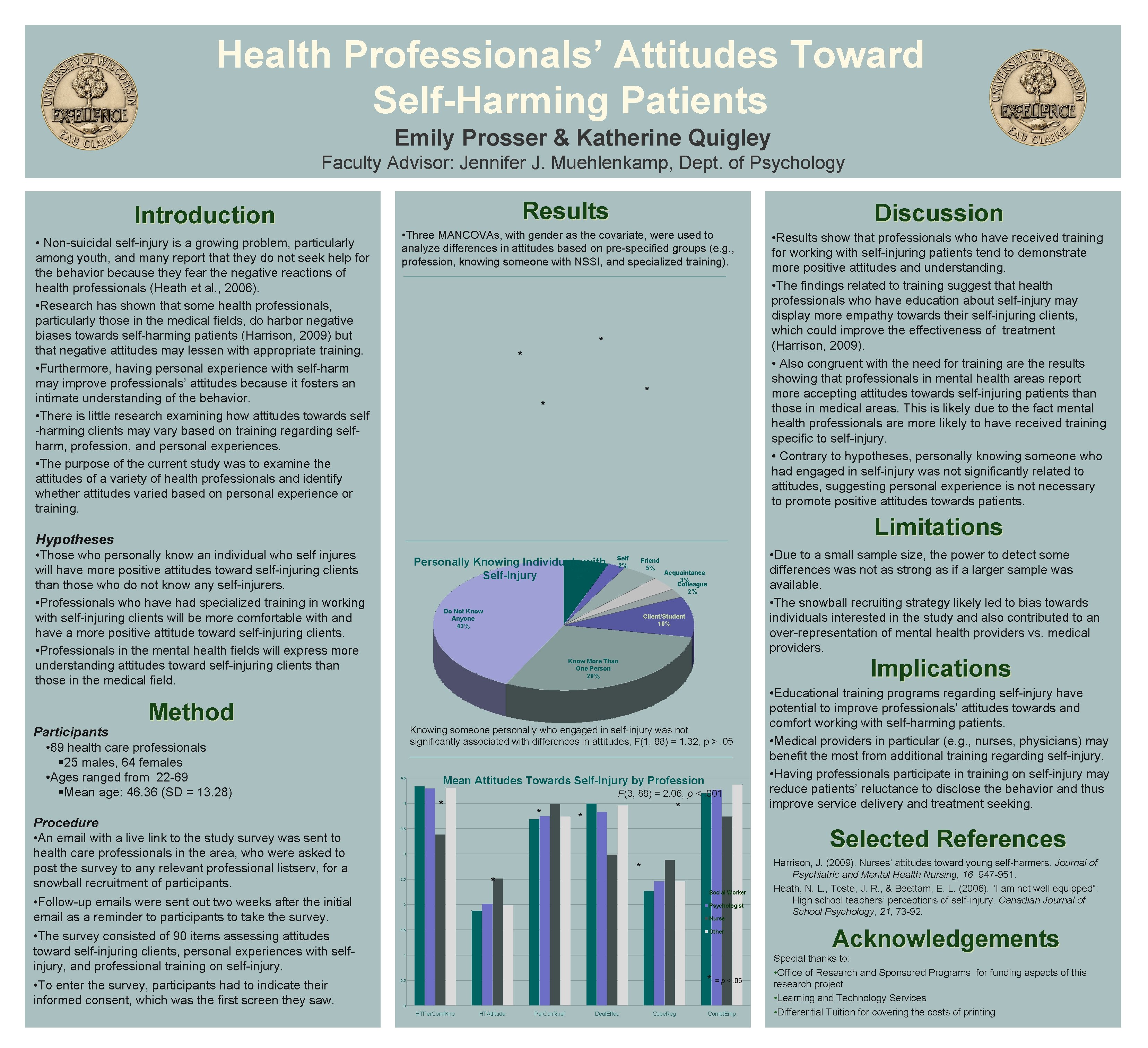
Health Professionals’ Attitudes Toward Self-Harming Patients Emily Prosser & Katherine Quigley Faculty Advisor: Jennifer J. Muehlenkamp, Dept. of Psychology Introduction • Non-suicidal self-injury is a growing problem, particularly among youth, and many report that they do not seek help for the behavior because they fear the negative reactions of health professionals (Heath et al. , 2006). • Research has shown that some health professionals, particularly those in the medical fields, do harbor negative biases towards self-harming patients (Harrison, 2009) but that negative attitudes may lessen with appropriate training. • Furthermore, having personal experience with self-harm may improve professionals’ attitudes because it fosters an intimate understanding of the behavior. • There is little research examining how attitudes towards self -harming clients may vary based on training regarding selfharm, profession, and personal experiences. • The purpose of the current study was to examine the attitudes of a variety of health professionals and identify whether attitudes varied based on personal experience or training. Results Discussion • Three MANCOVAs, with gender as the covariate, were used to analyze differences in attitudes based on pre-specified groups (e. g. , profession, knowing someone with NSSI, and specialized training). • Results show that professionals who have received training for working with self-injuring patients tend to demonstrate more positive attitudes and understanding. • The findings related to training suggest that health professionals who have education about self-injury may display more empathy towards their self-injuring clients, which could improve the effectiveness of treatment (Harrison, 2009). • Also congruent with the need for training are the results showing that professionals in mental health areas report more accepting attitudes towards self-injuring patients than those in medical areas. This is likely due to the fact mental health professionals are more likely to have received training specific to self-injury. • Contrary to hypotheses, personally knowing someone who had engaged in self-injury was not significantly related to attitudes, suggesting personal experience is not necessary to promote positive attitudes towards patients. * * Limitations Hypotheses • Those who personally know an individual who self injures will have more positive attitudes toward self-injuring clients than those who do not know any self-injurers. • Professionals who have had specialized training in working with self-injuring clients will be more comfortable with and have a more positive attitude toward self-injuring clients. • Professionals in the mental health fields will express more understanding attitudes toward self-injuring clients than those in the medical field. Personally Knowing Individuals with Family Self-Injury 6% health care professionals in the area, who were asked to post the survey to any relevant professional listserv, for a snowball recruitment of participants. • Follow-up emails were sent out two weeks after the initial email as a reminder to participants to take the survey. • Due to a small sample size, the power to detect some differences was not as strong as if a larger sample was available. • The snowball recruiting strategy likely led to bias towards individuals interested in the study and also contributed to an over-representation of mental health providers vs. medical providers. Acquaintance 3% Colleague 2% Client/Student 10% Implications Know More Than One Person 29% Knowing someone personally who engaged in self-injury was not significantly associated with differences in attitudes, F(1, 88) = 1. 32, p >. 05 4. 5 4 Procedure • An email with a live link to the study survey was sent to Friend 5% Do Not Know Anyone 43% Method Participants • 89 health care professionals § 25 males, 64 females • Ages ranged from 22 -69 §Mean age: 46. 36 (SD = 13. 28) Self 2% Mean Attitudes Towards Self-Injury by Profession F(3, 88) = 2. 06, p <. 001 * * Selected References 3. 5 3 * * 2. 5 Social Worker Psychologist 2 Nurse • The survey consisted of 90 items assessing attitudes toward self-injuring clients, personal experiences with selfinjury, and professional training on self-injury. 1. 5 • To enter the survey, participants had to indicate their informed consent, which was the first screen they saw. 0. 5 • Educational training programs regarding self-injury have potential to improve professionals’ attitudes towards and comfort working with self-harming patients. • Medical providers in particular (e. g. , nurses, physicians) may benefit the most from additional training regarding self-injury. • Having professionals participate in training on self-injury may reduce patients’ reluctance to disclose the behavior and thus improve service delivery and treatment seeking. Other 1 * = p <. 05 0 HTPer. Comf. Kno HTAttitude Per. Conf&ref Deal. Effec Cope. Reg Compt. Emp Harrison, J. (2009). Nurses’ attitudes toward young self-harmers. Journal of Psychiatric and Mental Health Nursing, 16, 947 -951. Heath, N. L. , Toste, J. R. , & Beettam, E. L. (2006). “I am not well equipped”: High school teachers’ perceptions of self-injury. Canadian Journal of School Psychology, 21, 73 -92. Acknowledgements Special thanks to: • Office of Research and Sponsored Programs for funding aspects of this research project • Learning and Technology Services • Differential Tuition for covering the costs of printing