
Health policies and procedures for Healthcare Organisations Dr
- Slides: 34
Health policies and procedures for Healthcare Organisations Dr. Israa Al-Rawashdeh MD, MPH, Ph. D Faculty of Medicine Mutah University 2021
Introduction • Providing healthcare services IS COMPLEX! • Health care organizations use policies and procedures so they can reduce this complexity. • In most health organizations, priority is given to direct patient care. However, managers need to write, review or update policies and procedures. • Well-written, up-to-date policies and procedures reduce practice variability that my result in substandard care and patient harm. • Therefore, maintenance of policies also ensures reduced risks (malpractice, claims. Etc. ).
What is a policy? • Policy: A set of principles outlining the context, goal, or purpose of an organization to guide decision making (action and inaction) in relation to processes or activities that take place or might be expected to occur (Hollnagel et al. , 2014).
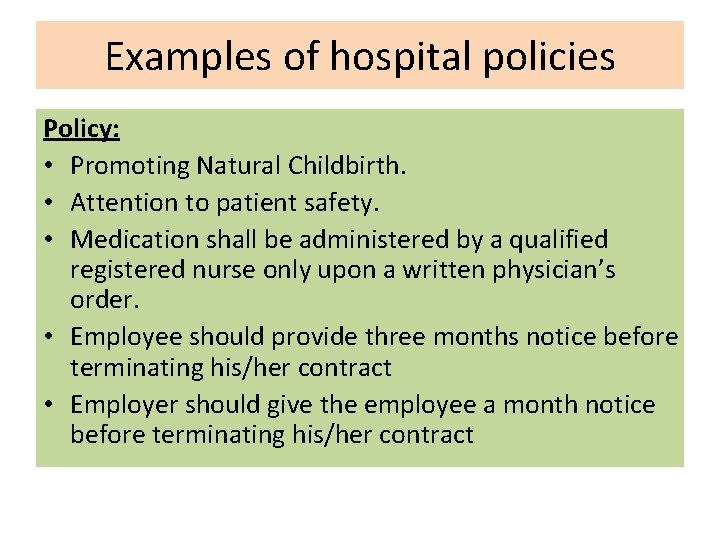
Examples of hospital policies Policy: • Promoting Natural Childbirth. • Attention to patient safety. • Medication shall be administered by a qualified registered nurse only upon a written physician’s order. • Employee should provide three months notice before terminating his/her contract • Employer should give the employee a month notice before terminating his/her contract
Procedure? Procedure: The desired, intentional action steps to be taken by specified persons to achieve a certain objective in a defined set of circumstances. i. e. How to carry out the policy!
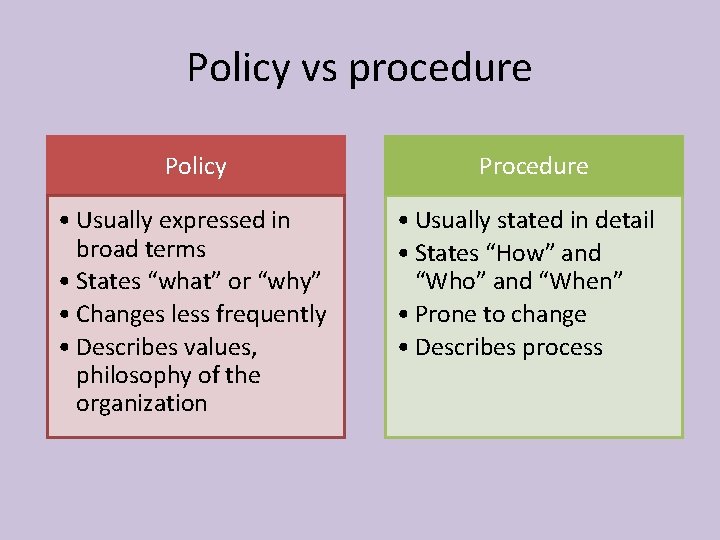
Policy vs procedure Policy • Usually expressed in broad terms • States “what” or “why” • Changes less frequently • Describes values, philosophy of the organization Procedure • Usually stated in detail • States “How” and “Who” and “When” • Prone to change • Describes process
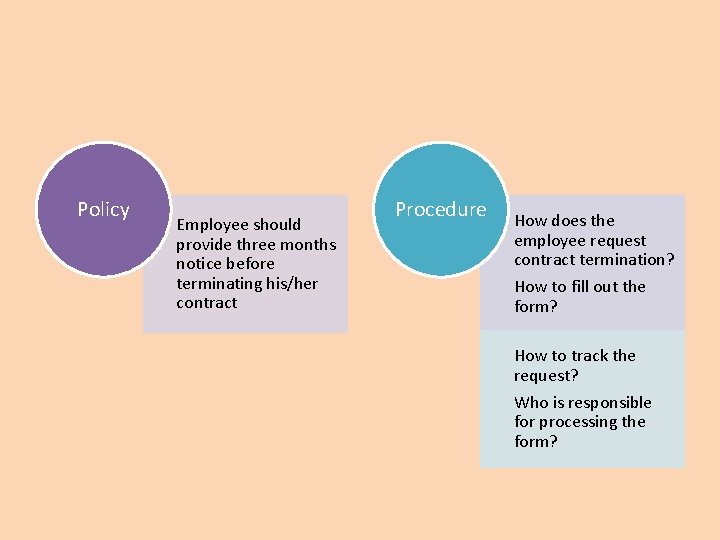
Policy Employee should provide three months notice before terminating his/her contract Procedure How does the employee request contract termination? How to fill out the form? How to track the request? Who is responsible for processing the form?
Protocol: Synonymous with procedure. Often used when describing clinical patient carerelated interventions. For example, a chemotherapy protocol or protocol to quality healthcare delivery. Guideline: Recommended actions for a specific situation or type of case. For example, A clinical practice guideline that outline blood-testing practices for patients who are taking anticoagulants.
The Purpose of Policies and Procedures Formalized, written policies and procedures fulfill a number of important purposes: 1. Ensure adherence with recognized professional practices therefore reducing practice variation (standardization). 2. Promote compliance with regulations. (i. e. All policies and procedures should not contradict with the government rules and regulations and MOH policies and procedures). 3. Can be used to ensure adherence to the accreditation requirements 4. Help staff understand their roles and responsibilities within the organization. particularly new personnel. 5. Reduce reliance on memory, which has been shown to be a major source of human errors.
Types of hospital policies and procedures There are several types of hospital policies and procedures but the main ones are : • Philosophical – Code of Ethics – Mission – Vision – Organizational values – Code of Conduct (specific situations) – Communication culture (Effective communication keeps internal processes running smoothly and helps to create positive relations with people both inside and outside the organization).
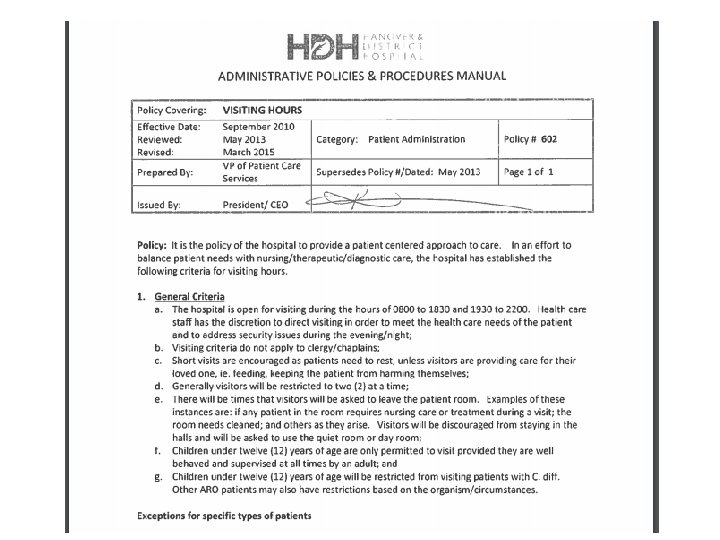
Types of hospital policies and procedures • Administrative – General Rules and regulations – Leaves, personnel processes – Smoking and environmental health policies – Security policies – Staff development – Total quality management policies
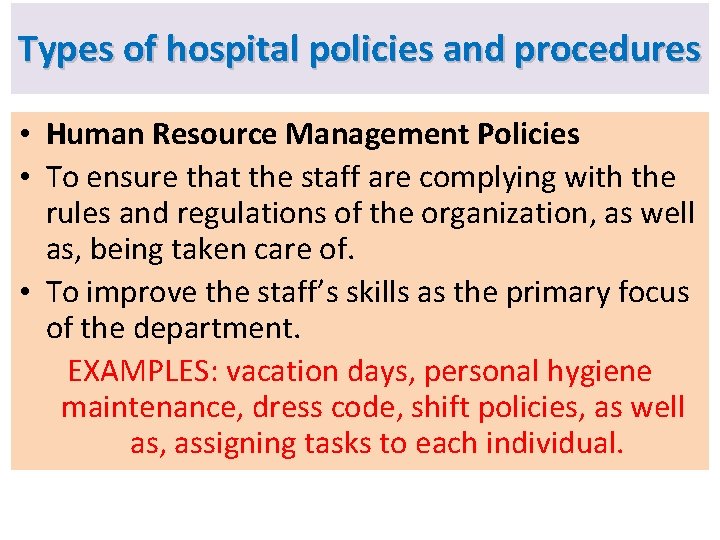
Types of hospital policies and procedures • Human Resource Management Policies • To ensure that the staff are complying with the rules and regulations of the organization, as well as, being taken care of. • To improve the staff’s skills as the primary focus of the department. EXAMPLES: vacation days, personal hygiene maintenance, dress code, shift policies, as well as, assigning tasks to each individual.
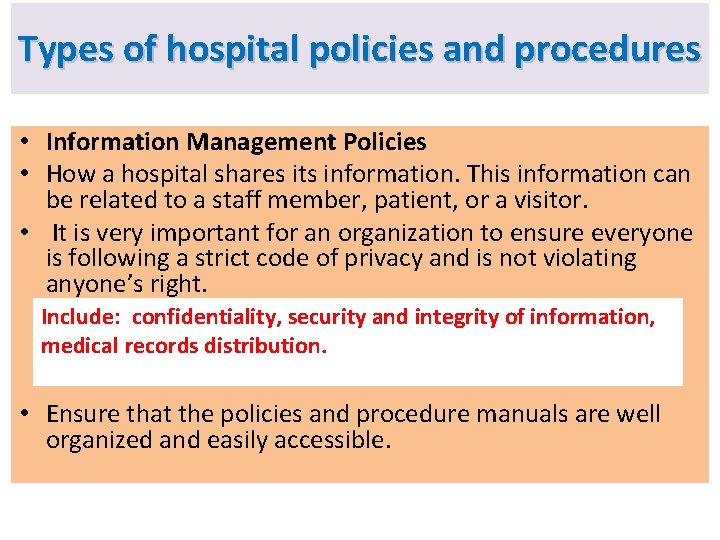
Types of hospital policies and procedures • Information Management Policies • How a hospital shares its information. This information can be related to a staff member, patient, or a visitor. • It is very important for an organization to ensure everyone is following a strict code of privacy and is not violating anyone’s right. Include: confidentiality, security and integrity of information, medical records distribution. • Ensure that the policies and procedure manuals are well organized and easily accessible.
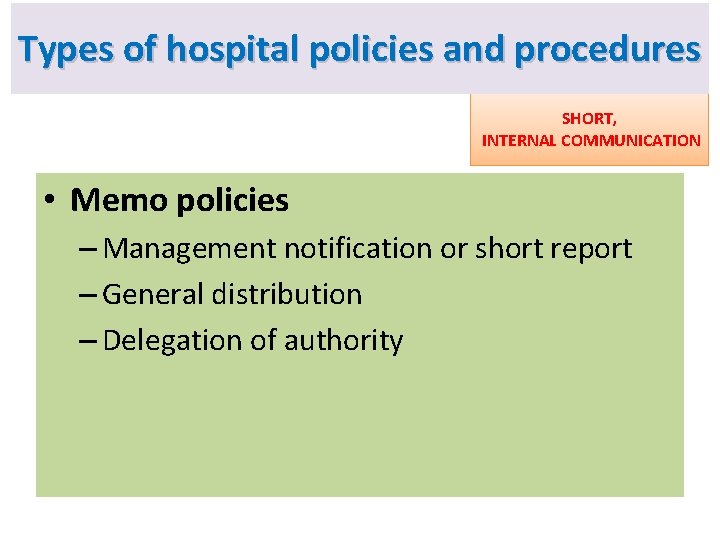
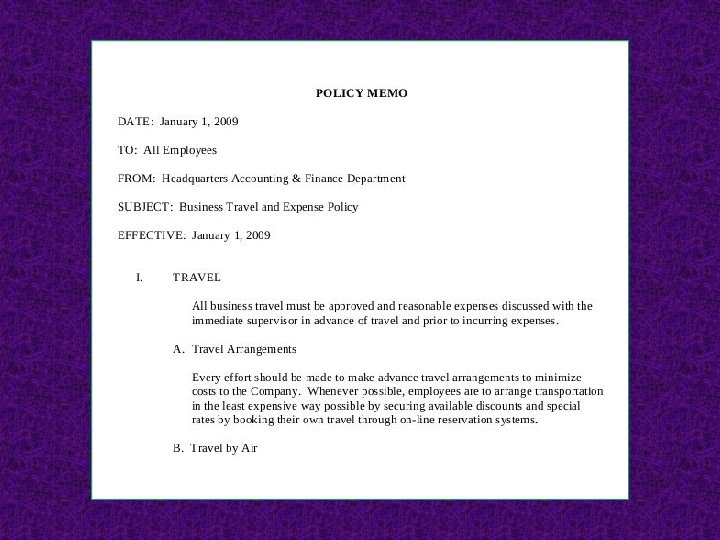
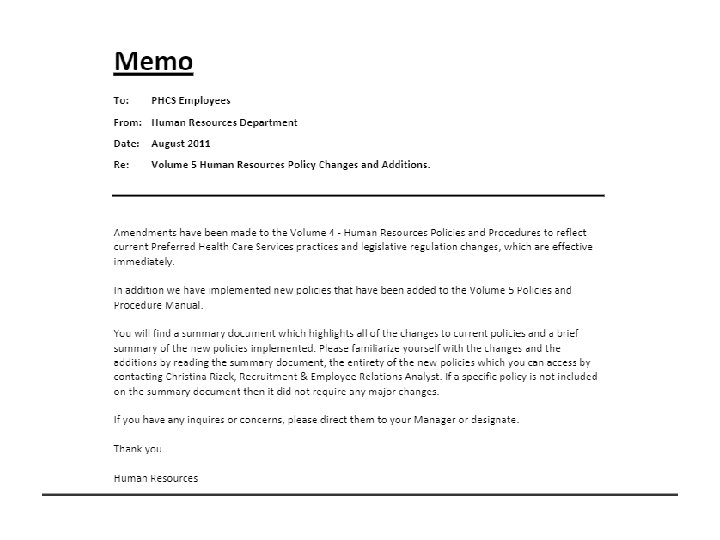
Types of hospital policies and procedures SHORT, INTERNAL COMMUNICATION • Memo policies – Management notification or short report – General distribution – Delegation of authority
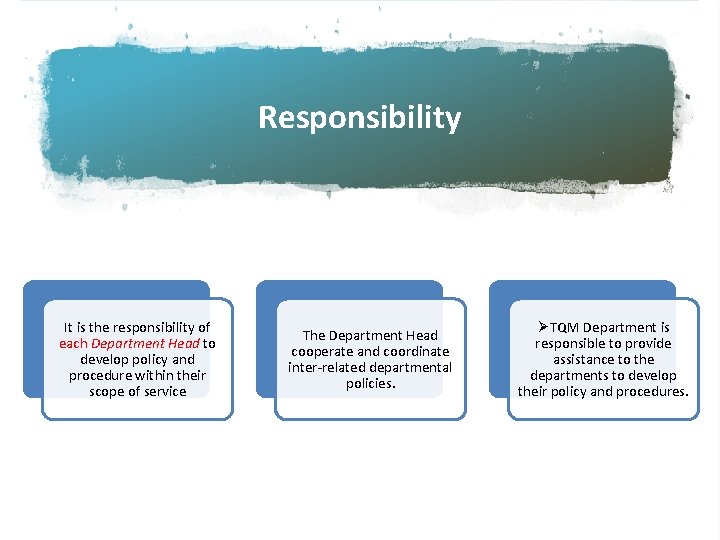
Responsibility It is the responsibility of each Department Head to develop policy and procedure within their scope of service The Department Head cooperate and coordinate inter-related departmental policies. ØTQM Department is responsible to provide assistance to the departments to develop their policy and procedures.
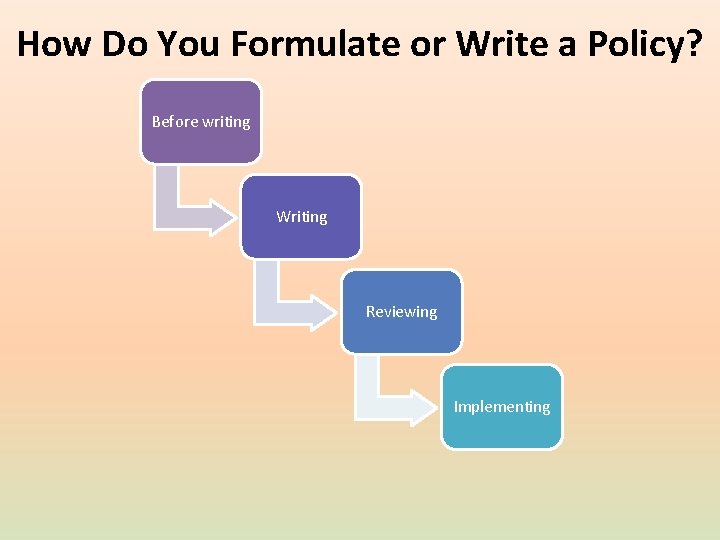
How Do You Formulate or Write a Policy? Before writing Writing Reviewing Implementing
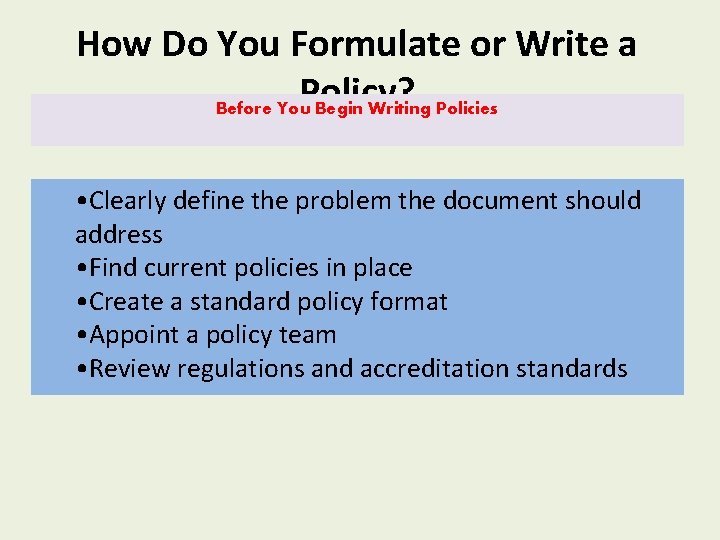
How Do You Formulate or Write a Policy? Before You Begin Writing Policies • Clearly define the problem the document should address • Find current policies in place • Create a standard policy format • Appoint a policy team • Review regulations and accreditation standards
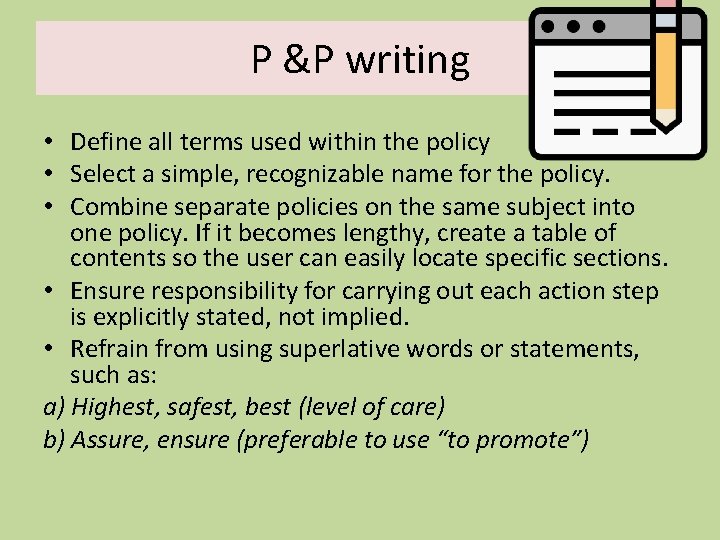
P &P writing • Define all terms used within the policy • Select a simple, recognizable name for the policy. • Combine separate policies on the same subject into one policy. If it becomes lengthy, create a table of contents so the user can easily locate specific sections. • Ensure responsibility for carrying out each action step is explicitly stated, not implied. • Refrain from using superlative words or statements, such as: a) Highest, safest, best (level of care) b) Assure, ensure (preferable to use “to promote”)
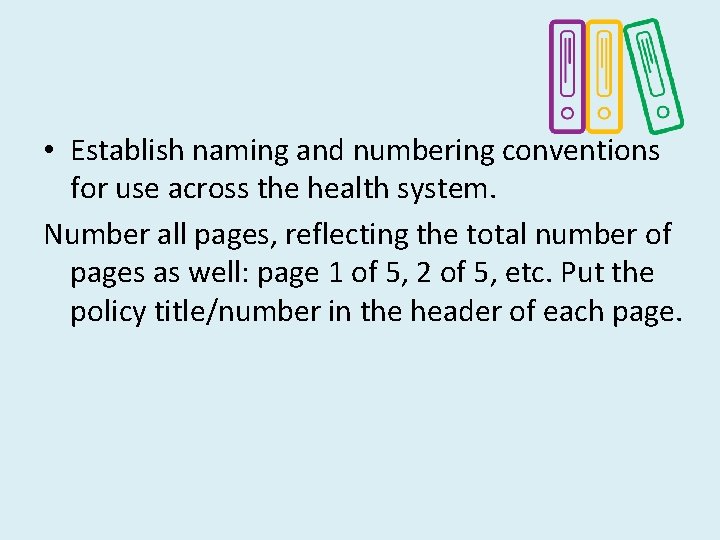
• Establish naming and numbering conventions for use across the health system. Number all pages, reflecting the total number of pages as well: page 1 of 5, 2 of 5, etc. Put the policy title/number in the header of each page.
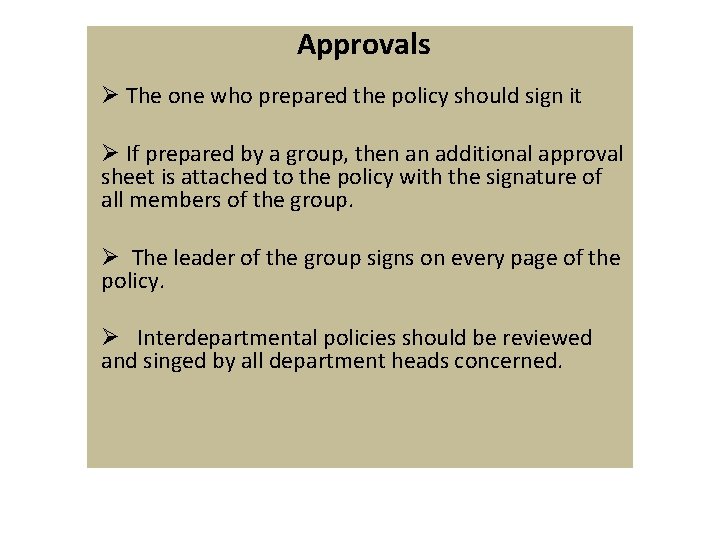
Approvals Ø The one who prepared the policy should sign it Ø If prepared by a group, then an additional approval sheet is attached to the policy with the signature of all members of the group. Ø The leader of the group signs on every page of the policy. Ø Interdepartmental policies should be reviewed and singed by all department heads concerned.
Approvals ØAll policies and procedures are reviewed and signed by the Total Quality Management Department ØAll policies and procedures should be approved by the following division heads as applicable and their official stamp affixed as appropriate
Policy Implementation Ø Implementation process involves: – – Distribution Familiarization Actual practice Monitoring
Policy Implementation/Distribution Distribute policies and obtain employee sign off All the hospital staff shall sign in the Acknowledgement Sheet to signify that they have read and understood the Policies and Procedures (Hospital general P&P, Departmental, Safety, Infection Control, etc. ). Original Copy filed in the Manual kept in every department
Familiarisation and actual practice • Train employees on the new policy Training helps employees see how policies apply to them. It walks them through how to properly follow procedures. • Monitor policy compliance and effectiveness
Monitoring It is recommended that all policies and procedures are subject for review every two (2) to 3 years and revised as needed (nature of policy). To ensure multidisciplinary approach to the services provided in the hospital, all policies shall be reviewed by a multi-disciplinary team.
Policy Analysis The process of predicting the impacts of possible policies (prospective) and evaluating past policies (retrospective)
Policy Termination Ø Policies should be terminated when cancelled by a later policy Ø A policy may be terminated by authority of the Program Director
Electronic Policy Libraries • Most healthcare organizations have replaced paper policy and procedure manuals with electronic policy libraries • To optimise the usefulness of electronic libraries: 1. Provide indices by policy name, subject, and sponsoring domain (administration, nursing, pharmacy, etc. ) 2. Incorporate “word search” functionality in order to facilitate searches for pertinent policies irrespective of their issuing domains. 3. Do not prohibit access to policies of one domain to personnel in other domains. persons in other departments may need to refer to those documents.
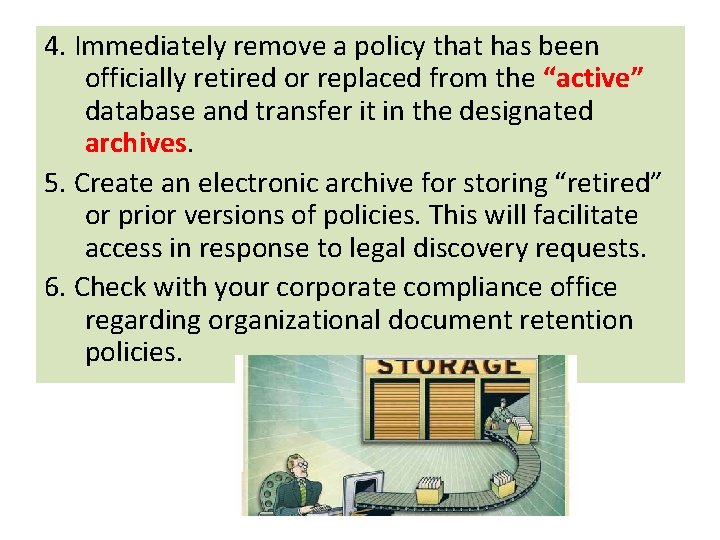
4. Immediately remove a policy that has been officially retired or replaced from the “active” database and transfer it in the designated archives. 5. Create an electronic archive for storing “retired” or prior versions of policies. This will facilitate access in response to legal discovery requests. 6. Check with your corporate compliance office regarding organizational document retention policies.
Thank you