
Health Planning in India Dr Abhay Nirgude Professor
Health Planning in India Dr Abhay Nirgude Professor & Head
• How the decisions are made regarding health policies and programs?

Specific learning objectives • Enlist the goals of National Health Policy 2002. • Write the recommendations of sir Joseph Bhore committee. • Enumerate the different health committees in India. • Objectives of health programs in five year plans.

National Health Policy-2002 • Objective: - To achieve an acceptable standard of good health amongst the general population of the country. • Approach : - To increase access to decentralized public health system by establishing new infrastructure in the existing institutions. • Primacy: - To preventive and first line curative initiatives at the primary health centre. • Policy : - focus on those diseases which are principally contributing to the disease burden. • Emphasis: - Rational use of drugs within the allopathic system
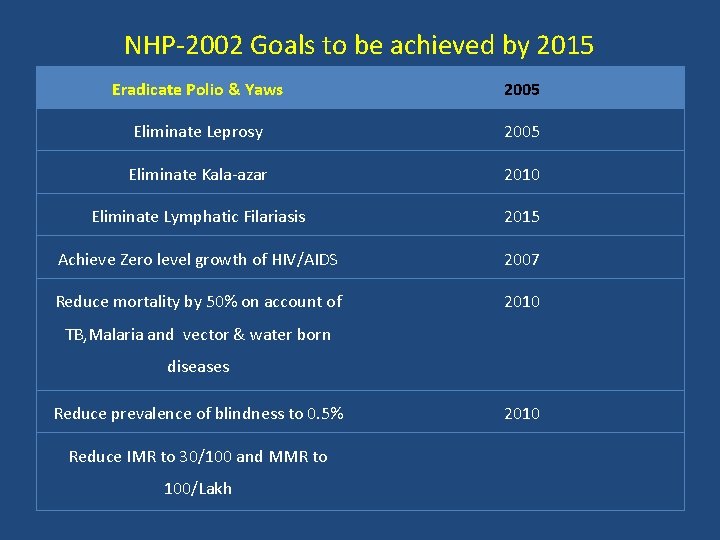
NHP-2002 Goals to be achieved by 2015 Eradicate Polio & Yaws 2005 Eliminate Leprosy 2005 Eliminate Kala-azar 2010 Eliminate Lymphatic Filariasis 2015 Achieve Zero level growth of HIV/AIDS 2007 Reduce mortality by 50% on account of 2010 TB, Malaria and vector & water born diseases Reduce prevalence of blindness to 0. 5% Reduce IMR to 30/100 and MMR to 100/Lakh 2010
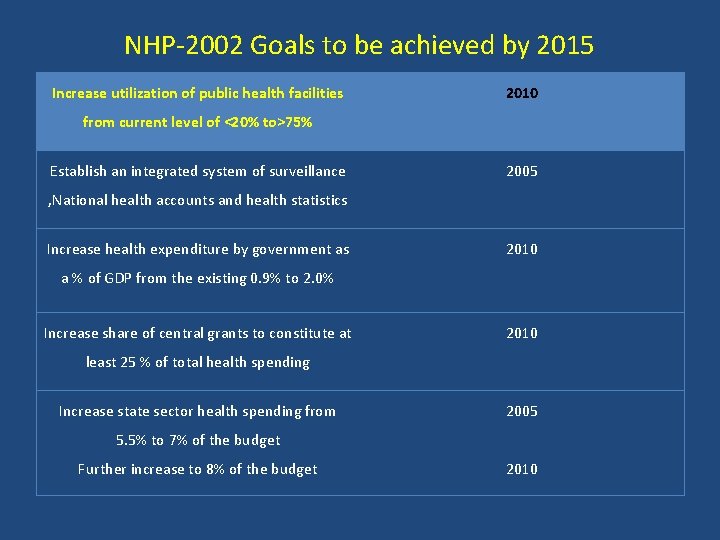
NHP-2002 Goals to be achieved by 2015 Increase utilization of public health facilities 2010 from current level of <20% to>75% Establish an integrated system of surveillance 2005 , National health accounts and health statistics Increase health expenditure by government as 2010 a % of GDP from the existing 0. 9% to 2. 0% Increase share of central grants to constitute at 2010 least 25 % of total health spending Increase state sector health spending from 2005 5. 5% to 7% of the budget Further increase to 8% of the budget 2010
Health Planning in India 1. Bhore Committee, 1946: - [ health survey & development committee] a) Integration of services b) Development of PHC’s c) Changes in med. Education-Social physicians d) Major National document.

Mudaliar Committee, 1962 Health survey & planning committee 1. To have fresh look at the health needs & resources. 2. Provide guidelines for national health planning. 3. To survey progress made in in the field of health since submission of Bhore Committee’s report. 4. To recommend future development and expansion of health services.
Cont… • Findings: 1. Inadequate quality of service by PHC’s Recommendations : 1. 2. 3. 4. 5. 6. 7. Consolidation of advances made in first 2 five year plans. Strengthening of district hospital with specialist services. Regional organizations under Regional Deputy or Assistant Directors. Each PHC for > 40, 000 population. To improve quality of health care provided by the PHC’s. Integration of medical & health services. Constitution of All India Health Service on the pattern of Indian Administrative Services.
Chadah Committee, 1963 Objective: - To study the arrangements necessary for maintenance phase of NMEP. Recommendations: 1. 2. 3. 4. Vigilance operations by general health services i. e. phc’s. One basic health worker per 10, 000 population. BHW----MPW=Malaria + F. P. + vital statistics Family planning health assistants ---supervise work of 3 -4 BHW’s. 5. At district level: - general health services were to take the responsibility of maintenance phase.
Mukerji committee, 1965. Objective: - To review the strategy for family planning programme. Recommendations: 1. Separate staff for family planning programme. 2. De-link malaria activities from family planning.
Mukerji committee, 1966 • Objective: To examine the issues of paucity funds and burden on state governments. Committee worked out the details of the Basic Health Worker
Jungalwala committee, 1967 (committee on integration of Health services) Objectives: 1. Integration of health services 2. Elimination of private practice by government doctors. “integrated health services” as defined by committee, I. A service with unified approach for all problems instead of a segmented approach for different problems. II. Preventive & curative care under unified manner at all levels.
Cont…. • Main steps recommended towards integration: a) Unified cadre b) Common seniority c) Recognition for extra qualification d) Equal pay for equal work e) Special pay for specialized work f) No private practice, and good service conditions. “Integration should be a process logical evolution rather than revolution”
Kartar Singh committee, 1973 “committee on Multipurpose Workers under health & Family Planning” Objectives: - to study & make recommendations on 1. Structure for integrated services. 2. Feasibility of having multipurpose, bipurpose workers in the field. 3. Training requirements of such workers 4. Utilization of mobile service units.
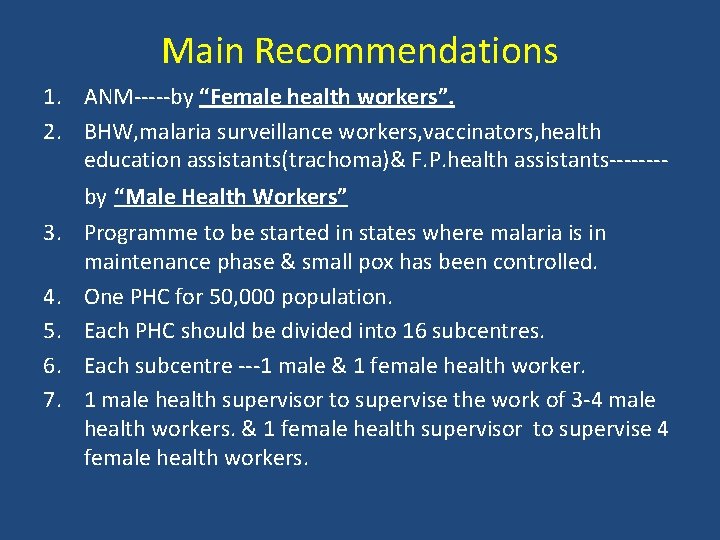
Main Recommendations 1. ANM-----by “Female health workers”. 2. BHW, malaria surveillance workers, vaccinators, health education assistants(trachoma)& F. P. health assistants-------by “Male Health Workers” 3. Programme to be started in states where malaria is in maintenance phase & small pox has been controlled. 4. One PHC for 50, 000 population. 5. Each PHC should be divided into 16 subcentres. 6. Each subcentre ---1 male & 1 female health worker. 7. 1 male health supervisor to supervise the work of 3 -4 male health workers. & 1 female health supervisor to supervise 4 female health workers.
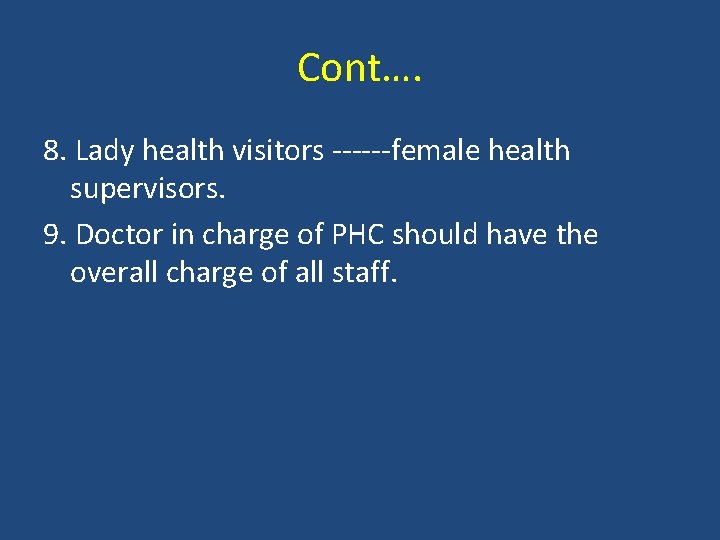
Cont…. 8. Lady health visitors ------female health supervisors. 9. Doctor in charge of PHC should have the overall charge of all staff.
Shrivastav committee, 1975 (Medical education & support manpower) Objectives: 1. To devise suitable curriculum for training a cadre of health assistants. 2. To suggest steps for improving the existing medical educational process. 3. To make any other suggestions to realise the above objectives.
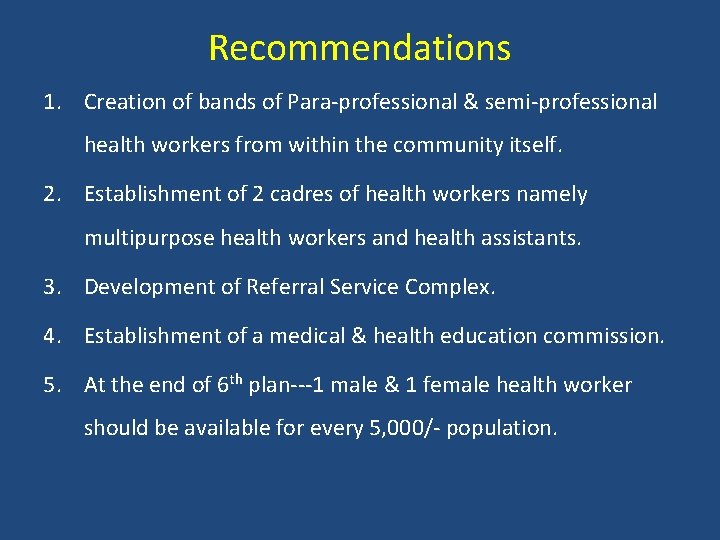
Recommendations 1. Creation of bands of Para-professional & semi-professional health workers from within the community itself. 2. Establishment of 2 cadres of health workers namely multipurpose health workers and health assistants. 3. Development of Referral Service Complex. 4. Establishment of a medical & health education commission. 5. At the end of 6 th plan---1 male & 1 female health worker should be available for every 5, 000/- population.
Rural Health Scheme, 1977 • Programme of training of community health care workers--steps: 1. Involvement of medical college: - reorienting medical education to the needs of rural people. 2. Reorientation training of multipurpose workers into unipurpose workers. Health for All by 2000 AD-
Planning Commission • Established in 1950 • Objectives: 1. To assess resources of the country 2. To draft developmental plans 3. Effective utilization of available resources Planning commission consists of A. Chairman B. Deputy Chairman C. Five members
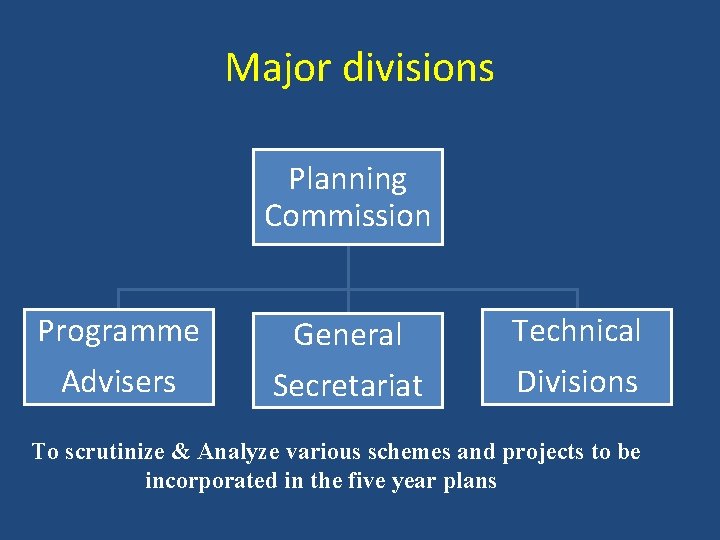
Major divisions Planning Commission Programme Advisers General Secretariat Technical Divisions To scrutinize & Analyze various schemes and projects to be incorporated in the five year plans
Health Sector Planning Health sector----sub-sectors 1. Water supply & sanitation 2. Control of communicable diseases 3. Medical education, training and research. 4. Medical care including hospitals, dispensaries & primary health centres. 5. Public health services 6. Family planning 7. Indigenous systems of medicine.
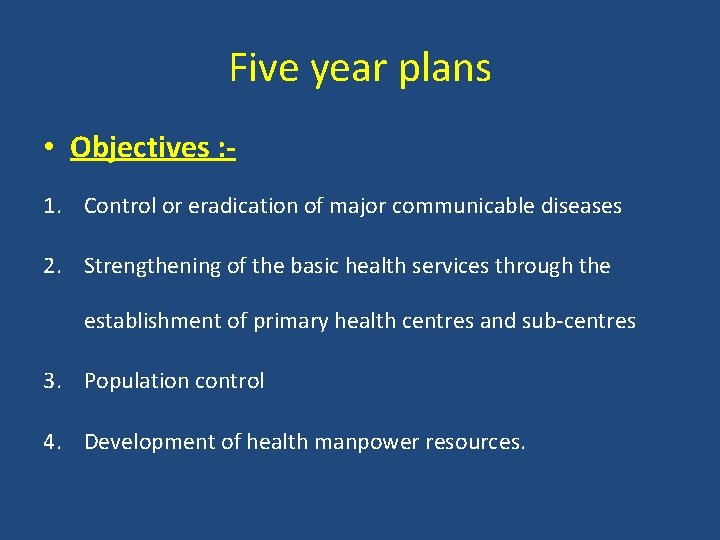
Five year plans • Objectives : 1. Control or eradication of major communicable diseases 2. Strengthening of the basic health services through the establishment of primary health centres and sub-centres 3. Population control 4. Development of health manpower resources.
Summary • NHP 2002 • Committees • Planning Commission
- Slides: 25