
Health Numeracy Literacy Implications for Clinician Competency Patient




- Slides: 19
Health Numeracy & Literacy: Implications for Clinician Competency & Patient Compliance Douglas Osei-Hyiaman, M. D. , Ph. D. Section on Neuro. Endocrinology, Laboratory of Physiologic Studies, National Institute on Alcohol Abuse and Alcoholism, National Institutes of Health, DHHS, Bethesda, MD, U. S. A. & Scientific Med. Consult LLC Fairfax, Virginia, U. S. A. 2016 Medical Knowledge Fiesta, Ghana College of Physicians & Surgeons, September 13 -16, ACCRA, GHANA
Case Anecdotes 1. 2. 3. 4. The The zero blood glucose level. anti-glycemic medication for hypertension. model diabetic/hypertensive 83 year old lady. glucometer I sent to my auntie.
Learning Objectives n Define health numeracy n Understand the importance of health numeracy n Describe the significance of health numeracy to both HCPs and patients in diabetes self-management n Explain the different ways health numeracy can be assessed and remedied. n Become aware that health literacy does not imply health numeracy. n Understand the initiatives to help alleviate poor numeracy. n Originate local specific innovations to improve numeracy.
Health Numeracy Defined n The ability to understand, use and derive meaning from numbers (Nelson et al 2008). n The extent to which individuals have the capacity to access, process, interpret, communicate, and act on numerical, probabilistic health information essential for making health decisions (Golbeck et al 2005). n The ability to understand use numbers in daily life (Cavannaugh et al 2008).
Importance of Health Numeracy-1 Low numeracy skills are associated with other health issues including: n Poor anti-coagulant control in those taking warfarin(Nelson et al 2005). n Poorer asthma control and increased hospital admissions (Cavanaugh et al 2009). n Obesity and poorer control of diabetes (Huizinga et al 2008; Cavanaugh et al 2009).
Importance of Health Numeracy-2 Health numeracy skills are needed for: n The correct number of medications at the right time. n Ordering new prescriptions to ensure ready stock. n Manage calendars to attend clinic appointments. n Making informed decision about potential efficacy of therapeutic recommendations by their HCPs.
Literacy Health Numeracy n Level of education is not always par with numeracy n Health care professionals could also be innumerate n Lack of classroom education does not imply innumeracy n In Ghana most people, including the elderly and the youth lack health numeracy. n Rural health sectors could be a good start for health numeracy research.
Approaches to dealing with low patient numeracy • • Make no assumptions about understanding Make the implicit explicit Ask open-ended questions (to assess understanding) Tailor information to patient Reinforce important messages Confirm comprehension Simplify numeracy concepts Ø emphasize numerical significance with sound language
Common, but incorrect reasons given for non-testing in developing countries (DC) Why DC diabetic patients don't do SMBG: • Due to the lack of glucometers • If any, glucometers are not affordable • If any, test strips are highly priced These are important, but not the primary reasons !
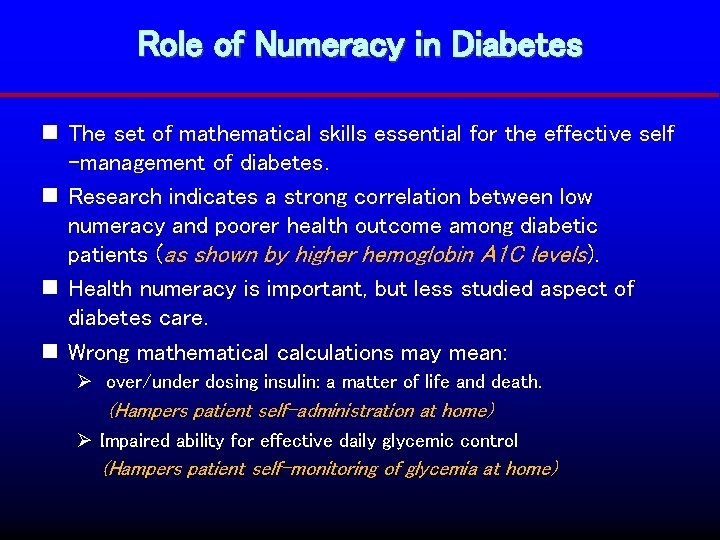
Role of Numeracy in Diabetes n The set of mathematical skills essential for the effective self -management of diabetes. n Research indicates a strong correlation between low numeracy and poorer health outcome among diabetic patients (as shown by higher hemoglobin A 1 C levels). n Health numeracy is important, but less studied aspect of diabetes care. n Wrong mathematical calculations may mean: Ø over/under dosing insulin: a matter of life and death. (Hampers patient self-administration at home) Ø Impaired ability for effective daily glycemic control (Hampers patient self-monitoring of glycemia at home)
The situation: u. To maintain good diabetic control, Type-1 diabetics must monitor their glucose levels at least 3 times/day. u. However, in developing countries, most diabetic patients seldom, if ever, monitor their blood glucose. u. Unless they visit a health center or hospital that has glucometer blood glucose is never monitored.
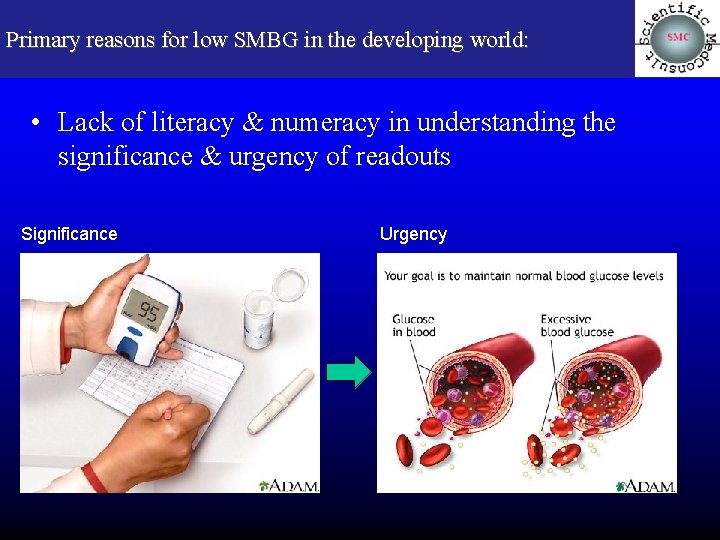
Primary reasons for low SMBG in the developing world: • Lack of literacy & numeracy in understanding the significance & urgency of readouts Significance Urgency
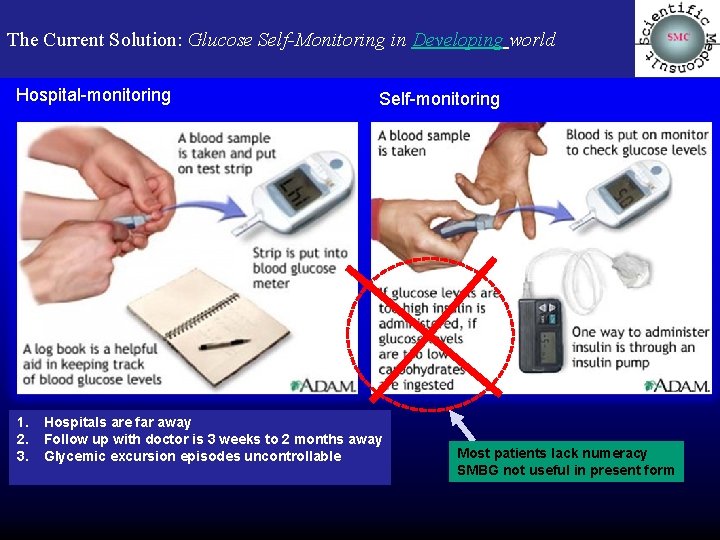
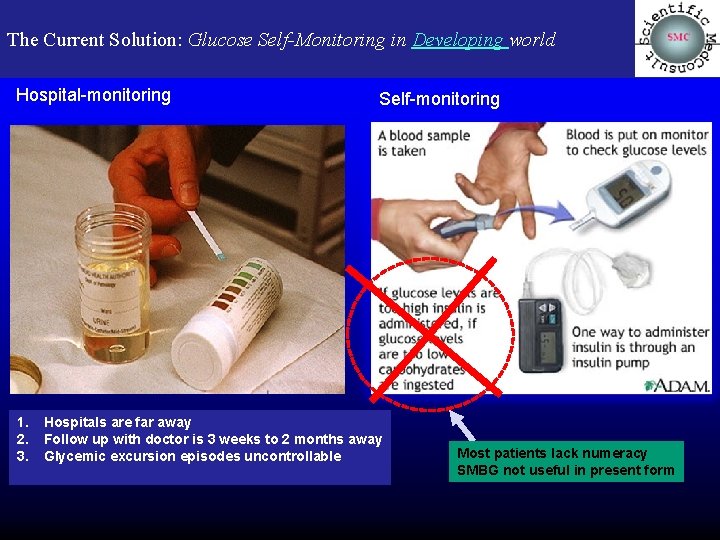
The Current Solution: Glucose Self-Monitoring in Developing world Hospital-monitoring 1. 2. 3. Self-monitoring Hospitals are far away Follow up with doctor is 3 weeks to 2 months away Glycemic excursion episodes uncontrollable Most patients lack numeracy SMBG not useful in present form
The Current Solution: Glucose Self-Monitoring in Developing world Hospital-monitoring 1. 2. 3. Self-monitoring Hospitals are far away Follow up with doctor is 3 weeks to 2 months away Glycemic excursion episodes uncontrollable Most patients lack numeracy SMBG not useful in present form
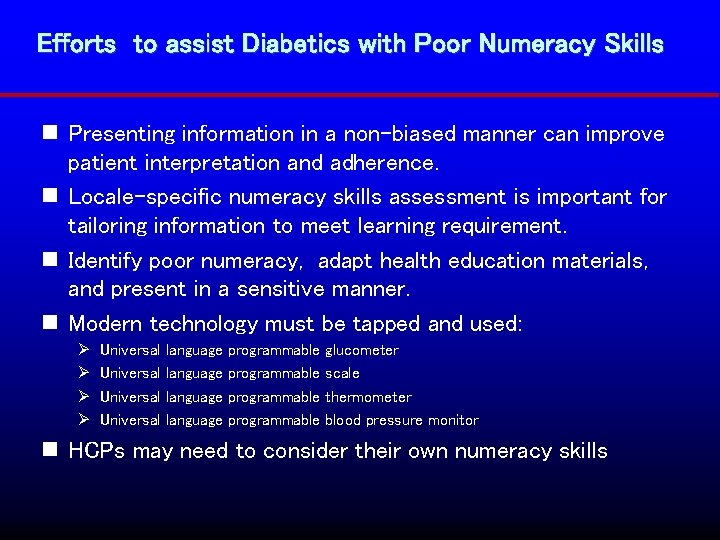
Efforts to assist Diabetics with Poor Numeracy Skills n Presenting information in a non-biased manner can improve patient interpretation and adherence. n Locale-specific numeracy skills assessment is important for tailoring information to meet learning requirement. n Identify poor numeracy, adapt health education materials, and present in a sensitive manner. n Modern technology must be tapped and used: Ø Ø Universal language programmable glucometer scale thermometer blood pressure monitor n HCPs may need to consider their own numeracy skills
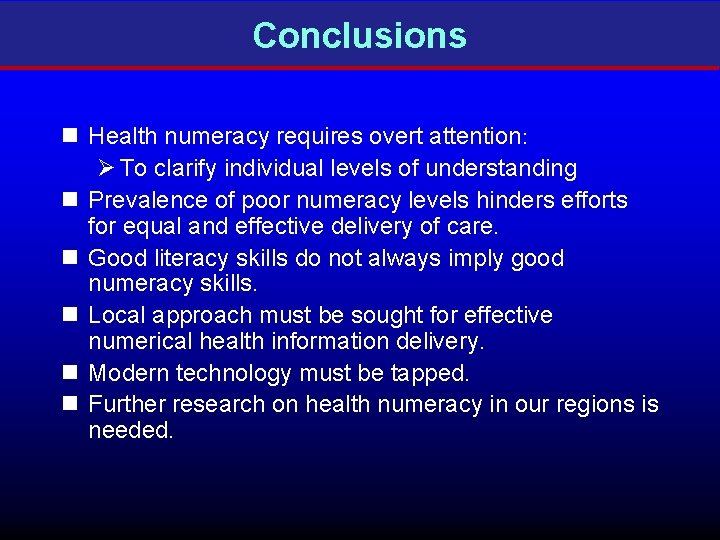
Conclusions n Health numeracy requires overt attention: Ø To clarify individual levels of understanding n Prevalence of poor numeracy levels hinders efforts for equal and effective delivery of care. n Good literacy skills do not always imply good numeracy skills. n Local approach must be sought for effective numerical health information delivery. n Modern technology must be tapped. n Further research on health numeracy in our regions is needed.