
Health Need assessment 17 9 2007 Grete Botten
Health Need assessment 17. 9. 2007 Grete Botten HELED
The goal of the course • Exploring the demographical and epidemiological changes of health problems and diseases (medical needs) • Epidemiological changes will be related to the political, social and economic situation for various population groups (gender and age, socio-economy, ethnicity, etc) and in different countries and priority questions • Demographical and epidemiological data will be used to assess future need for health care in different settings Signature (unit, name, etc. )
Learning objectives • Be familiar with demographic terms, trends and projections • Be able to find and use vital statistics in planning health services • Know basic epidemiological concepts and be able to use them in order to perform need assessment • Be able to identify epidemiological changes globally and to present evidence as to why this changes have happened • Be able to interpret trends and use techniques to make projections to estimate need for future health care services • See the relationship between the concepts need, demand supply • Relate need to priority and effectiveness • Use need assessment as basis for resource allocation Signature (unit, name, etc. )
What is Health Needs Assessment (HNA)? A systematic method of identifying unmet health and healthcare needs of a population, and making changes to meet those unmet needs The objective is to Specify services that will improve the health of the population Signature (unit, name, etc. )
Central concepts related to health need assessment • Needs • Demand • Supply • Efficiency • Priority Signature (unit, name, etc. )
Health Needs Assessment • Used for service planning, monitoring/ evaluation, responding to changing needs • Internal market/commissioning (like England) • Three approaches to HNA have been suggested: Epidemiological (focus in this course) Corporate Comparative Signature (unit, name, etc. )
The idea of need assessment • Health services may be based on two opposite ideologies – Based on planning within a public ownership – Based on market and competition • Within a planned service without market mechanism, facilities and capacity should meet the need of the population – Need assessment relevant for planning the services (within budget) – Need assessment relevant for the purchaser in in a provider/purchaser split model • Within a competitive market services will develop in response to the demand – Need assessment relevant for the owners, as they need to know the market situation Signature (unit, name, etc. )
What is included in Health Needs Assessment? • • Defining “disease” and services Know the prevalence of diseases Know the number that should be served Know the medical guidelines for examination and treatment - “state of the art” • Know the services available and their cost Signature (unit, name, etc. )
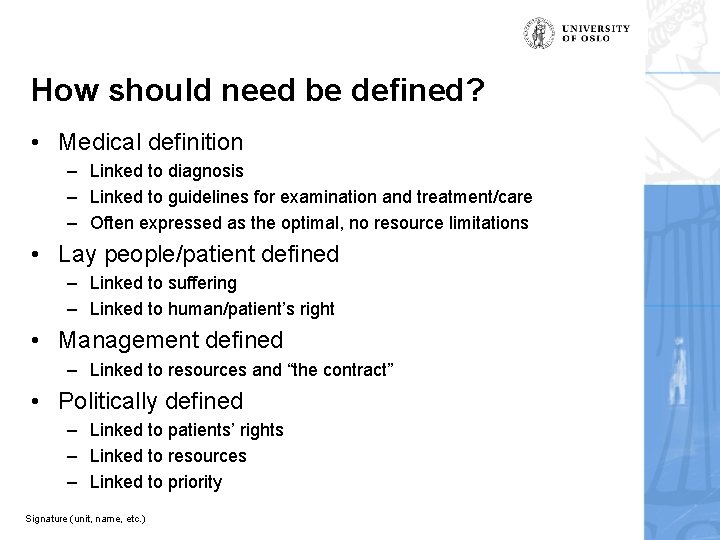
How should need be defined? • Medical definition – Linked to diagnosis – Linked to guidelines for examination and treatment/care – Often expressed as the optimal, no resource limitations • Lay people/patient defined – Linked to suffering – Linked to human/patient’s right • Management defined – Linked to resources and “the contract” • Politically defined – Linked to patients’ rights – Linked to resources – Linked to priority Signature (unit, name, etc. )
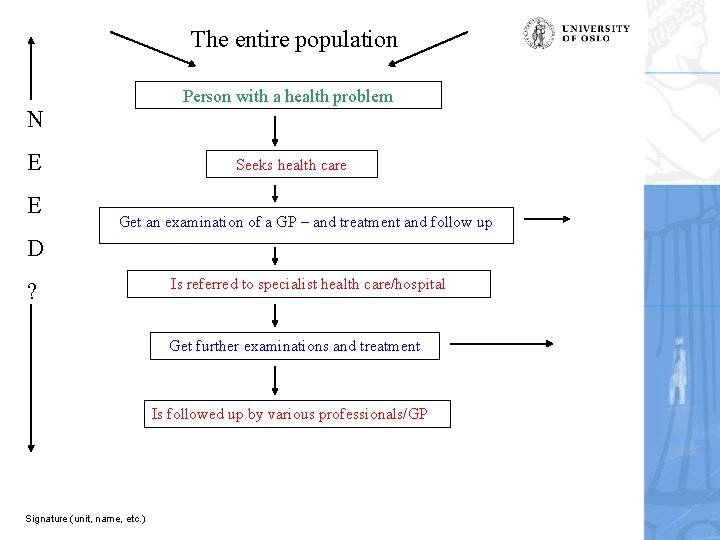
The entire population Person with a health problem N E E Seeks health care Get an examination of a GP – and treatment and follow up D ? Is referred to specialist health care/hospital Get further examinations and treatment Is followed up by various professionals/GP Signature (unit, name, etc. )
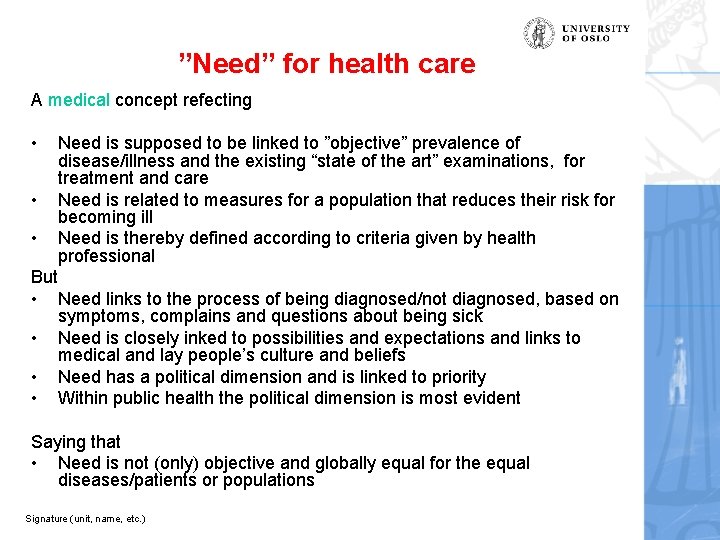
”Need” for health care A medical concept refecting • • • Need is supposed to be linked to ”objective” prevalence of disease/illness and the existing “state of the art” examinations, for treatment and care Need is related to measures for a population that reduces their risk for becoming ill Need is thereby defined according to criteria given by health professional But • Need links to the process of being diagnosed/not diagnosed, based on symptoms, complains and questions about being sick • Need is closely inked to possibilities and expectations and links to medical and lay people’s culture and beliefs • Need has a political dimension and is linked to priority • Within public health the political dimension is most evident Saying that • Need is not (only) objective and globally equal for the equal diseases/patients or populations Signature (unit, name, etc. )
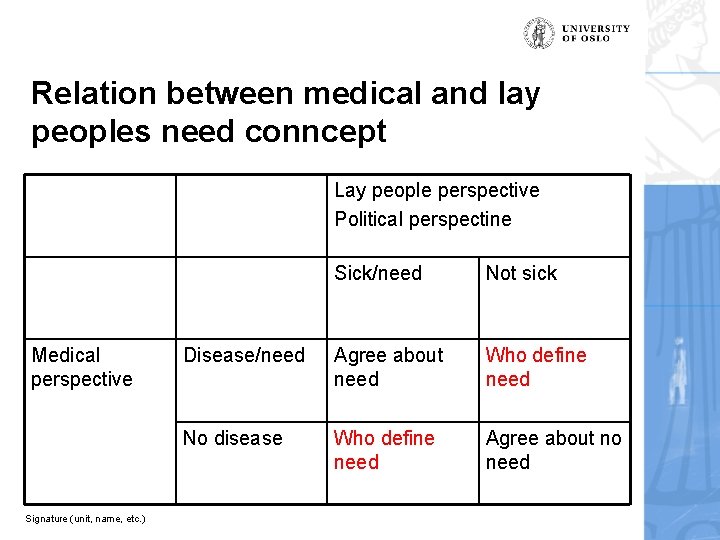
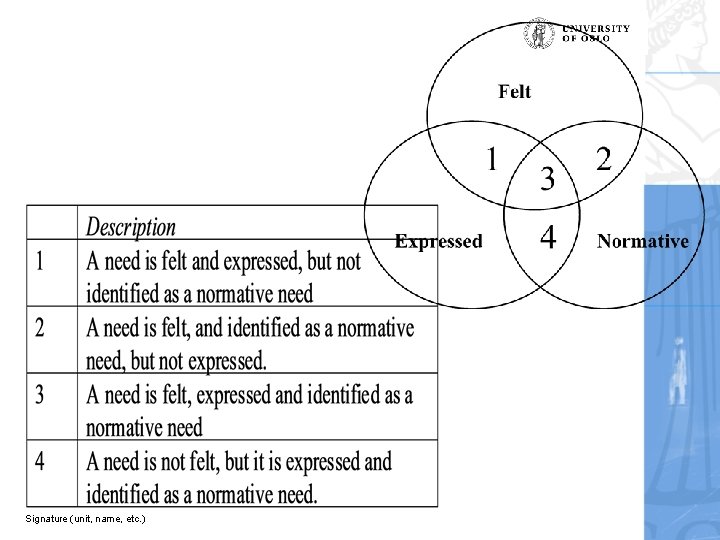
Relation between medical and lay peoples need conncept Lay people perspective Political perspectine Medical perspective Signature (unit, name, etc. ) Sick/need Not sick Disease/need Agree about need Who define need No disease Who define need Agree about no need
Signature (unit, name, etc. )
Unmet needs essential to identify • Identifying unmet need requires a public health focus which includes those not getting/seeking services • Need large surveys to identify those not identified through the health services • The relationship between – needs (unidentified, unmet, and met) – services (appropriate and inappropriate) Signature (unit, name, etc. )
Factors that will influence need for health care in a population • Demographic changes • New technology (both increase and reduce demand) • Prevention like vaccination, less smoking (public health measures)…. • Identification of risk factors and possibility for reduction (need assessment in itself) • New knowledge and changing attitudes Signature (unit, name, etc. )
Demand for health care An economic concepts, reflecting • The percieved need for services – Population – Patients – Health personell (throug their referrals …) • The willingness (ability) to pay for the services – Services are unlikely to be paid directly – Asymmetric information…. • What influences demand? Signature (unit, name, etc. )
Supply of health care An economic concepts, reflecting • What services are offered (in the market) • The price of those services – Often unknown both for ”buyer and seller”, at least in a public system • What will influence supply Signature (unit, name, etc. )
Need, demand supply - summary • Need (medical) relates to the prevalence of a disease – what people might benefit from and the number of people with a need • Demand relates to what is actually asked for in a market – expressed need • Any difference between them is unmet need • Supply relates to which services are offered in the marked • Met need is the services the population actually gets However • Need at the political/policy level relates to priority and efficiency Signature (unit, name, etc. )
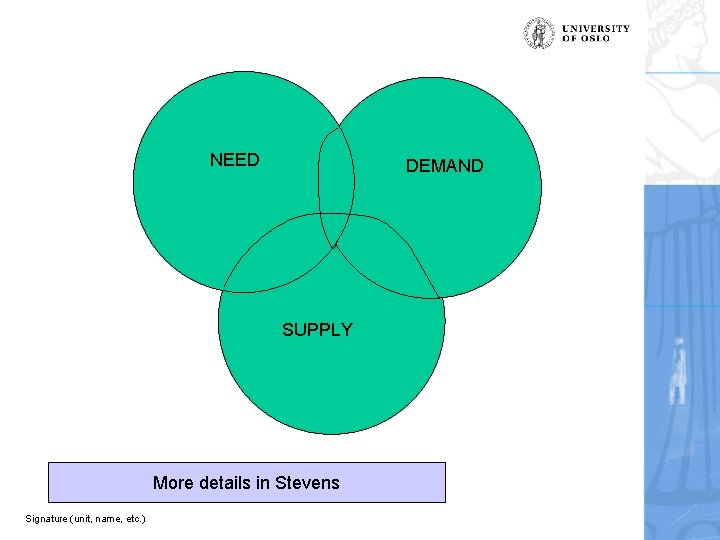
NEED DEMAND SUPPLY More details in Stevens Signature (unit, name, etc. )
• In a ”perfect situation” need, demand supply would be equal • Need may exceed demand • Demand may exceed need (as it is medically defined and prioritized) • Supply may be less than demand (and need) resulting in regulation/rationing – and queuing • May supply be higher than demand? ? Unstable situation Signature (unit, name, etc. )
Different scales/levels of HNA • • • National level Regional level/County level Municipality level Community GP/clinical level Signature (unit, name, etc. )
National level • Relevant for – National strategies to improve the services for eg • Specific/defined patient group • Build new facilities – Public health activities eg • Legislation • Vaccination program (influenza) – Reduce inequity eg • Assess the unmet need in various groups (based on diagnosis or social criteria) – Monitoring the situation / evaluation – Allocate resources according to needs • On national level important question: – Do all geographical areas get equal amount of resources, related to their population (need)? – Do all population/patient groups get equal access to the health services as response to their need Signature (unit, name, etc. )
Regional/county level • Need assessment relevant when – services are delivered at the regional level (provider) – public health programs aim at reaching a regional population • The same questions as at national level Signature (unit, name, etc. )
Local municipality/community level • In a provider/purchaser split model (know what to buy) • Planning necessary services for the local population/various patient groups • Hire health personnel to cover the need of the population, eg. in a patient list system, for nursing homes etc • For offering local private services Signature (unit, name, etc. )
Focus i HNA • Individual need or populations’ need? – Focus is populations’ need (as a sum of the individual needs) – Public health has per see a population approach • Specific diagnosis or relevant services? – Focus is on need for services more that diagnosis – Different medical diagnoses may need the same services • The past, present or future? – Focus is on the future (developing services for the number of people in the future) – Implement public health measures that reduces health problems in the future Signature (unit, name, etc. )
Health Needs Assessment • Used for service planning, monitoring/ evaluation, responding to changing needs • Internal market/commissioning • Three approaches to HNA have been suggested: Epidemiological Corporate Comparative Signature (unit, name, etc. )
Epidemiological approach • • Statement of the problem Subcategories (i. e. type 1, type 2 and gestational diabetes; severity categories for dementia) Prevalence and incidence Services available and their costs Effectiveness and cost-effectiveness of services Quantified models of care and recommendations Outcome measures, audit methods and targets Information and research requirements Signature (unit, name, etc. )
Components in an epidemiological approach to HNA • Defining the problem and objectives • Define the population • Prevalence and incidence of the actual health problem (in relation to treatment possibilities, not etiology) • Number intended to be covered/treated • Models and guidelines for treatment • Available services, their cost and their costeffectiveness • Recommendation • Model for future evaluation • Research requirement Signature (unit, name, etc. )
Corporate Approach • Based on the demands, wishes and perspectives of interested parties - professional, political and public views • Blurs difference between need and demand, and between science and vested interest • Encouraged by the 1989 reforms with its ‘local voices’ and current emphasis on partnership and collaboration [and public involvement] • Essential if policies are to be sensitive to local circumstances Signature (unit, name, etc. )
Comparative approach • Contrasts the services received in one area with those elsewhere • Should take into account local population characteristics (demography, mortality, morbidity) Signature (unit, name, etc. )
Methodological aspects • Approaches to Health Need Assessment – Population perspective – Use indicators that may express need (suurogates may be valuable) – • Types and sources of data (vital statistics, demography mm) • Analysing and interpreting the data • Conclusions Signature (unit, name, etc. )
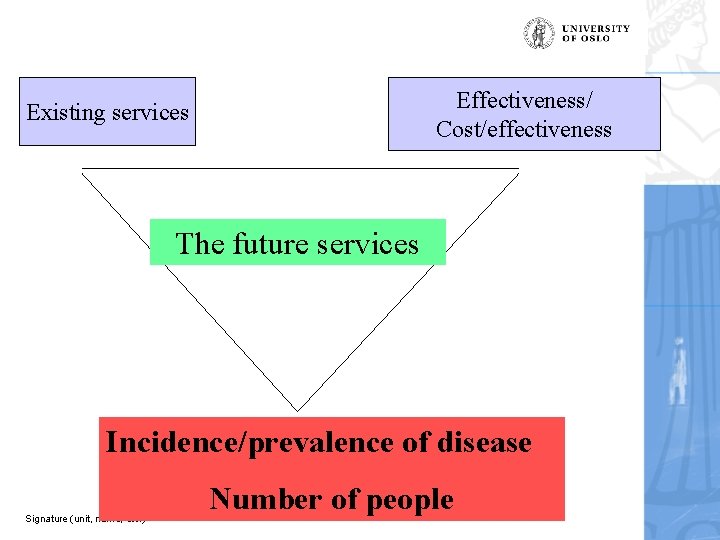
Effectiveness/ Cost/effectiveness Existing services The future services Incidence/prevalence of disease Signature (unit, name, etc. ) Number of people
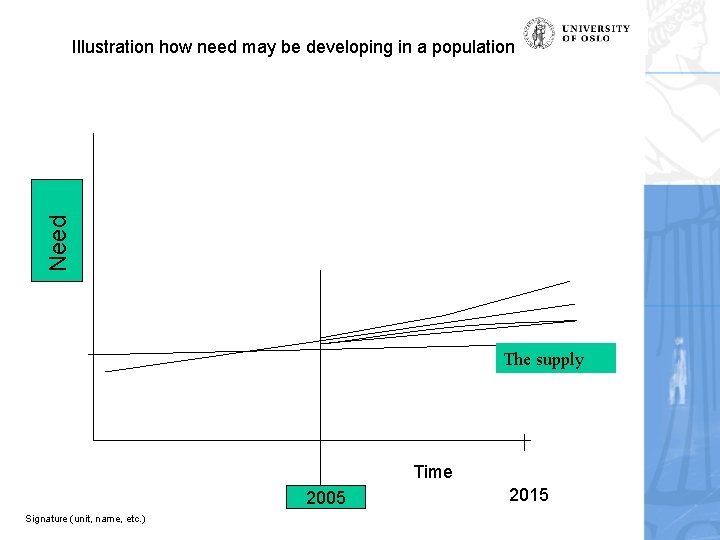
Need Illustration how need may be developing in a population The supply Time 2005 Signature (unit, name, etc. ) 2015
Table 3 in Stevens - etc. • The concepts Efficacy/effectiveness • Size of effect (scaled) • Quality of evidence about effectiveness – – – Several RCTs One RCT Clinical intervention trial (non RCT) Uncontrolled experiments Opinion based on experience Non evidence Signature (unit, name, etc. )
Methodological problems related to • Inadequate date on incidence/prevalence • Inadequate date on effectiveness and cost/effectiveness • Lack of agreement on threshold for intervention • Heterogeneous patient group • Treatment complex and often several possibilities Signature (unit, name, etc. )
Role of need assessment i NHS • Health services is bought on behalf of a population • Populations ability to benefit from health care must be included • A balance between enough information and not too many details • • • Health care needs of a defined population Appraisel of service options for meeting the needs Specification of pattern of service provision Choosing providers Contracts Signature (unit, name, etc. )
Summary • Need will be defined and discussed in a medical context, both within care and public health • Demograpfy must to be taken into consideration, a population approach • In four cases you will apply such need data and relate them to reality in different settings • Use of need indicator as basis for resource allocation will be discussed in a last lecture Signature (unit, name, etc. )
- Slides: 37