
Health Management Information System Main Healthcare Concerns Quality

- Slides: 19
Health Management Information System
Main Healthcare Concerns: Quality Safety Why? Human nature is …. We make mistakes Safety is a primary issue
Information has a role An essential prerequisite for the attainment of the goal of health for all is the continued free flow of information on health and biomedical topics within WHO, between the Organization and Member States, and among Member States.
The importance of (Health) Information • "in a disaster, accurate information, like clean water, is an indisputable good" Keen & Ryle, 1996
What is Health Information Management? • Information is the lifeblood of the health care delivery system. • The medical record, in manual or automated form, houses the medical information that describes all aspects of patient care. 5
• Improved health information system is clearly linked to good management. • Information is crucial at all management levels of the health services from periphery to the centre. It is required by policymakers, managers, health care providers, community health workers.
Health Information System A set of components and procedures organized with the objective of generating information which will improve health care management decisions at all levels of the health system. The ultimate objective of health information system is not “to gain information” but “to improve action”
Health information system An information system specially designed to assist in the management and planning of health program me as opposed to delivery of care
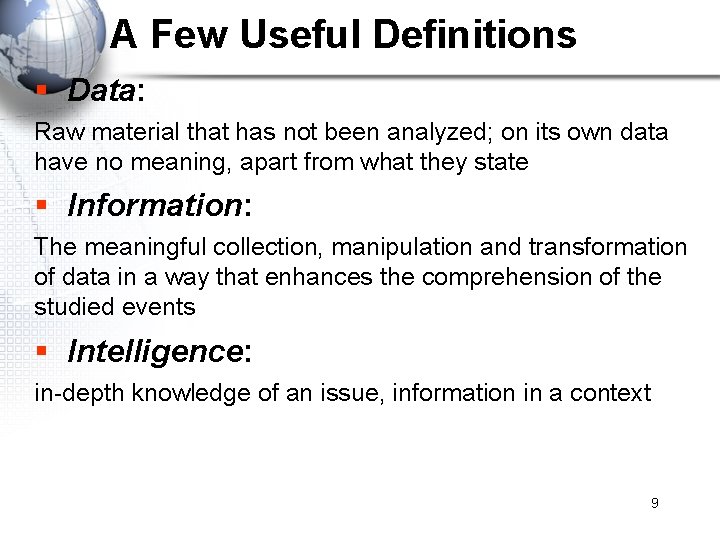
A Few Useful Definitions § Data: Raw material that has not been analyzed; on its own data have no meaning, apart from what they state § Information: The meaningful collection, manipulation and transformation of data in a way that enhances the comprehension of the studied events § Intelligence: in-depth knowledge of an issue, information in a context 9
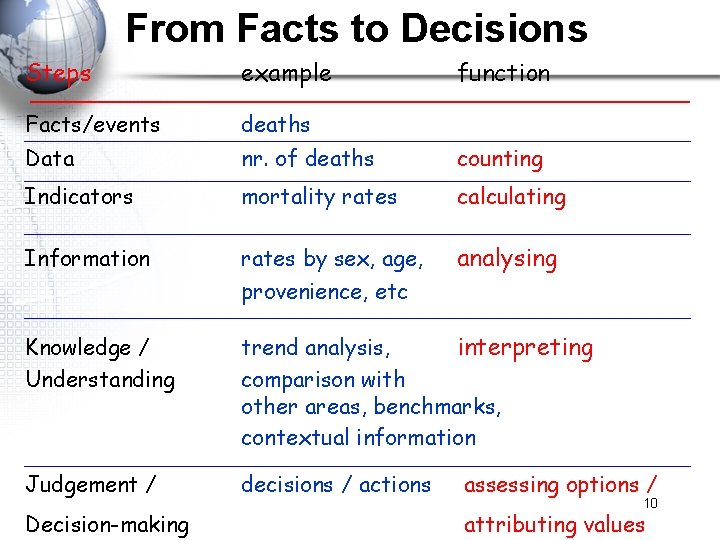
From Facts to Decisions Steps example function Facts/events deaths Data nr. of deaths counting Indicators mortality rates calculating Information rates by sex, age, analysing provenience, etc Knowledge / Understanding trend analysis, interpreting comparison with other areas, benchmarks, contextual information Judgement / decisions / actions Decision-making assessing options / 10 attributing values
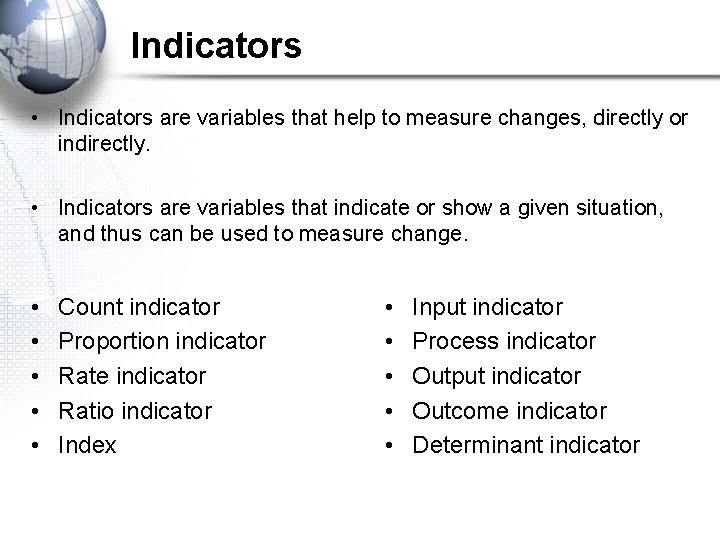
Indicators • Indicators are variables that help to measure changes, directly or indirectly. • Indicators are variables that indicate or show a given situation, and thus can be used to measure change. • • • Count indicator Proportion indicator Rate indicator Ratio indicator Index • • • Input indicator Process indicator Output indicator Outcome indicator Determinant indicator
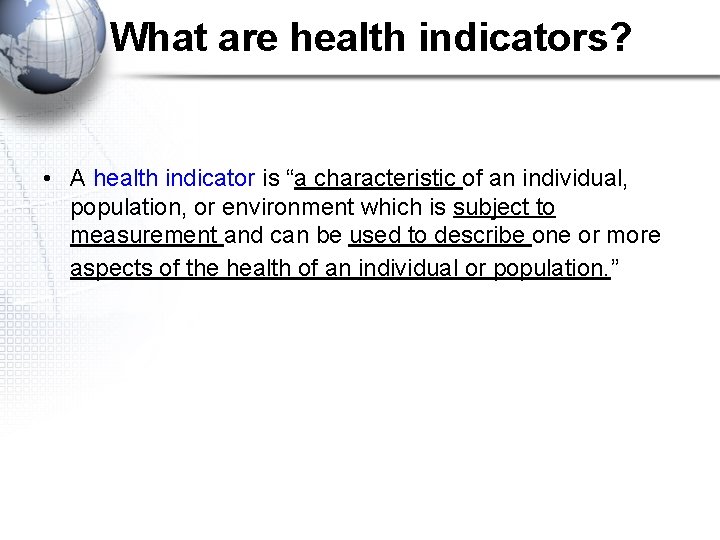
What are health indicators? • A health indicator is “a characteristic of an individual, population, or environment which is subject to measurement and can be used to describe one or more aspects of the health of an individual or population. ” Health Indicators, Part III
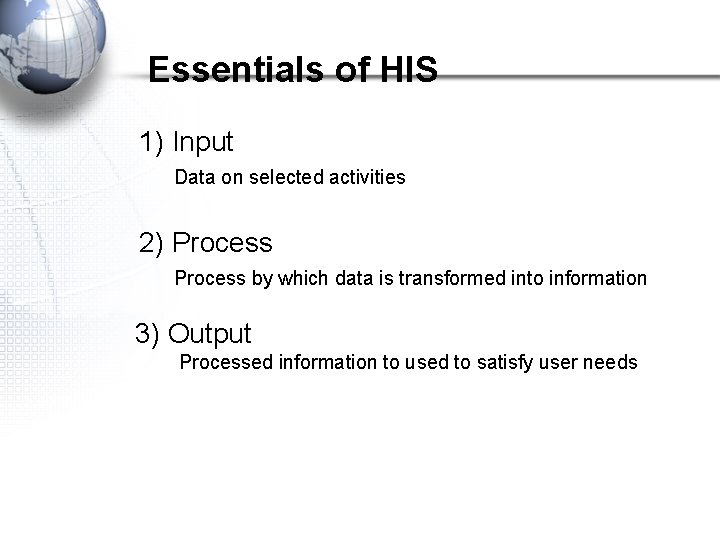
Essentials of HIS 1) Input Data on selected activities 2) Process by which data is transformed into information 3) Output Processed information to used to satisfy user needs
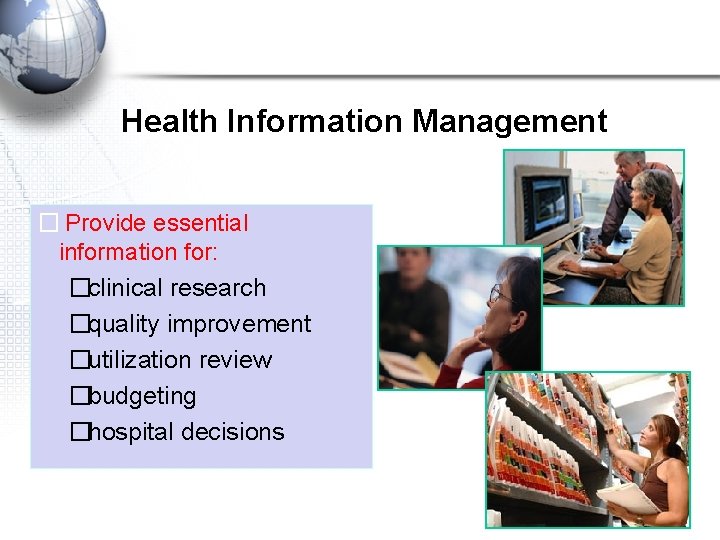
Health Information Management � Provide essential information for: �clinical research �quality improvement �utilization review �budgeting �hospital decisions
Function/Uses of information management 1) Obtain, 2) Manage and 3) Use information to improve the health care performance governance and management and support process
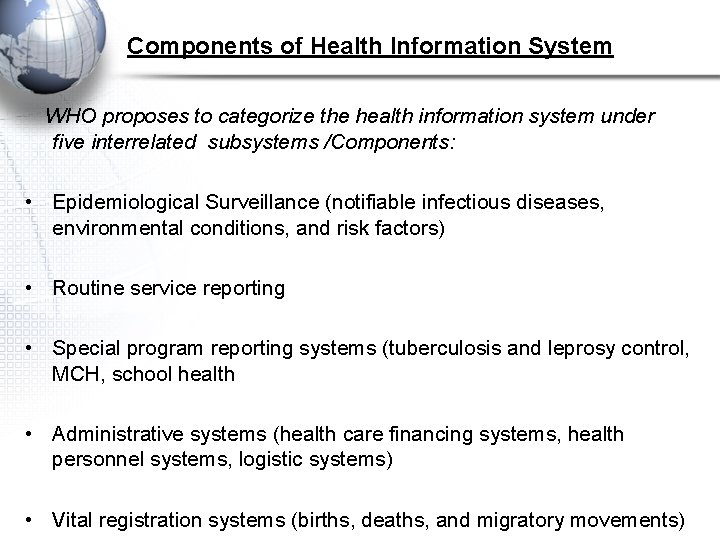
Components of Health Information System WHO proposes to categorize the health information system under five interrelated subsystems /Components: • Epidemiological Surveillance (notifiable infectious diseases, environmental conditions, and risk factors) • Routine service reporting • Special program reporting systems (tuberculosis and leprosy control, MCH, school health • Administrative systems (health care financing systems, health personnel systems, logistic systems) • Vital registration systems (births, deaths, and migratory movements)
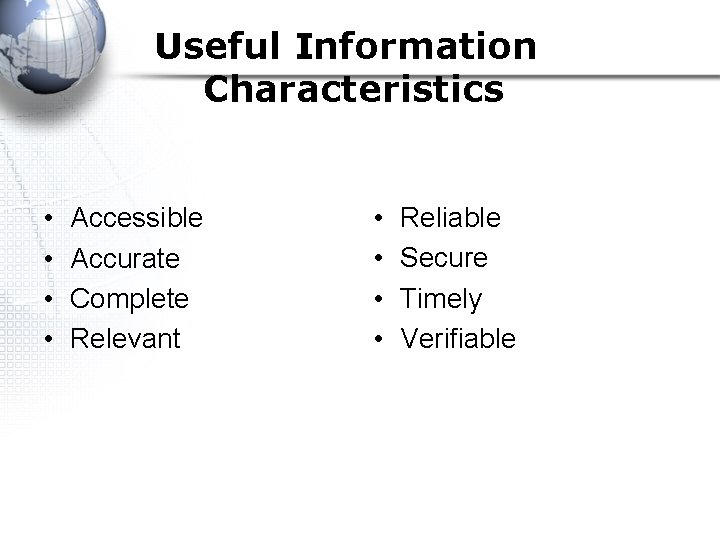
Useful Information Characteristics • • Accessible Accurate Complete Relevant • • Reliable Secure Timely Verifiable
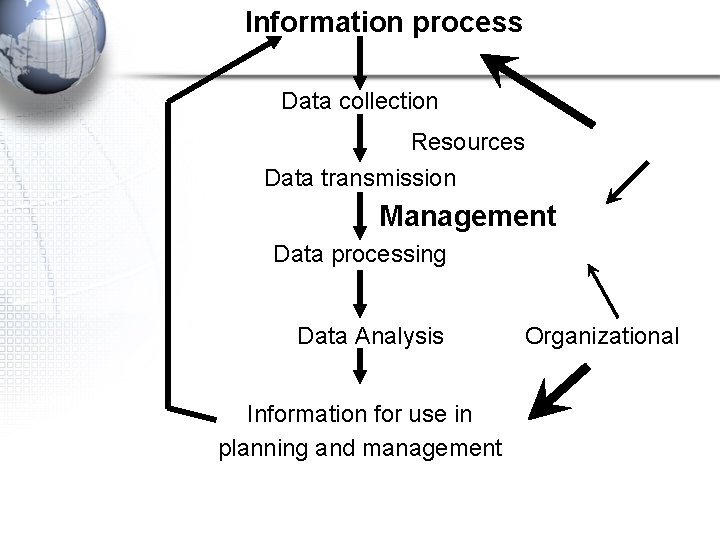
Information process Data collection Resources Data transmission Management Data processing Data Analysis Information for use in planning and management Organizational