
Health Literacy Hidden Barriers and Practical Strategies Hidden
Health Literacy: Hidden Barriers and Practical Strategies
Hidden Barriers to Communicating with Patients Clients/Patients: ü Education/Literacy/Language Health Literacy: The capacity to • Obtain, process, understand basic health information and services • Make appropriate health care decisions (act on information) • Access/navigate health care system
Using a Health Literacy Universal Precautions Approach ü Structuring the delivery of care as if everyone may have limited health literacy You cannot tell by looking n Higher literacy skills ≠ understanding n Anxiety can reduce ability to manage health information n Everyone benefits from clear communications n
National Assessment of Adult Literacy • • National assessment of health literacy skills of US adults Assessed both reading and math skills Focused on health-related materials and tasks 36% of adults were identified as having serious limitations in health literacy skills
IOM Report on Health Literacy • Health information is unnecessarily complex • Clinicians need health literacy training Healthy People 2020 Improve health communication/health literacy Joint Commission (1993) • Patients must be given information they understand
![“As a former nurse, trauma surgeon, and public health director [I realized] there was](http://slidetodoc.com/presentation_image_h2/f07a737782dd23a53cc5480d1c5f05f3/image-6.jpg "“As a former nurse, trauma surgeon, and public health director [I realized] there was")
“As a former nurse, trauma surgeon, and public health director [I realized] there was a wall between us and the people we were trying to serve. Health care professionals do not recognize that patients do not understand the health information we are trying to communicate. We must close the gap between what health care professionals know and what the rest of America understands. ” Dr. Richard Carmona, Former U. S. Surgeon General mentioned health literacy in 200 of last 260 speeches

U. S. high school dropout rate is 30% EPE Research Center (2008). “Cities in Crisis”
Red Flags for Low Literacy ü Frequently missed appointments ü Incomplete registration forms ü Non-compliance with medication ü Unable to name medications, explain purpose or dosing ü Identifies pills by looking at them, not reading label ü Unable to give coherent, sequential history ü Ask fewer questions ü Lack of follow-through on tests or referrals
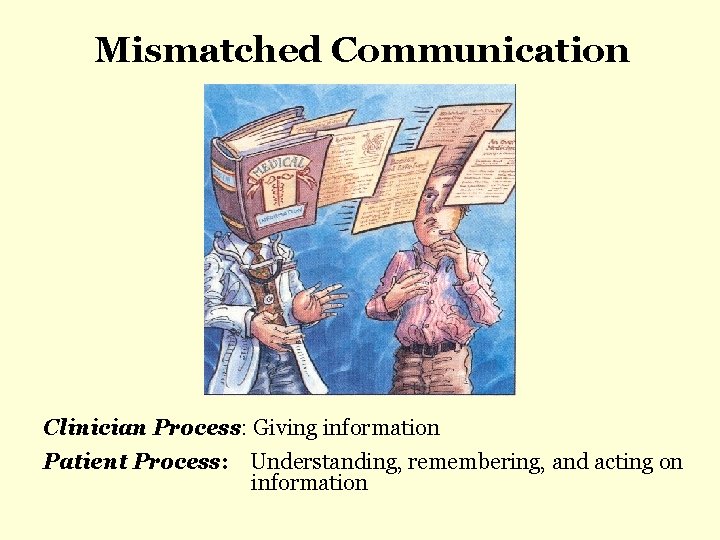
Mismatched Communication Clinician Process: Giving information Patient Process: Understanding, remembering, and acting on information
Our Expectations of Patients are Increasing… ü Prevention (eating, exercise, sunscreen, dental) ü Immunization ü Self Assessment of Health Status • Peak flow meter • Glucose testing ü Self-treatment • Insulin adjustments ü Health Care Use • When to go to clinic/ER • Referrals and followup • Insurance/Medicare
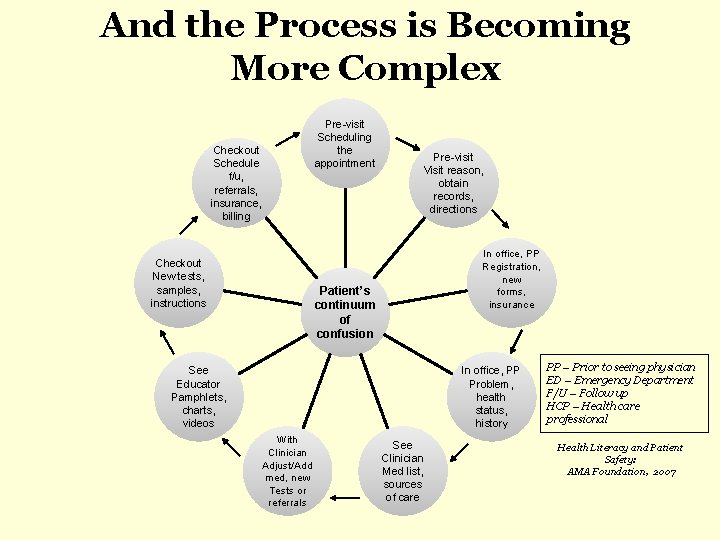
And the Process is Becoming More Complex Pre-visit Scheduling the appointment Checkout Schedule f/u, referrals, insurance, billing Checkout New tests, samples, instructions Pre-visit Visit reason, obtain records, directions In office, PP Registration, new forms, insurance Patient’s continuum of confusion See Educator Pamphlets, charts, videos In office, PP Problem, health status, history With Clinician Adjust/Add med, new Tests or referrals See Clinician Med list, sources of care PP – Prior to seeing physician ED – Emergency Department F/U – Follow up HCP – Health care professional Health Literacy and Patient Safety: AMA Foundation, 2007
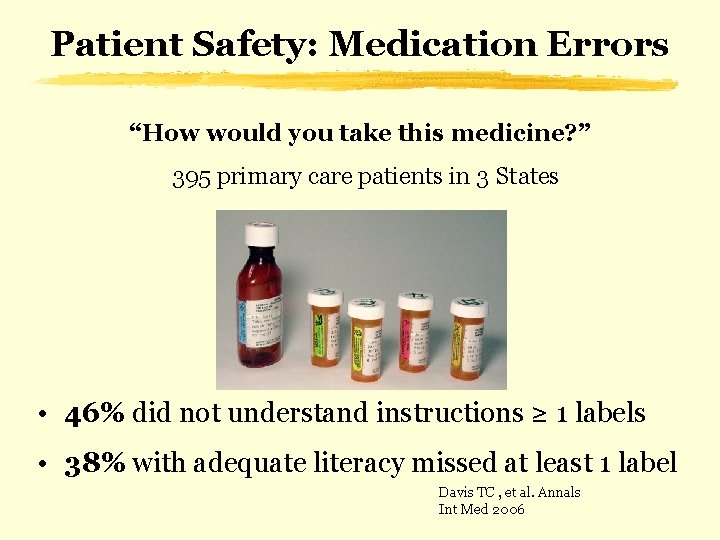
“ Patient Safety: Medication Errors “How would you take this medicine? ” 395 primary care patients in 3 States • 46% did not understand instructions ≥ 1 labels • 38% with adequate literacy missed at least 1 label Davis TC , et al. Annals Int Med 2006
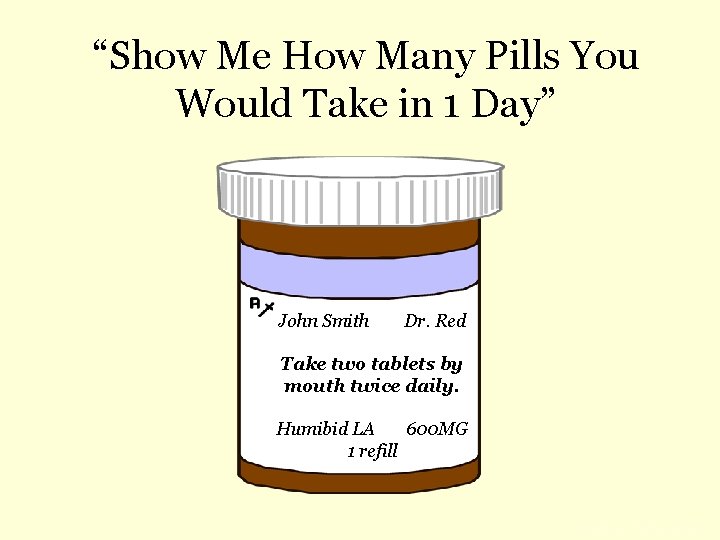
“Show Me How Many Pills You Would Take in 1 Day” John Smith Dr. Red Take two tablets by mouth twice daily. Humibid LA 600 MG 1 refill Slide by Terry Davis
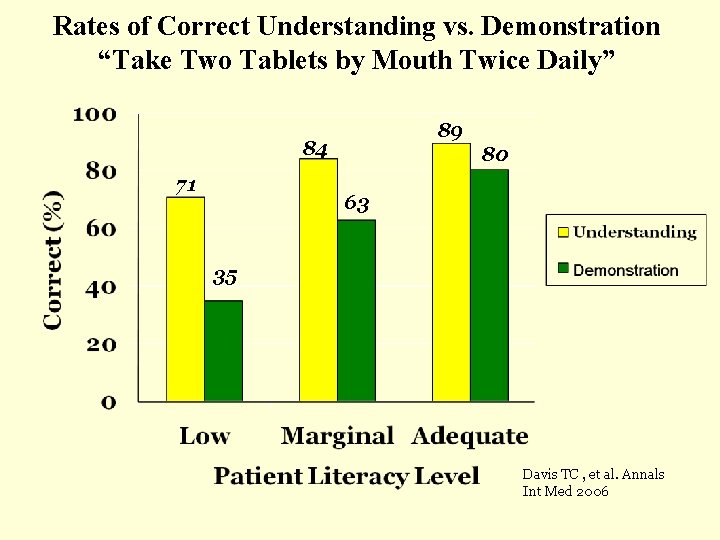
Rates of Correct Understanding vs. Demonstration “Take Two Tablets by Mouth Twice Daily” 89 84 71 80 63 35 Davis TC , et al. Annals Int Med 2006
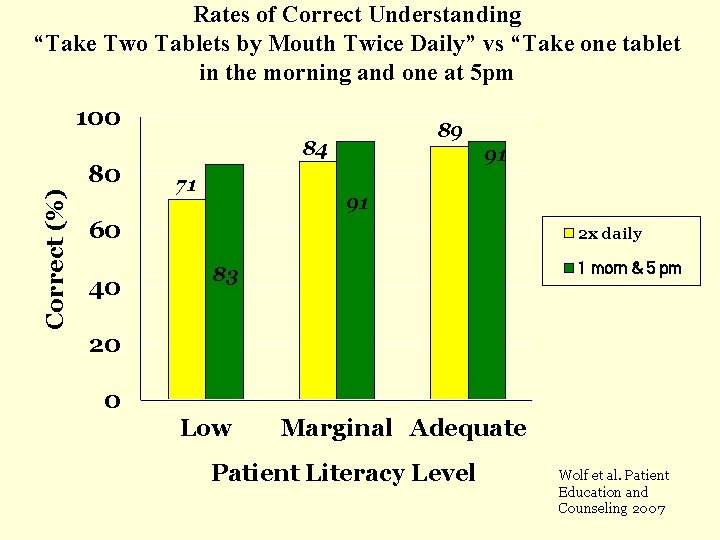
Rates of Correct Understanding “Take Two Tablets by Mouth Twice Daily” vs “Take one tablet in the morning and one at 5 pm 100 89 84 Correct (%) 80 71 91 91 60 40 2 x daily 1 morn & 5 pm 83 20 0 Low Marginal Adequate Patient Literacy Level Wolf et al. Patient Education and Counseling 2007
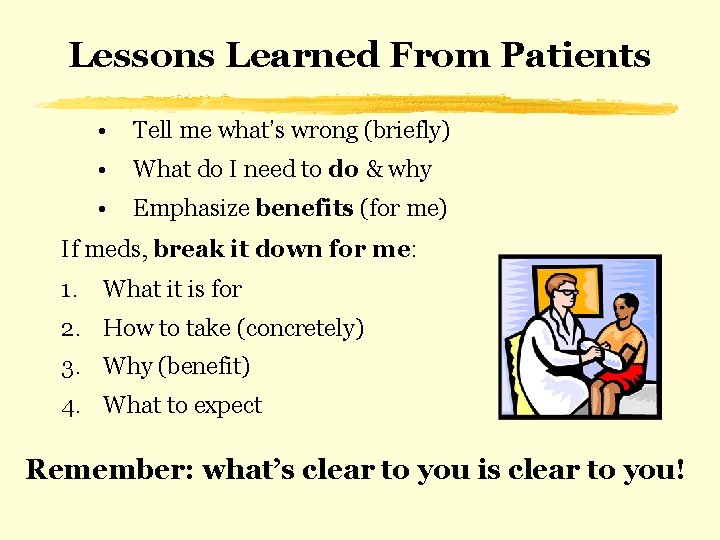
Lessons Learned From Patients • Tell me what’s wrong (briefly) • What do I need to do & why • Emphasize benefits (for me) If meds, break it down for me: 1. What it is for 2. How to take (concretely) 3. Why (benefit) 4. What to expect Remember: what’s clear to you is clear to you!
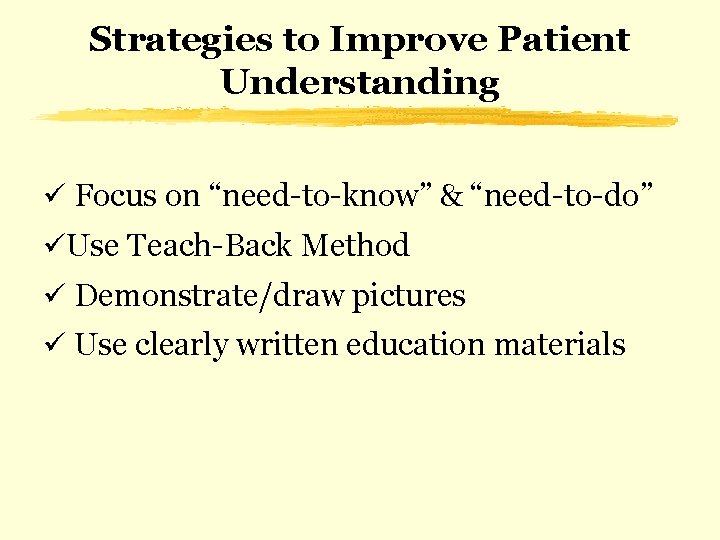
Strategies to Improve Patient Understanding ü Focus on “need-to-know” & “need-to-do” üUse Teach-Back Method ü Demonstrate/draw pictures ü Use clearly written education materials
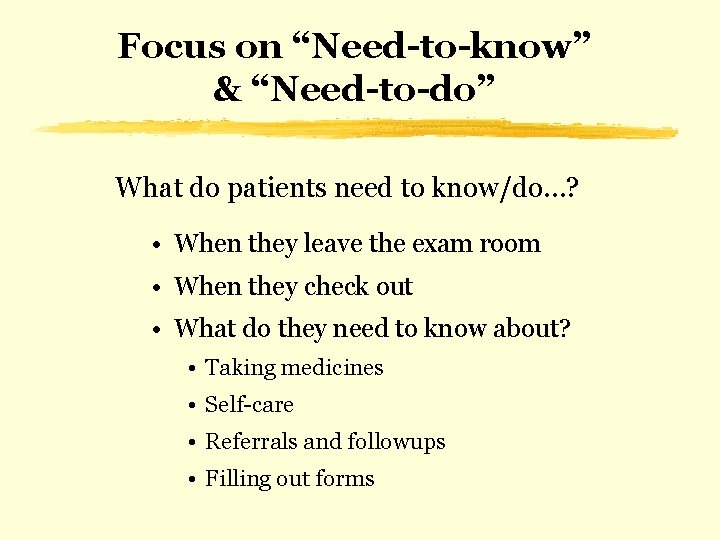
Focus on “Need-to-know” & “Need-to-do” What do patients need to know/do…? • When they leave the exam room • When they check out • What do they need to know about? • Taking medicines • Self-care • Referrals and followups • Filling out forms
Teach-Back Method ü Ensuring agreement and understanding about the care plan is essential to achieving adherence ü “I want to make sure I explained it correctly. Can you tell me in your words how you understand the plan? ” ü Some evidence that use of teach-back is associated with better diabetes control Schillinger, D. Archives of Internal Med, 2003
Teach-Back Improves Outcomes Diabetic Patients with Low Literacy Audio taped visits – 74 patients, 38 physicians ü Patients recalled < 50% of new concepts ü Physicians assessed understanding using teach-back 12% of time ü Use of teach-back was associated with good glycemic control ü Visits that assessed recall were not longer Schillinger, D. Archives of Internal Med, 2003
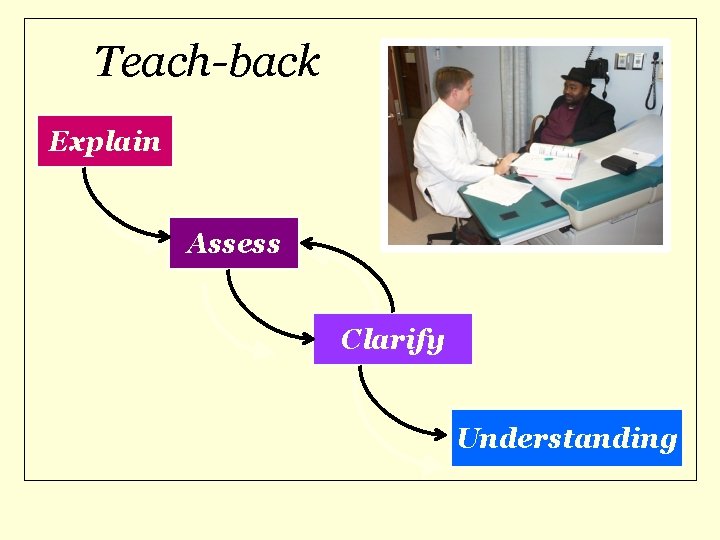
Teach-back Explain Assess Clarify Understanding
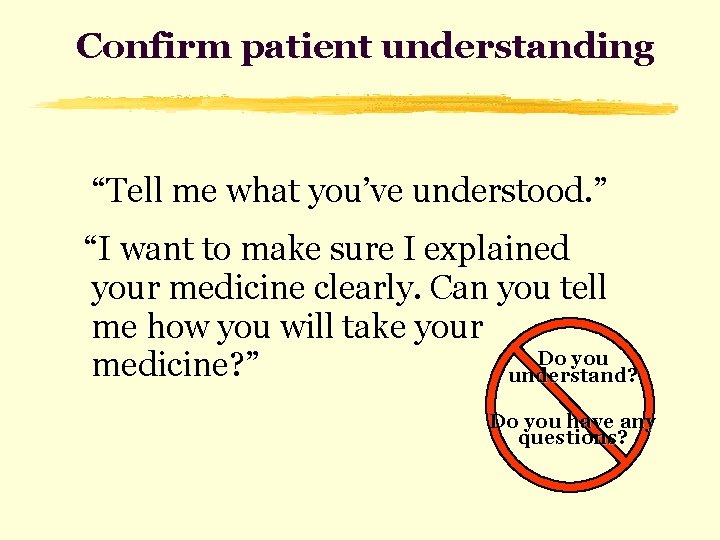
Confirm patient understanding “Tell me what you’ve understood. ” “I want to make sure I explained your medicine clearly. Can you tell me how you will take your Do you medicine? ” understand? Do you have any questions?
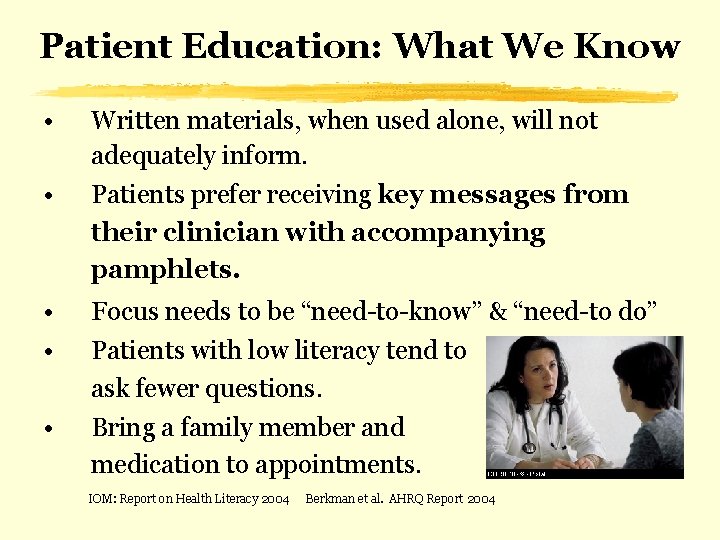
Patient Education: What We Know • • • Written materials, when used alone, will not adequately inform. Patients prefer receiving key messages from their clinician with accompanying pamphlets. Focus needs to be “need-to-know” & “need-to do” Patients with low literacy tend to ask fewer questions. Bring a family member and medication to appointments. IOM: Report on Health Literacy 2004 Berkman et al. AHRQ Report 2004
Visuals Improve Understanding/ Recall ü Pictures/demonstrations most helpful to patient with low literacy & visual learners ü Most health drawings too complicated ü Physician drawings often very good (not too complex) ü Patients say “show me” & “I can do it”
7 Tips for Clinicians ü Use plain language ü Limit information (3 -5 key points) ü Be specific and concrete, not general ü Demonstrate, draw pictures, use models ü Repeat/summarize ü Teach-Back (confirm understanding) ü Be positive, hopeful, empowering
Use Plain Language 20 complicated and commonly used words • Screening • Mental Health • Dermatologist • Annually • Immunization • Depression • Contraception • Respiratory problems • Hypertension • Oral • Community Resources • Monitor • Diabetes • Cardiovascular • Diet • Referral • Hygiene • Eligible • Prevention • Arthritis
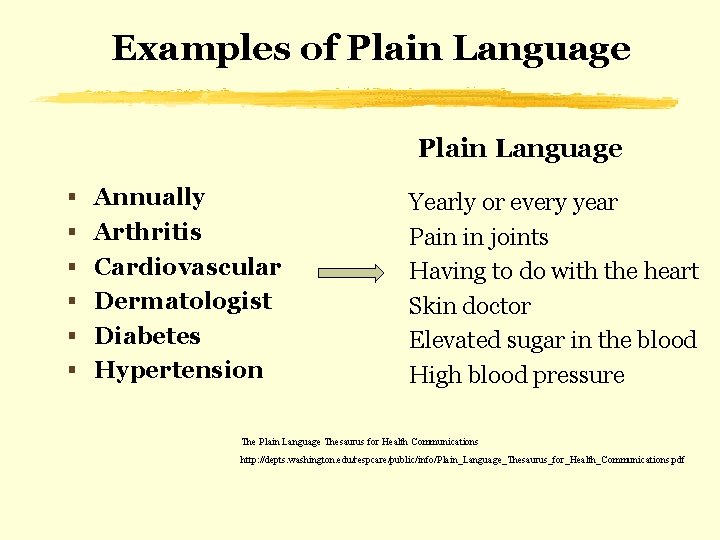
Examples of Plain Language § Annually § Arthritis § Cardiovascular § Dermatologist § Diabetes § Hypertension Yearly or every year Pain in joints Having to do with the heart Skin doctor Elevated sugar in the blood High blood pressure The Plain Language Thesaurus for Health Communications http: //depts. washington. edu/respcare/public/info/Plain_Language_Thesaurus_for_Health_Communications. pdf
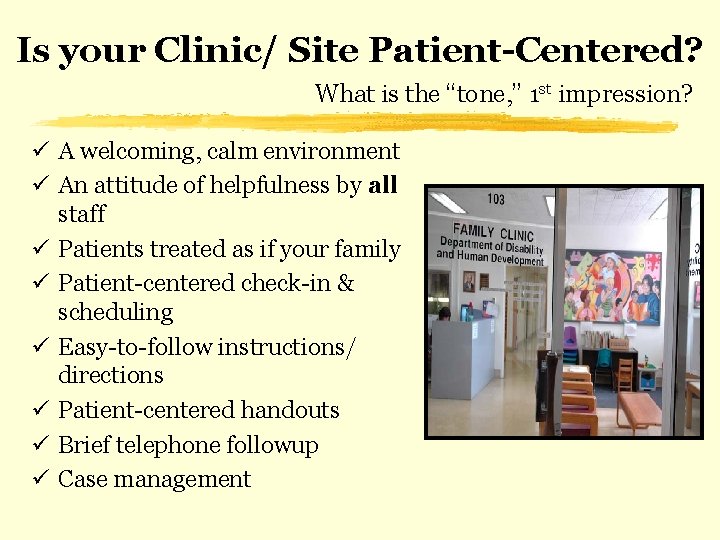
Is your Clinic/ Site Patient-Centered? What is the “tone, ” 1 st impression? ü A welcoming, calm environment ü An attitude of helpfulness by all staff ü Patients treated as if your family ü Patient-centered check-in & scheduling ü Easy-to-follow instructions/ directions ü Patient-centered handouts ü Brief telephone followup ü Case management
Discussion Questions ü Looking back, have there been instances when you suspected, or now suspect, that a patient might have low literacy? What were the signs? ü Do we do things in our practice that make it easier for patients with low literacy to understand services and information? n Consider the entire process of patient visits, from scheduling an appointment to check-out ü What strategies could all of us adopt to minimize barriers and misunderstanding for low literacy patients?
Acknowledgments Most slides and material were created by • Terry Davis, Ph. D With additions by • Darren De. Walt, MD, MPH • Ashley Hink, MPH • Victoria Hawk, RD, MPH • Angela Brega, Ph. D • Natabhona Mabachi, Ph. D
- Slides: 30