
Health Life Insurance Options and Benefits Essential Questions

+ Health & Life Insurance Options and Benefits
+ Essential Questions n. What are the types of health insurance and things to consider when selecting options? n. What are the types of life insurance and things to consider when selecting options?
+ Risk n. What n. How is it? do we handle risk? n. Bear the cost ourselves n. Use safety and avoidance measures to try and avoid costly incidents n. Transfer risks to another party by purchasing insurance policies
+ Insurance n. Risk management technique – an arrangement in which an insured pays money to an insurer to gain protection against risks and compensation for losses
+ Types of Insurance n. Health n. Life Insurance n. Homeowners n. Auto Insurance n. Other types? ? n(already discussed last 2!)

+ HEALTH INSURANCE
+ Sources of Health Insurance n Employers pay part or all the cost of a group health insurance plan as a benefit to their employees. Costs are generally lower as risk is spread over a large group n Private n Individuals purchase a policy to cover health costs for themselves or their immediate family. Greater flexibility in types of plan, but costs are higher n Government n State or federal government managed insurance paid from tax revenues. Must meet age and/or income qualifications
+ Managed Health Care Plans n HMO n a health care group that provides health care services to members for a set fee and a small co-pay n HSA n – Health Savings Account You contribute pre-tax dollars to the account for expected medical expenses for the coming year –-submit claims and receipts for reimbursement up to amount deposited n PPO n - Health maintenance organization - Preferred provider organization an agreement between health providers with employers or insurers to provide services at a reduced rate to employees
+ Managed Health Care Plans n POS-Point of Service n members use a primary physician who refers them as needed to participating specialist or members can see non -participating specialist members but, members pay more for their services n Fee n. A for Service plan in which an insured can select his/her own doctors and hospitals, pay costs at time of visit, and file form with insurance company for reimbursement of covered expenses
+ Terms to Know n Deductible – the amount you pay during the term (usually one year) before the insurance pays any medical expenses n Co-payments – Percentage of medical bills you must pay after meeting your deductible. Usually 10, 20 or 30% of the bill n Preauthorization – prior approval is required from the insurance company before major medical procedures are done. (e. g. surgery, chemotherapy) n Exclusions – medical expenses the policy will not cover (e. g. teen pregnancy, cosmetic surgery)

+ Terms to Know, continued n Pre-existing Conditions---An illness or injury that a person has at the time he/she enrolls in a health care plan n Renewability---A patient’s right to restart coverage annually n Maximum Benefit---A limit on the number of days one’s care will be covered, or the highest amount that can be paid in benefits for a specific procedure n Open enrollment period – time during which a person considers and chooses their options without cost increases or exclusions.
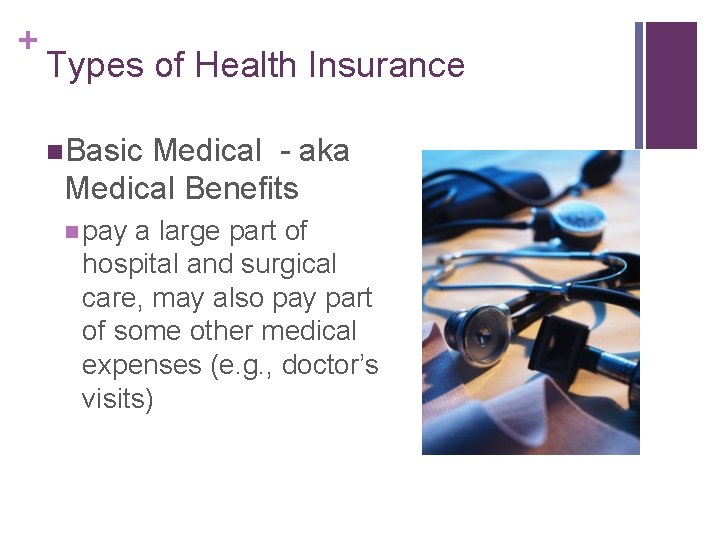
+ Types of Health Insurance n. Basic Medical - aka Medical Benefits n pay a large part of hospital and surgical care, may also pay part of some other medical expenses (e. g. , doctor’s visits)
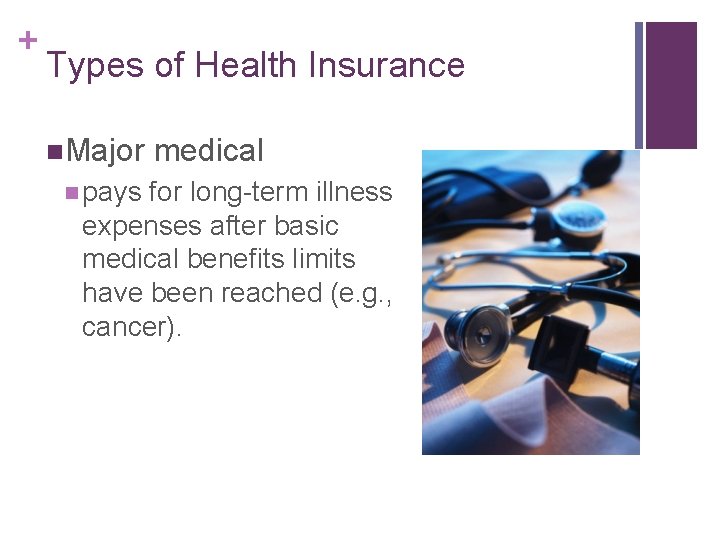
+ Types of Health Insurance n. Major n pays medical for long-term illness expenses after basic medical benefits limits have been reached (e. g. , cancer).
+ Other Types of Health Related Insurance Coverage n Dental n Pays Insurance for all or part of checkups which include examination, cleaning, and X-rays n Pays a portion or repairs such as fillings, crowns, and root canals n Offered with group rates through some employers
+ Other Types of Health Related Insurance Coverage n Vision n Pays Insurance for checkups n Covers a portion of the cost of lenses and frames
+ Other Types of Health Related Insurance Coverage n Accident n Often Insurance (e. g. School Insurance) available at low rates n Covers medical bills related to injury occurring at eligible locations and/or times (e. g. school grounds, sports events)

+ Other Types of Health Related Insurance Coverage n Medigap n Private Insurance insurance to individuals 65 or over who have Medicare plans. Covers the costs of copayments and deductibles.
+ Types of Disability Insurance n Disability n Pays a portion of income lost to a worker who is unable to return to work for an extended period of time because of illness or injury n Shop carefully as costs and benefits vary widely
+ Types of Disability Insurance n Workmen’s n Employers Compensation are require to have in every state in some form n Covers medical care, treatment, rehabilitation, and a portion of wages from injuries that occur in the workplace
+ Types of Disability Insurance n Long Term n Pays for care when a person with a chronic illness or injury cannot care for themselves for an extended period of time n Intended to cover the costs of extended home nursing care and related expenses which are not covered by regular medical benefits
+ Government Sponsored Health Insurance n Medicare n Covers eligible citizens 65 or older or eligible adults who can no longer work due to illness or disability n Funded from payroll taxes
+ Government Sponsored Health Insurance n Medicaid n Health insurance for eligible low income persons n Funded from state and federal tax revenue
+ Government Sponsored Health Insurance n CHIP – Children’s Health Insurance Program n Health insurance for children under 18 whose parents make too much to qualify for medicaid, but not enough to afford private insurance n Federal funds are distributed by the state
+ Government Sponsored Health Insurance n COBRA – Consolidated Omnibus Budget Reconciliation Act n Gives individuals the right to pay their own premiums and continue employer-sponsored group health insurance plan for a limited time after leaving a job.
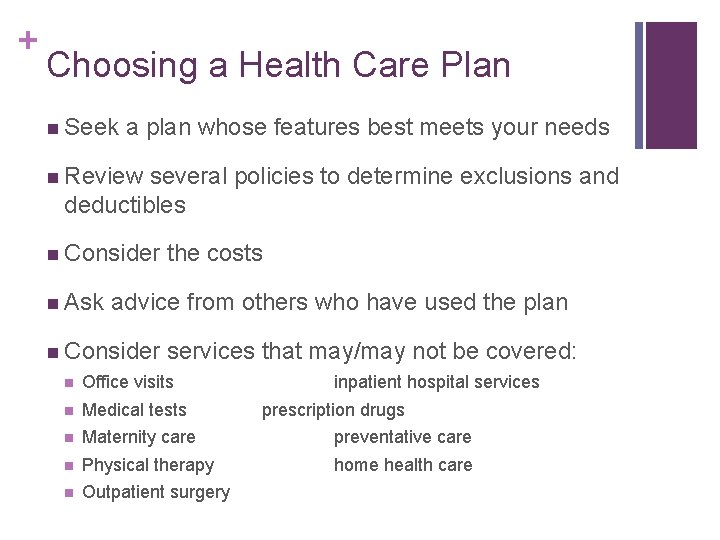
+ Choosing a Health Care Plan n Seek a plan whose features best meets your needs n Review several policies to determine exclusions and deductibles n Consider n Ask the costs advice from others who have used the plan n Consider services that may/may not be covered: n Office visits inpatient hospital services n Medical tests n Maternity care preventative care n Physical therapy home health care n Outpatient surgery prescription drugs
+ Life Insurance n. Contract between an insurance policy holder and an insurer, where the insurer promises to pay a designated beneficiary a sum of money (the "benefits") upon the death of the insured person. The policy holder typically pays a premium, either regularly or as a lump sum.
+ Life Insurance n The advantage for the policy owner is "peace of mind", in knowing that the death of the insured person will not result in financial hardship for loved ones. n Life policies are legal contracts and the terms of the contract describe the limitations of the insured events. Specific exclusions are often written into the contract to limit the liability of the insurer; common examples are claims relating to suicide, fraud, war, riot and civil commotion.
+ Life insurance n. Two Types n. Term n. Whole Life
+ Life insurance - Term n. Provides insurance for a specific period of time n. Relatively low cost n. No investment benefits n. Young person can buy large amount of coverage for minimum money

+ Life insurance – Term n. Types n Level of Term Insurance Term– premiums and death benefits stay the same for the life of the policy. n Decreasing Term – premiums stay the same but the benefits decrease over the life of the policy (e. g. home mortgage) n Renewable Term – the insured person can renew the policy without taking a physical
+ Life insurance – Term – cont’d n. Types of Term Insurance n Convertible Term – insured person can change the policy from convertible to permanent without taking a physical. Tends to be more expensive. n Permanent life insurance (aka cash value life insurance) provides coverage the person’s whole entire life and includes an investment component.
+ Life Insurance – Whole Life n. Provides insurance for whole lifetime as long as premiums are paid. n Benefit of coverage for a lifetime n More expensive than term because pays for premium plus an investment n Investment benefit – grows in cash value as premiums and interest accumulate; can borrow against it at low interest rate
+ Life insurance – Whole Life n. Types of Whole Life n Limited-payment life– coverage for entire life but premiums are higher than whole life because premiums are paid for a set number of years or until a set age n Universal life– allows adjustments of premium, face value and level of protection n Variable life– premiums are fixed, but face amount varies with investment results
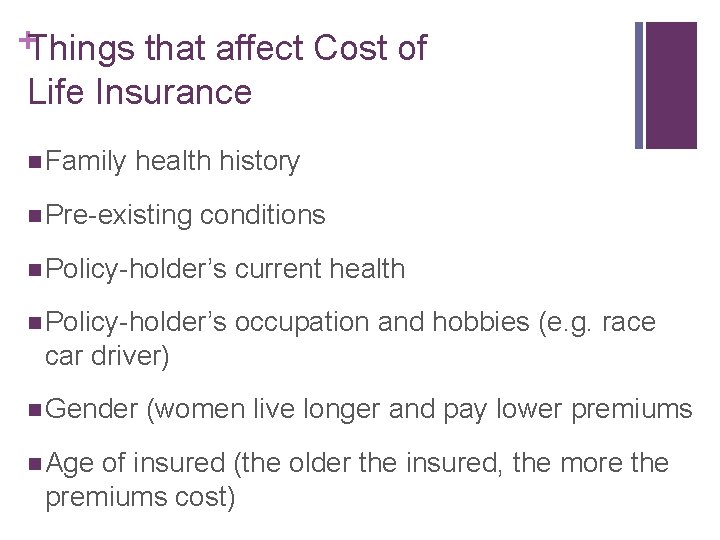
+Things that affect Cost of Life Insurance n Family health history n Pre-existing conditions n Policy-holder’s current health n Policy-holder’s occupation and hobbies (e. g. race car driver) n Gender n Age (women live longer and pay lower premiums of insured (the older the insured, the more the premiums cost)
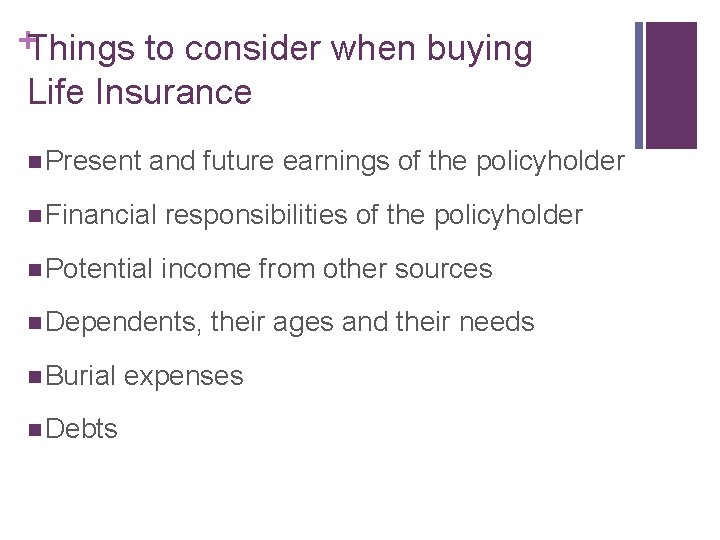
+Things to consider when buying Life Insurance n Present and future earnings of the policyholder n Financial responsibilities of the policyholder n Potential income from other sources n Dependents, n Burial n Debts their ages and their needs expenses
- Slides: 35