
Health Level 7 HL 7 A Brief Overview
Health Level 7 (HL 7): A Brief Overview of a 23 -Year Trajectory W 3 C Semantic Web Health Care and Life Sciences SIG Charlie Mead MD, MSc Chief Technology Officer, National Cancer Institute (NCI) Center for Biomedical Informatics and Information Technology (CBIIT) Chair, HL 7 Architecture Board (Ar. B)
Overview Time flies like an arrow. Fruit flies like a banana. • HL 7 Origins: Mission and Version 1. 0 • HL 7 Adoption: Version 2. x • HL 7 Maturation and Expansion: Version 3. 0 • HL 7 Evolution: Reorganization & Collaboration, Domain Analysis Models, Service-Awareness, and Enterprise Architecture • HL 7 Interoperability Contexts: the Translational Continuum • Pharma’s “next” business model: intersection with healthcare • National Cancer Institute: from ca. BIG™ to BIG-Health™
HL 7 Origins: Version 1. 0
1985 -89: A (relatively) Simple Problem • Collection of seven enterprise-related hospitals with ~30 ADT systems needed to exchange data • RS-232 -like byte-stream approach • Defined delimiters in message headers , fields/sub-fields, etc. • Syntactic interoperability with agreed-upon semantics in a restricted/closed domain-of-application • An engineering solution that worked! • Message paradigm (ACK/NACK) • “the only game in town” • Version 1. 0 (< 10 messages) released circa 1987, 1. 1 circa 1989 • Organization name chosen (Health Level 7) based on OSI stack • Solid adoption trajectory in US hospital community interest in expansion of message repertoire beyond ADT
HL 7 Adoption: Version 2. x
1989 -95: The Problem Gets Bigger • Increasing adoption drives interest in non-ADT domains • Financial/Patient Accounting • Orders management (e. g. labs, etc. ) • (gradually) Clinical Care (e. g. order sets, care plans, etc. ) • Organizational structure of HL 7 established • Technical Committees/SIGs (domain-specific) • Bottom-up message development based on “business triggers driving information exchange” • Optionality allowed in all messages • Complex relationships were hand-tooled on a per-message basis • Z-segments (the equivalent of free text in an RDBMS) allowed • Cross-TC sharing of semantics based on “good citizenship/awareness” • Content expands • Version 2. 0, 2. 1, and 2. 2 released between 1989 -92 • Version 2. 3, 2. 4, and 2. 5 relesed between 1992 -95
1989 -95: The Problem Gets Bigger • Adoption increases • 75% (1992)/95% (1995) of US hospitals utilized HL 7 2. x in two or more systems • Initial interest from non-US entities • • Canada Australia Europe UK NHS • HL 7 becomes an ANSI SDO to facilitate interaction with ISO • Slowly but surely, HL 7 was becoming a victim of its own success • “If you’ve seen one HL 7 implementation, you’ve seen one HL 7 implementation. ” • “HL 7 isn’t a standard, it’s a style guide. ”
HL 7 Maturation and Expansion: Version 3. 0
1995 -2006: Success Drives New Approaches • HL 7 Bo. D decided to embark on a new message-development strategy • Adoption of emerging UML as a standard modeling language • Adoption of a more formal abstract data type specification as underpinning for computable semantic interoperability • Decision to “stay out of the terminology business” and concentrate on the structures that bind terminologies, i. e…. • Development of a common Reference Information Model that would provide the “universe of semantics” for all HL 7 domains-of-interest and could be used to develop all HL 7 message structures • Emergence of a commitment to “more than just messaging in the HL 7 2. x sense” • Computable semantic interoperability • Other related standards • Arden Syntax • CCOW • Clinical Document Architecture (CDA)
Health Level Seven (HL 7) • “HL 7 develops specifications that enable the semantically interoperable exchange of healthcare data. ‘Data’ refers to any subject, patient, or population data required to facilitate the management or integration of any aspect healthcare including the management, delivery, evaluation of and reimbursement for healthcare services, as well as data necessary to conduct or support healthcare-related research. HL 7 Specifications are created to enable the semantically interoperable interchange of data between healthcare information systems across the entire healthcare continuum. ” -- (Mead paraphrase of HL 7 Mission Statement) • Conceptually congruent with W 3 C Semantic Web HCLS SIG Mission Statement
The Four Pillars of Computable Semantic Interoperability Necessary but not Sufficient • #1 - Common model (or harmonized sibling models) across all domains-of-interest • Information model vs Data model • The semantics of common structures – Domain Analysis Model • Discovered (in part) through analysis of business processes • #2 - Model bound to robust data type specification • HL 7 V 3 Abstract Data Type Specification (R 2) • ISO DT Specification
The Four Pillars of Computable Semantic Interoperability Necessary but not Sufficient • #3 - Methodology for binding terms from concept-based terminologies • Domain-specific semantics • #4 - A formally defined process for defining specific structures to be exchanged between machines, i. e. a “data exchange standard” • Static structures (as defined via Pillars 1 -3) bound to explicit data/information exchange constructs • As of Version 3. 0, these constructs were still defined as “messages” in the traditional HL 7 sense • Documents (content RIM-derived) could also be defined by HL 7 TCs and be exchanged within or without accompanying message constructs A single CSI statement is made by binding common, cross-domain structures to domain-specific terminologies (semantics).
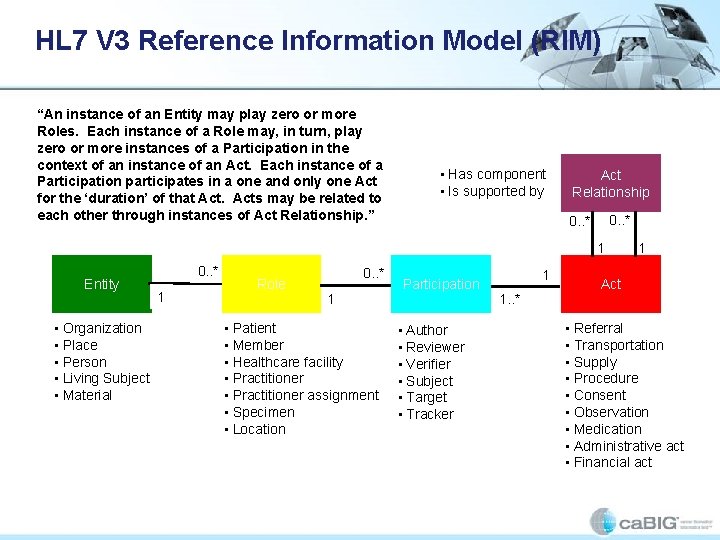
HL 7 V 3 Reference Information Model (RIM) “An instance of an Entity may play zero or more Roles. Each instance of a Role may, in turn, play zero or more instances of a Participation in the context of an instance of an Act. Each instance of a Participation participates in a one and only one Act for the ‘duration’ of that Acts may be related to each other through instances of Act Relationship. ” • Has component • Is supported by Act Relationship 0. . * 1 Entity • Organization • Place • Person • Living Subject • Material 0. . * 1 Role 0. . * 1 • Patient • Member • Healthcare facility • Practitioner assignment • Specimen • Location Participation • Author • Reviewer • Verifier • Subject • Target • Tracker 1 1. . * 1 Act • Referral • Transportation • Supply • Procedure • Consent • Observation • Medication • Administrative act • Financial act
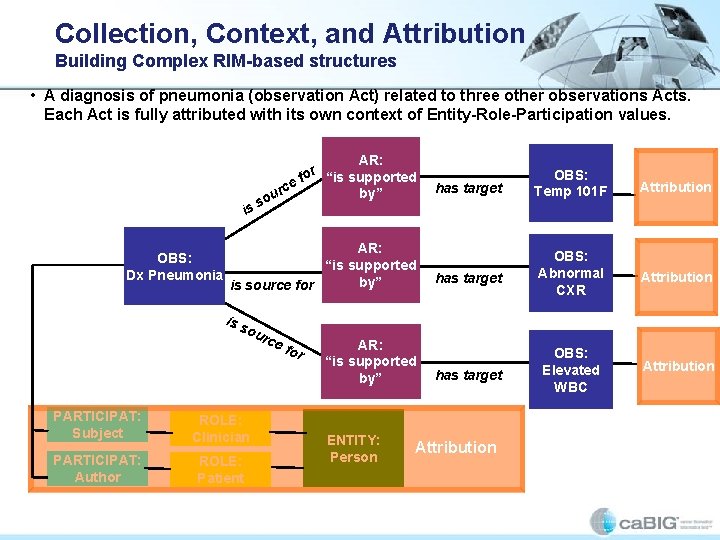
Collection, Context, and Attribution Building Complex RIM-based structures • A diagnosis of pneumonia (observation Act) related to three other observations Acts. Each Act is fully attributed with its own context of Entity-Role-Participation values. is OBS: Dx Pneumonia s AR: r fo “is supported ce r by” ou AR: “is supported by” is source for has target OBS: Temp 101 F Attribution has target OBS: Abnormal CXR Attribution has target OBS: Elevated WBC Attribution is s ou rc ef PARTICIPAT: Subject ROLE: Clinician PARTICIPAT: Author ROLE: Patient or AR: “is supported by” ENTITY: Person Attribution

Shakespeare in RIM-speak (courtesy of David Markwell) All the world’s a stage And all men and women are merely players One man, in his time, has many parts, First the infant, subject Mewling and puking responsible party direct target In the nurse’s arms.
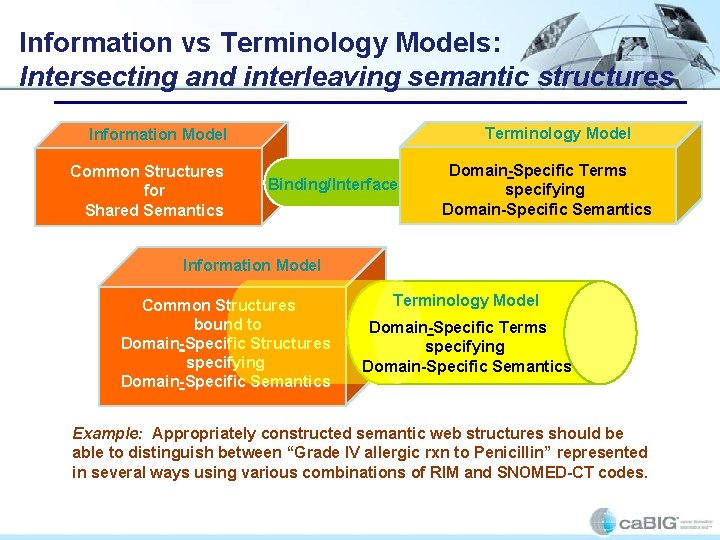
Information vs Terminology Models: Intersecting and interleaving semantic structures Terminology Model Information Model Common Structures for Shared Semantics Binding/Interface Domain-Specific Terms specifying Domain-Specific Semantics Information Model Common Structures bound to Domain-Specific Structures specifying Domain-Specific Semantics Terminology Model Domain-Specific Terms specifying Domain-Specific Semantics Example: Appropriately constructed semantic web structures should be able to distinguish between “Grade IV allergic rxn to Penicillin” represented in several ways using various combinations of RIM and SNOMED-CT codes.
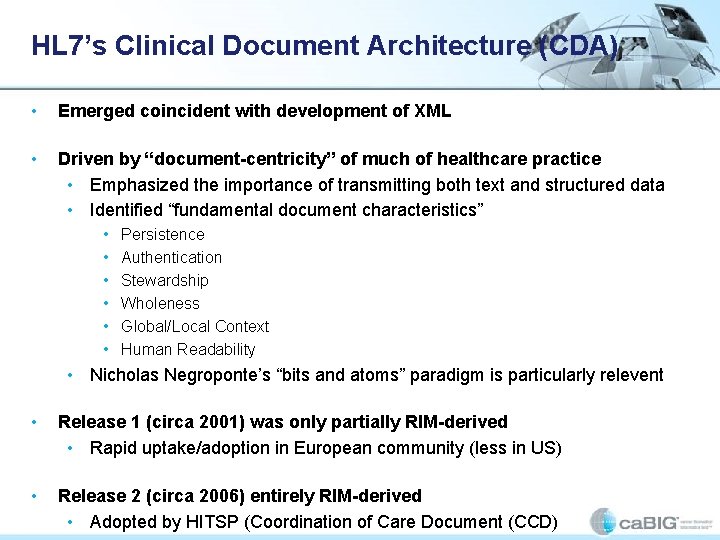
HL 7’s Clinical Document Architecture (CDA) • Emerged coincident with development of XML • Driven by “document-centricity” of much of healthcare practice • Emphasized the importance of transmitting both text and structured data • Identified “fundamental document characteristics” • • • Persistence Authentication Stewardship Wholeness Global/Local Context Human Readability • Nicholas Negroponte’s “bits and atoms” paradigm is particularly relevent • Release 1 (circa 2001) was only partially RIM-derived • Rapid uptake/adoption in European community (less in US) • Release 2 (circa 2006) entirely RIM-derived • Adopted by HITSP (Coordination of Care Document (CCD)
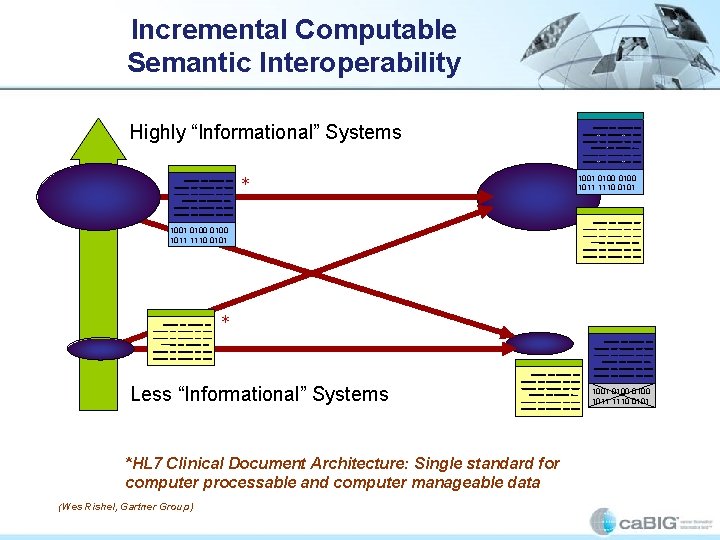
Incremental Computable Semantic Interoperability Highly “Informational” Systems * 1001 0100 1011 1110 0101 * Less “Informational” Systems *HL 7 Clinical Document Architecture: Single standard for computer processable and computer manageable data (Wes Rishel, Gartner Group) 1001 0100 1011 1110 0101
HL 7 TCs and the Life Sciences • Focus up until circa 1997 was “clinical care” • However, international interest in HL 7 led to new domains-of-interest and new TCs • Regulated Clinical Research Information Management (RCRIM) • Pharma (CDISC), FDA • • • Clinical Genomics Imaging Medical Devices Security Etc. Of particular interest to W 3 C SW HCLS SIG is the RCRIM TC
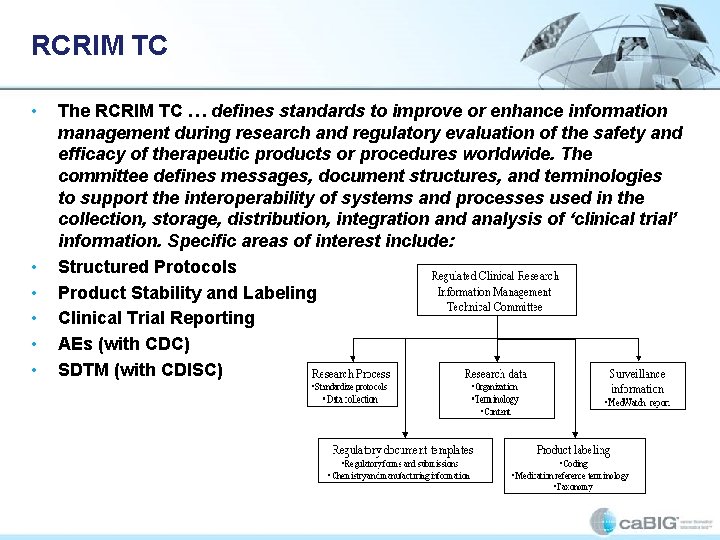
RCRIM TC • • • The RCRIM TC … defines standards to improve or enhance information management during research and regulatory evaluation of the safety and efficacy of therapeutic products or procedures worldwide. The committee defines messages, document structures, and terminologies to support the interoperability of systems and processes used in the collection, storage, distribution, integration and analysis of ‘clinical trial’ information. Specific areas of interest include: Structured Protocols Product Stability and Labeling Clinical Trial Reporting AEs (with CDC) SDTM (with CDISC)
A ca. BIG™ Example (from Covitz et al, Bioinformatics, V 19, N 18, P 2404) • • • Patient has headache, focal weakness, history of seizures Workup reveals glioblastoma multiforma, subtype astrocytoma Is this tumor histology associated with gene expression abnormalities? • Yes, in the p 53 signaling pathway including BCL 2, TIMP 3, GADD 45 A, CCND 1 Is there documented evidence of aberrant expression of (e. g. CCND 1)? • Yes, SAGE tags for cyclin D 1 appear with 3 x greater frequency in cancerous vs normal brain tissue Are any gene products of the p 53 signaling pathway known targets for therapeutic agents? • Yes, TP 53, RB 1, BCL 2, CDK 4, MDM 2, CCNE 1 Are any of the agents known to target these genes being specifically tested in glioblastoma patients? • Yes, trials xxx and yyy are currently underway
HL 7 Evolution: Reorganization & Collaboration, Domain Analysis Models, Service -Awareness, and Enterprise Architecture
Reorganization • As HL 7 has grew to have ~3000 members, 40+ TCs and SIGs, ~30 International Affiliates, and as several countries implementing (or attempting to implement) its standards, it became increasingly obvious that -- like a growing company -- it needed to reassess its organizational structure and processes. • Multi-dimensional effort began in 2005 and continuuing to present • Reconstituted Bo. D • CEO • CTO • Technical Steering Committee • Architecture Board • Decreased number of TCs/SIGs • Emphasis on project management and common development methodology • Use of ANSI DSTU to encourage testing before final ballot
Collaboration • HL 7 actively seeks collaboration with other organizations developing standards for healthcare, life sciences, clinical research internationally • Goal is to avoid redundant efforts • Examples include • • • ISO CEN OMG CDISC (Clinical Data Interchange Standards Consortium) • Established circa 2002 • Virtually entire pharma industry is represented • Prototype collaboration relationship for HL 7 via RCRIM TC • Leading developer of a DAM for domain of “Protocol-driven research and associated regulatory artifacts” the BRIDG Model
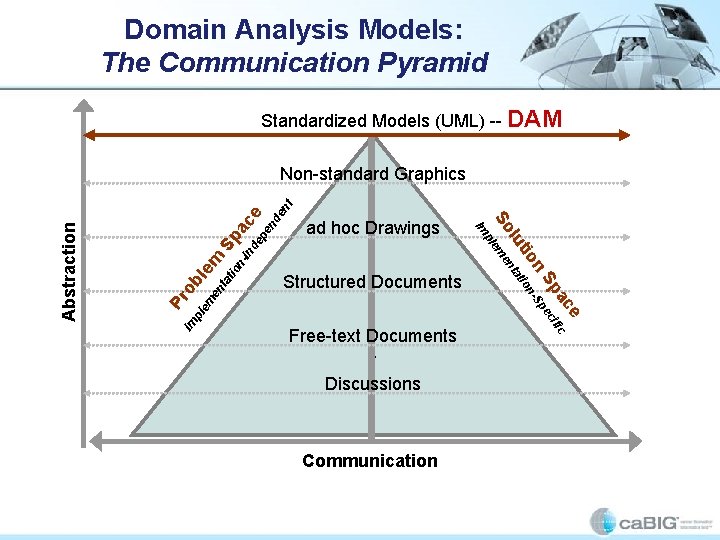
Domain Analysis Models: The Communication Pyramid Standardized Models (UML) -- DAM de n en ac de p Sp io n. In m le en ta t m ob Structured Documents pl e Pr Im e ac fic Sp eci n -Sp tio tation en Abstraction lu em pl Im ad hoc Drawings So e t Non-standard Graphics Free-text Documents ` Discussions Communication
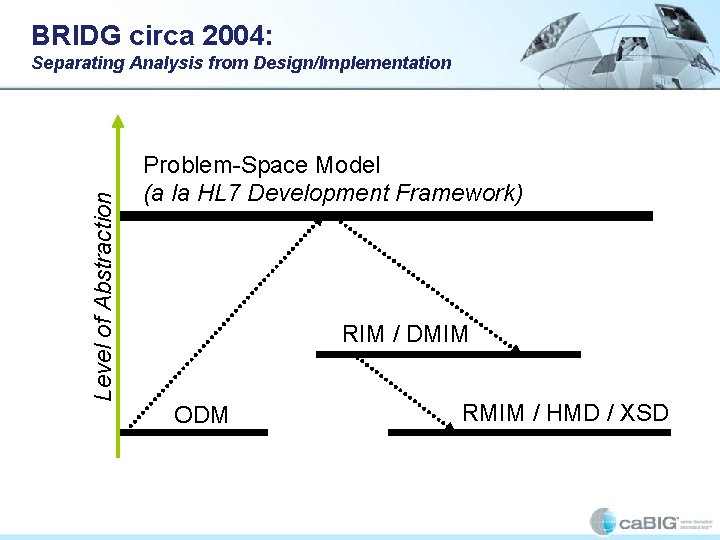
BRIDG circa 2004: Level of Abstraction Separating Analysis from Design/Implementation Problem-Space Model (a la HL 7 Development Framework) RIM / DMIM ODM RMIM / HMD / XSD
Lessons Learned: Using a DAM • DAMs need to be applied in the context of a larger development (message, service, application) management process • DAMs should be both domain-friendly and semantically robust (technology useful) • In order to be truly effective, standards development needs to become less like the Waterfall and more ‘Agile, ’ i. e. embedded in an interactive, iterative, incremental process. • Exemplar process has been successfully piloted at NCI and is now ready for application to all projects • A DAM that is ultimately used in message, application, or service development needs to address • Data Type bindings • Terminology bindings for coded data types
Lessons Learned: Working with BRIDG (1) • BRIDG only makes sense ‘in context’ • e. g. message development, application development, service specification, etc. • Analysis Paralysis occurs otherwise • Most effective use is in the context of an iterative/incremental development process (e. g. RUP, SCRUM, Agile, ect. ) • NCI has integrated use of the BRIDG Model (and the use of analysis models in general) into its development practices • HL 7 RCRIM appears to be ready to do the same • The BRIDG domain-of-interest is stable after 4+ years of use • Protocol-driven research involving human, animal, or device subjects and associated regulatory artifacts • Recently, questions have been raised as to whether the BRIDG domainof-interest should include post-marketing safety/adverse events • Initial indications are that the answer is ‘Yes’ and that the effect on the model’s structure will be minimal
Lessons Learned: Working with BRIDG (2) • Teams need to start with the existing BRIDG Model • Subset as needed based on project focus • Add new semantics (e. g. classes, attributes, relationships, business rules, etc. ) as needed • All new editions must be rigorously defined • Identify existing elements in the BRIDG model which are incorrect, unclear, too restrictive, etc.
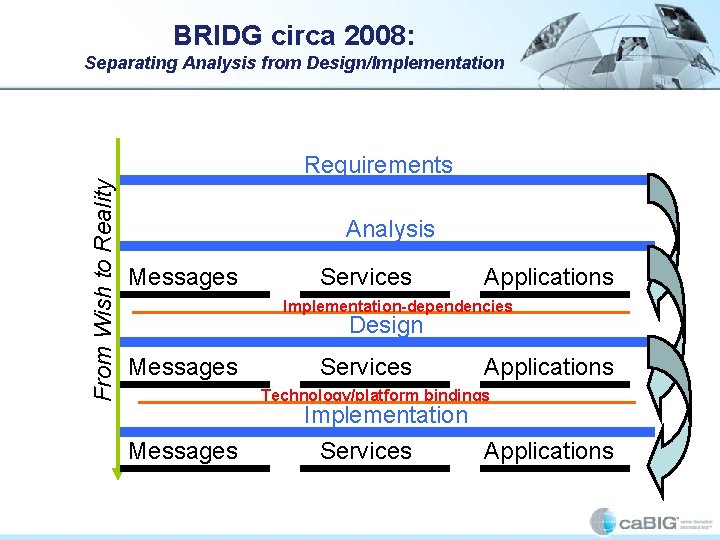
BRIDG circa 2008: Separating Analysis from Design/Implementation From Wish to Reality Requirements Analysis Messages Services Applications Implementation-dependencies Design Messages Services Applications Technology/platform bindings Implementation Messages Services Applications
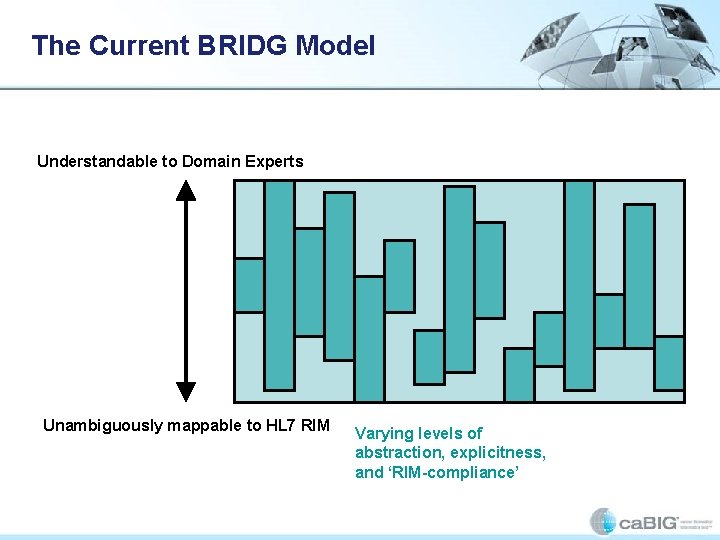
The Current BRIDG Model Understandable to Domain Experts Unambiguously mappable to HL 7 RIM Varying levels of abstraction, explicitness, and ‘RIM-compliance’
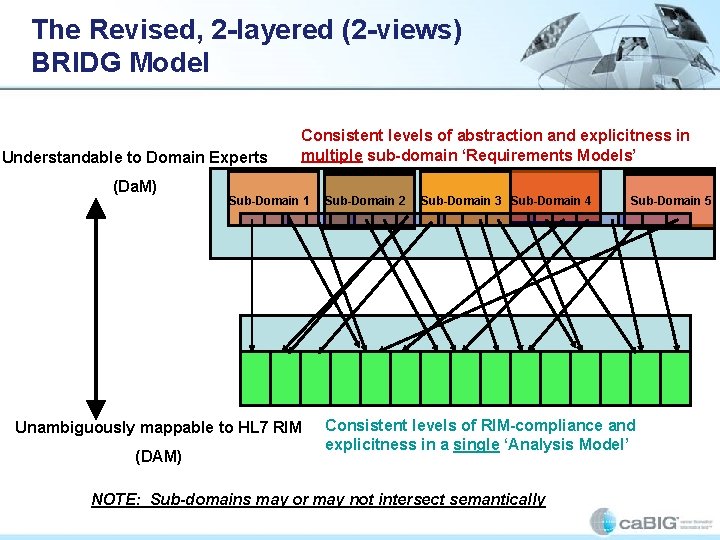
The Revised, 2 -layered (2 -views) BRIDG Model Understandable to Domain Experts (Da. M) Consistent levels of abstraction and explicitness in multiple sub-domain ‘Requirements Models’ Sub-Domain 1 Unambiguously mappable to HL 7 RIM (DAM) Sub-Domain 2 Sub-Domain 3 Sub-Domain 4 Sub-Domain 5 Consistent levels of RIM-compliance and explicitness in a single ‘Analysis Model’ NOTE: Sub-domains may or may not intersect semantically
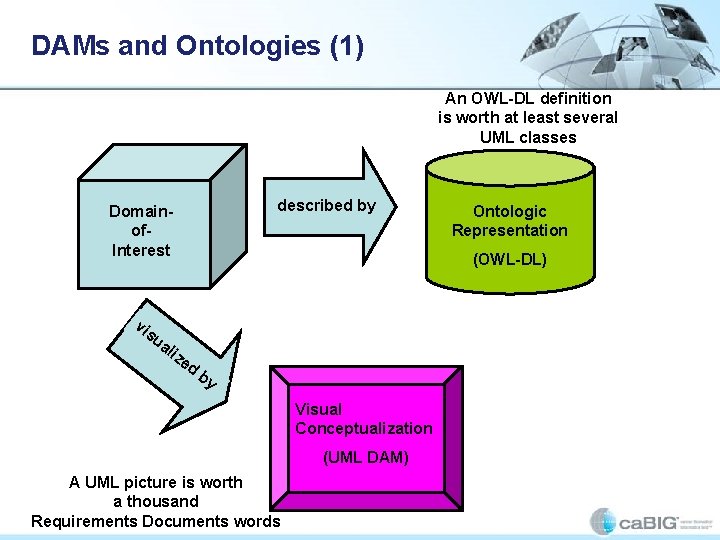
DAMs and Ontologies (1) An OWL-DL definition is worth at least several UML classes described by Domainof. Interest vi su al Ontologic Representation ize (OWL-DL) d by Visual Conceptualization (UML DAM) A UML picture is worth a thousand Requirements Documents words
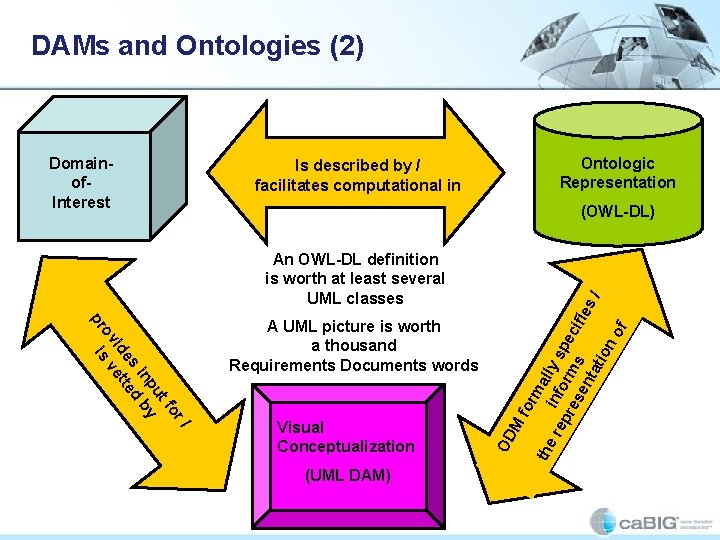
DAMs and Ontologies (2) Ontologic Representation Is described by / facilitates computational in An OWL-DL definition is worth at least several UML classes for (UML DAM) M Visual Conceptualization OD / or tf pu y in b es ed id ett ov v pr is A UML picture is worth a thousand Requirements Documents words ma l rep info ly sp res rms eci fie en s/ tat ion of (OWL-DL) the Domainof. Interest
Service Awareness within HL 7 • Initial work began in 2006 with the development of the Health Services Specification Project (HSSP), a joint effort with OMG • By CTO directive, has evolved to a directive to the newlyestablished Ar. B to develop a “Services-Aware Enterprise Architecture Framework” (SAEAF) for HL 7 • Requirements include • Maximum utilization of existing static artifacts • Development of computationally robust behavioral/interaction model • Development of a scalable Conformance/Compliance framework
Enterprise Integration Strategies: Objects vs Messages vs Services • Objects • Finely-granulated • Difficult to trace to business functionality • Encapsulation not a positive when crossing enterprise boundaries • Messages • Payloads based on standards support semantic interoperability • Embedding dynamic/behavioral semantics within message causes runtime context ambiguity or non-enforceable contract semantics • Application Roles • Receiver Responsibilities • Services • Traceable to business-level requirements • Separation of static semantics (message payload) from dynamic semantics (“integration points, ” contracts)
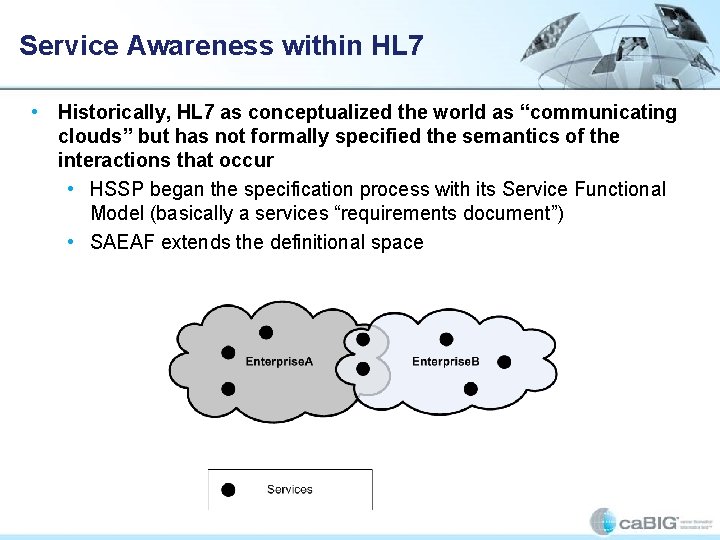
Service Awareness within HL 7 • Historically, HL 7 as conceptualized the world as “communicating clouds” but has not formally specified the semantics of the interactions that occur • HSSP began the specification process with its Service Functional Model (basically a services “requirements document”) • SAEAF extends the definitional space
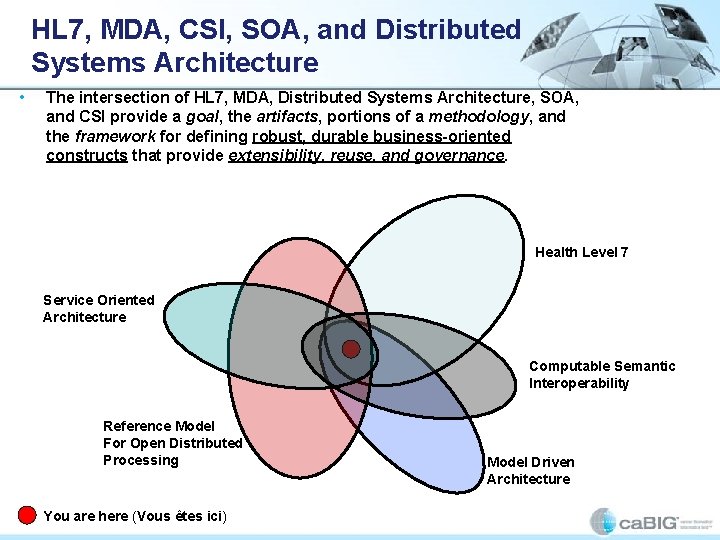
HL 7, MDA, CSI, SOA, and Distributed Systems Architecture • The intersection of HL 7, MDA, Distributed Systems Architecture, SOA, and CSI provide a goal, the artifacts, portions of a methodology, and the framework for defining robust, durable business-oriented constructs that provide extensibility, reuse, and governance. Health Level 7 Service Oriented Architecture Computable Semantic Interoperability Reference Model For Open Distributed Processing You are here (Vous êtes ici) Model Driven Architecture
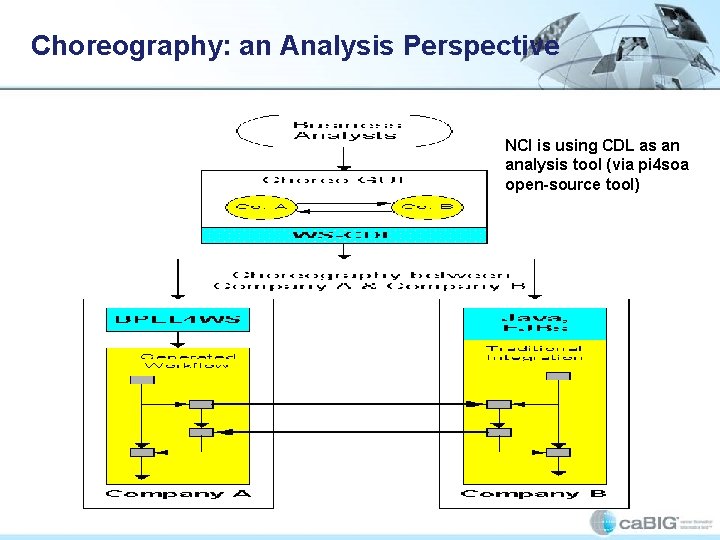
Choreography: an Analysis Perspective NCI is using CDL as an analysis tool (via pi 4 soa open-source tool)
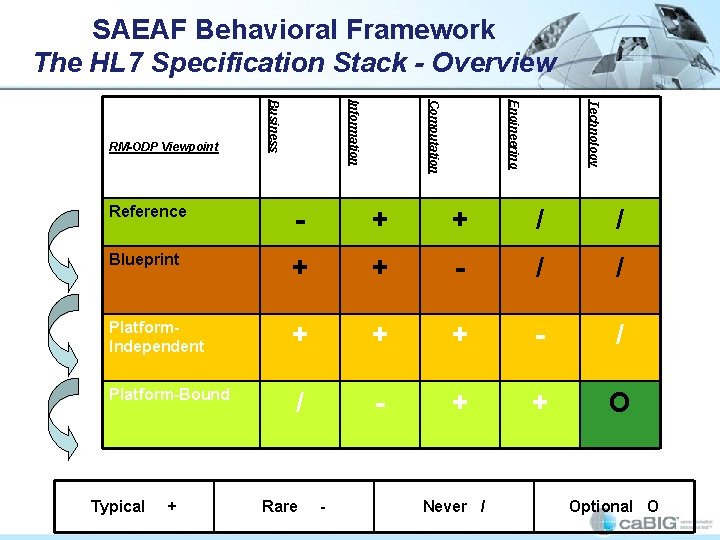
SAEAF Behavioral Framework The HL 7 Specification Stack - Overview Technology Engineering Computation Information Business RM-ODP Viewpoint Reference - + + / / Blueprint + + - / / Platform. Independent + + + - / Platform-Bound / - + + O Typical + Rare - Never / Optional O
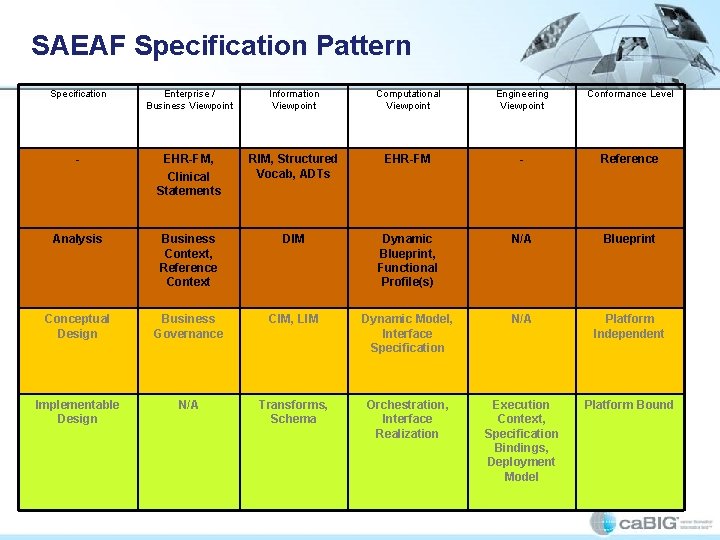
SAEAF Specification Pattern Specification Enterprise / Business Viewpoint Information Viewpoint Computational Viewpoint Engineering Viewpoint Conformance Level - EHR-FM, Clinical Statements RIM, Structured Vocab, ADTs EHR-FM - Reference Analysis Business Context, Reference Context DIM Dynamic Blueprint, Functional Profile(s) N/A Blueprint Conceptual Design Business Governance CIM, LIM Dynamic Model, Interface Specification N/A Platform Independent Implementable Design N/A Transforms, Schema Orchestration, Interface Realization Execution Context, Specification Bindings, Deployment Model Platform Bound
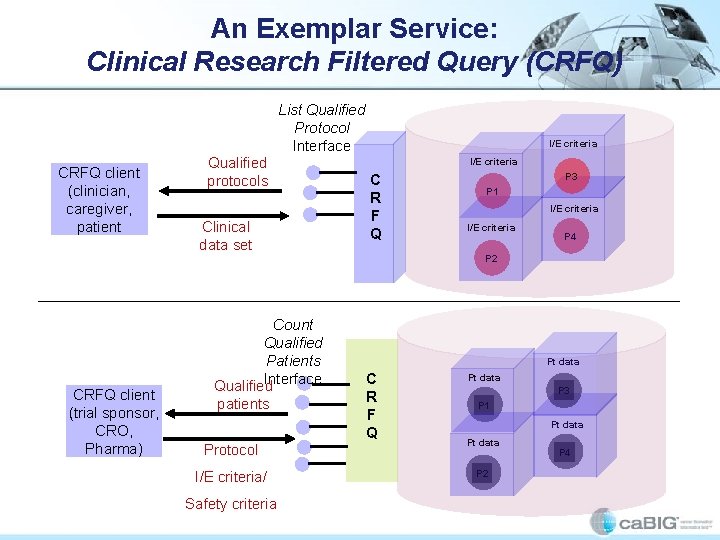
An Exemplar Service: Clinical Research Filtered Query (CRFQ) List Qualified Protocol Interface CRFQ client (clinician, caregiver, patient CRFQ client (trial sponsor, CRO, Pharma) Qualified protocols Clinical data set Count Qualified Patients Interface Qualified patients I/E criteria C R F Q P 3 P 1 I/E criteria P 2 Pt data C R F Q Pt data P 3 P 1 Pt data Protocol Pt data I/E criteria/ P 2 Safety criteria P 4
HL 7 Interoperability Contexts: The Translational Continuum -- Pharma’s “next” business model: intersection with healthcare -- National Cancer Institute: from ca. BIG™ to BIG-Health™
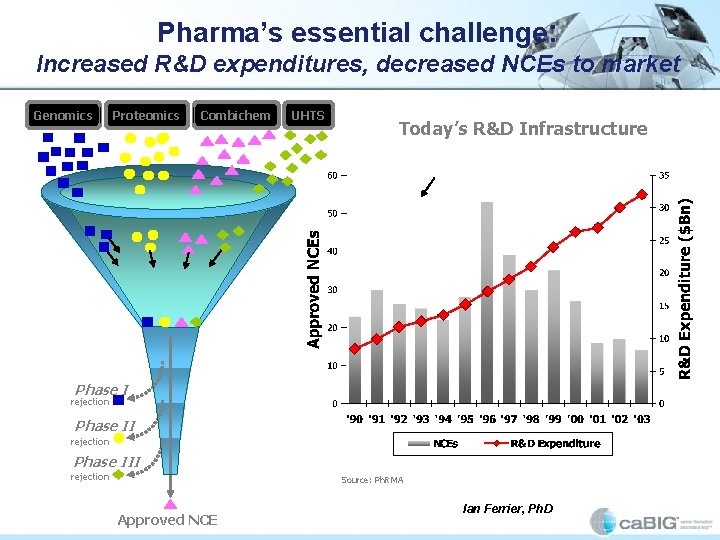
Pharma’s essential challenge: Increased R&D expenditures, decreased NCEs to market Genomics Proteomics Combichem UHTS Today’s R&D Infrastructure Phase I rejection Phase III rejection Source: Ph. RMA Approved NCE Ian Ferrier, Ph. D
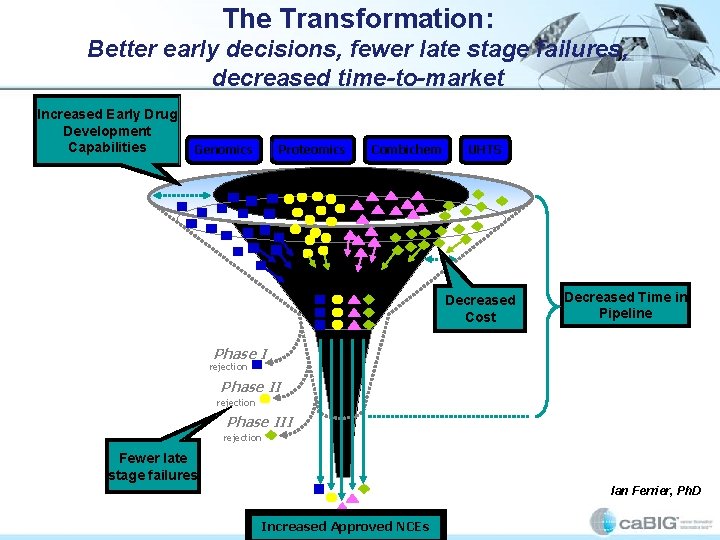
The Transformation: Better early decisions, fewer late stage failures, decreased time-to-market Increased Early Drug Development Capabilities Genomics Proteomics Combichem UHTS Decreased Cost Decreased Time in Pipeline Phase I rejection Phase III rejection Fewer late stage failures Ian Ferrier, Ph. D Increased Approved NCEs
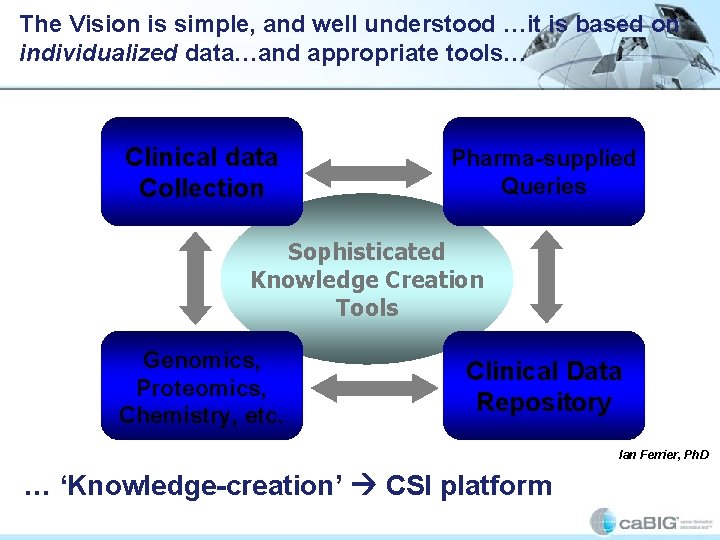
The Vision is simple, and well understood …it is based on individualized data…and appropriate tools… Clinical data Collection Pharma-supplied Queries Sophisticated Knowledge Creation Tools Genomics, Proteomics, Chemistry, etc. Clinical Data Repository Ian Ferrier, Ph. D … ‘Knowledge-creation’ CSI platform
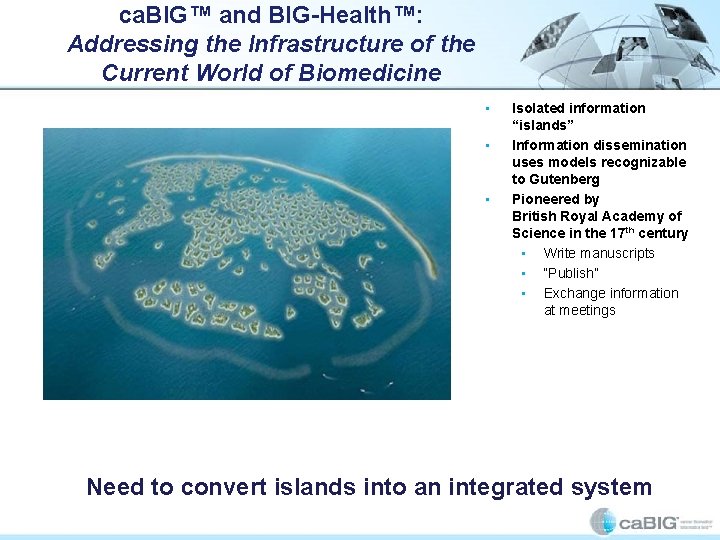
ca. BIG™ and BIG-Health™: Addressing the Infrastructure of the Current World of Biomedicine • • • Isolated information “islands” Information dissemination uses models recognizable to Gutenberg Pioneered by British Royal Academy of Science in the 17 th century • Write manuscripts • “Publish” • Exchange information at meetings Need to convert islands into an integrated system
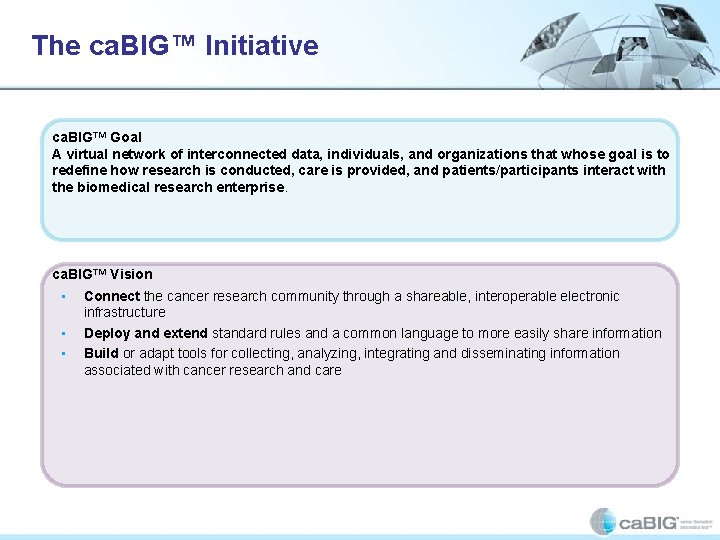
The ca. BIG™ Initiative ca. BIG™ Goal A virtual network of interconnected data, individuals, and organizations that whose goal is to redefine how research is conducted, care is provided, and patients/participants interact with the biomedical research enterprise. ca. BIG™ Vision • • • Connect the cancer research community through a shareable, interoperable electronic infrastructure Deploy and extend standard rules and a common language to more easily share information Build or adapt tools for collecting, analyzing, integrating and disseminating information associated with cancer research and care
ca. BIG™ Strategy • Connect the cancer research community through a shareable, interoperable infrastructure • Deploy and extend standard rules and a common language to more easily share information • Build or adapt tools for collecting, analyzing, integrating and disseminating information associated with cancer research and care
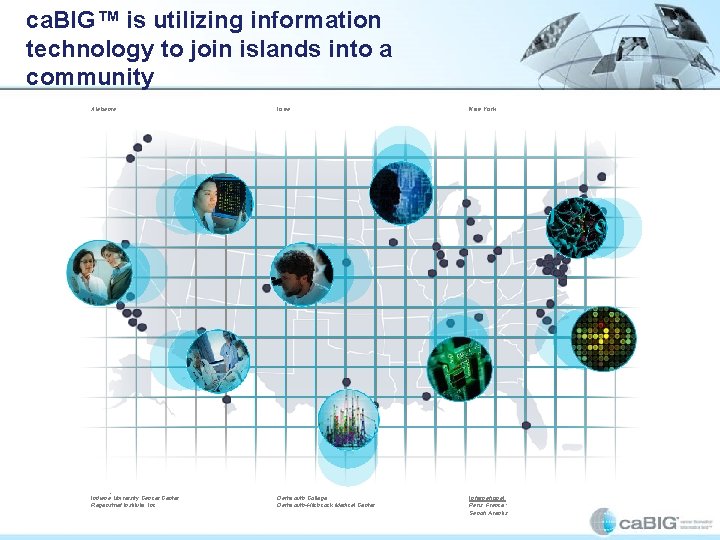
ca. BIG™ is utilizing information technology to join islands into a community Alabama Birmingham: UAB Comprehensive Cancer Center Arizona Phoenix: Translational Genomics Research Institute Tucson: University of Arizona California Berkeley: University of California Lawrence Berkeley National Laboratory University of California at Berkeley Los Angeles: AECOM California Institute of Technology University of Southern California Information Sciences Institute University of California at Irvine The Chao Family Comprehensive Cancer Center La Jolla: The Burnham Institute Sacramento: University of California Davis Cancer Center San Diego: SAIC San Francisco: University of California San Francisco Comprehensive Cancer Center Colorado Aurora: University of Colorado Cancer Center District of Columbia Department of Veterans Affairs Lombardi Cancer Research Center - Georgetown University Medical Center Florida Tampa: H. Lee Moffitt Cancer Center at the University of South Florida Hawaii Manoa: Cancer Research Center of Hawaii Illinois Argonne: Argonne National Laboratory Chicago: Robert H. Lurie Comprehensive Cancer Center of Northwestern University of Chicago Cancer Research Center Urbana-Champaign: University of Illinois at Urbana-Champaign Indianapolis: Indiana University Cancer Center Regenstrief Institute, Inc. Iowa City: Holden Comprehensive Canter Center at the University of Iowa Louisiana New Orleans: Tulane University School of Medicine Maine Bar Harbor: The Jackson Laboratory Maryland Baltimore: The Sidney Kimmel Comprehensive Cancer Center at Johns Hopkins University Bethesda: Consumer Advocates in Research and Related Activities (CARRA) NCI Cancer Therapy Evaluation Program NCI Center for Bioinformatics NCI Center for Cancer Research NCI Center for Strategic Dissemination NCI Division of Cancer Control and Population Sciences NCI Division of Cancer Epidemiology and Genetics NCI Division of Cancer Prevention NCI Division of Cancer Treatment and Diagnosis Terrapin Systems Rockville: Capital Technology Information Services Emmes Corporation Information Management Services, Inc. Massachusetts Cambridge: Akaza Research Massachusetts Institute of Technology Somerville: Panther Informatics Michigan Ann Arbor: Internet 2 University of Michigan Comprehensive Cancer Center Detroit: Meyer L. Prentis/Karmanos Comprehensive Cancer Center Minnesota Minneapolis: University of Minnesota Cancer Center Rochester: Mayo Clinic Cancer Center Nebraska Omaha: University of Nebraska Medical Center/Eppley Cancer Center New Hampshire Lebanon: Dartmouth College Dartmouth-Hitchcock Medical Center New York Buffalo: Roswell Park Cancer Institute Bronx: Albert Einstein Cancer Center Cold Spring Harbor: Cold Spring Harbor Laboratory New York: Herbert Irving Comprehensive Cancer Center Columbia University Memorial Sloan-Kettering Cancer Center New York University Medical Center White Plains: IBM North Carolina Chapel Hill: University of North Carolina Lineberger Comprehensive Cancer Center Raleigh-Durham: Alpha-Gamma Technologies, Inc. Constella Health Sciences Duke Comprehensive Cancer Center Ohio Cleveland: Case Comprehensive Cancer Center Columbus: Ohio State University Comprehensive Cancer Center Oregon Portland: Oregon Health & Science University Pennsylvania Philadelphia: Drexel University Fox Chase Cancer Center Kimmel Cancer Center at Thomas Jefferson University Abramson Cancer Center of the University of Pennsylvania Pittsburgh: University of Pittsburgh Cancer Institute Tennessee Memphis: St. Jude’s Children’s Research Hospital Texas Austin: 9 Star Research Houston: M. D. Anderson Cancer Center Virginia Fairfax: SRA International Reston: Scenpro Washington Seattle: Data. Works Development, Inc. Fred Hutchinson Cancer Research Center International Paris, France: Sanofi Aventis
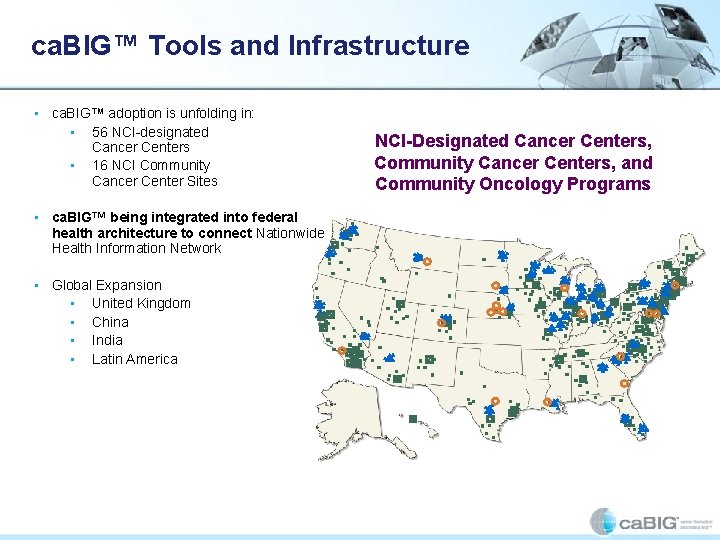
ca. BIG™ Tools and Infrastructure • ca. BIG™ adoption is unfolding in: • 56 NCI-designated Cancer Centers • 16 NCI Community Cancer Center Sites • ca. BIG™ being integrated into federal health architecture to connect Nationwide Health Information Network • Global Expansion • United Kingdom • China • India • Latin America NCI-Designated Cancer Centers, Community Cancer Centers, and Community Oncology Programs
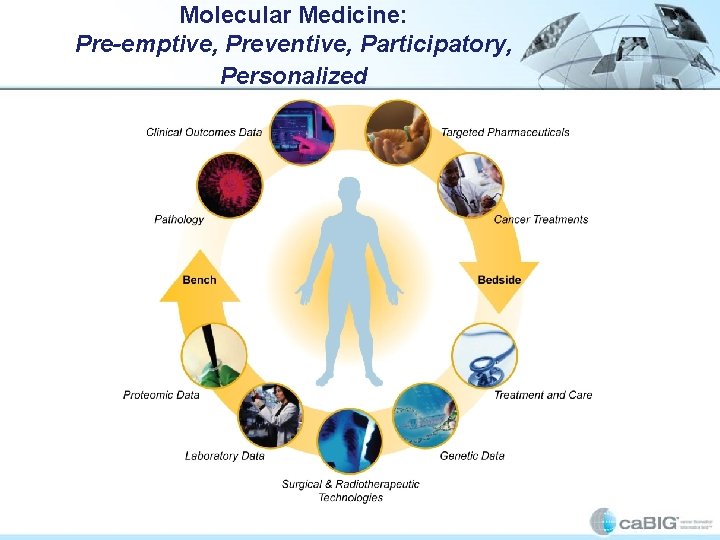
Molecular Medicine: Pre-emptive, Preventive, Participatory, Personalized
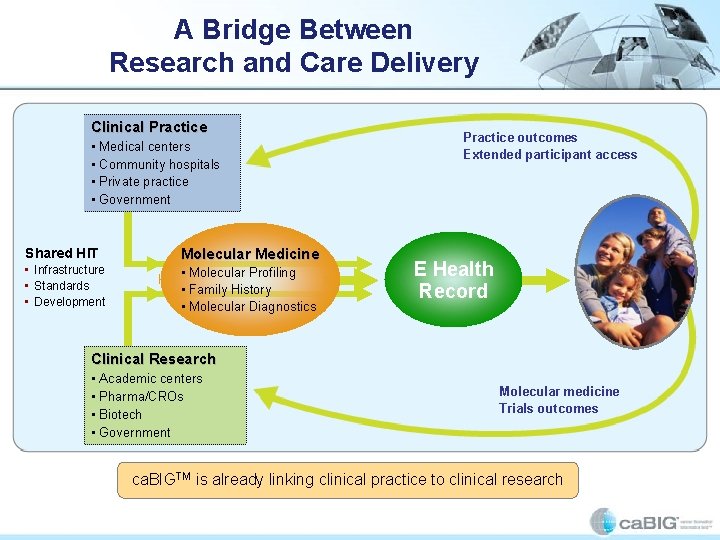
A Bridge Between Research and Care Delivery Clinical Practice • Medical centers • Community hospitals • Private practice • Government Shared HIT • Infrastructure • Standards • Development Molecular Medicine • Molecular Profiling • Family History • Molecular Diagnostics Practice outcomes Extended participant access E Health Record Clinical Research • Academic centers • Pharma/CROs • Biotech • Government Molecular medicine Trials outcomes ca. BIGTM is already linking clinical practice to clinical research
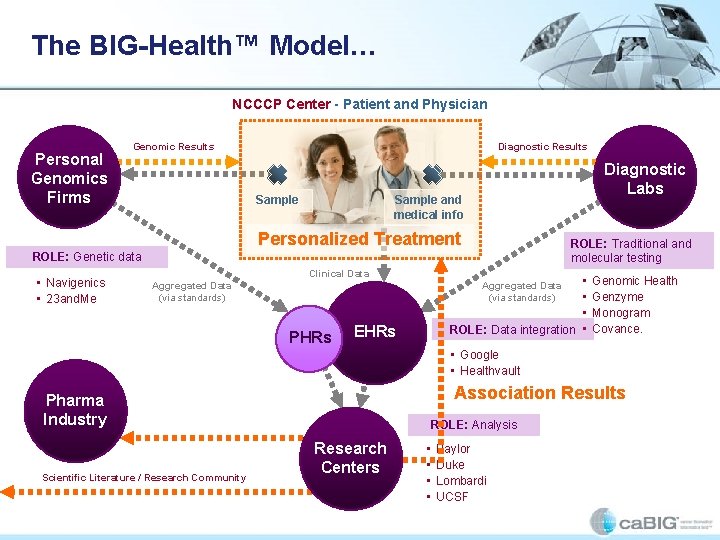
The BIG-Health™ Model… NCCCP Center - Patient and Physician Personal Genomics Firms Genomic Results Diagnostic Labs Sample and medical info Sample Personalized Treatment ROLE: Traditional and molecular testing ROLE: Genetic data • Navigenics • 23 and. Me Clinical Data • • • ROLE: Data integration • Aggregated Data (via standards) PHRs EHRs Genomic Health Genzyme Monogram Covance. • Google • Healthvault Association Results Pharma Industry Scientific Literature / Research Community ROLE: Analysis Research Centers • • Baylor Duke Lombardi UCSF
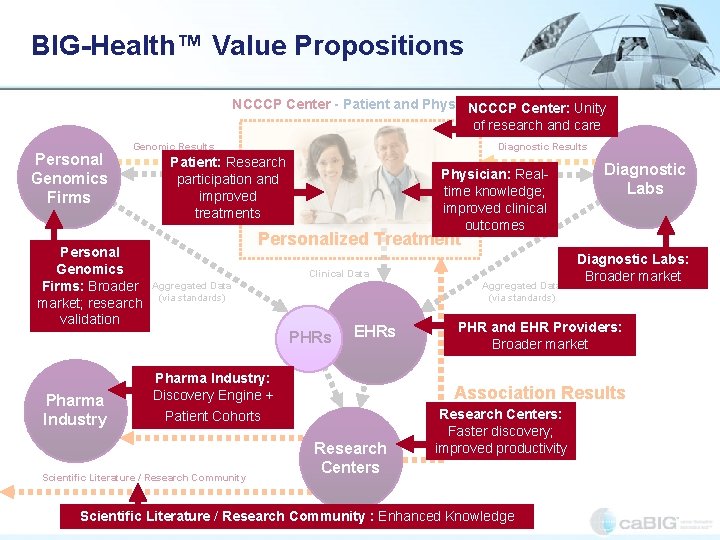
BIG-Health™ Value Propositions NCCCP Center - Patient and Physician NCCCP Center: Unity of research and care Personal Genomics Firms Genomic Results Personal Genomics Firms: Broader market; research validation Diagnostic Results Patient: Research participation and improved treatments Physician: Realtime knowledge; improved clinical outcomes Personalized Treatment Clinical Data Aggregated Data (via standards) PHRs Pharma Industry Diagnostic Labs EHRs Pharma Industry: Discovery Engine + Patient Cohorts Scientific Literature / Research Community Diagnostic Labs: Broader market PHR and EHR Providers: Broader market Association Results Research Centers: Faster discovery; improved productivity Scientific Literature / Research Community : Enhanced Knowledge
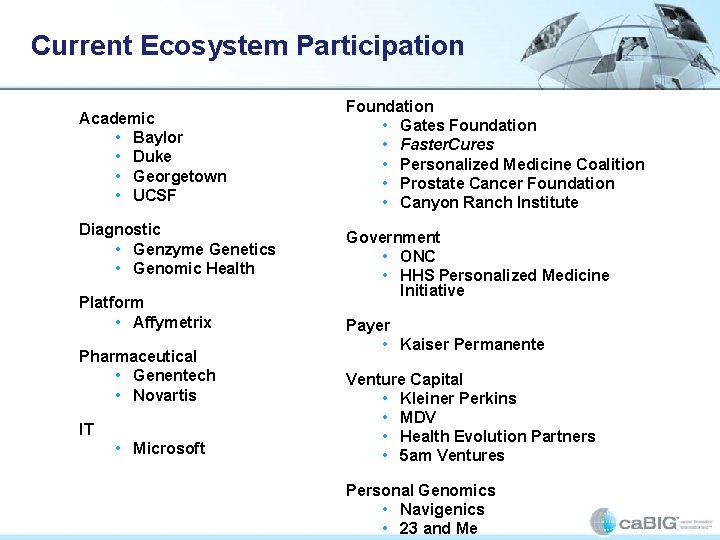
Current Ecosystem Participation Academic • Baylor • Duke • Georgetown • UCSF Diagnostic • Genzyme Genetics • Genomic Health Platform • Affymetrix Pharmaceutical • Genentech • Novartis IT • Microsoft Foundation • Gates Foundation • Faster. Cures • Personalized Medicine Coalition • Prostate Cancer Foundation • Canyon Ranch Institute Government • ONC • HHS Personalized Medicine Initiative Payer • Kaiser Permanente Venture Capital • Kleiner Perkins • MDV • Health Evolution Partners • 5 am Ventures Personal Genomics • Navigenics • 23 and Me
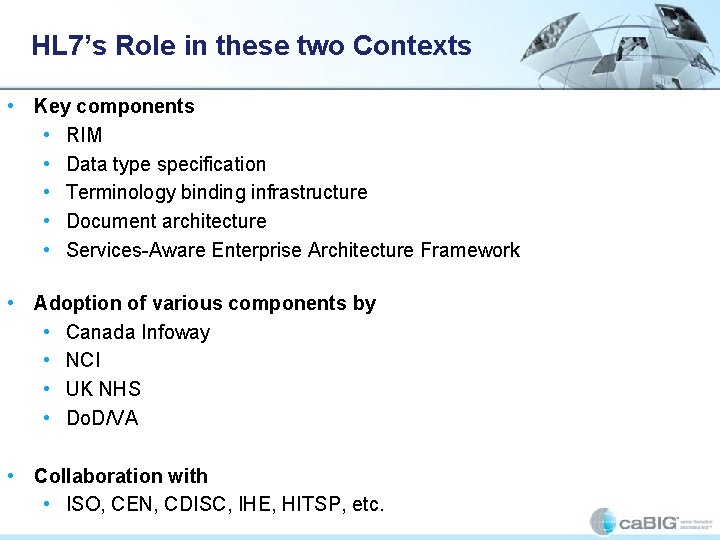
HL 7’s Role in these two Contexts • Key components • RIM • Data type specification • Terminology binding infrastructure • Document architecture • Services-Aware Enterprise Architecture Framework • Adoption of various components by • Canada Infoway • NCI • UK NHS • Do. D/VA • Collaboration with • ISO, CEN, CDISC, IHE, HITSP, etc.
Q&A QUESTIONS ANSWERS
- Slides: 58