
Health IT Standards Committee A Public Advisory Body
Health IT Standards Committee A Public Advisory Body on Health Information Technology to the National Coordinator for Health IT 2017 Interoperability Standards Advisory Task Force Draft Recommendations Kim Nolen, co-chair Richard Elmore, co-chair January 10, 2017
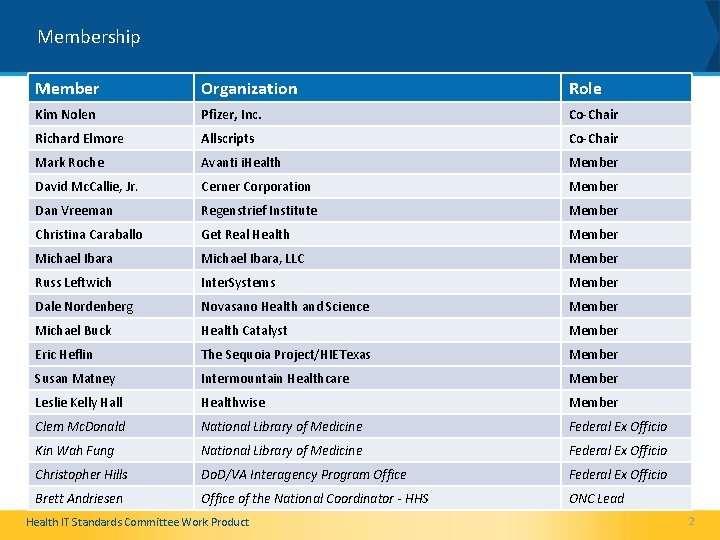
Membership Member Organization Role Kim Nolen Pfizer, Inc. Co-Chair Richard Elmore Allscripts Co-Chair Mark Roche Avanti i. Health Member David Mc. Callie, Jr. Cerner Corporation Member Dan Vreeman Regenstrief Institute Member Christina Caraballo Get Real Health Member Michael Ibara, LLC Member Russ Leftwich Inter. Systems Member Dale Nordenberg Novasano Health and Science Member Michael Buck Health Catalyst Member Eric Heflin The Sequoia Project/HIETexas Member Susan Matney Intermountain Healthcare Member Leslie Kelly Hall Healthwise Member Clem Mc. Donald National Library of Medicine Federal Ex Officio Kin Wah Fung National Library of Medicine Federal Ex Officio Christopher Hills Do. D/VA Interagency Program Office Federal Ex Officio Brett Andriesen Office of the National Coordinator - HHS ONC Lead Health IT Standards Committee Work Product 2
Implemented Recommendations from Phase I • The ISA should evolve to a more dynamic experience for users: » Link to or embed content from websites like the ONC Interoperability Proving Ground demonstrating interoperability use cases » Enable viewing of public comments and ONC responses in the context of which standards/interoperability needs they pertain » Link listed value sets to their publication in VSAC » In addition to the links mentioned above, allow some content like annotations and available value sets to be updated more frequently than yearly, as industry evolves. • The ISA structure should be further modified so that it: » uses a consistent format to separate vocabulary standards for observations from vocabulary standards for observation values Health IT Standards Committee Work Product 3
Implemented Recommendations from Phase I • The ISA term “Best Available Standards” be replaced with “Recognized Standards” » Recognized Standards will include voluntary consensus standards (see OMB Circular A-119 Revised) and related implementation specifications » To be listed in the ISA, Recognized Standards should be approved by the governing standards development organization (or equivalent governing body) as either – a trial standard for pilot use (or equivalent) – or approved for production use (or equivalent) • The ISA should add a category under Standards Process Maturity to include categories of 'ballot in development’ that could reflect emerging standards which may be in rapid development. • For Section I, Change “Applicable Value Set(s)” to "Applicable Value Set(s) and Starter Set(s)” and add Starter Set(s) in addition to Value Sets where applicable. • Numerous specific content updates to Section I Interoperability Needs as recommended by the Task Force. Health IT Standards Committee Work Product 4
Task Force Charge – Phase II In the second phase, the 2017 ISA Taskforce is charged to develop recommendations for the HITSC on the following: • Review interoperability needs and standards listed for Sections II & III (not completed in Phase I) • Discussion and recommendations around the TF’s priority list for inclusion in the 2017 ISA’s “Projected Additions” section. • Develop explanatory content for topic areas where additional information for stakeholders would be beneficial for better understanding » Including: APIs, Observations/Observation Values, Research, Consumer/Patient Access, Nursing Health IT Standards Committee Work Product 5
Phase II Draft Recommendations Health IT Standards Committee Work Product 6
Overarching Recommendations • Base standards (e. g. CDA, etc. ) that are listed for multiple interoperability needs should be re-located into a new section for “base standards” that can be referenced throughout the ISA. » These should be removed from individual interoperability needs within the ISA (unless they can be used alone to achieve the interoperability need) to avoid confusion by implementers. • Standards listed throughout the ISA are and should remain varied by the use case or interoperability need they support (i. e. , the “best” standard for one use case may result in loss of critical metadata or other important information for another use case) » Continued and expanded use of ONC’s Interoperability Proving Ground to showcase actual use of standards and best practices directly from the ISA is encouraged. • Where interoperability needs align with ONC Certification Criteria, these should be listed and linked appropriately so that stakeholders know what to certify to as things evolve. • Security patterns listed for each interoperability need in Sections II &III are duplicative. They should be relocated to an appendix that deals with general security concerns. Health IT Standards Committee Work Product 7
Overarching Recommendations • The ISA currently lacks interoperability needs supporting consumer/patient access to their health information. A section should be added to the ISA to address this. » Initial use cases identified include: – Consumer uses an app of choice (not necessarily connected to his/her healthcare provider) to connect to various clinical providers using different systems to access electronic health information – Research organization offers patient portal and/or apps to users and the patients need to access and aggregate data from multiple clinical systems » Final recommendations will include more detailed recommendations and use cases to better represent patient access within the ISA. • As the ISA grows to become a more robust tool for industry reference, it should also provide educational information about standards issues to support implementers. (e. g. observation/observation value pairings; emerging-API based standards; etc) » Recommended language from the Task Force in these areas has been provided as a separate document for Committee review. Health IT Standards Committee Work Product 8
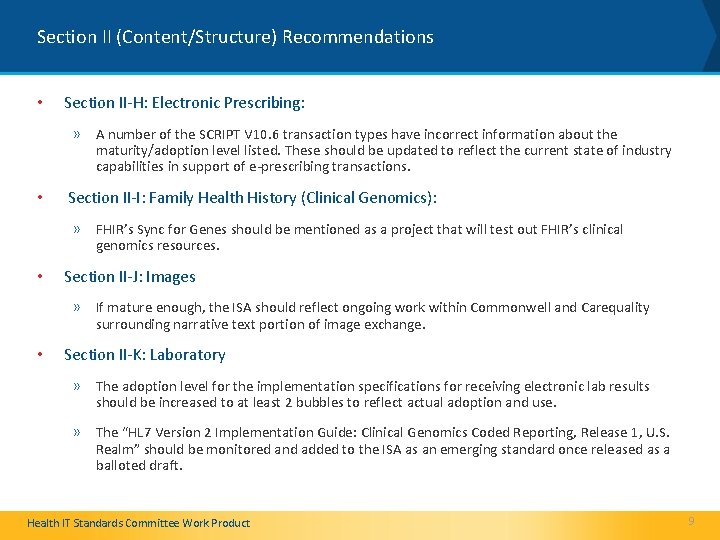
Section II (Content/Structure) Recommendations • Section II-H: Electronic Prescribing: » A number of the SCRIPT V 10. 6 transaction types have incorrect information about the maturity/adoption level listed. These should be updated to reflect the current state of industry capabilities in support of e-prescribing transactions. • Section II-I: Family Health History (Clinical Genomics): » FHIR’s Sync for Genes should be mentioned as a project that will test out FHIR’s clinical genomics resources. • Section II-J: Images » If mature enough, the ISA should reflect ongoing work within Commonwell and Carequality surrounding narrative text portion of image exchange. • Section II-K: Laboratory » The adoption level for the implementation specifications for receiving electronic lab results should be increased to at least 2 bubbles to reflect actual adoption and use. » The “HL 7 Version 2 Implementation Guide: Clinical Genomics Coded Reporting, Release 1, U. S. Realm” should be monitored and added to the ISA as an emerging standard once released as a balloted draft. Health IT Standards Committee Work Product 9
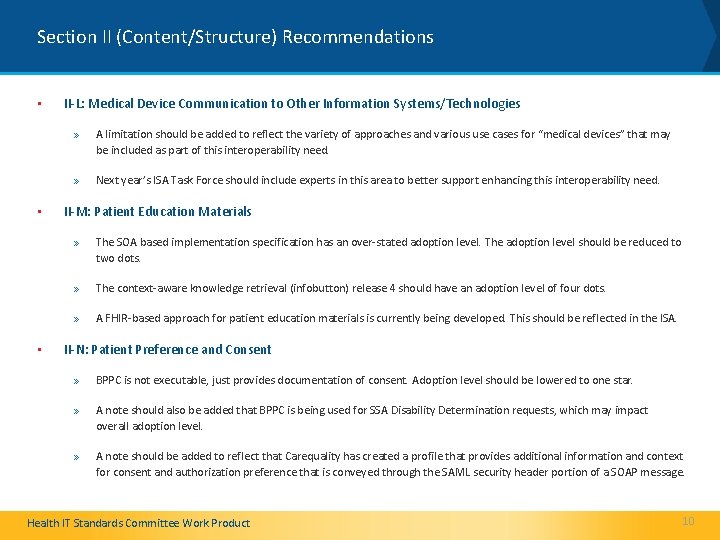
Section II (Content/Structure) Recommendations • • • II-L: Medical Device Communication to Other Information Systems/Technologies » A limitation should be added to reflect the variety of approaches and various use cases for “medical devices” that may be included as part of this interoperability need. » Next year’s ISA Task Force should include experts in this area to better support enhancing this interoperability need. II-M: Patient Education Materials » The SOA based implementation specification has an over-stated adoption level. The adoption level should be reduced to two dots. » The context-aware knowledge retrieval (infobutton) release 4 should have an adoption level of four dots. » A FHIR-based approach for patient education materials is currently being developed. This should be reflected in the ISA. II-N: Patient Preference and Consent » BPPC is not executable, just provides documentation of consent. Adoption level should be lowered to one star. » A note should also be added that BPPC is being used for SSA Disability Determination requests, which may impact overall adoption level. » A note should be added to reflect that Carequality has created a profile that provides additional information and context for consent and authorization preference that is conveyed through the SAML security header portion of a SOAP message. Health IT Standards Committee Work Product 10
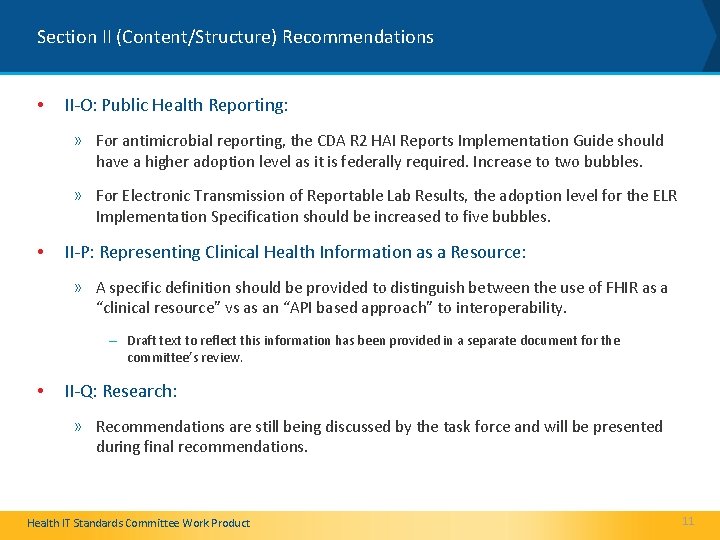
Section II (Content/Structure) Recommendations • II-O: Public Health Reporting: » For antimicrobial reporting, the CDA R 2 HAI Reports Implementation Guide should have a higher adoption level as it is federally required. Increase to two bubbles. » For Electronic Transmission of Reportable Lab Results, the adoption level for the ELR Implementation Specification should be increased to five bubbles. • II-P: Representing Clinical Health Information as a Resource: » A specific definition should be provided to distinguish between the use of FHIR as a “clinical resource” vs as an “API based approach” to interoperability. – Draft text to reflect this information has been provided in a separate document for the committee’s review. • II-Q: Research: » Recommendations are still being discussed by the task force and will be presented during final recommendations. Health IT Standards Committee Work Product 11
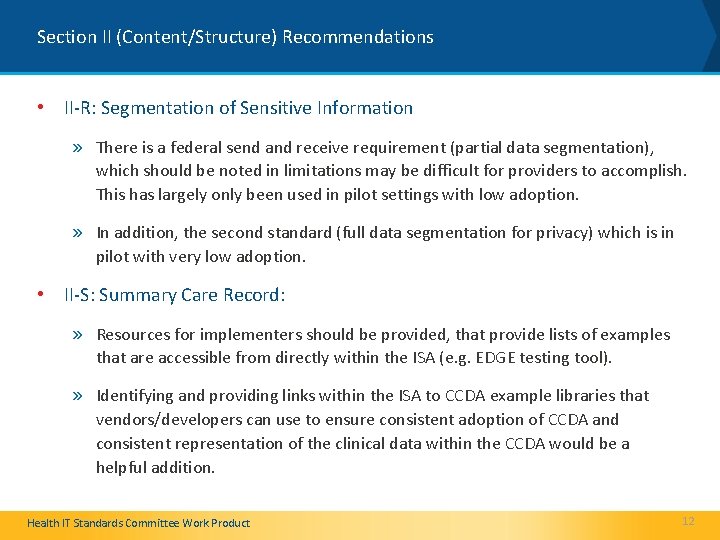
Section II (Content/Structure) Recommendations • II-R: Segmentation of Sensitive Information » There is a federal send and receive requirement (partial data segmentation), which should be noted in limitations may be difficult for providers to accomplish. This has largely only been used in pilot settings with low adoption. » In addition, the second standard (full data segmentation for privacy) which is in pilot with very low adoption. • II-S: Summary Care Record: » Resources for implementers should be provided, that provide lists of examples that are accessible from directly within the ISA (e. g. EDGE testing tool). » Identifying and providing links within the ISA to CCDA example libraries that vendors/developers can use to ensure consistent adoption of CCDA and consistent representation of the clinical data within the CCDA would be a helpful addition. Health IT Standards Committee Work Product 12
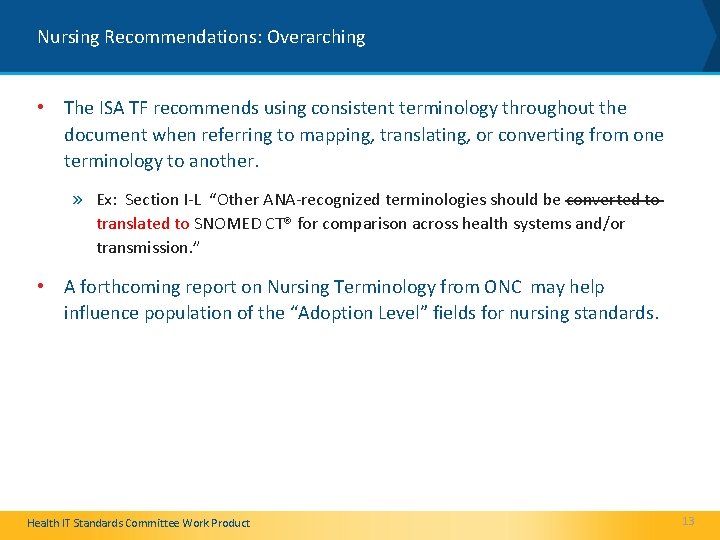
Nursing Recommendations: Overarching • The ISA TF recommends using consistent terminology throughout the document when referring to mapping, translating, or converting from one terminology to another. » Ex: Section I-L “Other ANA-recognized terminologies should be converted to translated to SNOMED CT® for comparison across health systems and/or transmission. ” • A forthcoming report on Nursing Terminology from ONC may help influence population of the “Adoption Level” fields for nursing standards. Health IT Standards Committee Work Product 13
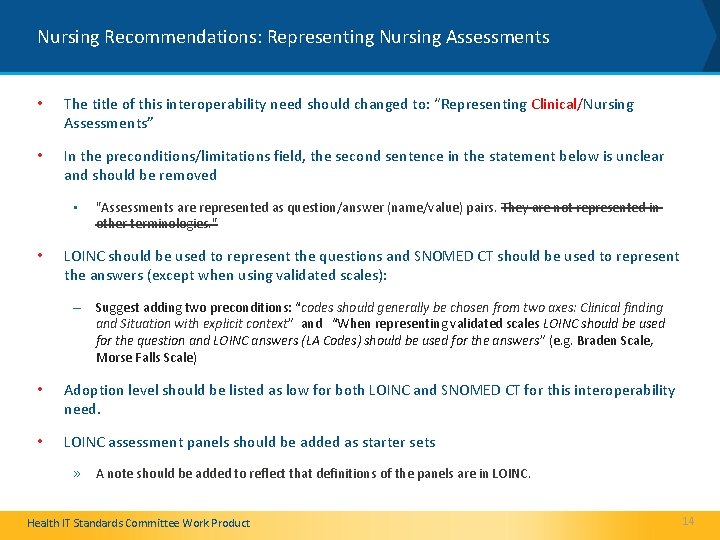
Nursing Recommendations: Representing Nursing Assessments • The title of this interoperability need should changed to: “Representing Clinical/Nursing Assessments” • In the preconditions/limitations field, the second sentence in the statement below is unclear and should be removed • • "Assessments are represented as question/answer (name/value) pairs. They are not represented in other terminologies. " LOINC should be used to represent the questions and SNOMED CT should be used to represent the answers (except when using validated scales): – Suggest adding two preconditions: “codes should generally be chosen from two axes: Clinical finding and Situation with explicit context” and “When representing validated scales LOINC should be used for the question and LOINC answers (LA Codes) should be used for the answers” (e. g. Braden Scale, Morse Falls Scale) • Adoption level should be listed as low for both LOINC and SNOMED CT for this interoperability need. • LOINC assessment panels should be added as starter sets » A note should be added to reflect that definitions of the panels are in LOINC. Health IT Standards Committee Work Product 14
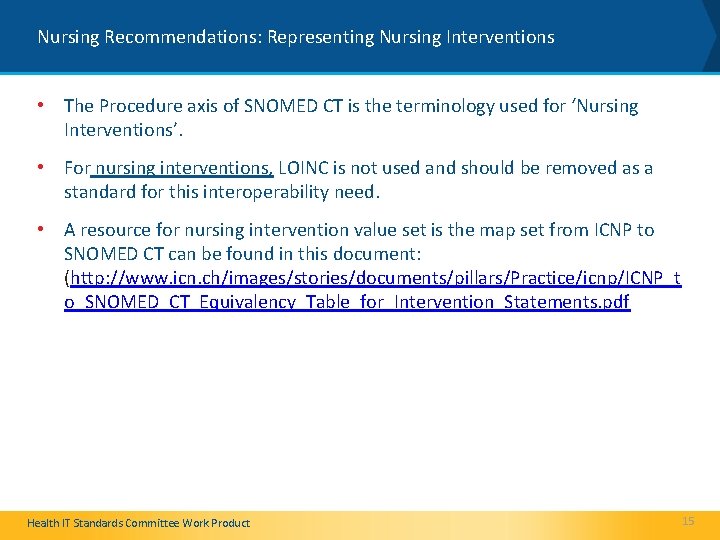
Nursing Recommendations: Representing Nursing Interventions • The Procedure axis of SNOMED CT is the terminology used for ‘Nursing Interventions’. • For nursing interventions, LOINC is not used and should be removed as a standard for this interoperability need. • A resource for nursing intervention value set is the map set from ICNP to SNOMED CT can be found in this document: (http: //www. icn. ch/images/stories/documents/pillars/Practice/icnp/ICNP_t o_SNOMED_CT_Equivalency_Table_for_Intervention_Statements. pdf Health IT Standards Committee Work Product 15
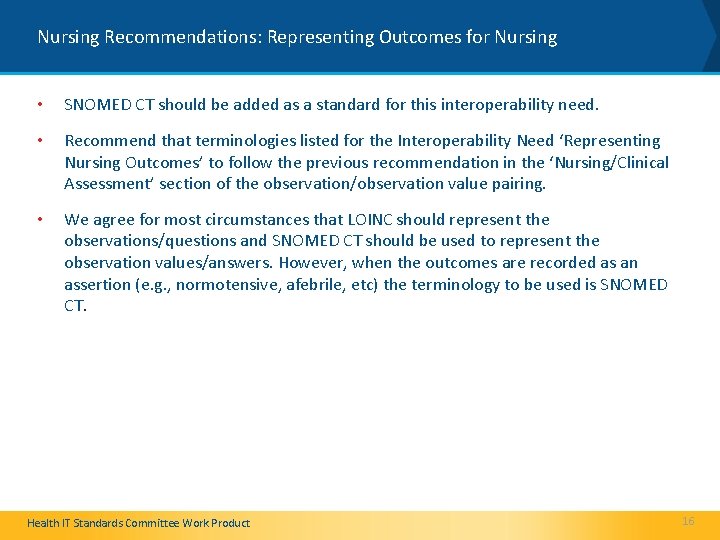
Nursing Recommendations: Representing Outcomes for Nursing • SNOMED CT should be added as a standard for this interoperability need. • Recommend that terminologies listed for the Interoperability Need ‘Representing Nursing Outcomes’ to follow the previous recommendation in the ‘Nursing/Clinical Assessment’ section of the observation/observation value pairing. • We agree for most circumstances that LOINC should represent the observations/questions and SNOMED CT should be used to represent the observation values/answers. However, when the outcomes are recorded as an assertion (e. g. , normotensive, afebrile, etc) the terminology to be used is SNOMED CT. Health IT Standards Committee Work Product 16
Nursing Recommendations: Representing Patient Problems for Nursing • We agree with SNOMED CT being used for this interoperability need. • The Limitations/Dependencies/Preconditions should be modified as follows: • Add “The use of SNOMED CT® for this interoperability need, codes should generally be chosen from two axes: Clinical finding and Situation with explicit context. ” • Add “Local and” to the beginning of the statement “Other ANA-recognized terminologies should be…” • Recommend adding “Nursing Problem List Subset of SNOMED CT” as a starter set Applicable Value Set and Starter Set section. • URL: https: //www. nlm. nih. gov/research/umls/Snomed/nursing_problemlist_subset. html Health IT Standards Committee Work Product 17
Ongoing Task Force Work (Recommendations to be Finalized/Delivered in Feb) • Section III Content (Services/Exchange) • Recommendations on Research Standards • Consumer Access Standards/Added Section Health IT Standards Committee Work Product 18

Health IT Standards Committee A Public Advisory Body on Health Information Technology to the National Coordinator for Health IT
- Slides: 19