
Health insurance claims distributions Robert Cole NZ Society

Health insurance claims distributions Robert Cole NZ Society of Actuaries conference Nov 2010
Disclaimer Thanks to my former employer for making the data available for this analysis All opinions, errors & omissions are my own

Exec summary – why claims distributions are important Proportion of nil-claimers • Member behaviour and value perceptions • Low claims rewards Claim size distribution • Member anti-selection • Product design (maximums, excesses, etc) • Pricing (rate cards, rating factors, large corporate schemes) Multi-year correlations in claiming • A very significant component of claims costs
Exec summary – key findings Significance of high-claiming members • 80/20 (or 80/8) - in any year >80% of total claims $ from 20% of claiming (about 8% of all) members • Total costs over large $ thresholds (eg $10 k) growing faster than average Material differences by factor • Age, gender, plan type Multi-year correlations in claiming • High-claiming members tend to remain high-claiming for long periods of time, and vice versa
Analysis method Total amount of claims paid summed up for every member by financial year from 03/04 to 09/10 • Can be zero or $ amount (up to about $110, 000) Member attributes at mid year (ie 31 December) • Age, gender, plan type, excess, individual or group, subsidy
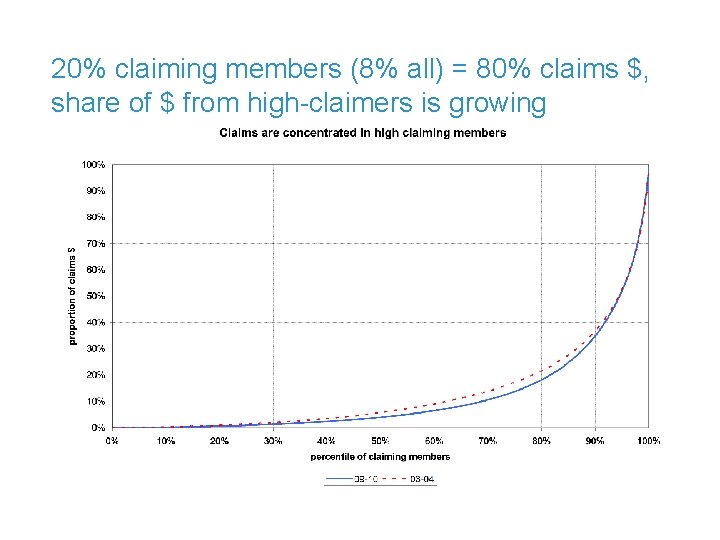
20% claiming members (8% all) = 80% claims $, share of $ from high-claimers is growing
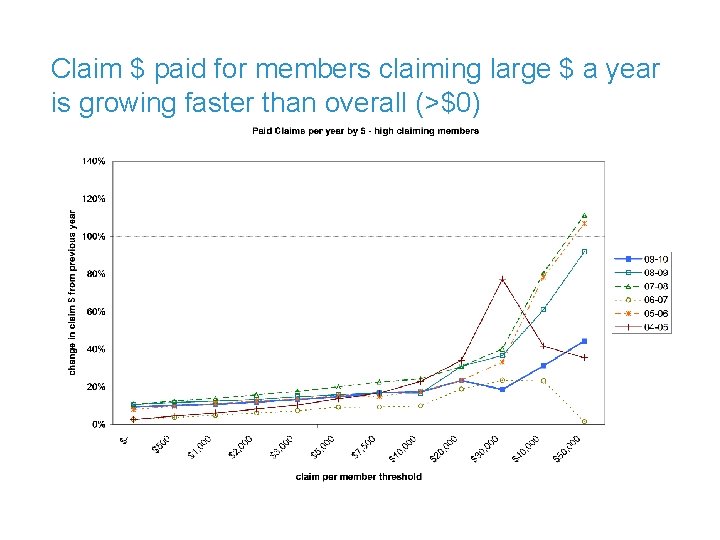
Claim $ paid for members claiming large $ a year is growing faster than overall (>$0)
Lower proportions of nil-claimers old ages, female, comprehensive plans
Older ages have more members with large annual claims than at younger ages
More high-claiming males
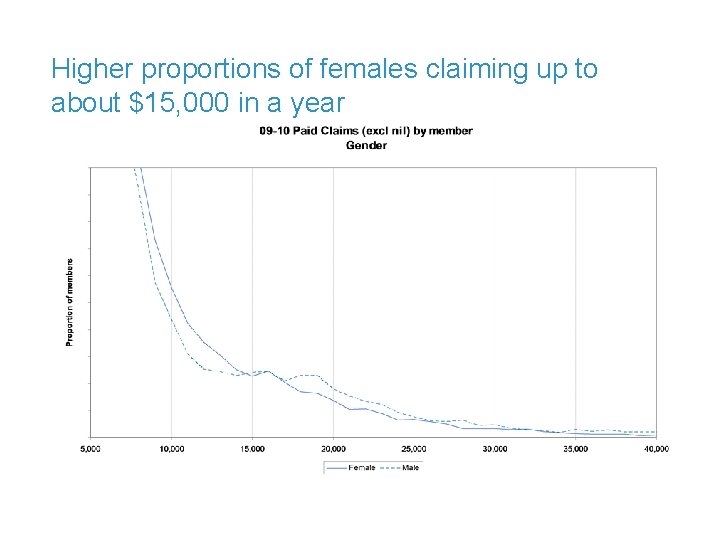
Higher proportions of females claiming up to about $15, 000 in a year
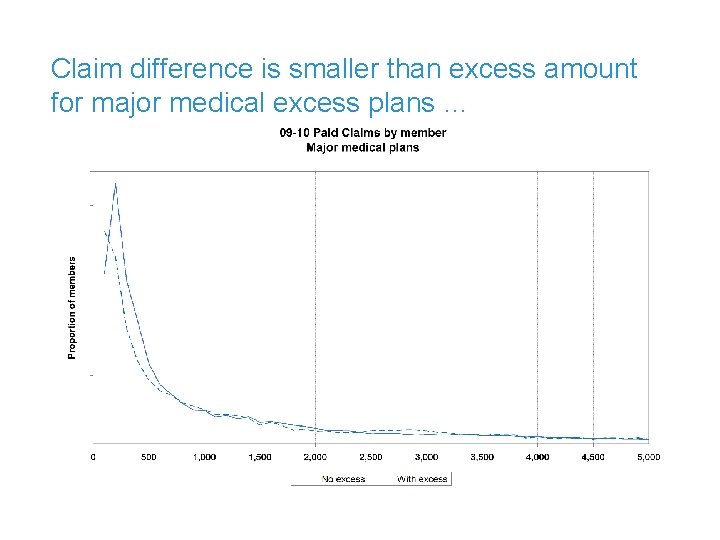
Claim difference is smaller than excess amount for major medical excess plans …
… and also for comprehensive excess plan
Serial correlations High-claiming members in a period are more likely to be high-claiming members in next period Low (or nil)-claiming members in a period are more likely to be low (or nil)-claiming members in next period • holds if period is 1 -year, 2 -years or 3 -years • holds if consecutive periods are overlapping or nonoverlapping Relevant for low claims reward design • proportions of members gaining or losing reward • proportions qualifying
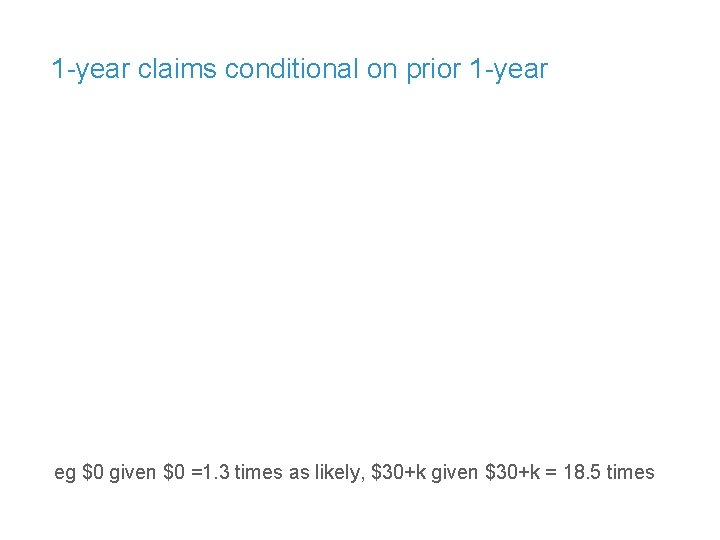
1 -year claims conditional on prior 1 -year eg $0 given $0 =1. 3 times as likely, $30+k given $30+k = 18. 5 times
1 -year claims conditional on prior 2 -years bigger effect than prior 1 -year
1 -year claims conditional on prior 3 -years bigger effect still
Any questions?
- Slides: 18