
Health Information Exchange for Emergency Medical Services Orange





- Slides: 26
Health Information Exchange for Emergency Medical Services Orange County +EMS Project SAFR Workflow Connect Conference July 19, 2017
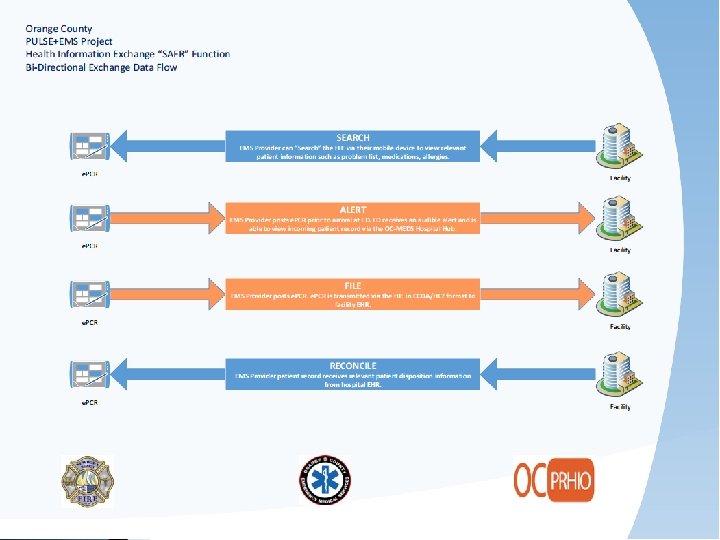
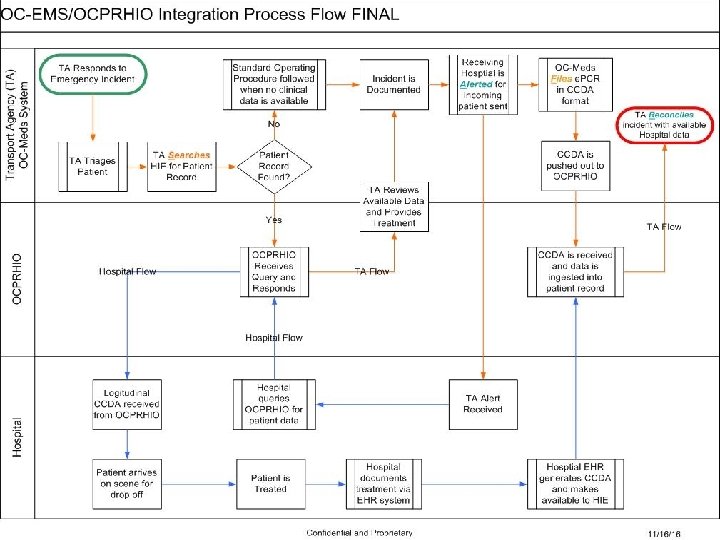
Objectives • Discuss the background of the PULSE+EMS project. • Discuss progress with implementing the federally defined “Search, Alert, File, and Reconcile” (SAFR) Health Information Exchange (HIE) Workflow process. • Discuss HIE pilot testing phase and project outcome. • Discuss patient privacy and information security.
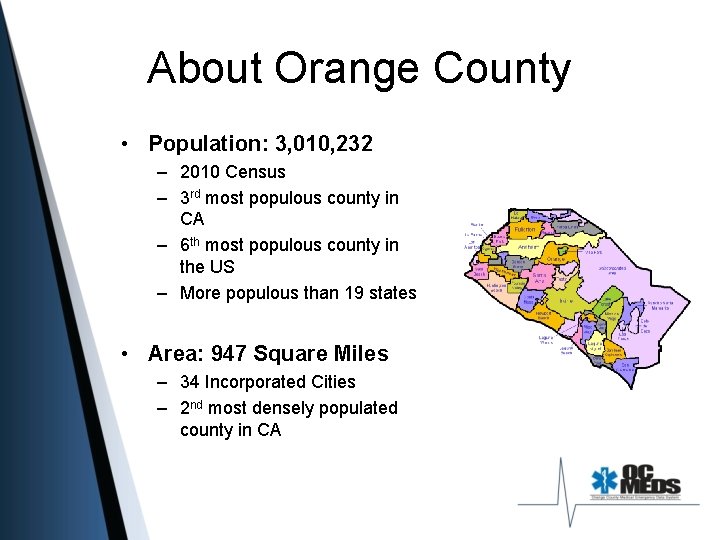
About Orange County • Population: 3, 010, 232 – 2010 Census – 3 rd most populous county in CA – 6 th most populous county in the US – More populous than 19 states • Area: 947 Square Miles – 34 Incorporated Cities – 2 nd most densely populated county in CA
Orange County EMS System • 190, 000+ 9 -1 -1 EMS Responses Annually • 12 Fire Departments • 25 Ambulance Companies – 400+ Licensed Ambulances • 25 Emergency Departments – – 6 Base Hospitals 4 Trauma Centers 14 STEMI Centers 9 Stroke Centers
Orange County EMS System • 3, 500+ EMTs • 1, 000+ Paramedics • 200 MICNs
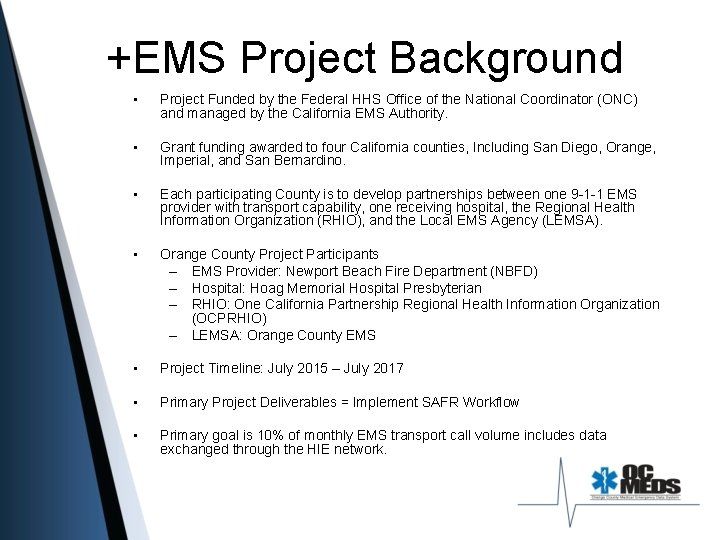
+EMS Project Background • Project Funded by the Federal HHS Office of the National Coordinator (ONC) and managed by the California EMS Authority. • Grant funding awarded to four California counties, Including San Diego, Orange, Imperial, and San Bernardino. • Each participating County is to develop partnerships between one 9 -1 -1 EMS provider with transport capability, one receiving hospital, the Regional Health Information Organization (RHIO), and the Local EMS Agency (LEMSA). • Orange County Project Participants – EMS Provider: Newport Beach Fire Department (NBFD) – Hospital: Hoag Memorial Hospital Presbyterian – RHIO: One California Partnership Regional Health Information Organization (OCPRHIO) – LEMSA: Orange County EMS • Project Timeline: July 2015 – July 2017 • Primary Project Deliverables = Implement SAFR Workflow • Primary goal is 10% of monthly EMS transport call volume includes data exchanged through the HIE network.
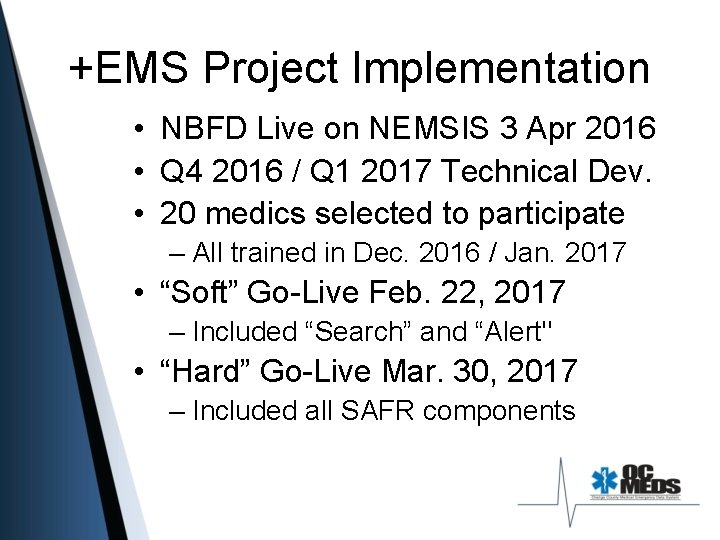
+EMS Project Implementation • NBFD Live on NEMSIS 3 Apr 2016 • Q 4 2016 / Q 1 2017 Technical Dev. • 20 medics selected to participate – All trained in Dec. 2016 / Jan. 2017 • “Soft” Go-Live Feb. 22, 2017 – Included “Search” and “Alert" • “Hard” Go-Live Mar. 30, 2017 – Included all SAFR components
SAFR – Practical Considerations • Each aspect of the SAFR model has an effect on EMS patient care operations and workflow. • Practical application of SAFR will change how OC EMS providers use their e. PCRs and will change how OC Receiving Hospitals receive and use EMS reports. • 20 users have been identified who are best suited to test these changes. Only these users will have permissions to search the HIE.
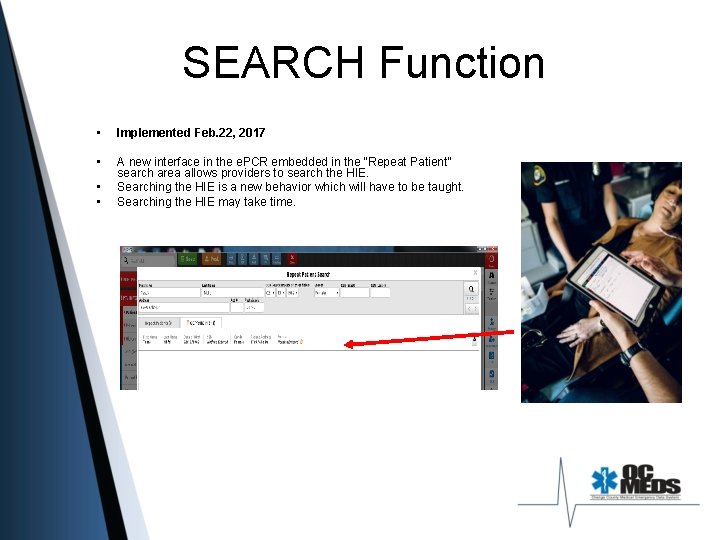
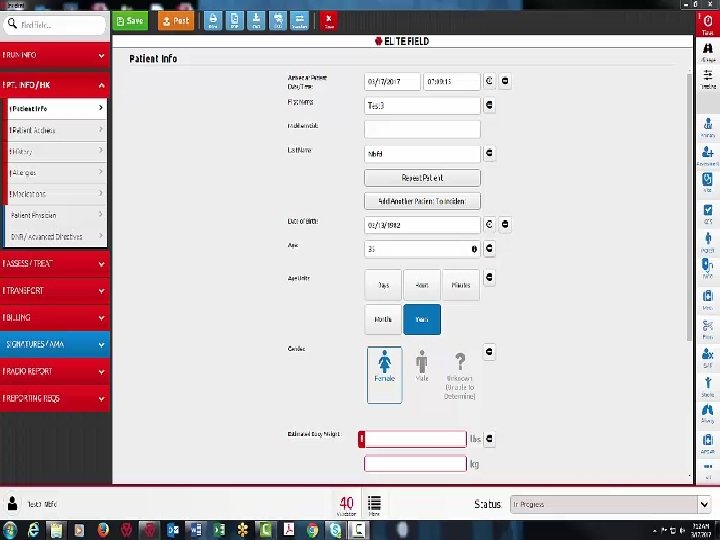
SEARCH Function • Implemented Feb. 22, 2017 • A new interface in the e. PCR embedded in the “Repeat Patient” search area allows providers to search the HIE. Searching the HIE is a new behavior which will have to be taught. Searching the HIE may take time. • •
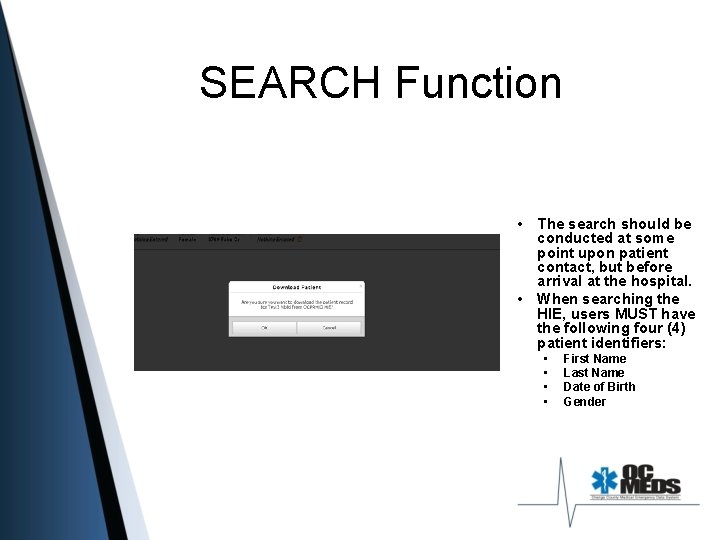
SEARCH Function • The search should be conducted at some point upon patient contact, but before arrival at the hospital. • When searching the HIE, users MUST have the following four (4) patient identifiers: • • First Name Last Name Date of Birth Gender
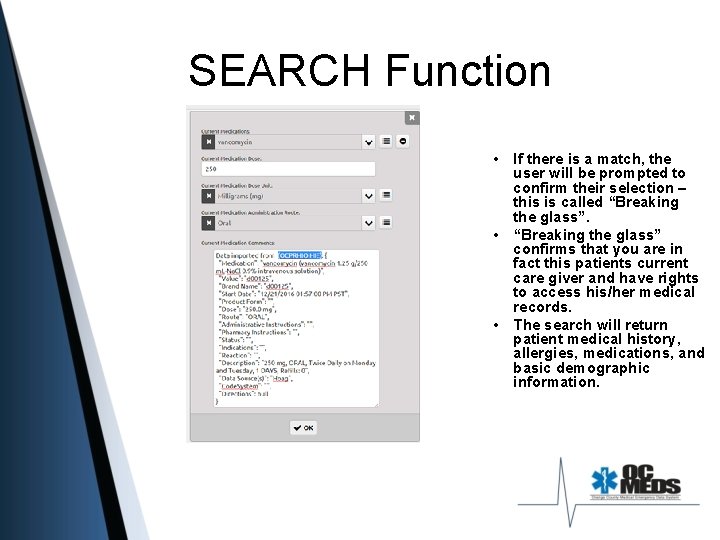
SEARCH Function • If there is a match, the user will be prompted to confirm their selection – this is called “Breaking the glass”. • “Breaking the glass” confirms that you are in fact this patients current care giver and have rights to access his/her medical records. • The search will return patient medical history, allergies, medications, and basic demographic information.
SEARCH DEMO VIDEO (NEXT SLIDE) VIDEO MAY ALSO BE VIEWED ONLINE AT: HTTPS: //YOUTU. BE/QVKBI_TKGBY
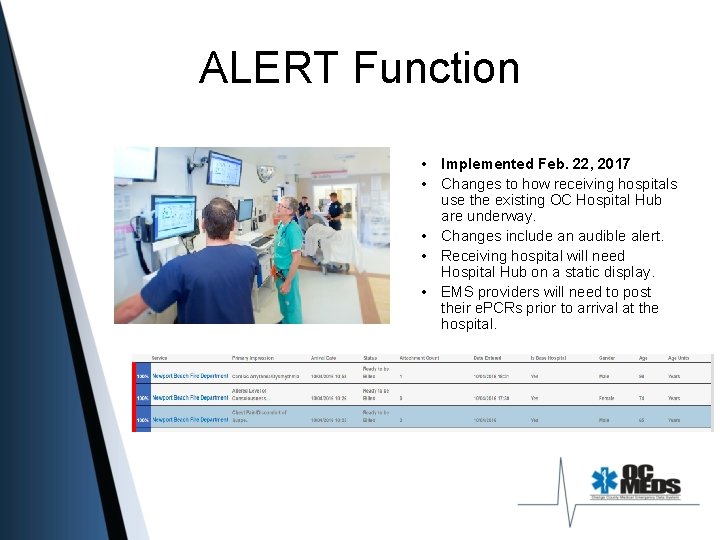
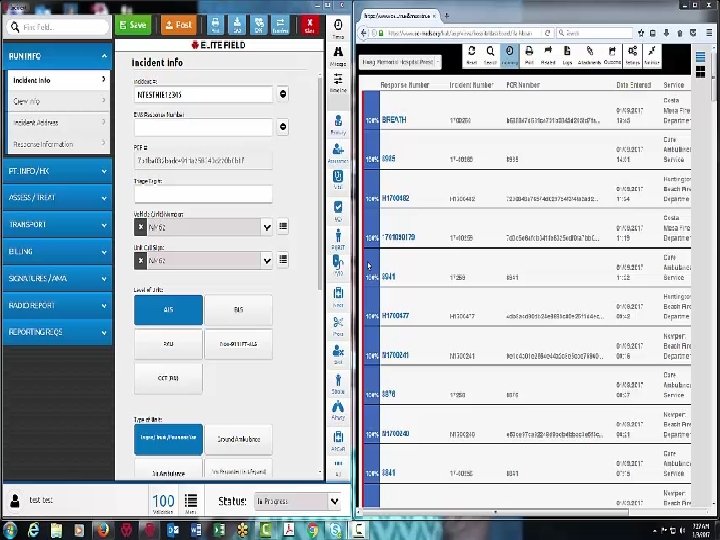
ALERT Function • Implemented Feb. 22, 2017 • Changes to how receiving hospitals use the existing OC Hospital Hub are underway. • Changes include an audible alert. • Receiving hospital will need Hospital Hub on a static display. • EMS providers will need to post their e. PCRs prior to arrival at the hospital.
ALERT DEMO VIDEO (NEXT SLIDE) VIDEO MAY ALSO BE VIEWED ONLINE AT: HTTPS: //YOUTU. BE/J 7 VIV 5 YYKT 0
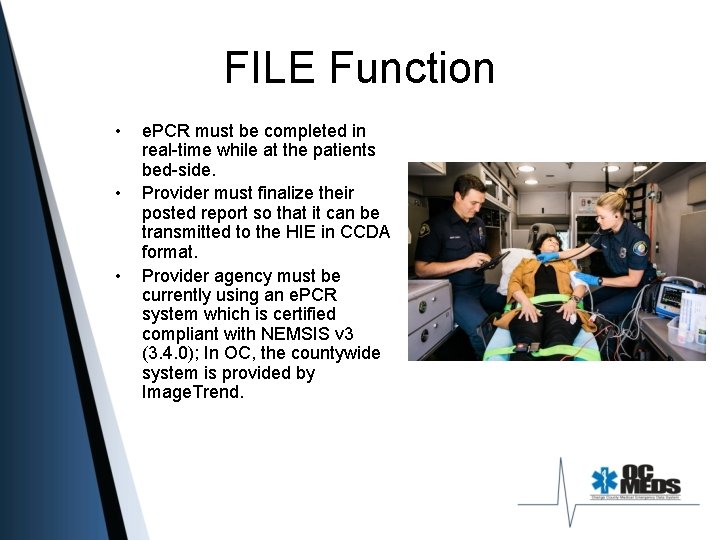
FILE Function • • • e. PCR must be completed in real-time while at the patients bed-side. Provider must finalize their posted report so that it can be transmitted to the HIE in CCDA format. Provider agency must be currently using an e. PCR system which is certified compliant with NEMSIS v 3 (3. 4. 0); In OC, the countywide system is provided by Image. Trend.
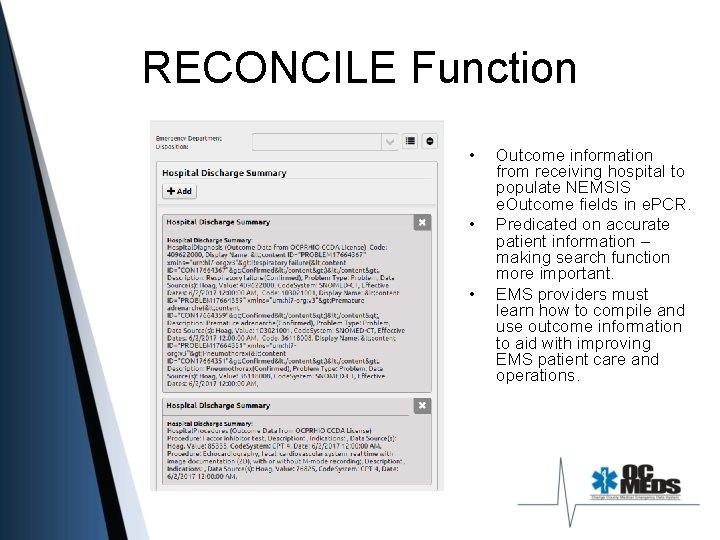
RECONCILE Function • • • Outcome information from receiving hospital to populate NEMSIS e. Outcome fields in e. PCR. Predicated on accurate patient information – making search function more important. EMS providers must learn how to compile and use outcome information to aid with improving EMS patient care and operations.
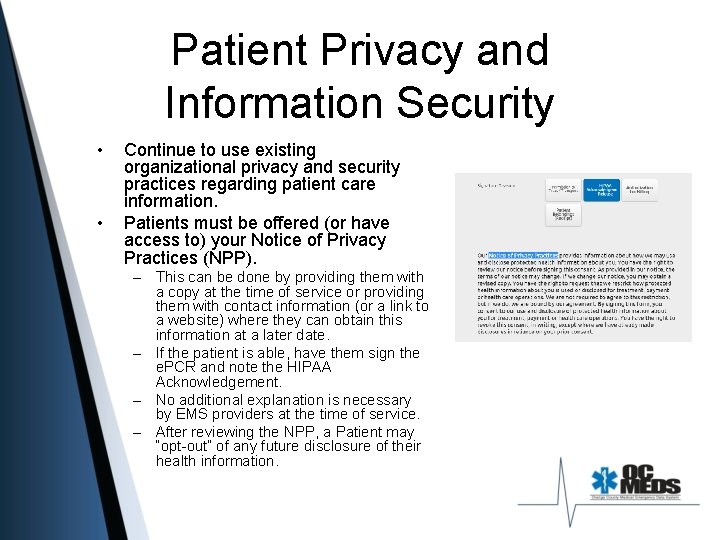
Patient Privacy and Information Security • • Continue to use existing organizational privacy and security practices regarding patient care information. Patients must be offered (or have access to) your Notice of Privacy Practices (NPP). – This can be done by providing them with a copy at the time of service or providing them with contact information (or a link to a website) where they can obtain this information at a later date. – If the patient is able, have them sign the e. PCR and note the HIPAA Acknowledgement. – No additional explanation is necessary by EMS providers at the time of service. – After reviewing the NPP, a Patient may “opt-out” of any future disclosure of their health information.
Patient Privacy and Information Security • Conducting a patient search using the HIE (breaking the glass) gives access to ALL patient records countywide; not just patients seen by your organization (like with “repeat patient” searches). • It’s important to use the HIE search responsibly and never access records for any patient that is not in your immediate care.
Summary • This is a grant funded project designed to test real-time health information exchange between EMS providers and hospitals. • NBFD is a partner with Hoag, OCPRHIO, and OCEMS whose key role is to pilot the SAFR model for data exchange and interoperability. • Implementing the SAFR model will include some changes to how the e. PCR system is currently used. • Patient privacy and information security are key components of responsible health information exchange.
Questions