
Health in Prisons Project Prison Health a Challenge
![Post-release mortality rates (females) Health in Prisons Project Farrell & Marsden [2008] n =](https://slidetodoc.com/presentation_image_h/a7e8c942fdcaae09891bbe8e76e0cbf2/image-19.jpg "Post-release mortality rates (females) Health in Prisons Project Farrell & Marsden [2008] n =")
- Slides: 27
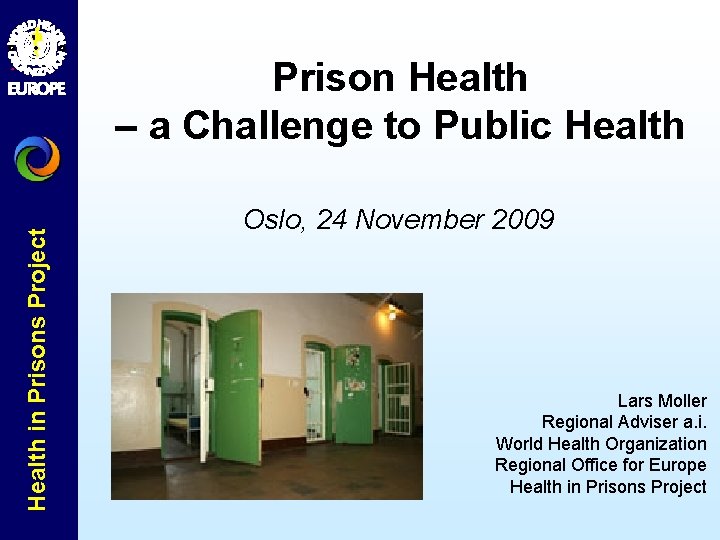
Health in Prisons Project Prison Health – a Challenge to Public Health Oslo, 24 November 2009 Lars Moller Regional Adviser a. i. World Health Organization Regional Office for Europe Health in Prisons Project
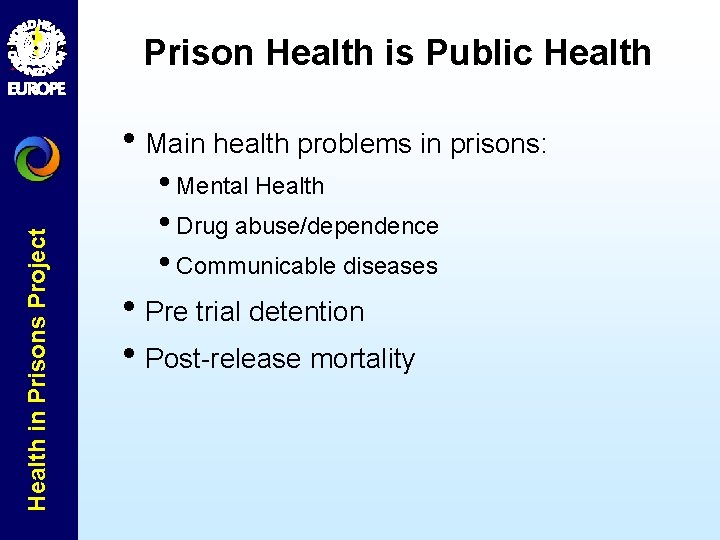
Prison Health is Public Health in Prisons Project • Main health problems in prisons: • Mental Health • Drug abuse/dependence • Communicable diseases • Pre trial detention • Post-release mortality
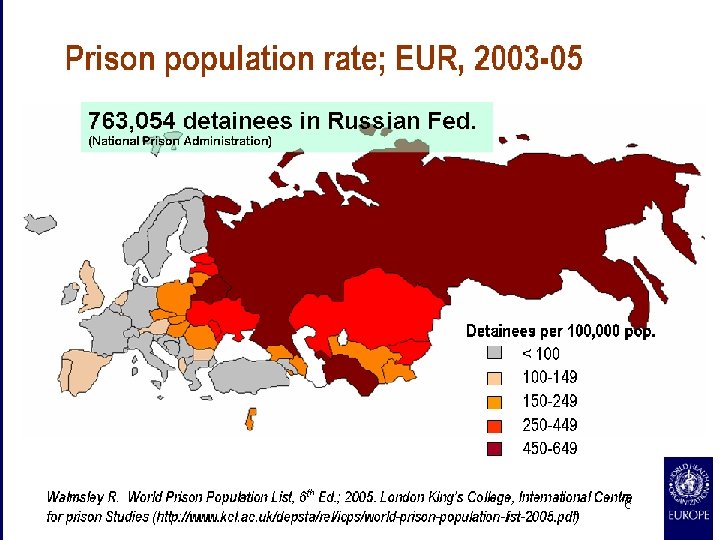
Health in Prisons Project
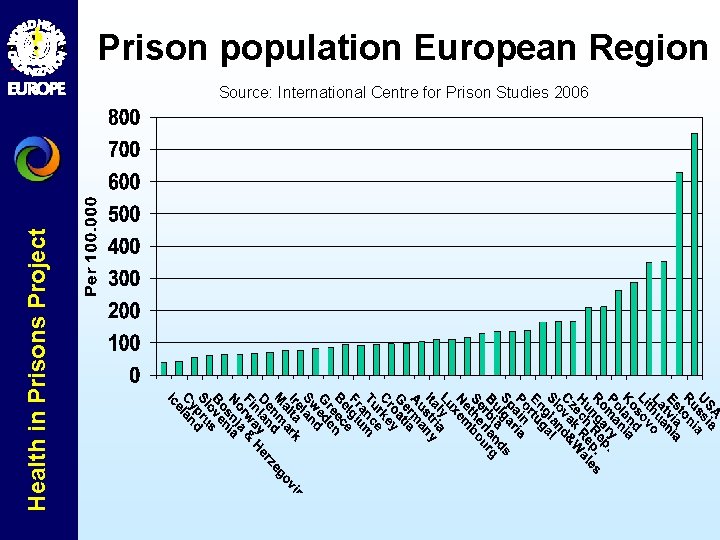
Prison population European Region Health in Prisons Project Source: International Centre for Prison Studies 2006
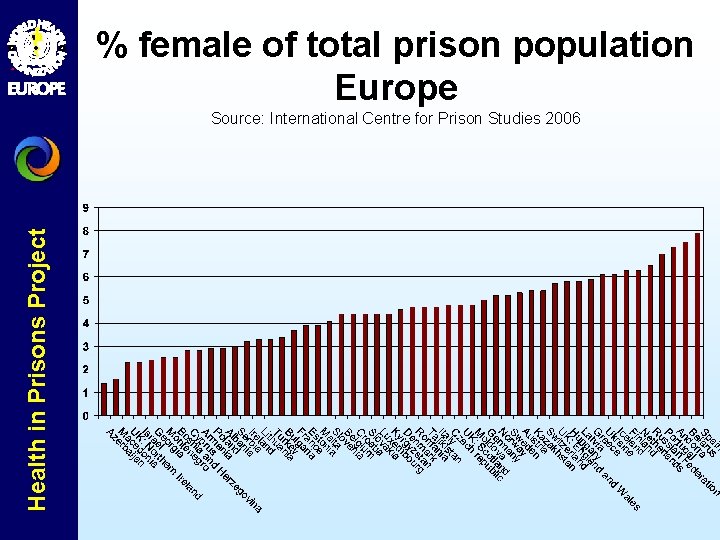
% female of total prison population Europe Health in Prisons Project Source: International Centre for Prison Studies 2006
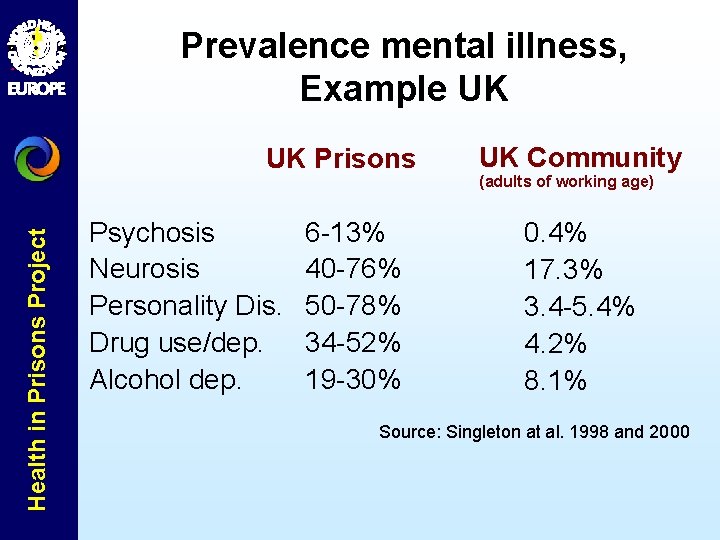
Prevalence mental illness, Example UK Health in Prisons Project UK Prisons Psychosis Neurosis Personality Dis. Drug use/dep. Alcohol dep. 6 -13% 40 -76% 50 -78% 34 -52% 19 -30% UK Community (adults of working age) 0. 4% 17. 3% 3. 4 -5. 4% 4. 2% 8. 1% Source: Singleton at al. 1998 and 2000
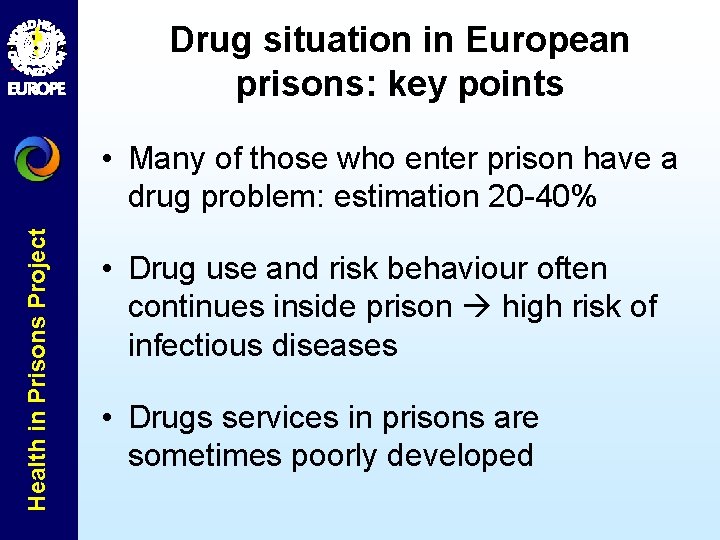
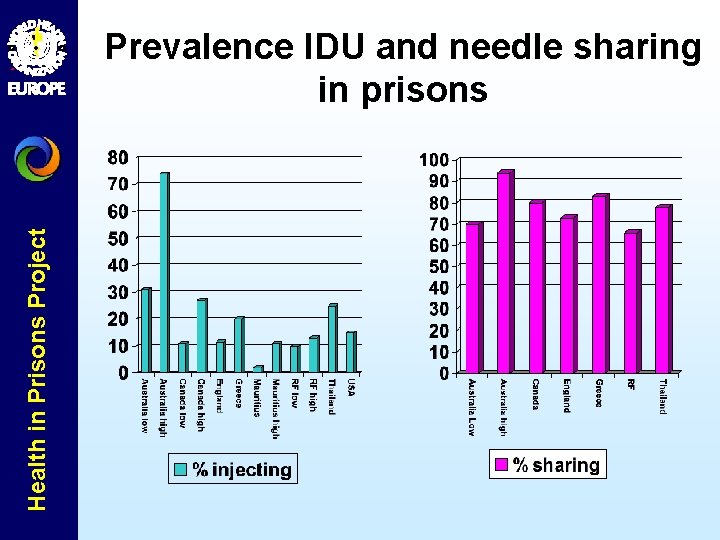
Drug situation in European prisons: key points Health in Prisons Project • Many of those who enter prison have a drug problem: estimation 20 -40% • Drug use and risk behaviour often continues inside prison high risk of infectious diseases • Drugs services in prisons are sometimes poorly developed
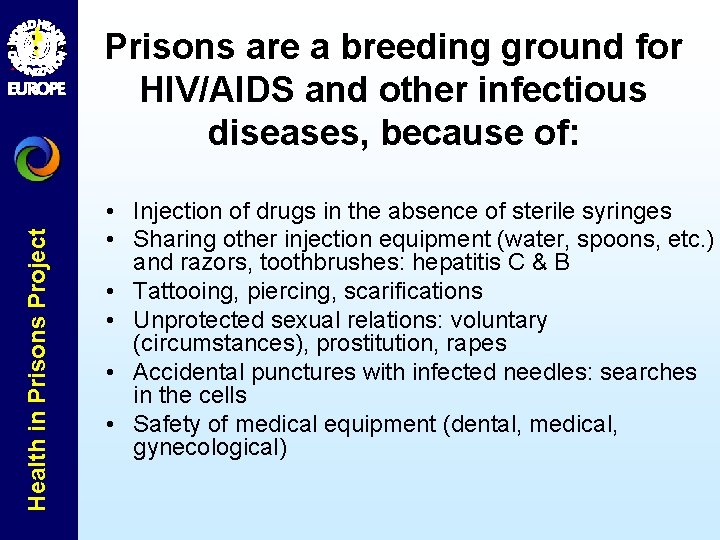
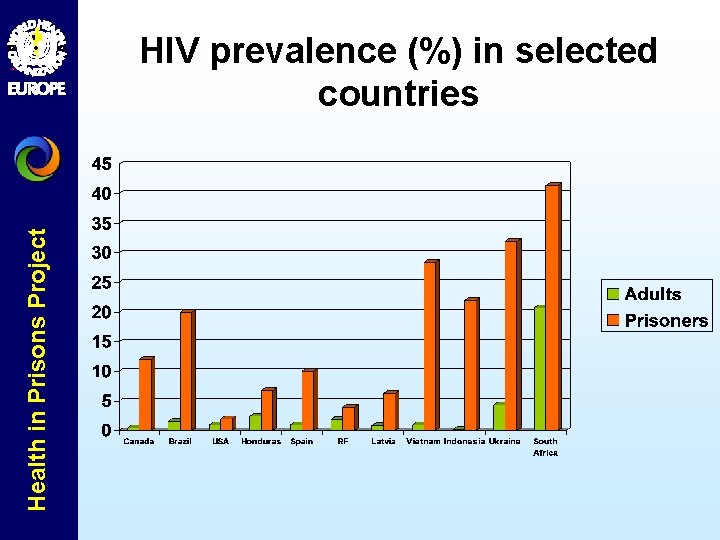
Health in Prisons Project Prisons are a breeding ground for HIV/AIDS and other infectious diseases, because of: • Injection of drugs in the absence of sterile syringes • Sharing other injection equipment (water, spoons, etc. ) and razors, toothbrushes: hepatitis C & B • Tattooing, piercing, scarifications • Unprotected sexual relations: voluntary (circumstances), prostitution, rapes • Accidental punctures with infected needles: searches in the cells • Safety of medical equipment (dental, medical, gynecological)
Health in Prisons Project HIV prevalence (%) in selected countries
Health in Prisons Project Prevalence IDU and needle sharing in prisons
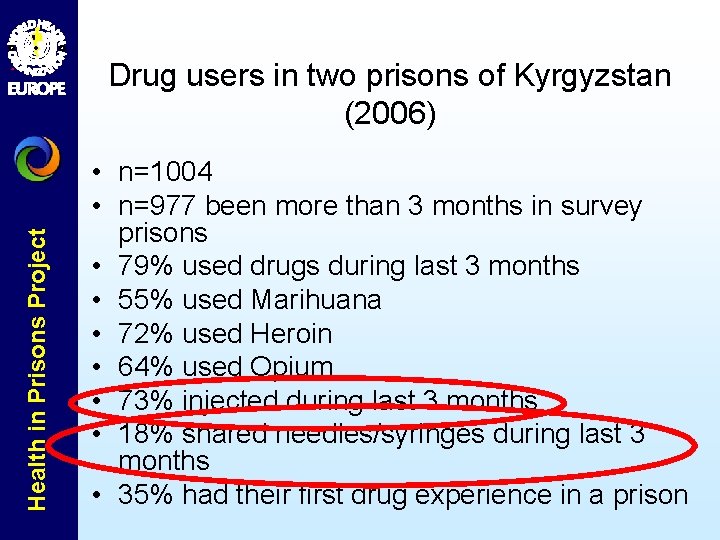
Health in Prisons Project Drug users in two prisons of Kyrgyzstan (2006) • n=1004 • n=977 been more than 3 months in survey prisons • 79% used drugs during last 3 months • 55% used Marihuana • 72% used Heroin • 64% used Opium • 73% injected during last 3 months • 18% shared needles/syringes during last 3 months • 35% had their first drug experience in a prison
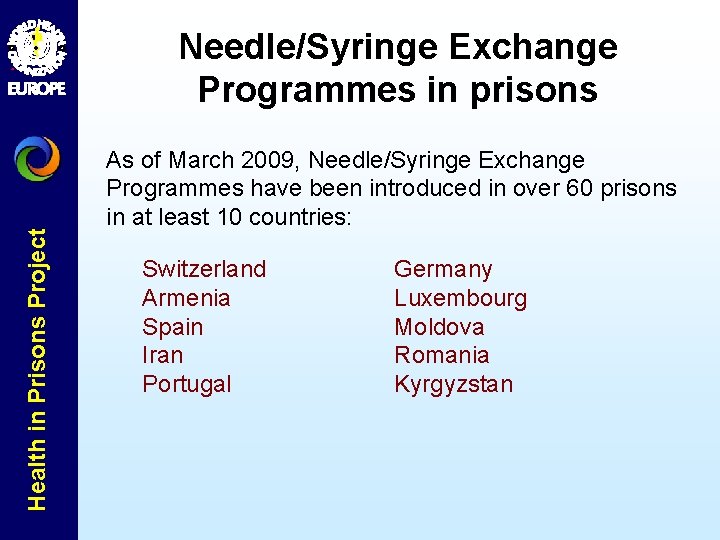
Health in Prisons Project Needle/Syringe Exchange Programmes in prisons As of March 2009, Needle/Syringe Exchange Programmes have been introduced in over 60 prisons in at least 10 countries: Switzerland Armenia Spain Iran Portugal Germany Luxembourg Moldova Romania Kyrgyzstan
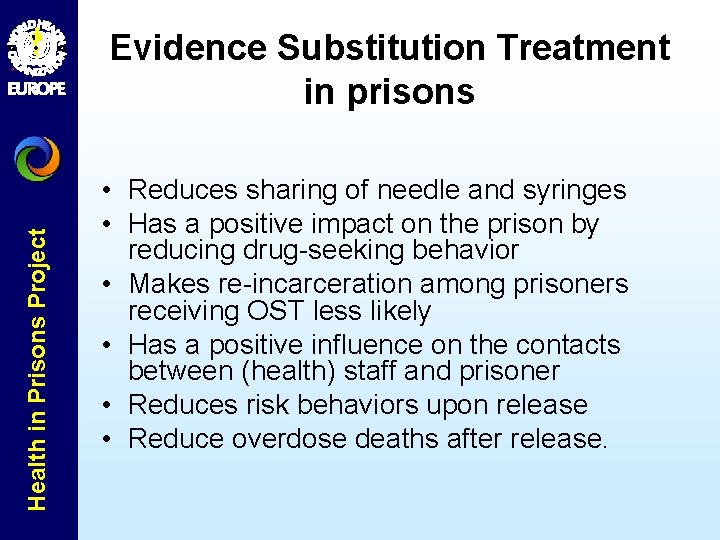
Health in Prisons Project Evidence Substitution Treatment in prisons • Reduces sharing of needle and syringes • Has a positive impact on the prison by reducing drug-seeking behavior • Makes re-incarceration among prisoners receiving OST less likely • Has a positive influence on the contacts between (health) staff and prisoner • Reduces risk behaviors upon release • Reduce overdose deaths after release.
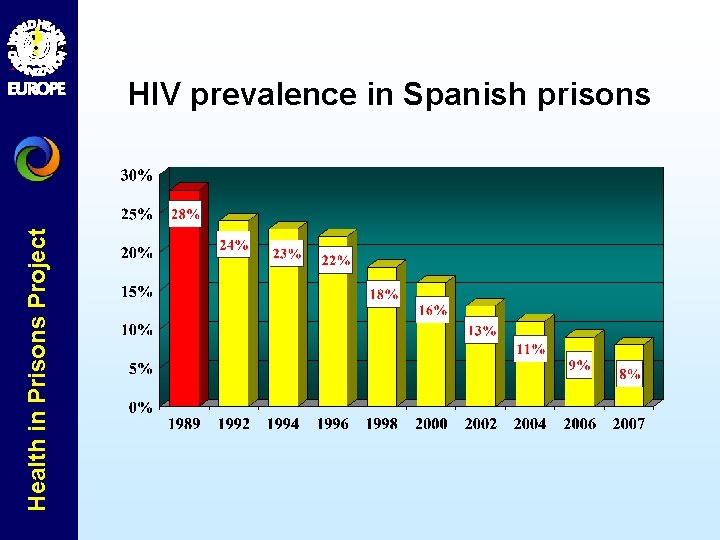
Health in Prisons Project HIV prevalence in Spanish prisons
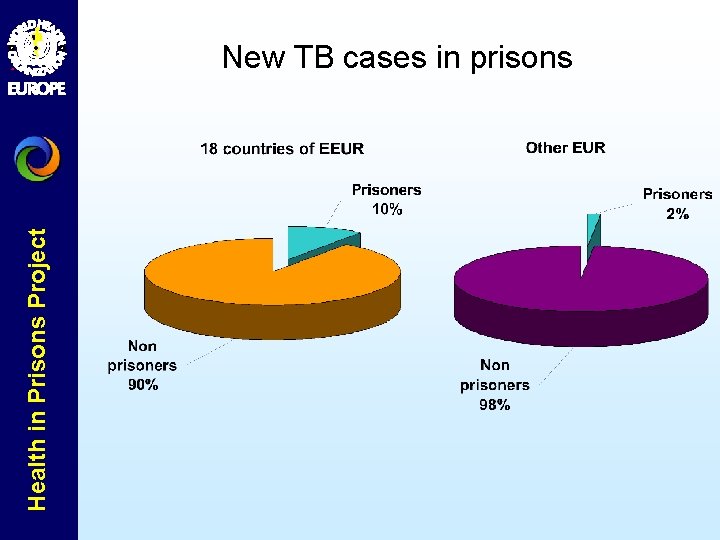
Health in Prisons Project New TB cases in prisons
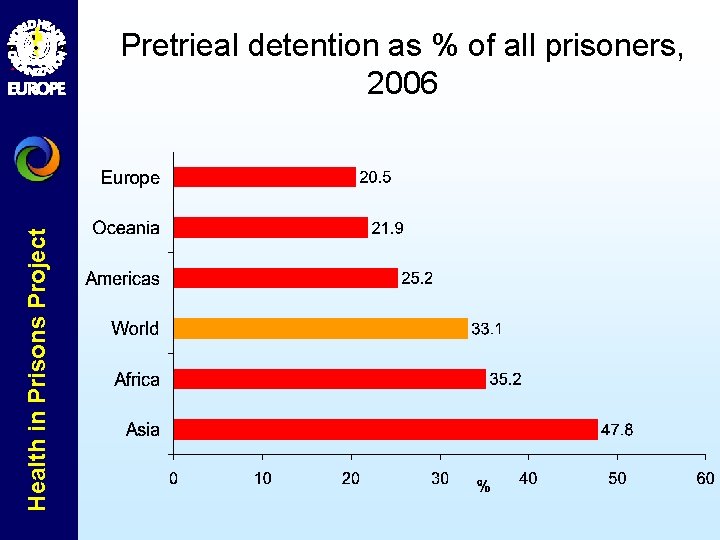
Health in Prisons Project Pretrieal detention as % of all prisoners, 2006
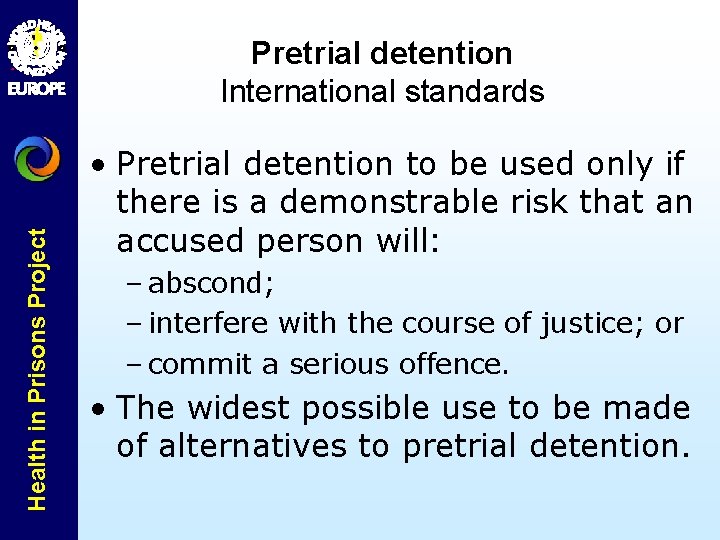
Health in Prisons Project Pretrial detention International standards • Pretrial detention to be used only if there is a demonstrable risk that an accused person will: – abscond; – interfere with the course of justice; or – commit a serious offence. • The widest possible use to be made of alternatives to pretrial detention.
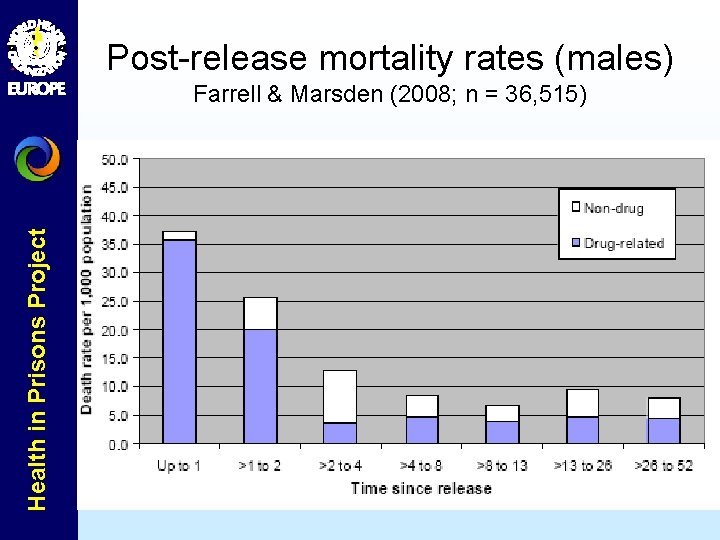
Post-release mortality rates (males) Health in Prisons Project Farrell & Marsden (2008; n = 36, 515)
Post-release mortality rates (females) Health in Prisons Project Farrell & Marsden [2008] n = 12, 256
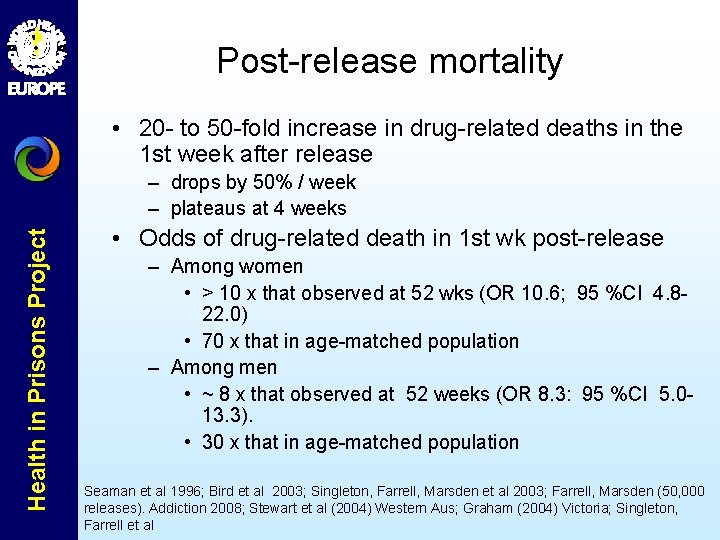
Post-release mortality • 20 - to 50 -fold increase in drug-related deaths in the 1 st week after release Health in Prisons Project – drops by 50% / week – plateaus at 4 weeks • Odds of drug-related death in 1 st wk post-release – Among women • > 10 x that observed at 52 wks (OR 10. 6; 95 %CI 4. 822. 0) • 70 x that in age-matched population – Among men • ~ 8 x that observed at 52 weeks (OR 8. 3: 95 %CI 5. 013. 3). • 30 x that in age-matched population Seaman et al 1996; Bird et al 2003; Singleton, Farrell, Marsden et al 2003; Farrell, Marsden (50, 000 releases). Addiction 2008; Stewart et al (2004) Western Aus; Graham (2004) Victoria; Singleton, Farrell et al
Health in Prisons Project
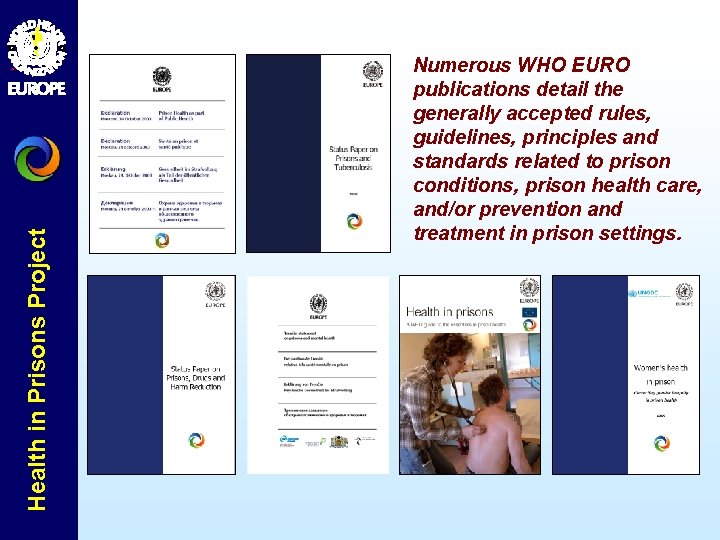
Health in Prisons Project Numerous WHO EURO publications detail the generally accepted rules, guidelines, principles and standards related to prison conditions, prison health care, and/or prevention and treatment in prison settings.
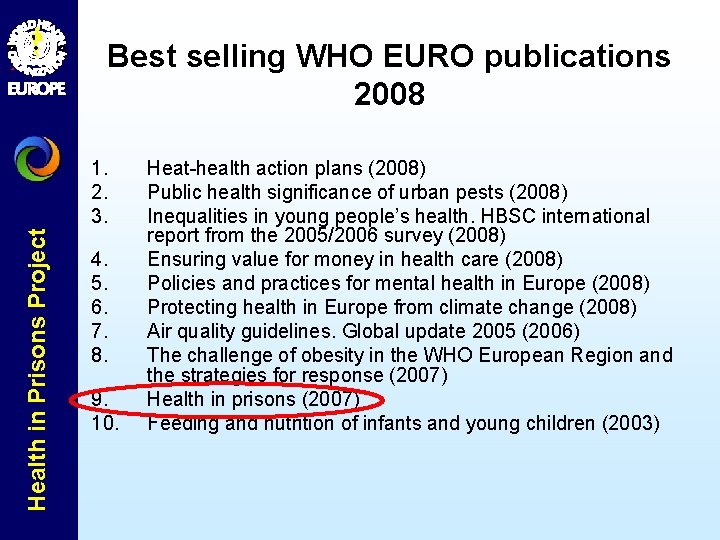
Best selling WHO EURO publications 2008 Health in Prisons Project 1. 2. 3. 4. 5. 6. 7. 8. 9. 10. Heat-health action plans (2008) Public health significance of urban pests (2008) Inequalities in young people’s health. HBSC international report from the 2005/2006 survey (2008) Ensuring value for money in health care (2008) Policies and practices for mental health in Europe (2008) Protecting health in Europe from climate change (2008) Air quality guidelines. Global update 2005 (2006) The challenge of obesity in the WHO European Region and the strategies for response (2007) Health in prisons (2007) Feeding and nutrition of infants and young children (2003)
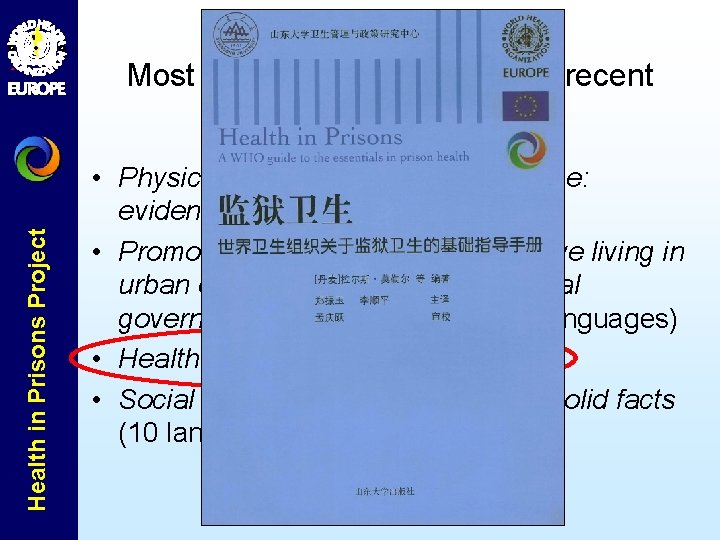
Health in Prisons Project Most translated publications in recent years • Physical activity and health in Europe: evidence for action (15 languages) • Promoting physical activity and active living in urban environments. The role of local governments. The solid facts. (15 languages) • Health in prisons (12 languages) • Social determinants of health. The solid facts (10 languages).
Health in Prisons Project
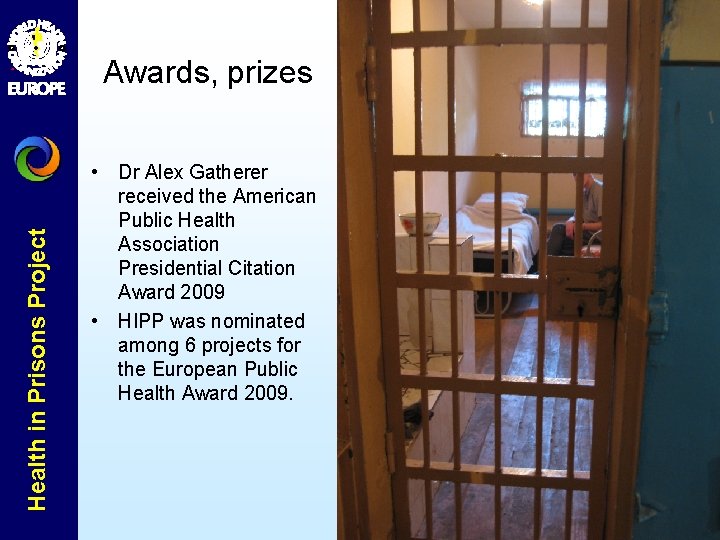
Health in Prisons Project Awards, prizes • Dr Alex Gatherer received the American Public Health Association Presidential Citation Award 2009 • HIPP was nominated among 6 projects for the European Public Health Award 2009.
Health in Prisons Project Thank you! Website HIPP: www. euro. who. int/prisons Email: lmo@euro. who. int