
Health Impact Assessment A tool to integrate health
- Slides: 43
Health Impact Assessment: A tool to integrate health considerations into planning decisions Aaron Wernham, M. D. , M. S. Director | The Health Impact Project 901 E Street, NW, Washington, D. C. 2004 p: 202. 540. 6346 e: awernham@pewtrusts. org www. healthimpactproject. org
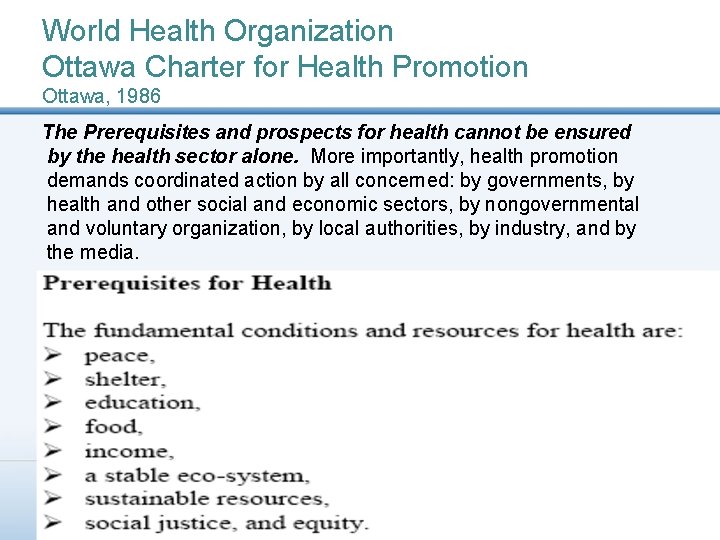
World Health Organization Ottawa Charter for Health Promotion Ottawa, 1986 The Prerequisites and prospects for health cannot be ensured by the health sector alone. More importantly, health promotion demands coordinated action by all concerned: by governments, by health and other social and economic sectors, by nongovernmental and voluntary organization, by local authorities, by industry, and by the media.
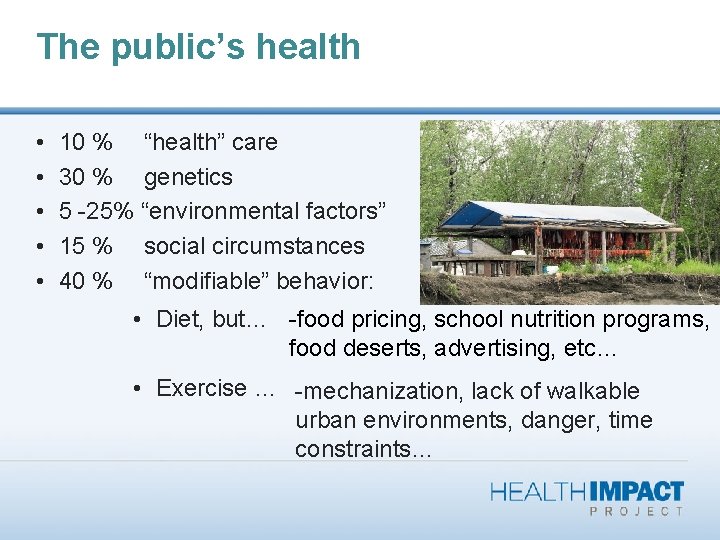
The public’s health • • • 10 % “health” care 30 % genetics 5 -25% “environmental factors” 15 % social circumstances 40 % “modifiable” behavior: • Diet, but… -food pricing, school nutrition programs, food deserts, advertising, etc… • Exercise … -mechanization, lack of walkable urban environments, danger, time constraints…
“Health is the responsibility of all sectors” How do we put this into practice? Ø No common language: • transportation engineers don’t understand health data. • public health professionals don’t understand the constraints and limitations of the planning process Ø Few routine/formalized requirements Ø No funding for new public health activities Ø Going out on a limb: Public health is science-driven, and policy and planning are governed by many other considerations: economics, politics, technology, deadines, etc …
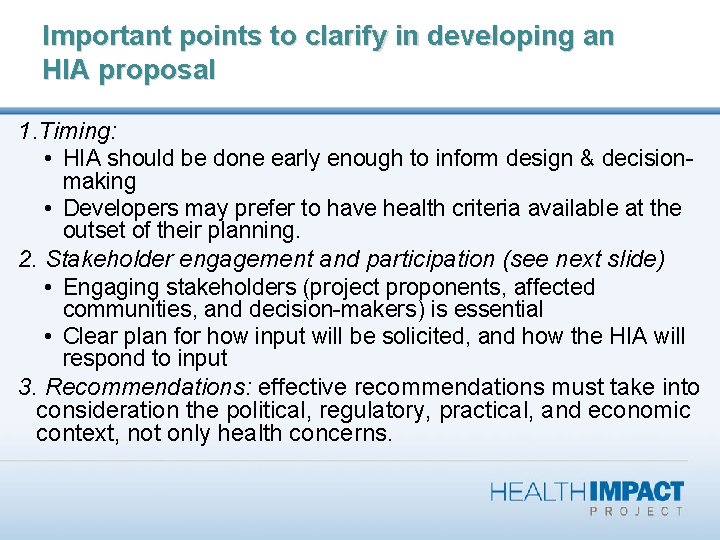
Important points to clarify in developing an HIA proposal 1. Timing: • HIA should be done early enough to inform design & decision- making • Developers may prefer to have health criteria available at the outset of their planning. 2. Stakeholder engagement and participation (see next slide) • Engaging stakeholders (project proponents, affected communities, and decision-makers) is essential • Clear plan for how input will be solicited, and how the HIA will respond to input 3. Recommendations: effective recommendations must take into consideration the political, regulatory, practical, and economic context, not only health concerns.
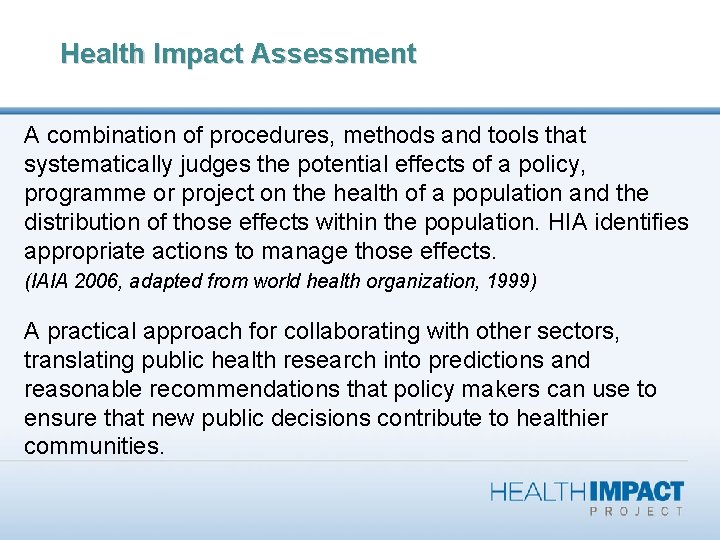
Health Impact Assessment A combination of procedures, methods and tools that systematically judges the potential effects of a policy, programme or project on the health of a population and the distribution of those effects within the population. HIA identifies appropriate actions to manage those effects. (IAIA 2006, adapted from world health organization, 1999) A practical approach for collaborating with other sectors, translating public health research into predictions and reasonable recommendations that policy makers can use to ensure that new public decisions contribute to healthier communities.
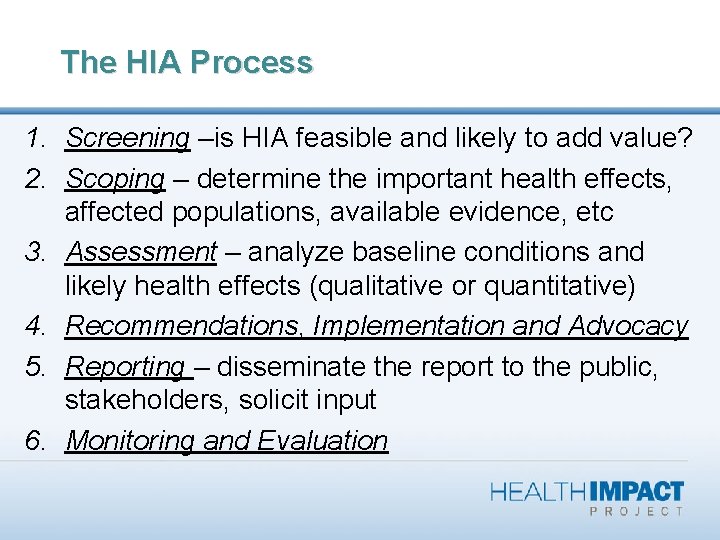
The HIA Process 1. Screening –is HIA feasible and likely to add value? 2. Scoping – determine the important health effects, affected populations, available evidence, etc 3. Assessment – analyze baseline conditions and likely health effects (qualitative or quantitative) 4. Recommendations, Implementation and Advocacy 5. Reporting – disseminate the report to the public, stakeholders, solicit input 6. Monitoring and Evaluation
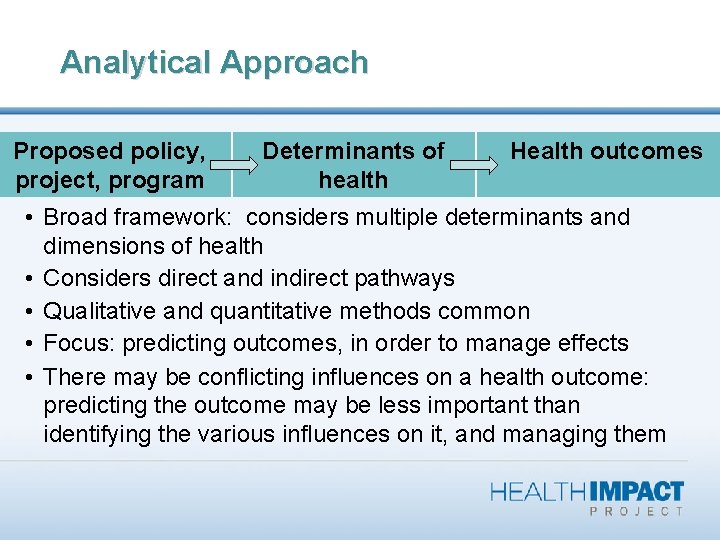
Analytical Approach Proposed policy, project, program Determinants of health Health outcomes • Broad framework: considers multiple determinants and dimensions of health • Considers direct and indirect pathways • Qualitative and quantitative methods common • Focus: predicting outcomes, in order to manage effects • There may be conflicting influences on a health outcome: predicting the outcome may be less important than identifying the various influences on it, and managing them
HIA is NOT… • Evaluation: not best for looking at effects of an existing policy or program, or evaluating the impacts of a past action • Risk assessment: HIA should not be used to look at one narrow subset of issues. Best when it starts by asking “what are the potential direct and indirect impacts on health” • Exhaustive: should not catalogue every hypothetical risk. Instead focus on the most important effects, those of greatest concern to the impacted community, and those best supported by evidence • Focused on quantifying risk: the most important task is to use reasoned judgment about risk to promote sound management strategies
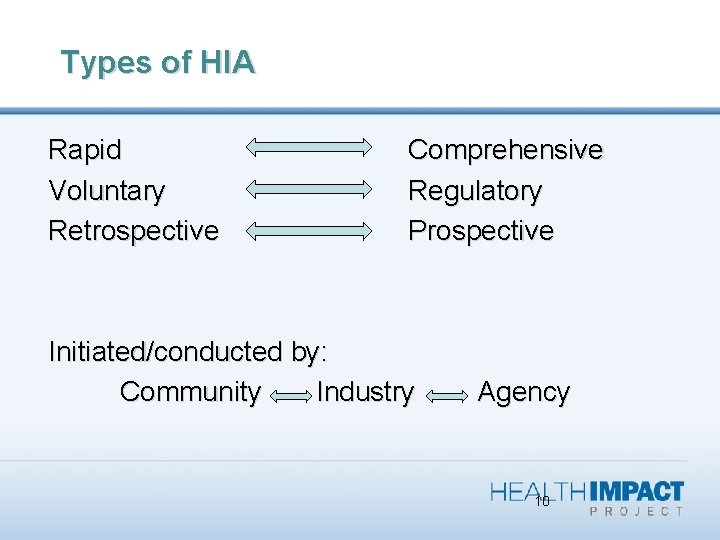
Types of HIA Rapid Voluntary Retrospective Comprehensive Regulatory Prospective Initiated/conducted by: Community Industry Agency 10
Health Impact Assessment Current Applications: Canada and Australia: considerable work, both within EIA and for other policies and projects. EU: common use of HIA • broad applications in policy-making, land-use, etc • variety of governance structures U. S. : 80+ HIAs to date: • Sporadic, often funded by foundations • Other than some EIA laws, no formal requirements 11
Health Impact Assessment International business is starting to use it. World Bank and IFC: part of evaluation standards for large development loans (IFC Guidance Note 4: http: //www. ifc. org/ifcext/enviro. nsf/Content/Guidance. Notes) Equator Principles: ratified by the majority of large lending banks worldwide, the Equator Principles delineate ethical requirements for large development loans: they refer to IFC standards (http: //www. equator-principles. com/principles. shtml ) 12
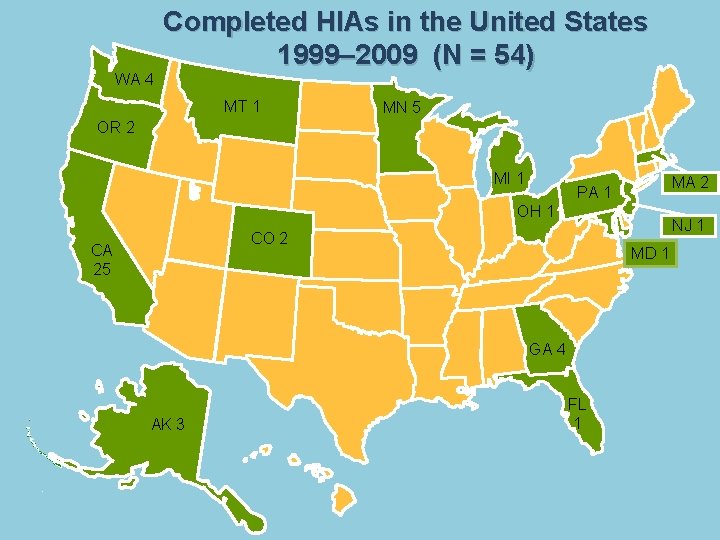
WA 4 Completed HIAs in the United States 1999– 2009 (N = 54) MT 1 MN 5 OR 2 MI 1 MA 2 PA 1 OH 1 NJ 1 CO 2 CA 25 MD 1 GA 4 AK 3 FL 1
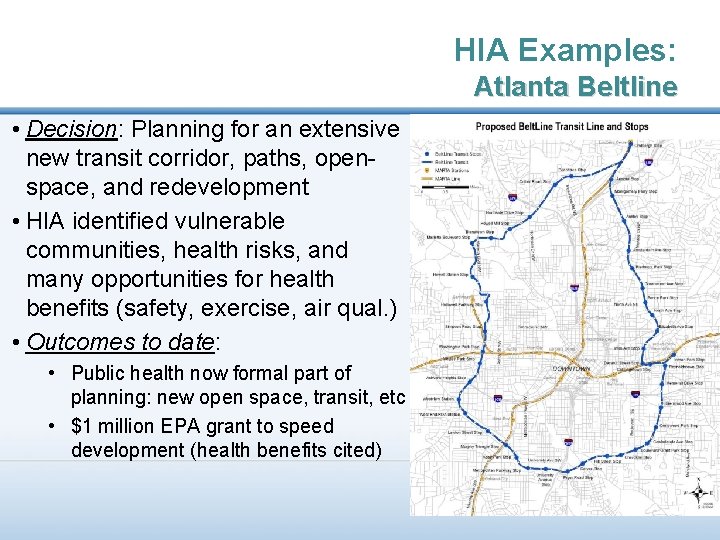
HIA Examples: Atlanta Beltline • Decision: Planning for an extensive new transit corridor, paths, openspace, and redevelopment • HIA identified vulnerable communities, health risks, and many opportunities for health benefits (safety, exercise, air qual. ) • Outcomes to date: • Public health now formal part of planning: new open space, transit, etc • $1 million EPA grant to speed development (health benefits cited)
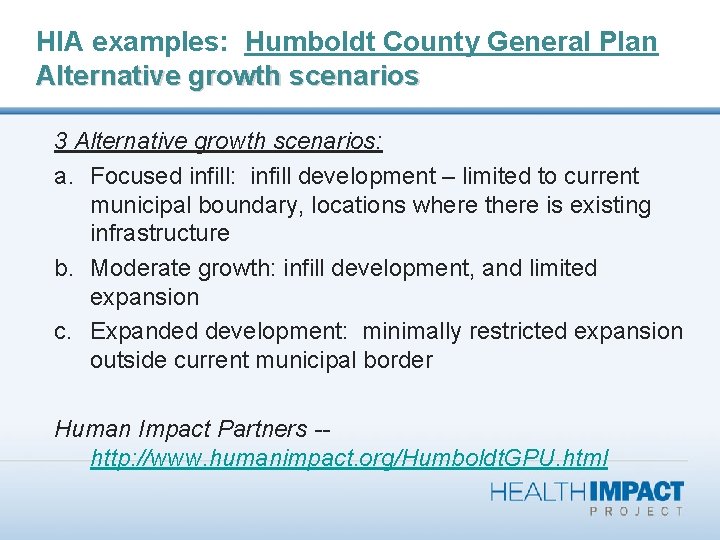
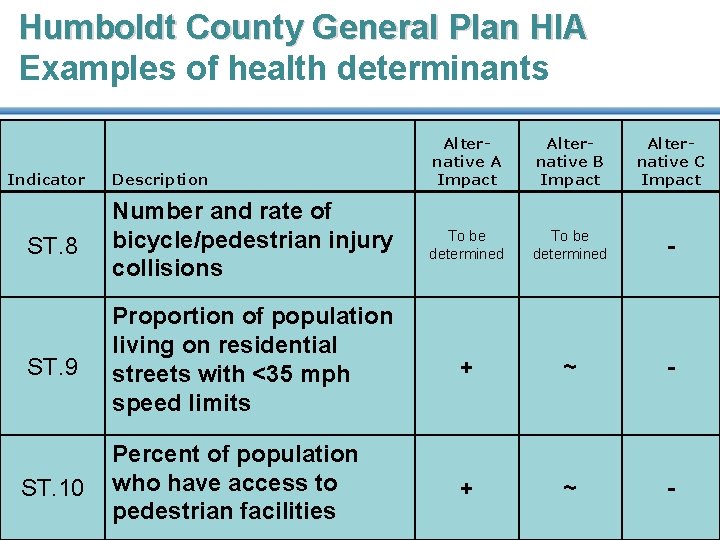
HIA examples: Humboldt County General Plan Alternative growth scenarios 3 Alternative growth scenarios: a. Focused infill: infill development – limited to current municipal boundary, locations where there is existing infrastructure b. Moderate growth: infill development, and limited expansion c. Expanded development: minimally restricted expansion outside current municipal border Human Impact Partners -http: //www. humanimpact. org/Humboldt. GPU. html
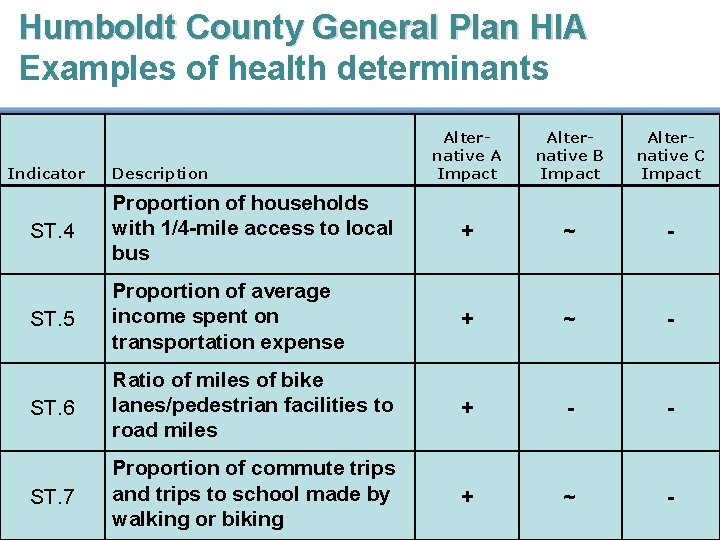
Humboldt County General Plan HIA Examples of health determinants Alternative A Impact Alternative B Impact Alternative C Impact ST. 4 Proportion of households with 1/4 -mile access to local bus + ~ - ST. 5 Proportion of average income spent on transportation expense + ~ - ST. 6 Ratio of miles of bike lanes/pedestrian facilities to road miles + - - ST. 7 Proportion of commute trips and trips to school made by walking or biking + ~ - Indicator Description
Humboldt County General Plan HIA Examples of health determinants Indicator Description Alternative A Impact Alternative B Impact Alternative C Impact To be determined - ST. 8 Number and rate of bicycle/pedestrian injury collisions ST. 9 Proportion of population living on residential streets with <35 mph speed limits + ~ - ST. 10 Percent of population who have access to pedestrian facilities + ~ -
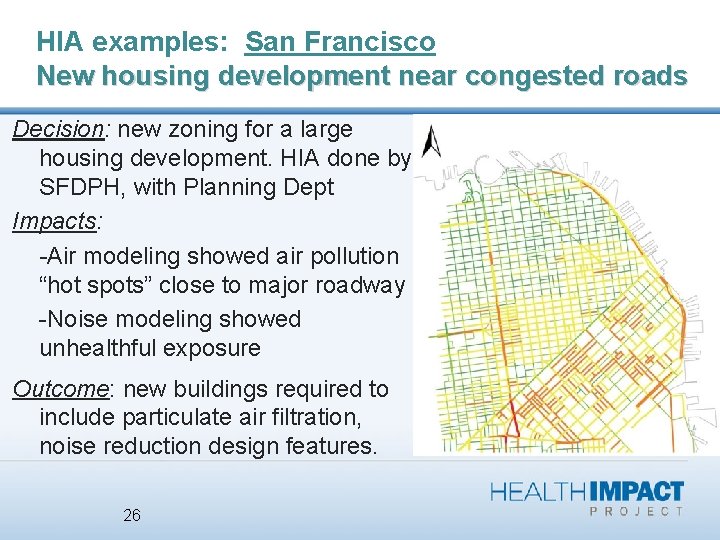
HIA examples: San Francisco New housing development near congested roads Decision: new zoning for a large housing development. HIA done by SFDPH, with Planning Dept Impacts: -Air modeling showed air pollution “hot spots” close to major roadway -Noise modeling showed unhealthful exposure Outcome: new buildings required to include particulate air filtration, noise reduction design features. 26
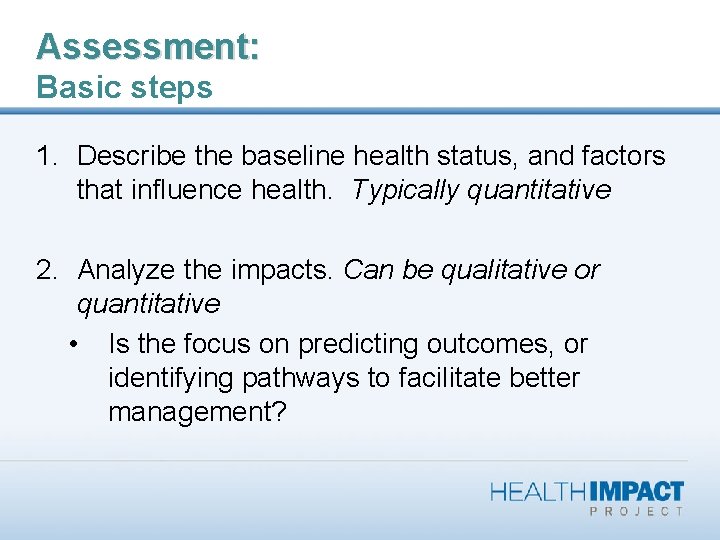
Assessment: Basic steps 1. Describe the baseline health status, and factors that influence health. Typically quantitative 2. Analyze the impacts. Can be qualitative or quantitative • Is the focus on predicting outcomes, or identifying pathways to facilitate better management?
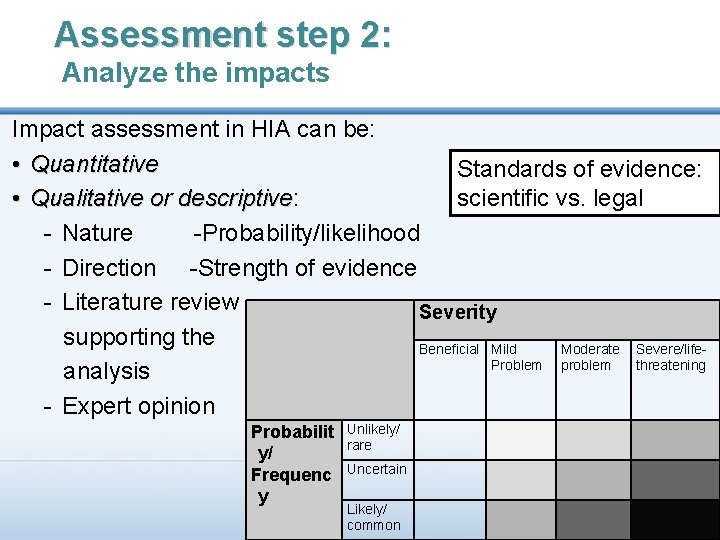
Assessment step 2: Analyze the impacts Impact assessment in HIA can be: • Quantitative Standards of evidence: scientific vs. legal • Qualitative or descriptive: descriptive - Nature -Probability/likelihood - Direction -Strength of evidence - Literature review Severity supporting the Beneficial Mild Moderate Severe/life. Problem problem threatening analysis - Expert opinion Probabilit y/ Frequenc y Unlikely/ rare Uncertain Likely/ common
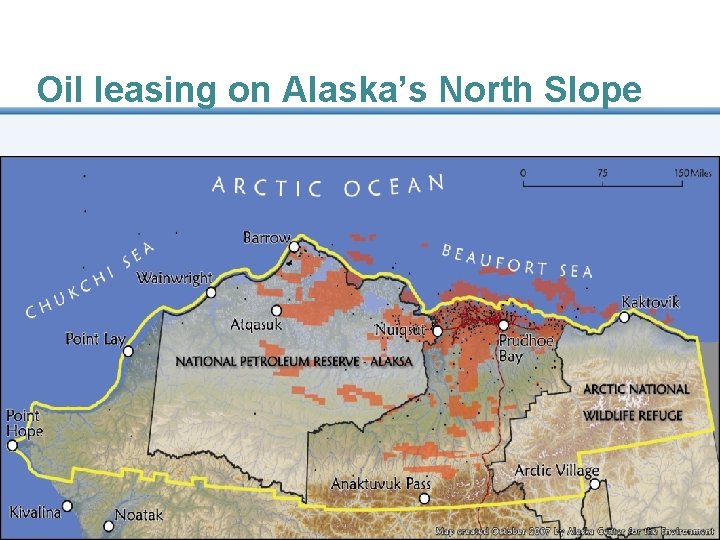
Oil leasing on Alaska’s North Slope
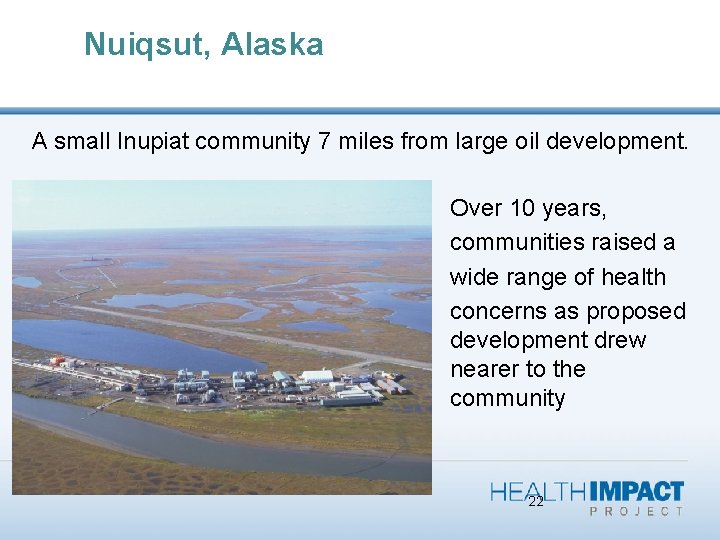
Nuiqsut, Alaska A small Inupiat community 7 miles from large oil development. Over 10 years, communities raised a wide range of health concerns as proposed development drew nearer to the community 22
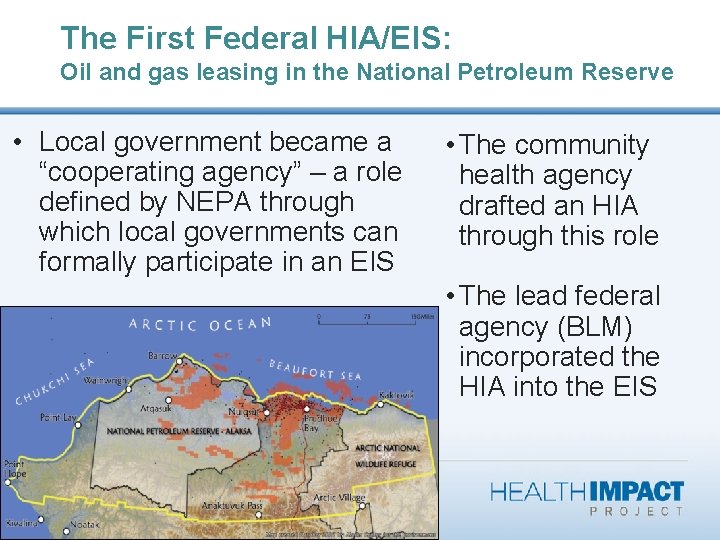
The First Federal HIA/EIS: Oil and gas leasing in the National Petroleum Reserve • Local government became a “cooperating agency” – a role defined by NEPA through which local governments can formally participate in an EIS • The community health agency drafted an HIA through this role • The lead federal agency (BLM) incorporated the HIA into the EIS
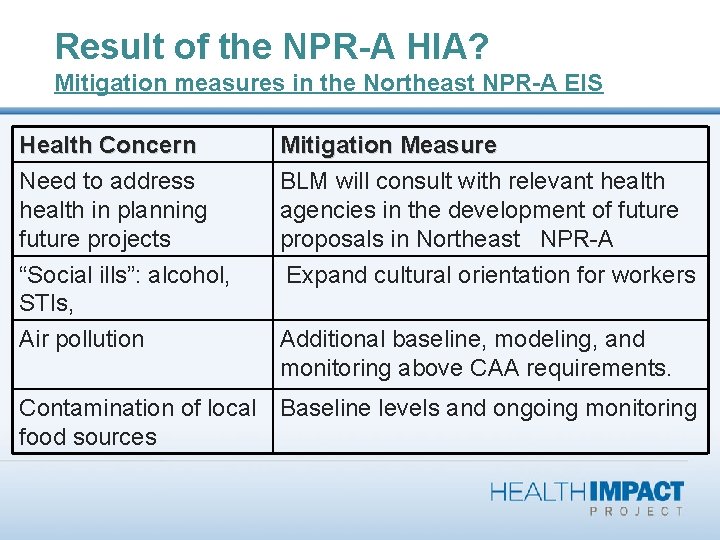
Result of the NPR-A HIA? Mitigation measures in the Northeast NPR-A EIS General Outcome: This was a very contentious leasing proposal. Community engagement via the cooperating agency relationship and HIA process resulted in: • Improved relationships between the community and the agency • A compromise leasing plan that was widely accepted on both sides
Result of the NPR-A HIA? Mitigation measures in the Northeast NPR-A EIS Health Concern Need to address health in planning future projects Mitigation Measure BLM will consult with relevant health agencies in the development of future proposals in Northeast NPR-A “Social ills”: alcohol, STIs, Air pollution Expand cultural orientation for workers Additional baseline, modeling, and monitoring above CAA requirements. Contamination of local Baseline levels and ongoing monitoring food sources
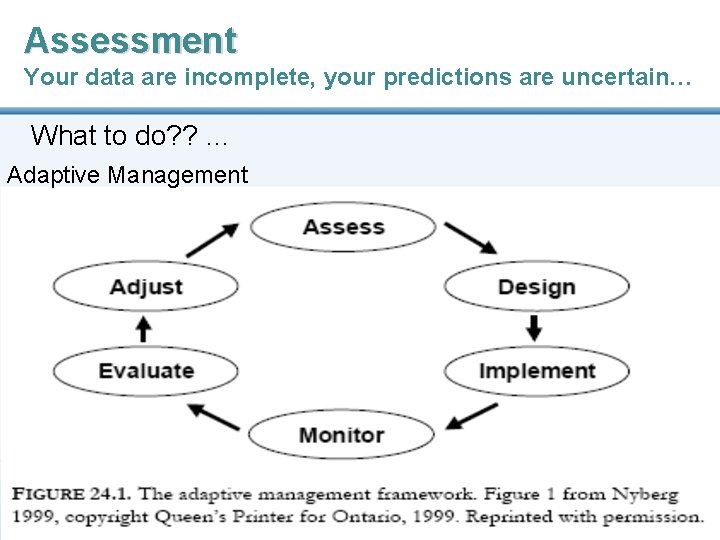
Assessment Your data are incomplete, your predictions are uncertain… What to do? ? … Adaptive Management 26
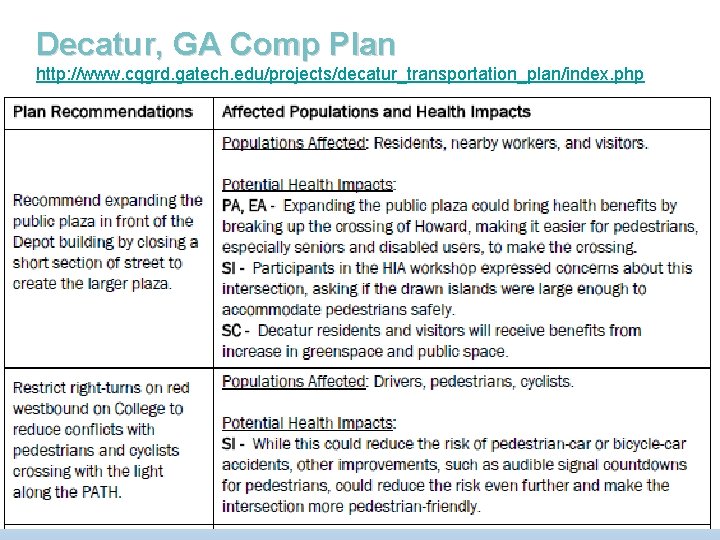
Decatur, GA Comp Plan http: //www. cqgrd. gatech. edu/projects/decatur_transportation_plan/index. php http: //carbon. ucdenver. edu/~kkri zek/pdfs/EIARinpress. pdf
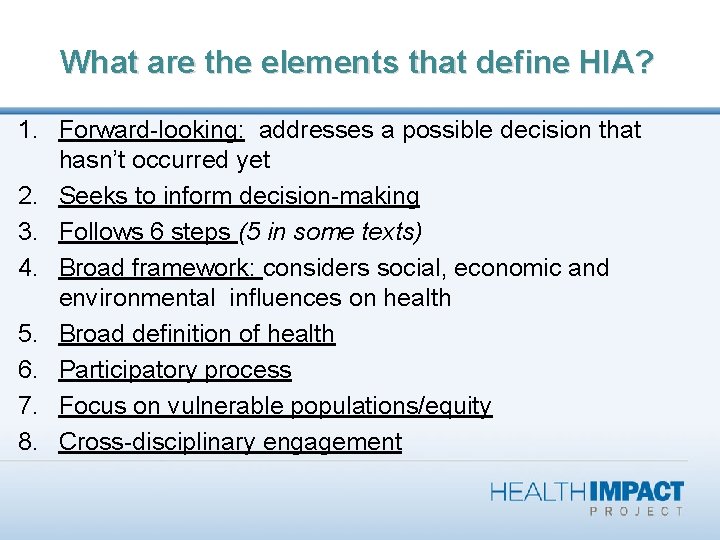
What are the elements that define HIA? 1. Forward-looking: addresses a possible decision that hasn’t occurred yet 2. Seeks to inform decision-making 3. Follows 6 steps (5 in some texts) 4. Broad framework: considers social, economic and environmental influences on health 5. Broad definition of health 6. Participatory process 7. Focus on vulnerable populations/equity 8. Cross-disciplinary engagement
“HIA 2. 0” – beyond project-specific applications • Should a new HIA be done for each new project or program? • Can HIA be a formative learning tool that results in adoption of new “healthy by design” principles that obviate the need for HIA on every projects?
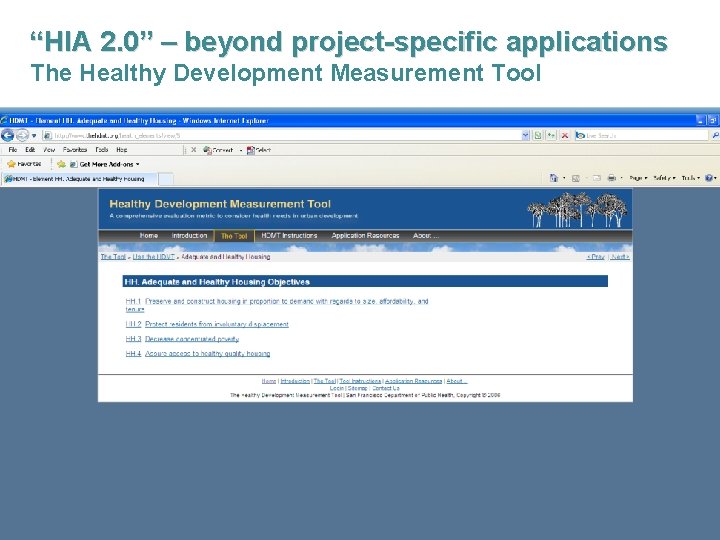
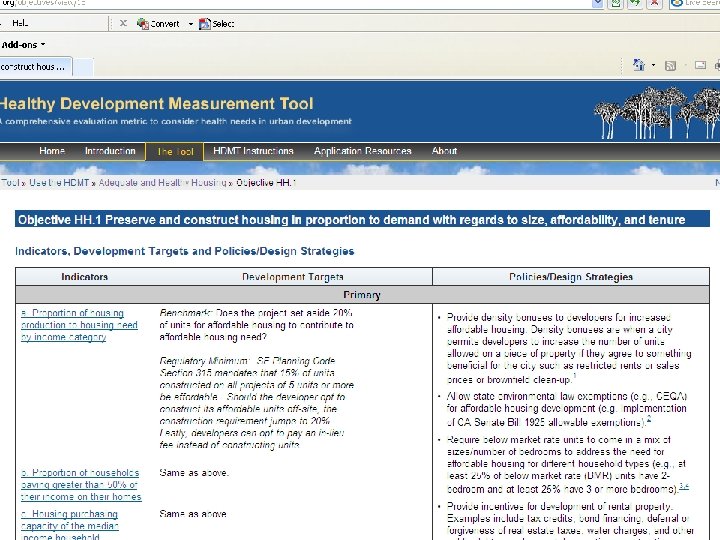
“HIA 2. 0” – beyond project-specific applications The Healthy Development Measurement Tool
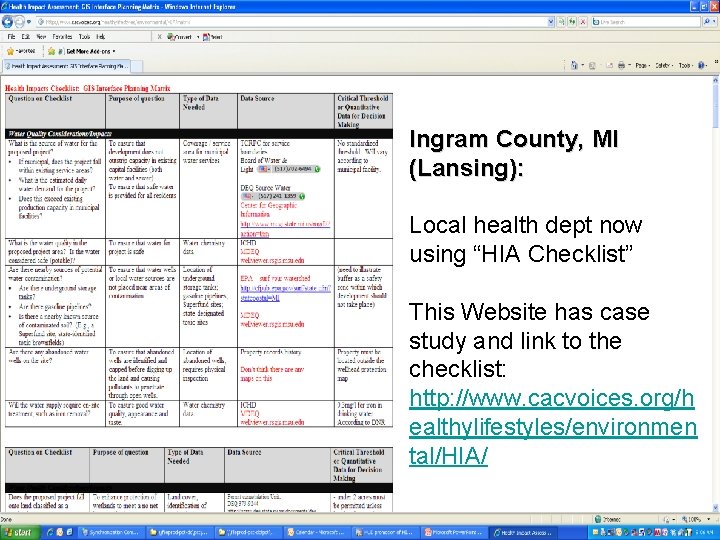
Ingram County, MI (Lansing): Local health dept now using “HIA Checklist” This Website has case study and link to the checklist: http: //www. cacvoices. org/h ealthylifestyles/environmen tal/HIA/
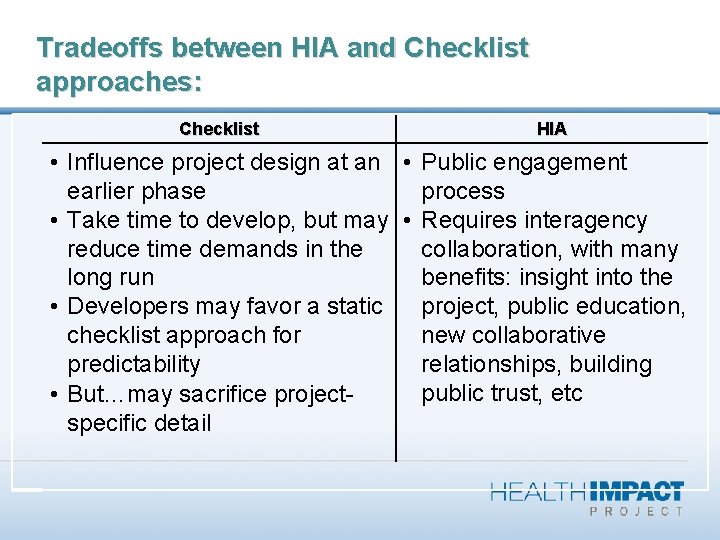
Tradeoffs between HIA and Checklist approaches: Checklist HIA • Influence project design at an • Public engagement earlier phase process • Take time to develop, but may • Requires interagency reduce time demands in the collaboration, with many long run benefits: insight into the • Developers may favor a static project, public education, checklist approach for new collaborative predictability relationships, building public trust, etc • But…may sacrifice projectspecific detail
The Health Impact Project: A collaboration of the Robert Wood Johnson Foundation and The Pew Charitable Trusts Overall Objective: To promote and support the use of HIA as a tool to ensure that decisions in nonhealth sectors, whether at the local, state, tribal, or federal level, are made with health in mind. Visit www. healthimpactproject. org
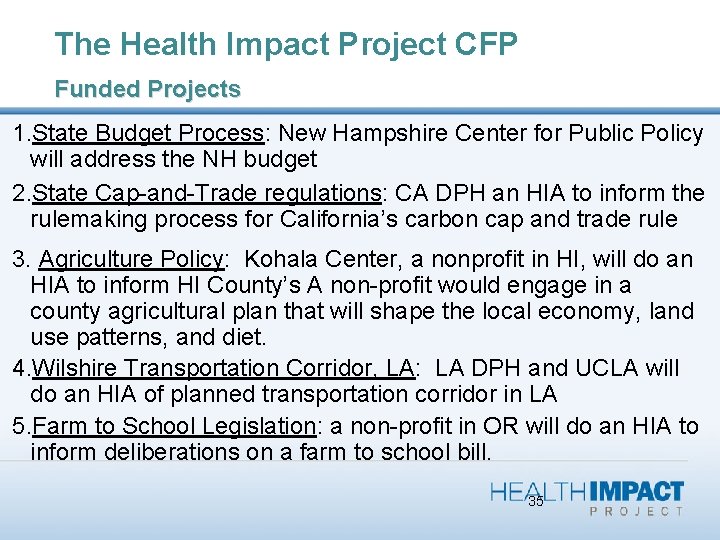
The Health Impact Project CFP Funded Projects 1. State Budget Process: New Hampshire Center for Public Policy will address the NH budget 2. State Cap-and-Trade regulations: CA DPH an HIA to inform the rulemaking process for California’s carbon cap and trade rule 3. Agriculture Policy: Kohala Center, a nonprofit in HI, will do an HIA to inform HI County’s A non-profit would engage in a county agricultural plan that will shape the local economy, land use patterns, and diet. 4. Wilshire Transportation Corridor, LA: LA DPH and UCLA will do an HIA of planned transportation corridor in LA 5. Farm to School Legislation: a non-profit in OR will do an HIA to inform deliberations on a farm to school bill. 35
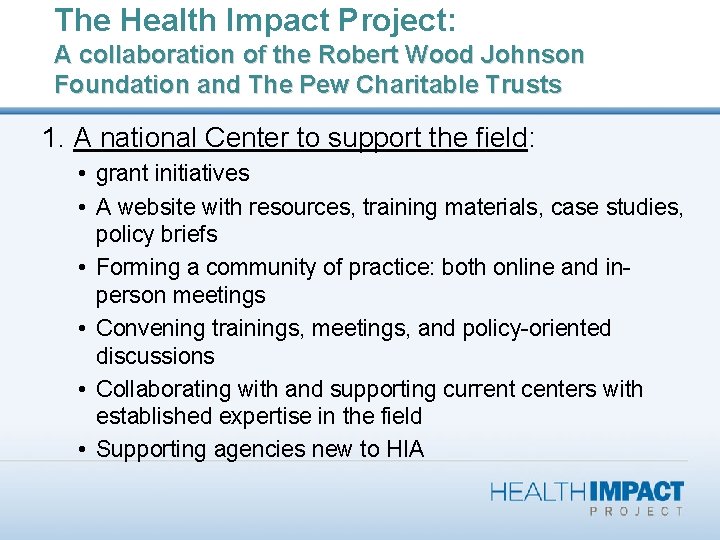
The Health Impact Project: A collaboration of the Robert Wood Johnson Foundation and The Pew Charitable Trusts 1. A national Center to support the field: • grant initiatives • A website with resources, training materials, case studies, policy briefs • Forming a community of practice: both online and inperson meetings • Convening trainings, meetings, and policy-oriented discussions • Collaborating with and supporting current centers with established expertise in the field • Supporting agencies new to HIA
The Health Impact Project: A collaboration of the Robert Wood Johnson Foundation and The Pew Charitable Trusts 2. Building the case for HIA: • Funding a series of demonstration projects that address real-time decisions on proposed policies, programs, and projects at the local, state, and tribal level: see the CFP at www. healthimpactproject. org • Building a technical assistance network to support new HIA practitioners • A “rapid response” fund to allow local health departments or others complete rapid HIAs of smallerscale, shorter-term decision making.
The Health Impact Project: A collaboration of the Robert Wood Johnson Foundation and The Pew Charitable Trusts 4. Are there existing regulations, policies, and standards that support the inclusion of health considerations? • Review existing legal constructs that may support the inclusion of health – zoning laws, growth plans, regulatory impact analysis, etc.
Discussion?
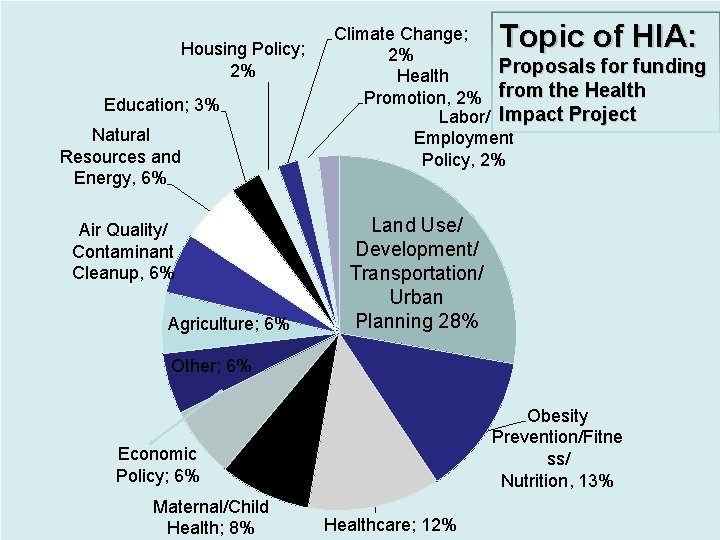
Subject Area Housing Policy; 2% Education; 3% Natural Resources and Energy, 6% Air Quality/ Contaminant Cleanup, 6% Agriculture; 6% Topic of HIA: Climate Change; 2% Proposals for funding Health Promotion, 2% from the Health Labor/ Impact Project Employment Policy, 2% Land Use/ Development/ Transportation/ Urban Planning 28% Other; 6% Obesity Prevention/Fitne ss/ Nutrition, 13% Economic Policy; 6% Maternal/Child Health; 8% Healthcare; 12%
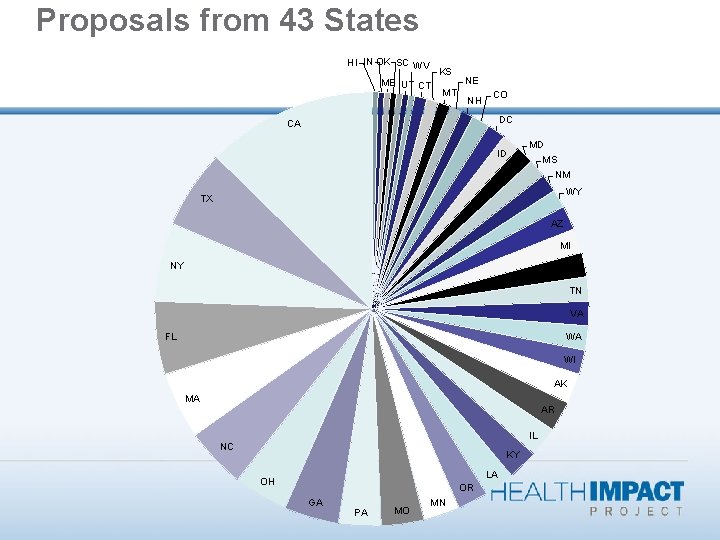
Proposals from 43 States HI IN OK SC WV KS ME UT CT MT NE NH CO DC CA ID MD MS NM WY TX AZ MI NY NJ TN VA WA FL WI AK MA AR IL NC KY LA OH OR GA PA MO MN
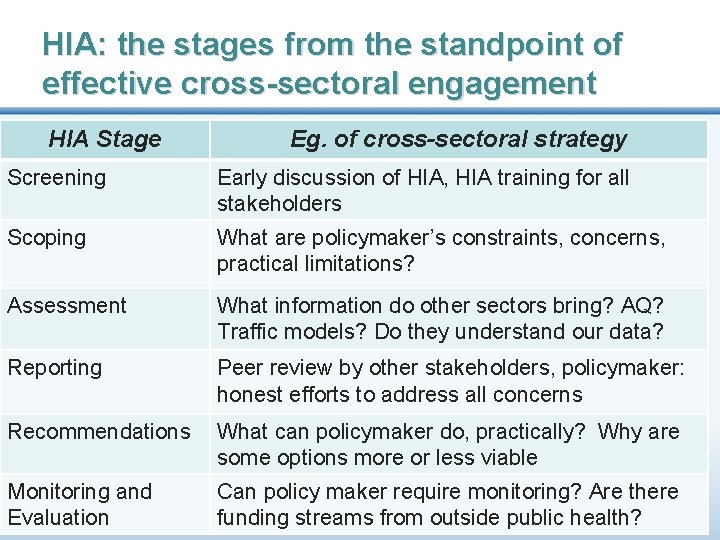
HIA: the stages from the standpoint of effective cross-sectoral engagement HIA Stage Eg. of cross-sectoral strategy Screening Early discussion of HIA, HIA training for all stakeholders Scoping What are policymaker’s constraints, concerns, practical limitations? Assessment What information do other sectors bring? AQ? Traffic models? Do they understand our data? Reporting Peer review by other stakeholders, policymaker: honest efforts to address all concerns Recommendations What can policymaker do, practically? Why are some options more or less viable Monitoring and Evaluation Can policy maker require monitoring? Are there funding streams from outside public health?
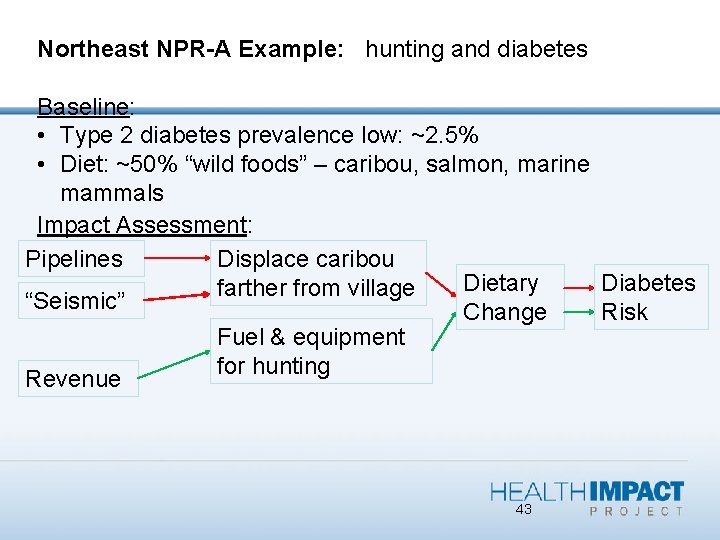
Northeast NPR-A Example: hunting and diabetes Baseline: • Type 2 diabetes prevalence low: ~2. 5% • Diet: ~50% “wild foods” – caribou, salmon, marine mammals Impact Assessment: Pipelines Displace caribou Dietary Diabetes farther from village “Seismic” Change Risk Fuel & equipment for hunting Revenue 43