
Health Hazards of Sulphur Dioxide SO 2 Outline










- Slides: 34
Health Hazards of Sulphur Dioxide (SO 2)
Outline What is Sulphur Dioxide? Where is it found? Occupational, environmental Routes of exposure Health effects OEL and IDLH Air sampling Controls 1
Identify the Hazards What is Sulphur Dioxide? CAS# 7446 -09 -5 Chemical compound with formula SO 2 Colourless gas with a pungent odour SO 2 in air occurs mainly from activities associated with burning of sulphur-containing materials 2
Identify the Hazards Chemical and Physical Properties of SO 2 At room temperature, colourless gas with pungent, irritating odour A non-flammable gas Heavier than air A liquid when under pressure Dissolves in water very easily (highly soluble) 3
Identify the Hazards Properties of SO 2 (cont’d) Most people can smell or taste SO 2 at levels of 0. 3 to 1 parts per million (ppm) Ø At concentrations above 3 ppm, odour considered pungent and irritating (easily detected odour) Therefore, considered to have adequate warning properties. 4
Identify the Hazards Sources of Exposure Generated from burning of sulphur, smelting and roasting of sulphide ores, combustion of hydrogen sulphide Exposures can also occur when burning any material coated with a residue of ore and/or concentrate SO 2 used in industry for: • Production of sulphuric acid • Paper manufacturing • Food or beverage preservation 5
Identify the Hazards Natural Environment Exposures Majority of SO 2 in air comes from human sources, mainly industrial activity; also present in motor vehicle emissions SO 2 reacts with other chemicals to form tiny particles which are associated with respiratory symptoms. SO 2 and nitrogen oxides react with other substances to form acids (eg. acid rain) 6
Identify the Hazards Where SO 2 exists at Vale Exposures: Mines Furnaces Converter Aisle Liquid SO 2 Plant Acid Plant Fluid Bed Roasting Weak Acid Treatment Plant 7
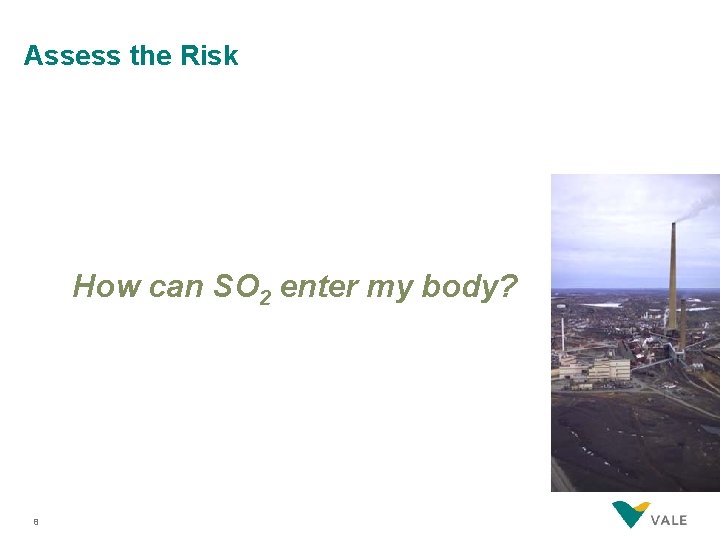
Assess the Risk How can SO 2 enter my body? 8
Assess the Risk Routes of Entry • Inhalation – breathing in the chemical • Absorption – the chemical soaks through the skin and eyes (gas and liquid) when moisture present on skin • Ingestion – swallowing the chemical - Not a method of exposure to SO 2 9
Assess the Risk Once in your body If inhaled, SO 2 may absorb into your body through nose and lungs (some is exhaled without being absorbed) Most only penetrates as far as nose and throat (upper respiratory tract), with only minor portion reaching lungs (lower respiratory tract) ØUnless heavy breathing or mouth breathing Inhaled SO 2 reacts with moisture of mucous membranes and respiratory tract to form sulfurous acid (severe irritant) Breaks down to sulfate and excreted in urine 10
How Can SO 2 Affect My Health? 11
Assess the Risk Health effects of SO 2 Upper Respiratory Tract irritant (eyes, nose, throat) Ø Causes coughing, mucous secretion Ø Can aggravate conditions such as asthma and chronic bronchitis 12
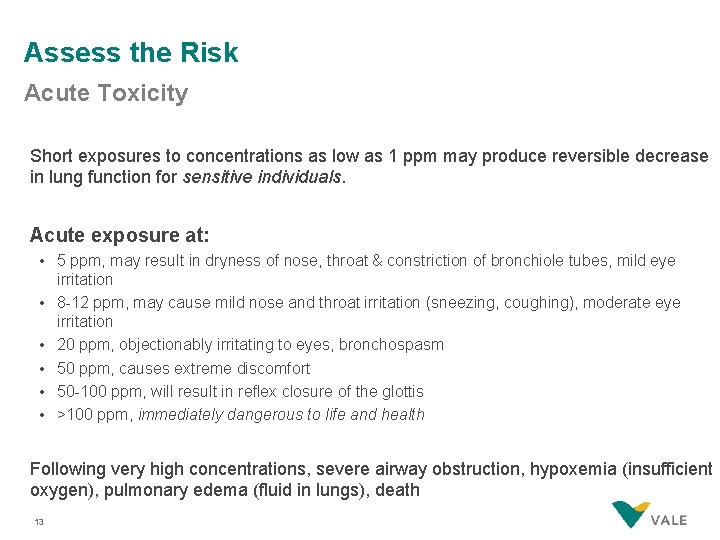
Assess the Risk Acute Toxicity Short exposures to concentrations as low as 1 ppm may produce reversible decrease in lung function for sensitive individuals. Acute exposure at: • 5 ppm, may result in dryness of nose, throat & constriction of bronchiole tubes, mild eye irritation • 8 -12 ppm, may cause mild nose and throat irritation (sneezing, coughing), moderate eye irritation • 20 ppm, objectionably irritating to eyes, bronchospasm • 50 ppm, causes extreme discomfort • 50 -100 ppm, will result in reflex closure of the glottis • >100 ppm, immediately dangerous to life and health Following very high concentrations, severe airway obstruction, hypoxemia (insufficient oxygen), pulmonary edema (fluid in lungs), death 13
Acute Toxicity (cont’d) SO 2 gas will react with moisture on skin • May cause severe irritation Liquid SO 2 may cause burns • Symptoms of mild frostbite include numbness, prickling and itching of affected area. 14
Assess the Risk Chronic Health Effects Long-term exposure to lower levels of SO 2 may cause: Respiratory effects: • Pulmonary impairment (levels < 5 ppm) Skin: • Rare SO 2 is not classifiable as to its carcinogenicity to humans (Group 3). 15
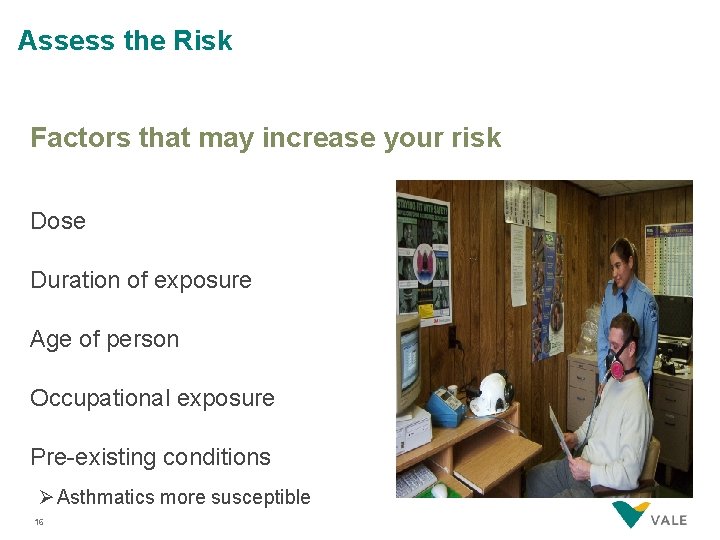
Assess the Risk Factors that may increase your risk Dose Duration of exposure Age of person Occupational exposure Pre-existing conditions Ø Asthmatics more susceptible 16
Assess the Risk Ontario’s Occupational Exposure Limits (OEL) Time-Weighted Average (TWA) The concentration for a normal 8 -hour workday and 40 -hour workweek, to which it is believed that nearly all workers may be repeatedly exposed, day after day, without adverse effects. TWA for SO 2 = 2 ppm for 8 hr shift = 1. 3 ppm for 12 hr shift *Without respiratory protection 17
OEL (cont’d) Short-Term Exposure Limit (STEL) The maximum airborne concentration of a biological or chemical agent to which a worker is exposed in any fifteen-minute period determined from a single sample or a time-weighted average of sequential samples taken during such period. STEL for SO 2 = 5 ppm 18
Immediately Dangerous to Life and Health (IDLH) An atmosphere that poses an immediate threat to life, would cause irreversible adverse health effects, or would impair an individual’s ability to escape IDLH for SO 2 - 100 ppm Therefore, short-term exposures to high levels of SO 2 can be life-threatening. 19
Assess the Risk Air Sampling SO 2 gas collected. The sampling train consists of a 37 mm cassette, a pretreated support pad and a pump. 20
Assess the Risk Air Sampling AREA SAMPLING: Placing the sampling equipment in a representative fixed position in the work area. Useful as an index of general contamination. Can be used to determine whether to post as a “Respirator Protection Required” area. Can be used to determine efficiency of controls. 21
Assess the Risk Air Sampling PERSONAL MONITORING is conducted: In the worker’s breathing zone. Doing his/her normal work activities. Over an entire work shift. *Results determine worker exposure (for compliance with OELs) 22
Control Risk Types of Controls Engineering Controls Administrative Controls Work and Hygiene Practices PPE 23
Engineering Controls Includes: Substitution Ventilation Enclosure/isolation The above controls can be implemented: At the source Along the path At the worker 24
Administrative Controls Includes: Training on hazards recognition, safe work & hygiene practices Maintaining adequate hygiene facilities (hand washing and showering) Transferring high risk workers out of work area Occupational Health Programs Written documentation of safe work procedures (site specific) 25
Work and Hygiene Practices Some of the things you can do to protect your health: Wash hands, face, scrub nails before eating, drinking, smoking • Ensure: using soap & warm water & washing for sufficient time Shower, wash, change before going home Eat, drink only in designated areas Keep your work area clean – daily housekeeping Follow adequate controls (ie. wearing PPE) REPORT any illness or injuries right away (even if you think they are minor), faulted engineering controls 26
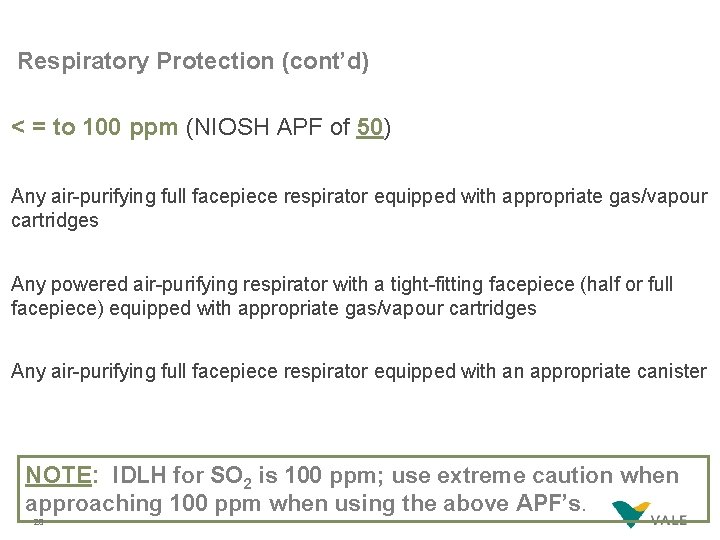
Respiratory Protection (cont’d) < = to 100 ppm (NIOSH APF of 50) Any air-purifying full facepiece respirator equipped with appropriate gas/vapour cartridges Any powered air-purifying respirator with a tight-fitting facepiece (half or full facepiece) equipped with appropriate gas/vapour cartridges Any air-purifying full facepiece respirator equipped with an appropriate canister NOTE: IDLH for SO 2 is 100 ppm; use extreme caution when approaching 100 ppm when using the above APF’s. 29
Respiratory Protection (cont’d) > than 100 ppm Any positive pressure, full facepiece Self Contained Breathing Apparatus (SCBA) Any positive pressure, full facepiece Supplied Air Respirator (SAR) with an auxiliary positive-pressure SCBA 30
Please Ensure these Practices (Controls) are Protecting YOU by…. . Participating in air monitoring (wearing a pump) Ø tells us about YOUR lung exposure to contaminants that shift 31
References American Conference of Governmental Industrial Hygienists. 2001. Sulfur Dioxide In: Documentation of the Chemical Exposure Indices. ACGIH®, Cincinnati, OH. U. S. National Institute for Occupational Safety and Health. 1994. NIOSH Pocket Guide to Chemical Hazards. DHHS (NIOSH) Pub. No. 94— 116. Superintendent of Documents, U. S. Government Printing Office, Washington, DC. U. S. Agency for Toxic Substances and Disease Registry. 1998. Toxicological Profile for Sulfur Dioxide. ATSDR/TP-8817. U. S. Public Health Services, ATSDR, Atlanta, GA. U. S. Agency for Toxic Substances and Disease Registry. 1998. Public Health Statement Sulfur Dioxide. ATSDR/TP-8817. U. S. Public Health Services, ATSDR, Atlanta, GA. 32
References (cont’d) Canadian Centre for Occupational Health and Safety. Basic Information on Sulfur Dioxide. Retrieved from http: //www. ccohs. ca/oshanswers/chemicals/chem_profiles/sulfurdi/basic_sul. html on December 1, 2008. Canadian Centre for Occupational Health and Safety. Health Effects of Sulfur Dioxide. Retrieved from http: //www. ccohs. ca/oshanswers/chemicals/chem_profiles/sulfurdi/health_sul. htm l on December 1, 2008. Canadian Centre for Occupational Health and Safety. Personal Protective Equipment for Sulfur Dioxide. Retrieved from http: //www. ccohs. ca/oshanswers/chemicals/chem_profiles/sulfurdi/personal_sul. h tml on December 1, 2008. 33
References (cont’d) U. S. Agency for Toxic Substances and Disease Registry. 1998. Tox. FAQs Chemical Agent Briefing Sheets: Sulfur Dioxide. U. S. Public Health Services, ATSDR, Atlanta, GA. OHCOW. 1998. Fact Sheet: Sulphur Dioxide. Occupational Health Clinics for Ontario Workers Inc. 34
Document Control Revision # 01 35 DATE February 24, 2012 NATURE OF CHANGE PAGE INSERTED, REPLACED, REVISED OR CANCELLED Reformat all slides to Vale format. All slides Change in terminology (TWA, STEL) Slides 17 & 18 APPROVED BY DOCUMENT OWNER Cassidy Throssell, Sr. Specialist Occ Health