
HEALTH EQUITY Many Voices Shared Vision Jeanne Ayers
- Slides: 49
HEALTH EQUITY: Many Voices, Shared Vision Jeanne Ayers Assistant Commissioner, Minnesota Department of Health The 2016 MPHA Annual Conference May 26, 2016
Public Health “Public health is what we, as a society, do collectively to assure the conditions in which (all) people can be healthy. ” Institute of Medicine (1988), Future of Public Health
What is Health? From WHO 1948 and Ottawa Charter for Health 1986 "Health is a state of complete physical, mental and social well-being and not merely the absence of disease or infirmity. Health is a resource for everyday life, not the objective of living. ”
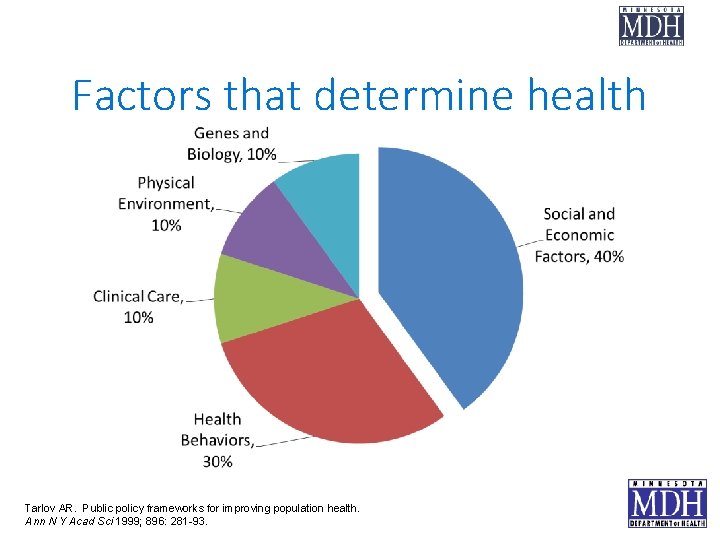
Factors that determine health Tarlov AR. Public policy frameworks for improving population health. Ann N Y Acad Sci 1999; 896: 281 -93.
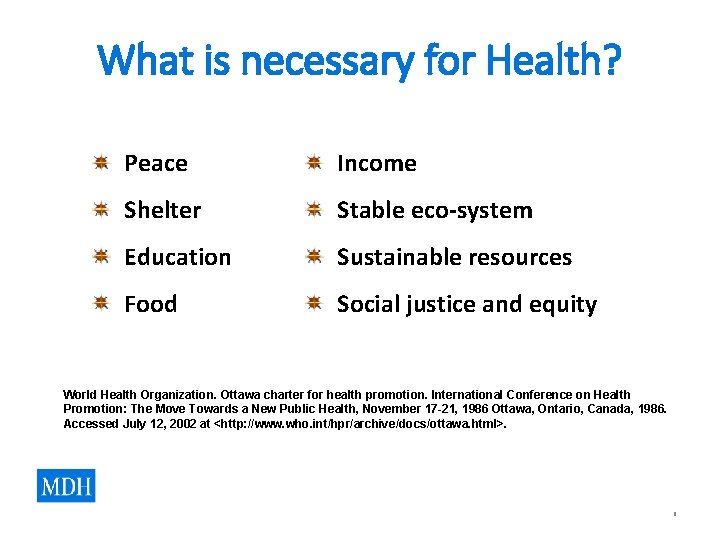
What is necessary for Health? Peace Income Shelter Stable eco-system Education Sustainable resources Food Social justice and equity World Health Organization. Ottawa charter for health promotion. International Conference on Health Promotion: The Move Towards a New Public Health, November 17 -21, 1986 Ottawa, Ontario, Canada, 1986. Accessed July 12, 2002 at <http: //www. who. int/hpr/archive/docs/ottawa. html>. 6
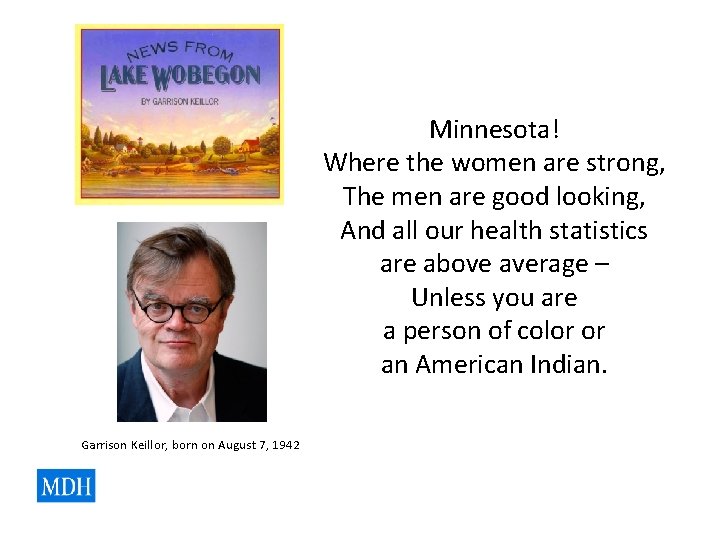
Minnesota! Where the women are strong, The men are good looking, And all our health statistics are above average – Unless you are a person of color or an American Indian. Garrison Keillor, born on August 7, 1942
Advancing Health Equity in Minnesota Report to the Legislature “…the opportunity to be healthy is not equally available everywhere or for everyone in the state. ”
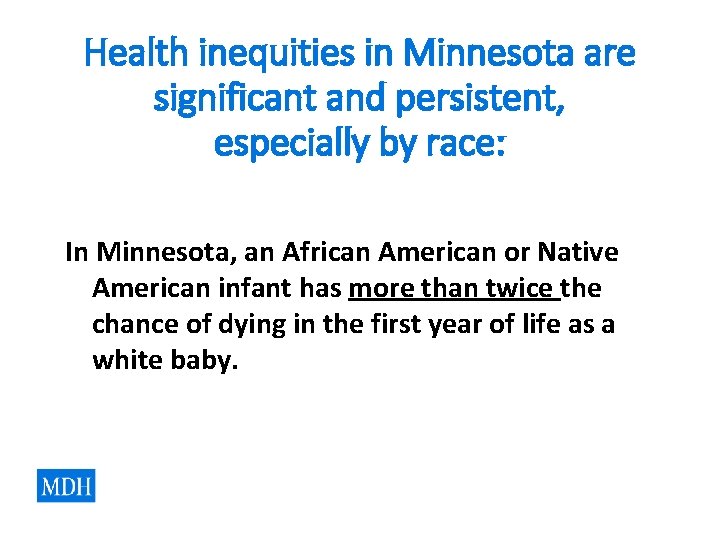
Health inequities in Minnesota are significant and persistent, especially by race: In Minnesota, an African American or Native American infant has more than twice the chance of dying in the first year of life as a white baby.
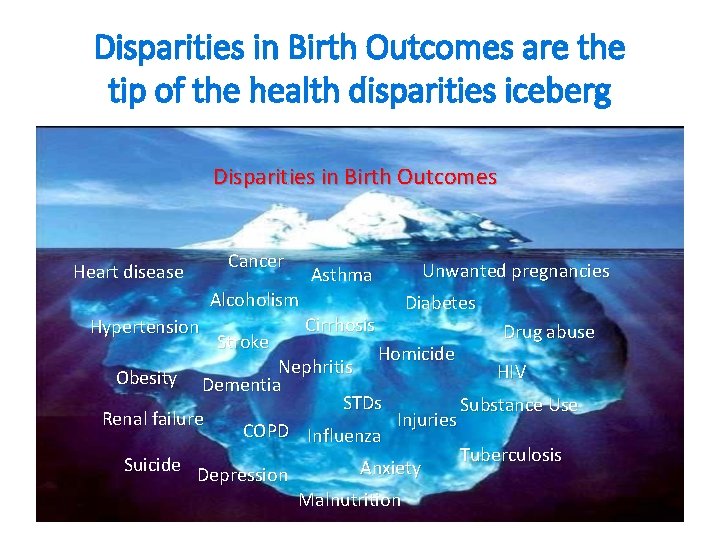
Disparities in Birth Outcomes are the tip of the health disparities iceberg Disparities in Birth Outcomes Heart disease Cancer Alcoholism Hypertension Stroke Asthma Cirrhosis Unwanted pregnancies Diabetes Homicide Drug abuse Nephritis HIV Dementia STDs Substance Use Renal failure Injuries COPD Influenza Tuberculosis Suicide Depression Anxiety Malnutrition Obesity
Roots of Inequities how did we get here? § § Disparities are not simply because of lack of access to health care or to poor individual choices. Disparities are mostly the result of policy decisions that systematically disadvantage some populations over others. § Especially, populations of color and American Indians, GLBTQ, and low income § Structural Racism
Predictors of Health by Race The connection between systemic disadvantage and health inequities by race is clear and predictive of the future health of our community.
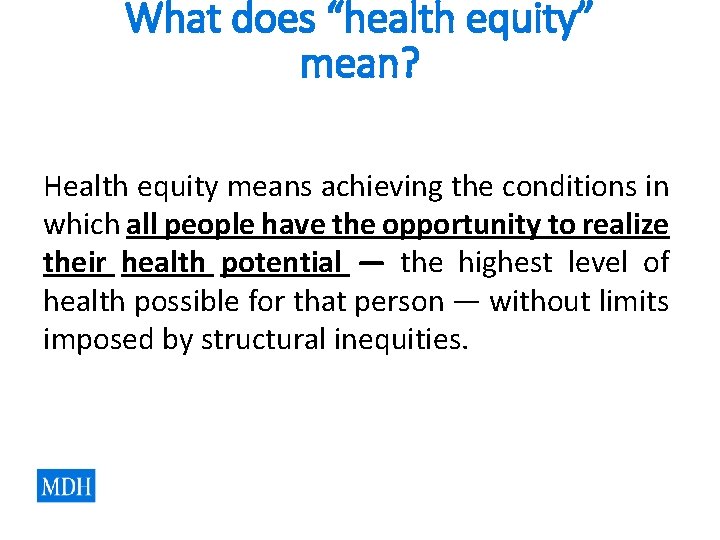
What does “health equity” mean? Health equity means achieving the conditions in which all people have the opportunity to realize their health potential — the highest level of health possible for that person — without limits imposed by structural inequities.
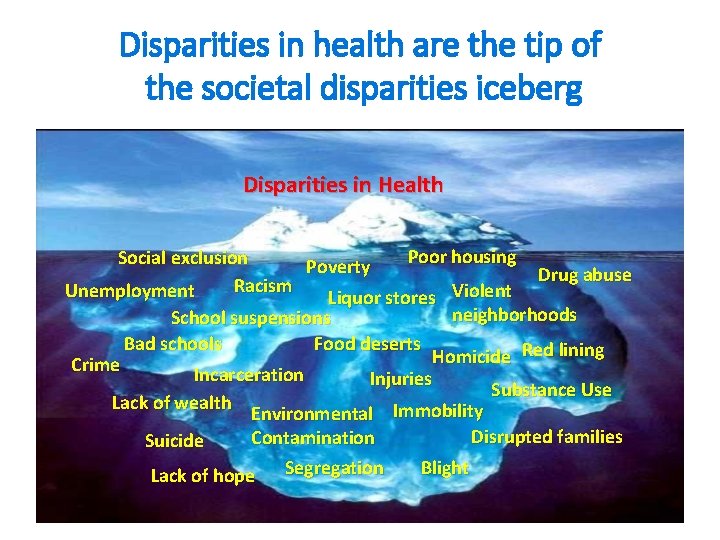
Disparities in health are the tip of the societal disparities iceberg Disparities in Health Poor housing Social exclusion Poverty Drug abuse Racism Unemployment Liquor stores Violent neighborhoods School suspensions Bad schools Food deserts Homicide Red lining Crime Incarceration Injuries Substance Use Lack of wealth Environmental Immobility Disrupted families Contamination Suicide Blight Lack of hope Segregation
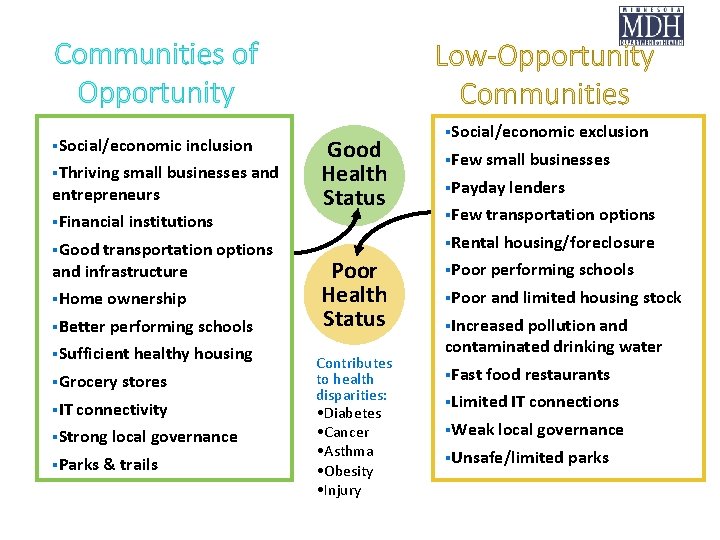
Communities of Opportunity §Social/economic inclusion §Thriving small businesses and entrepreneurs §Financial institutions §Good transportation options and infrastructure §Home ownership §Better performing schools §Sufficient healthy housing §Grocery stores §IT connectivity §Strong local governance §Parks & trails Good Health Status §Social/economic exclusion §Few small businesses §Payday lenders §Few transportation options §Rental housing/foreclosure Poor Health Status Contributes to health disparities: • Diabetes • Cancer • Asthma • Obesity • Injury §Poor performing schools §Poor and limited housing stock §Increased pollution and contaminated drinking water §Fast food restaurants §Limited IT connections §Weak local governance §Unsafe/limited parks
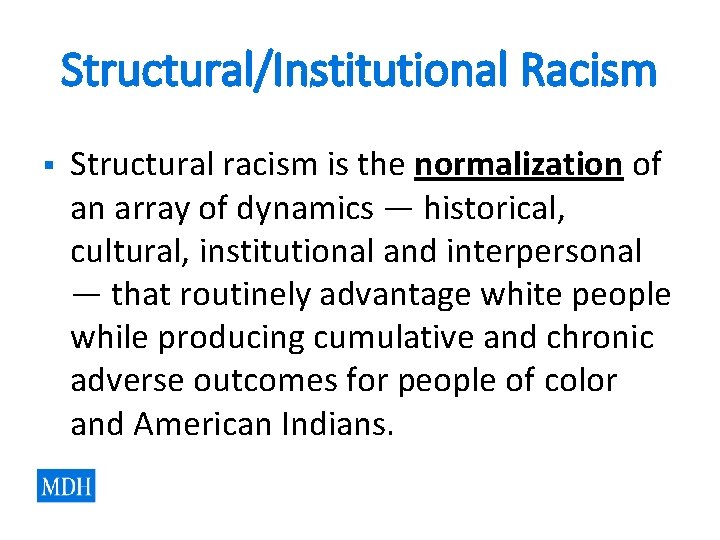
Structural/Institutional Racism § Structural racism is the normalization of an array of dynamics — historical, cultural, institutional and interpersonal — that routinely advantage white people while producing cumulative and chronic adverse outcomes for people of color and American Indians.
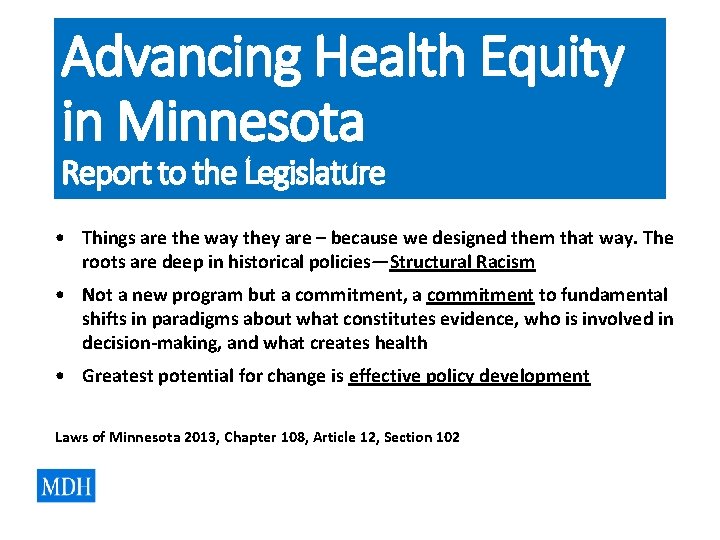
Advancing Health Equity in Minnesota Report to the Legislature • Things are the way they are – because we designed them that way. The roots are deep in historical policies—Structural Racism • Not a new program but a commitment, a commitment to fundamental shifts in paradigms about what constitutes evidence, who is involved in decision-making, and what creates health • Greatest potential for change is effective policy development Laws of Minnesota 2013, Chapter 108, Article 12, Section 102
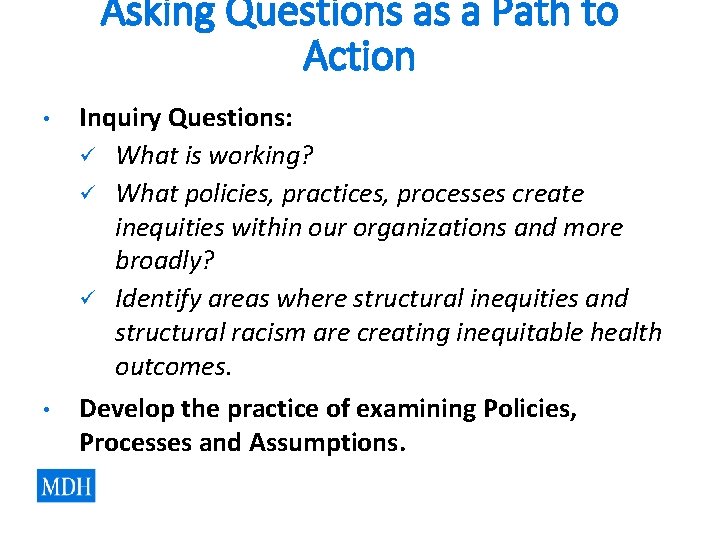
Asking Questions as a Path to Action • Inquiry Questions: ü What is working? ü What policies, practices, processes create inequities within our organizations and more broadly? ü Identify areas where structural inequities and structural racism are creating inequitable health outcomes. • Develop the practice of examining Policies, Processes and Assumptions.
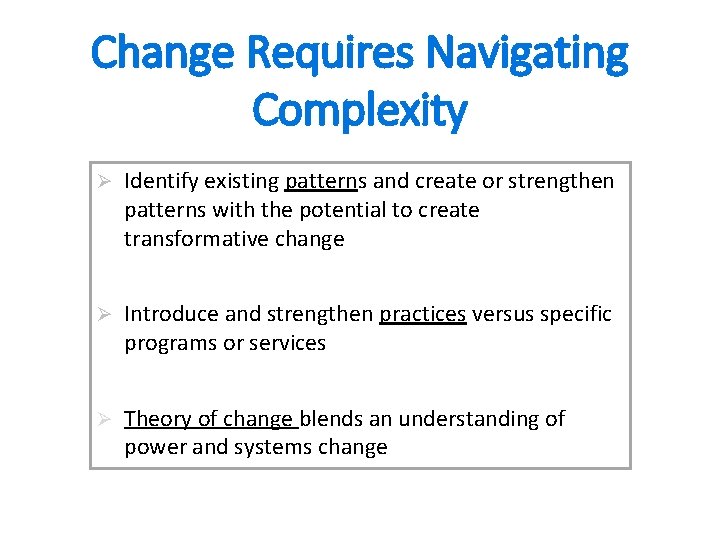
Change Requires Navigating Complexity Ø Identify existing patterns and create or strengthen patterns with the potential to create transformative change Ø Introduce and strengthen practices versus specific programs or services Ø Theory of change blends an understanding of power and systems change
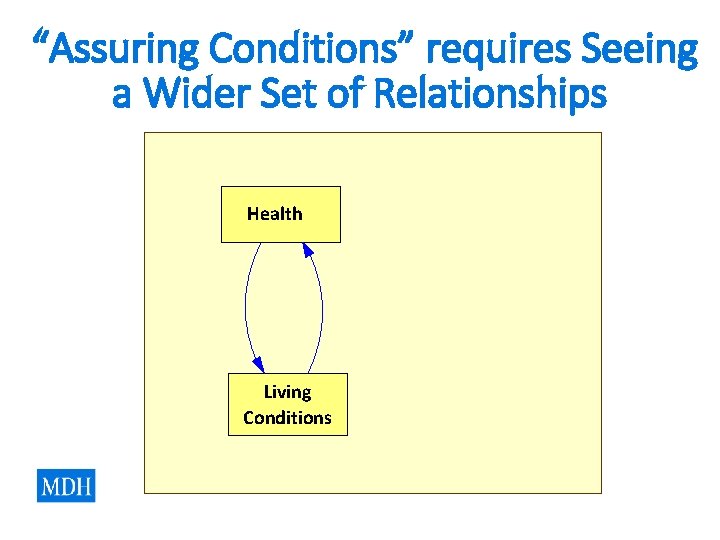
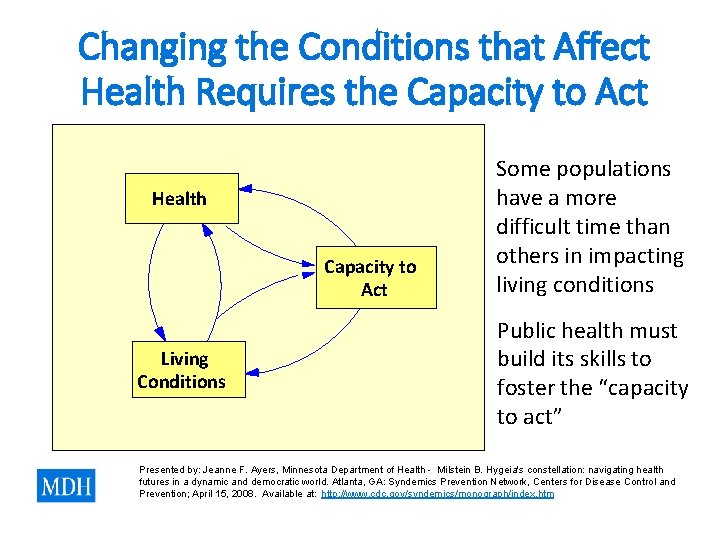
“Assuring Conditions” requires Seeing a Wider Set of Relationships Health Living Conditions
Social Determinants of Health § The conditions and circumstances in which people are born, grow, live, work, and age. These circumstances are shaped by a set of forces beyond the control of the individual: economics and the distribution of money, power, social policies, and politics at the global, national, state, and local levels. § WHO and CDC (adapted)
Changing the Conditions that Affect Health Requires the Capacity to Act Health Capacity to Act Living Conditions Some populations have a more difficult time than others in impacting living conditions Public health must build its skills to foster the “capacity to act” Presented by: Jeanne F. Ayers, Minnesota Department of Health - Milstein B. Hygeia's constellation: navigating health futures in a dynamic and democratic world. Atlanta, GA: Syndemics Prevention Network, Centers for Disease Control and Prevention; April 15, 2008. Available at: http: //www. cdc. gov/syndemics/monograph/index. htm
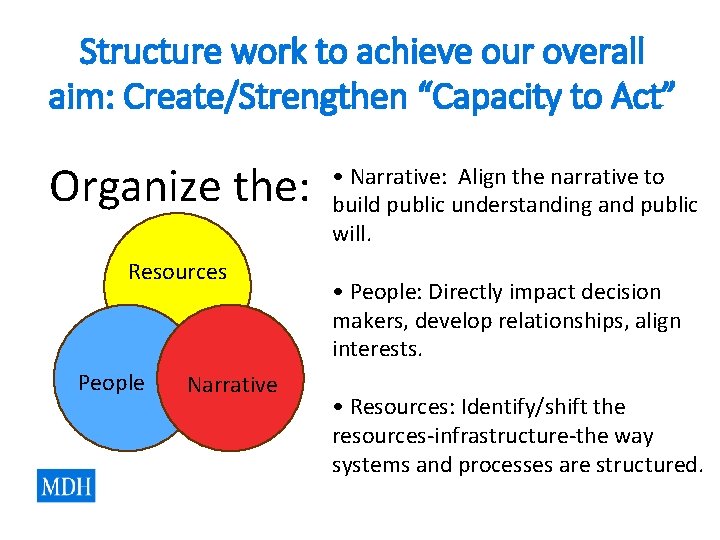
Structure work to achieve our overall aim: Create/Strengthen “Capacity to Act” Organize the: Resources People Narrative • Narrative: Align the narrative to build public understanding and public will. • People: Directly impact decision makers, develop relationships, align interests. • Resources: Identify/shift the resources-infrastructure-the way systems and processes are structured.
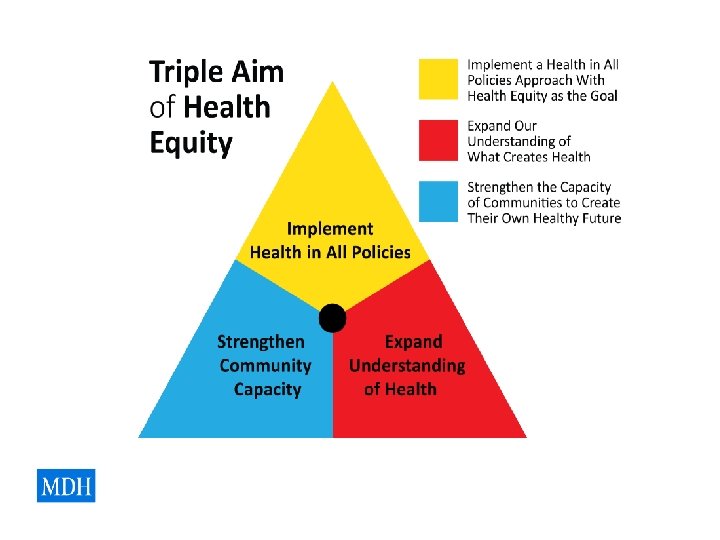
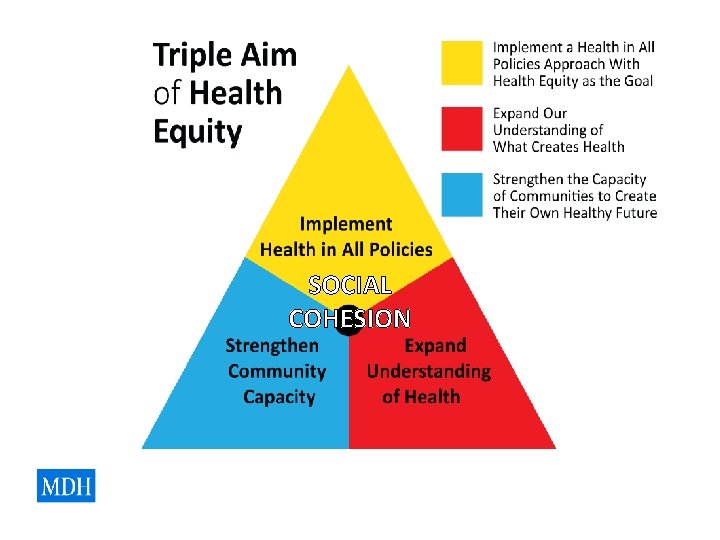
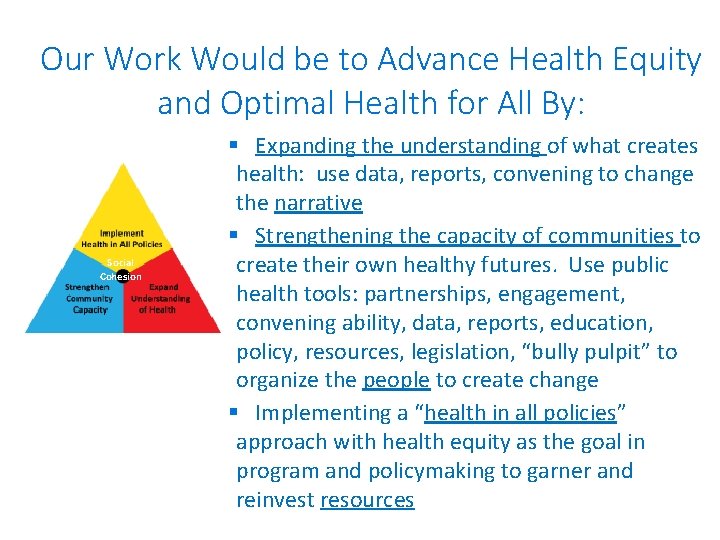
Foundational Practices to Advance Health Equity § § § Purposefully expand the understanding and conversation of what creates health to include the “opportunity for health” (organize narrative-knowledge) Strengthen the capacity of communities to create their own healthy futures. Use public health tools: partnerships, engagement, convening ability, data, reports, education, policy, resources, legislation, “bully pulpit” (organize people) Implement a “health in all policies” approach with health equity as the goal in program and policymaking (organize resources-and how systems work)
SOCIAL COHESION
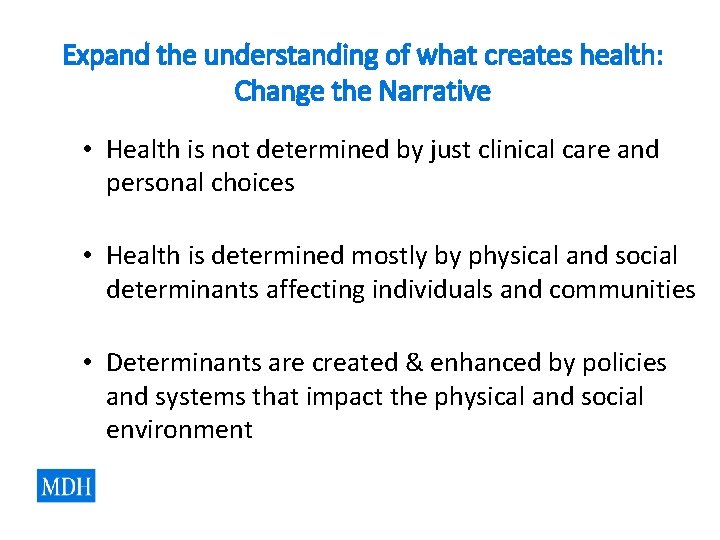
Expand the understanding of what creates health: Change the Narrative • Health is not determined by just clinical care and personal choices • Health is determined mostly by physical and social determinants affecting individuals and communities • Determinants are created & enhanced by policies and systems that impact the physical and social environment
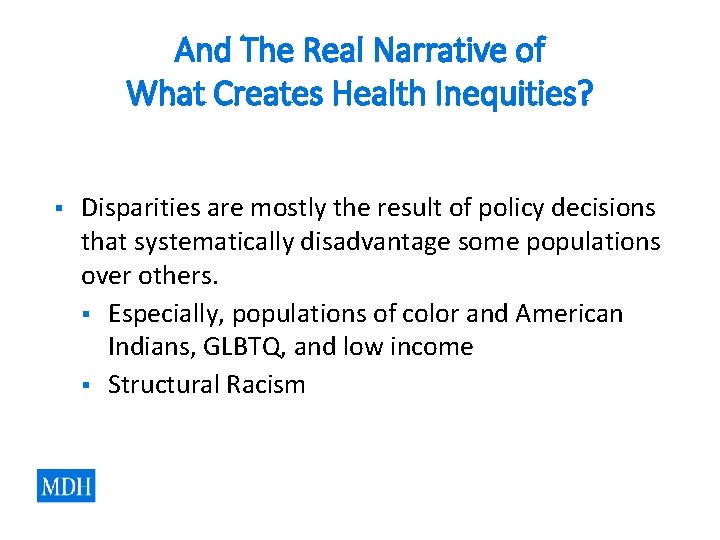
And The Real Narrative of What Creates Health Inequities? § Disparities are mostly the result of policy decisions that systematically disadvantage some populations over others. § Especially, populations of color and American Indians, GLBTQ, and low income § Structural Racism
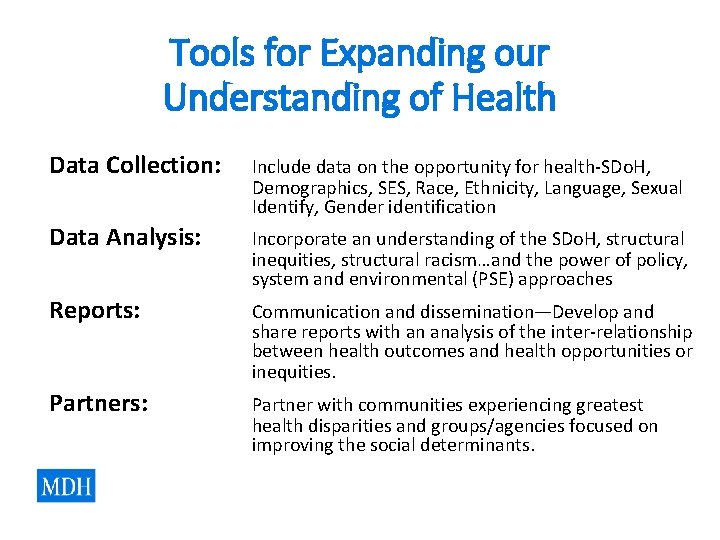
Tools for Expanding our Understanding of Health Data Collection: Include data on the opportunity for health-SDo. H, Demographics, SES, Race, Ethnicity, Language, Sexual Identify, Gender identification Data Analysis: Incorporate an understanding of the SDo. H, structural inequities, structural racism…and the power of policy, system and environmental (PSE) approaches Reports: Communication and dissemination—Develop and share reports with an analysis of the inter-relationship between health outcomes and health opportunities or inequities. Partners: Partner with communities experiencing greatest health disparities and groups/agencies focused on improving the social determinants.
Asking the Right Questions About Assumptions Can Help Change the Narrative § What values underlie the decision-making process? § What is assumed to be true about the world and the role of the institution in the world? § What standards of success are being applied at different decision points, and by whom?
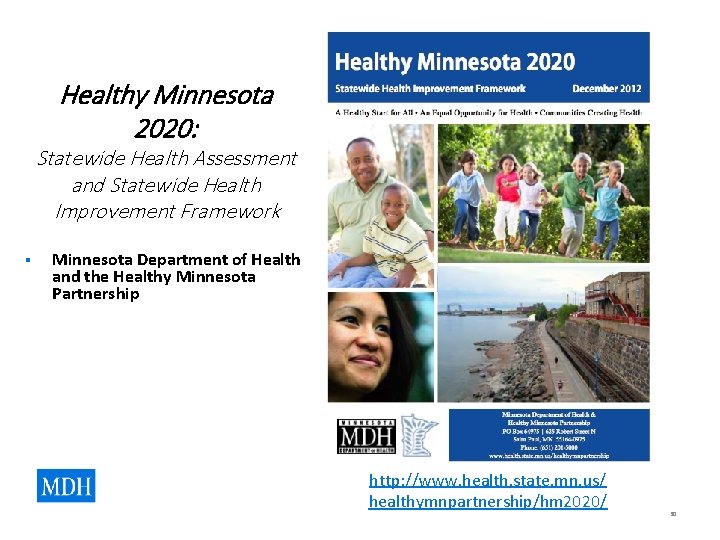
Healthy Minnesota 2020: Statewide Health Assessment and Statewide Health Improvement Framework § Minnesota Department of Health and the Healthy Minnesota Partnership http: //www. health. state. mn. us/ healthymnpartnership/hm 2020/ 30
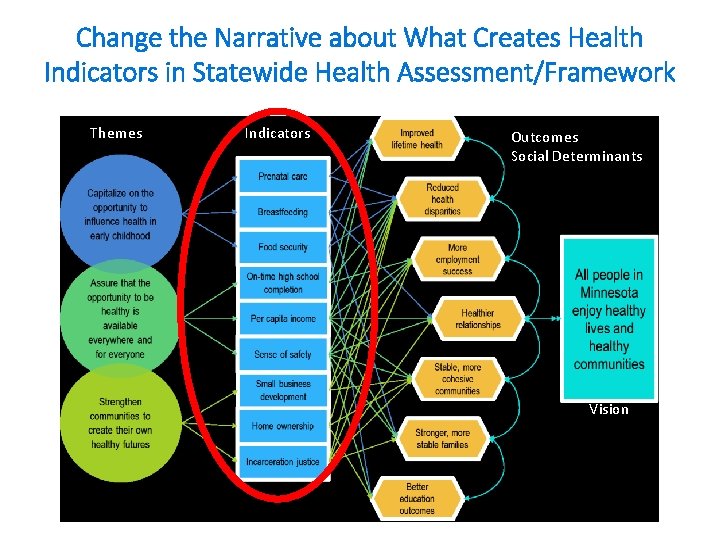
Change the Narrative about What Creates Health Indicators in Statewide Health Assessment/Framework Themes Indicators Outcomes Social Determinants Vision
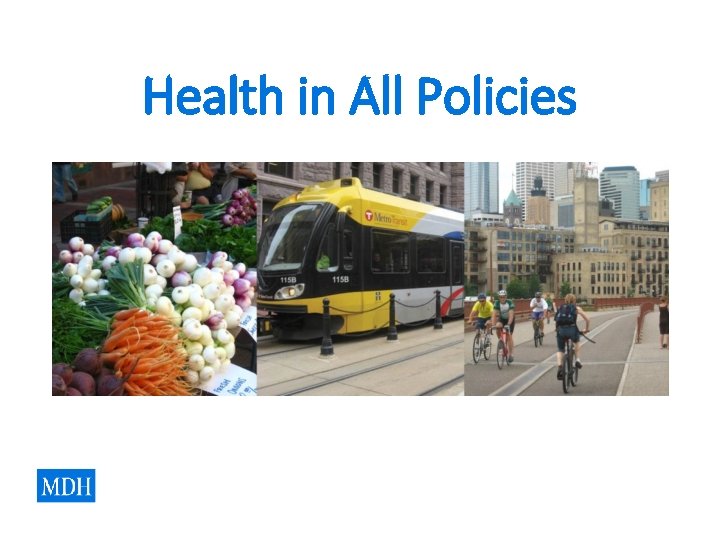
Health in All Policies
Implement Health In All Policies-Equity § Health in All Policies (HIAP) is a collaborative approach that integrates and articulates health considerations into policy making and programming across sectors, and at all levels, to improve the health of all communities and people. § § HIAP requires practitioners in all sectors to collaborate to define and achieve mutually beneficial goals. Hi. AP—with Equity as the Aim.
Tools in Health in All Policies Approach § Data § Reports § Internal Policy Alignment § White Papers § Health Notes § Health Impact Assessments § Community Engagement--partners § Asking Questions
Health in all Policies: Questions to ask to advance health equity § § § What do we know about who will benefit? What health impacts can we anticipate? Who will experience these impacts? What and whose values, beliefs and assumptions are guiding or influencing the decision? What do we know about impact(outcome) versus intent of the policy? Would the issue/policy benefit from further study or a health impact assessment(HIA)?
Policy and System Changes Related to Social Determinants of Health (selected) § Income-Minimum Wage § State and Foundation Grant-making § Paid Leave – Family and Sick § Minnesota Food Charter § State and Federal Transportation Policy § § REL(D) data State Agency Policy Changes § CHW-MA manual, Training-SHIP § Governor’s initiatives § Broadband connectivity § § E-Health Policies § Ban the Box-Sentencing reforms § Bullying—School Discipline policies Others – depending on the opportunities § Data § Community energy § Partnerships
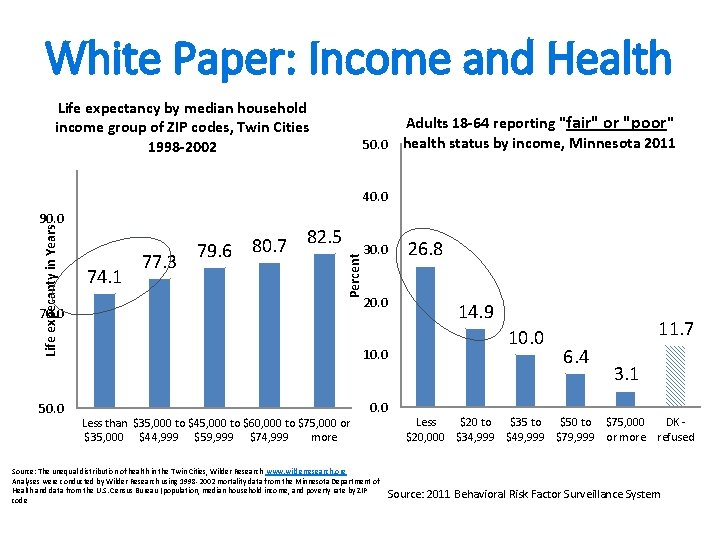
White Paper: Income and Health Life expectancy by median household income group of ZIP codes, Twin Cities 1998 -2002 Adults 18 -64 reporting "fair" or "poor" 50. 0 health status by income, Minnesota 2011 Life expecanty in Years 90. 0 74. 1 77. 3 82. 5 80. 7 79. 6 Percent 40. 0 70. 0 50. 0 30. 0 20. 0 10. 0 Less than $35, 000 to $45, 000 to $60, 000 to $75, 000 or $35, 000 $44, 999 $59, 999 $74, 999 more 0. 0 Source: The unequal distribution of health in the Twin Cities, Wilder Research www. wilderresearch. org Analyses were conducted by Wilder Research using 1998 -2002 mortality data from the Minnesota Department of Health and data from the U. S. Census Bureau (population, median household income, and poverty rate by ZIP code 26. 8 14. 9 10. 0 11. 7 6. 4 3. 1 Less $20 to $35 to $50 to $75, 000 DK $20, 000 $34, 999 $49, 999 $79, 999 or more refused Source: 2011 Behavioral Risk Factor Surveillance System
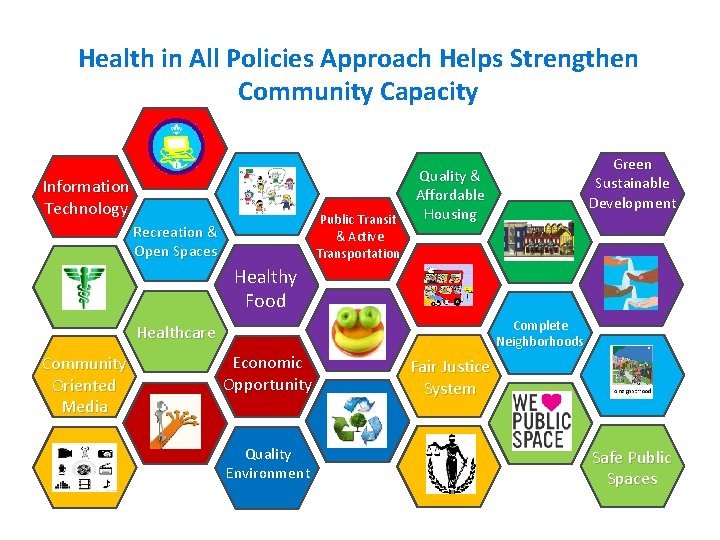
Health in All Policies Approach Helps Strengthen Community Capacity Information Technology Public Transit & Active Transportation Recreation & Open Spaces Green Sustainable Development Quality & Affordable Housing Healthy Food Complete Neighborhoods Healthcare Community Oriented Media Economic Opportunity Quality Environment Fair Justice System Safe Public Spaces
Strengthen Community Capacity to achieve our overall aim § Our efforts to broaden and shift our relationships with community organizations is rooted in our understanding of the limitations of our traditional approaches § How do we transform the “distribution of money, power, social policies, and politics at all levels to assure the conditions for health are available to all? § Assess our skills and intentionally build our internal capacityrace, power, assets, differences, similarities § Tension and partnership work together
Tool Kit for Strengthening the Capacity of Communities § Community engagement plan § Stakeholder identification including interests § Community governance models § Advisory and Community Leadership Teams § Community input on grant criteria § Community benefit accountability § Participatory Budgeting § Set of questions
Asking the right questions helps strengthen community capacity to create their own healthy future § Who is at the decision-making table, and who is not? § Who has the power at the table? § How should the decision-making table be set, and who should set it? § Who is being held accountable and to whom or what are they accountable?
Overall Lessons § Organic – must be interwoven with all other workrecognize it is iterative § Must be intentional § Commitment: Requires commitment to building our organizational and community capacity --skills Leadership – Hold our selves and each other accountable-bring more people into decision-making § § Imperfect-incomplete work--navigating toward health equity -- permission to make course corrections
Asking the Right Questions Is a Path to Action for Change § What would it look like if equity was the starting point for decision-making? § Our work would be different.
Our Work Would be to Advance Health Equity and Optimal Health for All By: Social Cohesion § Expanding the understanding of what creates health: use data, reports, convening to change the narrative § Strengthening the capacity of communities to create their own healthy futures. Use public health tools: partnerships, engagement, convening ability, data, reports, education, policy, resources, legislation, “bully pulpit” to organize the people to create change § Implementing a “health in all policies” approach with health equity as the goal in program and policymaking to garner and reinvest resources
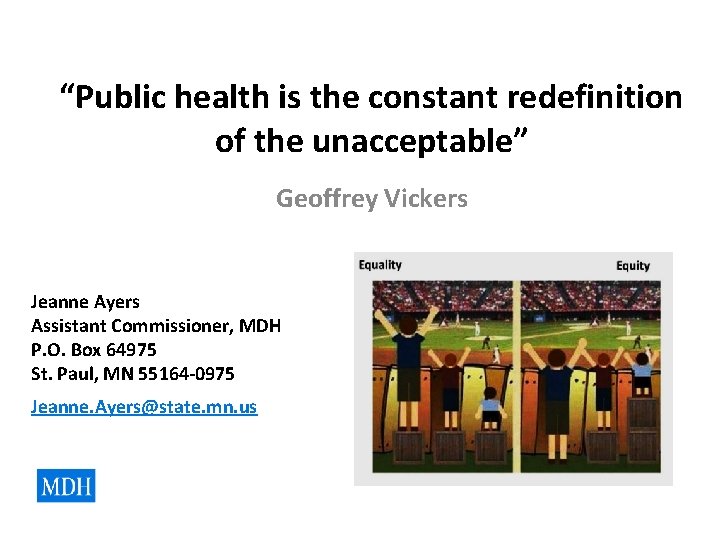
“Public health is the constant redefinition of the unacceptable” Geoffrey Vickers Jeanne Ayers Assistant Commissioner, MDH P. O. Box 64975 St. Paul, MN 55164 -0975 Jeanne. Ayers@state. mn. us
Links to Referenced Reports § The Health of Minnesota: Statewide Health Assessment: http: //www. health. state. mn. us/healthymnpartnership/sha/ § Healthy Minnesota 2020: Statewide Health Improvement Framework: http: //www. health. state. mn. us/healthymnpartnership/hm 2020/#fw § Advancing Health Equity: Report to the Legislature Report: http: //www. health. state. mn. us/divs/chs/healthequity/index. htm § White Paper on Income and Health: http: //www. health. state. mn. us/divs/opa/2014 incomeandhealth. pdf
Links to Referenced Reports § White Paper on Paid Leave and Health http: // www. health. state. mn. us/news/2015 paidleave. pdf § MDH 2015 -2019 Strategic Plan and Community Engagement Plan § http: //www. health. state. mn. us/about/strategicplan. pdf § http: //www. health. state. mn. us/divs/opi/community/plan/docs/ce plan_2016 -2019_draft. pdf § http: //www. health. state. mn. us/divs/opi/community/plan/docs/ce workplan_2016_draft. pdf
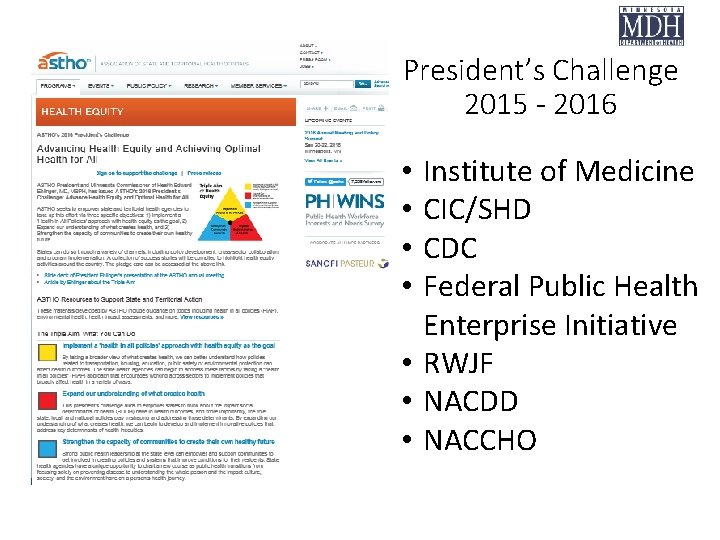
Links to Referenced Reports § Association of State and Territorial Health Officers (ASTHO) http: //www. astho. org/Programs/Health. Equity/ § ASTHO-Dr Ehlinger’s President’s Challenge: http: //www. astho. org/Health-Equity/2016 -Challenge/ § Big 10 Committee on Institutional Cooperation Health Equity Initiative: https: //www. cic. net/projects/healthequity-initiative
President’s Challenge 2015 - 2016 Institute of Medicine CIC/SHD CDC Federal Public Health Enterprise Initiative • RWJF • NACDD • NACCHO • •