
Health Emergency Response Data System HERDS NY State

- Slides: 25
Health Emergency Response Data System (HERDS) NY State Health Commerce Enterprise-wide Integrated Information Systems Public Health Preparedness, Planning, Response
HERDS operates within the NY State Health Commerce System (HCS) A Secure, Standards-based , Integrated Infrastructure for Enterprise-wide Health Information Interchange.
NY State Health Commerce System(HCS) • Operational Since 1995 • Web Based and Accessible via the Internet • Requires Id and Password • An integrated architecture supporting a wide array of information exchange applications health –Routine Information interchange – Preparedness and response. Examples • Disease surveillance and Lab reporting • Health Alerting • Volunteer data base • HERDS ( Health Care preparedness and Response ) • Used by ALL local health departments, health facilities, health providers and practitioners.
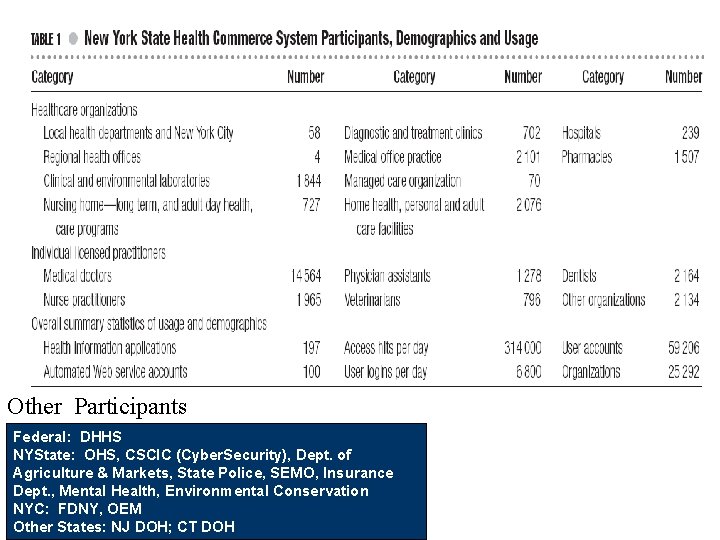
Other Participants Federal: DHHS NYState: OHS, CSCIC (Cyber. Security), Dept. of Agriculture & Markets, State Police, SEMO, Insurance Dept. , Mental Health, Environmental Conservation NYC: FDNY, OEM Other States: NJ DOH; CT DOH
A Natural Platform for Public Health Preparedness üLeverages Existing Infrastructure • Security • Availability • Identity Management and Access control • Application Development Environment • Core Integration Applications üLeverages Existing Presence of Needed Partners on HCS üPresents common user interface and identification system to users üOne stop shopping for data and data reporting üPresents opportunity for integration of data systems
HERDS Evolved in Response to Information issues during 911 and Anthrax Letter Attacks. • • • Developed: at the request of Greater NY Hospital Association and Emergency Planning Coordination Counsel. Issues: Health care deluged with information requests during the events. o Competing, conflicting and disparate requests from multiple sources (Federal Agencies, Law Enforcement, State/local health, media/Press) o No formal process existed for collecting information o Multiple requests were disruptive to providers’ and State’s response to event o No clear authority for collection and dissemination of data Requires: centralized integrated system maintained by State Health Regulatory Authority for monitoring and reporting of facility resource information: available and needed for response or capacity planning. Resource needs for events can vary significantly with type of event and change as event evolves.
Post 9/11 Response (2001 -2002) Define Requirements from Ground-upwards • • Coordination by Greater NY Hospital Association Establish Emergency Preparedness Coordinating Council (EPCC) Regional planning and response (NY, NJ, CT) – Establish ongoing dialogue: meetings, briefings, and drills – Establish Framework for communicating regarding emergencies, alerts, advisories, and protocols EPCC composition: – Providers of all types (hospitals, nursing homes, home care, physician organizations) – Local, state, and federal agencies (health, emergency management, and law enforcement)
EPCC Outcome Mandate for A Statewide Health Emergency Response Data System • Develop system to meet information exchange needs based on 9/11 and extend to Public Health Events in general – Facility resources, surge – Event-related visits – Event Patient locator/tracking system • Goals: – Develop agreed-upon needs for the data system – Protect confidential, Competitive and proprietary data: Use Central authoritative source: State Health Department Regulatory authority – Use Existing Infrastructure
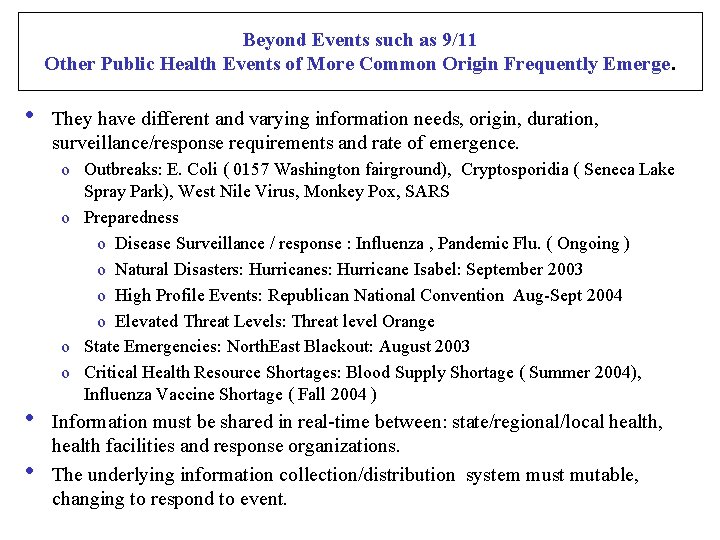
Beyond Events such as 9/11 Other Public Health Events of More Common Origin Frequently Emerge. • • • They have different and varying information needs, origin, duration, surveillance/response requirements and rate of emergence. o Outbreaks: E. Coli ( 0157 Washington fairground), Cryptosporidia ( Seneca Lake Spray Park), West Nile Virus, Monkey Pox, SARS o Preparedness o Disease Surveillance / response : Influenza , Pandemic Flu. ( Ongoing ) o Natural Disasters: Hurricane Isabel: September 2003 o High Profile Events: Republican National Convention Aug-Sept 2004 o Elevated Threat Levels: Threat level Orange o State Emergencies: North. East Blackout: August 2003 o Critical Health Resource Shortages: Blood Supply Shortage ( Summer 2004), Influenza Vaccine Shortage ( Fall 2004 ) Information must be shared in real-time between: state/regional/local health, health facilities and response organizations. The underlying information collection/distribution system must mutable, changing to respond to event.
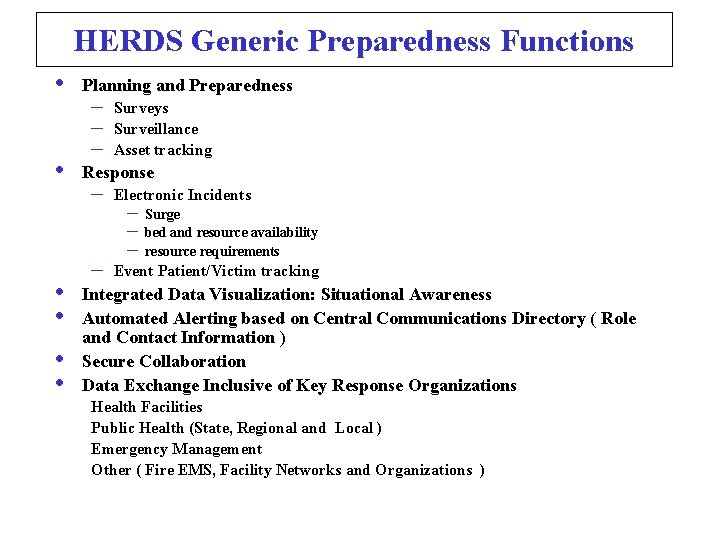
HERDS Generic Preparedness Functions • • • Planning and Preparedness – – – Surveys Surveillance Asset tracking Response – – Electronic Incidents – – – Surge bed and resource availability resource requirements Event Patient/Victim tracking Integrated Data Visualization: Situational Awareness Automated Alerting based on Central Communications Directory ( Role and Contact Information ) Secure Collaboration Data Exchange Inclusive of Key Response Organizations Health Facilities Public Health (State, Regional and Local ) Emergency Management Other ( Fire EMS, Facility Networks and Organizations )
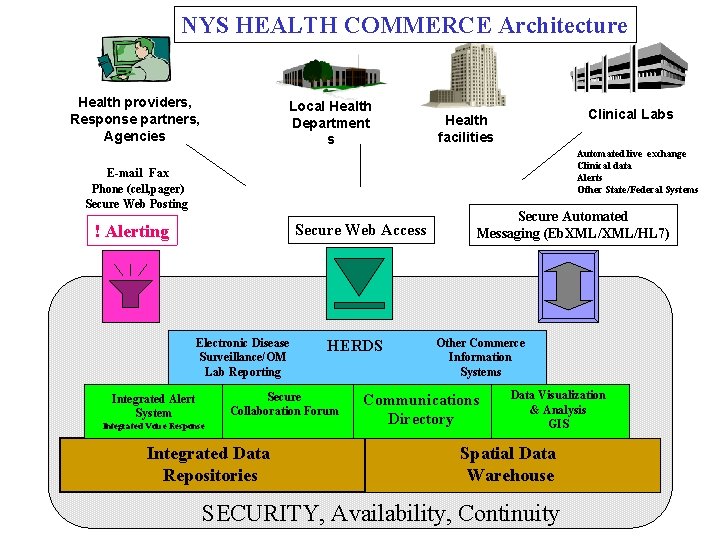
NYS HEALTH COMMERCE Architecture Health providers, Response partners, Agencies Local Health Department s Clinical Labs Health facilities Automated live exchange Clinical data Alerts Other State/Federal Systems E-mail Fax Phone (cell, pager) Secure Web Posting Secure Web Access ! Alerting Electronic Disease Surveillance/OM Lab Reporting HERDS Secure Collaboration Forum Integrated Alert System Integrated Voice Response Integrated Data Repositories Secure Automated Messaging (Eb. XML/HL 7) Other Commerce Information Systems Communications Directory Data Visualization & Analysis GIS Spatial Data Warehouse SECURITY, Availability, Continuity
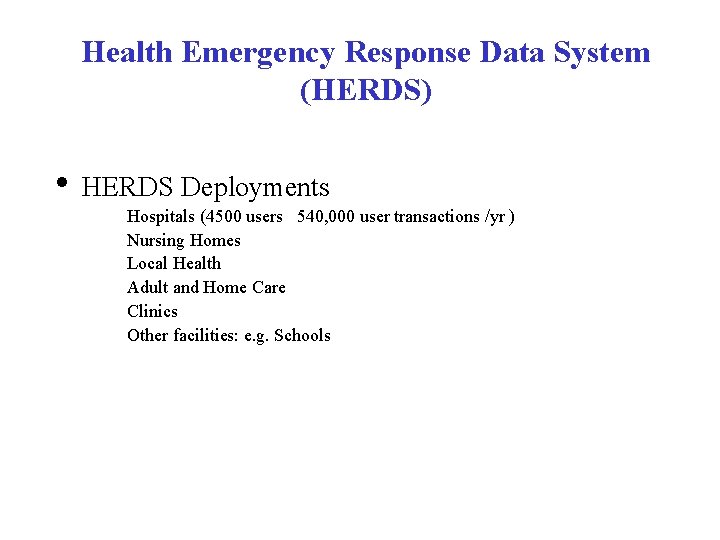
Health Emergency Response Data System (HERDS) • HERDS Deployments Hospitals (4500 users 540, 000 user transactions /yr ) Nursing Homes Local Health Adult and Home Care Clinics Other facilities: e. g. Schools
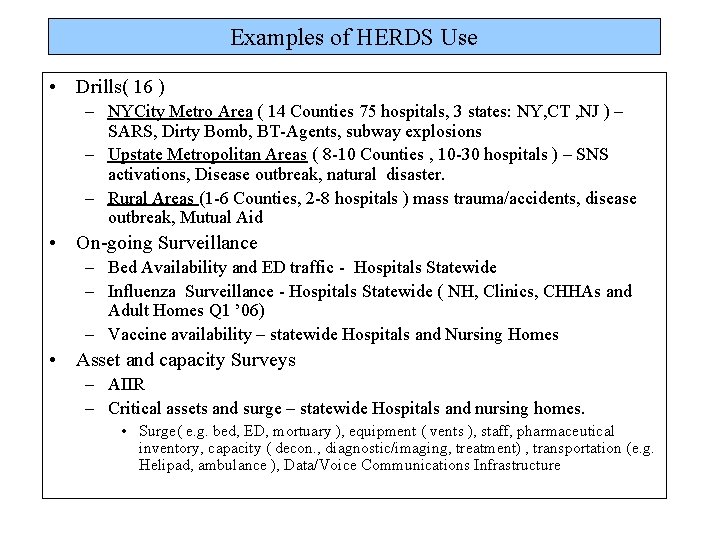
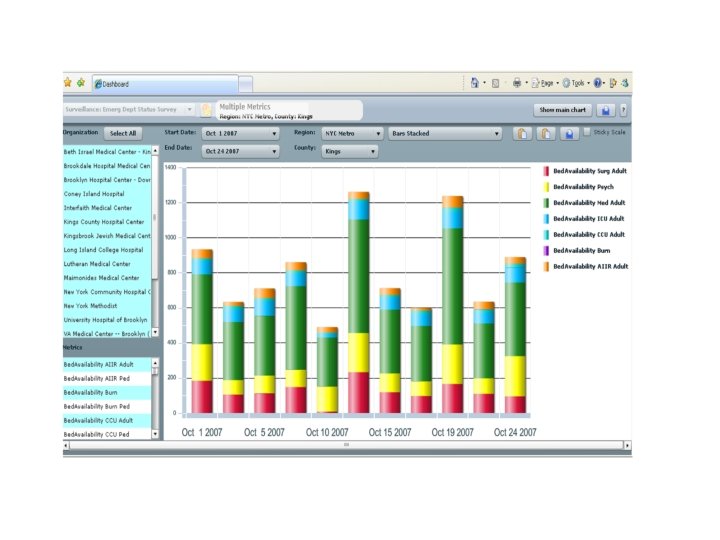
Examples of HERDS Use • Drills( 16 ) – NYCity Metro Area ( 14 Counties 75 hospitals, 3 states: NY, CT , NJ ) – SARS, Dirty Bomb, BT-Agents, subway explosions – Upstate Metropolitan Areas ( 8 -10 Counties , 10 -30 hospitals ) – SNS activations, Disease outbreak, natural disaster. – Rural Areas (1 -6 Counties, 2 -8 hospitals ) mass trauma/accidents, disease outbreak, Mutual Aid • On-going Surveillance – Bed Availability and ED traffic - Hospitals Statewide – Influenza Surveillance - Hospitals Statewide ( NH, Clinics, CHHAs and Adult Homes Q 1 ’ 06) – Vaccine availability – statewide Hospitals and Nursing Homes • Asset and capacity Surveys – AIIR – Critical assets and surge – statewide Hospitals and nursing homes. • Surge( e. g. bed, ED, mortuary ), equipment ( vents ), staff, pharmaceutical inventory, capacity ( decon. , diagnostic/imaging, treatment) , transportation (e. g. Helipad, ambulance ), Data/Voice Communications Infrastructure
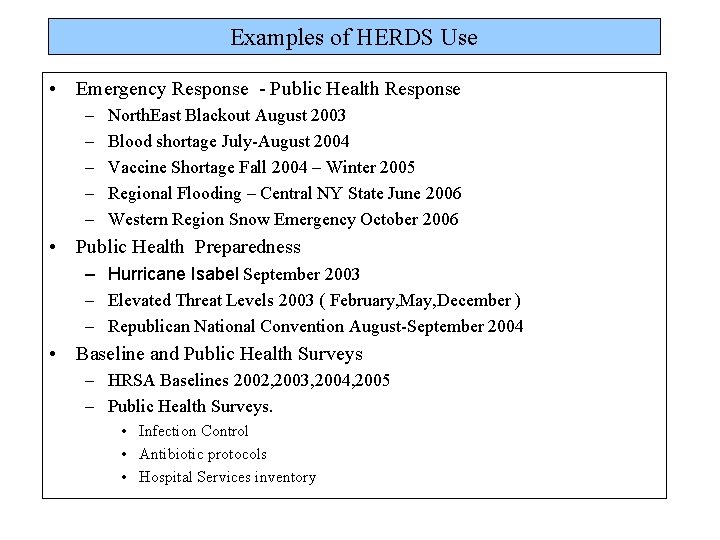
Examples of HERDS Use • Emergency Response - Public Health Response – – – North. East Blackout August 2003 Blood shortage July-August 2004 Vaccine Shortage Fall 2004 – Winter 2005 Regional Flooding – Central NY State June 2006 Western Region Snow Emergency October 2006 • Public Health Preparedness – Hurricane Isabel September 2003 – Elevated Threat Levels 2003 ( February, May, December ) – Republican National Convention August-September 2004 • Baseline and Public Health Surveys – HRSA Baselines 2002, 2003, 2004, 2005 – Public Health Surveys. • Infection Control • Antibiotic protocols • Hospital Services inventory
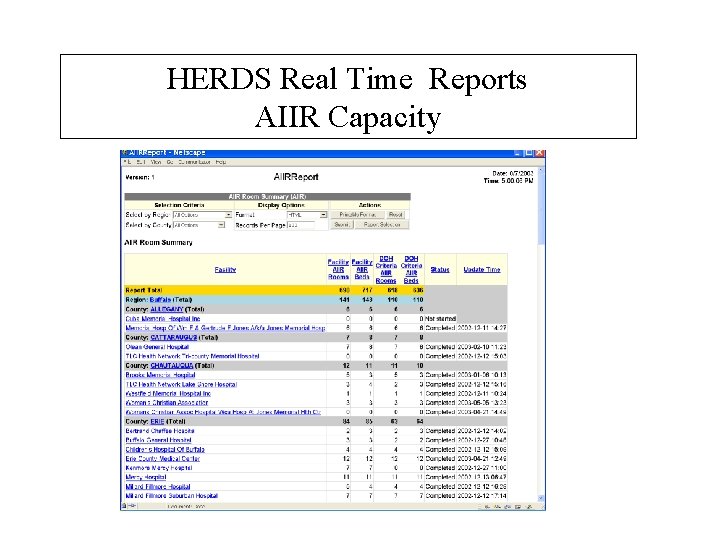
HERDS Real Time Reports AIIR Capacity
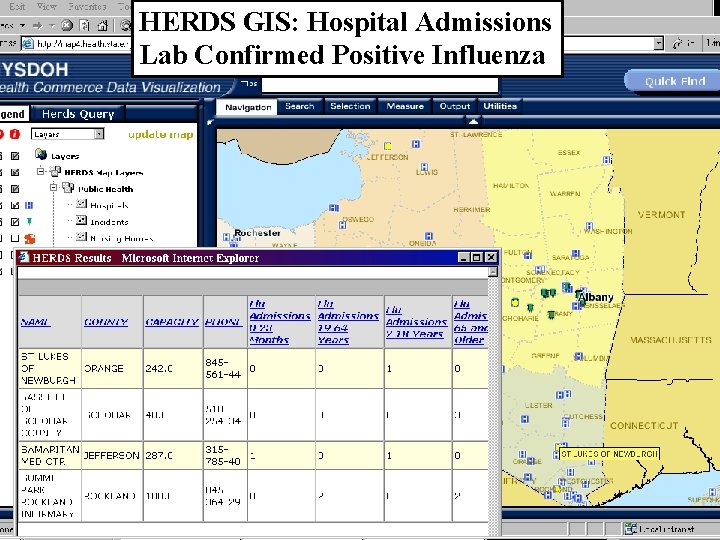
HERDS GIS: Hospital Admissions Lab Confirmed Positive Influenza
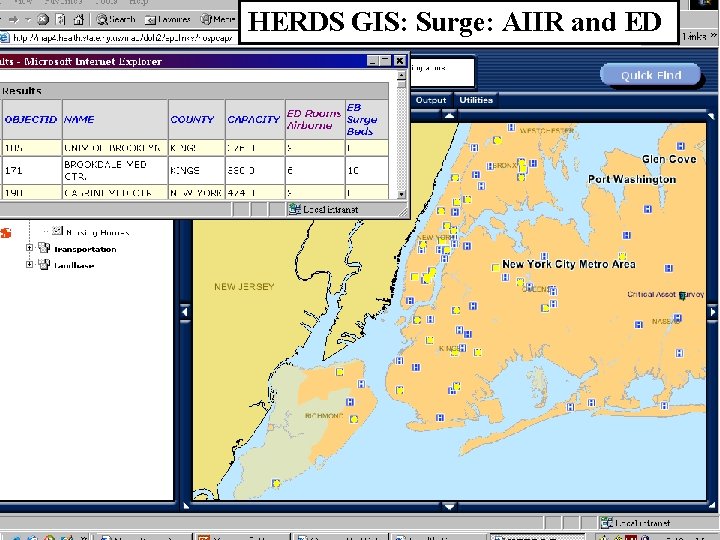
HERDS GIS: Surge: AIIR and ED
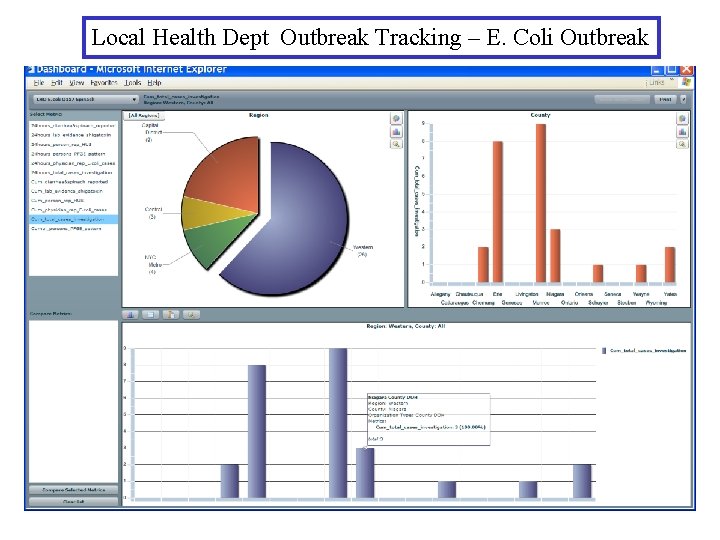
Local Health Dept Outbreak Tracking – E. Coli Outbreak
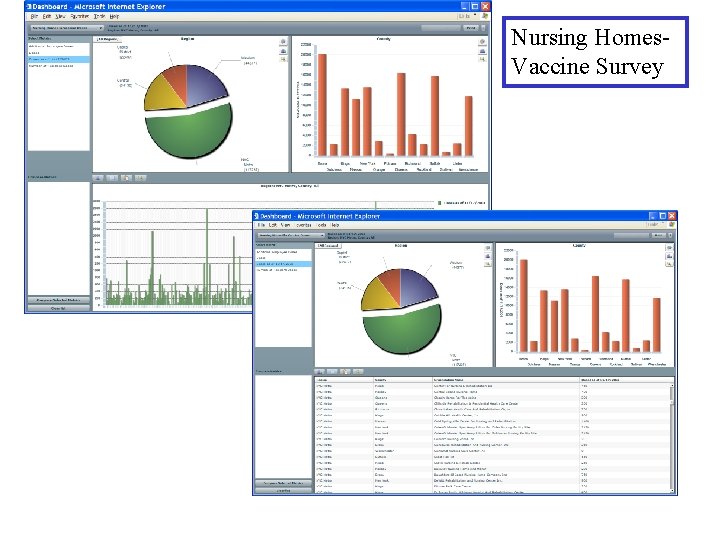
Nursing Homes- Vaccine Survey
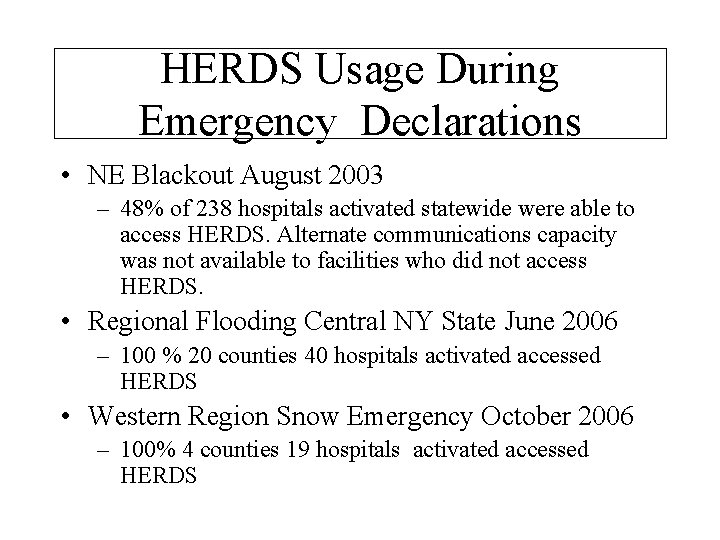
HERDS Usage During Emergency Declarations • NE Blackout August 2003 – 48% of 238 hospitals activated statewide were able to access HERDS. Alternate communications capacity was not available to facilities who did not access HERDS. • Regional Flooding Central NY State June 2006 – 100 % 20 counties 40 hospitals activated accessed HERDS • Western Region Snow Emergency October 2006 – 100% 4 counties 19 hospitals activated accessed HERDS
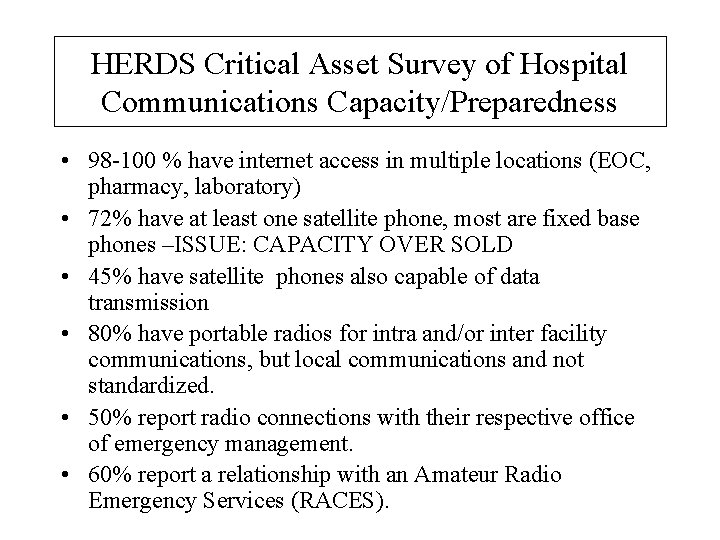
HERDS Critical Asset Survey of Hospital Communications Capacity/Preparedness • 98 -100 % have internet access in multiple locations (EOC, pharmacy, laboratory) • 72% have at least one satellite phone, most are fixed base phones –ISSUE: CAPACITY OVER SOLD • 45% have satellite phones also capable of data transmission • 80% have portable radios for intra and/or inter facility communications, but local communications and not standardized. • 50% report radio connections with their respective office of emergency management. • 60% report a relationship with an Amateur Radio Emergency Services (RACES).
Statement of the problem • Sophisticated electronic Public Health preparedness and response systems are evolving at the state and local level: designed to establish exchange of critical data between response partners. • The response systems are used in emergencies and their effectiveness is dependent on efficient and timely accessibility by all health response partners ( state and local health, health facilities, etc. ) • Access to data or information exchange resources needed for clinical care for both victims affected by the event and health consumers within the affected health care region are also dependent on continuity and availability of communications infrastructure during the event. • All critical health functions are therefore dependent on the very communications infrastructure( voice, data, video) that would be subject to outage/disruption due to the emergency event itself. • During an event the outage/disruption could be due to – Physical damage related to the event – Surge due to usage during the event – Reallocation of communications resources to other sectors via national or regional ICS decisions.
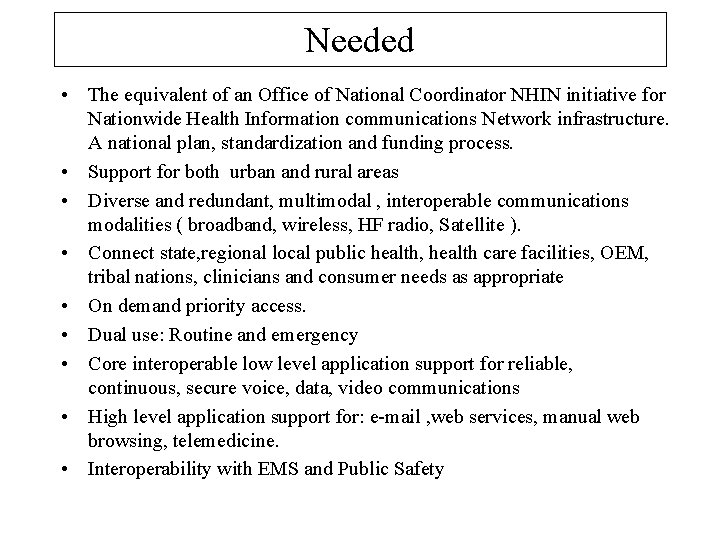
Needed • The equivalent of an Office of National Coordinator NHIN initiative for Nationwide Health Information communications Network infrastructure. A national plan, standardization and funding process. • Support for both urban and rural areas • Diverse and redundant, multimodal , interoperable communications modalities ( broadband, wireless, HF radio, Satellite ). • Connect state, regional local public health, health care facilities, OEM, tribal nations, clinicians and consumer needs as appropriate • On demand priority access. • Dual use: Routine and emergency • Core interoperable low level application support for reliable, continuous, secure voice, data, video communications • High level application support for: e-mail , web services, manual web browsing, telemedicine. • Interoperability with EMS and Public Safety
References and Background • • • Gotham I, Sottolano D, Hennessy M, et al. An Integrated Information System for All Hazards Health Preparedness and Response. NY State Health Emergency Response Data System (HERDS). J Public Health Management Practice, 2007, 13(5), 486– 496 Gotham I, Eidson M, White D, et al. West Nile Virus: A Case Study in How NY State Health Information Infrastructure Facilitates Preparation and Response to Disease Outbreaks. Journal of Public Health Management Practice. 2001, 7(5): 75 -86. Gotham I, Smith P, Birkhead G, Davisson M. Policy Issues in Developing Information Systems for Public Health Surveillance of Communicable Diseases. In: O’Carroll P, Yasnoff W, Ward E, Ripp L, and Martin E, editors. Public Health Informatics and Information Systems. New York: Springer-Verlag; 2003: 537 -73.