
Health Education Assessment Project Developing Performance Tasks Objectives
Health Education Assessment Project Developing Performance Tasks
Objectives • Define performance tasks (PTs). • Describe characteristics of PTs. • Address considerations in developing PTs. • Identify steps in developing PTs. • Describe scoring criteria.
Overall Goal: Health Literacy Health literacy is the capacity of an individual to obtain, interpret, and understand basic health information and services and the competence to use such information and services in ways that enhance health. Joint Committee on Health Education Standards
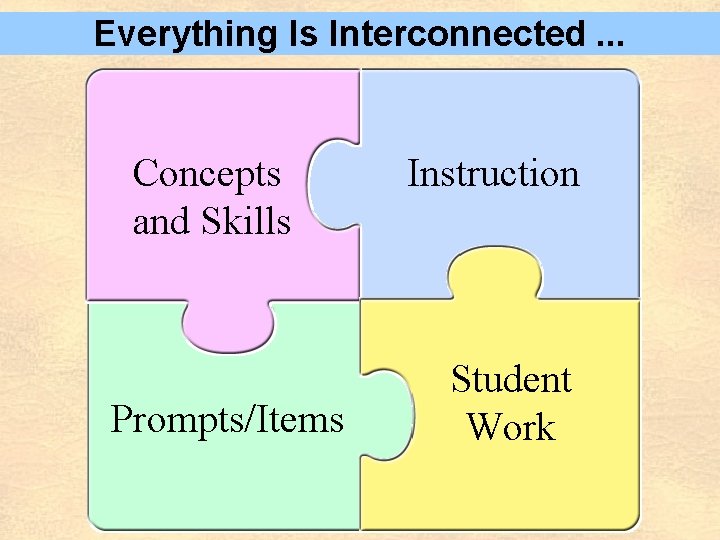
Everything Is Interconnected. . . Concepts and Skills Prompts/Items Instruction Student Work
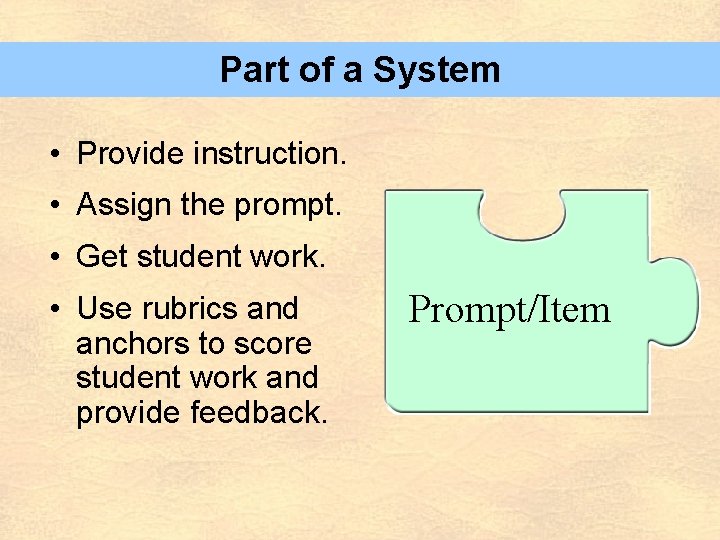
Part of a System • Provide instruction. • Assign the prompt. • Get student work. • Use rubrics and anchors to score student work and provide feedback. Prompt/Item
What Is a Performance Task? It is an assignment or set of directions that ask students to undertake a task— or series of tasks—to demonstrate proficiency in health knowledge (content) and health skills.
What Is a Performance Task? (continued) • an activity that may be completed outside of class and over time • an activity that is embedded in the curriculum

What Is the Purpose of Performance Tasks? For Teachers. . . • to ensure students develop lifelong health skills, rather than merely learn health education facts • to develop learning opportunities that address both content and skills • to assess what students know and what they can do
What Is the Purpose of Performance Tasks? For students. . . • to give all students—regardless of their learning style—opportunities to show what they know and can do • to help students develop self-direction and take responsibility for their own learning • to provide learning experiences that are engaging, interactive, and fun
Examples of Activities in Performance Tasks • • developing a photo essay rewriting a tale role-playing producing a brochure or poster • creating a fitness calendar
Why Use Performance Tasks?
Elements of Performance Tasks • context of the situation • problem or problems to be addressed • criteria or standards by which students will be evaluated
Characteristics of Good Performance Tasks Good performance tasks: • emphasize important skills and concepts • link to classroom instruction • engage students • are developmentally appropriate for the grade level
Characteristics of Good Performance Tasks (continued) Good performance tasks: • may be completed over multiple class periods or outside of class • may provide the option to work in groups • can be scored on two 4 -point scales (one for content, one for skills)
Before You Begin Take into consideration: • who will score it • how it will be scored • where the product will be scored

Steps for Developing Performance Tasks 1. Specify the health concepts and skills students need to acquire. 2. Tie the topic and skill to students’ interests, their everyday lives, or the world around them.
Steps for Developing Performance Tasks (continued) 3. Provide project options from which students can choose. 4. Identify the criteria you will use—for both content and skills—to assess students’ work.
Example of a Good Performance Task Elements: • overview • requirements • time • materials • instruction • assessment criteria

How Do You “Grade” Performance Tasks?
What Is a Rubric? A rubric is a set of criteria for directing student performance and for scoring performance-based assessments.
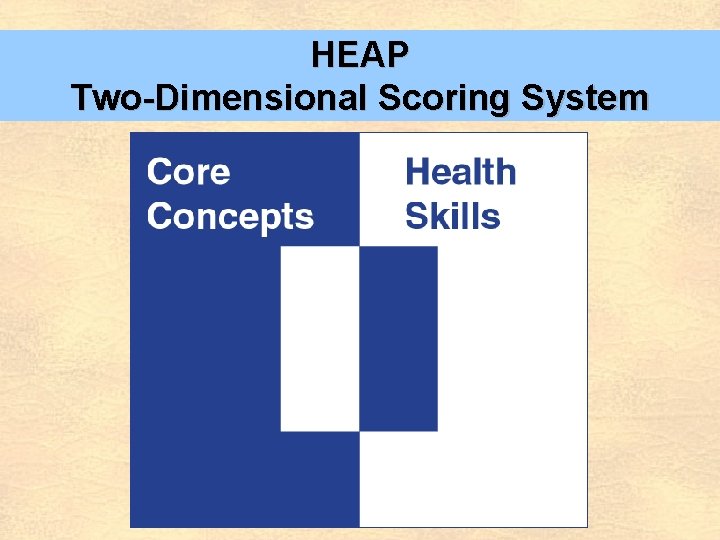
HEAP Two-Dimensional Scoring System
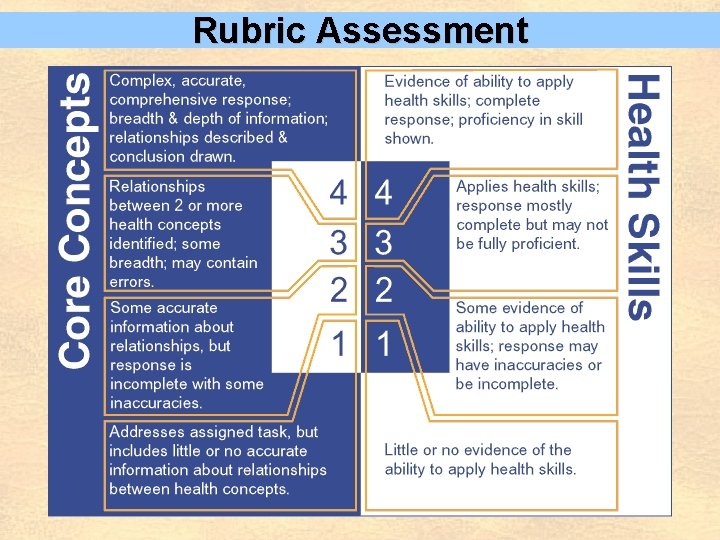
Rubric Assessment
Scoring Criteria • What content information will be used to evaluate students’ acquisition of health knowledge? • How will students demonstrate the skill asked for in the performance task? – What skill cues (criteria) will be used to assess proficiency?

Content Scores Based on a student’s ability to show: • accuracy • comprehensiveness • relationships among concepts • conclusions drawn
Skill Scores Based on a student’s ability to demonstrate proficiency in a health skill: • Analyzing Influences • Accessing Information • Interpersonal Communication • Decision Making • Goal Setting • Self Management • Advocacy
Checklist for Scoring Criteria ___ Have the scoring criteria been identified for both content and skills? ___ Is the language for the criteria clear, consistent, and unambiguous? ___ Do the criteria focus on the student’s response and not on the student’s values?
Homework Activity • Review the template. • Review each component. • Select a project. • Complete a template. • Think about the instruction students would need to complete the performance task. • Post the completed template according to the course instructions provided.
Teacher Reflection • What have I taught? • How can I teach this better? • What results did I expect but not find? • What will I do next to build students’ capacity to acquire health skills and understand health concepts?
Teacher Reflection (continued) • How can I rephrase or revise assignments to help students meet the standards? • Which elements of this instruction were essential and which were non-essential? • What kinds of support and resources do I and my students need to help students become more proficient?
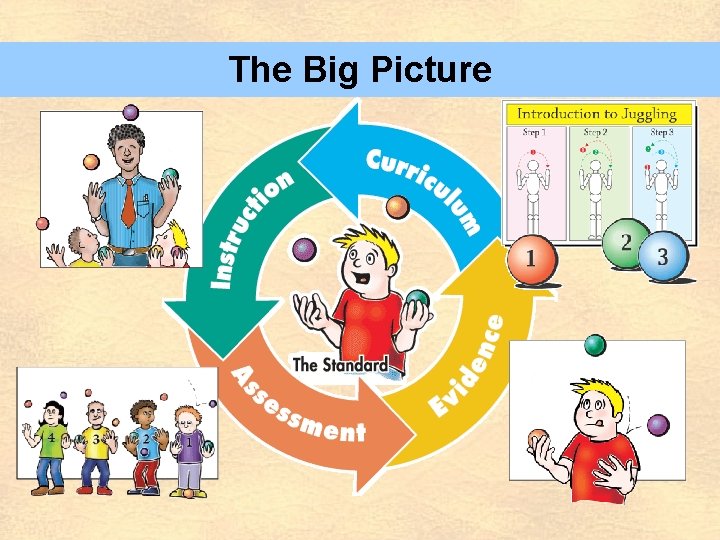
The Big Picture
Keep in Mind. . . • Knowledge and skills are not acquired through rote or in short, disconnected lessons. • Knowledge and skills are acquired when students can elaborate on, question, and use information in meaningful, relevant ways.
Final Wish We hope this module has been instrumental in supporting your efforts to adopt a skills-based, standards-based approach to teaching health education.
- Slides: 32