
HEALTH COMMUNICATION BY DEREJE GELETA BSC MPH LEARNING
HEALTH COMMUNICATION BY: DEREJE GELETA ( BSC, MPH)
LEARNING OBJECTIVE Upon successful the completion of this Module, the student will able to: Describe communication List the components of communication List Appeals of communication List barriers to effective communication BY: DEREJE G (BSC, MPH), HU 12/21/2021 2
INTRODUCTION Communication is the process by which two or more people exchange ideas, facts, feelings or impressions in ways that each gains a common or mutual understanding of the meaning and the use of the message. Evert M. Rogers (1993), defined “communication as the process by which an idea is transferred from a source to a receiver with intent to change his/her behavior. BY: DEREJE G (BSC, MPH), HU 12/21/2021 3
RELEVANCE TO HEALTH To mobilize the community, To implement HE & HP programs To coordinate with different agencies. The ultimate goal of all Health communication is to create behavioral change. BY: DEREJE G (BSC, MPH), HU 12/21/2021 4
KEY CHARACTERISTICS OF HEALTH COMMUNICATION Audience-centered Research-based Multidisciplinary Strategic Cost-effective Aimed at behavioral or social change (BCC/SBCC) BY: DEREJE G (BSC, MPH), HU 12/21/2021 5
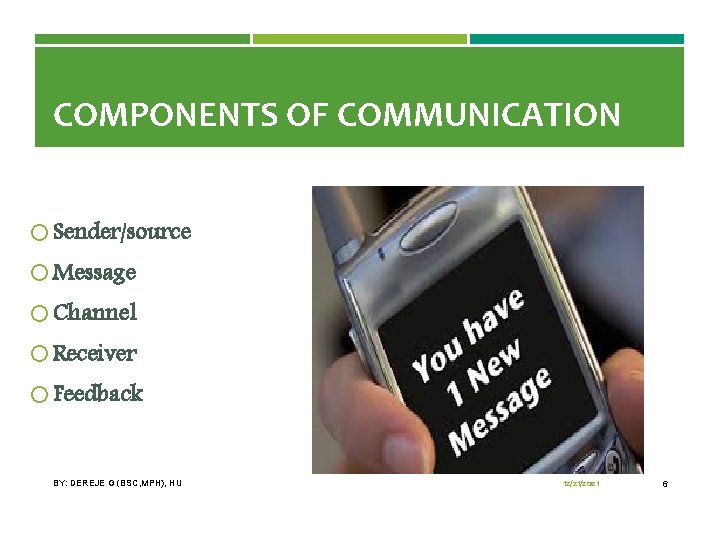
COMPONENTS OF COMMUNICATION Sender/source Message Channel Receiver Feedback BY: DEREJE G (BSC, MPH), HU 12/21/2021 6
SOURCE The sender is the originator of the messages. The source can be from an individual or groups, an institution or organization. BY: DEREJE G (BSC, MPH), HU 12/21/2021 7
RECEIVER/AUDIENCE Is the person or the group for whom the communication is intended or the person who receive the message. BY: DEREJE G (BSC, MPH), HU 12/21/2021 8
MESSAGE Message is a piece of information, ideas, facts, opinion, feeling, attitude or a course of action that passed from the sender to the receiver. It is the subject matter of communication. Something that is considered important for the audience to know or do BY: DEREJE G (BSC, MPH), HU 12/21/2021 9
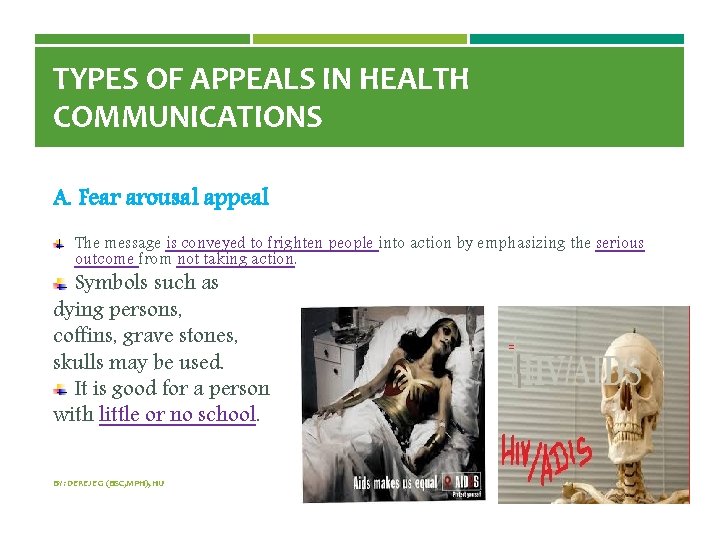
TYPES OF APPEALS IN HEALTH COMMUNICATIONS A. Fear arousal appeal The message is conveyed to frighten people into action by emphasizing the serious outcome from not taking action. Symbols such as dying persons, coffins, grave stones, skulls may be used. It is good for a person with little or no school. BY: DEREJE G (BSC, MPH), HU 12/21/2021 10
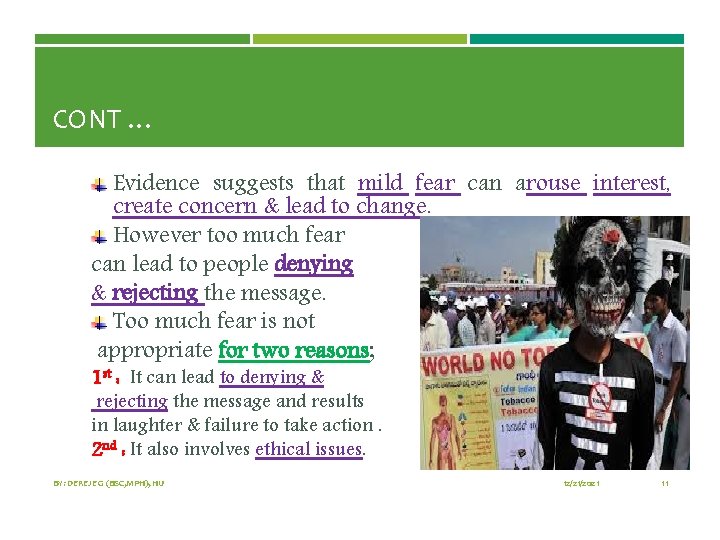
CONT … Evidence suggests that mild fear can arouse interest, create concern & lead to change. However too much fear can lead to people denying & rejecting the message. Too much fear is not appropriate for two reasons; 1 st : It can lead to denying & rejecting the message and results in laughter & failure to take action. 2 nd : It also involves ethical issues. BY: DEREJE G (BSC, MPH), HU 12/21/2021 11
B. HUMOUR The message is conveyed in a funny way such as cartoon. Humour very good way of attracting interest & attention. It can also serve as useful role to lighten the tension when dealing is serious subjects. BY: DEREJE G (BSC, MPH), HU 12/21/2021 12
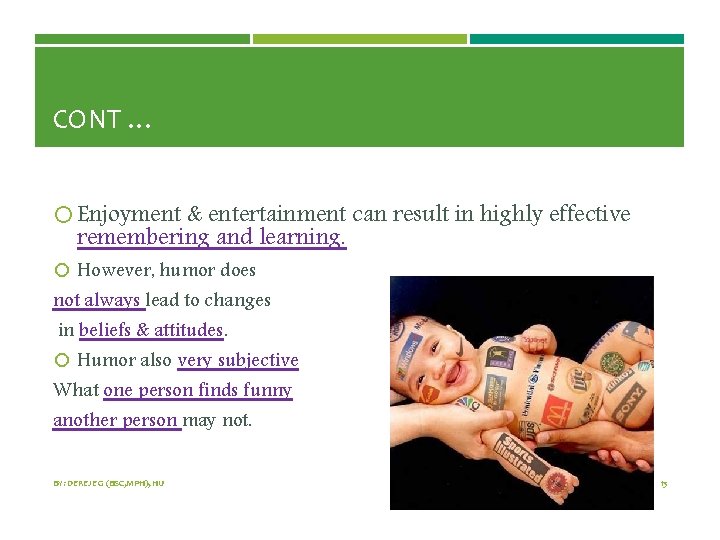
CONT … Enjoyment & entertainment can result in highly effective remembering and learning. However, humor does not always lead to changes in beliefs & attitudes. Humor also very subjective What one person finds funny another person may not. BY: DEREJE G (BSC, MPH), HU 12/21/2021 13
C. LOGICAL/FACTUAL The message is conveyed to convince people by giving facts, figures and information It carries weight with a person of high educational level. Information on its own is usually not enough to change behaviors BY: DEREJE G (BSC, MPH), HU 12/21/2021 14
D. EMOTIONAL APPEAL The message is conveying to convince people by arousing emotions, images & feelings rather than giving facts & figures e. g. by showing smiling babies, wealthy families with latrine, etc. , and associating with FP education. A Person with less education will often be more convinced by simple emotional appeals from people they trust. BY: DEREJE G (BSC, MPH), HU 12/21/2021 15

E. ONE SIDED MESSAGE Only presents the advantages of taking action & does not mention any possible disadvantages. E. g. educating the mothers only about benefits of oral contraceptive pill. F. Two sided message Presents both the advantages & disadvantages (pros’ & cons’) of taking action. BY: DEREJE G (BSC, MPH), HU 12/21/2021 16
G. POSITIVE APPEAL Communications that ask people to do something, e. g. breast feed your child, use a latrine. H. Negative Appeal Communications that ask people not to do something, e. g. do not bottle feed your child, do not defecate in the bush. BY: DEREJE G (BSC, MPH), HU 12/21/2021 17
CHANNEL A channel is the physical bridge or the media by which the message travels from a source to a receiver. The commonest types of channel are audio, visual, or combined audio-visual & printed materials The channel is essential. The medium – be it TV, newspaper, or a meeting – dictates who receives the message. BY: DEREJE G (BSC, MPH), HU 12/21/2021 18
FEEDBACK Feedback Is the mechanism of assessing what has happened on the receivers after the communication has occurred. A communication is said to have feedback when the receiver of the message gives his/her responses to the sender of the message. BY: DEREJE G (BSC, MPH), HU 12/21/2021 19
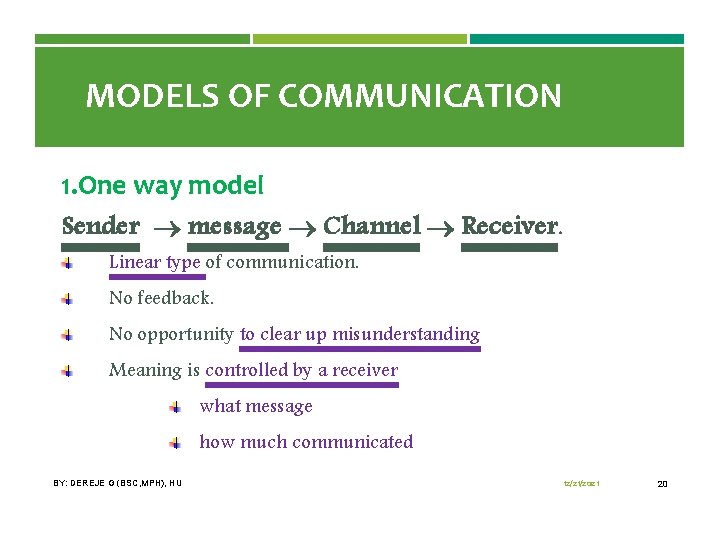
MODELS OF COMMUNICATION 1. One way model Sender message Channel Receiver. Linear type of communication. No feedback. No opportunity to clear up misunderstanding Meaning is controlled by a receiver what message how much communicated BY: DEREJE G (BSC, MPH), HU 12/21/2021 20
CONT … No input from the receiver Motivation of the sender may be personal gain or public good Quick if the message is simple and needs quicker communication e. g. date & time of meeting may be less effective BY: DEREJE G (BSC, MPH), HU 12/21/2021 21
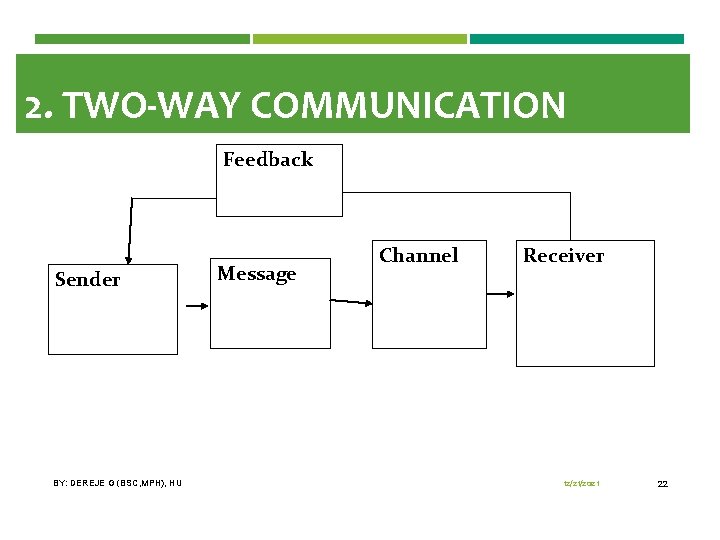
2. TWO-WAY COMMUNICATION Feedback Sender BY: DEREJE G (BSC, MPH), HU Message Channel Receiver 12/21/2021 22
CONT. … Advantages Suitable for more complex messages Feedback is added Allows the sender to find out how much the message is received - can be monitored Sender can affect the quality and quantity of the feedback through the type of question chosen and the way it is asked. BY: DEREJE G (BSC, MPH), HU 12/21/2021 23
METHODS OF COMMUNICATION There are two main groups of methods; Face-to-face (‘interpersonal’) Mass media. BY: DEREJE G (BSC, MPH), HU 12/21/2021 24
INTERPERSONAL METHODS Forms of communication involving direct interaction between the source & receiver. In most instances the decisive criterion for personal communication is. � Communication at the same time & � Communication at the same place BY: DEREJE G (BSC, MPH), HU . 12/21/2021 25
CONT … 1. Dynamic or bi-directional 2. Feed back 3. Multisensory (channel) 4. Useful in all stages of adoption of innovation 5. useful when the topic is taboo or sensitive. 6. Can fit to local needs 7. Can be highly selective BY: DEREJE G (BSC, MPH), HU 12/21/2021 26
LIMITATIONS Easily distorted – as we mostly rely on word-of-mouth. Often needs multi-lingual Needs personal status/ credibility Needs professional knowledge & preparation BY: DEREJE G (BSC, MPH), HU 12/21/2021 27
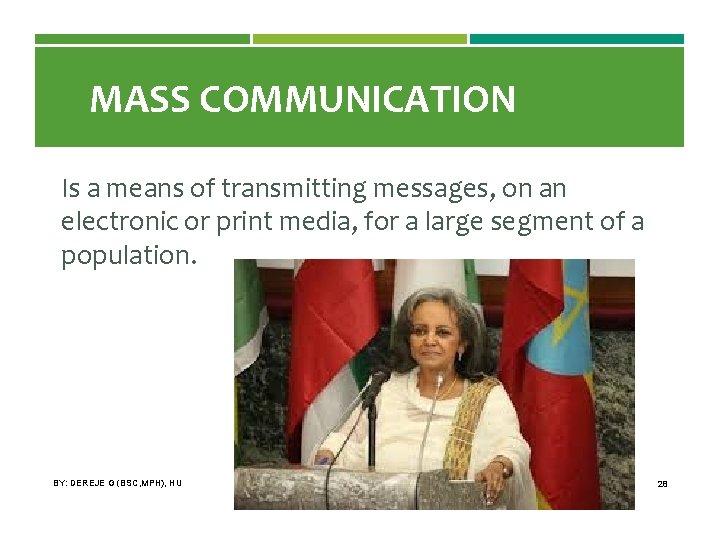
MASS COMMUNICATION Is a means of transmitting messages, on an electronic or print media, for a large segment of a population. BY: DEREJE G (BSC, MPH), HU 12/21/2021 28
ADVANTAGES 1. They can reach many people quickly. 2. They are accurate and believable e. g. article on a newspaper, or “voice” of highly respected person. 3. They can provide continuing reminders and reinforcement. 4. Useful to communicate new ideas to early adopters (opinion leaders). 12/21/2021 BY: DEREJE G (BSC, MPH), HU 29
LIMITATIONS 1. One sided/poorly organized 2. Does not differentiate the target 3. Only provides non-specific information BY: DEREJE G (BSC, MPH), HU 12/21/2021 30
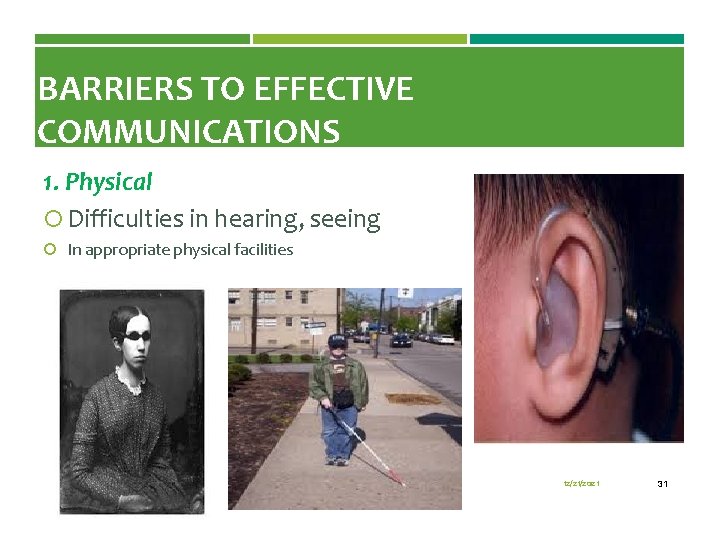
BARRIERS TO EFFECTIVE COMMUNICATIONS 1. Physical Difficulties in hearing, seeing In appropriate physical facilities BY: DEREJE G (BSC, MPH), HU 12/21/2021 31
CONT … 2. Intellectual The natural ability, home background, schooling affects the perception of the receiver for what he sees & hears. The ability of the facilitator/ education/ instructor. BY: DEREJE G (BSC, MPH), HU 12/21/2021 32
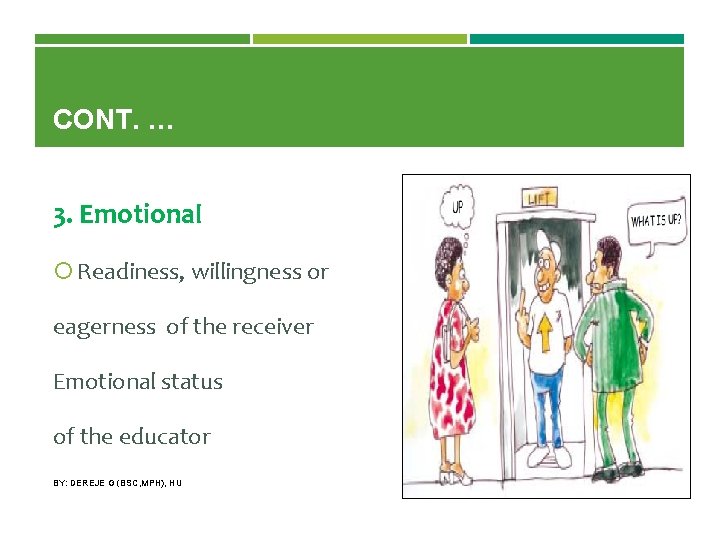
CONT. … 3. Emotional Readiness, willingness or eagerness of the receiver Emotional status of the educator BY: DEREJE G (BSC, MPH), HU 12/21/2021 33
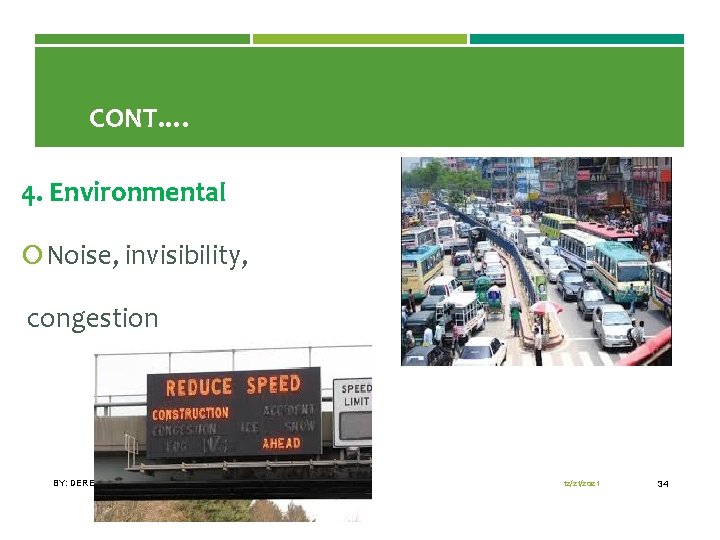
CONT. … 4. Environmental Noise, invisibility, congestion BY: DEREJE G (BSC, MPH), HU 12/21/2021 34
CONT … 5. Cultural Customs, beliefs, religion, attitudes, economic and social class differences, language variation. 6. Status of the source 7. Inconsistencies between verbal & non- verbal communication BY: DEREJE G (BSC, MPH), HU 12/21/2021 35

THE END THANK YOU !! BY: DEREJE G (BSC, MPH), HU 12/21/2021 36
- Slides: 36