
Health Coaching Program Integrates Community Members Into Primary
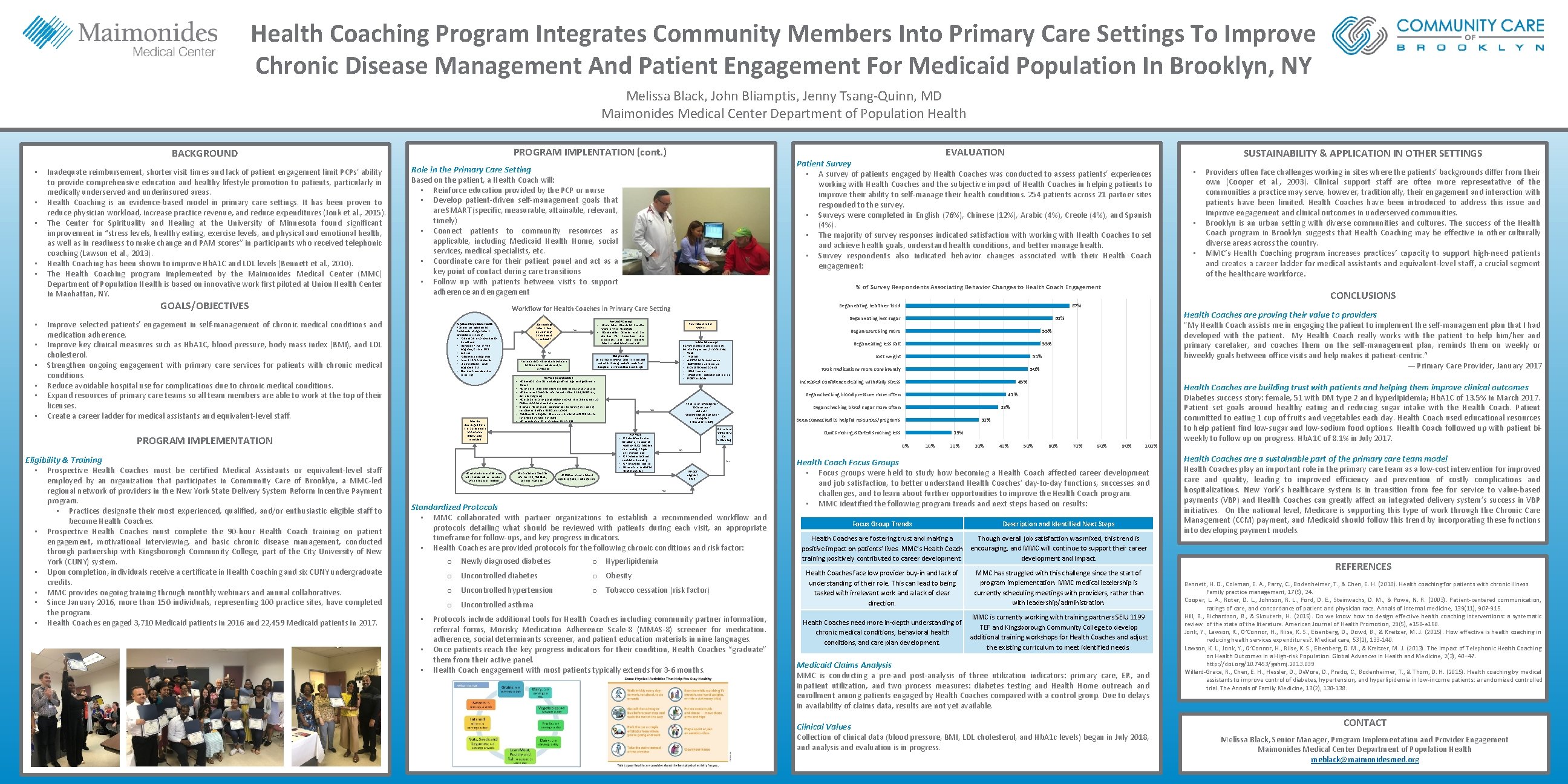
Health Coaching Program Integrates Community Members Into Primary Care Settings To Improve Chronic Disease Management And Patient Engagement For Medicaid Population In Brooklyn, NY Melissa Black, John Bliamptis, Jenny Tsang-Quinn, MD Maimonides Medical Center Department of Population Health • • • Inadequate reimbursement, shorter visit times and lack of patient engagement limit PCPs’ ability to provide comprehensive education and healthy lifestyle promotion to patients, particularly in medically underserved and underinsured areas. Health Coaching is an evidence-based model in primary care settings. It has been proven to reduce physician workload, increase practice revenue, and reduce expenditures (Jonk et al. , 2015). The Center for Spirituality and Healing at the University of Minnesota found significant improvement in “stress levels, healthy eating, exercise levels, and physical and emotional health, as well as in readiness to make change and PAM scores” in participants who received telephonic coaching (Lawson et al. , 2013). Health Coaching has been shown to improve Hb. A 1 C and LDL levels (Bennett et al. , 2010). The Health Coaching program implemented by the Maimonides Medical Center (MMC) Department of Population Health is based on innovative work first piloted at Union Health Center in Manhattan, NY. • • • Based on the patient, a Health Coach will: • Reinforce education provided by the PCP or nurse • Develop patient-driven self-management goals that are SMART (specific, measurable, attainable, relevant, timely) • Connect patients to community resources as applicable, including Medicaid Health Home, social services, medical specialists, etc. • Coordinate care for their patient panel and act as a key point of contact during care transitions • Follow up with patients between visits to support adherence and engagement Registries/Population Health Practices use registries to proactively manage patient populations including: • Patients at-risk or overdue for annual visit • Elevated BP but no HTN diagnosis; Chronic CVD • Asthma • Palliative care diagnoses • Recent ED/Hospital visits • Uncontrolled or newly diagnosed DM • Overdue preventive care screenings • • • Patient is discharged from the practice with appropriate follow-up(s) scheduled • • MA identifies patients who are overdue for preventive care screenings, and helps identify patients suited to work with HC No • Intake Screenings Support staff conducts screenings (various frequencies, as applicable): • Vitals • PHQ-2/9 • AUDIT-C for alcohol misuse • DAST-10 for substance use • 5 A’s of Tobacco Control • Blood Pressure • MMAS-8 for medication adherence • IPOS/Pain Scale Daily Huddle Clinical team reviews patients scheduled with outstanding medical needs and delegates responsibilities accordingly HC Visit (as applicable) HC develops care plan including self-management goals with patient HC connects patient to relevant entitlements, social programs HC discusses applicable referrals with patient (HH, NYS Quits, Asthma programs) HC establishes an ongoing relationship with the patient, sets up follow-up appointment or check-ins Smokers: HC conducts motivational interviewing on smoking cessation and offers NYS Quits support Palliative Care Eligible: HC ensures completion of IPOS (can be completed by patient or staff) HC records care plan in practice EMR or GSI HH at risk or CVD eligible? Tobacco user? Asthma? Palliative-eligible diagnosis? HH eligible? (HC/support staff) Yes PCP Visit • • 50% Increased confidence dealing with daily stress Conditions, Behavioral Health or SUD, Palliative care need(s), Fragile psychosocial need PCP provides tobacco cessation counseling PCP completes med rec Makes warm handoff to HC (if pt eligible) 45% Yes IMPACT eligible? (PCP) HC follows up with patient regarding goals, challenges etc. 38% 30% 19% 0% No protocols detailing what should be reviewed with patients during each visit, an appropriate timeframe for follow-ups, and key progress indicators. Health Coaches are provided protocols for the following chronic conditions and risk factor: o Hyperlipidemia o Uncontrolled diabetes o Obesity o Uncontrolled hypertension o Tobacco cessation (risk factor) Protocols include additional tools for Health Coaches including community partner information, referral forms, Morisky Medication Adherence Scale-8 (MMAS-8) screener for medication. adherence, social determinants screener, and patient education materials in nine languages. Once patients reach the key progress indicators for their condition, Health Coaches “graduate” them from their active panel. Health Coach engagement with most patients typically extends for 3 -6 months. 10% 20% 30% 40% 50% 60% 70% 80% 90% 100% Health Coach Focus Groups • Focus groups were held to study how becoming a Health Coach affected career development • and job satisfaction, to better understand Health Coaches’ day-to-day functions, successes and challenges, and to learn about further opportunities to improve the Health Coach program. MMC identified the following program trends and next steps based on results: Focus Group Trends Description and Identified Next Steps Health Coaches are fostering trust and making a positive impact on patients’ lives. MMC’s Health Coach training positively contributed to career development. Though overall job satisfaction was mixed, this trend is encouraging, and MMC will continue to support their career development and impact. Health Coaches face low provider buy-in and lack of understanding of their role. This can lead to being tasked with irrelevant work and a lack of clear direction. MMC has struggled with this challenge since the start of program implementation. MMC medical leadership is currently scheduling meetings with providers, rather than with leadership/administration. Health Coaches need more in-depth understanding of chronic medical conditions, behavioral health conditions, and care plan development. MMC is currently working with training partners SEIU 1199 TEF and Kingsborough Community College to develop additional training workshops for Health Coaches and adjust the existing curriculum to meet identified needs. Medicaid Claims Analysis MMC is conducting a pre-and post-analysis of three utilization indicators: primary care, ER, and inpatient utilization, and two process measures: diabetes testing and Health Home outreach and enrollment among patients engaged by Health Coaches compared with a control group. Due to delays in availability of claims data, results are not yet available. Clinical Values • Health Coaches are building trust with patients and helping them improve clinical outcomes 41% Quit smoking/started smoking less • Providers often face challenges working in sites where the patients’ backgrounds differ from their own (Cooper et al. , 2003). Clinical support staff are often more representative of the communities a practice may serve, however, traditionally, their engagement and interaction with patients have been limited. Health Coaches have been introduced to address this issue and improve engagement and clinical outcomes in underserved communities. Brooklyn is an urban setting with diverse communities and cultures. The success of the Health Coach program in Brooklyn suggests that Health Coaching may be effective in other culturally diverse areas across the country. MMC’s Health Coaching program increases practices’ capacity to support high-need patients and creates a career ladder for medical assistants and equivalent-level staff, a crucial segment of the healthcare workforce. "My Health Coach assists me in engaging the patient to implement the self-management plan that I had developed with the patient. My Health Coach really works with the patient to help him/her and primary caretaker, and coaches them on the self-management plan, reminds them on weekly or biweekly goals between office visits and help makes it patient-centric. “ — Primary Care Provider, January 2017 51% Been connected to helpful resources/programs o Uncontrolled asthma • 55% Began checking blood sugar more often Standardized Protocols • MMC collaborated with partner organizations to establish a recommended workflow and o Newly diagnosed diabetes Began eating less salt Took medications more consistently No • 55% Lost weight Warm hand -off to BCM (as applicable) • PCP identifies Chronic HC completes applicable referrals (HH, NYS Quits, Asthma programs) Began exercising more • Health Coaches are proving their value to providers 60% Began checking blood pressure more often • HC conducts case conference with provider/other members of care team, as needed Began eating less sugar New patient visit or walk-in SUSTAINABILITY & APPLICATION IN OTHER SETTINGS CONCLUSIONS 67% Began eating healthier food who are HH or HC eligible Yes working with Health Coaches and the subjective impact of Health Coaches in helping patients to improve their ability to self-manage their health conditions. 254 patients across 21 partner sites responded to the survey. Surveys were completed in English (76%), Chinese (12%), Arabic (4%), Creole (4%), and Spanish (4%). The majority of survey responses indicated satisfaction with working with Health Coaches to set and achieve health goals, understand health conditions, and better manage health. Survey respondents also indicated behavior changes associated with their Health Coach engagement: % of Survey Respondents Associating Behavior Changes to Health Coach Engagement • HC identifies patients for the day Practice and/or HC conducts outreach to patient to schedule visit, as applicable • • Eligibility & Training • Prospective Health Coaches must be certified Medical Assistants or equivalent-level staff • • Pre-Visit Planning Does existing patient have an upcoming appointment scheduled? • PROGRAM IMPLEMENTATION • • Workflow for Health Coaches in Primary Care Setting Improve selected patients’ engagement in self-management of chronic medical conditions and medication adherence. Improve key clinical measures such as Hb. A 1 C, blood pressure, body mass index (BMI), and LDL cholesterol. Strengthen ongoing engagement with primary care services for patients with chronic medical conditions. Reduce avoidable hospital use for complications due to chronic medical conditions. Expand resources of primary care teams so all team members are able to work at the top of their licenses. Create a career ladder for medical assistants and equivalent-level staff. employed by an organization that participates in Community Care of Brooklyn, a MMC-led regional network of providers in the New York State Delivery System Reform Incentive Payment program. • Practices designate their most experienced, qualified, and/or enthusiastic eligible staff to become Health Coaches. Prospective Health Coaches must complete the 90 -hour Health Coach training on patient engagement, motivational interviewing, and basic chronic disease management, conducted through partnership with Kingsborough Community College, part of the City University of New York (CUNY) system. Upon completion, individuals receive a certificate in Health Coaching and six CUNY undergraduate credits. MMC provides ongoing training through monthly webinars and annual collaboratives. Since January 2016, more than 150 individuals, representing 100 practice sites, have completed the program. Health Coaches engaged 3, 710 Medicaid patients in 2016 and 22, 459 Medicaid patients in 2017. Patient Survey • A survey of patients engaged by Health Coaches was conducted to assess patients’ experiences Role in the Primary Care Setting GOALS/OBJECTIVES • EVALUATION PROGRAM IMPLENTATION (cont. ) BACKGROUND Collection of clinical data (blood pressure, BMI, LDL cholesterol, and Hb. A 1 c levels) began in July 2018, and analysis and evaluation is in progress. Diabetes success story: female, 51 with DM type 2 and hyperlipidemia; Hb. A 1 C of 13. 5% in March 2017. Patient set goals around healthy eating and reducing sugar intake with the Health Coach. Patient committed to eating 1 cup of fruits and vegetables each day. Health Coach used educational resources to help patient find low-sugar and low-sodium food options. Health Coach followed up with patient biweekly to follow up on progress. Hb. A 1 C of 8. 1% in July 2017. Health Coaches are a sustainable part of the primary care team model Health Coaches play an important role in the primary care team as a low-cost intervention for improved care and quality, leading to improved efficiency and prevention of costly complications and hospitalizations. New York’s healthcare system is in transition from fee for service to value-based payments (VBP) and Health Coaches can greatly affect an integrated delivery system’s success in VBP initiatives. On the national level, Medicare is supporting this type of work through the Chronic Care Management (CCM) payment, and Medicaid should follow this trend by incorporating these functions into developing payment models. REFERENCES Bennett, H. D. , Coleman, E. A. , Parry, C. , Bodenheimer, T. , & Chen, E. H. (2010). Health coaching for patients with chronic illness. Family practice management, 17(5), 24. Cooper, L. A. , Roter, D. L. , Johnson, R. L. , Ford, D. E. , Steinwachs, D. M. , & Powe, N. R. (2003). Patient-centered communication, ratings of care, and concordance of patient and physician race. Annals of internal medicine, 139(11), 907 -915. Hill, B. , Richardson, B. , & Skouteris, H. (2015). Do we know how to design effective health coaching interventions: a systematic review of the state of the literature. American Journal of Health Promotion, 29(5), e 158 -e 168. Jonk, Y. , Lawson, K. , O’Connor, H. , Riise, K. S. , Eisenberg, D. , Dowd, B. , & Kreitzer, M. J. (2015). How effective is health coaching in reducing health services expenditures? . Medical care, 53(2), 133 -140. Lawson, K. L. , Jonk, Y. , O’Connor, H. , Riise, K. S. , Eisenberg, D. M. , & Kreitzer, M. J. (2013). The impact of Telephonic Health Coaching on Health Outcomes in a High-risk Population. Global Advances in Health and Medicine, 2(3), 40– 47. http: //doi. org/10. 7453/gahmj. 2013. 039 Willard-Grace, R. , Chen, E. H. , Hessler, D. , De. Vore, D. , Prado, C. , Bodenheimer, T. , & Thom, D. H. (2015). Health coaching by medical assistants to improve control of diabetes, hypertension, and hyperlipidemia in low-income patients: a randomized controlled trial. The Annals of Family Medicine, 13(2), 130 -138. CONTACT Melissa Black, Senior Manager, Program Implementation and Provider Engagement Maimonides Medical Center Department of Population Health meblack@maimonidesmed. org
- Slides: 1