
Health Care Provider Incentive Program 2019 2021 Funding
- Slides: 20
Health Care Provider Incentive Program: 2019 -2021 Funding Recommendations Joe Sullivan, OHA Marc Overbeck, OHA HEALTH POLICY AND ANALYTICS DIVISION
Background: Healthcare Provider Incentive Program HB 3261 was passed in 2017, creating the Healthcare Provider Incentive Program and Fund. Purpose of the Program: to help Oregon master the challenge of the diversity, training, supply and distribution of the Health Professional Workforce in the state. Oregon Health Policy Board (advised by Health Care Workforce Committee) responsible for the distribution of resources from the Health Care Provider Incentive Fund. HEALTH CARE PROVIDER INCENTIVE PROGRAM Health Policy and Analytics 2
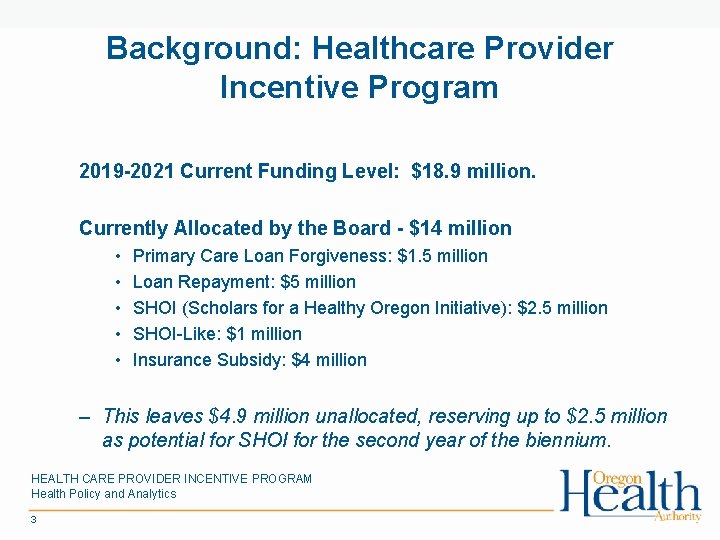
Background: Healthcare Provider Incentive Program 2019 -2021 Current Funding Level: $18. 9 million. Currently Allocated by the Board - $14 million • • • Primary Care Loan Forgiveness: $1. 5 million Loan Repayment: $5 million SHOI (Scholars for a Healthy Oregon Initiative): $2. 5 million SHOI-Like: $1 million Insurance Subsidy: $4 million – This leaves $4. 9 million unallocated, reserving up to $2. 5 million as potential for SHOI for the second year of the biennium. HEALTH CARE PROVIDER INCENTIVE PROGRAM Health Policy and Analytics 3
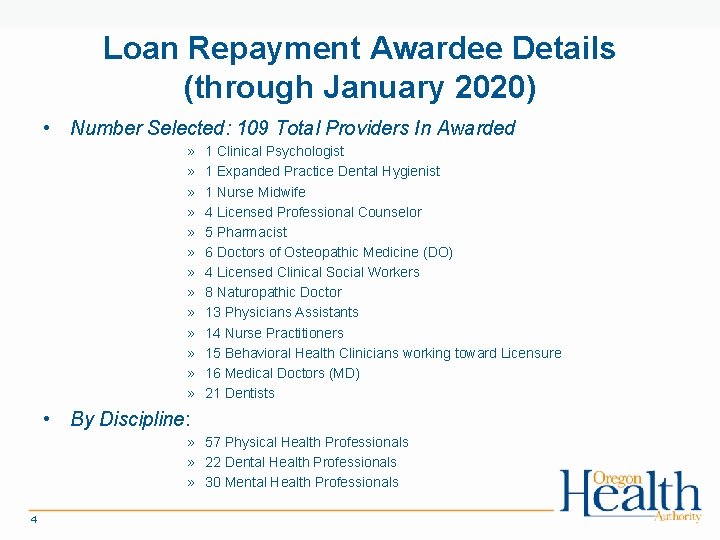
Loan Repayment Awardee Details (through January 2020) • Number Selected: 109 Total Providers In Awarded » » » » 1 Clinical Psychologist 1 Expanded Practice Dental Hygienist 1 Nurse Midwife 4 Licensed Professional Counselor 5 Pharmacist 6 Doctors of Osteopathic Medicine (DO) 4 Licensed Clinical Social Workers 8 Naturopathic Doctor 13 Physicians Assistants 14 Nurse Practitioners 15 Behavioral Health Clinicians working toward Licensure 16 Medical Doctors (MD) 21 Dentists • By Discipline: » 57 Physical Health Professionals » 22 Dental Health Professionals » 30 Mental Health Professionals 4
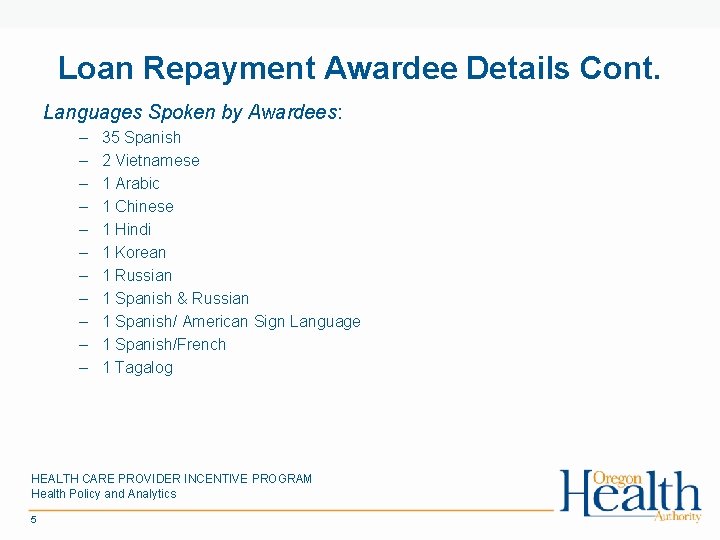
Loan Repayment Awardee Details Cont. Languages Spoken by Awardees: – – – 35 Spanish 2 Vietnamese 1 Arabic 1 Chinese 1 Hindi 1 Korean 1 Russian 1 Spanish & Russian 1 Spanish/ American Sign Language 1 Spanish/French 1 Tagalog HEALTH CARE PROVIDER INCENTIVE PROGRAM Health Policy and Analytics 5
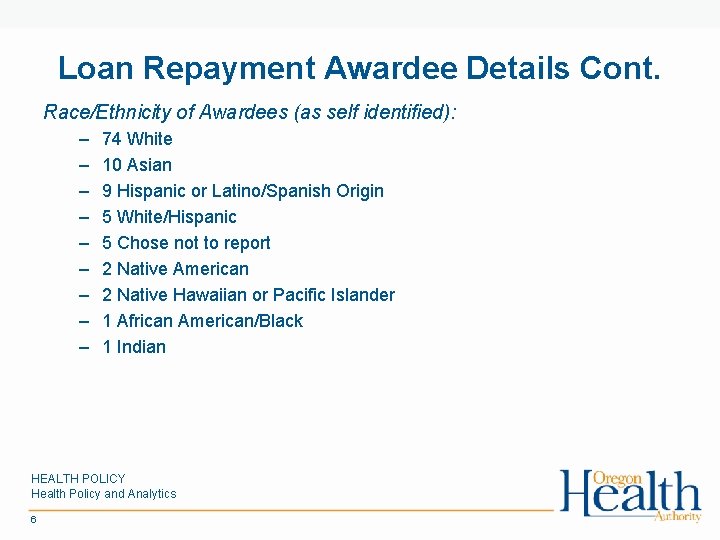
Loan Repayment Awardee Details Cont. Race/Ethnicity of Awardees (as self identified): – – – – – 74 White 10 Asian 9 Hispanic or Latino/Spanish Origin 5 White/Hispanic 5 Chose not to report 2 Native American 2 Native Hawaiian or Pacific Islander 1 African American/Black 1 Indian HEALTH POLICY Health Policy and Analytics 6
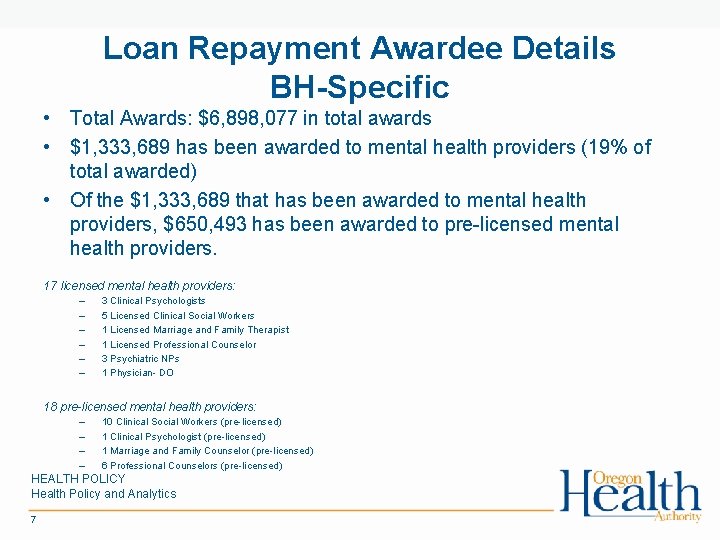
Loan Repayment Awardee Details BH-Specific • Total Awards: $6, 898, 077 in total awards • $1, 333, 689 has been awarded to mental health providers (19% of total awarded) • Of the $1, 333, 689 that has been awarded to mental health providers, $650, 493 has been awarded to pre-licensed mental health providers. 17 licensed mental health providers: – – – 3 Clinical Psychologists 5 Licensed Clinical Social Workers 1 Licensed Marriage and Family Therapist 1 Licensed Professional Counselor 3 Psychiatric NPs 1 Physician- DO 18 pre-licensed mental health providers: – – 10 Clinical Social Workers (pre-licensed) 1 Clinical Psychologist (pre-licensed) 1 Marriage and Family Counselor (pre-licensed) 6 Professional Counselors (pre-licensed) HEALTH POLICY Health Policy and Analytics 7
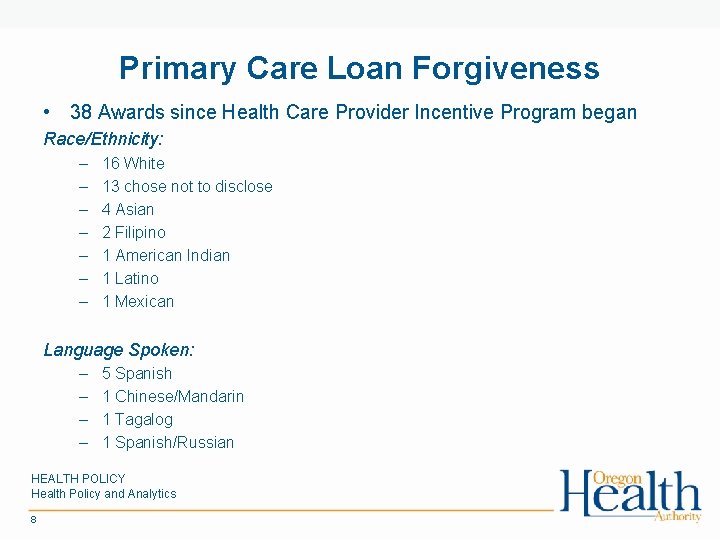
Primary Care Loan Forgiveness • 38 Awards since Health Care Provider Incentive Program began Race/Ethnicity: – – – – 16 White 13 chose not to disclose 4 Asian 2 Filipino 1 American Indian 1 Latino 1 Mexican Language Spoken: – – 5 Spanish 1 Chinese/Mandarin 1 Tagalog 1 Spanish/Russian HEALTH POLICY Health Policy and Analytics 8
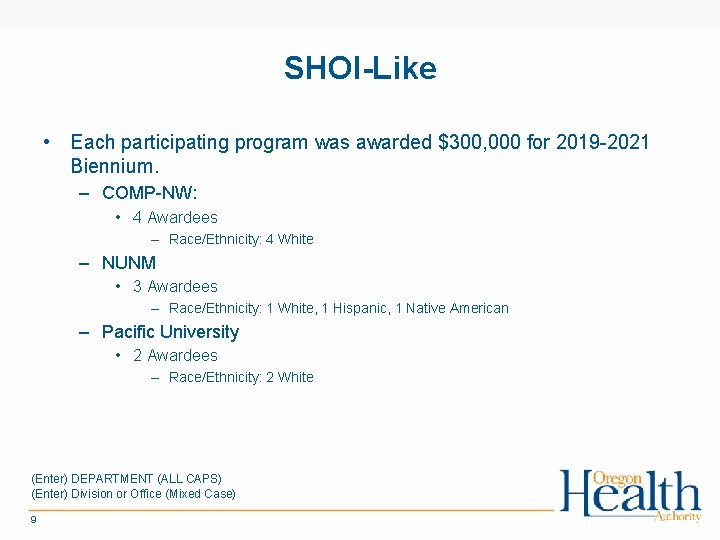
SHOI-Like • Each participating program was awarded $300, 000 for 2019 -2021 Biennium. – COMP-NW: • 4 Awardees – Race/Ethnicity: 4 White – NUNM • 3 Awardees – Race/Ethnicity: 1 White, 1 Hispanic, 1 Native American – Pacific University • 2 Awardees – Race/Ethnicity: 2 White (Enter) DEPARTMENT (ALL CAPS) (Enter) Division or Office (Mixed Case) 9
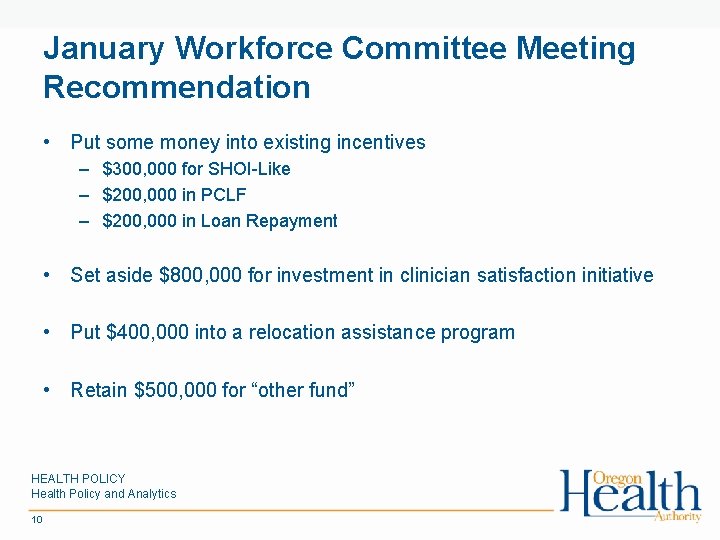
January Workforce Committee Meeting Recommendation • Put some money into existing incentives – $300, 000 for SHOI-Like – $200, 000 in PCLF – $200, 000 in Loan Repayment • Set aside $800, 000 for investment in clinician satisfaction initiative • Put $400, 000 into a relocation assistance program • Retain $500, 000 for “other fund” HEALTH POLICY Health Policy and Analytics 10
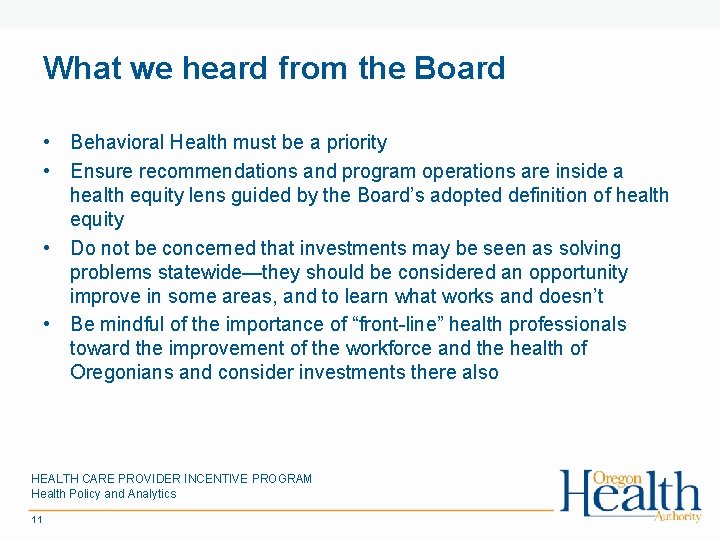
What we heard from the Board • Behavioral Health must be a priority • Ensure recommendations and program operations are inside a health equity lens guided by the Board’s adopted definition of health equity • Do not be concerned that investments may be seen as solving problems statewide—they should be considered an opportunity improve in some areas, and to learn what works and doesn’t • Be mindful of the importance of “front-line” health professionals toward the improvement of the workforce and the health of Oregonians and consider investments there also HEALTH CARE PROVIDER INCENTIVE PROGRAM Health Policy and Analytics 11
Two Options for a Revised Recommendation • Option 1 – Invest all remaining money in a new incentive for Behavioral Health • Option 2 – Smaller new investment in Behavioral Health and push some moneys out to bolster existing incentives HEALTH CARE PROVIDER INCENTIVE PROGRAM Health Policy and Analytics )12
Option 1 • $2. 4 million for new Behavioral Health Incentive HEALTH POLICY Health Policy and Analytics )13
Option 1 • $2. 4 Million for a specifically targeted Behavioral Health (BH) incentive. – Propose including QHMA/QMHP/Licensed Behavioral Health Clinicians. • Would allow clinicians who are licensed or working toward it (and in Residential/Day Treatment and Community Based setting) as well as unlicensed providers to apply for Loan Repayment. • Would expand service delivery methods to include Community Based Services and Telehealth. • Would expand qualified “site” types to include Residential Treatment, Day. Treatment, Community Based Services. *Currently not eligible under LR. HEALTH CARE PROVIDER INCENTIVE PROGRAM Health Policy and Analytics 14
Option 2 • $900, 000 additional for Loan Repayment, earmarked for Behavioral Health • $700, 000 for a new, additional BH Incentive • $400, 000 additional for SHOI-Like • $400, 000 additional for PCLF HEALTH CARE PROVIDER INCENTIVE PROGRAM Health Policy and Analytics )15
Option 2, Continued • $700, 000 for a New, Unlicensed Behavioral Health Clinician incentive. • Would allow for Bachelors-level student loans to be repaid for those who qualify (currently only Graduate-level loans are) • Will expand eligible practice sites to Residential, Community-based, Day Treatment type settings Intent is to pay down Bachelors-level student loans , in effort to incentivize provider to go back to school for Masters Degree and work toward licensure – Also a recruitment and retention tool for sites who qualify but might otherwise lose these clinicians before 3 years’ time HEALTH CARE PROVIDER INCENTIVE PROGRAM Health Policy and Analytics 16
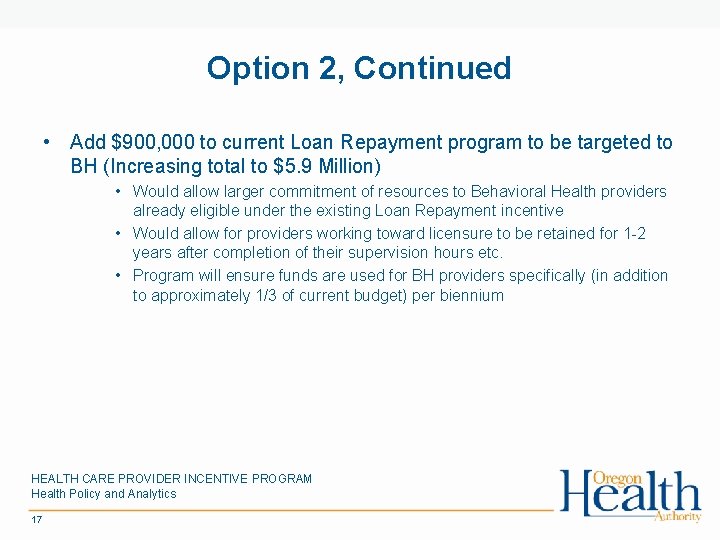
Option 2, Continued • Add $900, 000 to current Loan Repayment program to be targeted to BH (Increasing total to $5. 9 Million) • Would allow larger commitment of resources to Behavioral Health providers already eligible under the existing Loan Repayment incentive • Would allow for providers working toward licensure to be retained for 1 -2 years after completion of their supervision hours etc. • Program will ensure funds are used for BH providers specifically (in addition to approximately 1/3 of current budget) per biennium HEALTH CARE PROVIDER INCENTIVE PROGRAM Health Policy and Analytics 17
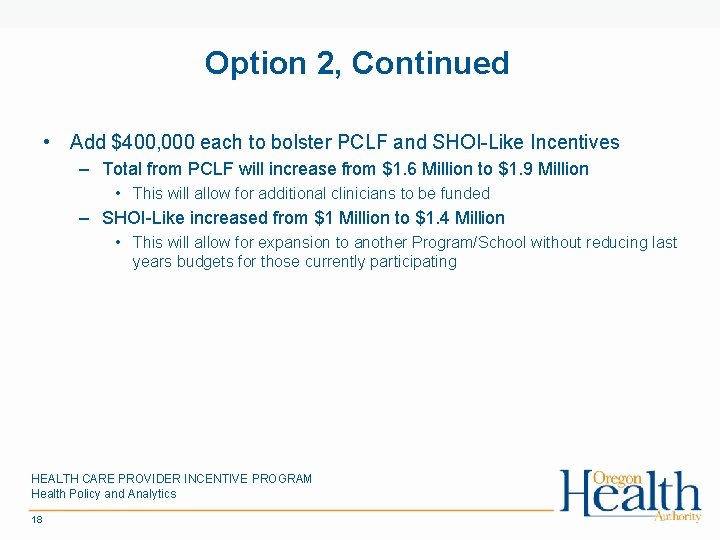
Option 2, Continued • Add $400, 000 each to bolster PCLF and SHOI-Like Incentives – Total from PCLF will increase from $1. 6 Million to $1. 9 Million • This will allow for additional clinicians to be funded – SHOI-Like increased from $1 Million to $1. 4 Million • This will allow for expansion to another Program/School without reducing last years budgets for those currently participating HEALTH CARE PROVIDER INCENTIVE PROGRAM Health Policy and Analytics 18
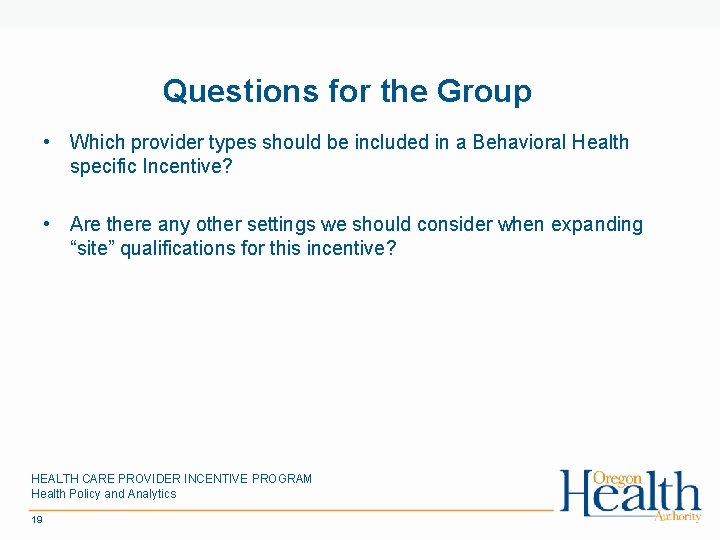
Questions for the Group • Which provider types should be included in a Behavioral Health specific Incentive? • Are there any other settings we should consider when expanding “site” qualifications for this incentive? HEALTH CARE PROVIDER INCENTIVE PROGRAM Health Policy and Analytics 19
Questions? Joe Sullivan Health Care Provider Incentives Coordinator Primary Care Office Health Policy Division 503 -559 -0340 joseph. a. sullivan@dhsoha. state. or. us HEALTH CARE PROVIDER INCENTIVE PROGRAM Health Policy and Analytics 20