
Health Care of the Past Present and Future
- Slides: 21
Health Care of the Past, Present and Future Copyright © 2007 by Mosby, Inc. , an affiliate of Elsevier Inc.
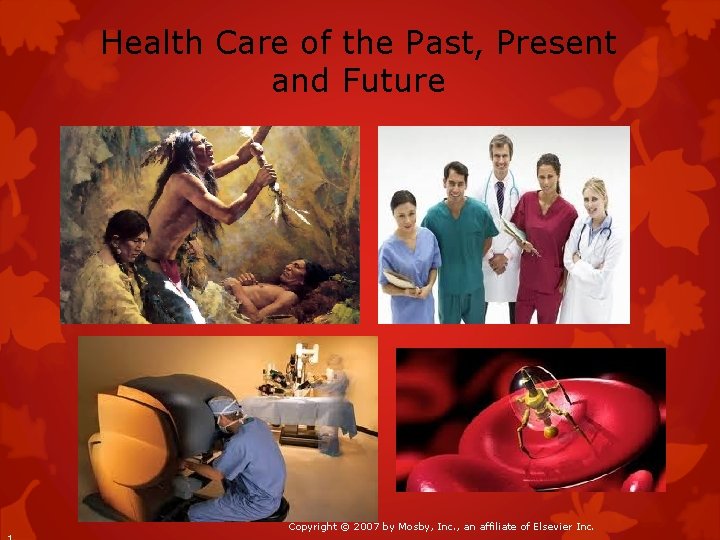
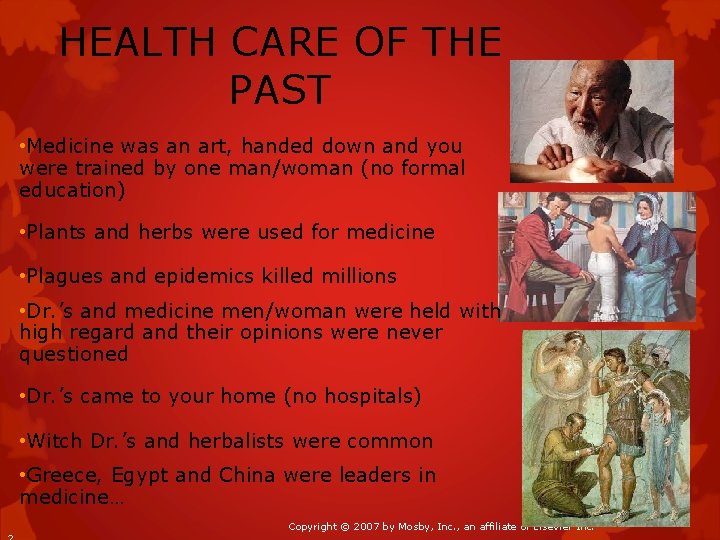
HEALTH CARE OF THE PAST • Medicine was an art, handed down and you were trained by one man/woman (no formal education) • Plants and herbs were used for medicine • Plagues and epidemics killed millions • Dr. ’s and medicine men/woman were held with high regard and their opinions were never questioned • Dr. ’s came to your home (no hospitals) • Witch Dr. ’s and herbalists were common • Greece, Egypt and China were leaders in medicine… Copyright © 2007 by Mosby, Inc. , an affiliate of Elsevier Inc.
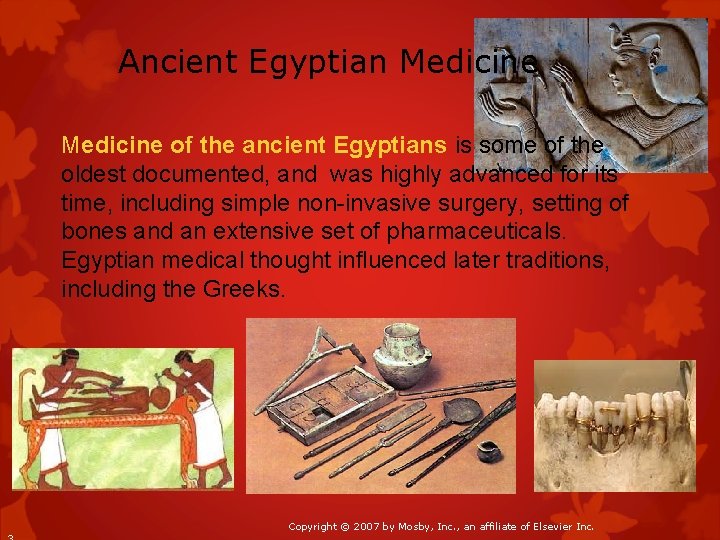
Ancient Egyptian Medicine of the ancient Egyptians is some of the oldest documented, and was highly advanced for its time, including simple non-invasive surgery, setting of bones and an extensive set of pharmaceuticals. Egyptian medical thought influenced later traditions, including the Greeks. Copyright © 2007 by Mosby, Inc. , an affiliate of Elsevier Inc.
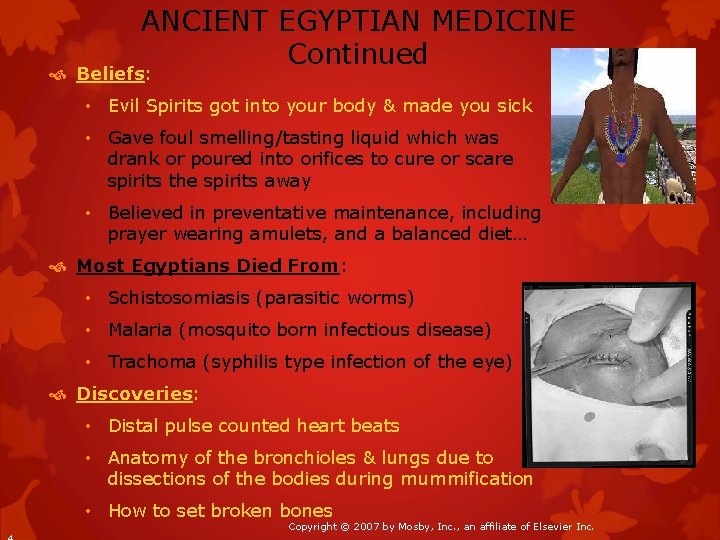
ANCIENT EGYPTIAN MEDICINE Continued Beliefs: • Evil Spirits got into your body & made you sick • Gave foul smelling/tasting liquid which was drank or poured into orifices to cure or scare spirits the spirits away • Believed in preventative maintenance, including prayer wearing amulets, and a balanced diet… Most Egyptians Died From: • Schistosomiasis (parasitic worms) • Malaria (mosquito born infectious disease) • Trachoma (syphilis type infection of the eye) Discoveries: • Distal pulse counted heart beats • Anatomy of the bronchioles & lungs due to dissections of the bodies during mummification • How to set broken bones Copyright © 2007 by Mosby, Inc. , an affiliate of Elsevier Inc.
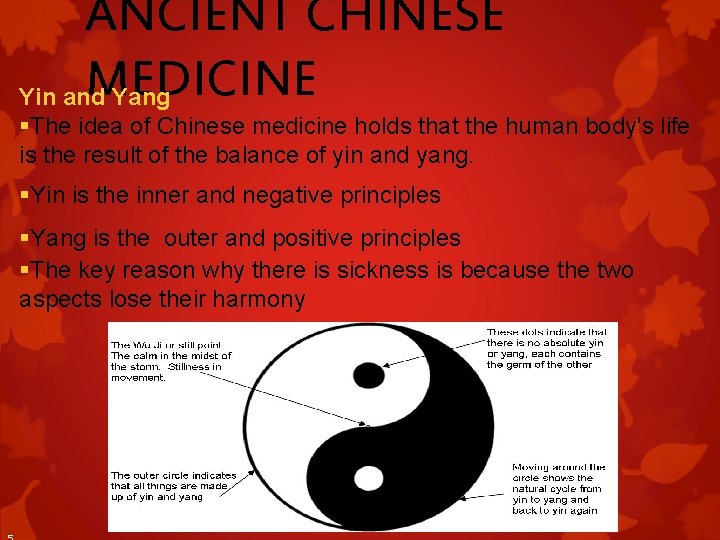
ANCIENT CHINESE MEDICINE Yin and Yang §The idea of Chinese medicine holds that the human body's life is the result of the balance of yin and yang. §Yin is the inner and negative principles §Yang is the outer and positive principles §The key reason why there is sickness is because the two aspects lose their harmony Copyright © 2007 by Mosby, Inc. , an affiliate of Elsevier Inc.
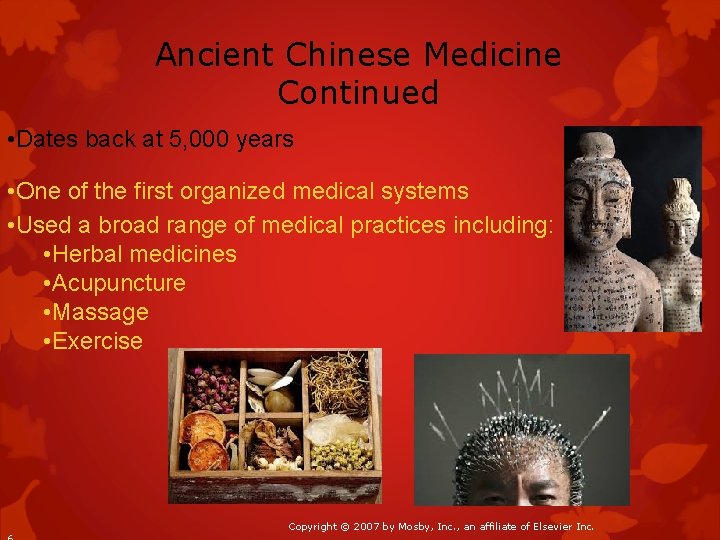
Ancient Chinese Medicine Continued • Dates back at 5, 000 years • One of the first organized medical systems • Used a broad range of medical practices including: • Herbal medicines • Acupuncture • Massage • Exercise Copyright © 2007 by Mosby, Inc. , an affiliate of Elsevier Inc.
Copyright © 2007 by Mosby, Inc. , an affiliate of Elsevier Inc.
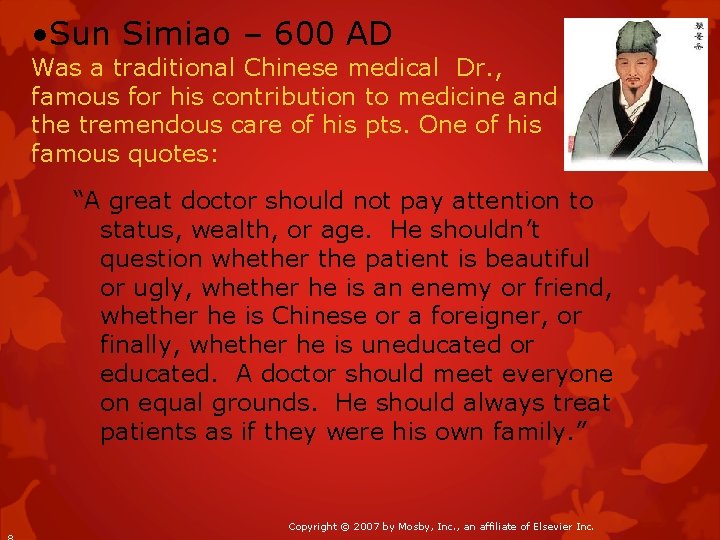
• Sun Simiao – 600 AD Was a traditional Chinese medical Dr. , famous for his contribution to medicine and the tremendous care of his pts. One of his famous quotes: “A great doctor should not pay attention to status, wealth, or age. He shouldn’t question whether the patient is beautiful or ugly, whether he is an enemy or friend, whether he is Chinese or a foreigner, or finally, whether he is uneducated or educated. A doctor should meet everyone on equal grounds. He should always treat patients as if they were his own family. ” Copyright © 2007 by Mosby, Inc. , an affiliate of Elsevier Inc.
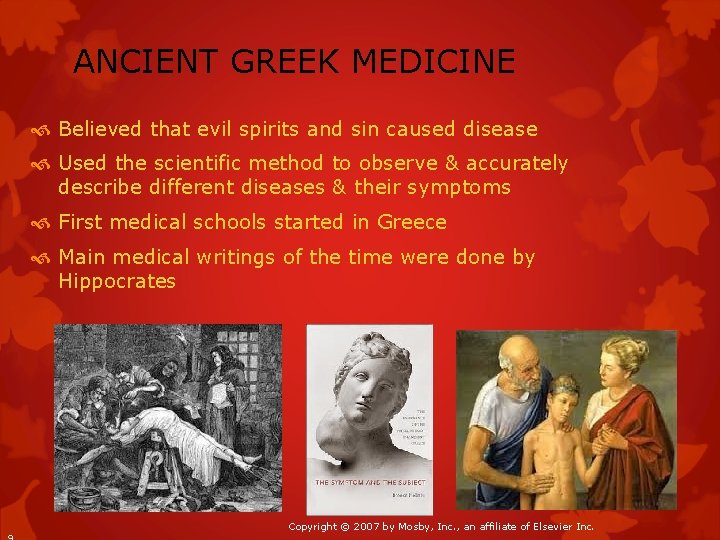
ANCIENT GREEK MEDICINE Believed that evil spirits and sin caused disease Used the scientific method to observe & accurately describe different diseases & their symptoms First medical schools started in Greece Main medical writings of the time were done by Hippocrates Copyright © 2007 by Mosby, Inc. , an affiliate of Elsevier Inc.
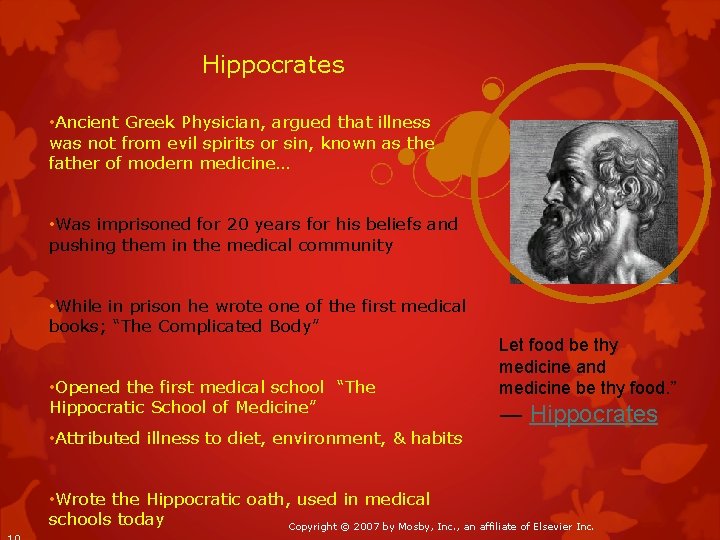
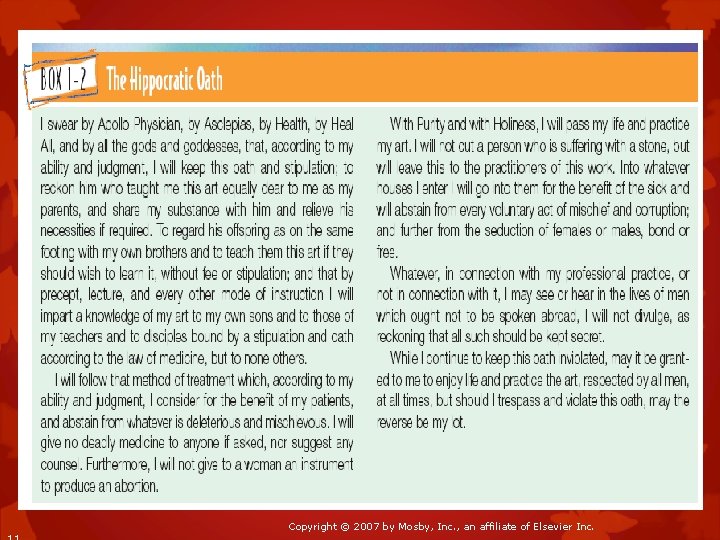
Hippocrates • Ancient Greek Physician, argued that illness was not from evil spirits or sin, known as the father of modern medicine… • Was imprisoned for 20 years for his beliefs and pushing them in the medical community • While in prison he wrote one of the first medical books; “The Complicated Body” • Opened the first medical school “The Hippocratic School of Medicine” • Attributed illness to diet, environment, & habits Let food be thy medicine and medicine be thy food. ” ― Hippocrates • Wrote the Hippocratic oath, used in medical schools today Copyright © 2007 by Mosby, Inc. , an affiliate of Elsevier Inc.
Copyright © 2007 by Mosby, Inc. , an affiliate of Elsevier Inc.
Health Care of The Present § Dr. ’s have formal training, and must be licensed § Medications are by prescription and dispensed by a pharmacy § Pt. ’s utilize the internet and get second opinions, Dr. ’s opinions are not taken as the final word § Dr. ’s see patients in their office or the hospital § Focus is on preventing disease, emergency preparedness, terrorists attacks, and pandemics § Herbalists and homeopathic practitioners are seen as practitioners of “quackery” § HIPAA (Health Insurance Portability and Accountability Act) ensures patient privacy § Insurance is needed to cover high cost of medical care § Pt. is approached as a team; MD, Nurse, CNA, housekeeping, dietary, therapists, etc… Copyright © 2007 by Mosby, Inc. , an affiliate of Elsevier Inc.
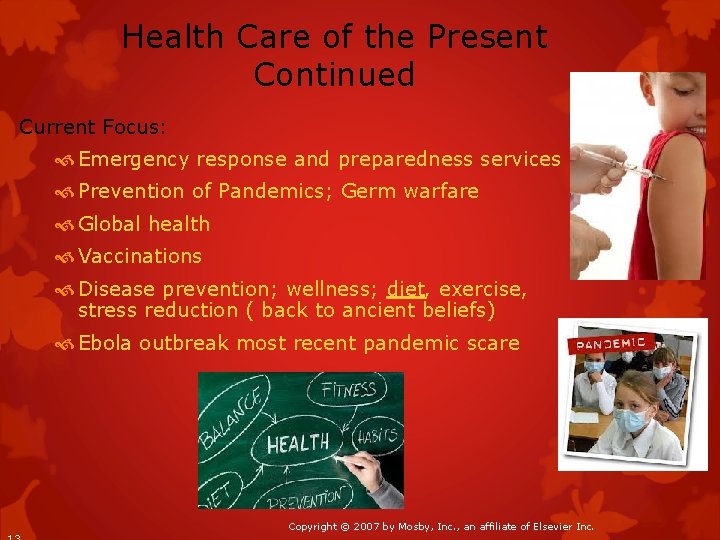
Health Care of the Present Continued Current Focus: Emergency response and preparedness services Prevention of Pandemics; Germ warfare Global health Vaccinations Disease prevention; wellness; diet, exercise, stress reduction ( back to ancient beliefs) Ebola outbreak most recent pandemic scare Copyright © 2007 by Mosby, Inc. , an affiliate of Elsevier Inc.
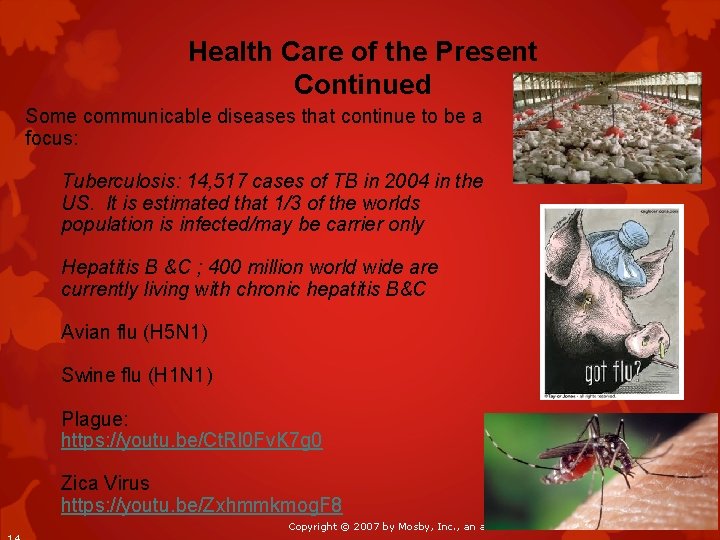
Health Care of the Present Continued Some communicable diseases that continue to be a focus: Tuberculosis: 14, 517 cases of TB in 2004 in the US. It is estimated that 1/3 of the worlds population is infected/may be carrier only Hepatitis B &C ; 400 million world wide are currently living with chronic hepatitis B&C Avian flu (H 5 N 1) Swine flu (H 1 N 1) Plague: https: //youtu. be/Ct. Rl 0 Fv. K 7 g 0 Zica Virus https: //youtu. be/Zxhmmkmog. F 8 Copyright © 2007 by Mosby, Inc. , an affiliate of Elsevier Inc.
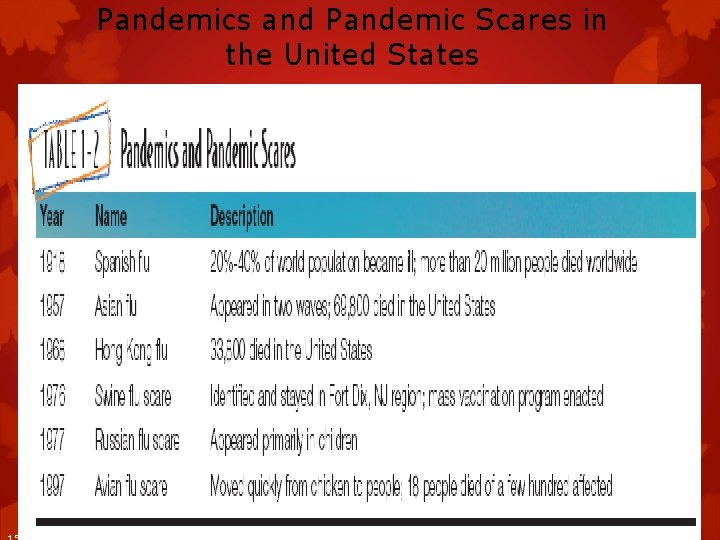
Pandemics and Pandemic Scares in the United States Copyright © 2007 by Mosby, Inc. , an affiliate of Elsevier Inc.
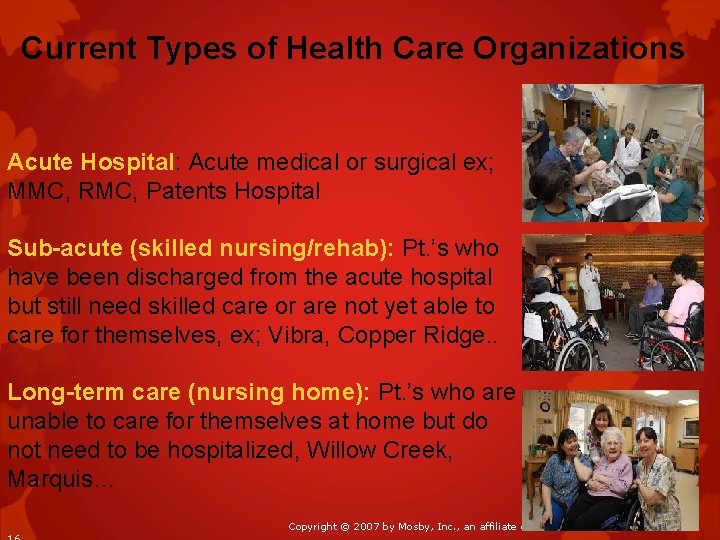
Current Types of Health Care Organizations Acute Hospital: Acute medical or surgical ex; MMC, RMC, Patents Hospital Sub-acute (skilled nursing/rehab): Pt. ’s who have been discharged from the acute hospital but still need skilled care or are not yet able to care for themselves, ex; Vibra, Copper Ridge. . Long-term care (nursing home): Pt. ’s who are unable to care for themselves at home but do not need to be hospitalized, Willow Creek, Marquis… Copyright © 2007 by Mosby, Inc. , an affiliate of Elsevier Inc.
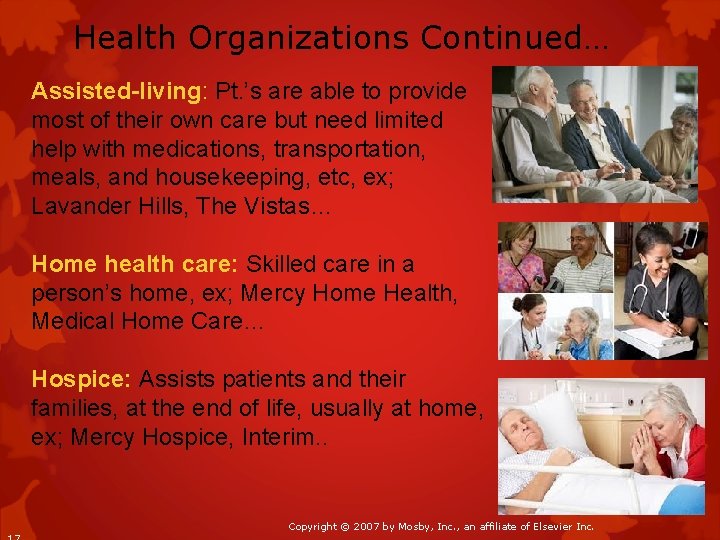
Health Organizations Continued… Assisted-living: Pt. ’s are able to provide most of their own care but need limited help with medications, transportation, meals, and housekeeping, etc, ex; Lavander Hills, The Vistas… Home health care: Skilled care in a person’s home, ex; Mercy Home Health, Medical Home Care… Hospice: Assists patients and their families, at the end of life, usually at home, ex; Mercy Hospice, Interim. . Copyright © 2007 by Mosby, Inc. , an affiliate of Elsevier Inc.
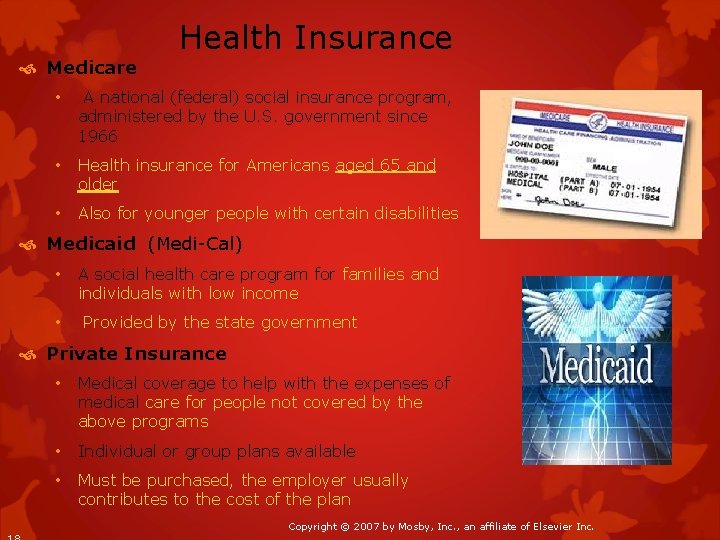
Health Insurance Medicare • A national (federal) social insurance program, administered by the U. S. government since 1966 • Health insurance for Americans aged 65 and older • Also for younger people with certain disabilities Medicaid (Medi-Cal) • • A social health care program for families and individuals with low income Provided by the state government Private Insurance • Medical coverage to help with the expenses of medical care for people not covered by the above programs • Individual or group plans available • Must be purchased, the employer usually contributes to the cost of the plan Copyright © 2007 by Mosby, Inc. , an affiliate of Elsevier Inc.
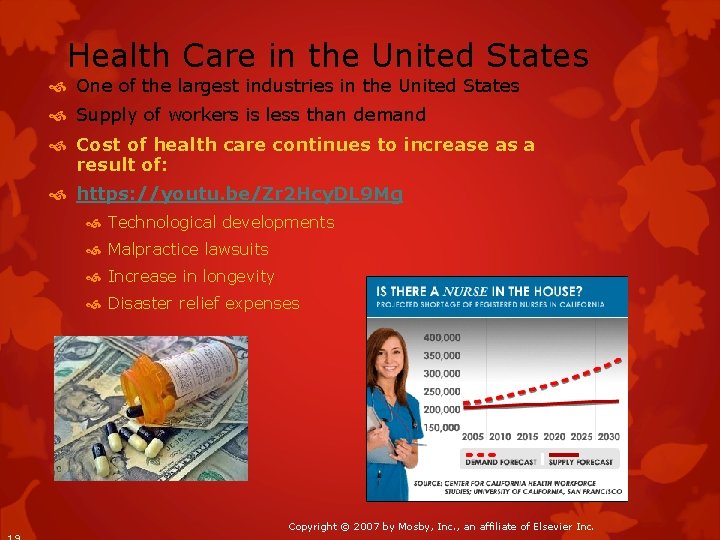
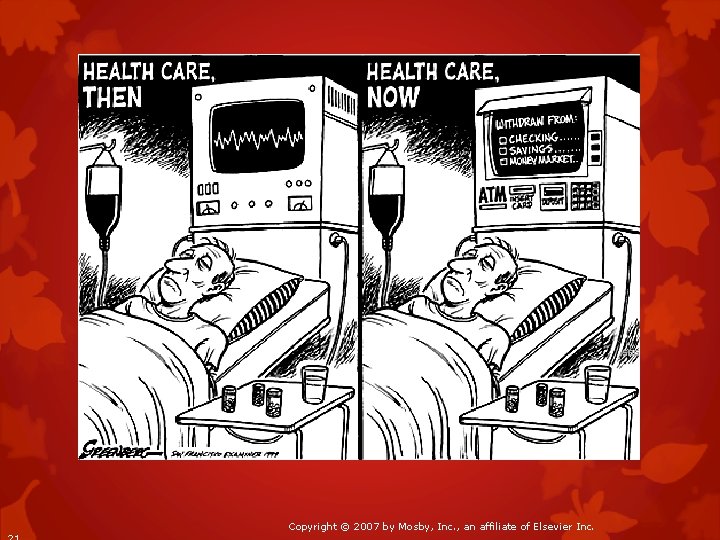
Health Care in the United States One of the largest industries in the United States Supply of workers is less than demand Cost of health care continues to increase as a result of: https: //youtu. be/Zr 2 Hcy. DL 9 Mg Technological developments Malpractice lawsuits Increase in longevity Disaster relief expenses Copyright © 2007 by Mosby, Inc. , an affiliate of Elsevier Inc.
Health Care of the Future Wellness Promotion and Services which will include: • Nutritional advice, stress reduction counseling, habit cessation management, and exercise instruction, yoga therapy and diabetes education. Care of the elderly-aging population Increased home care Larger hospitals will be for critically ill only More rehab/sub-acute and long term care facilities Increased use of alternative medicines Remote surgeries Nanotechnology Telemedicine https: //youtu. be/Bpl. Zm. PNfd. PQ https: //youtu. be/d 7 Ioj. FFHti. A https: //youtu. be/VJ_3 GJNz 4 fg Stem cell therapies Copyright © 2007 by Mosby, Inc. , an affiliate of Elsevier Inc.
Copyright © 2007 by Mosby, Inc. , an affiliate of Elsevier Inc.