
Health Benefits Administration An Introduction to the HR
Health Benefits Administration An Introduction to the HR Professional’s Role California Department of Human Resources
Learning Objectives • Describe the HR Professional’s role in health eligibility/enrollment • Locate and identify needed rules, procedures, and information • Make determination of eligibility • Categorize enrollment transactions
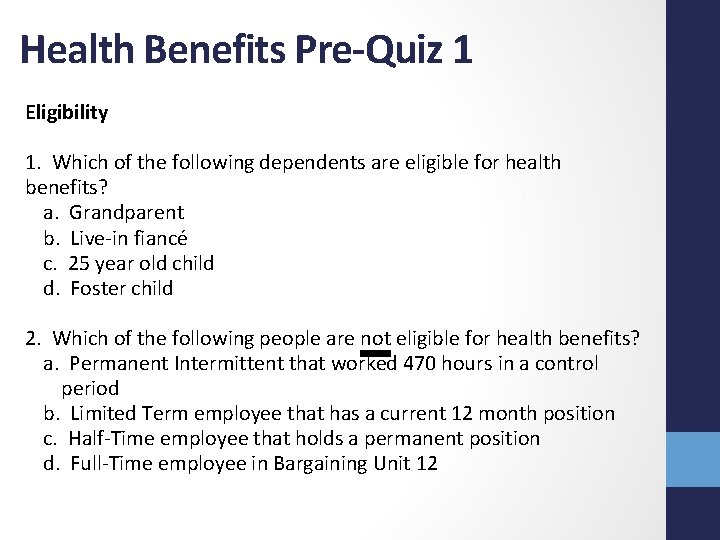
Health Benefits Pre-Quiz 1 Eligibility 1. Which of the following dependents are eligible for health benefits? a. Grandparent b. Live-in fiancé c. 25 year old child d. Foster child 2. Which of the following people are not eligible for health benefits? a. Permanent Intermittent that worked 470 hours in a control period b. Limited Term employee that has a current 12 month position c. Half-Time employee that holds a permanent position d. Full-Time employee in Bargaining Unit 12
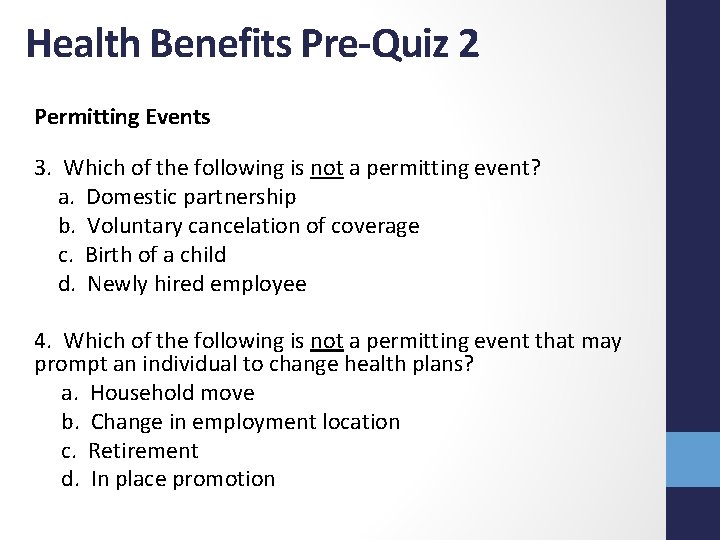
Health Benefits Pre-Quiz 2 Permitting Events 3. Which of the following is not a permitting event? a. Domestic partnership b. Voluntary cancelation of coverage c. Birth of a child d. Newly hired employee 4. Which of the following is not a permitting event that may prompt an individual to change health plans? a. Household move b. Change in employment location c. Retirement d. In place promotion
Health Benefits Pre-Quiz 3 Bonus Question 5. How often are open enrollments required per the Public Employees’ Medical and Hospital Care Act (PEHMCA)? a. b. c. d. Annually Once every other year Once every three years Periodically
Role of the HR Professional 1 Your Role is Essential: • Provide accurate information on enrollment, eligibility requirements, benefits, and costs • Ensure that only eligible employees and dependents are placed on the roll
Role of the HR Professional 2 • Process enrollments timely • Retain all documentation in OPF • Proactively monitor continued eligibility
There’s a Lot to Know • Product • Rules • System
Know the Cal. PERS Products • Web site—www. calpers. ca. gov • Health Plan Cal. PERS-specific Web sites • Health Program Guides • Health Benefit Summaries • Health Plan Evidence of Coverage (EOC)
Know the Rules • Public Employees’ Medical & Hospital Care Act (PEMHCA)— • Government Code § 22750– 22944 • CA Code of Regulations § 599. 500– 599. 517 • Cal. PERS State Health Benefits Guide • Cal. PERS Circular Letters • Cal. HR Policy Statements (Formerly PMLs) • State Collective Bargaining Contracts
Know the System • Take my|Cal. PERS Training • Use my|Cal. PERS Resources • Subscribe to my|Cal. PERS Notifications
WIIFM • The more you know, the easier your job becomes • Rising health benefit costs are a leading cause of anemic pay raises
Discussion Question 1 • An employee comes to you expressing confusion in selecting a health plan, and asks you which health plan is the best. What actions would you take and what information would you provide to assist them in making a selection?
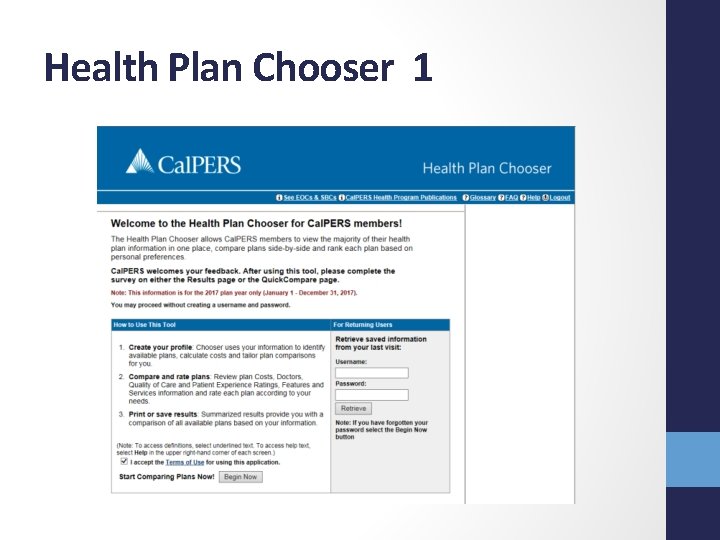
Health Plan Chooser 1
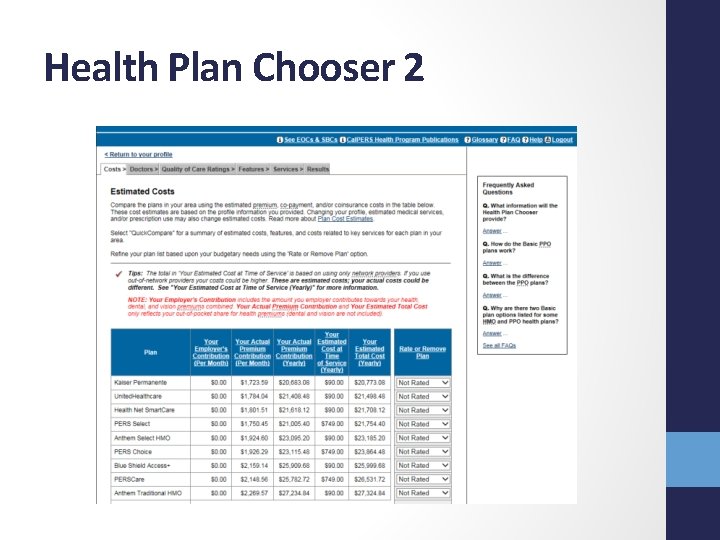
Health Plan Chooser 2
Eligibility • Based on appointment tenure and time base: • Tenure—More than 6 months • Time Base—Half-time or more • Special Rules for: • Permanent Intermittents • Seasonal Firefighters
Eligible Employees 1 • Permanent Full-Time • Permanent Part-Time (half-time or more) • Permanent Intermittent • Must work ≥ 480 hours in control period or ≥ 960 hours in 2 consecutive control periods • Must requalify each control period
Eligible Employees 2 • Limited Term of more than 6 months and: • Full-Time, or • Part-Time (half-time or more)
Ineligible Employees 1 • Employees whose appointment is: -Temporary (except for TAUs) -Limited Term, 6 months or less -Less than half-time -Intermittent, other than Permanent Intermittent
Temporary Authorization Utilization (TAU) 1 Current state employees: • TAU does not have to be more than 6 months. • Time base must be half-time or more.
Temporary Authorization Utilization (TAU) 2 New state employees: • TAU must be more than 6 months. • Time base must be half-time or more. • If later appointed Permanent Intermittent, cannot use hours worked as TAU to qualify for a control period.
Dependent Eligibility—Why. . . • Only spouses, domestic partners, and disabled adult children, but not other adults? • Only natural, adopted, step/DP children, children in parent-child relationship, but not other children?
Dependent Eligibility Verification Checklist (Cal. HR Form 781) 1 Required to: • Verify dependents are eligible for health, dental, and premier vision benefits before enrollment. • Annually recertify parent-child relationships (PCR).
Dependent Eligibility Verification Checklist (Cal. HR Form 781) 2 • Section 1—Required forms and acceptable documents to determine dependent eligibility • Section 2—Documents the employee knows their obligations by their signature • Section 3—Documents HR staff took necessary steps by their signature
Required Enrollment Documents • Cal. PERS Circular Letter 600 -045 -12 • Cal. HR Health Benefits Policy (formerly PML)
Eligible Dependents 1 • Spouse or registered domestic partner • Employee’s children, up to age 26: • Natural children • Adopted children • Step children • Registered domestic partner's children
Eligible Dependents 2 • Employee’s disabled adult children— • Must be incapable of self-support due to a mental or physical condition • Must be disabled and enrolled prior to age 26 • Cal. PERS approves : • “Member Questionnaire for the Cal. PERS Disabled Dependent Health Benefit” and • “Medical Report for the Disabled Dependent Benefit”
Eligible Dependents 3 Initial certification of disabled adult child must be: • Within 60 days before and 60 days after child’s 26 th birthday (employee and child currently enrolled) Or • Within 60 days of newly eligible employee’s initial health enrollment
Eligible Dependents 4 • Children up to age 26 for whom employee has: “assumed a parent-child relationship. . . by intentional assumption of parental status, or assumption of parental duties” [CA Code of Regulations § 599. 500(o)] PCR (parent-child relationship)
PCR Eligibility Procedure • Employee must complete Affidavit of Parent. Child Relationship and provide documentations showing a current parent-child relationship. • HR Manager and Health Benefits Officer must sign Affidavit.
Enrolling PCR Child Under Age 19 Employee submits: • A copy of the first page from the previous tax year’s income tax return, showing child is a dependent OR • Court order with employee as legal guardian • Bank, credit card, tuition or insurance statement • School records • Bills or mail indicating common residency
Re-certifying PCR Child Under Age 19 Employee must submit a copy of the first page from the previous tax year’s income tax return, showing child is a dependent.
Enrolling and Re-certifying PCR Child, Age 19 to 26 Employee submits: • A copy of the first page from the previous tax year’s income tax return, showing child is a dependent OR • Other documentation showing child is financially dependent, provided that the child: • Lives with employee for more than 50 percent or is a full-time student, AND • Is more than 50 percent dependent upon employee
PCR Annual Recertification • Annual Recertification Required (Circular Letter 600 -058 -12) • Employee must submit a new affidavit and documentations showing current parent-child relationship • HR Manager and Health Benefits Officer must sign Affidavit
Ineligible Dependents 1 • Former spouses and former registered domestic partners are not eligible (even if a court orders the employee to provide health coverage) • Children age 26 and older • Disabled adult children not enrolled and disabled prior to age 26
Ineligible Dependents 2 • Grandchildren, grandparents, aunts, uncles, nieces, nephews, etc. • Foster children • Spouses/domestic partners of adult children
Ineligible Dependents 3 • Live-in boyfriend/girlfriend and his/her children • Anyone already enrolled in a Cal. PERS health plan on their own or as another subscriber’s dependent
Benefit Entitlement • Government Code section 20128 allows Cal. PERS to require information it deems necessary to determine a member or beneficiary’s benefit entitlement.
Enrollment 1 • Self-Only or • Self and all eligible dependents • Exceptions: • Family member with other (non-Cal. PERS) coverage • Spouse not living with employee • Children over 18 • Family member in military
Enrollment 2 • Failure to Enroll required Dependent(s): • Notice the employee in writing that all family members will be deleted from coverage effective the last day of the following month. • If the employee does not comply timely, administratively disenroll all family members. • CA Code of Regulations § 599. 502(a)(6)
Enrollment 3 • Enrollment Types: • New Enrollment • Open Enrollment • Special Enrollment • Late Enrollment (HIPAA) • Permitting Event—occurrence that permits an enrollment action
New Enrollment • New hires may enroll within 60 days of appointment • Permanent Intermittents may enroll within 60 days following completion of qualifying control period • Coverage effective the first of the month following the date HBD-12 is received in HR Office.
Open Enrollment • Held each fall for approximately 30 days • Employees may enroll, change plans, cancel coverage, add, or delete dependents • Changes effective January 1 (start of new plan year) • Cal. PERS issues Circular Letter in summer with open enrollment info & instructions
Special Enrollment • Triggered by permitting events, such as: • Marriage • Birth (Reference Circular Letter 600 -007) • Adoption or placement for adoption • Involuntary loss of other coverage • Court-ordered coverage • Must enroll within 60 days of event • Effective 1 st of the month following
Late Enrollment (HIPAA) • Outside of open enrollment or more than 60 days following permitting event • 90 -day waiting period • Coverage effective 1 st of the month following expiration of 90 -day waiting period • Reference Circular Letter 600 -007
Transactions • Mandatory • Permissive • Plan Changes • Prohibited • Reason Codes; Effective Date Methods www. calpers. ca. gov
Mandatory Transactions • Additions or deletions required by law from: • Court-ordered coverage • Divorce (deletion of ex-spouse and stepchildren) • Death of a family member • Dependent reaches age 26 • Separation from employment or reduction in time base (Circular Letter 600 -067 -10) • Birth or adoption
Permissive Transactions • Additions or deletions that are voluntary at the employee’s option. • Examples include: • Child reaches age 18 • Family member enters or leaves military • Family member obtains other coverage • Custody change for child under age 18
Health Plan Change Triggers enabling a plan change: • Household move • Change in employment location • Retirement • Becoming Medicare-eligible
Not Permitted • Dual Coverage • Split Enrollments—dependents can’t be split between two Cal. PERS subscribers • Upon discovery, the employee’s health account must be corrected retroactively • Retroactivity (Circular Letter 600 -215 -05)
Off Pay Status • Circular Letter 600 -050 -14 • Employee may direct pay premiums when off pay status, such as: leave of absence (LOA), pending approval of disability retirement, suspension. • If employee declines to direct pay: must complete a HBD-12 to cancel coverage • When an employee returns to work: update my|Cal. PERS and schedule resumption of payroll deductions
Employee Must Report Timely • Marriage/Domestic Partnership • Divorce/Termination of Domestic Partnership • Death of a member/family member • Change of residential address • Medicare-eligible due to age or disability
Discussion Question 2 • What about the role of the HR professional in health eligibility/enrollment is most challenging? • What kinds of support would help most with these challenges?
Separation and Divorce 1 • If separated, but still married: • Cannot drop minor step-children. • If court-orders coverage: • If employee is not enrolled, must enroll. • Health plan must provide coverage where dependents reside. • If employee refuses, HR administratively enrolls family in PERS Choice.
Separation and Divorce 2 • When divorce is final: • Disenroll ex-spouse and step-children • COBRA rights • A court ordering employee to provide ex-spouse with health coverage does not bind the state to provide it, or make the ex-spouse eligible for state benefits.
Dependent Health Vesting Check bargaining unit contract of the employee.
Medicare 1 • Advise employees reaching age 65 and new-hires age 65 or older to contact Social Security Administration for their Medicare options, rights, and obligations. • Lifetime penalty (premium surcharge) for late Medicare Part B enrollment.
Medicare 2 Cannot enroll Medicare-covered employees into Flex. Elect or Co. Ben Cash Option.
Summary • Your role is important. • Administering health benefits matters to the employees and the state. • Organize and use reference materials online.
- Slides: 60