
Health Assessment Praxis Learning Outcome 2 Apply the


- Slides: 43
Health Assessment & Praxis Learning Outcome 2 - Apply the Nursing Process
Nursing Assessment Learning Step 1
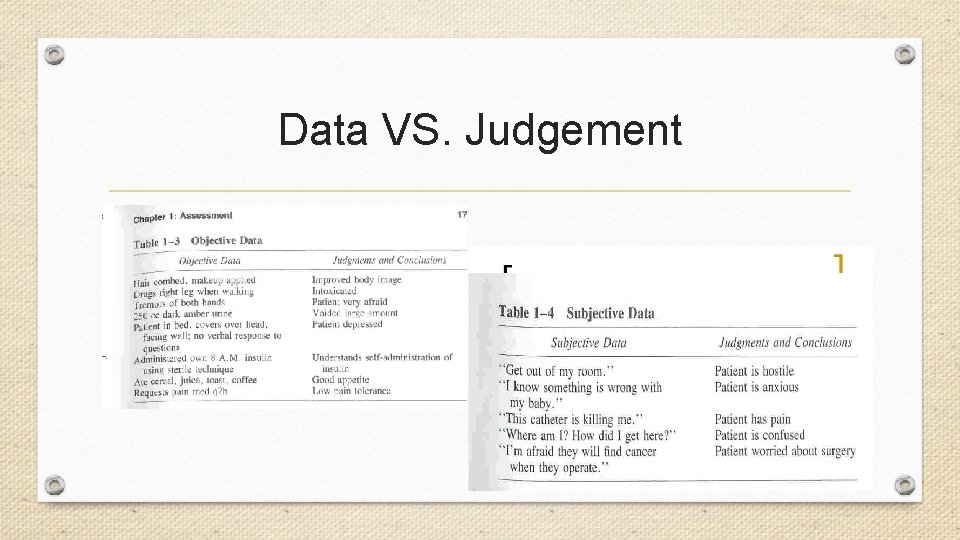
Nursing Assessment • Collecting Data • Subjective and Objective • Comprehensive Nursing Health History
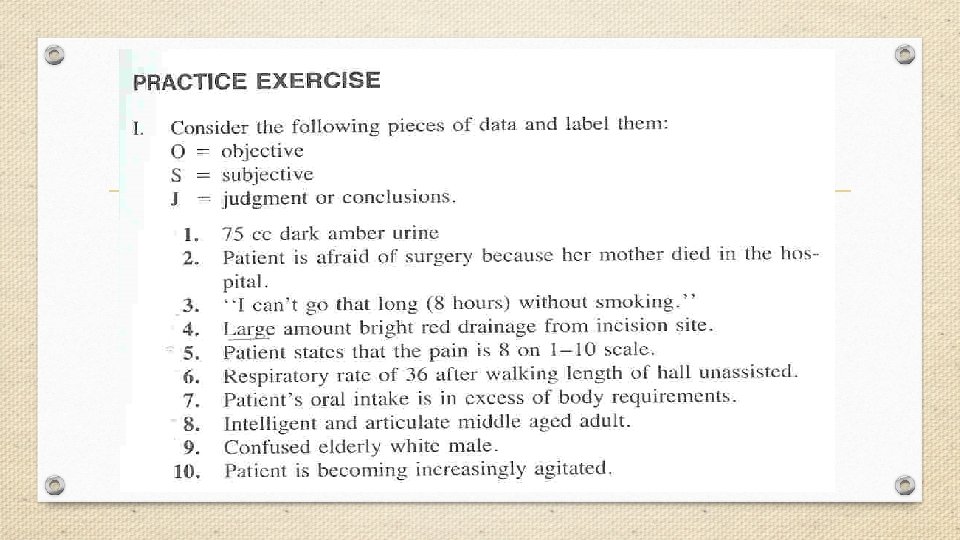
Data VS. Judgement
Methods of Data Collection • Interview • During the Interview, you need to:
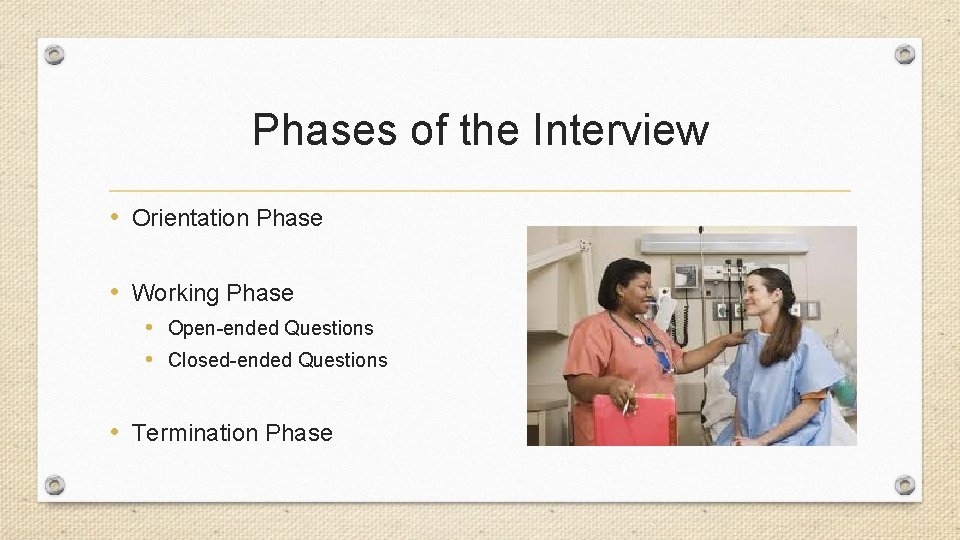
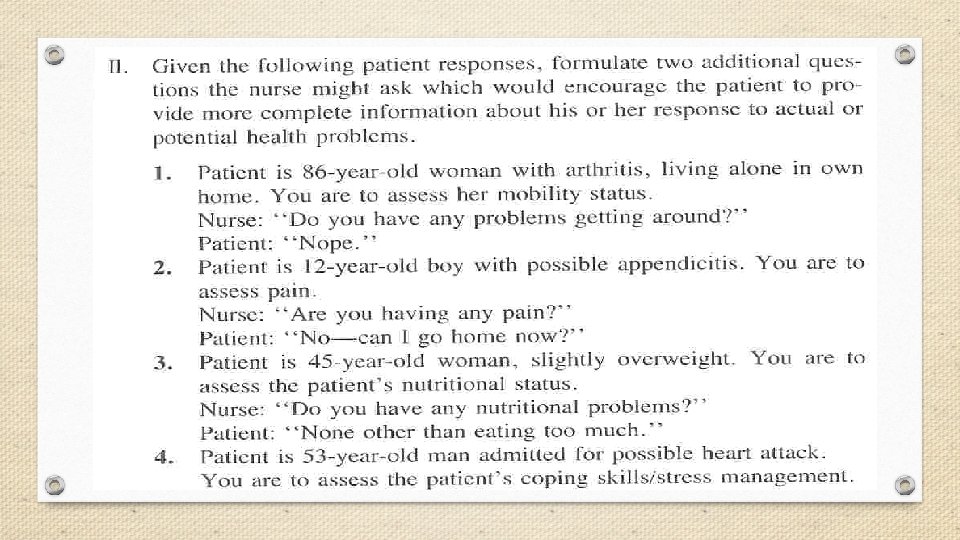
Phases of the Interview • Orientation Phase • Working Phase • Open-ended Questions • Closed-ended Questions • Termination Phase
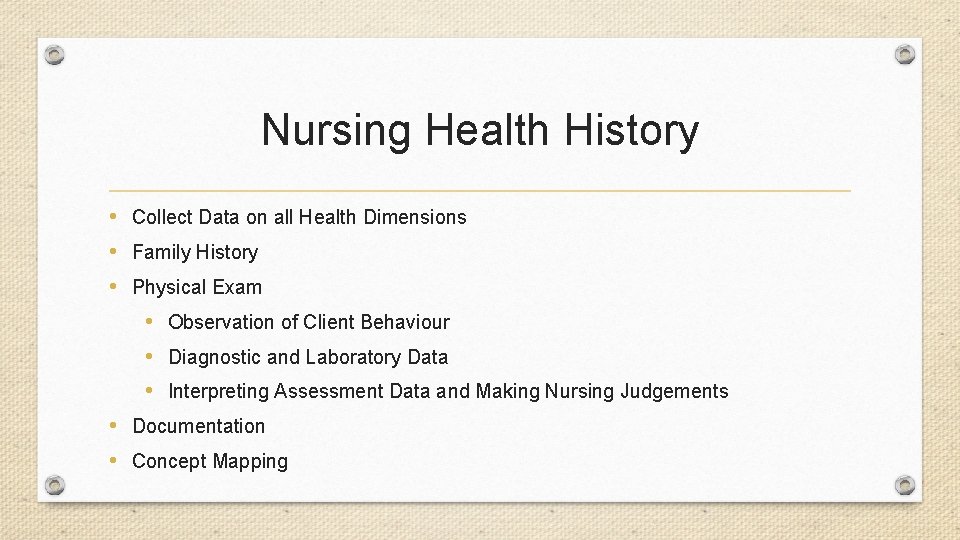
Nursing Health History • Collect Data on all Health Dimensions • Family History • Physical Exam • Observation of Client Behaviour • Diagnostic and Laboratory Data • Interpreting Assessment Data and Making Nursing Judgements • Documentation • Concept Mapping
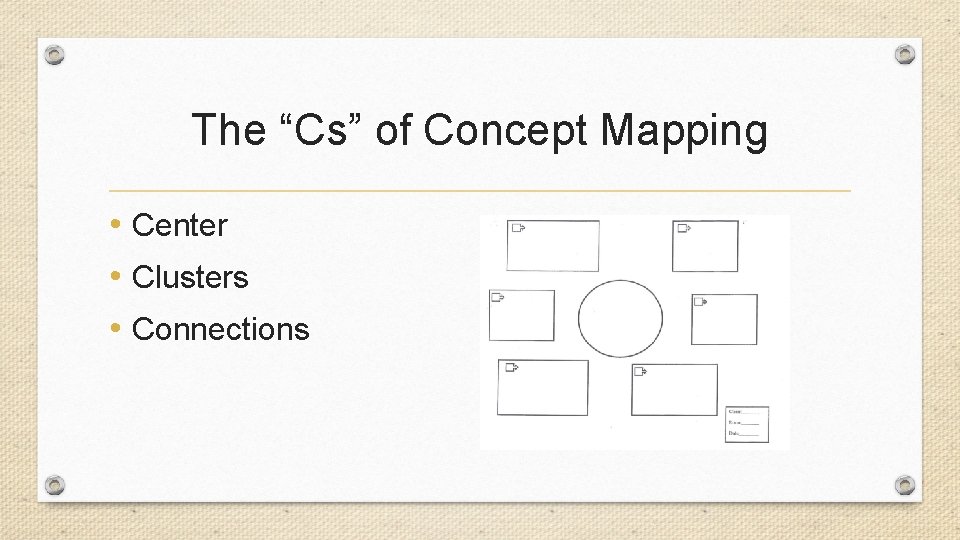
The “Cs” of Concept Mapping • Center • Clusters • Connections
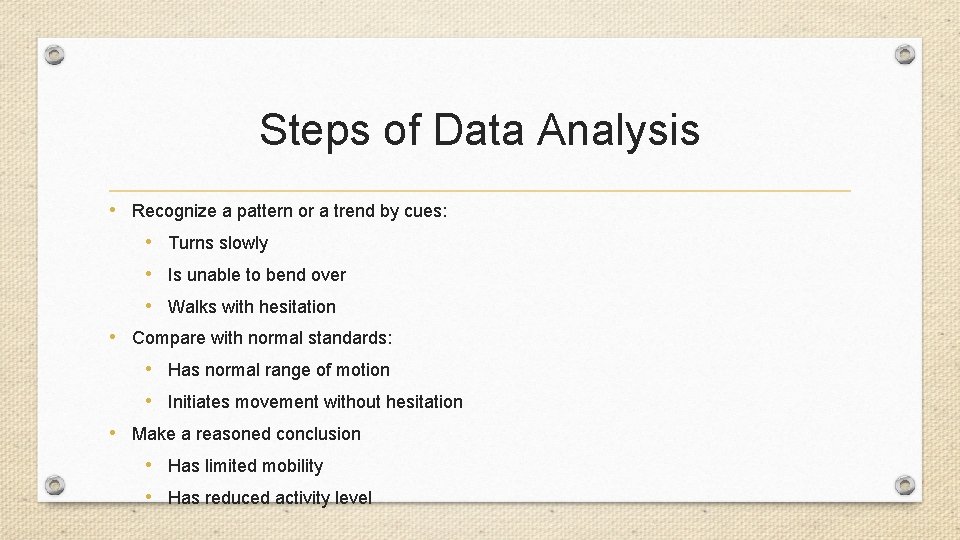
Steps of Data Analysis • Recognize a pattern or a trend by cues: • Turns slowly • Is unable to bend over • Walks with hesitation • Compare with normal standards: • Has normal range of motion • Initiates movement without hesitation • Make a reasoned conclusion • Has limited mobility • Has reduced activity level
Assessment Review • During a nursing assessment the nurse systematically collects, verifies, • • and analyzes and communicates data about a client. The nurse must apply the principles of critical thinking. Comprehensive approaches to data collection go from general to specific. The nurse assesses clients by organizing patterns of behaviour and physiological responses that pertain to a functional health category. The nurse then compares data with the client's baseline. The nurse must cluster clues of assessment data and begin to identify emerging patterns and potential problems.
Nursing Diagnosis Learning Step 1
Nursing Diagnosis • Forming a diagnostic conclusion that will determine the nursing care a client receives. • Problems treated primarily by nurses are nursing diagnosis • Focuses on actual or potential response to a health problem
Diagnosis Medical VS. Nursing • Diagnose- “to know” • Medical Diagnosis- identifying a disease or condition based on specific evaluation of physical signs, symptoms, medical history, and diagnostic tests. • Physicians are licensed to treat these • Nursing Diagnosis- determines health problems within the domain of nursing. Comes from analyzing data and making a clinical judgement with response to actual or potential health problems. • Figure 12 -6 - Page 165 P&P
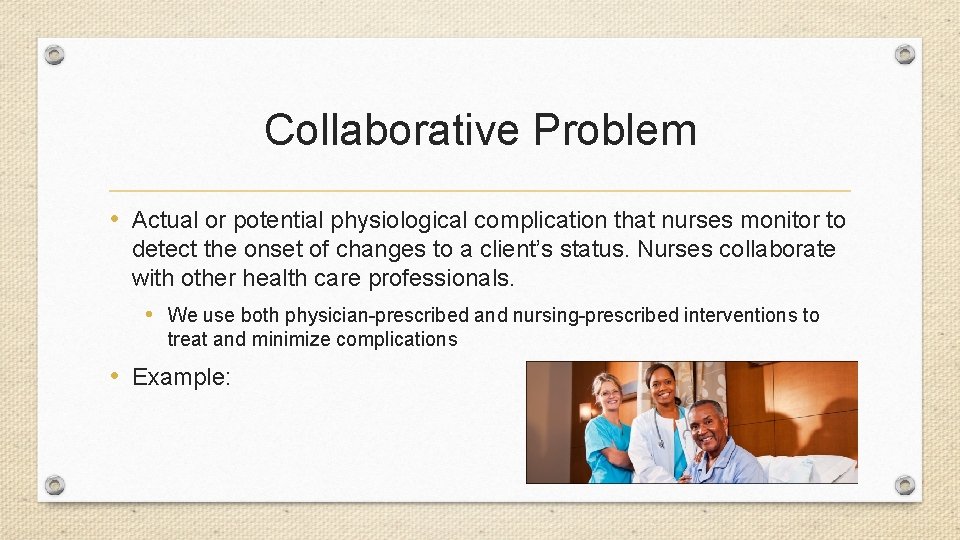
Collaborative Problem • Actual or potential physiological complication that nurses monitor to detect the onset of changes to a client’s status. Nurses collaborate with other health care professionals. • We use both physician-prescribed and nursing-prescribed interventions to treat and minimize complications • Example:
Nursing Diagnosis • Conclusions drawn using common nomenclature • A part of professional practice • List of Nursing Diagnoses provided by NANDA-I
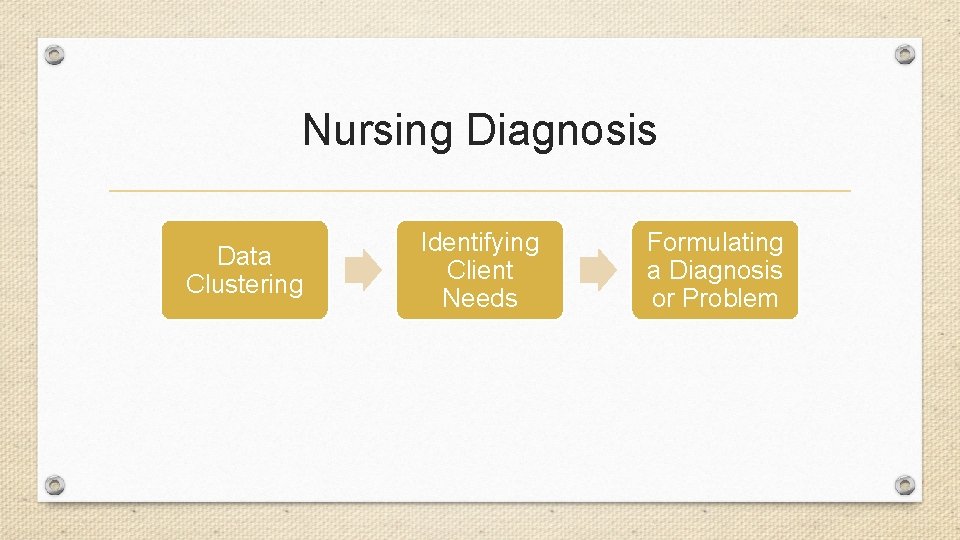
Nursing Diagnosis Data Clustering Identifying Client Needs Formulating a Diagnosis or Problem
Nursing Diagnosis • We create by identifying defining characteristics- the clinical criteria or assessment findings that help confirm a nursing diagnosis. • Clinical criteria- objective or subjective signs and symptoms, clusters of signs and symptoms, or risk factors that lead to a diagnostic conclusion.
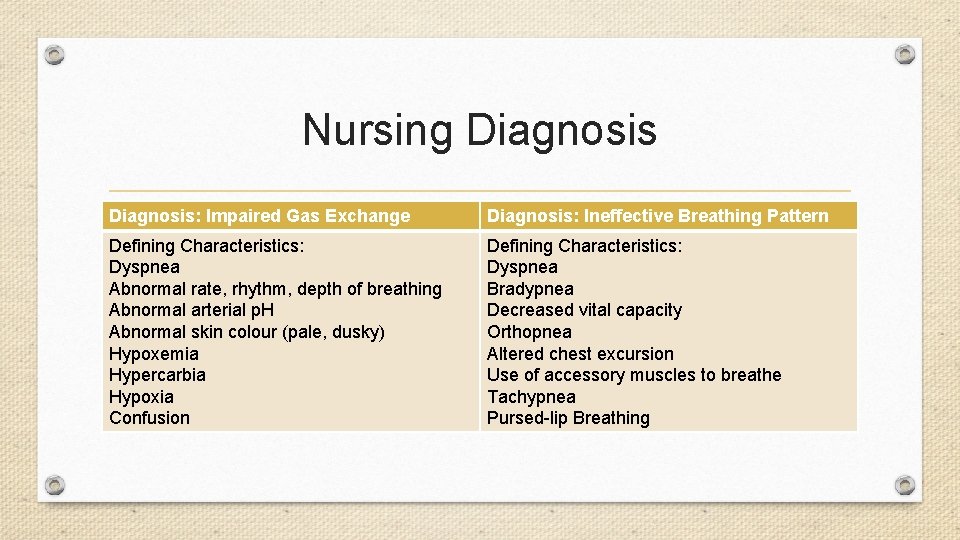
Nursing Diagnosis: Impaired Gas Exchange Diagnosis: Ineffective Breathing Pattern Defining Characteristics: Dyspnea Abnormal rate, rhythm, depth of breathing Abnormal arterial p. H Abnormal skin colour (pale, dusky) Hypoxemia Hypercarbia Hypoxia Confusion Defining Characteristics: Dyspnea Bradypnea Decreased vital capacity Orthopnea Altered chest excursion Use of accessory muscles to breathe Tachypnea Pursed-lip Breathing
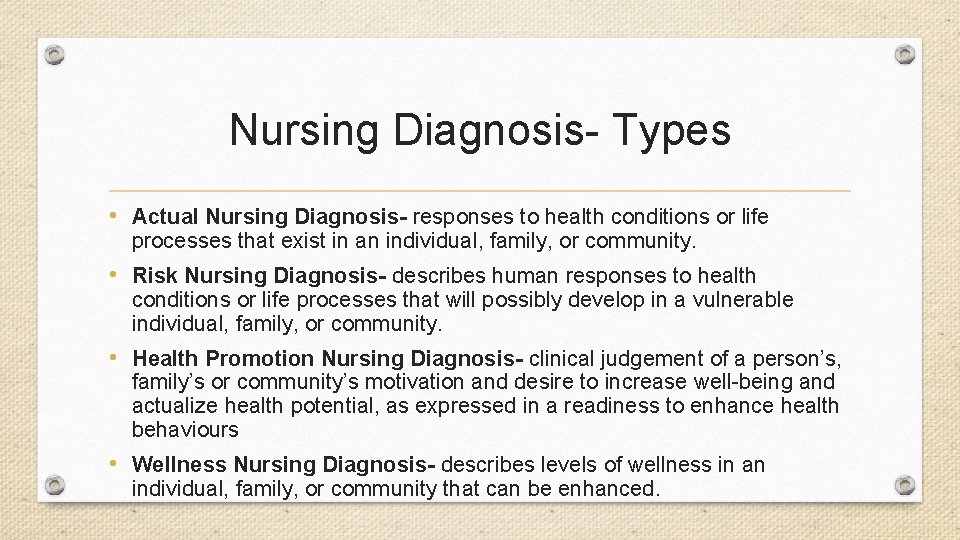
Nursing Diagnosis- Types • Actual Nursing Diagnosis- responses to health conditions or life processes that exist in an individual, family, or community. • Risk Nursing Diagnosis- describes human responses to health conditions or life processes that will possibly develop in a vulnerable individual, family, or community. • Health Promotion Nursing Diagnosis- clinical judgement of a person’s, family’s or community’s motivation and desire to increase well-being and actualize health potential, as expressed in a readiness to enhance health behaviours • Wellness Nursing Diagnosis- describes levels of wellness in an individual, family, or community that can be enhanced.
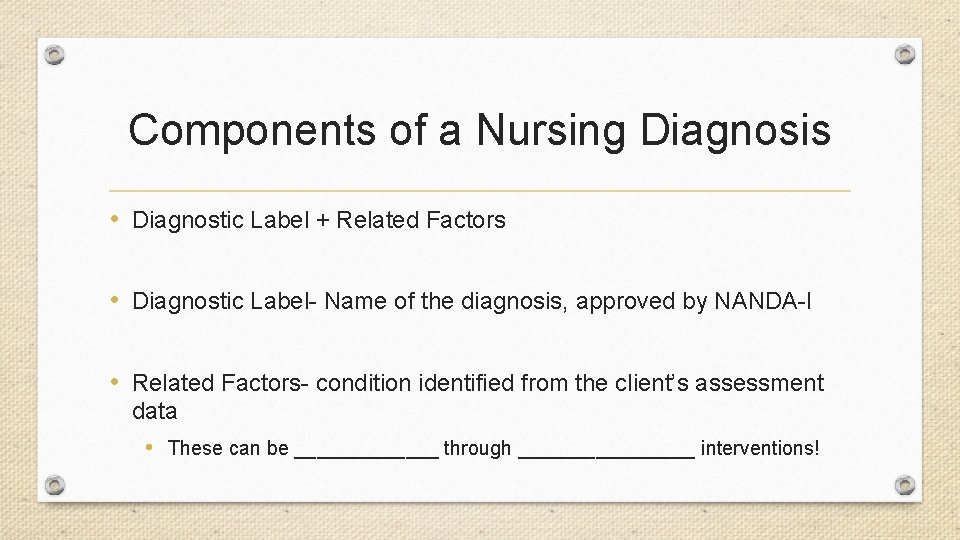
Components of a Nursing Diagnosis • Diagnostic Label + Related Factors • Diagnostic Label- Name of the diagnosis, approved by NANDA-I • Related Factors- condition identified from the client’s assessment data • These can be _______ through ________ interventions!
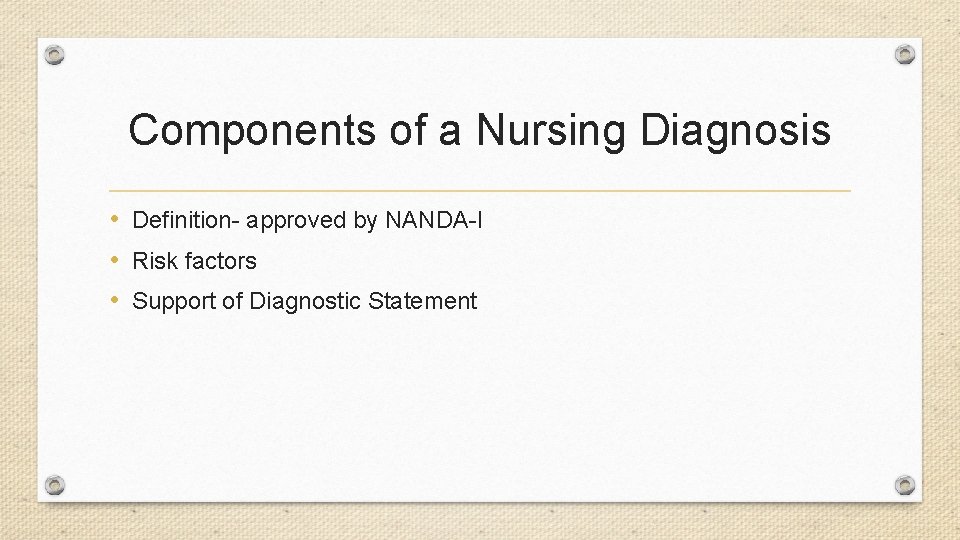
Components of a Nursing Diagnosis • Definition- approved by NANDA-I • Risk factors • Support of Diagnostic Statement
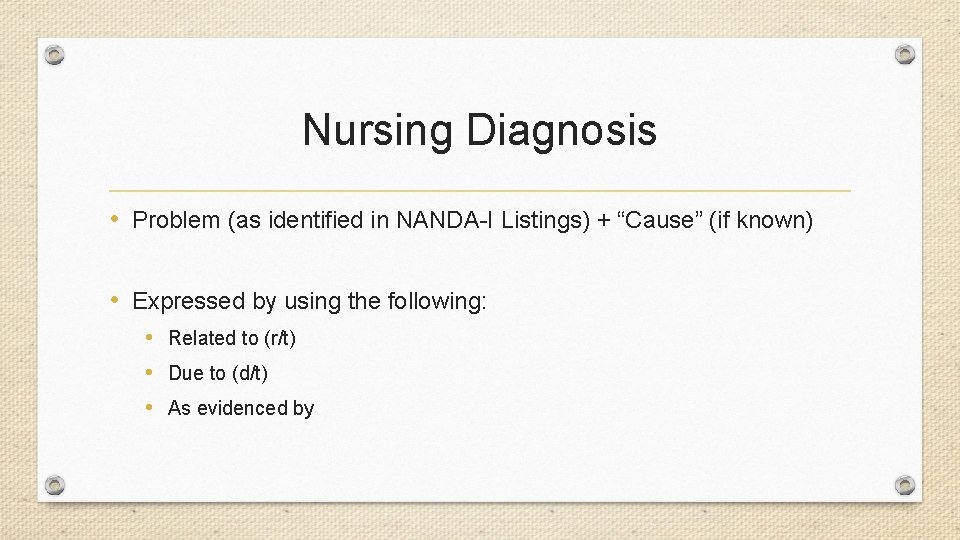
Nursing Diagnosis • Problem (as identified in NANDA-I Listings) + “Cause” (if known) • Expressed by using the following: • Related to (r/t) • Due to (d/t) • As evidenced by
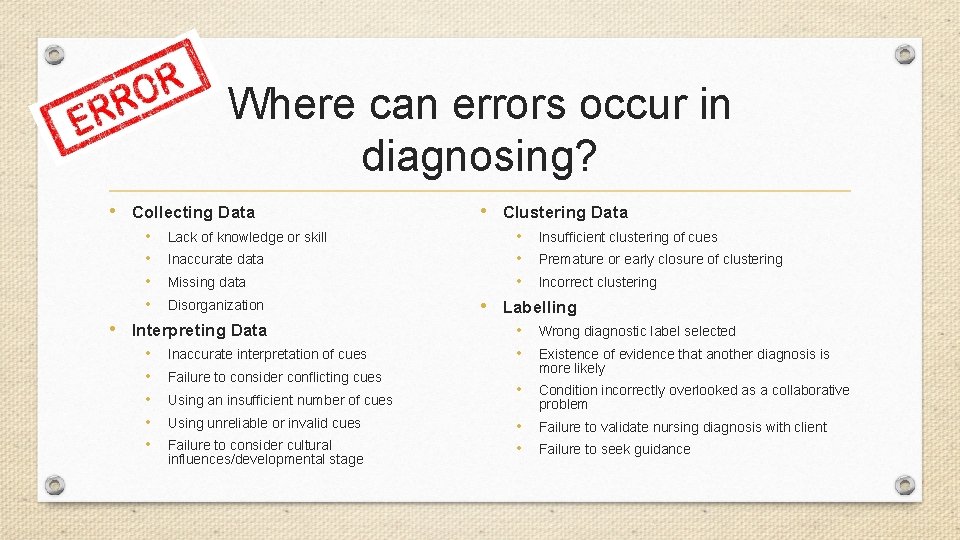
Where can errors occur in diagnosing? • Collecting Data • • Lack of knowledge or skill Inaccurate data Missing data Disorganization • Interpreting Data • • • Inaccurate interpretation of cues Failure to consider conflicting cues Using an insufficient number of cues Using unreliable or invalid cues Failure to consider cultural influences/developmental stage • Clustering Data • • • Insufficient clustering of cues Premature or early closure of clustering Incorrect clustering • Labelling • • Wrong diagnostic label selected • Condition incorrectly overlooked as a collaborative problem • • Failure to validate nursing diagnosis with client Existence of evidence that another diagnosis is more likely Failure to seek guidance
Let’s Practice • A person who has just had their right leg amputated • A person who just had surgery for a broken leg • A person with terminal cancer
Critical Thinking • Mrs. Spezio has a pressure ulcer over the coccyx that is 5 cm in diameter and approximately 1 cm deep. The tissue surrounding the ulcer is inflamed and tender to touch. Mrs. Spezio is transferring from a long-term care facility where she had resided for six months after a massive stroke. She is unable to move independently in bed and does not sense pressure or discomfort over her coccyx or hips. In view of this clinical situation, identify the defining characteristics and related factors for the nursing diagnosis impaired skin integrity.
Planning Stage
Planning = Setting Priorities + Establishing Goals + Planning Interventions
Priorities • Setting priorities involves ranking nursing diagnoses or client problem, using principles such as urgency or importance, to establish a preferred order for nursing actions. • High Priority • If untreated, will it result in harm to the client?
Priorities • Intermediate Priority • Non-life threatening, non-emergency needs of the client • Low-Priority • Not always directly related to a specific illness or prognosis, but affect the client’s future well-being
Goals • Goals - what you hope to achieve with your client • Goals need to be: • • Specific Measurable Observable Time-limited Achievable Client-Centered Involves only one behaviour or response
Goals • What does it mean to be client-centered? • Short-Term Goal • Long-Term Goal Begin each goal with: Client will…
Expected Outcomes • A specific measurable change in a client’s status that you expect in response to nursing care. • Help us determine when our goals have been met • There are usually several desired outcomes for each nursing diagnosis and goal • The terms expected outcomes and goals are often used interchangeably and are often combined into one statement
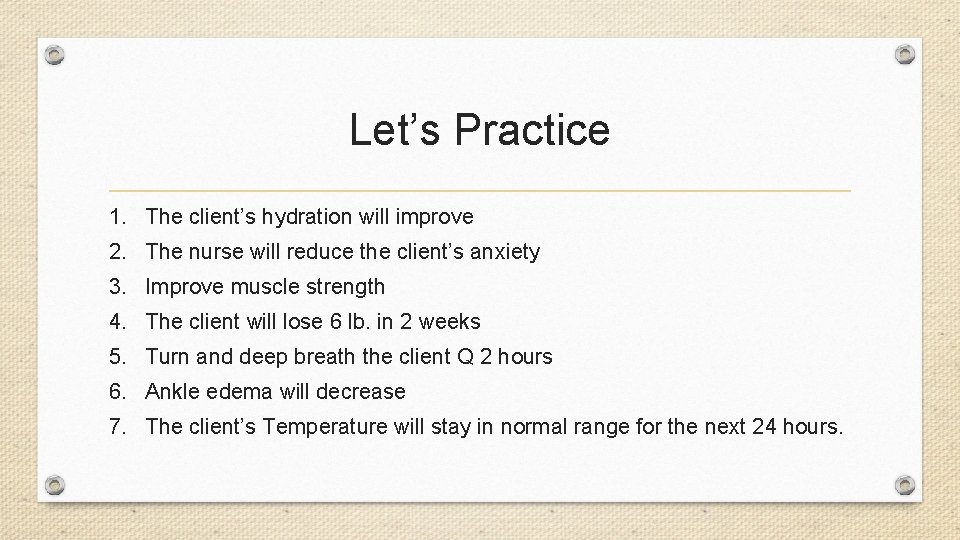
Let’s Practice 1. The client’s hydration will improve 2. The nurse will reduce the client’s anxiety 3. Improve muscle strength 4. The client will lose 6 lb. in 2 weeks 5. Turn and deep breath the client Q 2 hours 6. Ankle edema will decrease 7. The client’s Temperature will stay in normal range for the next 24 hours.
Nursing Interventions • Independent Nursing Interventions • Dependent Nursing Interventions • Collaborative Nursing Interventions-
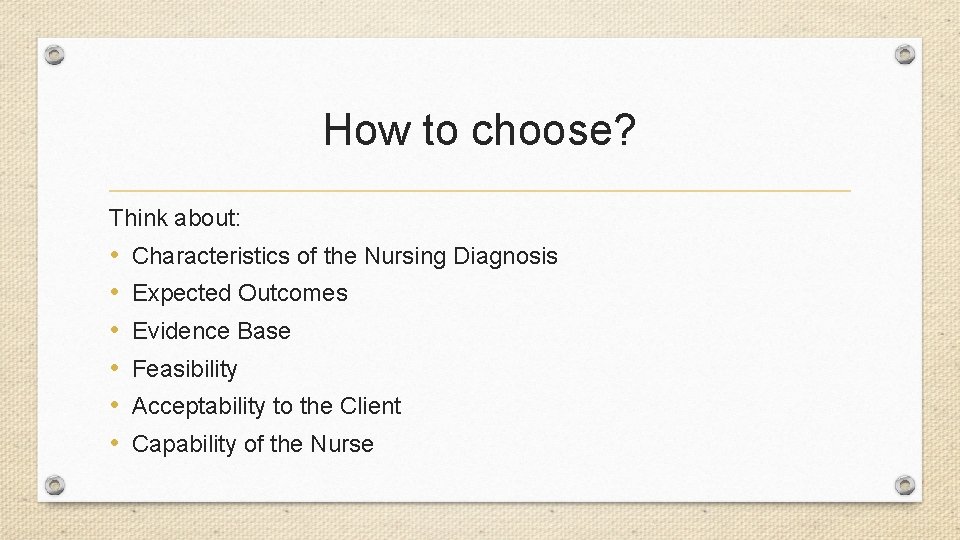
How to choose? Think about: • • • Characteristics of the Nursing Diagnosis Expected Outcomes Evidence Base Feasibility Acceptability to the Client Capability of the Nurse
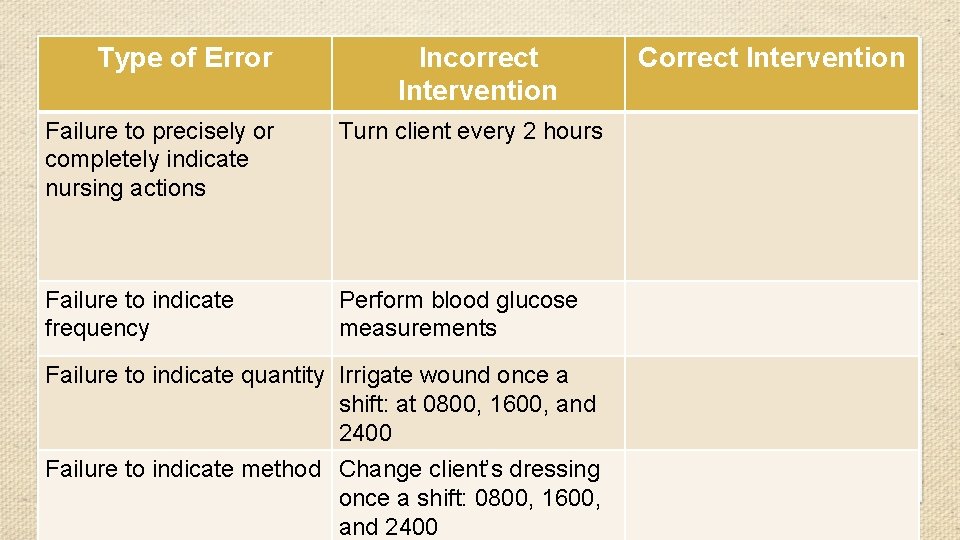
Type of Error Incorrect Intervention Failure to precisely or completely indicate nursing actions Turn client every 2 hours Failure to indicate frequency Perform blood glucose measurements Failure to indicate quantity Irrigate wound once a shift: at 0800, 1600, and 2400 Failure to indicate method Change client’s dressing once a shift: 0800, 1600, and 2400 Correct Intervention
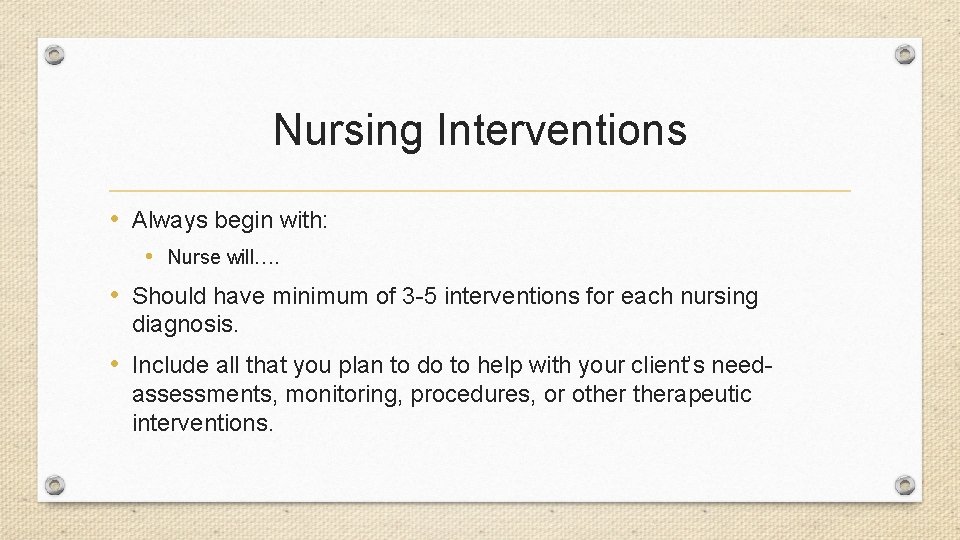
Nursing Interventions • Always begin with: • Nurse will…. • Should have minimum of 3 -5 interventions for each nursing diagnosis. • Include all that you plan to do to help with your client’s needassessments, monitoring, procedures, or otherapeutic interventions.
Nursing Care Plans • Bringing it all together! • Include: • Any nurse should be able to pick up the care plan and identify client’s needs and situation!
Terms to Know… • Kardex- a filing system that allows quick reference to the needs of the client for certain aspects of nursing care. The careplan is a part of this. • Critical pathways- multidisciplinary treatment plans. Outline treatment that a patient may require for the treatment of a condition • Consultation- seeking the expertise of a specialist, such as another nurse or another member of the health care team.