
Health and Your Wellness Coach Whitaker Vocabulary Lifestyle

Health and Your Wellness Coach Whitaker
Vocabulary • Lifestyle diseases—disease caused by unhealthy behaviors and other factors. • Risk Factor—anything that increases the likelihood of injury, disease, or health problems. • Sedentary—not taking part of physical activity regularly. • Health—state of well being in which all components of health are in balance. • Value—a strong belief or ideal • Wellness—the achievement of a person’s best in all 6 components of health.
Vocabulary • Life skill—a tool for building a healthy life. • Coping—dealing with problems and troubles in an effective way. • Resource—something that you can use to help achieve a goal. • Consequence—a result of your actions and decisions. • Collaborate—to work together with one or more people. • Peer Pressure—a feeling you should do something because that is what your friends want. • Refusal skills—a strategy to avoid doing something you don’t want to do.
Vocabulary • Self-Esteem—a measure of how much you value, respect, and feel confident about yourself. • Empathy—the ability to understand another person’s feelings, behaviors, and attitudes. • Emotion—feeling that is produced in response to life experiences. • Defense mechanism—an unconscious behavior used to avoid experiencing unpleasant emotions. • Mental illness—an illness that affects a person’s thought, emotions, and behaviors.
Health Today • Health in the Past: Infectious ____________ 1. Can be passed from one person to another caused by pathogens such as viruses and bacteria. 2. Leading cause of death in America in the 1800’s and 1900’s • Health Today: _______________ Diseases 1. Diseases caused by unhealthy factors and other behaviors. 2. Influenced by the ____________you make that affect your health
What Do You Think Are the Most Serious Health Problems for Teens 1. 2. 3. 4. 5.
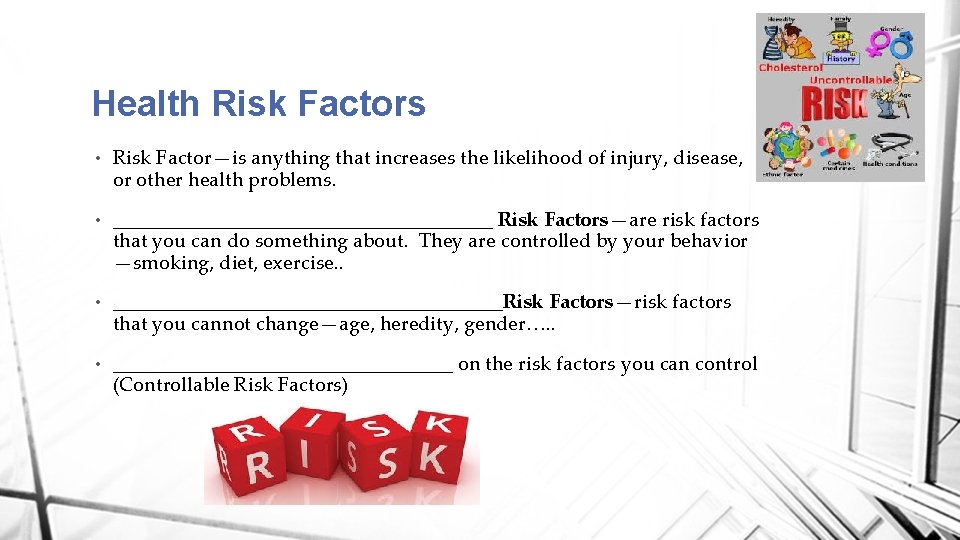
Health Risk Factors • Risk Factor—is anything that increases the likelihood of injury, disease, or other health problems. • ___________________ Risk Factors—are risk factors that you can do something about. They are controlled by your behavior —smoking, diet, exercise. . • ____________________Risk Factors—risk factors that you cannot change—age, heredity, gender…. . • _________________ on the risk factors you can control (Controllable Risk Factors)
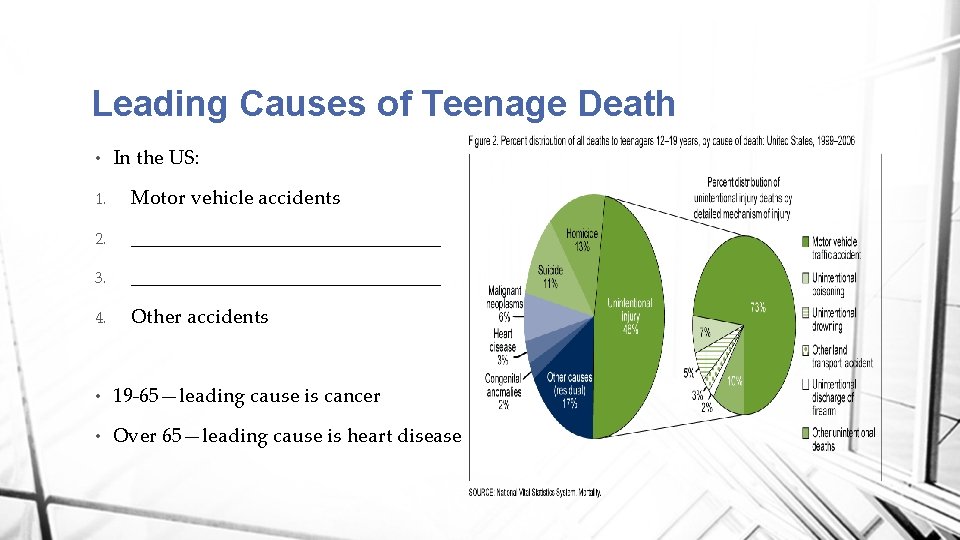
Leading Causes of Teenage Death • In the US: 1. Motor vehicle accidents 2. ________________ 3. ________________ 4. Other accidents • 19 -65—leading cause is cancer • Over 65—leading cause is heart disease
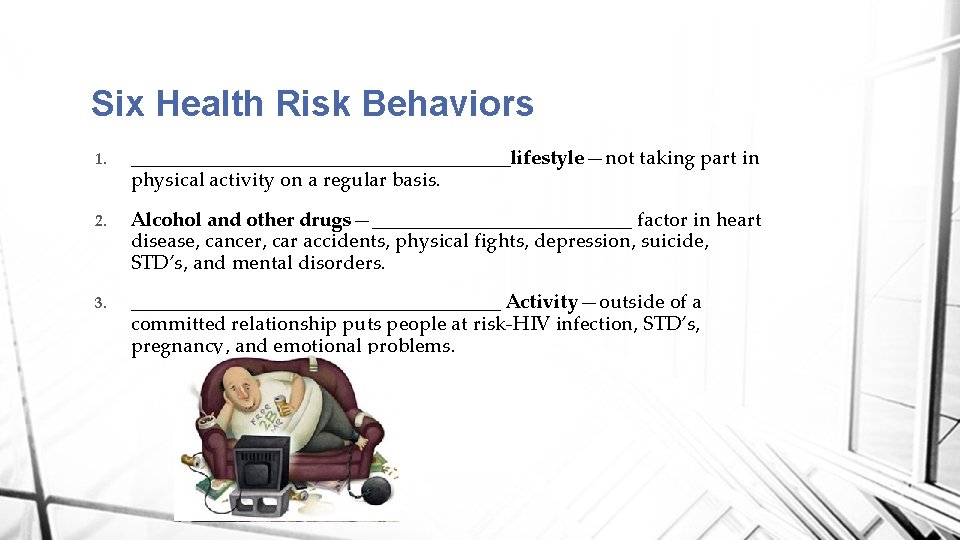
Six Health Risk Behaviors 1. ___________________lifestyle—not taking part in physical activity on a regular basis. 2. Alcohol and other drugs—_____________ factor in heart disease, cancer, car accidents, physical fights, depression, suicide, STD’s, and mental disorders. 3. ___________________ Activity—outside of a committed relationship puts people at risk-HIV infection, STD’s, pregnancy, and emotional problems.
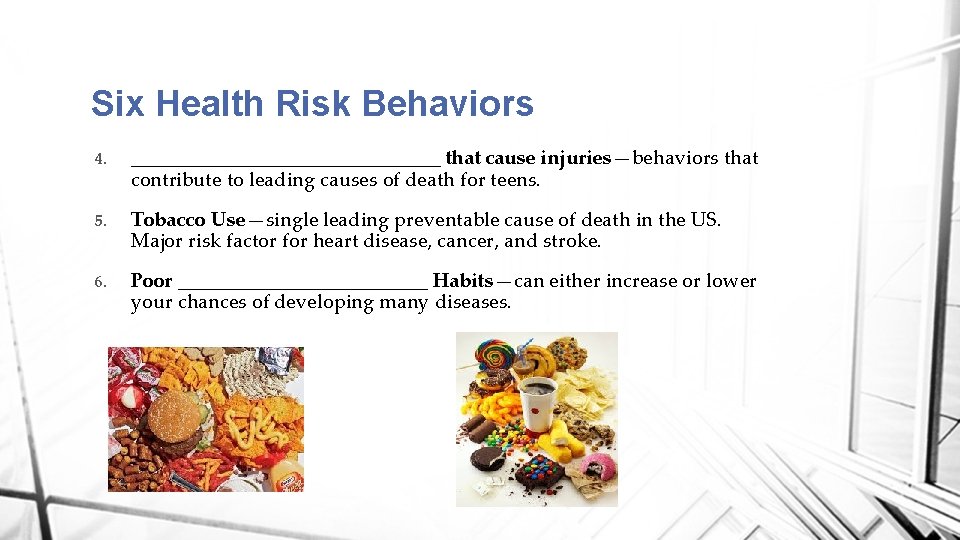
Six Health Risk Behaviors 4. ________________ that cause injuries—behaviors that contribute to leading causes of death for teens. 5. Tobacco Use—single leading preventable cause of death in the US. Major risk factor for heart disease, cancer, and stroke. 6. Poor _____________ Habits—can either increase or lower your chances of developing many diseases.
Activity Choices • Working with a partner, Controllable Risk Factors Table For—chronic diseases, other life stresses (making parents happy), poor health habits, or risky behavior. Most Have: 1. What it is? 2. Drawing in the middle. 3. Six controllable risk factors
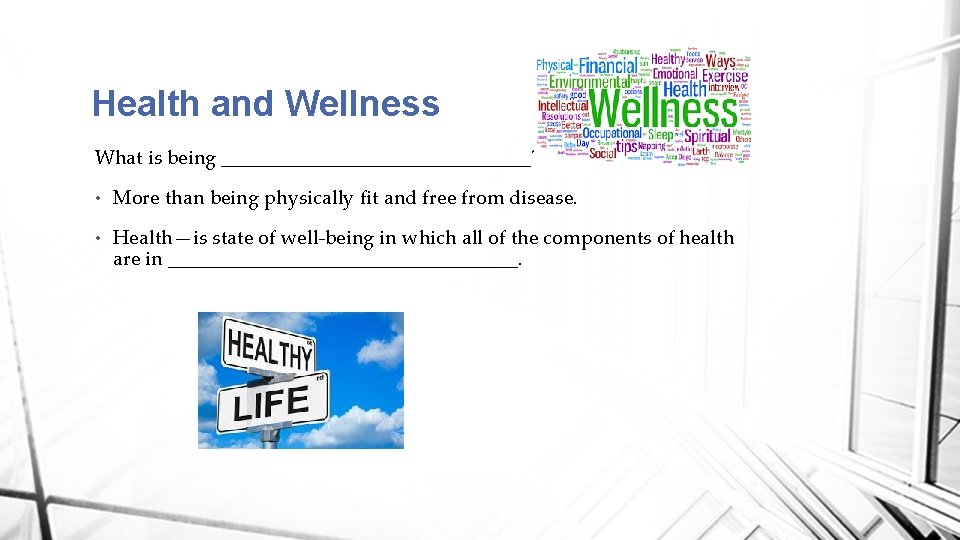
Health and Wellness What is being ________________? • More than being physically fit and free from disease. • Health—is state of well-being in which all of the components of health are in __________________.
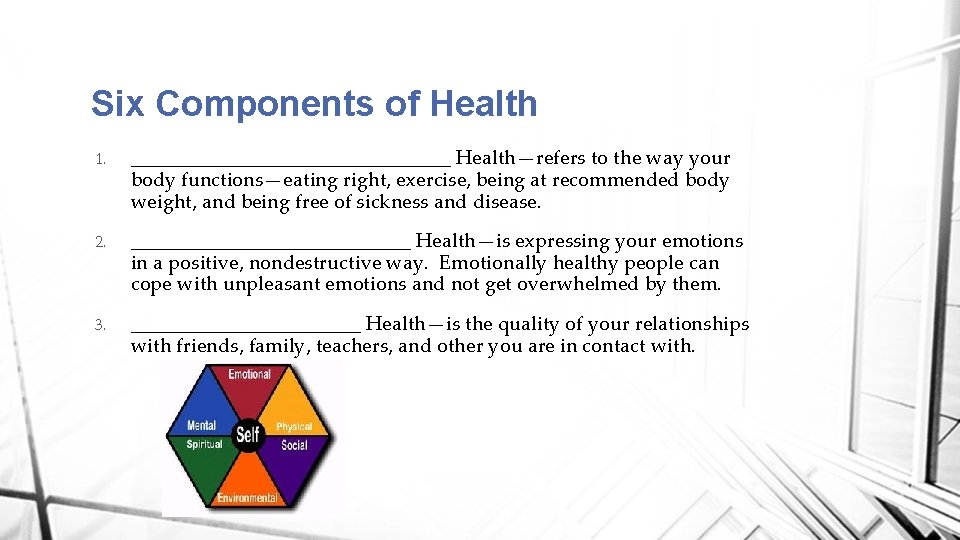
Six Components of Health 1. ________________ Health—refers to the way your body functions—eating right, exercise, being at recommended body weight, and being free of sickness and disease. 2. ______________ Health—is expressing your emotions in a positive, nondestructive way. Emotionally healthy people can cope with unpleasant emotions and not get overwhelmed by them. 3. ____________ Health—is the quality of your relationships with friends, family, teachers, and other you are in contact with.
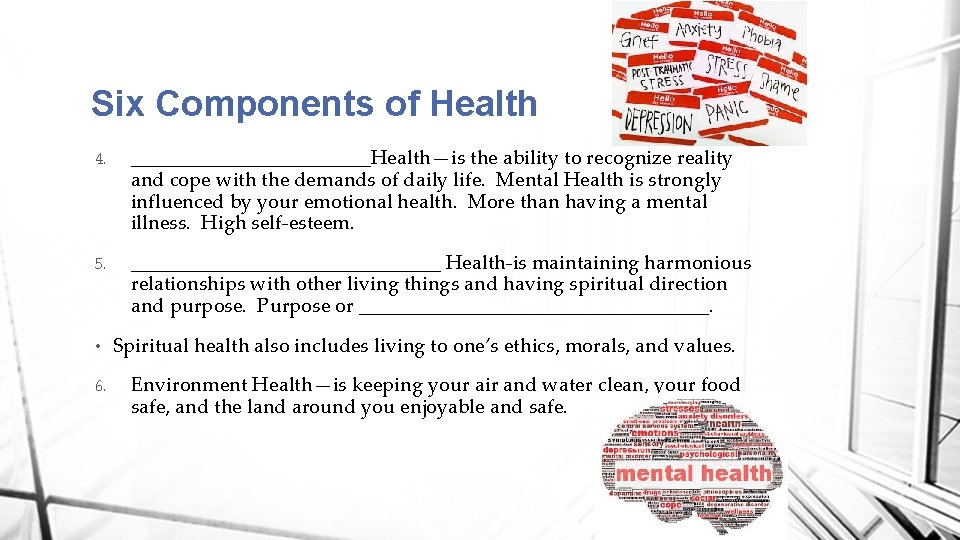
Six Components of Health 4. ____________Health—is the ability to recognize reality and cope with the demands of daily life. Mental Health is strongly influenced by your emotional health. More than having a mental illness. High self-esteem. 5. ________________ Health-is maintaining harmonious relationships with other living things and having spiritual direction and purpose. Purpose or __________________. • 6. Spiritual health also includes living to one’s ethics, morals, and values. Environment Health—is keeping your air and water clean, your food safe, and the land around you enjoyable and safe.
Wellness: Striving for Optimal Health • ____________________-is the achievement of a person’s best in all six components of health • ____________________ to think a person can do this all the time. It is more of a continuum or a sliding scale.
Influences on Your Wellness • Heredity Influences—traits you inherit from your parents. • Social influences—your health is influenced by the relationships you have with other ____________________. • Cultural influences—culture is the values, beliefs, and practices shared by people that have a common ________________. • Environmental influences—Your surroundings, the area where you live, and all the things you have contact with are part of your environment.
Activity • Six Components of Health • Concept Map of Six Components of Health with two positive and two negative aspects of each 6 components. • *Make a List of Every Decision You Make in a Day
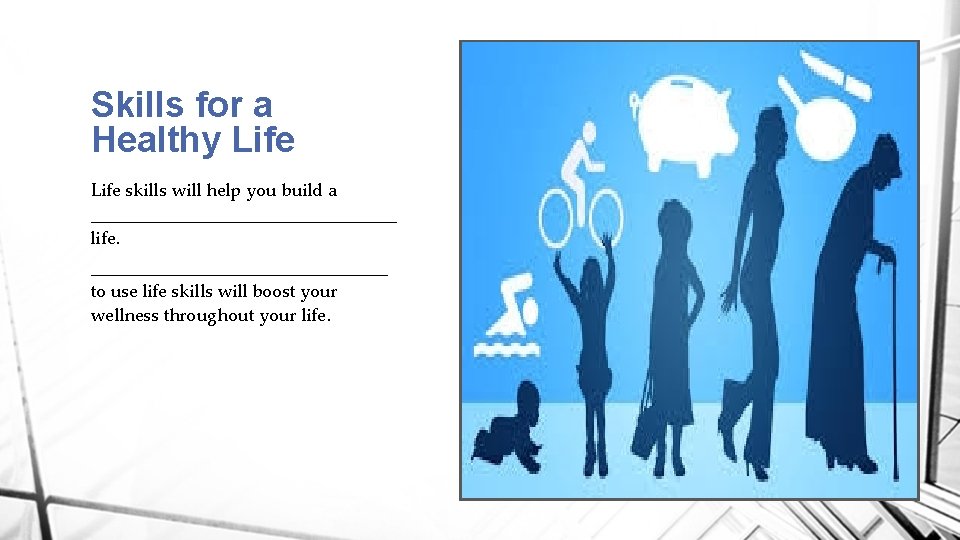
Skills for a Healthy Life skills will help you build a _________________ life. _________________ to use life skills will boost your wellness throughout your life.
Ten Life Skills 1. Assessing your health—helps you to evaluate your health so you know what to ______________________. 2. Communicating effectively—teach you good communication skills, which include knowing how to listen and speak effectively. 3. Practicing Wellness—how to practice healthy behaviors daily so you can have life-long ______________________. 4. Coping—dealing with troubles or problems in an effective way. 5. Being a wise consumer—help you make good decisions when buying health products and ____________________.
Ten Life Skills 6. Evaluating Media Messages—media has a significant influence on how you learn about the world. This skills gives you the tools to analyze media _________________________. 7. Using Community Resources—this life skill will help you find these services to provide help to all six components of health. 8. Making GREAT Decisions--everyone wants to make the right decisions for themselves. Life is about the choices you make. 9. Using Refusal Skills—provides you with different ways to say no to the things you do not want to do. 10. Setting Goals—provides help to reach your life ________________.
Making GREAT Decisions • You make decisions everyday about EVERYTHING everyday. • Making decisions is important because YOU are responsible for the consequences of your decisions. • Consequences are the results of your actions and _________________________. • Seek advice and collaborate important decisions with your parents or someone you trust.
Making GREAT Decisions Model G—Give thought to the ___________________ • Pause and think before giving an impulsive answer. R—Review your choices • Helps to think about all choices. E—Evaluate the consequences of each _______________ • Weigh the pros and cons of each choice. A—Assess and choose the best choice • Make the choice. Your values have a big effect on your decision making. T—Think it over ________________________ • Reflect on the choice.
Everyone Makes Mistakes • You will make mistakes—Make up for them!!! • If you make a poor decision: ___________—stop and admit that you made a poor decision. When you admit your wrong decision, you take responsibility for it. THINK—think about someone that you can talk about the problem. Discuss ways to fix the situation. GO—do your best to correct the ________________.
Talking My Baby Self • Give yourself advice on my top ten life survival skills. 1. Graphic 2. Act it Out 3. Speech 4. Sing or write a song about it.
Resisting Pressure From Others • Who influences________________? • Peer pressure—is a feeling that you should do something because that is what your friends want. • Your family can also influence your behaviors and decisions. • Media can influences your decisions as well. Influences can be: 1. _____________________—having positive role models and being influenced to improve yourself. 2. ______________________—being pressured to do something that you don’t want to do. Consequences of negative pressure can be serious.
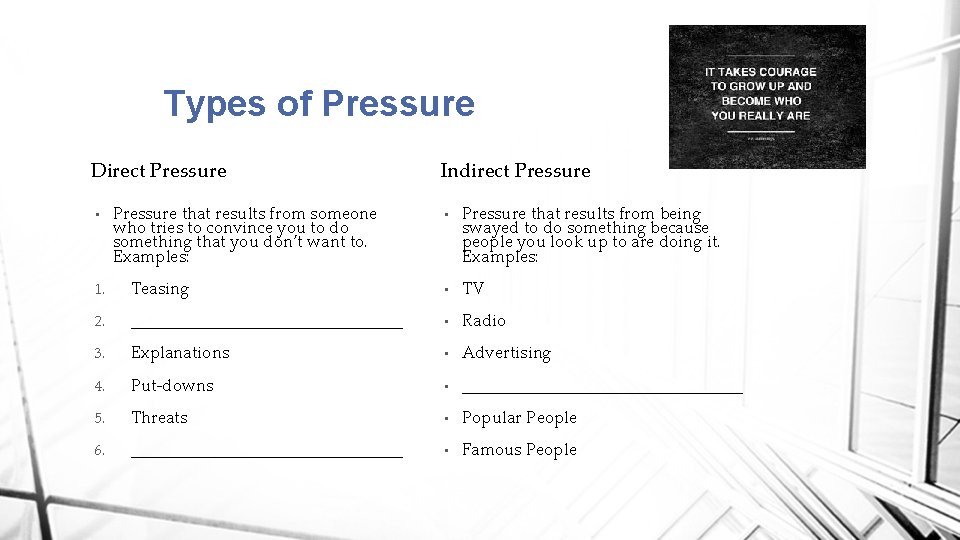
Types of Pressure Direct Pressure • Pressure that results from someone who tries to convince you to do something that you don’t want to. Examples: Indirect Pressure • Pressure that results from being swayed to do something because people you look up to are doing it. Examples: 1. Teasing • TV 2. ________________ • Radio 3. Explanations • Advertising 4. Put-downs • _________________ 5. Threats • Popular People 6. ________________ • Famous People
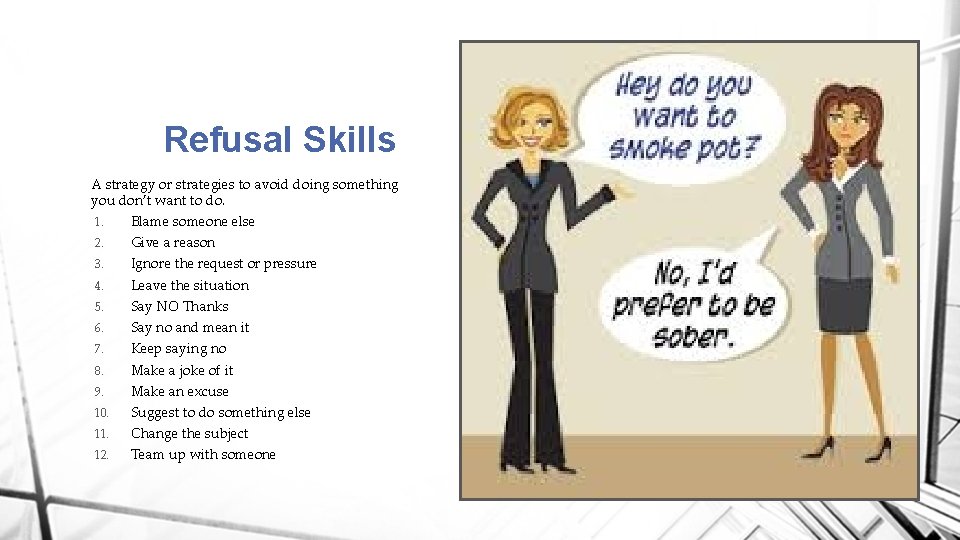
Refusal Skills A strategy or strategies to avoid doing something you don’t want to do. 1. Blame someone else 2. Give a reason 3. Ignore the request or pressure 4. Leave the situation 5. Say NO Thanks 6. Say no and mean it 7. Keep saying no 8. Make a joke of it 9. Make an excuse 10. Suggest to do something else 11. Change the subject 12. Team up with someone
Refusal Skills Skits
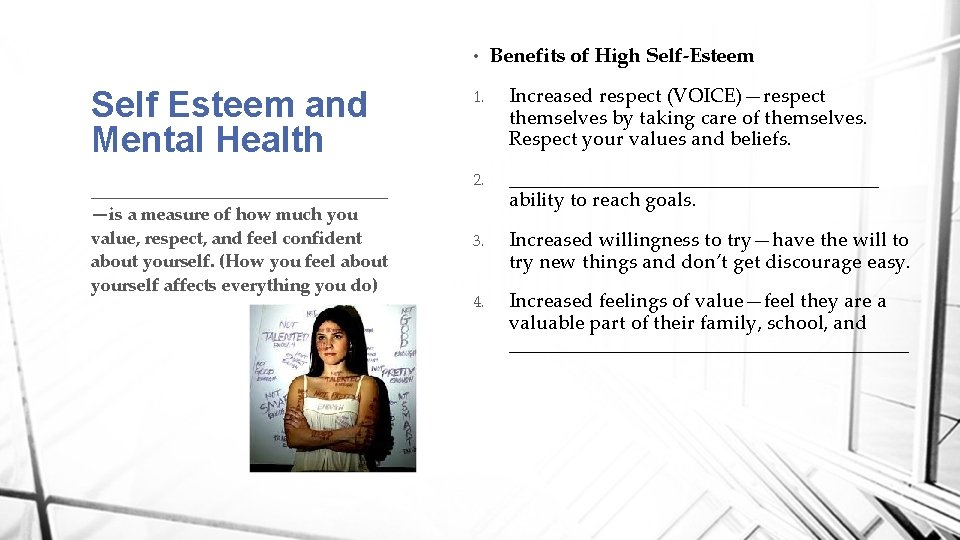
• Self Esteem and Mental Health _________________ —is a measure of how much you value, respect, and feel confident about yourself. (How you feel about yourself affects everything you do) Benefits of High Self-Esteem 1. Increased respect (VOICE)—respect themselves by taking care of themselves. Respect your values and beliefs. 2. ___________________ ability to reach goals. 3. Increased willingness to try—have the will to try new things and don’t get discourage easy. 4. Increased feelings of value—feel they are a valuable part of their family, school, and ____________________
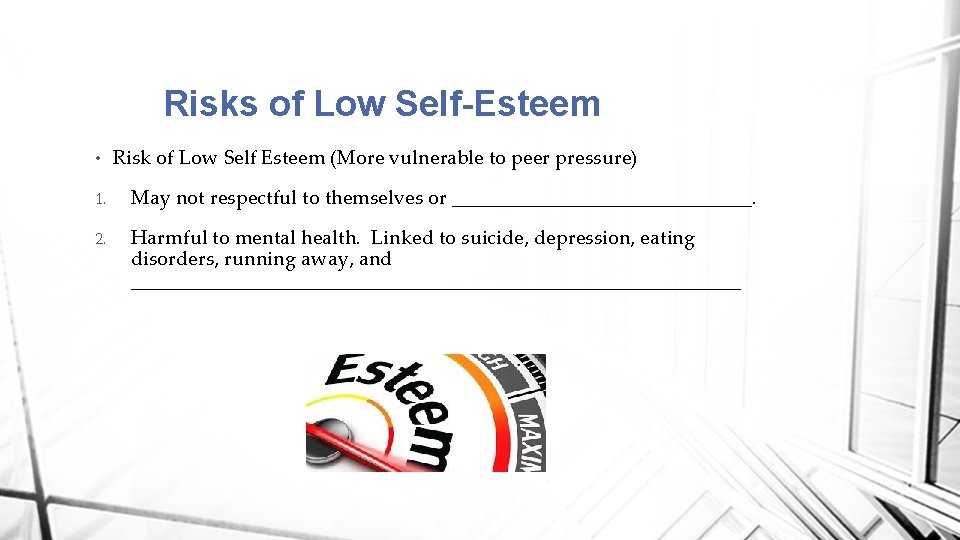
Risks of Low Self-Esteem • Risk of Low Self Esteem (More vulnerable to peer pressure) 1. May not respectful to themselves or _______________. 2. Harmful to mental health. Linked to suicide, depression, eating disorders, running away, and _______________________________
High V Low Self Esteem High • ________________ Low • Feels insecure • Disrespects self and others • Respects self and others • Vulnerable to peer pressure • Tries new things • Doesn’t feel valuable • Feels valuable to society • Feels depressed • Fears _________________ • Uses drugs and alcohol • Adjusts to change • Feels optimistic • Feels pessimistic • Makes decisions based on values • Behaves destructively
Development of Self Esteem • 1. • 2. • 3. Starts when you are born (Parents) ________________________ Measure how someone views themselves Interpreting Messages From Others How you interpret messages about yourself has a lot to do how you view yourself. Negative __________________________ • Can serve as good advice (constructive criticism) • Can be harmful—you have the power to control your self esteem.
Improving Your Self-Esteem 1. • 2. Use positive _____________________ Control the messages to yourself by coaching yourself. Act with ___________________________ • Doing what one knows is right • Don’t let anyone violate your integrity 3. • 4. • Choose supportive friends Avoid friends that are critical, disrespectful, or bring you down. Accept ___________________________ You are not perfect. Accept who you are despite your imperfections.
Promoting Yourself 1. What are five positive things that you do well? 2. What is your personality like? 3. What are three things people would say about you? Draw yourself and list the answers to these questions.
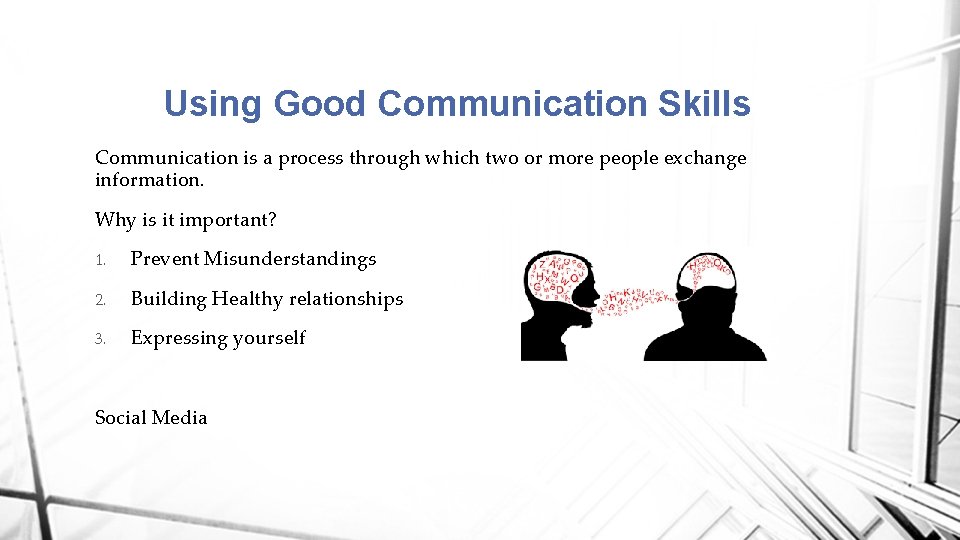
Using Good Communication Skills Communication is a process through which two or more people exchange information. Why is it important? 1. Prevent Misunderstandings 2. Building Healthy relationships 3. Expressing yourself Social Media
Communication Styles 1. • 2. • Passive Does not offer opposition when challenged or pressured and goes along with what other people want. Aggressive To be hostile and unfriendly in the way one expresses oneself. 3. Assertive (What we strive for) • Most healthy way to communicate. • Express oneself in a direct, respectful way. • Not easy when someone upsets you.
Speaking Skills Verbal Communication refers to the words and tones we use when we speak. 1. • 2. • 3. Voice Volume How loud or soft you are speaking. Tone and Pitch Refer to the inflections or emphasis in your voice when you speak “I” Messages and “You” Messages • “I” message is a way of talking that explains how you feel while remaining calm, and polite. • “You” messages can lead to fights by blaming someone else. 4. • Empathy Ability to understand another person’s feelings, behaviors, and attitudes.
1. Listening Skills Communication includes not only sending messages but receiving messages 1. 2. 3. Do’s • Maintain eye contact • Lean forward and face speaker • Ask questions • Nod your head • Paraphrase speaker Active Listening—means letting the speaker know you are listening and clarifying. 2. • Don’t interrupt or change subject Paraphrasing—using your words to restate what someone else said. • Don’t look at your watch • Don’t tap your foot • Don’t thing about something else • Don’t watch TV Body Language—communication without saying a word. Don’ts
45 Second Speeches
Mental and Emotional Health • Mental Health is the state of mental well being in which someone can cope with the demands of daily _________________. People who are mentally and emotionally healthy have the following _____________________________: • A sense of control—take charge of their lives. • Ability to endure failures and frustrations—set backs part of learning. • Ability to see events positively—see challenges as opportunities. • Ability to express emotions in a healthy way
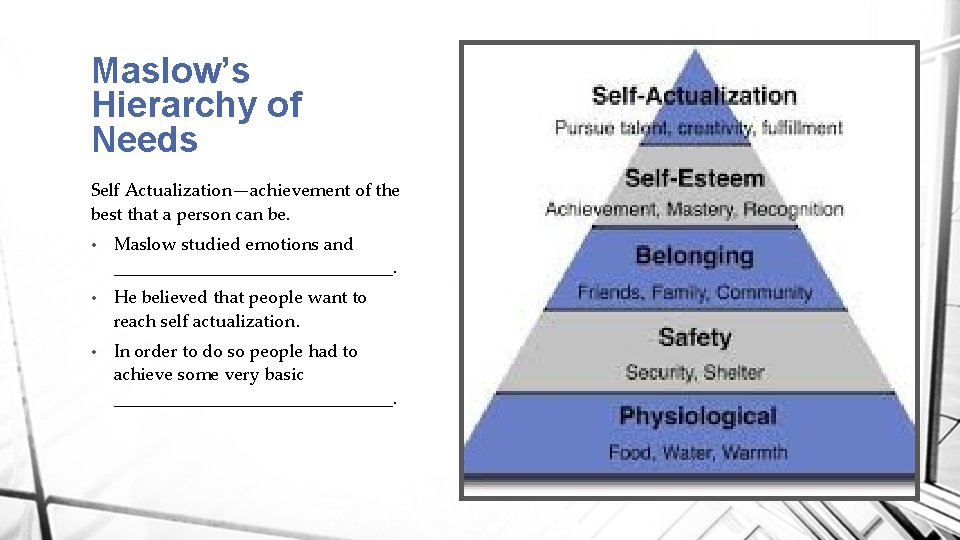
Maslow’s Hierarchy of Needs Self Actualization—achievement of the best that a person can be. • Maslow studied emotions and ________________. • He believed that people want to reach self actualization. • In order to do so people had to achieve some very basic ________________.
Expressing Emotions • Emotions are the feeling that is produced in response to life experiences. • Emotions are not good or ____________________. • However, expressions of emotions can have positive or negative effects. Learning to express your _______________________________: 1. Based on how others around you express emotions. 2. You can learn to express your emotions more constructively regardless of how others around you do.
Managing Emotions • _______________________can be overwhelming Suggestions to help handle them: 1. Talk it Out 2. Blow off steam 3. _______________
Handling Difficult Emotions 1. ____________________—results from frustration or helplessness. Keep your anger from getting out of control. 2. Fear—use self-talk instead of thinking about being scared. 3. Guilt—alerts you that you are behaving in a way that goes against your values. RIGHT THE WRONG 4. ___________________________—caused by fear that something you love or own will be lost. 5. Loneliness—isolation from others. Join a group, club, or team.
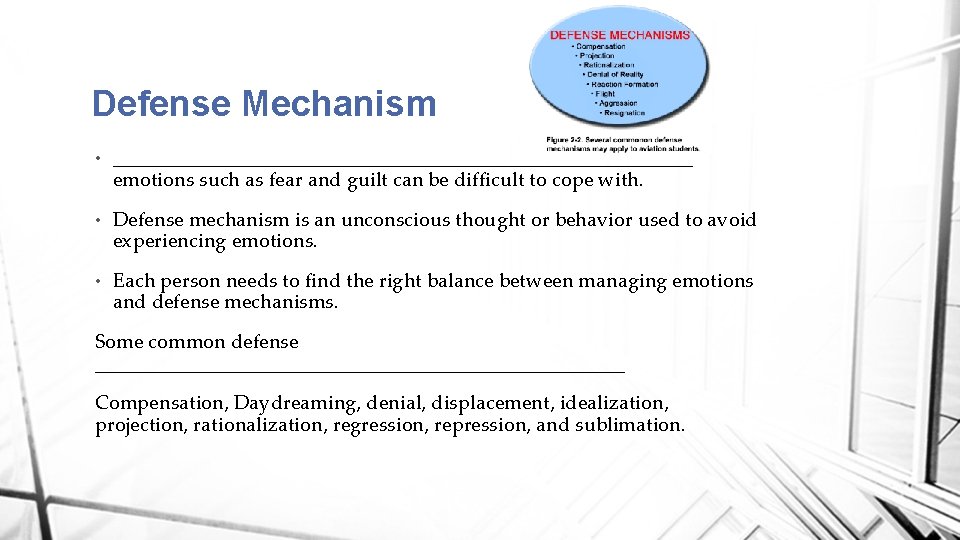
Defense Mechanism • _____________________________ emotions such as fear and guilt can be difficult to cope with. • Defense mechanism is an unconscious thought or behavior used to avoid experiencing emotions. • Each person needs to find the right balance between managing emotions and defense mechanisms. Some common defense ___________________________ Compensation, Daydreaming, denial, displacement, idealization, projection, rationalization, regression, repression, and sublimation.
Skit with Handling Emotions
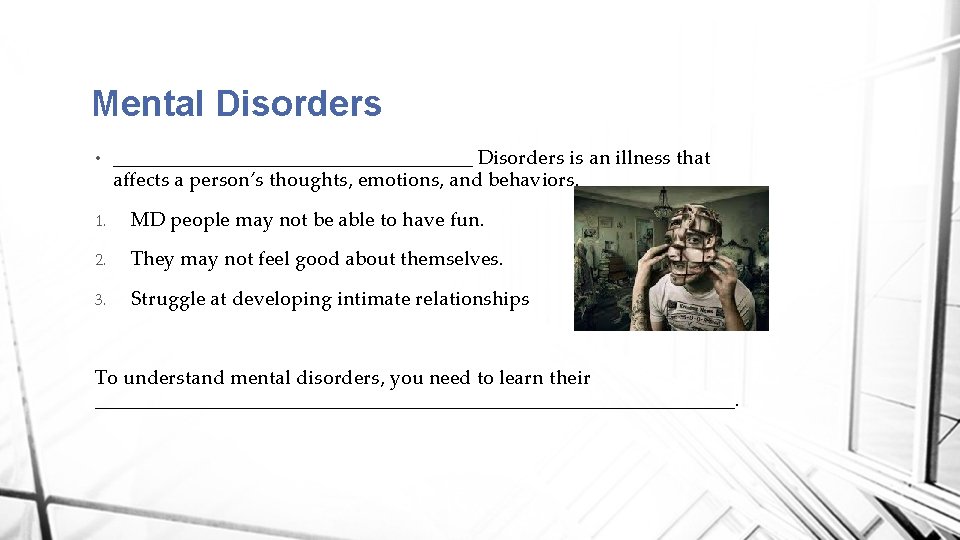
Mental Disorders • __________________ Disorders is an illness that affects a person’s thoughts, emotions, and behaviors. 1. MD people may not be able to have fun. 2. They may not feel good about themselves. 3. Struggle at developing intimate relationships To understand mental disorders, you need to learn their ________________________________.
Types of Mental Disorders • There are many types of Mental Disorders with a variety of symptoms. Some of these include: • Too much or too little sleep • Feeling of extreme sadness • Unexplained mood changes • Drug or alcohol • Inability to concentration • Extreme anxiety or irrational fear • Personality changes • False perception of reality
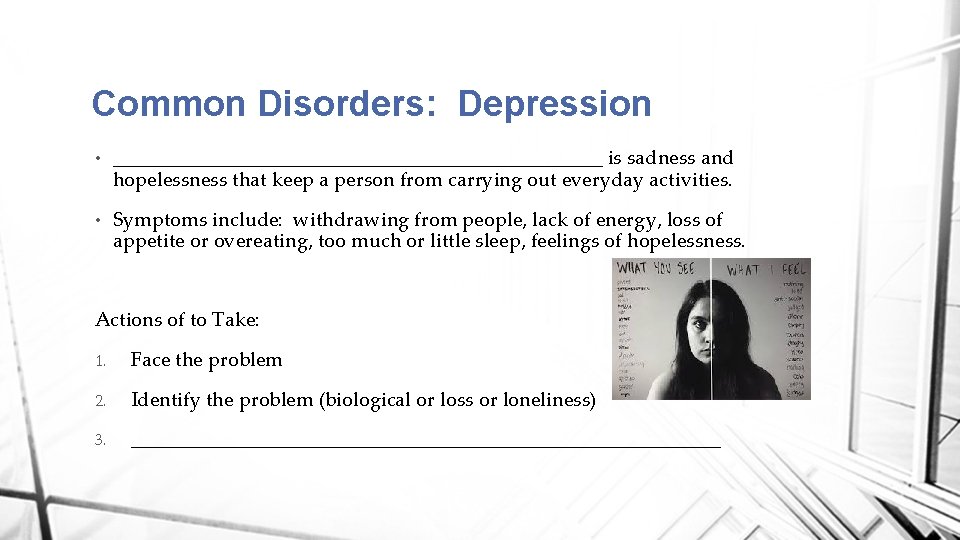
Common Disorders: Depression • _________________________ is sadness and hopelessness that keep a person from carrying out everyday activities. • Symptoms include: withdrawing from people, lack of energy, loss of appetite or overeating, too much or little sleep, feelings of hopelessness. Actions of to Take: 1. Face the problem 2. Identify the problem (biological or loss or loneliness) 3. ______________________________
ADHD • A person is frequently inattentive or impulsively hyperactive to the point that he or she has problems accomplishing daily ________________________________
Anxiety Disorders • It is normal to feel nervous or worried but it occurs frequently or if it causes terror it may be an anxiety disorder. 1. ______________________Disorder—the person feels extreme fear for his or her life even though they are not in danger. 2. _____________________—characterized by excessive or persistent fear of something. 3. Obsessive Compulsive Disorder—triggered by uncomfortable thoughts and repetitive behaviors. Other include: PTSD, Eating Disorders, Hypochondria, bipolar disorder, and schizophrenia.
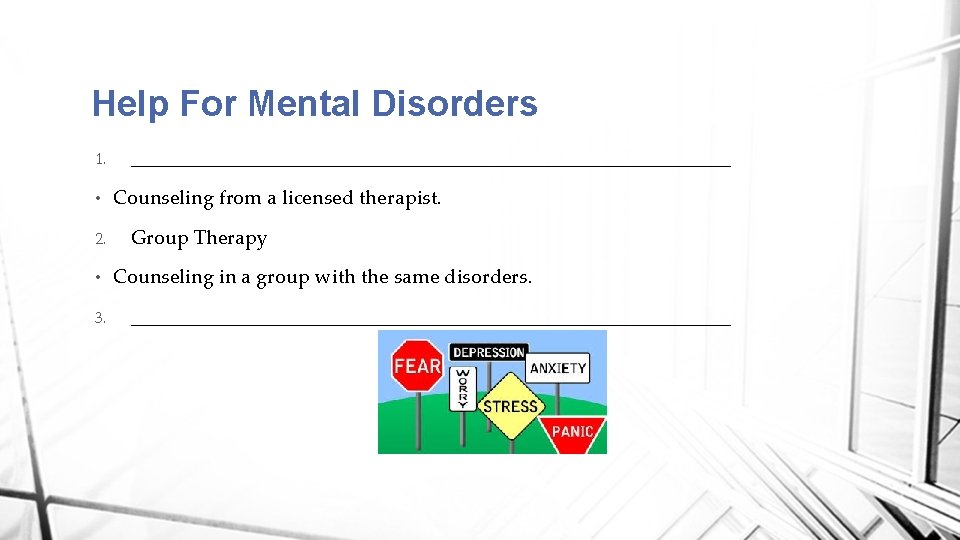
Help For Mental Disorders 1. • 2. • 3. ______________________________ Counseling from a licensed therapist. Group Therapy Counseling in a group with the same disorders. ______________________________

Commercials
- Slides: 53