
Health and Safety in Emergency Management Why prepare


- Slides: 47
Health and Safety in Emergency Management
Why prepare for emergencies • Power blackout of 2003 • Peterborough flood of 2004 • SARS 2003 • Pending pandemic • Some health care and community care organizations are more ready than others to respond to emergencies. © Copyright 2006 Ontario Safety Association for Community & Healthcare. All rights reserved/tous droits réservés. Reproduction in whole or in part by any means without express written consent of Ontario Safety Association for Community & Healthcare is prohibited by law. 2
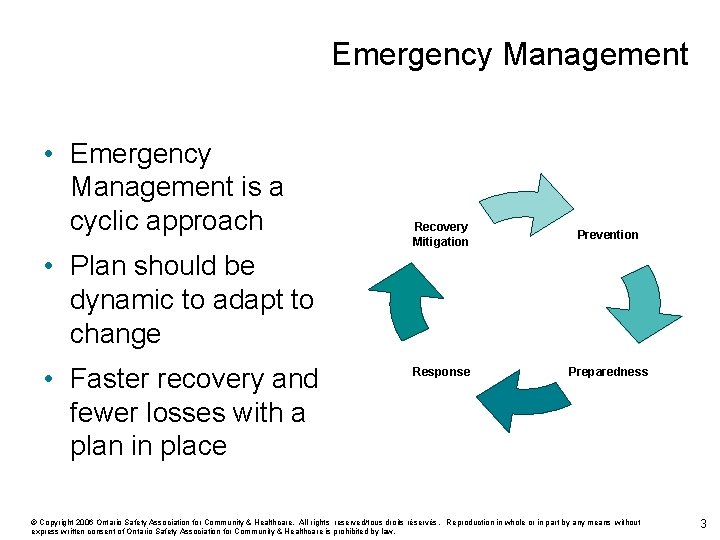
Emergency Management • Emergency Management is a cyclic approach Recovery Mitigation Prevention Response Preparedness • Plan should be dynamic to adapt to change • Faster recovery and fewer losses with a plan in place © Copyright 2006 Ontario Safety Association for Community & Healthcare. All rights reserved/tous droits réservés. Reproduction in whole or in part by any means without express written consent of Ontario Safety Association for Community & Healthcare is prohibited by law. 3
Natural hazards Emergencies caused by Natural hazards • Hurricane • Windstorm • Flood • Forest fire • Tornado • Winter/ice storm • Landslide • Epidemic/pandemic © Copyright 2006 Ontario Safety Association for Community & Healthcare. All rights reserved/tous droits réservés. Reproduction in whole or in part by any means without express written consent of Ontario Safety Association for Community & Healthcare is prohibited by law. 4
Man-made hazards Emergencies caused by man-made hazards (human acts or omissions) • Building fire • Explosions • Bomb threats • Major transportation accident • Power failure (black out or other system failure) • CBRN disasters (chemical, biological, radiological, nuclear) © Copyright 2006 Ontario Safety Association for Community & Healthcare. All rights reserved/tous droits réservés. Reproduction in whole or in part by any means without express written consent of Ontario Safety Association for Community & Healthcare is prohibited by law. 5
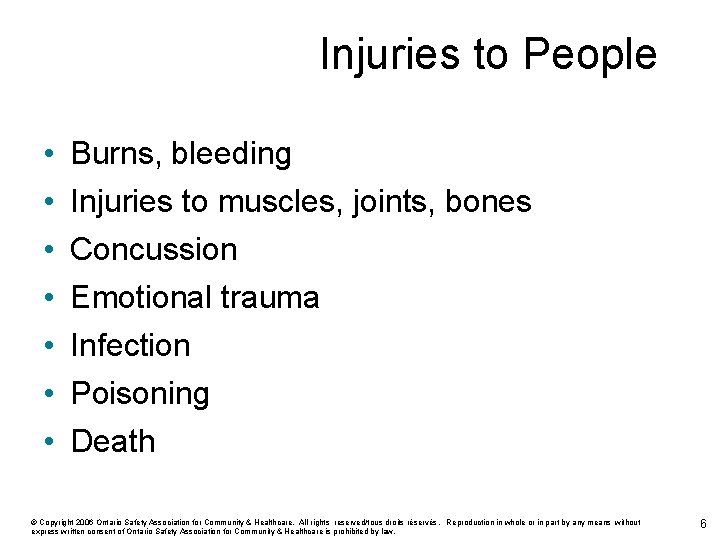
Injuries to People • • Burns, bleeding Injuries to muscles, joints, bones Concussion Emotional trauma Infection Poisoning Death © Copyright 2006 Ontario Safety Association for Community & Healthcare. All rights reserved/tous droits réservés. Reproduction in whole or in part by any means without express written consent of Ontario Safety Association for Community & Healthcare is prohibited by law. 6
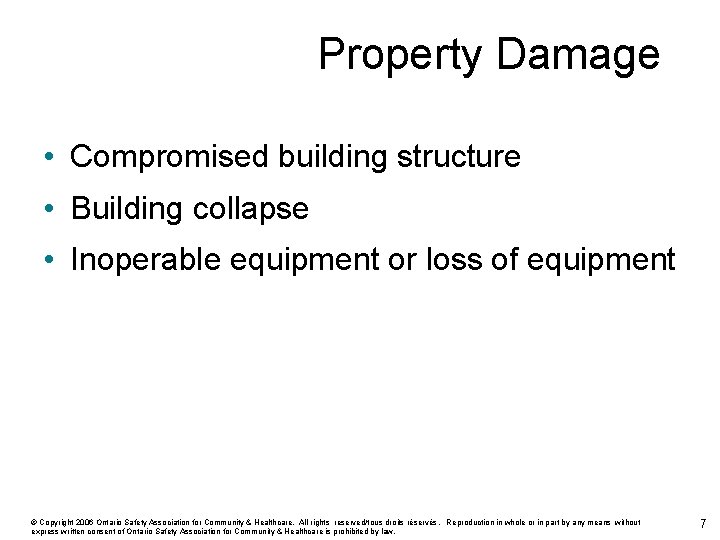
Property Damage • Compromised building structure • Building collapse • Inoperable equipment or loss of equipment © Copyright 2006 Ontario Safety Association for Community & Healthcare. All rights reserved/tous droits réservés. Reproduction in whole or in part by any means without express written consent of Ontario Safety Association for Community & Healthcare is prohibited by law. 7
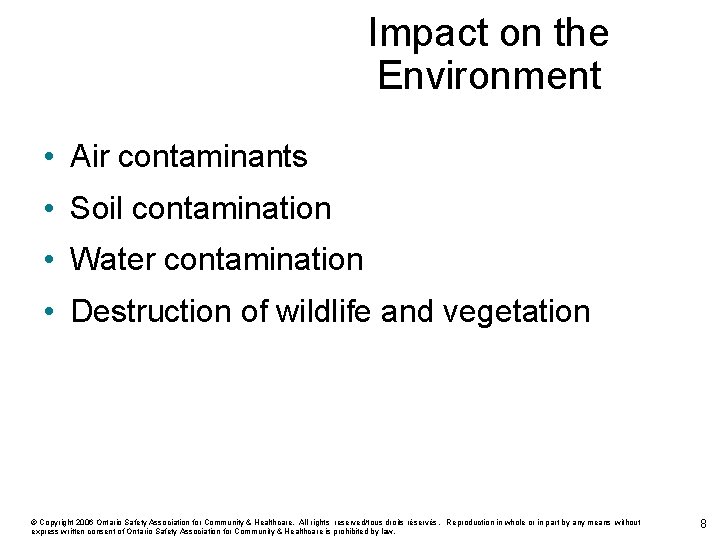
Impact on the Environment • Air contaminants • Soil contamination • Water contamination • Destruction of wildlife and vegetation © Copyright 2006 Ontario Safety Association for Community & Healthcare. All rights reserved/tous droits réservés. Reproduction in whole or in part by any means without express written consent of Ontario Safety Association for Community & Healthcare is prohibited by law. 8
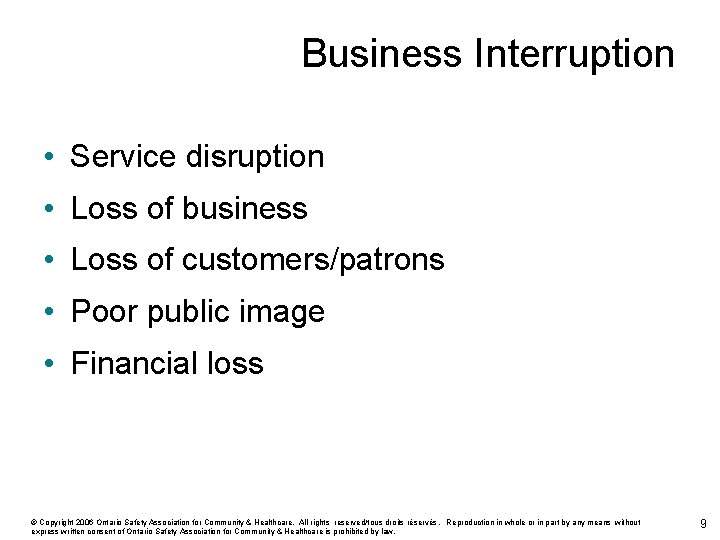
Business Interruption • Service disruption • Loss of business • Loss of customers/patrons • Poor public image • Financial loss © Copyright 2006 Ontario Safety Association for Community & Healthcare. All rights reserved/tous droits réservés. Reproduction in whole or in part by any means without express written consent of Ontario Safety Association for Community & Healthcare is prohibited by law. 9
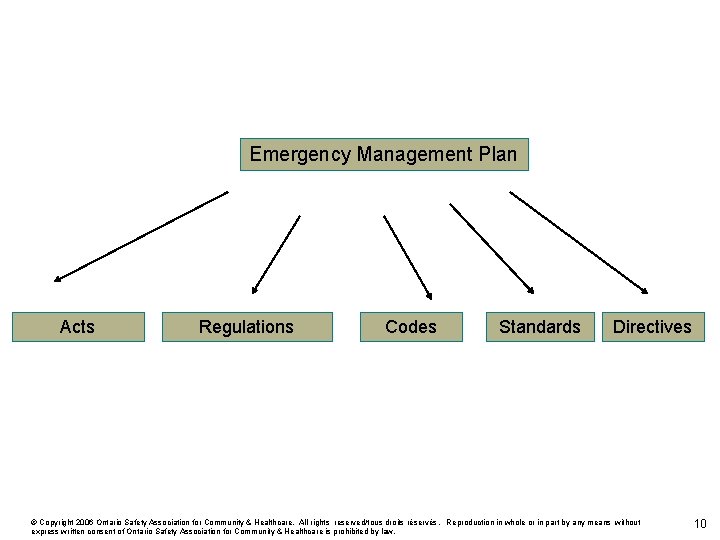
Emergency Management Plan Acts Regulations Codes Standards Directives © Copyright 2006 Ontario Safety Association for Community & Healthcare. All rights reserved/tous droits réservés. Reproduction in whole or in part by any means without express written consent of Ontario Safety Association for Community & Healthcare is prohibited by law. 10
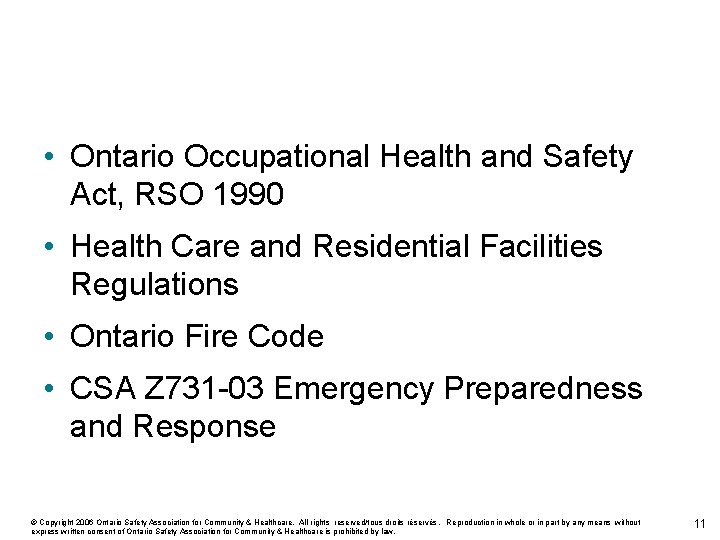
• Ontario Occupational Health and Safety Act, RSO 1990 • Health Care and Residential Facilities Regulations • Ontario Fire Code • CSA Z 731 -03 Emergency Preparedness and Response © Copyright 2006 Ontario Safety Association for Community & Healthcare. All rights reserved/tous droits réservés. Reproduction in whole or in part by any means without express written consent of Ontario Safety Association for Community & Healthcare is prohibited by law. 11
Directives • Mo. HLTC Emergency Management Unit • Health Canada • Other (as applicable to the workplace) © Copyright 2006 Ontario Safety Association for Community & Healthcare. All rights reserved/tous droits réservés. Reproduction in whole or in part by any means without express written consent of Ontario Safety Association for Community & Healthcare is prohibited by law. 12
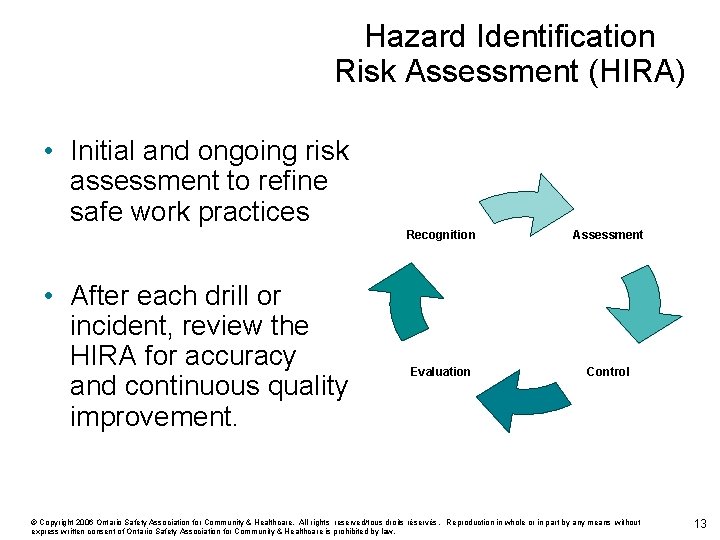
Hazard Identification Risk Assessment (HIRA) • Initial and ongoing risk assessment to refine safe work practices • After each drill or incident, review the HIRA for accuracy and continuous quality improvement. Recognition Assessment Evaluation Control © Copyright 2006 Ontario Safety Association for Community & Healthcare. All rights reserved/tous droits réservés. Reproduction in whole or in part by any means without express written consent of Ontario Safety Association for Community & Healthcare is prohibited by law. 13
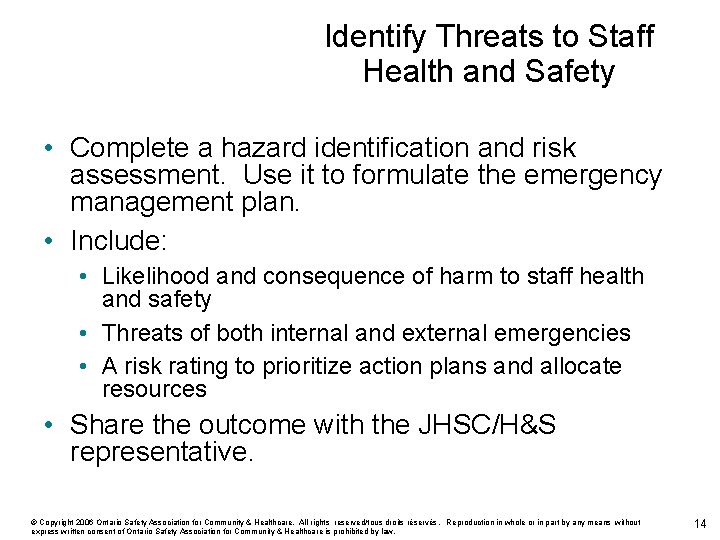
Identify Threats to Staff Health and Safety • Complete a hazard identification and risk assessment. Use it to formulate the emergency management plan. • Include: • Likelihood and consequence of harm to staff health and safety • Threats of both internal and external emergencies • A risk rating to prioritize action plans and allocate resources • Share the outcome with the JHSC/H&S representative. © Copyright 2006 Ontario Safety Association for Community & Healthcare. All rights reserved/tous droits réservés. Reproduction in whole or in part by any means without express written consent of Ontario Safety Association for Community & Healthcare is prohibited by law. 14
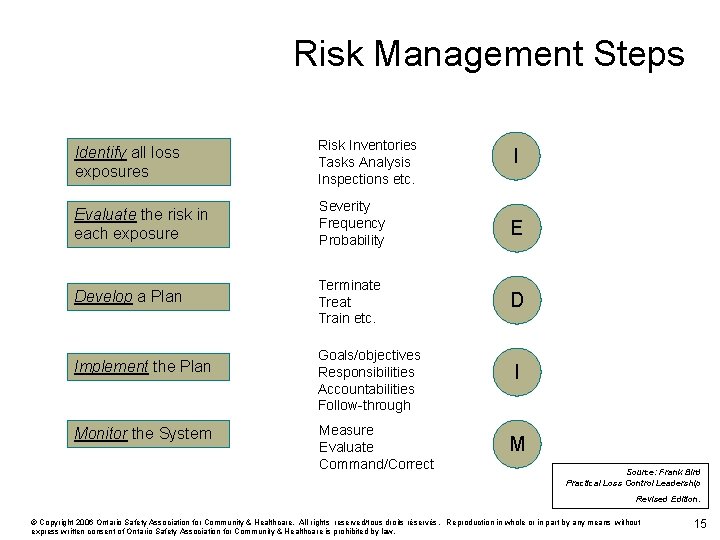
Risk Management Steps Identify all loss exposures Risk Inventories Tasks Analysis Inspections etc. I Evaluate the risk in each exposure Severity Frequency Probability E Develop a Plan Terminate Treat Train etc. D Implement the Plan Monitor the System Goals/objectives Responsibilities Accountabilities Follow-through Measure Evaluate Command/Correct I M Source: Frank Bird Practical Loss Control Leadership Revised Edition. © Copyright 2006 Ontario Safety Association for Community & Healthcare. All rights reserved/tous droits réservés. Reproduction in whole or in part by any means without express written consent of Ontario Safety Association for Community & Healthcare is prohibited by law. 15
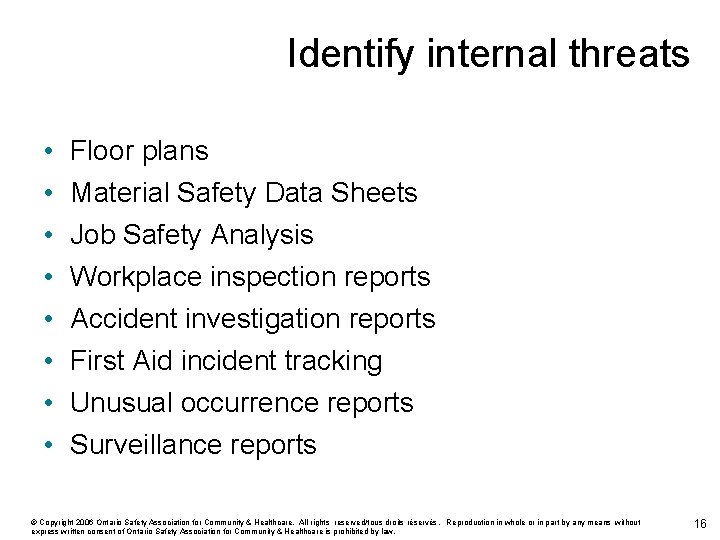
Identify internal threats • • Floor plans Material Safety Data Sheets Job Safety Analysis Workplace inspection reports Accident investigation reports First Aid incident tracking Unusual occurrence reports Surveillance reports © Copyright 2006 Ontario Safety Association for Community & Healthcare. All rights reserved/tous droits réservés. Reproduction in whole or in part by any means without express written consent of Ontario Safety Association for Community & Healthcare is prohibited by law. 16
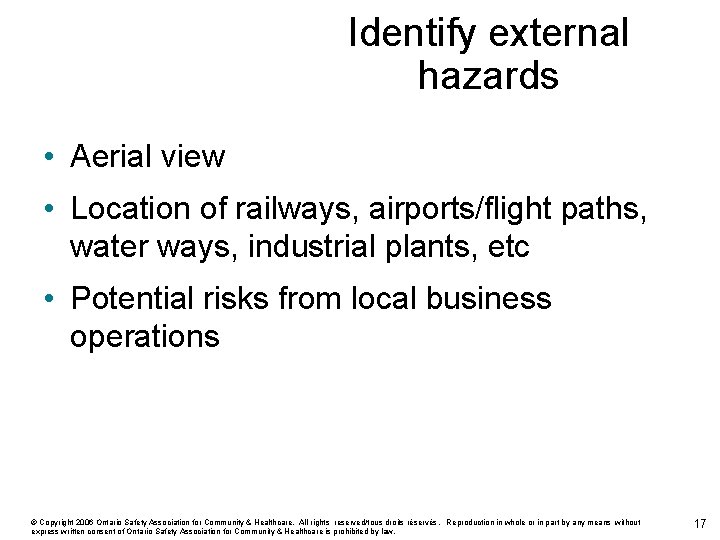
Identify external hazards • Aerial view • Location of railways, airports/flight paths, water ways, industrial plants, etc • Potential risks from local business operations © Copyright 2006 Ontario Safety Association for Community & Healthcare. All rights reserved/tous droits réservés. Reproduction in whole or in part by any means without express written consent of Ontario Safety Association for Community & Healthcare is prohibited by law. 17
Risk Assessment • What is the likelihood of an emergency if the hazard is not controlled? • What is the severity of the outcome if the emergency occurs? • Estimate the number of people or physical assets that are likely to be threatened, as well as probable consequences of the emergency. © Copyright 2006 Ontario Safety Association for Community & Healthcare. All rights reserved/tous droits réservés. Reproduction in whole or in part by any means without express written consent of Ontario Safety Association for Community & Healthcare is prohibited by law. 18
Assess Resources and Capabilities • facilities • equipment and supplies • capabilities of the workforce (expertise, experience) • training © Copyright 2006 Ontario Safety Association for Community & Healthcare. All rights reserved/tous droits réservés. Reproduction in whole or in part by any means without express written consent of Ontario Safety Association for Community & Healthcare is prohibited by law. 19
Emergency response equipment and personnel • Appropriate and on-site emergency response equipment • Current inventory of emergency equipment and supplies • Maintenance and inspection program for equipment including personal protective equipment (PPE) • Trained personnel available to provide on-site emergency response • Contracted specialists available where required © Copyright 2006 Ontario Safety Association for Community & Healthcare. All rights reserved/tous droits réservés. Reproduction in whole or in part by any means without express written consent of Ontario Safety Association for Community & Healthcare is prohibited by law. 20
Medical or first aid • Medical or first-aid capabilities • Agreements with neighboring facilities (mutual aid support) • Capabilities of mutual aid partners to provide service © Copyright 2006 Ontario Safety Association for Community & Healthcare. All rights reserved/tous droits réservés. Reproduction in whole or in part by any means without express written consent of Ontario Safety Association for Community & Healthcare is prohibited by law. 21
Evacuation • Emergency evacuation of staff, clients/residents, family members, and the public, including casualties • Staff are trained in evacuation procedures • A procedure is in place to account for all personnel and clients/individuals supported © Copyright 2006 Ontario Safety Association for Community & Healthcare. All rights reserved/tous droits réservés. Reproduction in whole or in part by any means without express written consent of Ontario Safety Association for Community & Healthcare is prohibited by law. 22
Communication • Clearly defined internal and external lines of communication • Strategies for communicating critical information to employees and their families, the joint health and safety committee, etc. • Communication and back-up systems available • Staff are educated in communication strategies and trained to use the equipment • Fan out system established and tested © Copyright 2006 Ontario Safety Association for Community & Healthcare. All rights reserved/tous droits réservés. Reproduction in whole or in part by any means without express written consent of Ontario Safety Association for Community & Healthcare is prohibited by law. 23
Liaison • Community partners (healthcare and other service providers) have been identified and included in developing and testing emergency plans • Mutual aid agreements identify available resources • Established procedures for site representatives to co-ordinate activities with local government officials © Copyright 2006 Ontario Safety Association for Community & Healthcare. All rights reserved/tous droits réservés. Reproduction in whole or in part by any means without express written consent of Ontario Safety Association for Community & Healthcare is prohibited by law. 24
Review Plans • Review existing policies and procedures • Use older plans only as a foundation • Liaise with community partners in the development, implementation, review and revision of your emergency management plan • After each drill or emergency, review the hazard identification and risk assessment for accuracy • Identify any gaps and revise the assessment for continuous improvement • Share the outcome of any H&S assessment with the JHSC/H&S representative(s). © Copyright 2006 Ontario Safety Association for Community & Healthcare. All rights reserved/tous droits réservés. Reproduction in whole or in part by any means without express written consent of Ontario Safety Association for Community & Healthcare is prohibited by law. 25
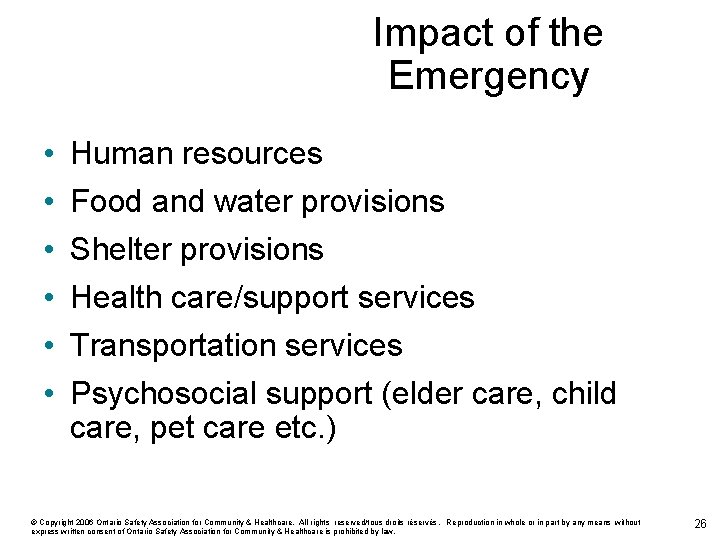
Impact of the Emergency • • • Human resources Food and water provisions Shelter provisions Health care/support services Transportation services Psychosocial support (elder care, child care, pet care etc. ) © Copyright 2006 Ontario Safety Association for Community & Healthcare. All rights reserved/tous droits réservés. Reproduction in whole or in part by any means without express written consent of Ontario Safety Association for Community & Healthcare is prohibited by law. 26
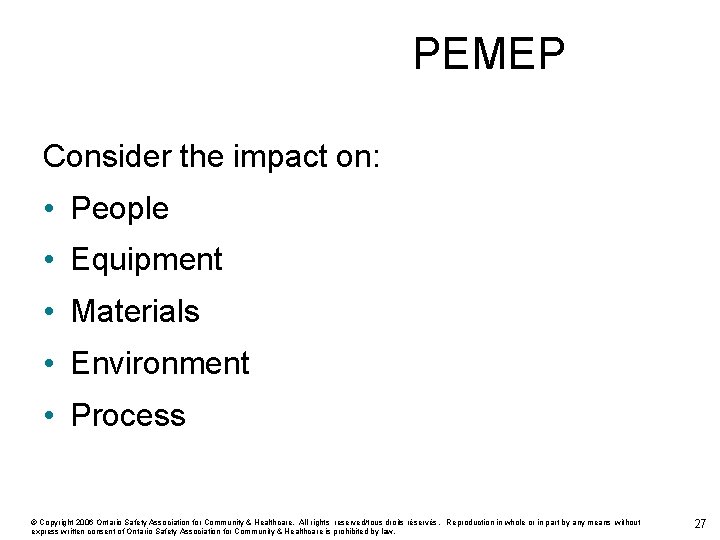
PEMEP Consider the impact on: • People • Equipment • Materials • Environment • Process © Copyright 2006 Ontario Safety Association for Community & Healthcare. All rights reserved/tous droits réservés. Reproduction in whole or in part by any means without express written consent of Ontario Safety Association for Community & Healthcare is prohibited by law. 27
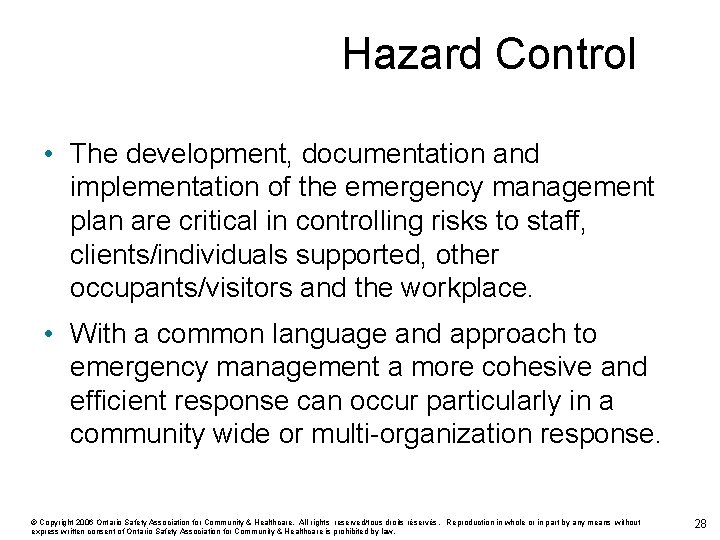
Hazard Control • The development, documentation and implementation of the emergency management plan are critical in controlling risks to staff, clients/individuals supported, other occupants/visitors and the workplace. • With a common language and approach to emergency management a more cohesive and efficient response can occur particularly in a community wide or multi-organization response. © Copyright 2006 Ontario Safety Association for Community & Healthcare. All rights reserved/tous droits réservés. Reproduction in whole or in part by any means without express written consent of Ontario Safety Association for Community & Healthcare is prohibited by law. 28
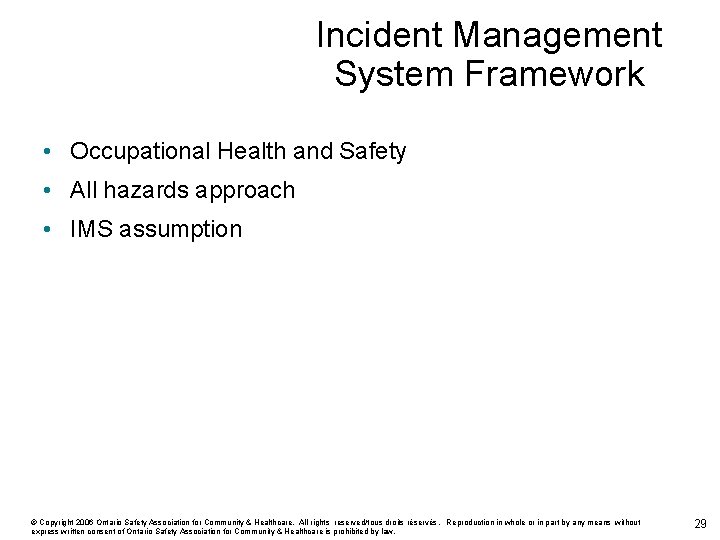
Incident Management System Framework • Occupational Health and Safety • All hazards approach • IMS assumption © Copyright 2006 Ontario Safety Association for Community & Healthcare. All rights reserved/tous droits réservés. Reproduction in whole or in part by any means without express written consent of Ontario Safety Association for Community & Healthcare is prohibited by law. 29
Hazard Control • At the source • Along the path • At the worker • Identify and implement these control strategies for specific hazards identified in the HIRA on which the plan is based. © Copyright 2006 Ontario Safety Association for Community & Healthcare. All rights reserved/tous droits réservés. Reproduction in whole or in part by any means without express written consent of Ontario Safety Association for Community & Healthcare is prohibited by law. 30
Emergency Management Policy • indicates a commitment to establishing an emergency management plan to eliminate or minimize risks • includes the responsibilities and accountabilities of all workplace parties • is signed by the most senior management level • is communicated to all staff on an ongoing basis at orientation, during training, at staff meetings etc. • is evaluated for operational expectations • is reviewed and revised at least once a year in consultation with the JHSC/H&S representative(s) © Copyright 2006 Ontario Safety Association for Community & Healthcare. All rights reserved/tous droits réservés. Reproduction in whole or in part by any means without express written consent of Ontario Safety Association for Community & Healthcare is prohibited by law. 31
Procedures • Each organization should develop procedures for the types of emergencies identified in the hazard identification/risk assessment. • Procedures provide details on the application of the policy. • General procedures may be applicable to all hazards (“all hazards approach” to emergency management) (i. e. communications) • Specific procedures for the type of hazard and resulting emergency (i. e. decontamination) • Emergency codes should be supported by specific written procedures © Copyright 2006 Ontario Safety Association for Community & Healthcare. All rights reserved/tous droits réservés. Reproduction in whole or in part by any means without express written consent of Ontario Safety Association for Community & Healthcare is prohibited by law. 32
Occupational Health and Safety in the Emergency Management Plan © Copyright 2006 Ontario Safety Association for Community & Healthcare. All rights reserved/tous droits réservés. Reproduction in whole or in part by any means without express written consent of Ontario Safety Association for Community & Healthcare is prohibited by law. 33
Emergency Management Plan • Identify threats to staff health and safety based on the hazard identification and risk assessment (HIRA) • Use the HIRA in the writing of the plan • In the plan, outline safe work practices • Communicate your written policy on emergency management to all staff © Copyright 2006 Ontario Safety Association for Community & Healthcare. All rights reserved/tous droits réservés. Reproduction in whole or in part by any means without express written consent of Ontario Safety Association for Community & Healthcare is prohibited by law. 34
Emergency Management Plan • Determine the roles, responsibilities and accountabilities of all workplace parties in the Incident Management System (IMS) • Communicate a written process for your Incident Manager to receive recommendations or directions from an external body • Include in the plan a process for evacuating all or part to the workplace • Evaluate all occupational health and safety aspects of the emergency management plan at least once per year © Copyright 2006 Ontario Safety Association for Community & Healthcare. All rights reserved/tous droits réservés. Reproduction in whole or in part by any means without express written consent of Ontario Safety Association for Community & Healthcare is prohibited by law. 35
Safety Function • Designate a Safety Officer in the IMS • Involve the Safety Officer in an ongoing process of HIRA for occupational health and safety • Have a written policy and procedure for workplace accident or incident investigation • Have a written policy and procedure to deal with work refusal and work stop orders © Copyright 2006 Ontario Safety Association for Community & Healthcare. All rights reserved/tous droits réservés. Reproduction in whole or in part by any means without express written consent of Ontario Safety Association for Community & Healthcare is prohibited by law. 36
Communications • Clearly define internal and external lines of communication • Establish strategies for communicating critical information to staff and their families • Make sure that communication equipment is available for use • Train staff in communication strategies and the operation of equipment • Establish and test a written emergency fan-out system © Copyright 2006 Ontario Safety Association for Community & Healthcare. All rights reserved/tous droits réservés. Reproduction in whole or in part by any means without express written consent of Ontario Safety Association for Community & Healthcare is prohibited by law. 37
Liaison • Designate a Liaison Officer in the IMS • Identify community partners and include them in the development and testing of the plan • Develop written mutual aid agreements with community partners © Copyright 2006 Ontario Safety Association for Community & Healthcare. All rights reserved/tous droits réservés. Reproduction in whole or in part by any means without express written consent of Ontario Safety Association for Community & Healthcare is prohibited by law. 38
Administration. Human Resources • Designate a Human Resources Unit Leader to coordinate human resources • Determine staffing levels needed to respond safely in an emergency • Develop a contingency plan for increasing and relieving your workforce • Maintain a data bank of information on available and reserve employees and volunteers © Copyright 2006 Ontario Safety Association for Community & Healthcare. All rights reserved/tous droits réservés. Reproduction in whole or in part by any means without express written consent of Ontario Safety Association for Community & Healthcare is prohibited by law. 39
Administration- Psychosocial Support Services • Set up psychosocial support services for staff or communicate availability of resources in the community • Educate staff to recognize psychosocial stress in themselves and others • Establish a critical incident stress management program to assist staff or source community service providers for this function © Copyright 2006 Ontario Safety Association for Community & Healthcare. All rights reserved/tous droits réservés. Reproduction in whole or in part by any means without express written consent of Ontario Safety Association for Community & Healthcare is prohibited by law. 40
Planning Function- Drills, Exercises, Training • Designate someone to coordinate training, education and mock drills • Assess training needs for staff based on the HIRA and learning needs assessment • Develop or access curriculum to meet identified needs • Provide different modes of training, education and mock drills • Provide general and specific training • Clearly define the frequency of drills • Conduct drills and training on all shifts • Evaluate training needs annually and maintain all records © Copyright 2006 Ontario Safety Association for Community & Healthcare. All rights reserved/tous droits réservés. Reproduction in whole or in part by any means without express written consent of Ontario Safety Association for Community & Healthcare is prohibited by law. 41
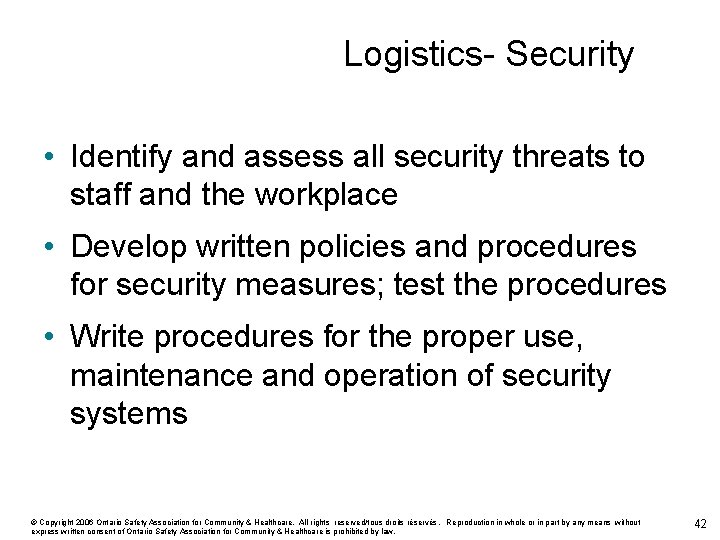
Logistics- Security • Identify and assess all security threats to staff and the workplace • Develop written policies and procedures for security measures; test the procedures • Write procedures for the proper use, maintenance and operation of security systems © Copyright 2006 Ontario Safety Association for Community & Healthcare. All rights reserved/tous droits réservés. Reproduction in whole or in part by any means without express written consent of Ontario Safety Association for Community & Healthcare is prohibited by law. 42
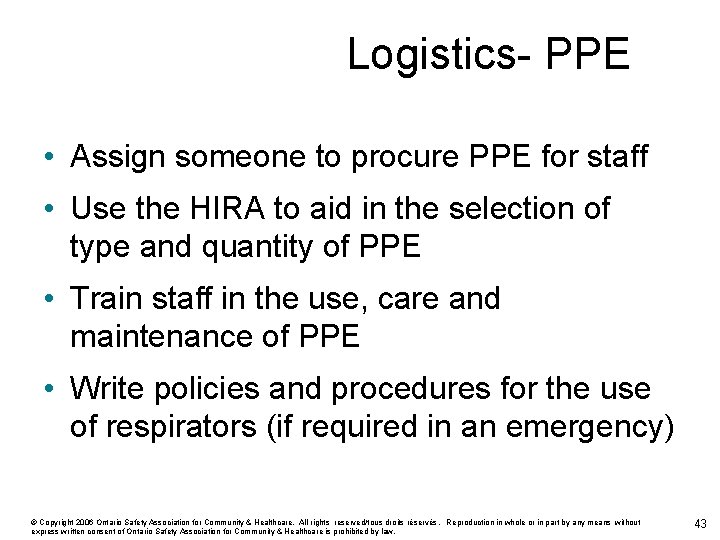
Logistics- PPE • Assign someone to procure PPE for staff • Use the HIRA to aid in the selection of type and quantity of PPE • Train staff in the use, care and maintenance of PPE • Write policies and procedures for the use of respirators (if required in an emergency) © Copyright 2006 Ontario Safety Association for Community & Healthcare. All rights reserved/tous droits réservés. Reproduction in whole or in part by any means without express written consent of Ontario Safety Association for Community & Healthcare is prohibited by law. 43
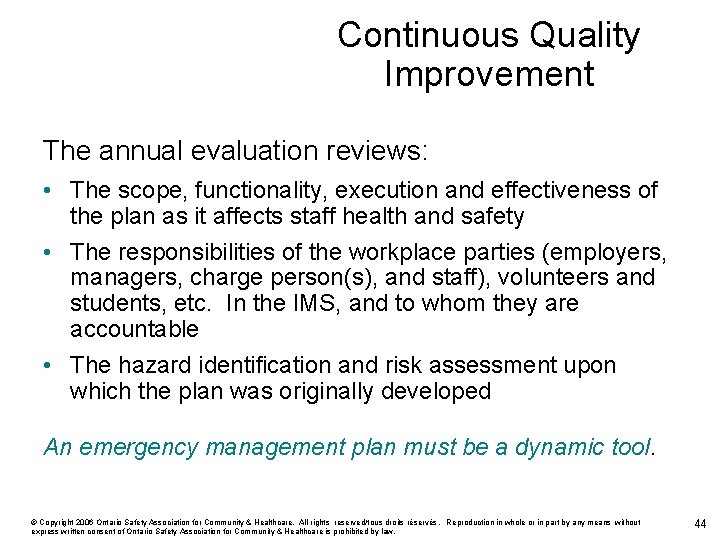
Continuous Quality Improvement The annual evaluation reviews: • The scope, functionality, execution and effectiveness of the plan as it affects staff health and safety • The responsibilities of the workplace parties (employers, managers, charge person(s), and staff), volunteers and students, etc. In the IMS, and to whom they are accountable • The hazard identification and risk assessment upon which the plan was originally developed An emergency management plan must be a dynamic tool. © Copyright 2006 Ontario Safety Association for Community & Healthcare. All rights reserved/tous droits réservés. Reproduction in whole or in part by any means without express written consent of Ontario Safety Association for Community & Healthcare is prohibited by law. 44
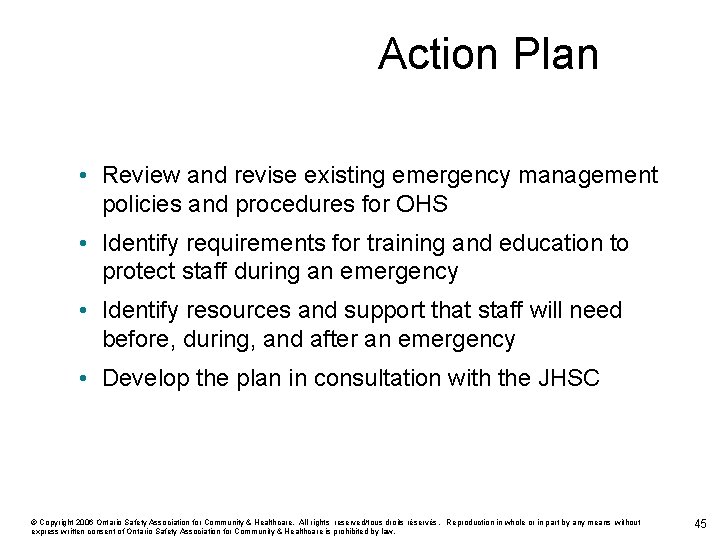
Action Plan • Review and revise existing emergency management policies and procedures for OHS • Identify requirements for training and education to protect staff during an emergency • Identify resources and support that staff will need before, during, and after an emergency • Develop the plan in consultation with the JHSC © Copyright 2006 Ontario Safety Association for Community & Healthcare. All rights reserved/tous droits réservés. Reproduction in whole or in part by any means without express written consent of Ontario Safety Association for Community & Healthcare is prohibited by law. 45
• When the next emergency hits will you be ready? • Group exercise: Identifying our strengths and opportunities for improvement. © Copyright 2006 Ontario Safety Association for Community & Healthcare. All rights reserved/tous droits réservés. Reproduction in whole or in part by any means without express written consent of Ontario Safety Association for Community & Healthcare is prohibited by law. 46
Questions? Comments? © Copyright 2006 Ontario Safety Association for Community & Healthcare. All rights reserved/tous droits réservés. Reproduction in whole or in part by any means without express written consent of Ontario Safety Association for Community & Healthcare is prohibited by law. 47