
Health and Safety Executive Work at Height and
- Slides: 15
Health and Safety Executive Work at Height and working with contractors Presented by Tony Almond Safety Topics Team
Health and Safety Executive Work at Height • Where did the Work at Height Regulations (WAHR) come from and why do we have them? • What do stakeholders / industry say about them? • Some statistics, what can they tell us • Why do falls happen in schools? • What can you do about it?
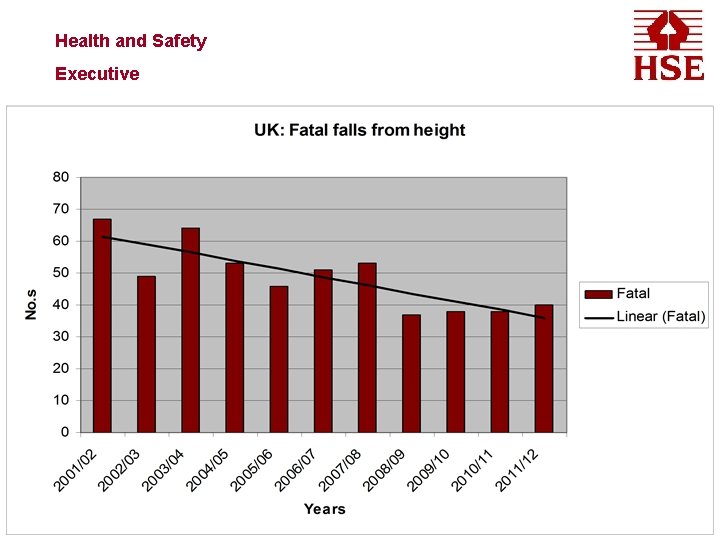
Health and Safety Executive Where do the regulations come from and why do we have them? • The WAHR implement EU law, the Temporary Work at Height Directive 2001/45/EC (TWAHD) • Previously, we had industry-specific legal requirements to control work at height e. g. in construction, shipbuilding, docks and offshore regulations • The WAHR combine the vast majority of earlier regulations into a single set of cross-cutting, goal setting regulations. • They apply to all work at height activities across all sectors (approximately 10. 5 million jobs and just over a million business enterprises). • Falls from height remain one of the biggest causes of workplace fatalities. In 2011 -12 there were 40 fatal falls (provisional figures), 25 of which occurred in construction
Health and Safety Executive What did Stakeholders say about them? • Many organisations, including Access Industry Forum (AIF) and others reinforced the need for the protection the WAHR offer • Main concerns – guidance being primarily aimed at construction – burdensome on simple activities e. g. window cleaning and basic maintenance jobs
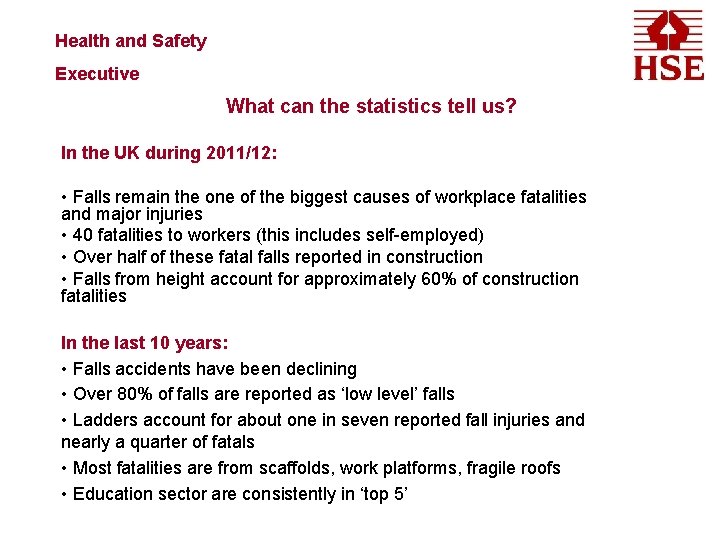
Health and Safety Executive What can the statistics tell us? In the UK during 2011/12: • Falls remain the one of the biggest causes of workplace fatalities and major injuries • 40 fatalities to workers (this includes self-employed) • Over half of these fatal falls reported in construction • Falls from height account for approximately 60% of construction fatalities In the last 10 years: • Falls accidents have been declining • Over 80% of falls are reported as ‘low level’ falls • Ladders account for about one in seven reported fall injuries and nearly a quarter of fatals • Most fatalities are from scaffolds, work platforms, fragile roofs • Education sector are consistently in ‘top 5’
Health and Safety Executive
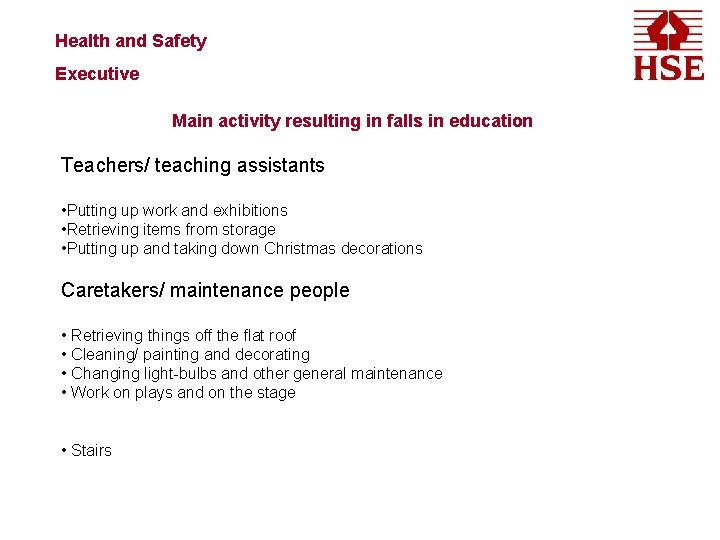
Health and Safety Executive Main activity resulting in falls in education Teachers/ teaching assistants • Putting up work and exhibitions • Retrieving items from storage • Putting up and taking down Christmas decorations Caretakers/ maintenance people • Retrieving things off the flat roof • Cleaning/ painting and decorating • Changing light-bulbs and other general maintenance • Work on plays and on the stage • Stairs
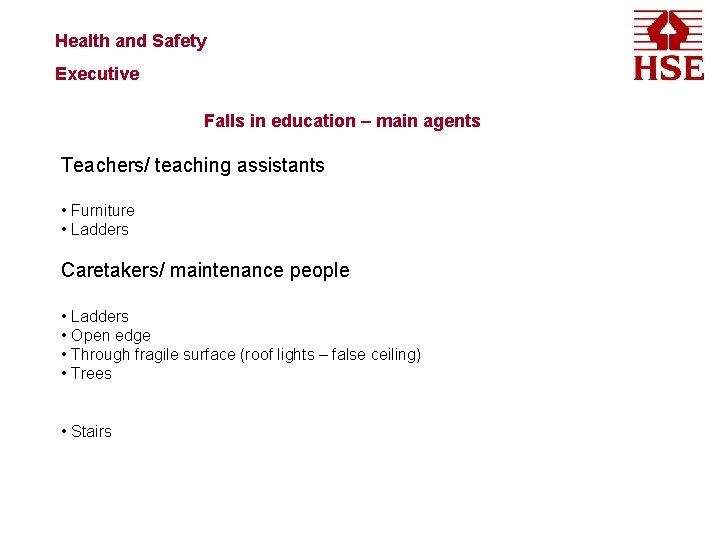
Health and Safety Executive Falls in education – main agents Teachers/ teaching assistants • Furniture • Ladders Caretakers/ maintenance people • Ladders • Open edge • Through fragile surface (roof lights – false ceiling) • Trees • Stairs
Health and Safety Executive Work at Height – things to remember If you must work at height; • Take a moment to plan the work • Use the right equipment for the job • Make sure it is in good condition • Make sure the surface you are placing the equipment on is stable and that the equipment can be set up properly • Make sure that staff are competent (this does not mean you need a training course!) And……….
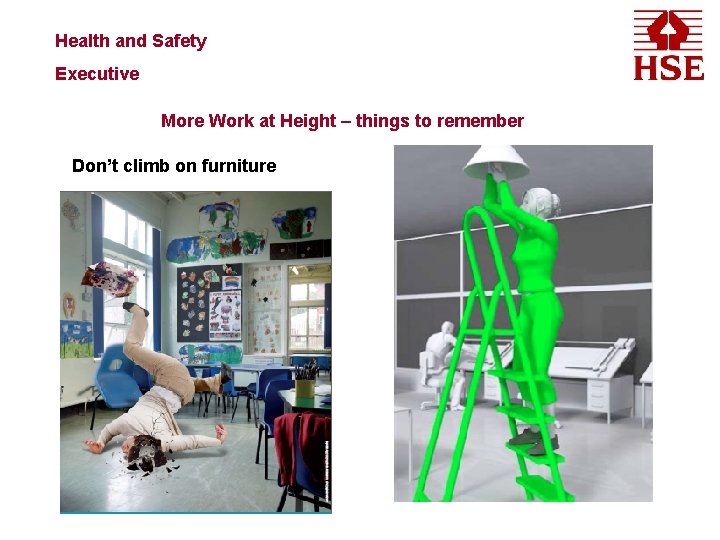
Health and Safety Executive More Work at Height – things to remember Don’t climb on furniture
Health and Safety Executive Where to get help • HSE website www. hse. gov. uk/falls • WAIT tool – helps you decide on the right access equipment • Safe use of Ladders and step ladders • Work at height Guidance for schools • Some Local Authorities have developed their own guidance
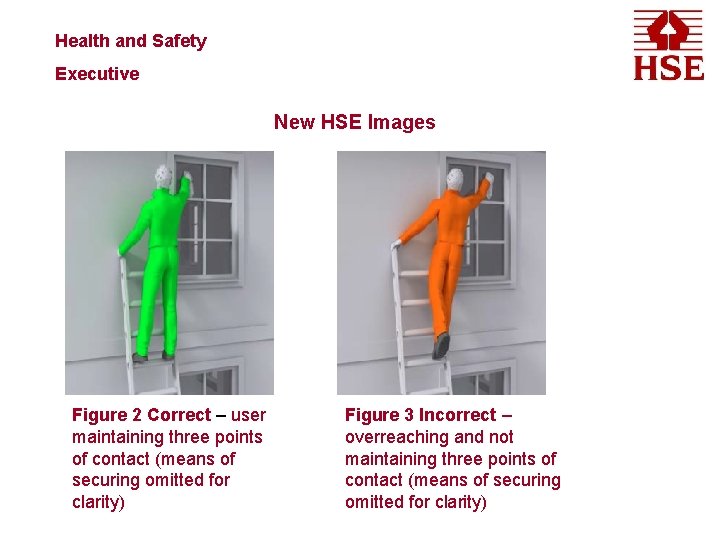
Health and Safety Executive New HSE Images Figure 2 Correct – user maintaining three points of contact (means of securing omitted for clarity) Figure 3 Incorrect – overreaching and not maintaining three points of contact (means of securing omitted for clarity)
Health and Safety Executive Summary • Take a moment to plan the work • Use the right equipment • Make sure staff who need to work at height are competent • If you are not sure get help
Health and Safety Executive Managing Contractors Things to remember: • Choosing the right contractor • Risk Management; • need to be aware of the findings of the risk assessment • if staff and pupils are on site think about segregation • informing staff • informing the contractor (do’s and don’ts) • Communicate regularly and openly • Manage the work – stay up to date Where can I get help? • Local Authority • HSE Website
Health and Safety Executive Thank you for listening, any questions ?