
Health and Safety Basic First Aid Issues y
Health and Safety & Basic First Aid Issues y t e f a S d n d Health a side Code. y n r a t n k u is o R C f e o ess ntent of th o c d An Awaren n a it ir ding the sp n a t s r e d n ork. r changes) e w h • U t m a a e e t w , d y r, electricit n fitness an e io t a it d w ( e p s x d r E • iding haza o v a d n a g • Identifyin id kit? a t s ir f p u o r First Aid onal and g s r e p a in mon help m ould be u h s s t o t a h w W o • ures and h d e c o r p y c • Emergen es d shock. r n u a d g e c in o d r e p le tion , nds and b u o w • Resuscita , and scalds ia s m n r r e u h b t r o o p nt of hy asions, min r b a , s t • Treatme u c , of blisters t n e splinters. m t , a n r e r u t b e n h u s T • sect bites, en limbs. in k , o s r e b h d c n a a d hea islocations d , s in a r p s ing • Recognis
1. 2. 3. 4. 5. Follow local signs, advice and access restrictions – don’t stray off footpaths or enter private property. Leave gates and property as you find them – always close gates behind you. Litter can be dangerous to wildlife and farm animals - take all rubbish with you. Don't damage or remove rocks, plants or trees - they are homes and food for insects, birds and animals. Wild animals and farm animals can behave unpredictably, especially if they're with their young, so give them plenty of space and stay quiet. Other important points: • Always walk towards oncoming traffic in single file on roads (on the right-hand side of the road). • Keep away from the edges of cliffs (obviously!) • Only cross rivers at fords or on stable bridges. • Only cross railway lines on marked crossings. • Never start a fire in the countryside. • Don’t contaminate fresh water. • Don’t make unnecessary noise that will disturb other people or animals. Mobiles and Music Mobile phones and MP 3 players are strictly not allowed on expeditions. One designated person carry a mobile phone in a sealed plastic bag (only they should bring one and KNOW THEIR NUMBER PLEASE!!)
Fitness and Teamwork • You are part of a group and should support each other at all times. • You should ALL take turns at map reading AND ideally ALL of you should know where you are at ALL times. Check with each other when navigating. • Be sensitive to people with different levels of fitness – If someone wants to stop and is very tired, have a short break. – Encourage and motivate weaker walkers into keeping going and keep the stronger walkers at the back. • NEVER lose sight of any of your group. You ALL must start, progress and finish together to pass the expedition. • NEVER leave a member of your group alone under any circumstances.
Avoiding Trouble – TOP TIPS • Hazards – Stick to your route closely. – Be particularly aware when near water, railways, roads, shooting ranges and quarries. – Don’t touch or try to climb electric fences. – Wear plenty of sunblock and a wide-brimmed hat to avoid sunburn/heatstroke. Drink lots of water (little and often) to avoid dehydration. – Do not accept lifts from strangers or go into people’s homes under any circumstances. • The weather – Check the weather forecasts before you go. Look for signs which will indicate changes in the weather eg. Put on waterproofs when clouds go black. – Lightning – Stay away from trees, summits and ridges, sit down on your kip mat/rucksack with your feet off the floor, hands folded in front and tucked in OR get in a tent or minibus if you are at camp. – Wind chill cant be underestimated. Strong winds are tiring and drive rain into clothes and tents. Don’t pitch a tent side-on to the wind – it will blow away!
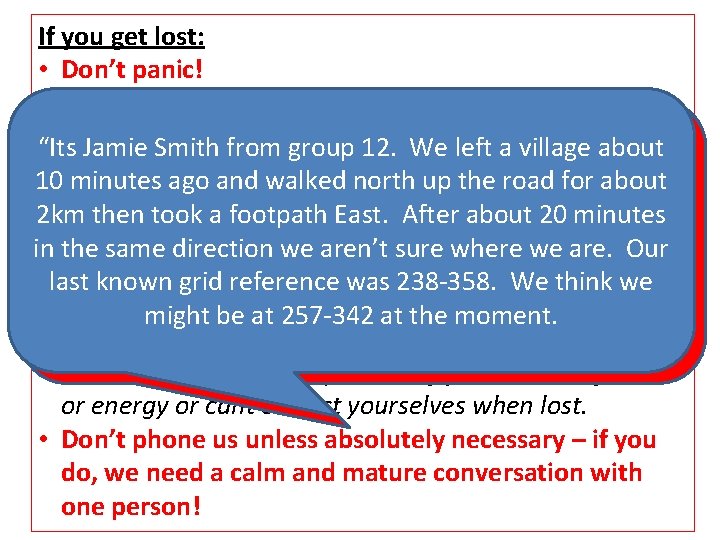
If you get lost: • Don’t panic! • If you know where you are on the map, plan a new route to. Smith your checkpoint “Its Jamie from group 12. We left! a village about “Hi Sir, its me • OR retrace your andnorth get back on your 10 minutes ago andsteps walked up the road route for about • OR head for aalost ‘collecting feature’ (road, river) orare follow We are in a. East. field…. . there 2 km then took footpath After about 20 minutes a natural (eg. Aaren’t valley, sure stream) likely to lead to incows. the same. Ifeature direction we where we are. Our can see some trees. Do you habitation – go downhill, not up!! last known grid reference was 238 -358. We think we • You wont fail an getting lost but you know are? ” might be expedition atwhere 257 -342 for atwe the moment. have to correct yourself (we getquickly. this a lot!!) • You will not pass the expedition if you run out of time or energy or cant correct yourselves when lost. • Don’t phone us unless absolutely necessary – if you do, we need a calm and mature conversation with one person!
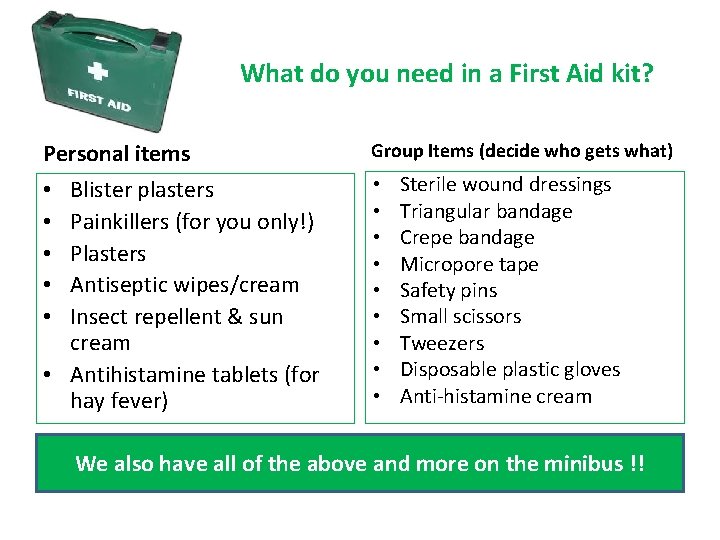
What do you need in a First Aid kit? Personal items Group Items (decide who gets what) Blister plasters Painkillers (for you only!) Plasters Antiseptic wipes/cream Insect repellent & sun cream • Antihistamine tablets (for hay fever) • • • • Sterile wound dressings Triangular bandage Crepe bandage Micropore tape Safety pins Small scissors Tweezers Disposable plastic gloves Anti-histamine cream We also have all of the above and more on the minibus !!
As a group, Decide on what you think you should do for each of these
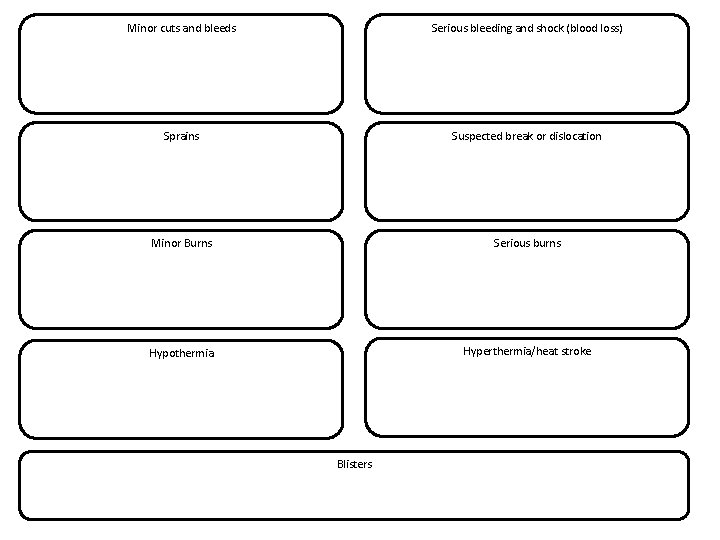
Minor cuts and bleeds Serious bleeding and shock (blood loss) Sprains Suspected break or dislocation Minor Burns Serious burns Hypothermia Hyperthermia/heat stroke Blisters
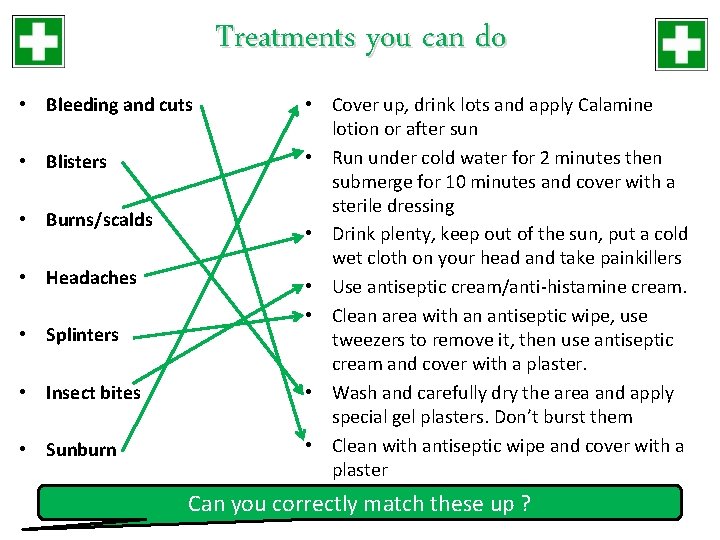
Treatments you can do • Bleeding and cuts • Blisters • Burns/scalds • Headaches • Splinters • Insect bites • Sunburn • Cover up, drink lots and apply Calamine lotion or after sun • Run under cold water for 2 minutes then submerge for 10 minutes and cover with a sterile dressing • Drink plenty, keep out of the sun, put a cold wet cloth on your head and take painkillers • Use antiseptic cream/anti-histamine cream. • Clean area with an antiseptic wipe, use tweezers to remove it, then use antiseptic cream and cover with a plaster. • Wash and carefully dry the area and apply special gel plasters. Don’t burst them • Clean with antiseptic wipe and cover with a plaster Can you correctly match these up ?
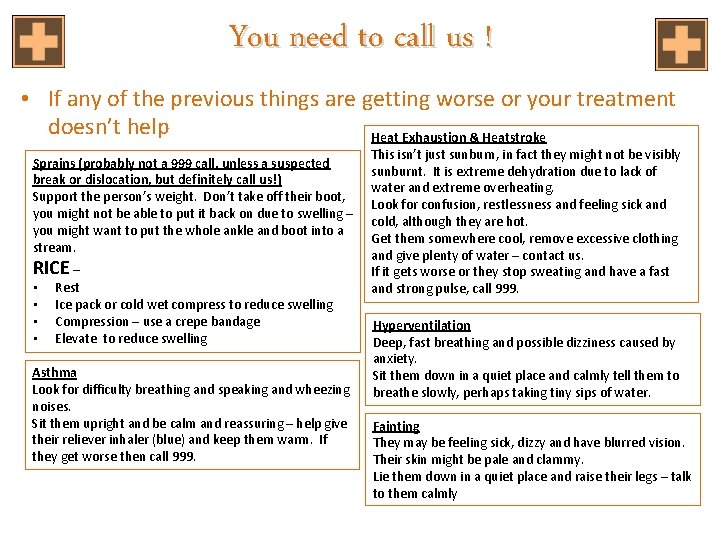
You need to call us ! • If any of the previous things are getting worse or your treatment doesn’t help Heat Exhaustion & Heatstroke Sprains (probably not a 999 call, unless a suspected break or dislocation, but definitely call us!) Support the person’s weight. Don’t take off their boot, you might not be able to put it back on due to swelling – you might want to put the whole ankle and boot into a stream. RICE – • • Rest Ice pack or cold wet compress to reduce swelling Compression – use a crepe bandage Elevate to reduce swelling Asthma Look for difficulty breathing and speaking and wheezing noises. Sit them upright and be calm and reassuring – help give their reliever inhaler (blue) and keep them warm. If they get worse then call 999. This isn’t just sunburn, in fact they might not be visibly sunburnt. It is extreme dehydration due to lack of water and extreme overheating. Look for confusion, restlessness and feeling sick and cold, although they are hot. Get them somewhere cool, remove excessive clothing and give plenty of water – contact us. If it gets worse or they stop sweating and have a fast and strong pulse, call 999. Hyperventilation Deep, fast breathing and possible dizziness caused by anxiety. Sit them down in a quiet place and calmly tell them to breathe slowly, perhaps taking tiny sips of water. Fainting They may be feeling sick, dizzy and have blurred vision. Their skin might be pale and clammy. Lie them down in a quiet place and raise their legs – talk to them calmly
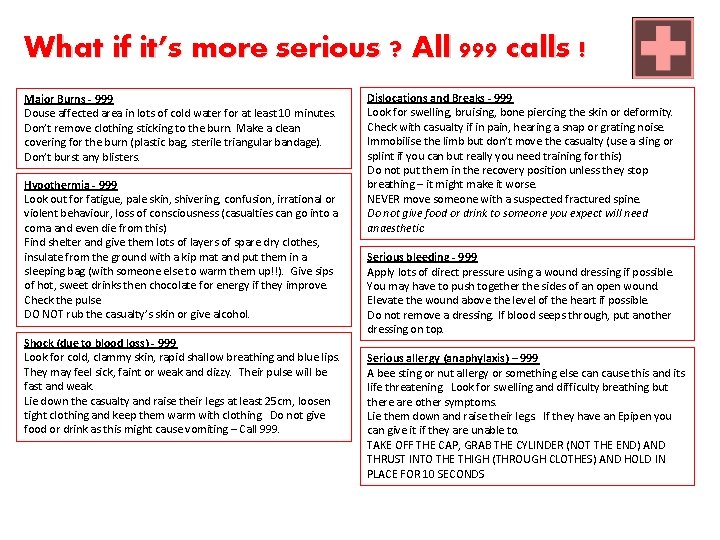
What if it’s more serious ? All 999 calls ! Major Burns - 999 Douse affected area in lots of cold water for at least 10 minutes. Don’t remove clothing sticking to the burn. Make a clean covering for the burn (plastic bag, sterile triangular bandage). Don’t burst any blisters. Hypothermia - 999 Look out for fatigue, pale skin, shivering, confusion, irrational or violent behaviour, loss of consciousness (casualties can go into a coma and even die from this) Find shelter and give them lots of layers of spare dry clothes, insulate from the ground with a kip mat and put them in a sleeping bag (with someone else to warm them up!!). Give sips of hot, sweet drinks then chocolate for energy if they improve. Check the pulse DO NOT rub the casualty’s skin or give alcohol. Shock (due to blood loss) - 999 Look for cold, clammy skin, rapid shallow breathing and blue lips. They may feel sick, faint or weak and dizzy. Their pulse will be fast and weak. Lie down the casualty and raise their legs at least 25 cm, loosen tight clothing and keep them warm with clothing. Do not give food or drink as this might cause vomiting – Call 999. Dislocations and Breaks - 999 Look for swelling, bruising, bone piercing the skin or deformity. Check with casualty if in pain, hearing a snap or grating noise. Immobilise the limb but don’t move the casualty (use a sling or splint if you can but really you need training for this) Do not put them in the recovery position unless they stop breathing – it might make it worse. NEVER move someone with a suspected fractured spine. Do not give food or drink to someone you expect will need anaesthetic Serious bleeding - 999 Apply lots of direct pressure using a wound dressing if possible. You may have to push together the sides of an open wound. Elevate the wound above the level of the heart if possible. Do not remove a dressing. If blood seeps through, put another dressing on top. Serious allergy (anaphylaxis) – 999 A bee sting or nut allergy or something else can cause this and its life threatening. Look for swelling and difficulty breathing but there are other symptoms. Lie them down and raise their legs. If they have an Epipen you can give it if they are unable to. TAKE OFF THE CAP, GRAB THE CYLINDER (NOT THE END) AND THRUST INTO THE THIGH (THROUGH CLOTHES) AND HOLD IN PLACE FOR 10 SECONDS
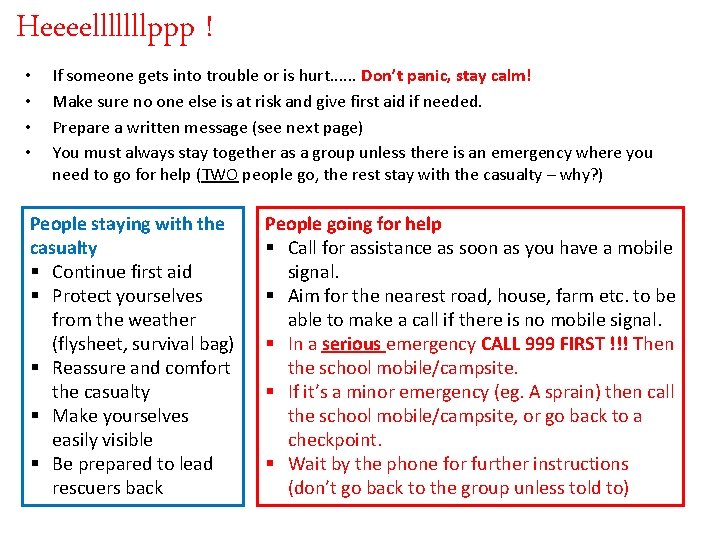
Heeeelllllllppp ! • • If someone gets into trouble or is hurt. . . Don’t panic, stay calm! Make sure no one else is at risk and give first aid if needed. Prepare a written message (see next page) You must always stay together as a group unless there is an emergency where you need to go for help (TWO people go, the rest stay with the casualty – why? ) People staying with the casualty § Continue first aid § Protect yourselves from the weather (flysheet, survival bag) § Reassure and comfort the casualty § Make yourselves easily visible § Be prepared to lead rescuers back People going for help § Call for assistance as soon as you have a mobile signal. § Aim for the nearest road, house, farm etc. to be able to make a call if there is no mobile signal. § In a serious emergency CALL 999 FIRST !!! Then the school mobile/campsite. § If it’s a minor emergency (eg. A sprain) then call the school mobile/campsite, or go back to a checkpoint. § Wait by the phone for further instructions (don’t go back to the group unless told to)
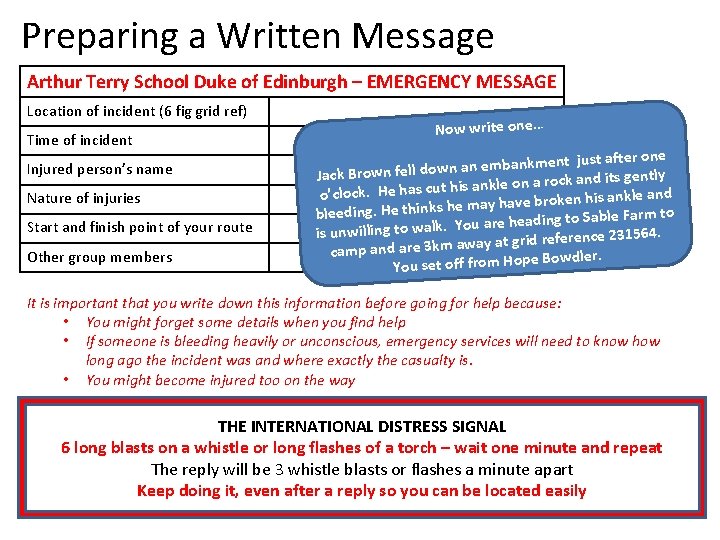
Preparing a Written Message Arthur Terry School Duke of Edinburgh – EMERGENCY MESSAGE Location of incident (6 fig grid ref) Time of incident Injured person’s name Nature of injuries Start and finish point of your route Other group members Now write one… kment just after one an b em an n w o d ll fe Jack Brown and its gently ck ro a n o e kl an is h o’clock. He has cut n his ankle and ke ro b e av h ay m e h bleeding. He thinks g to Sable Farm to in d ea h e ar u Yo k. al is unwilling to w reference 231564. id gr at ay aw m 3 k e camp and ar e Bowdler. You set off from Hop It is important that you write down this information before going for help because: • You might forget some details when you find help • If someone is bleeding heavily or unconscious, emergency services will need to know how long ago the incident was and where exactly the casualty is. • You might become injured too on the way THE INTERNATIONAL DISTRESS SIGNAL 6 long blasts on a whistle or long flashes of a torch – wait one minute and repeat The reply will be 3 whistle blasts or flashes a minute apart Keep doing it, even after a reply so you can be located easily
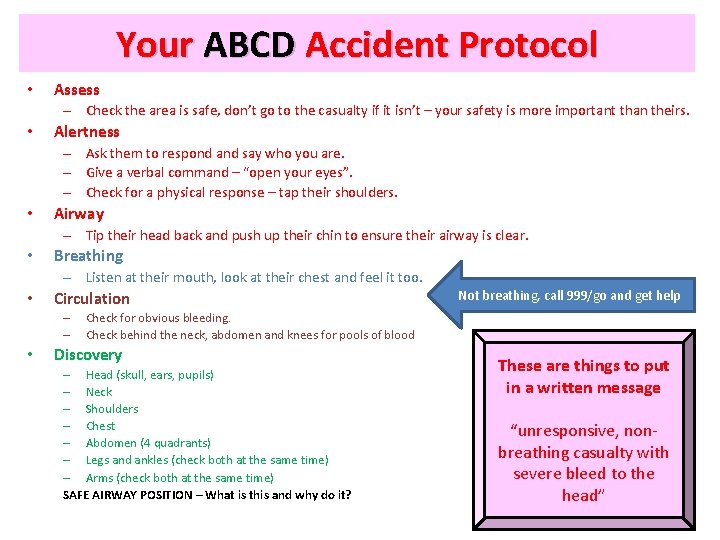
Your ABCD Accident Protocol • Assess – Check the area is safe, don’t go to the casualty if it isn’t – your safety is more important than theirs. • Alertness – Ask them to respond and say who you are. – Give a verbal command – “open your eyes”. – Check for a physical response – tap their shoulders. • Airway – Tip their head back and push up their chin to ensure their airway is clear. • Breathing – Listen at their mouth, look at their chest and feel it too. • Circulation – – • Not breathing, call 999/go and get help Check for obvious bleeding. Check behind the neck, abdomen and knees for pools of blood Discovery – Head (skull, ears, pupils) – Neck – Shoulders – Chest – Abdomen (4 quadrants) – Legs and ankles (check both at the same time) – Arms (check both at the same time) SAFE AIRWAY POSITION – What is this and why do it? These are things to put in a written message “unresponsive, nonbreathing casualty with severe bleed to the head”
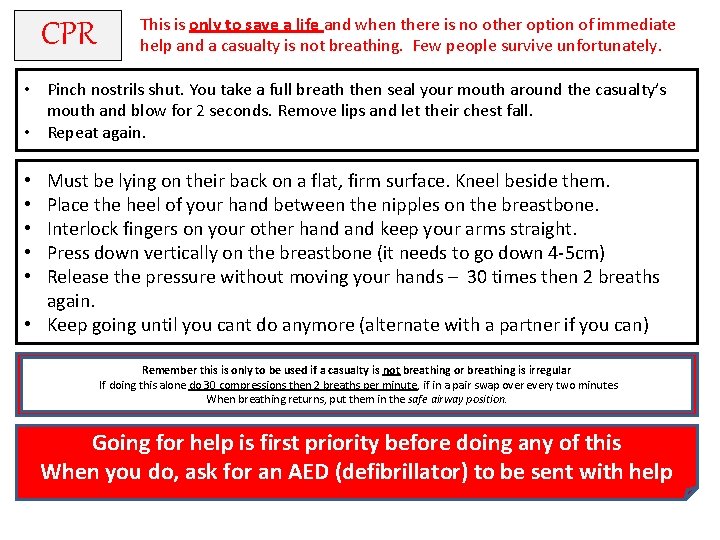
CPR This is only to save a life and when there is no other option of immediate help and a casualty is not breathing. Few people survive unfortunately. • Pinch nostrils shut. You take a full breath then seal your mouth around the casualty’s mouth and blow for 2 seconds. Remove lips and let their chest fall. • Repeat again. Must be lying on their back on a flat, firm surface. Kneel beside them. Place the heel of your hand between the nipples on the breastbone. Interlock fingers on your other hand keep your arms straight. Press down vertically on the breastbone (it needs to go down 4 -5 cm) Release the pressure without moving your hands – 30 times then 2 breaths again. • Keep going until you cant do anymore (alternate with a partner if you can) • • • Remember this is only to be used if a casualty is not breathing or breathing is irregular If doing this alone do 30 compressions then 2 breaths per minute, if in a pair swap over every two minutes When breathing returns, put them in the safe airway position. Going for help is first priority before doing any of this When you do, ask for an AED (defibrillator) to be sent with help
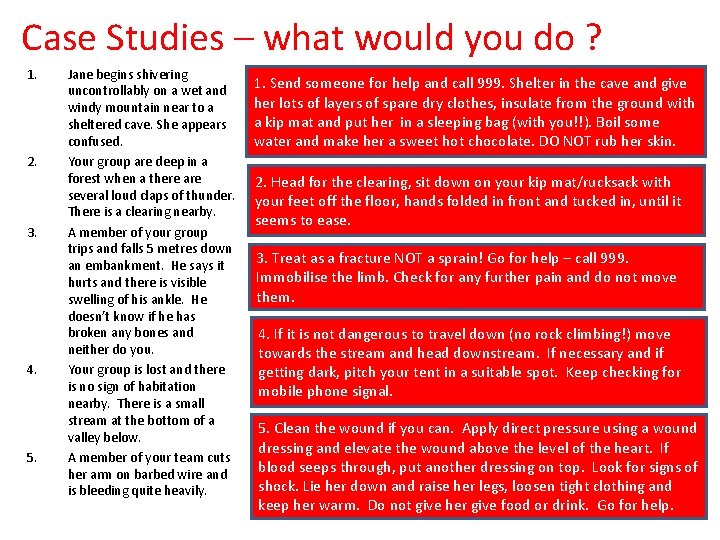
Case Studies – what would you do ? 1. 2. 3. 4. 5. Jane begins shivering uncontrollably on a wet and windy mountain near to a sheltered cave. She appears confused. Your group are deep in a forest when a there are several loud claps of thunder. There is a clearing nearby. A member of your group trips and falls 5 metres down an embankment. He says it hurts and there is visible swelling of his ankle. He doesn’t know if he has broken any bones and neither do you. Your group is lost and there is no sign of habitation nearby. There is a small stream at the bottom of a valley below. A member of your team cuts her arm on barbed wire and is bleeding quite heavily. 1. Send someone for help and call 999. Shelter in the cave and give her lots of layers of spare dry clothes, insulate from the ground with a kip mat and put her in a sleeping bag (with you!!). Boil some water and make her a sweet hot chocolate. DO NOT rub her skin. 2. Head for the clearing, sit down on your kip mat/rucksack with your feet off the floor, hands folded in front and tucked in, until it seems to ease. 3. Treat as a fracture NOT a sprain! Go for help – call 999. Immobilise the limb. Check for any further pain and do not move them. 4. If it is not dangerous to travel down (no rock climbing!) move towards the stream and head downstream. If necessary and if getting dark, pitch your tent in a suitable spot. Keep checking for mobile phone signal. 5. Clean the wound if you can. Apply direct pressure using a wound dressing and elevate the wound above the level of the heart. If blood seeps through, put another dressing on top. Look for signs of shock. Lie her down and raise her legs, loosen tight clothing and keep her warm. Do not give her give food or drink. Go for help.
If time – Try Triangular bandage tying • Collar and cuff • Bandanas • Horizontal slings • Elevation slings
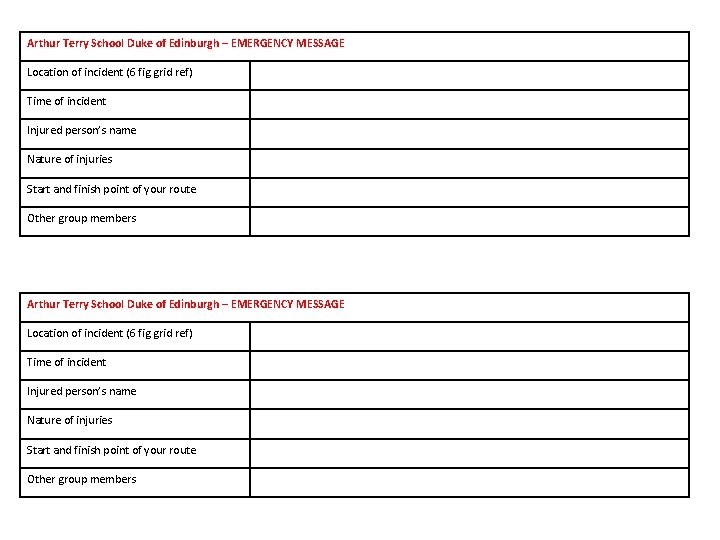
Arthur Terry School Duke of Edinburgh – EMERGENCY MESSAGE Location of incident (6 fig grid ref) Time of incident Injured person’s name Nature of injuries Start and finish point of your route Other group members
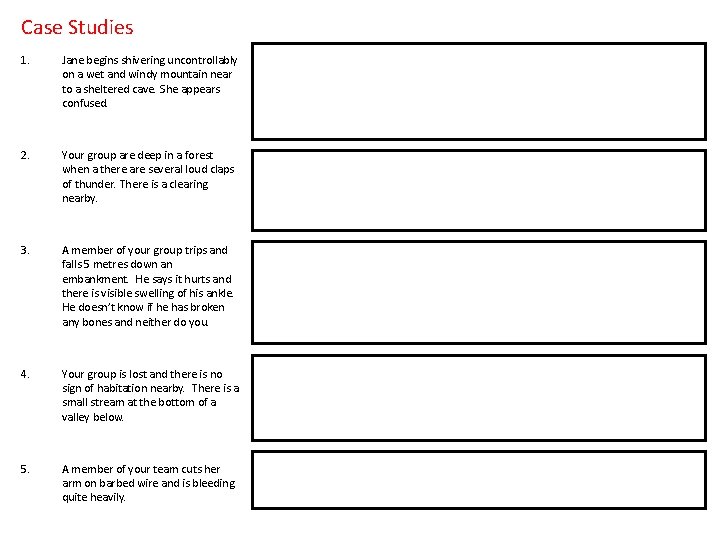
Case Studies 1. Jane begins shivering uncontrollably on a wet and windy mountain near to a sheltered cave. She appears confused. 2. Your group are deep in a forest when a there are several loud claps of thunder. There is a clearing nearby. 3. A member of your group trips and falls 5 metres down an embankment. He says it hurts and there is visible swelling of his ankle. He doesn’t know if he has broken any bones and neither do you. 4. Your group is lost and there is no sign of habitation nearby. There is a small stream at the bottom of a valley below. 5. A member of your team cuts her arm on barbed wire and is bleeding quite heavily.
Next year… • For Silver Award students we are planning to run a 12 week first aid course that you can use for your Skill section !
- Slides: 20