
Health and disease signs in farm animals health
- Slides: 25
Health and disease signs in farm animals : health signs which appear on healthy • animal such as : The eyes gloss , bright skin , • moist nose pad , the mucous membranes • uncongested , good appetite , regularity of rumination process , natural milk production , natural body temperature , regularity of (respiration rate and pulse rate ).
disease signs which appear on sick animal such as : - depressed , isolated from the herd , the • hair loss its gloss , dry nose pad , stopped from the eating and rumination , reduce of milk production and change milk composition , change a nature of urine , feces , body temperature and breathing , and these changes occur according to type of disease.
The Disease It is changing in some tissues of the body • or its functions because of infecting in the microorganisms (bacteria, viruses, Parasites , Protozoa , Fungi ) ● diseases cause significant economic losses in animal production. ● The breeder must be identify the most • important signs of health and disease in animals to reduce the losses that cause by these diseases.
1 - The pulse rate : - Pulse rate : - It is expansion of the • arteries walls by blood waves that will be paying by the heart in these arteries. ● the pulse rate is consider indicator for • health of circulatory system.
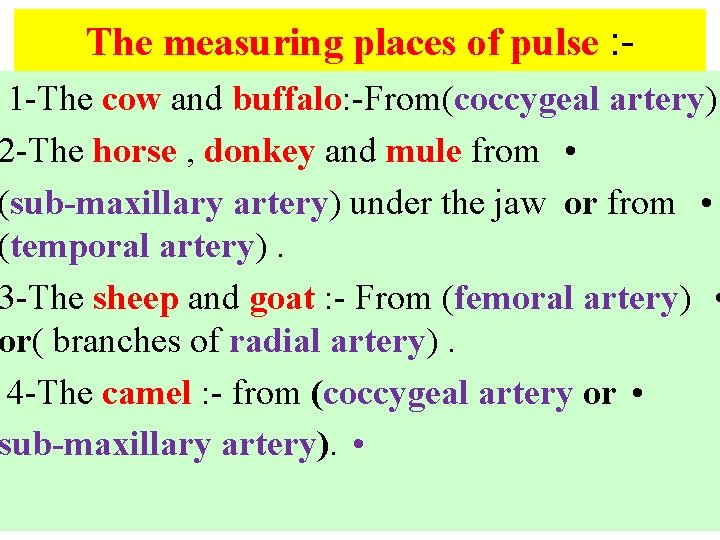
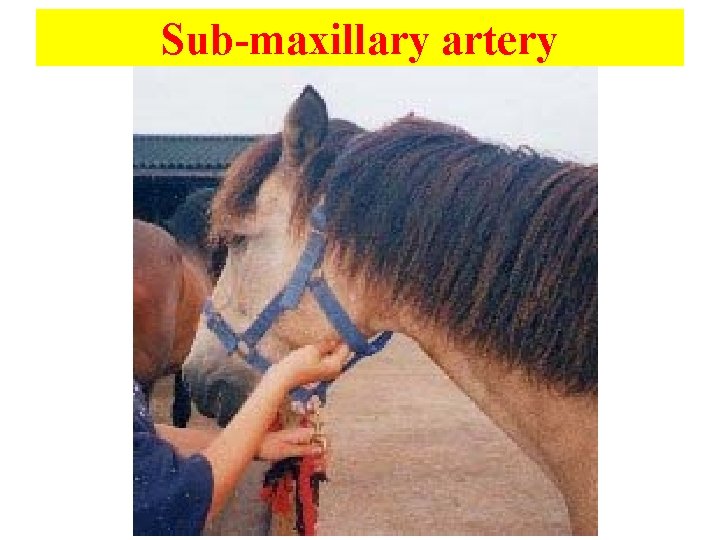
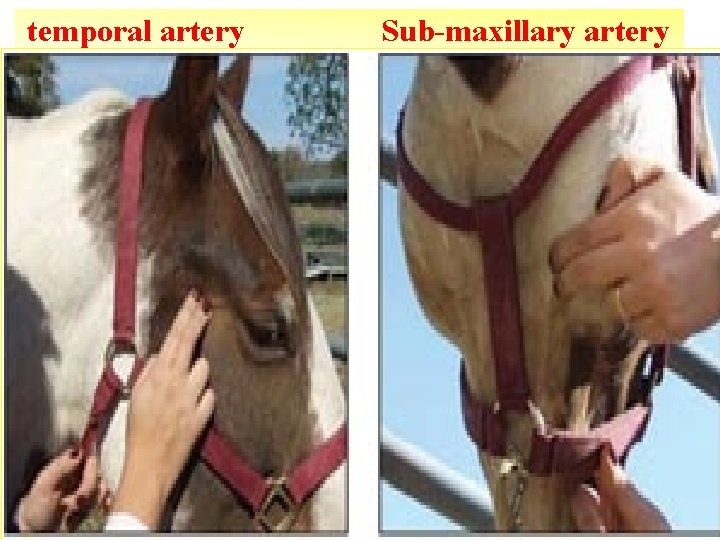
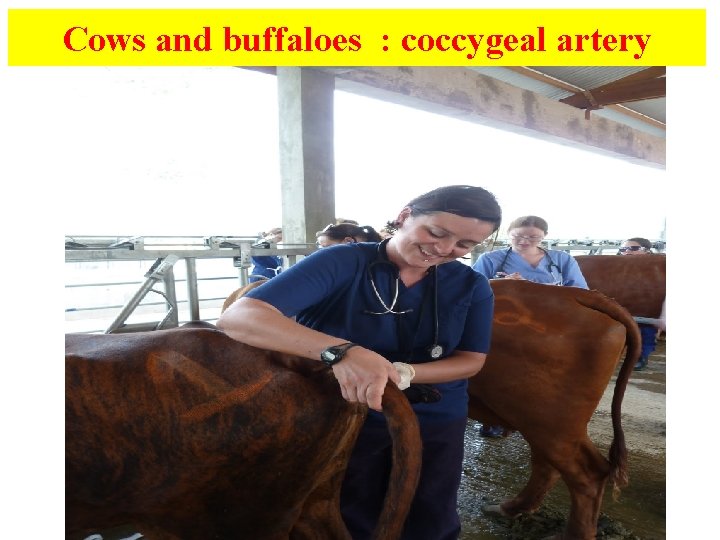
The measuring places of pulse : - 1 -The cow and buffalo: -From(coccygeal artery) 2 -The horse , donkey and mule from • (sub-maxillary artery) under the jaw or from • (temporal artery). 3 -The sheep and goat : - From (femoral artery) • or( branches of radial artery). 4 -The camel : - from (coccygeal artery or • sub-maxillary artery). •
Sub-maxillary artery
temporal artery Sub-maxillary artery
Cows and buffaloes : coccygeal artery
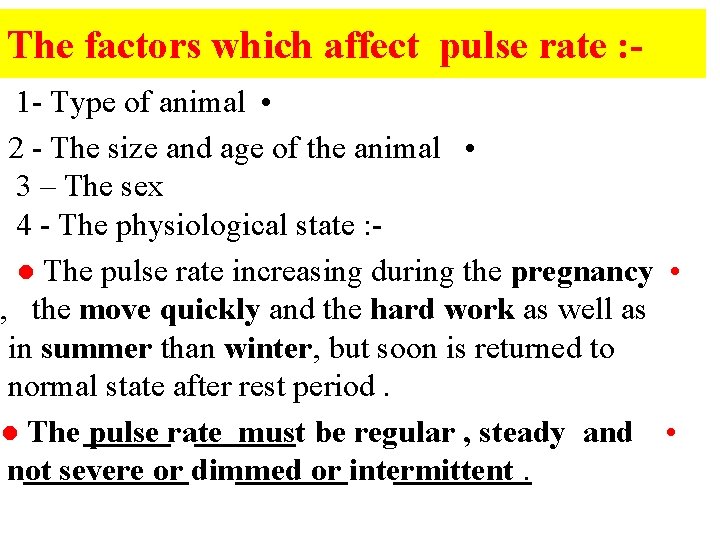
The factors which affect pulse rate : - 1 - Type of animal • 2 - The size and age of the animal • 3 – The sex 4 - The physiological state : ● The pulse rate increasing during the pregnancy • , the move quickly and the hard work as well as in summer than winter, but soon is returned to normal state after rest period. ● The pulse rate must be regular , steady and • not severe or dimmed or intermittent.
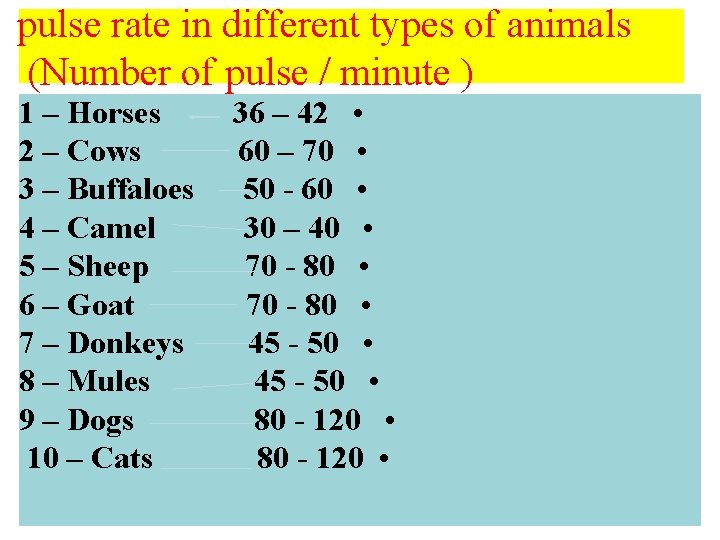
pulse rate in different types of animals (Number of pulse / minute ) 1 – Horses 2 – Cows 3 – Buffaloes 4 – Camel 5 – Sheep 6 – Goat 7 – Donkeys 8 – Mules 9 – Dogs 10 – Cats 36 – 42 • 60 – 70 • 50 - 60 • 30 – 40 • 70 - 80 • 45 - 50 • 80 - 120 •
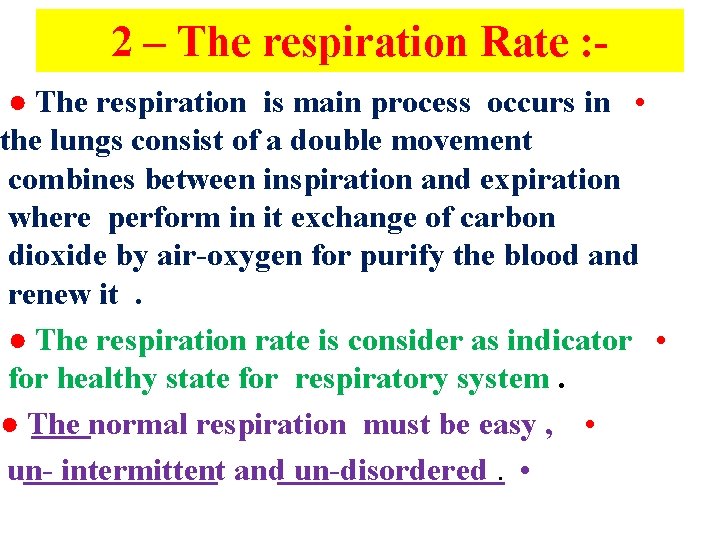
2 – The respiration Rate : - ● The respiration is main process occurs in • the lungs consist of a double movement combines between inspiration and expiration where perform in it exchange of carbon dioxide by air-oxygen for purify the blood and renew it. ● The respiration rate is consider as indicator • for healthy state for respiratory system. ● The normal respiration must be easy , • un- intermittent and un-disordered. •
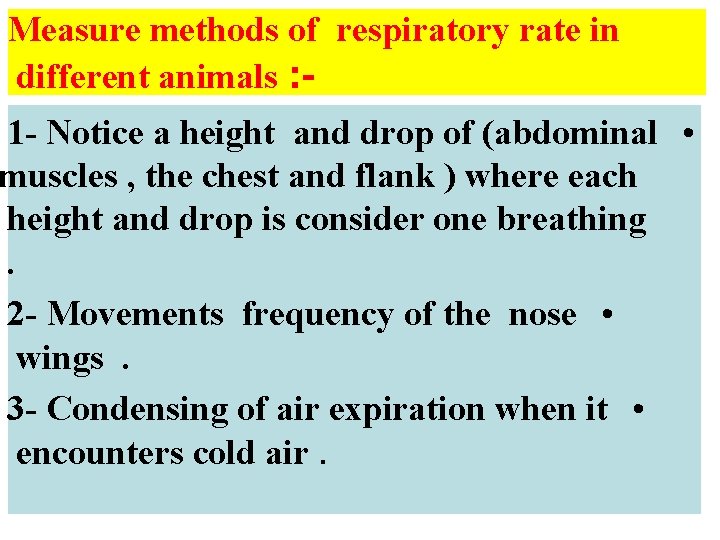
Measure methods of respiratory rate in different animals : - 1 - Notice a height and drop of (abdominal • muscles , the chest and flank ) where each height and drop is consider one breathing. 2 - Movements frequency of the nose • wings. 3 - Condensing of air expiration when it • encounters cold air.
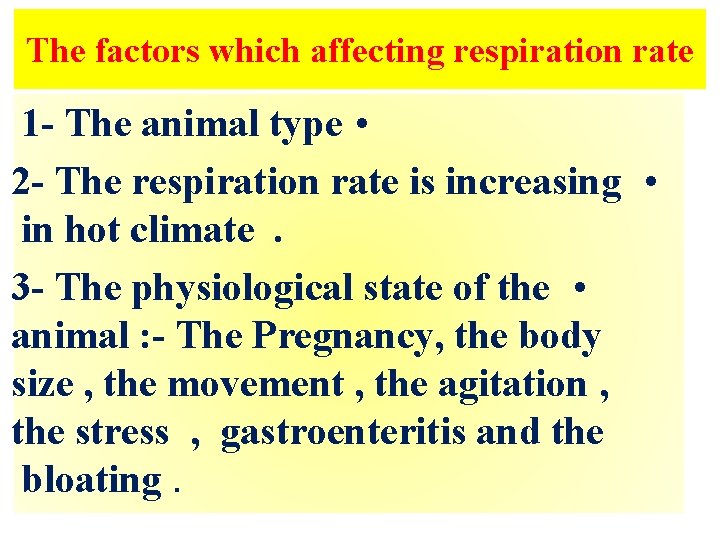
The factors which affecting respiration rate 1 - The animal type • 2 - The respiration rate is increasing • in hot climate. 3 - The physiological state of the • animal : - The Pregnancy, the body size , the movement , the agitation , the stress , gastroenteritis and the bloating.
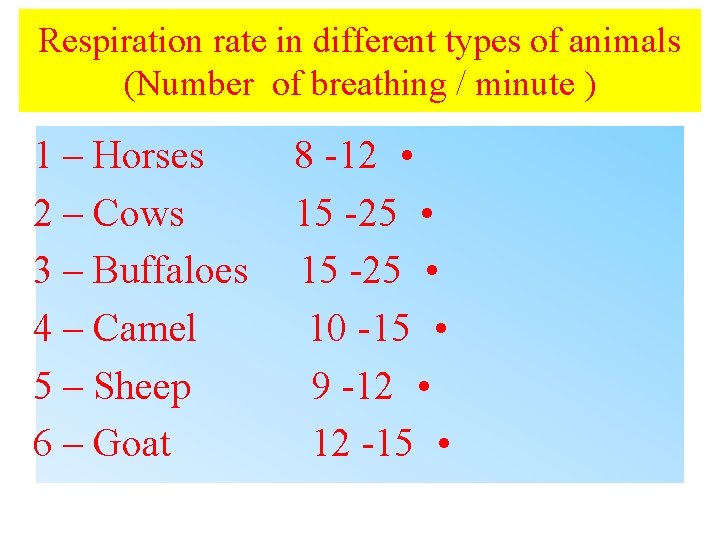
Respiration rate in different types of animals (Number of breathing / minute ) 1 – Horses 2 – Cows 3 – Buffaloes 4 – Camel 5 – Sheep 6 – Goat 8 -12 • 15 -25 • 10 -15 • 9 -12 • 12 -15 •
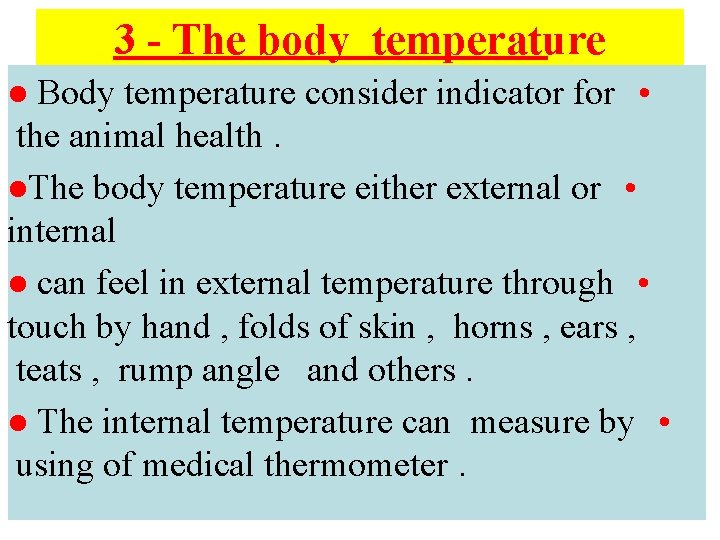
3 - The body temperature ● Body temperature consider indicator for • the animal health. ●The body temperature either external or • internal ● can feel in external temperature through • touch by hand , folds of skin , horns , ears , teats , rump angle and others. ● The internal temperature can measure by • using of medical thermometer.
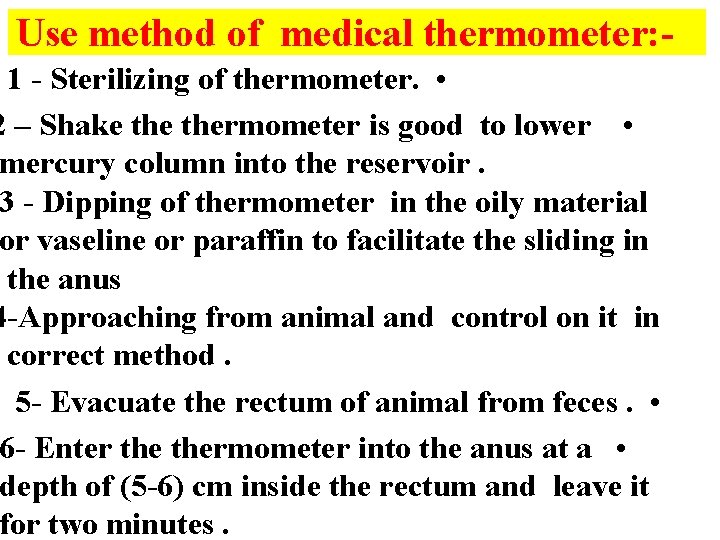
Use method of medical thermometer: - 1 - Sterilizing of thermometer. • 2 – Shake thermometer is good to lower • mercury column into the reservoir. 3 - Dipping of thermometer in the oily material or vaseline or paraffin to facilitate the sliding in the anus 4 -Approaching from animal and control on it in correct method. 5 - Evacuate the rectum of animal from feces. • 6 - Enter thermometer into the anus at a • depth of (5 -6) cm inside the rectum and leave it for two minutes.
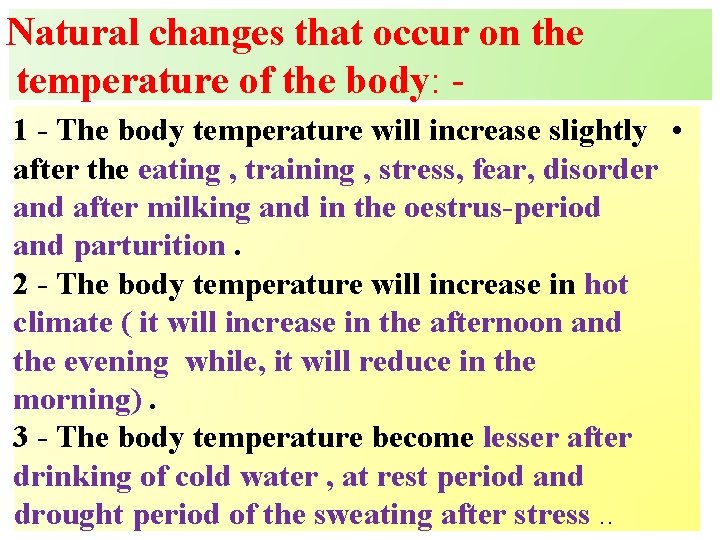
Natural changes that occur on the temperature of the body: 1 - The body temperature will increase slightly • after the eating , training , stress, fear, disorder and after milking and in the oestrus-period and parturition. 2 - The body temperature will increase in hot climate ( it will increase in the afternoon and the evening while, it will reduce in the morning). 3 - The body temperature become lesser after drinking of cold water , at rest period and drought period of the sweating after stress. .
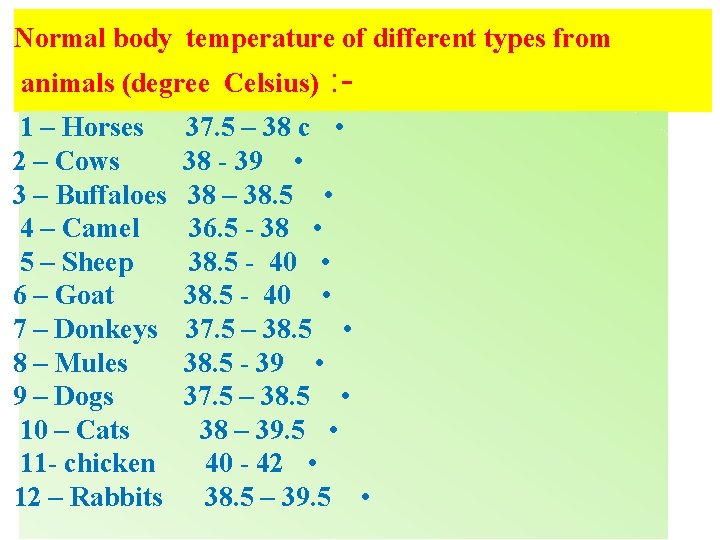
Normal body temperature of different types from animals (degree Celsius) 1 – Horses 2 – Cows 3 – Buffaloes 4 – Camel 5 – Sheep 6 – Goat 7 – Donkeys 8 – Mules 9 – Dogs 10 – Cats 11 - chicken 12 – Rabbits : - 37. 5 – 38 c • 38 - 39 • 38 – 38. 5 • 36. 5 - 38 • 38. 5 - 40 • 37. 5 – 38. 5 • 38. 5 - 39 • 37. 5 – 38. 5 • 38 – 39. 5 • 40 - 42 • 38. 5 – 39. 5 •
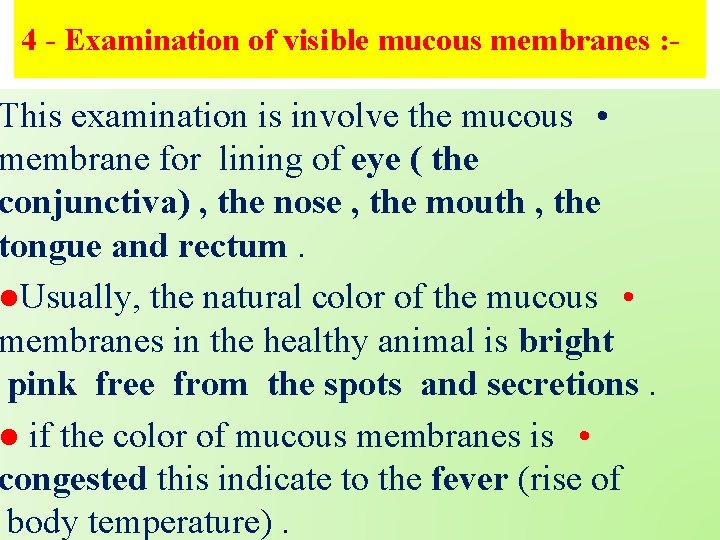
4 - Examination of visible mucous membranes : - This examination is involve the mucous • membrane for lining of eye ( the conjunctiva) , the nose , the mouth , the tongue and rectum. ●Usually, the natural color of the mucous • membranes in the healthy animal is bright pink free from the spots and secretions. ● if the color of mucous membranes is • congested this indicate to the fever (rise of body temperature).
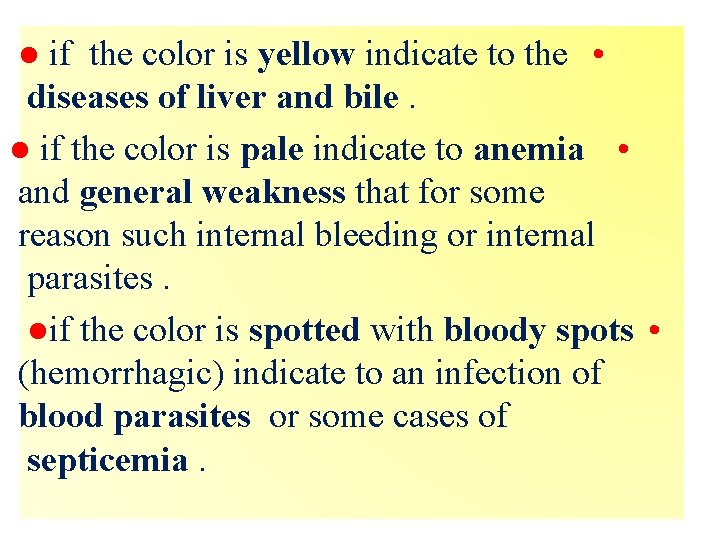
● if the color is yellow indicate to the • diseases of liver and bile. ● if the color is pale indicate to anemia • and general weakness that for some reason such internal bleeding or internal parasites. ●if the color is spotted with bloody spots • (hemorrhagic) indicate to an infection of blood parasites or some cases of septicemia.
5 - The skin and hair condition: ● Skin of the healthy animal is clean , bright , • soft , easy the pulling and move , the hair is a bright , shining and in one direction. ● In case of infection in the skin diseases will note hair loss , presence of dandruffs while be coarse and non-bright. ● There is natural phenomenon , a partial loss for hair in horses and cattle in (the spring and autumn ) and this hair replace by a new hair.
6 - The Appetite : - It is ability and desire of animals to eat • the food. ●The horse have appetite : - collecting the food with lips • without falling it to the manger. ● The cows have appetite : - taking the food in her mouth • without being chewed it and send it to the rumen and at rest time will return it to the mouth again in balls shape for re-chewing it. ● Such operations perform in healthy animal in regularly • and simplicity, while the sick animal can not do this processes regularly.
7 - Defecation ● In healthy animal : - • ● Must be the defecation is naturally without of difficulty or pain. ● The feces must be in the form of balls when come down from the anus and then disintegrate when it touch the ground. ● The natural feces color is (golden yellow) or tendency to green and according to type of food. ● The feces smell must be natural. • ● The feces must be free of mucous materials and • intestinal worms. ● The defecation is occur about (8) times / day in healthy animal (Horses). • •
Urination ● The urine must be normal in amount , the color • ( light yellow , bright and non-bloody ) and the smell. ● Must be urination of animal is natural and • without pain. ● If the animal urinate a lot or little this is • meaning the defect in urinary system or neurological center. ● The normal quantity of urine (1 / 4 - 1 / 2 • gallon) / at one time.
Administration of medicines 1 - Through the mouth (per- os) : -Such as balling , • tablets, capsules and drenches. 2 - Through the nostrils : - Such as nose drops and Inhalations. 3 - Through the eye : - Such as eye drops , lotions and ointments. 4 - Per- rectum : - Such as rectul enema. 5 - Per-vagina : -Such as vaginal douches and pessaries. 6 - Intra-mammary : - Such as ointments and injections. 7 - Over the skin : - Such as ointments and fomentation. 8 - Medicines are give by Injections : - Such as Intra-muscular, Intra-venous, intra-uterine, Intramammary, Intra-ruminal.