
Healing of Extraction Socket and Affecting Factors Department

- Slides: 27
Healing of Extraction Socket and Affecting Factors Department of Oral and Maxillofacial Surgery Dentistry Explorer
Contents • Introduction to healing of extraction socket • Stages of healing • Factors affecting healing of extraction socket • Conclusion Dentistry Explorer
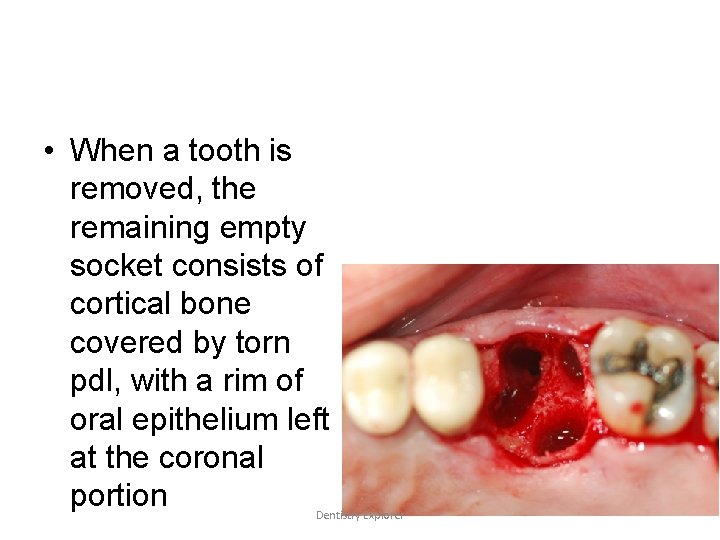
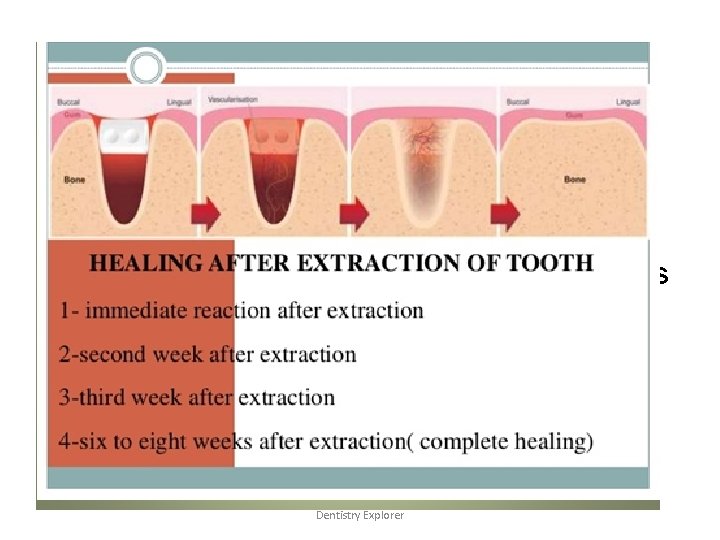
• When a tooth is removed, the remaining empty socket consists of cortical bone covered by torn pdl, with a rim of oral epithelium left at the coronal portion Dentistry Explorer
Dentistry Explorer
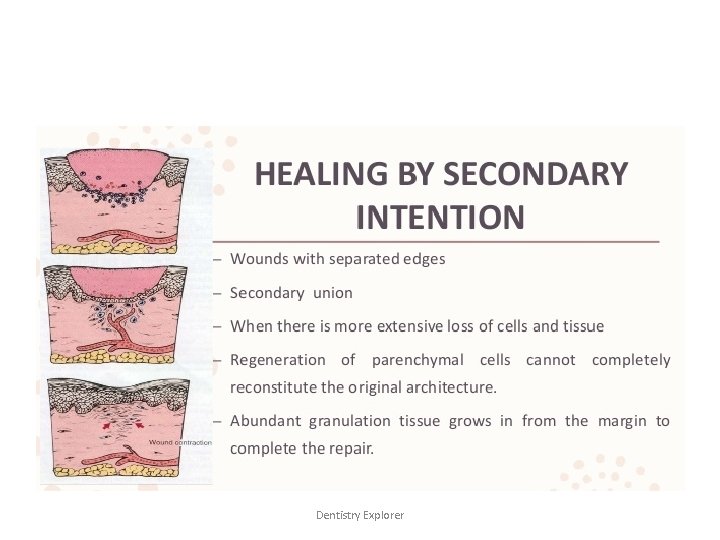
• The socket fills with blood, which coagulates and seals the socket from oral environment • Healing process of extraction socket takes place by secondary intention and many months(4 -6) must pass before a socket heals to the degree to which it becomes difficult to distinguish from surrounding bone. Dentistry Explorer
It can be described as following sequence of events: o Immediate reaction following extraction o First week wound o Second week wound o Third week wound o Fourth week wound Dentistry Explorer
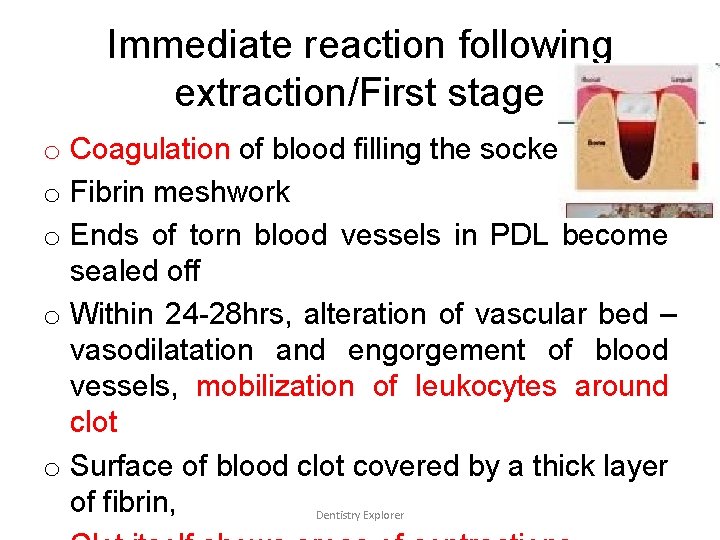
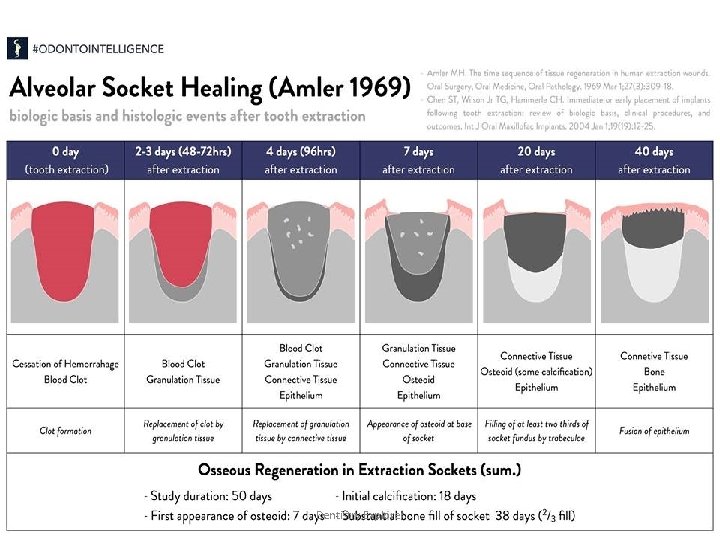
Immediate reaction following extraction/First stage o Coagulation of blood filling the socket o Fibrin meshwork o Ends of torn blood vessels in PDL become sealed off o Within 24 -28 hrs, alteration of vascular bed – vasodilatation and engorgement of blood vessels, mobilization of leukocytes around clot o Surface of blood clot covered by a thick layer of fibrin, Dentistry Explorer
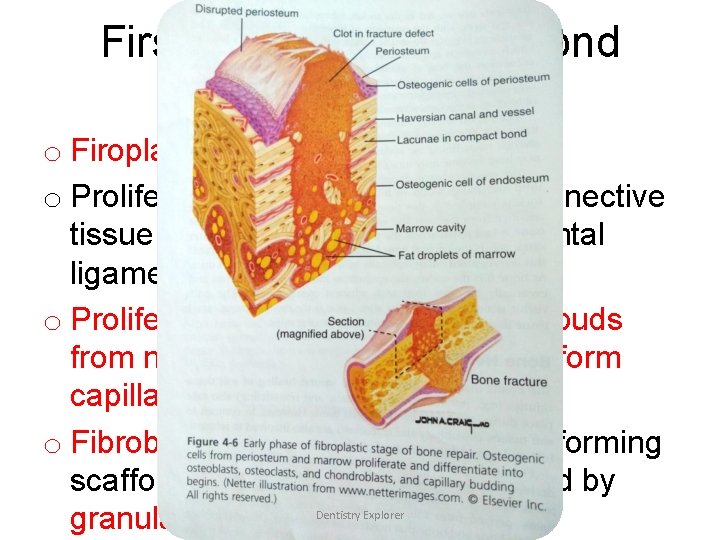
First week wound / second stage o Firoplasia occurs o Proliferation of fibroblasts from connective tissue cells in remnants of periodontal ligament o Proliferation into area of epithelial buds from neighboring blood vessels to form capillary network o Fibroblasts begin to grow into clot forming scaffold which is gradually replaced by granulation tissue Dentistry Explorer
o Crest of alveolar bone exhibits beginning of osteoclastic activity o Thick layer of leukocytes forms over surface of clot and edge of wound continues to exhibit epithelial proliferation Dentistry Explorer
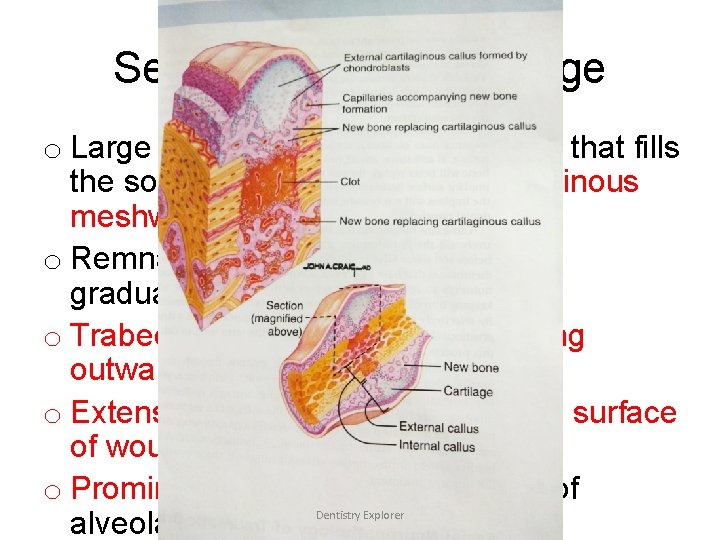
Second week/ third stage o Large amount of granulation tissue that fills the socket, blood clot becomes fibrinous meshwork o Remnants of periodontal ligament gradually undergo degeneration o Trabecule of osteoid seen extending outward from wall of alveolus o Extensive epithelial proliferation on surface of wound o Prominent osteoclastic resorption of alveolar crests Dentistry Explorer
o Resorption of sequestrum when fragments of necrotic bone which may have been fractured from rim of socket during extraction Dentistry Explorer
Third week wound/fourth stage o Organised original clot (maturation of granulation tissue) o Young trabecule of osteoid from around entire periphery of wound from socket wall o Crest of alveolar bone is rounded off o Wound may have been completely epithelialized o R/G examination- increase in bone density Dentistry Explorer
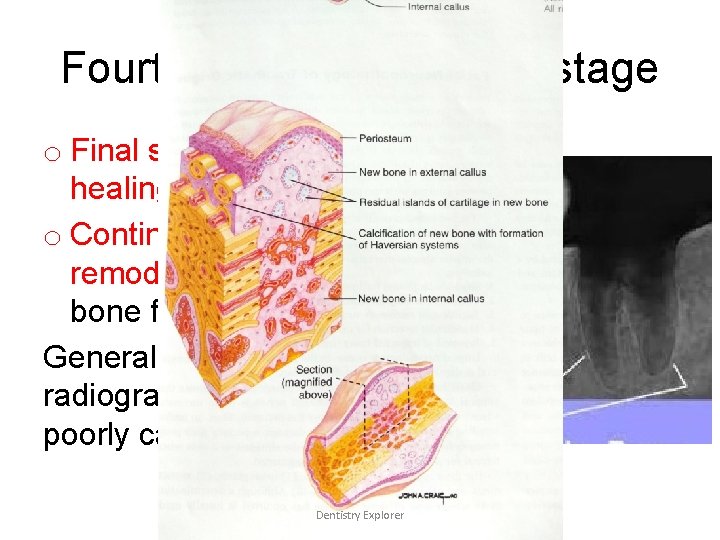
Fourth week wound/ fifth stage o Final stage of wound healing o Continuous deposition and remodeling resorption of bone filling alveolar socket General radiolucency in radiograph seen because of poorly calcified bone Dentistry Explorer
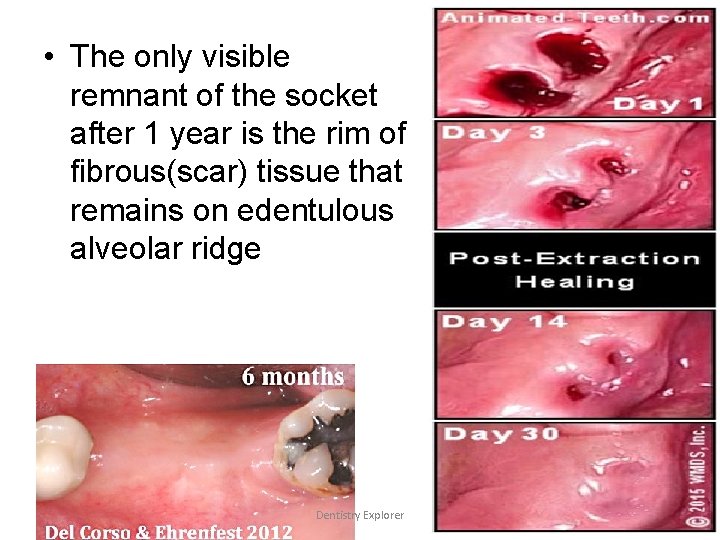
• The only visible remnant of the socket after 1 year is the rim of fibrous(scar) tissue that remains on edentulous alveolar ridge Dentistry Explorer
Factors affecting Healing of extraction socket o There are 6 factors that influence healing of any wound o Infection o Size of wound o Blood supply o Resting of part o Foreign body o General condition of patient Dentistry Explorer
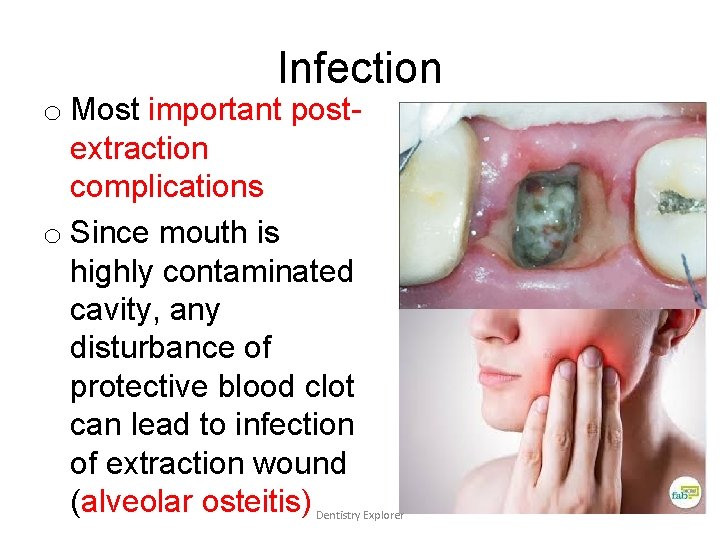
Infection o Most important postextraction complications o Since mouth is highly contaminated cavity, any disturbance of protective blood clot can lead to infection of extraction wound (alveolar osteitis) Dentistry Explorer
o Within 7 -14 days, body usually overcomes this infection o According to study done by Claflin 1936, it was postulated that treatment of alveolar osteitis in human is probably more effective in controlling pain than in promoting healing Dentistry Explorer
Size o Larger the wound, more time is needed for repair o Suturing can reduce healing time of extraction by decrease in their area o Also protects clot and granulation tissue from irritating factors o Lessens amount of epithelial proliferation necessary to cover wound Dentistry Explorer
Blood supply o In cases of patients with arteriosclerosis or dense alveolar bone, circulation is impaired o Excessive trauma also produces disturbed blood supply Dentistry Explorer
Resting of Part o Healing will be proper if the wounded part is provided proper rest o But it need not be considered in respect to delayed healing of tooth sockets because the rigid character of bone tissue accounts for imobility in Dentistry Explorer
Foreign bodies o Most common causes of complications in post extraction healing o Enamel, calculus, amalgam, bone fragments in socket can cause delay in tissue repair o Smaller bone fragments-resorbed o Larger-undergo necrosis and become center of localized area of Dentistry Explorer
Whether retained root tips are considered foreign bodies and affect wound healing? o body will not tolerate an infected root tip o Study of Glickman, Pruzansky, Ostrach 1947, on sockets of rat and Simpson, vital root fragments were left –infection do not occur Vitality of pulpal tissue may persist and normal healing of wound take place Dentistry Explorer
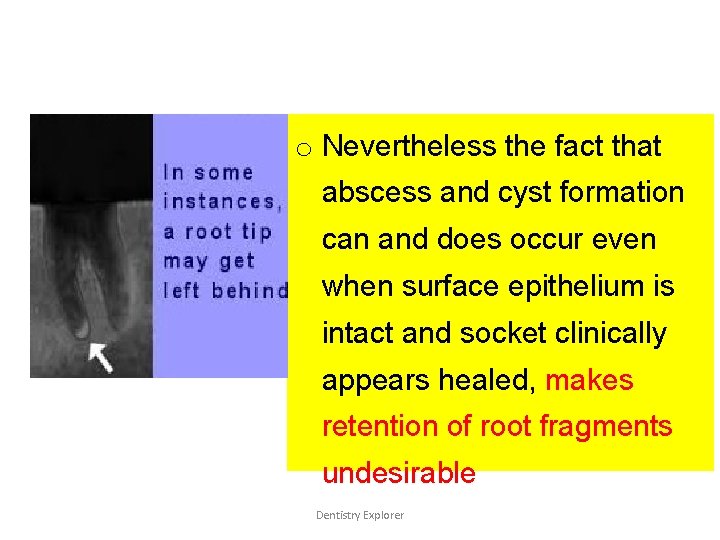
o Nevertheless the fact that abscess and cyst formation can and does occur even when surface epithelium is intact and socket clinically appears healed, makes retention of root fragments undesirable Dentistry Explorer
General condition of patient Consideration should given to o Proper fluid and electrolyte o Vitamin intake o Blood protein level o Nutrition of patients o Profound anemia, diabetes and long lasting debilitating diseases also may adversely affect repair Dentistry Explorer
• Conclusion Dentistry Explorer
REFRENCES Dentistry Explorer
Dentistry Explorer