
HEADWAY COMPRESSION DURING QUEUE DISCHARGE AT SIGNALIZED INTERSECTIONS

- Slides: 22
HEADWAY COMPRESSION DURING QUEUE DISCHARGE AT SIGNALIZED INTERSECTIONS PREPARED BY; SAMET SERDAR 140408007 WRITERS Feng-Bor Lin Daniel R. Thomas
CONTENTS INTRODUCTION AIM OF THE STUDY SCOPE OF THE STUDY METHODOLOGY CONCLUSION REFERENCES
INTRODUCTION • Saturation flow is one of the basic parameters used in the design of a signalized intersection. • Saturation flow is the maximum number of vehicles that can be discharged on an intersection after the light turned green. • In other words; it is the steady maximum queue discharge rate of an hour on the intersection when light turned green for an hour.
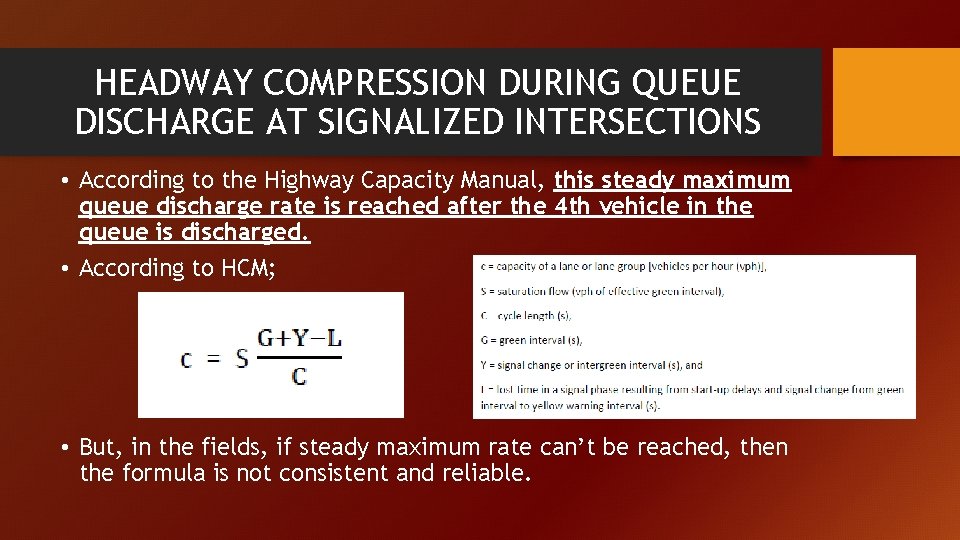
HEADWAY COMPRESSION DURING QUEUE DISCHARGE AT SIGNALIZED INTERSECTIONS • According to the Highway Capacity Manual, this steady maximum queue discharge rate is reached after the 4 th vehicle in the queue is discharged. • According to HCM; • But, in the fields, if steady maximum rate can’t be reached, then the formula is not consistent and reliable.
HEADWAY COMPRESSION DURING QUEUE DISCHARGE AT SIGNALIZED INTERSECTIONS • According to past studies in Hawaii and Taiwan, the queue discharge rate was not show a rapid increase after the 4 th vehicle is discharged after when the green light is on. • As a result, the queue discharge rate increases even when the 15 th vehicle discharges from the intersection. • Considering these studies, the consistency of the method of "calculating the saturation flow for the capacity analysis of signalized intersections" according to HCM was examined and three intersections were studied in Long Island, New York.
AIM OF THE STUDY • Examining the consistency of the capacity and saturation flow formula in the Highway Capacity Manual • Analyzing the margins of errors when the formula is used when inappropriate conditions occur • To learn whether errors are valid in different locations
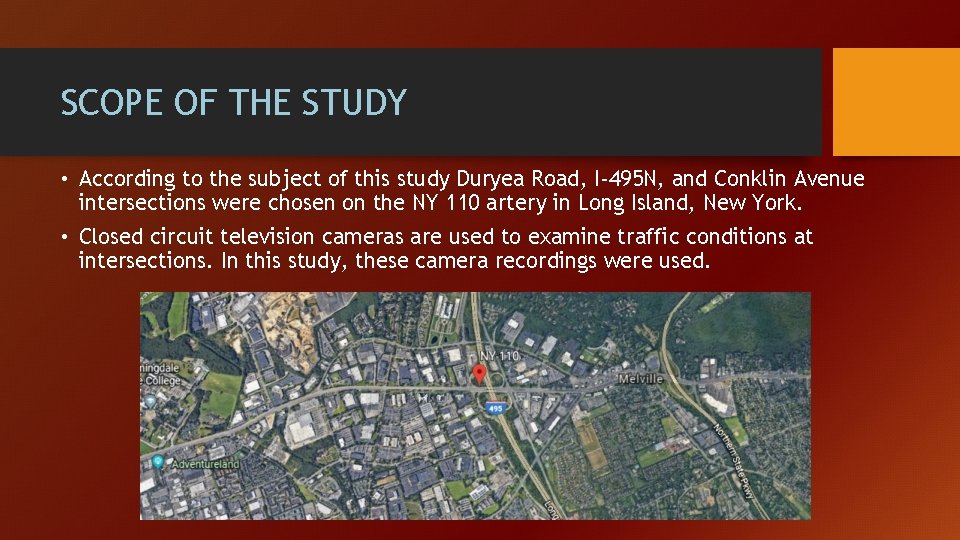
SCOPE OF THE STUDY • According to the subject of this study Duryea Road, I-495 N, and Conklin Avenue intersections were chosen on the NY 110 artery in Long Island, New York. • Closed circuit television cameras are used to examine traffic conditions at intersections. In this study, these camera recordings were used.
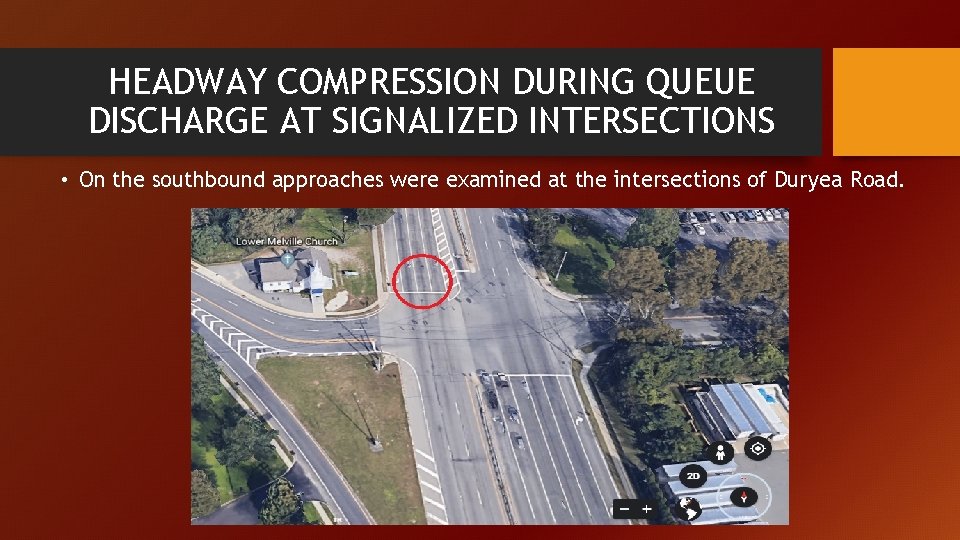
HEADWAY COMPRESSION DURING QUEUE DISCHARGE AT SIGNALIZED INTERSECTIONS • On the southbound approaches were examined at the intersections of Duryea Road.
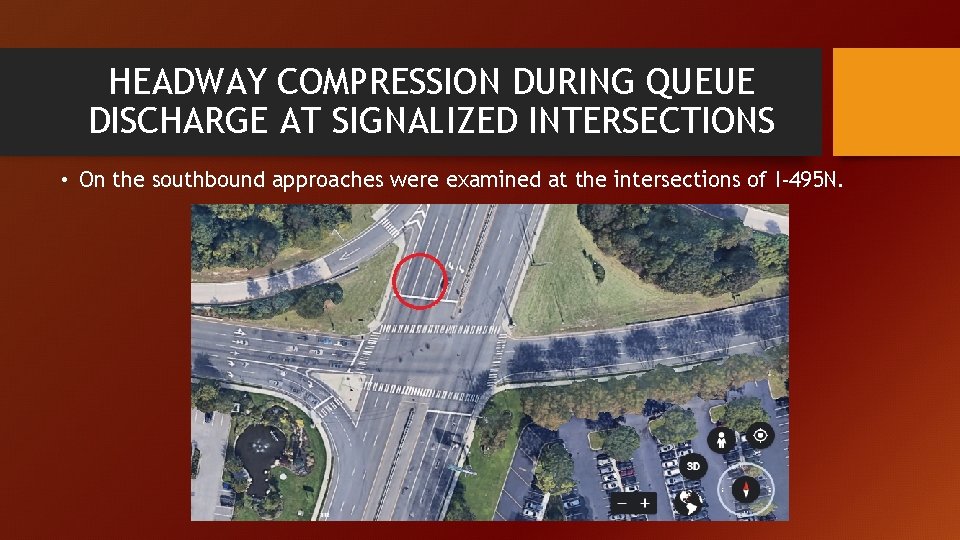
HEADWAY COMPRESSION DURING QUEUE DISCHARGE AT SIGNALIZED INTERSECTIONS • On the southbound approaches were examined at the intersections of I-495 N.
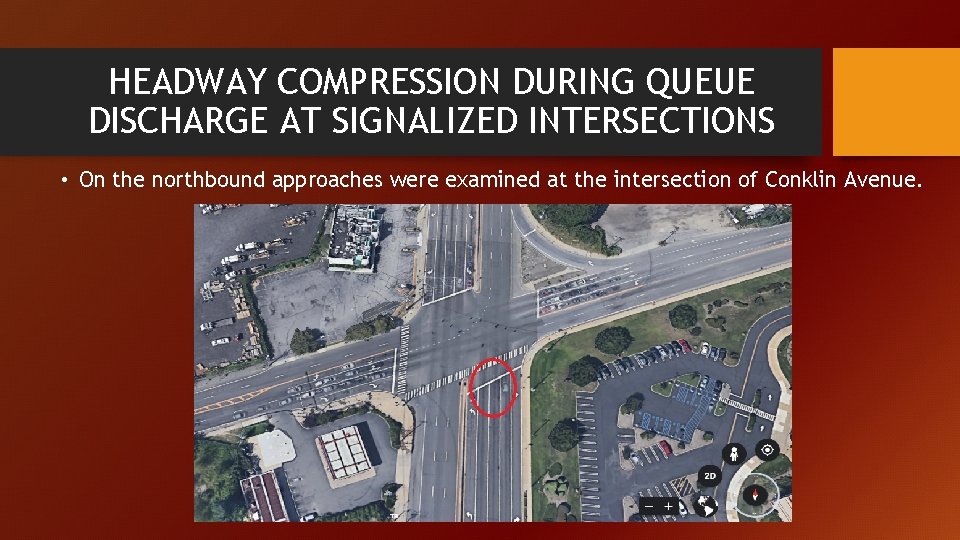
HEADWAY COMPRESSION DURING QUEUE DISCHARGE AT SIGNALIZED INTERSECTIONS • On the northbound approaches were examined at the intersection of Conklin Avenue.
HEADWAY COMPRESSION DURING QUEUE DISCHARGE AT SIGNALIZED INTERSECTIONS • Duryea Road and Conklin Avenue intersections have the same components; -three straight-through lanes -one left-turn bay and one right lane -in this study for both intersections, the outer straight-through lane was selected for observations • I-495 N intersection consists; -two straight-through lanes and one right-turn lane -in this study, the inner straight-through lane was selected for observation
HEADWAY COMPRESSION DURING QUEUE DISCHARGE AT SIGNALIZED INTERSECTIONS • Before the observations, some parameters and conditions were identified. Ø Queue Vehicles: Those who stop at the red light and join the queue at the green light. Ø Discharge Time: The moment when the vehicle's rear wheel crosses the line after the green light turns on. Ø Duration of the green light time at the intersections of Duryea Road and Conklin Avenue did not identify from the video recordings so the discharge time was determined between the time the vehicle started to move and the time it crossed the line. A further 1 second discharge time was added to determine the mean time and to minimize the error. Ø Buses, mid-sized delivering trucks, large trucks and vehicles behind large vehicles were also not considered in the study. Every remaining vehicle was included as a passenger car.
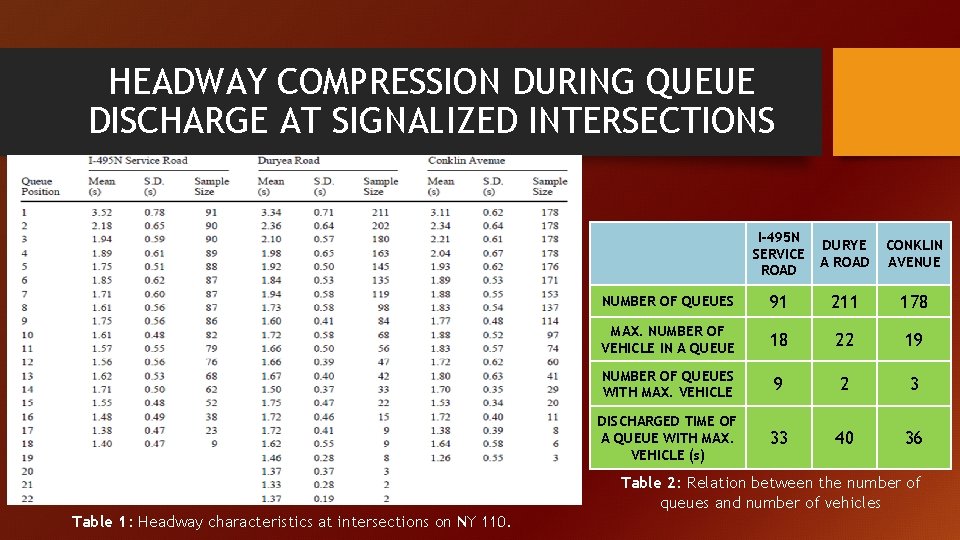
HEADWAY COMPRESSION DURING QUEUE DISCHARGE AT SIGNALIZED INTERSECTIONS I-495 N SERVICE ROAD DURYE A ROAD CONKLIN AVENUE NUMBER OF QUEUES 91 211 178 MAX. NUMBER OF VEHICLE IN A QUEUE 18 22 19 NUMBER OF QUEUES WITH MAX. VEHICLE 9 2 3 DISCHARGED TIME OF A QUEUE WITH MAX. VEHICLE (s) 33 40 36 Table 2: Relation between the number of queues and number of vehicles Table 1: Headway characteristics at intersections on NY 110.
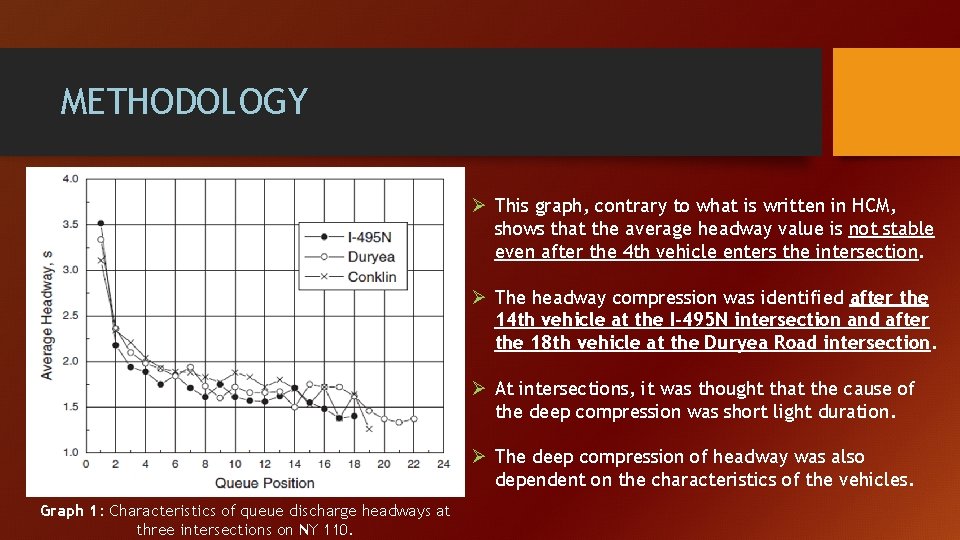
METHODOLOGY Ø This graph, contrary to what is written in HCM, shows that the average headway value is not stable even after the 4 th vehicle enters the intersection. Ø The headway compression was identified after the 14 th vehicle at the I-495 N intersection and after the 18 th vehicle at the Duryea Road intersection. Ø At intersections, it was thought that the cause of the deep compression was short light duration. Ø The deep compression of headway was also dependent on the characteristics of the vehicles. Graph 1: Characteristics of queue discharge headways at three intersections on NY 110.
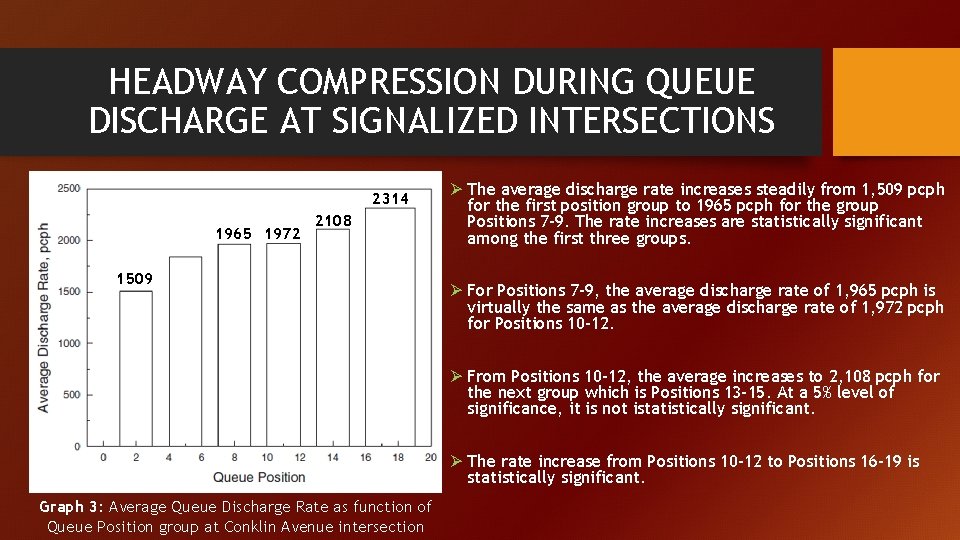
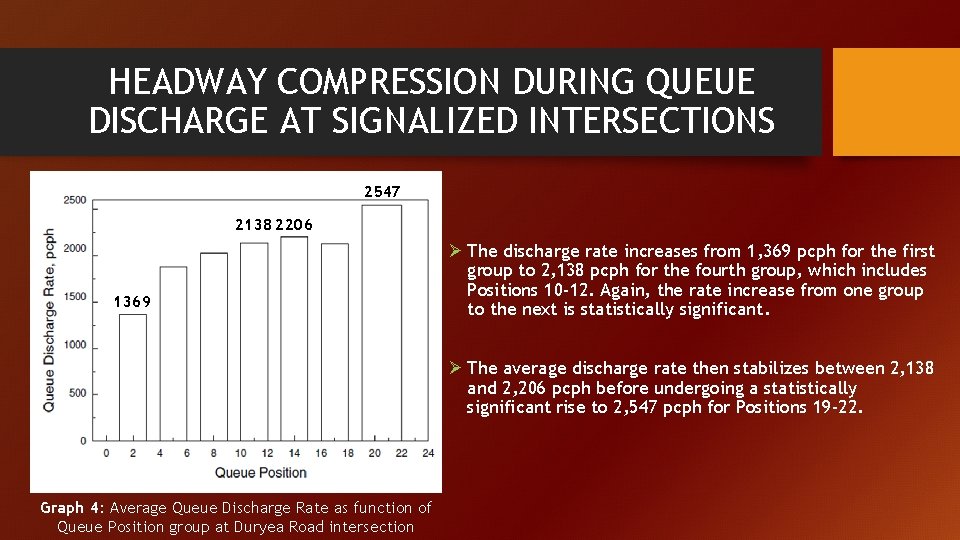
HEADWAY COMPRESSION DURING QUEUE DISCHARGE AT SIGNALIZED INTERSECTIONS • Based on the average headway-queue position graph, three or four groups' discharge rate is averaged, and graphs were plotted. • The difference between the average discharge rates which are examined was tested for statistical significance at 5% using one-way Analysis of Variance (ANOVA). • One-way ANOVA is used to calculate the significance of the difference between three and more independent means in a normally distributed series.
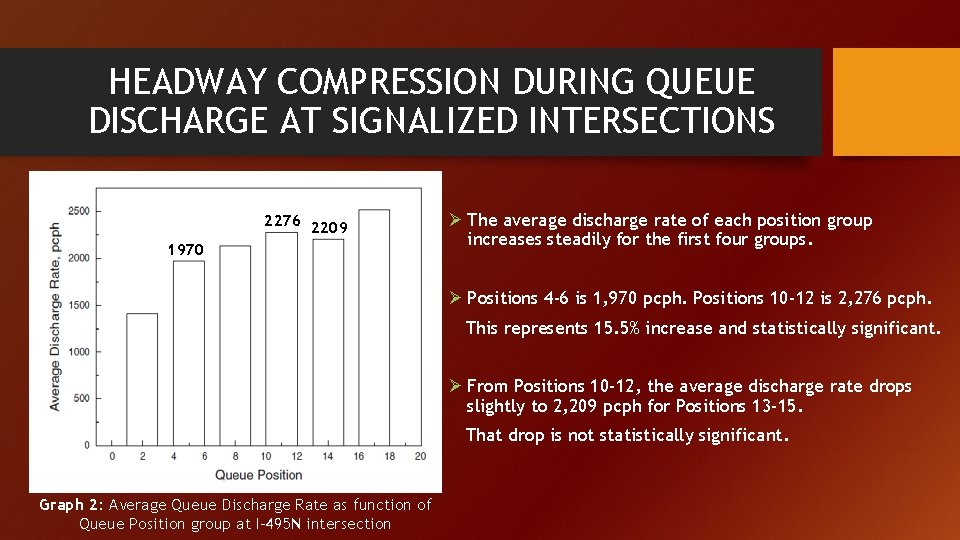
HEADWAY COMPRESSION DURING QUEUE DISCHARGE AT SIGNALIZED INTERSECTIONS 2276 2209 1970 Ø The average discharge rate of each position group increases steadily for the first four groups. Ø Positions 4 -6 is 1, 970 pcph. Positions 10 -12 is 2, 276 pcph. This represents 15. 5% increase and statistically significant. Ø From Positions 10 -12, the average discharge rate drops slightly to 2, 209 pcph for Positions 13 -15. That drop is not statistically significant. Graph 2: Average Queue Discharge Rate as function of Queue Position group at I-495 N intersection
HEADWAY COMPRESSION DURING QUEUE DISCHARGE AT SIGNALIZED INTERSECTIONS 2314 1965 1972 2108 1509 Ø The average discharge rate increases steadily from 1, 509 pcph for the first position group to 1965 pcph for the group Positions 7 -9. The rate increases are statistically significant among the first three groups. Ø For Positions 7 -9, the average discharge rate of 1, 965 pcph is virtually the same as the average discharge rate of 1, 972 pcph for Positions 10 -12. Ø From Positions 10 -12, the average increases to 2, 108 pcph for the next group which is Positions 13 -15. At a 5% level of significance, it is not istatistically significant. Ø The rate increase from Positions 10 -12 to Positions 16 -19 is statistically significant. Graph 3: Average Queue Discharge Rate as function of Queue Position group at Conklin Avenue intersection
HEADWAY COMPRESSION DURING QUEUE DISCHARGE AT SIGNALIZED INTERSECTIONS 2547 2138 2206 1369 Ø The discharge rate increases from 1, 369 pcph for the first group to 2, 138 pcph for the fourth group, which includes Positions 10 -12. Again, the rate increase from one group to the next is statistically significant. Ø The average discharge rate then stabilizes between 2, 138 and 2, 206 pcph before undergoing a statistically significant rise to 2, 547 pcph for Positions 19 -22. Graph 4: Average Queue Discharge Rate as function of Queue Position group at Duryea Road intersection
HEADWAY COMPRESSION DURING QUEUE DISCHARGE AT SIGNALIZED INTERSECTIONS • In general, the discharge rate at intersections increases between groups. • Discharge rate is at 4 -6 positions; 1843 pcph at Conklin Avenue intersection 1970 pcph at I-495 N and Duryea Road intersection And the total average for these three areas is 1896 pcph. • The discharge rate, which is expected to remain constant after the 4 th position, is 2129 pcph in the 10 -12 positions. This represents a 12% increase.
CONCLUSION • As a result of this study, it was found that the headway compression of the queue discharge over a long part of the green time is not specific to Hawaii and Taiwan. Also at the I-495 N, Duryea Road and Conklin Avenue intersections, the discharge rate tended to increase gradually, while the queue discharge continue. • The maximum discharge rates of the queue lengths examined for up to 18 vehicles. • A significant difference was found between this study result and the information which is stated as the 4 th position in the Highway Capacity Manual. So it means that, the lack of a easily definable maximum discharge rate at the intersections will cause problems in the use of the equation for capacity analysis in Highway Capacity Manual. • Failure of the capacity analysis may lead to an incorrect calculation of the headway between the vehicles, thus incorrectly determining the level of service.
REFERENCES • Headway Compression during Queue Discharge at Signalized Intersections, Feng-Bor Lin, Daniel R. Thomas, 2005 • http: //mustafaotrar. net/istatistik/tek-yonlu-varyans-analizianova/ • Google Earth
THANKS FOR LISTENING!