
Headteacher and Chair of Governor Briefings March 2018
Headteacher and Chair of Governor Briefings March 2018
Agenda National and Local Updates Closing the Gap Governance Assessment and Curriculum EYFS
National and Local Updates
The role of the Council • Ensuring the system works • Improving outcomes for vulnerable children • Acting as champions for children and families
New education structure Three service areas under Tim Browne, Head of Education: • • • Education Outcomes & Intervention - Jane Lloyd Davies Commissioning for Learning - Clare Medland Services for Children with Additional Needs - Charlotte Jones
Education Outcomes and Intervention • • • Education Leads & Performance Advisers - support and intervention, ensuring action towards improvement; supporting collaboration and structural change; delivery of the National Curriculum; delivery of statutory and non-statutory responsibilities in relation to governor services, newly qualified teachers and assessment. This team works in partnership with system leaders, Ofsted and the office of the Regional Schools Commissioner. Lead for health and wellbeing (lead officer – Fiona Quan ) - training, advice and guidance to schools on a range of areas related to the health and well being including the PSHE curriculum and the on-line pupil survey HR business partner for schools (Margaret Wilkins) - providing a range of specialist advice to schools alongside the education outcomes and intervention team.
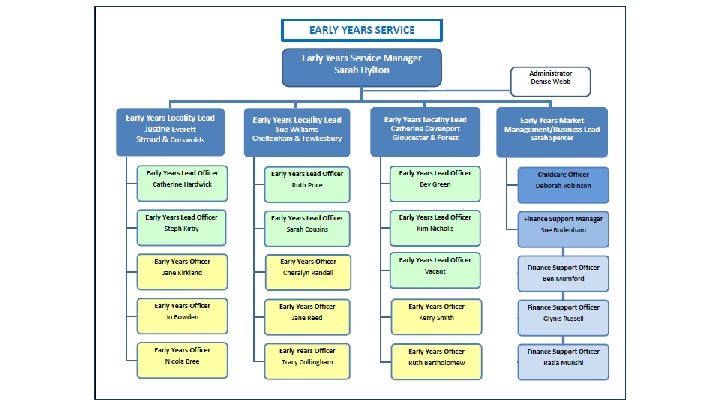
Early Years Service Responsible for: • statutory and non-statutory duties re improving outcomes and reducing inequalities for children aged 0 -5 • building the quality and capacity of early years providers across the maintained, private, voluntary and independent sector • creating the flexibility to provide a higher level of intervention for those children with the most complex needs and commissioning more specialist provision • supporting the development of the early years and childcare market to address gaps and support the sufficiency of high quality places.
• Virtual School for Children in Care (Headteacher – Jane Featherstone) • Gloucestershire Music (Head of GM - Lisa Mayo) and Make Music Gloucestershire
Commissioning for Learning • Universal Commissioning (Service manager Gareth Vine) • Specialist Commissioning (Service manager tbc) • Post 16 (Service manager tbc) • Data Hub (Service manager Cindy Gazzard)
Services for Children with Additional Needs • Access to Education (Service Manager - Sam Roberts) • Education Inclusion (Service Manager - Lisa Meggs) • EHCP Service (Service Manager - TBC) • Engagement & Quality (Edel Keating) • Education Psychology Service & Advisory Teaching Service (Service Manager Deborah Shepherd)
Services for Children with Additional Needs • Access to Education– ensuring children can access a school place • Education Inclusion – ensuring children with additional needs are supported to remain in school and achieve • EHCP – ensuring children with most complex SEN are well supported through the EHCP process • Advisory Teaching Service & Educational Psychology – helping to build specialist knowledge in schools and support children • Engagement & Quality – ensuring co-production with parent/carers and children & young people and integration with health & social care
Education Inclusion • • Manager: Lisa Meggs Locality Lead Cheltenham and Tewkesbury: Vikki Burt Locality Lead Stroud and Cotswold: Nathan Roe Locality Lead Gloucester and Forest: Jamie Ford Service includes Outcome Coordinators and Inclusion Officers, plus educational expertise in the MASH. In ensuring children with additional needs are supported to remain in school and achieve, responsibilities include: • Ensuring CYP have access to an education appropriate to meet their needs through supporting families and education settings in the development of inclusive practice and environments • Supporting families and educational settings to take early action to address emerging issues • Meeting statutory duties for attendance, exclusion, home education and children in employment / entertainment
Ofsted notification contacts: 01452 427161 or 01452 427308 HR & Governor Services Performance Advisers Education Leads Exclusions: exclusions@gloucestershire. gov. uk CME: missingpupils@gloucestershire. gov. uk Education Outcomes and Intervention Attendance: attendance@gloucestershire. gov. uk Governor Services: governor. services@gloucestershire. gov. uk Assessment: Assessment@gloucestershire. gov. uk Jane Lloyd-Davies GHLL: GHLL@gloucestershire. gov. uk Head of Education Performance & Inclusion EHE: EHE@gloucestershire. gov. uk (01452) 328691 NQTs: NQTs@gloucestershire. gov. uk Jane. Lloyd-Davies@ gloucestershire. gov. uk Early Years: earlyyearsteam@gloucestershire. gov. uk Barry Jones Sandra Shepherd Caroline Coates Education Lead Elspeth Murano Cath Liptrot Sandra Parker Jennie Leighton Governor Services Jane Pritchard. Meaker Anna Barker Wendy Gallagher Governor Services Tim Foster Fiona Quan Anne Lloyd NQT Co-ordinator Fiona Mc. Morrow Sara Vestey Sarah Hylton Early Years Service Manager Deb Harris Vanessa Grimshaw Margaret Wilkins HR Business Partner Schools
Arrangements for supporting school improvement • Addressing underperformance and schools causing concern through early intervention • Developing school to school support through the identification of best practice and brokering expertise from local schools
National Context • • • Autonomy of schools Greater choice for parents Funding delegated to schools Increasingly rigorous and changing Ofsted inspections School improvement through system leadership and school to school support • Changes to the curriculum and exam system
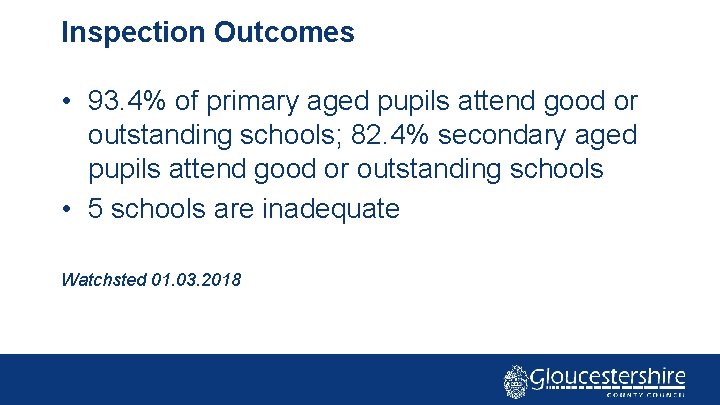
Inspection Outcomes • 93. 4% of primary aged pupils attend good or outstanding schools; 82. 4% secondary aged pupils attend good or outstanding schools • 5 schools are inadequate Watchsted 01. 03. 2018
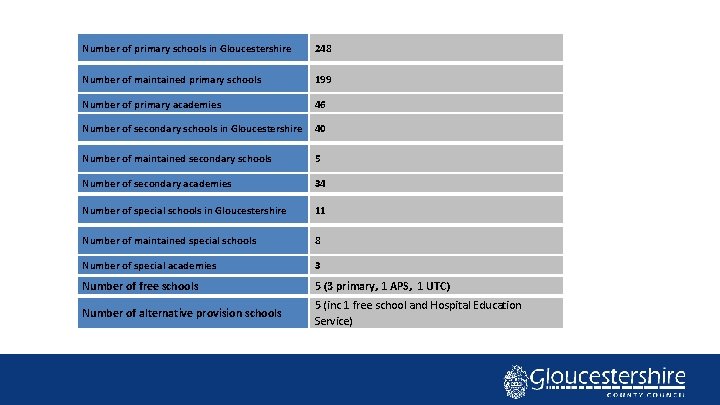
Number of primary schools in Gloucestershire 248 Number of maintained primary schools 199 Number of primary academies 46 Number free schools Number of of primary secondary schools in Gloucestershire 3 40 Number of maintained secondary schools 5 Number of secondary academies 34 Number of secondary free schools Number of special schools in Gloucestershire 1 11 Number of maintained special schools 8 Number of special academies 3 Number of free schools Number ofspecial free schools 1 (3 primary, 1 APS, 1 UTC) 5 Number of alternative provision schools 5 (inc 1 free school and Hospital Education Service)
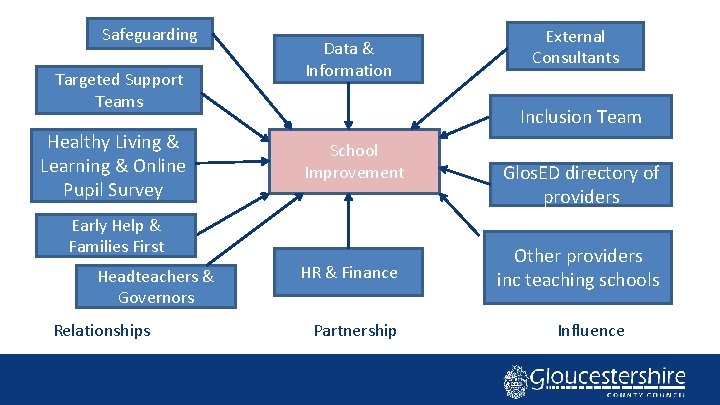
Safeguarding Targeted Support Teams Healthy Living & Learning & Online Pupil Survey Data & Information Inclusion Team School Improvement Early Help & Families First Headteachers & Governors Relationships External Consultants HR & Finance Partnership Glos. ED directory of providers Other providers inc teaching schools Influence
Identification • Self-referral • Use of an Ofsted-style risk assessment model – performance data, distance from inspection • Scrutiny of data and information (e. g. Ofsted ratings and recommendations, pupil numbers, attendance and exclusion rates, governor vacancies, budget deficits, staff turnover) • Softer information – parental concerns, governor issues and queries, attendance/non-attendance at briefings • Reference to common characteristics of schools causing concern
Addressing school (and academy) underperformance and ensuring high standards Academies • Local influence/keeping in touch • Referral to RSC or Ofsted Maintained schools • Support for schools causing concern (including RI) • Intervention in schools in Ofsted categories
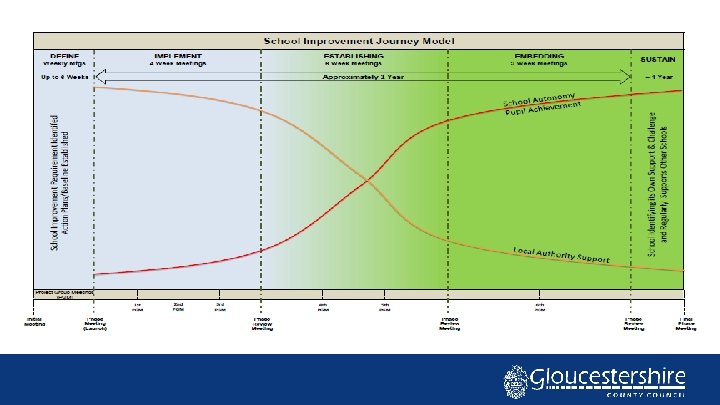
School Improvement Journey • Easily understood and intuitive • Model shows the timeline of the improvement journey • School autonomy increases and LA support reduces • Well documented , phased approach • Regular project group meetings and phase reviews
Tools include: • Risk assessment, checklist, scoping tool (is/is not) • SMART criteria (specific, measurable, achievable, relevant and time bound) • RACI chart (responsible, accountable, consulted, informed) • GANTT chart • Communication strategy • Journey charters
Key drivers: • Raising Achievement Plan (RAP) • Project group including Project Lead, Headteacher, Chair of Governors, HR, Finance • Consultant Headteachers and schools • External Consultants • Glos. Ed Leaders • Governor trainers
Our Partners • Gloucestershire Association of Secondary Headteachers • Gloucestershire Association of Primary Headteachers • Gloucestershire Association of Special Headteachers • Primary Partnerships and Clusters • Gloucestershire Governors’ Association • Dioceses • Academy sponsors • Teaching schools and alliances; Maths Hub • Others, e. g. EEF
Universal offer to schools includes: • • • English, maths and science network; newsletters; secondary senior leaders meetings; SENCO clusters; attendance networks Newly qualified teacher programme of training (in association with Heads and Adfecto) Closing the Gaps workshops and annual conference Headteacher, governor and clerk briefings New and acting Heads programme Single issue school led improvement model Bespoke training in response to local needs Early Years Governor services Other training that is commissioned/brokered GHLL Assessment and moderation networks
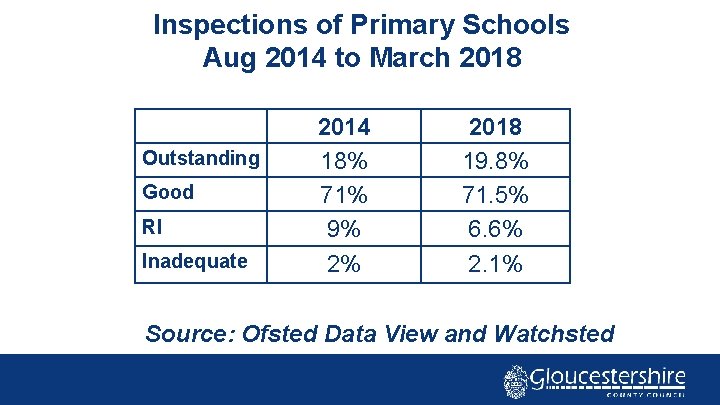
Inspections of Primary Schools Aug 2014 to March 2018 Outstanding Good RI Inadequate 2014 18% 71% 9% 2% 2018 19. 8% 71. 5% 6. 6% 2. 1% Source: Ofsted Data View and Watchsted
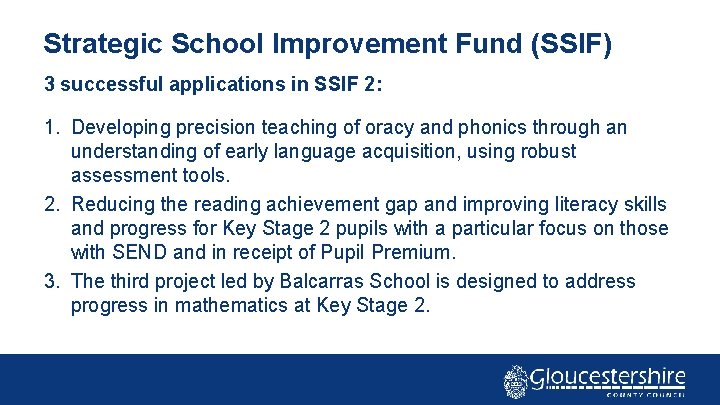
Strategic School Improvement Fund (SSIF) 3 successful applications in SSIF 2: 1. Developing precision teaching of oracy and phonics through an understanding of early language acquisition, using robust assessment tools. 2. Reducing the reading achievement gap and improving literacy skills and progress for Key Stage 2 pupils with a particular focus on those with SEND and in receipt of Pupil Premium. 3. The third project led by Balcarras School is designed to address progress in mathematics at Key Stage 2.
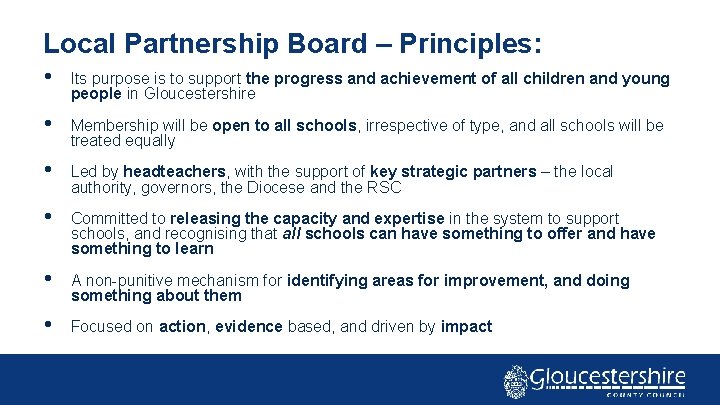
Local Partnership Board – Principles: • Its purpose is to support the progress and achievement of all children and young people in Gloucestershire • Membership will be open to all schools, irrespective of type, and all schools will be treated equally • Led by headteachers, with the support of key strategic partners – the local authority, governors, the Diocese and the RSC • Committed to releasing the capacity and expertise in the system to support schools, and recognising that all schools can have something to offer and have something to learn • A non-punitive mechanism for identifying areas for improvement, and doing something about them • Focused on action, evidence based, and driven by impact
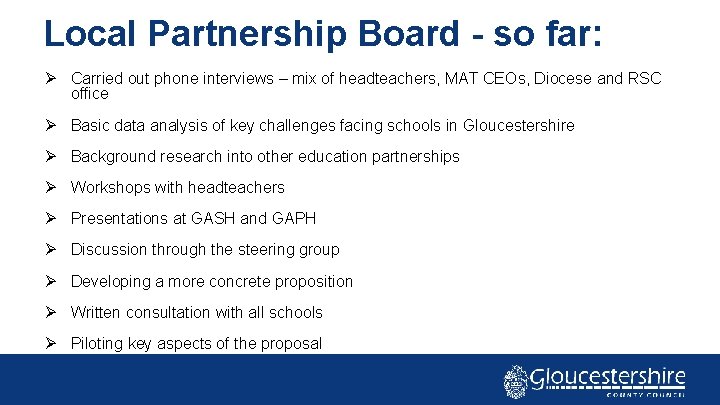
Local Partnership Board - so far: Ø Carried out phone interviews – mix of headteachers, MAT CEOs, Diocese and RSC office Ø Basic data analysis of key challenges facing schools in Gloucestershire Ø Background research into other education partnerships Ø Workshops with headteachers Ø Presentations at GASH and GAPH Ø Discussion through the steering group Ø Developing a more concrete proposition Ø Written consultation with all schools Ø Piloting key aspects of the proposal
GHLL and Active Gloucestershire What’s happening this year? • • Introduced 9 target schools to research based behaviour to change practice. Purpose: provide support to increase physical activity levels of the least active pupils. Aim: set up opportunities for schools to share ‘good practice’ (2018 -19) Relaunched Gloucestershire ‘Daily Mile’. Over 1/3 of primary schools are now participating. New package includes free materials such as maps, stickers, useful tips from schools already engaged. Sign up at www. oldspotstrail. co. uk or contact tomhall@activegloucestershire. org Starting to support schools to capture wider outcomes of increased physical activity by sharing strategies to snapshot impact on emotional wellbeing, social skills, concentration, behaviour change, for example.

GHLL and Active Gloucestershire How can we help you? We can support you in school to: • maximise the impact of your PE and Sport Premium funding. Active Gloucestershire offer a free advisory service and school visits are available. • set up your Daily Mile. • set up physical activity interventions. • help you analyse and document the impact and outcomes of your interventions. Please ensure your PE and Sport premium reporting template has been uploaded onto your website by 1 April – for further details please contact tomhall@activegloucestershire. org or chris. powell@ghll. org. uk
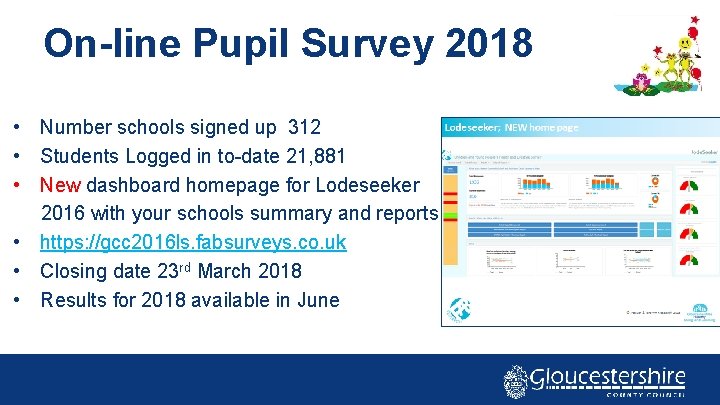
On-line Pupil Survey 2018 • Number schools signed up 312 • Students Logged in to-date 21, 881 • New dashboard homepage for Lodeseeker 2016 with your schools summary and reports • https: //gcc 2016 ls. fabsurveys. co. uk • Closing date 23 rd March 2018 • Results for 2018 available in June
Moving towards statutory RSE! Children and Social Work Act introduces statutory relationships and sex education across all secondary schools, and statutory relationships education across all primary schools. Faith schools will retain the right to teach according to the tenets of their faith – within requirement of Equality Act - Church of England Catholic Education Service in support of statutory status Development of guidance led by Ian Bauckham CBE, with consultation with schools, young people and parents to determine content of RSE and on the fit with PSHE – closed on 12 th February 18 Final statutory guidance will be published in 2018, ready for delivery in September 2019, but. . Schools do not need to wait to make improvements to quality and delivery of RSE – the legislation will build on existing effective practice

This teacher's planning and resource pack has been produced by the Gloucestershire Healthy Living and Learning Team by both teachers in the county and sexual health specialists. It is intended that quality, universal RSE should become available throughout Gloucestershire. Contact ghll@gloucestershire. gov. uk for more information
Free Events Fischer Family Trust (FFT), Analysing School Performance (ASP) and the Inspection Dashboard Summary Report (IDSR) Date 23 rd April 2018 Times either 9. 30 -12. 00 or 12. 30 -15. 00 Venue The Pavilion Cheltenham GL 51 6 PN 1 free place per s choo l This is a complimentary two hour presentation delivered by FFT where you will learn about the key features of the new FFT Aspire, ASP and IDSR systems. Apply via GCCPlus: https: //www. gloucestershire. gov. uk/schoolsnet/gccplus/ Delegates will need to bring along a copy of their school’s FFT Aspire School Dashboard/print out of ASP and IDSR.
Ofsted Inspections Update
Ofsted
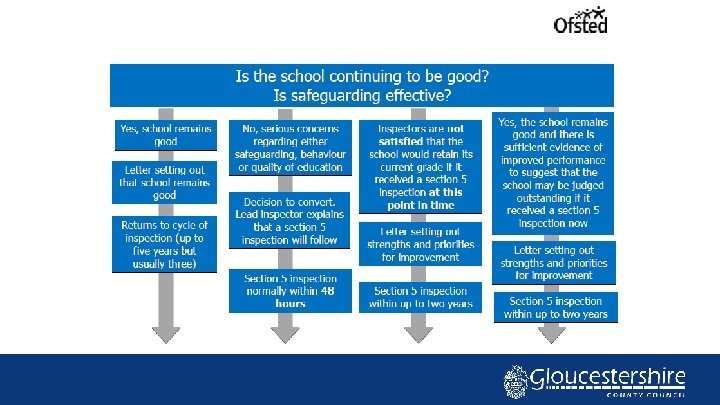
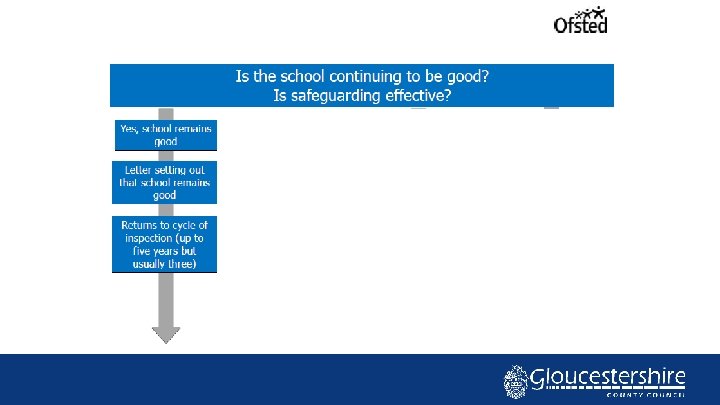
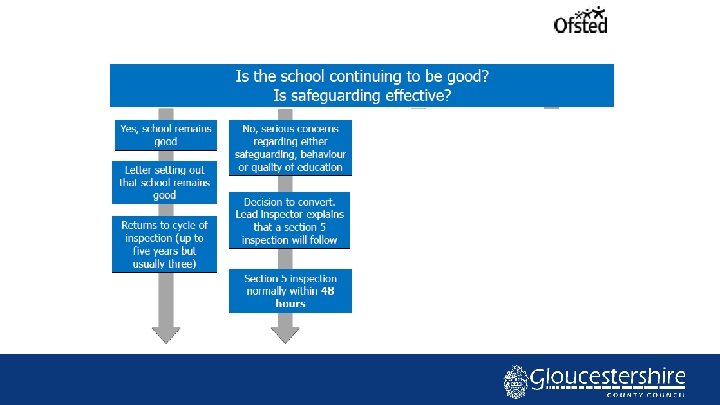
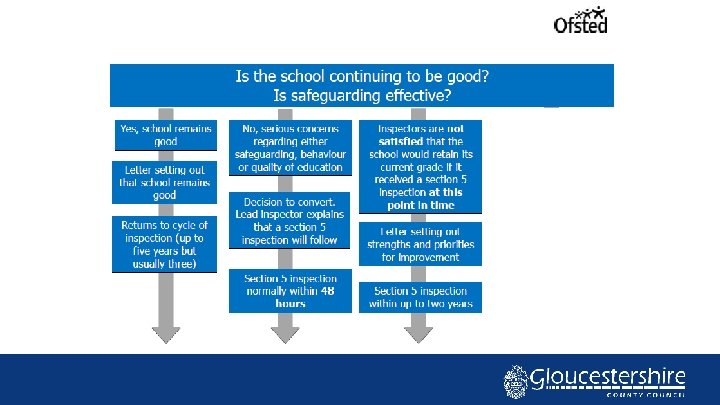
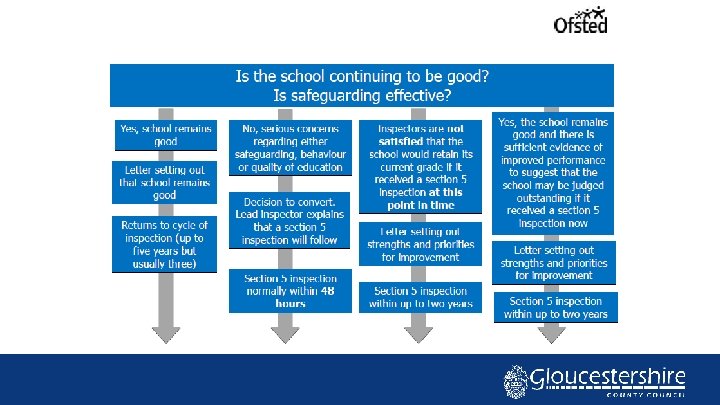
Ofsted – experiences of inspection - Accurate self evaluation Topic books Curriculum Subject leaders Tracking systems Data presentation Prior attainment Any concerns during inspection / factual accuracy check
Closing the Gap
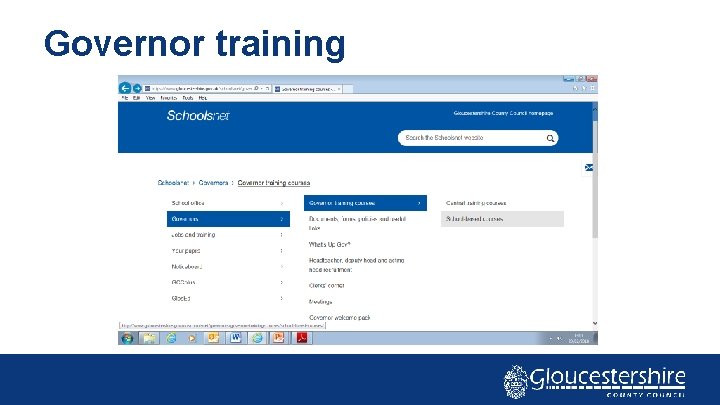
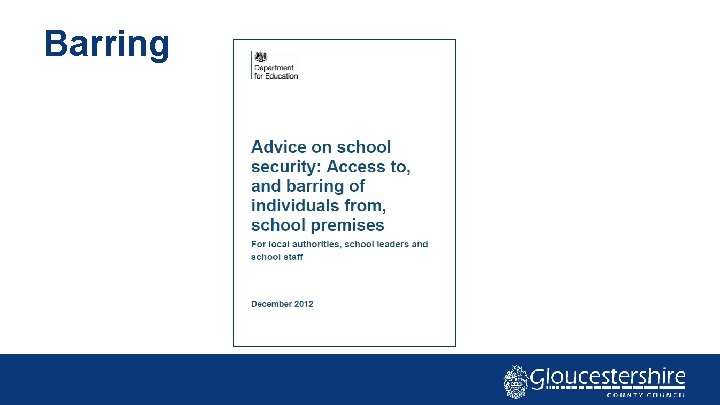
Governance • Governor training • Social media • Barring
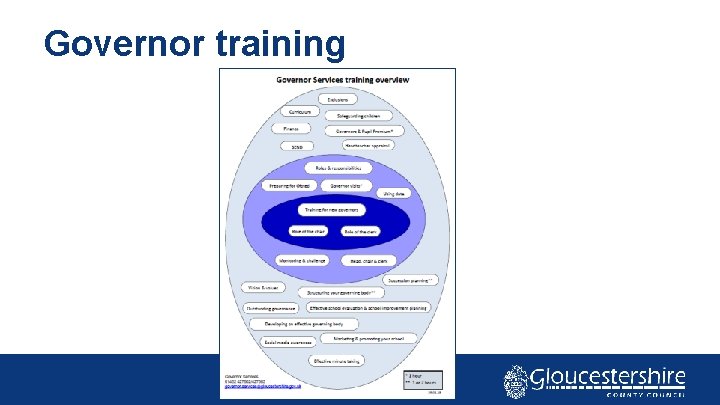
Governor training
Governor training

Social media
Barring
Assessment and Curriculum
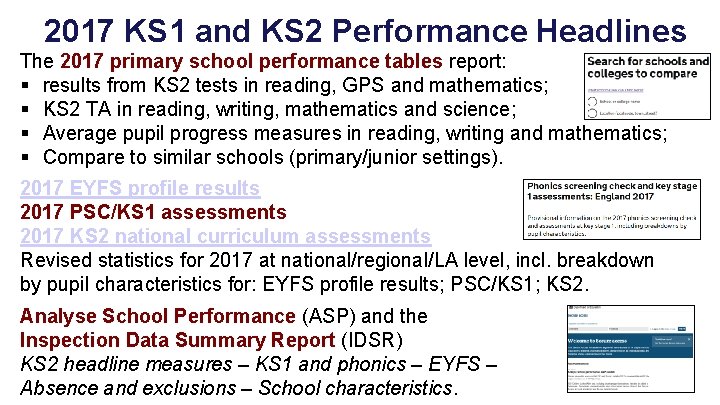
2017 KS 1 and KS 2 Performance Headlines The 2017 primary school performance tables report: § results from KS 2 tests in reading, GPS and mathematics; § KS 2 TA in reading, writing, mathematics and science; § Average pupil progress measures in reading, writing and mathematics; § Compare to similar schools (primary/junior settings). 2017 EYFS profile results 2017 PSC/KS 1 assessments 2017 KS 2 national curriculum assessments Revised statistics for 2017 at national/regional/LA level, incl. breakdown by pupil characteristics for: EYFS profile results; PSC/KS 1; KS 2. Analyse School Performance (ASP) and the Inspection Data Summary Report (IDSR) KS 2 headline measures – KS 1 and phonics – EYFS – Absence and exclusions – School characteristics.
Primary assessment in England (September 2017) § Revise ELGs to ‘make them clearer and align them more closely with teaching in KS 1’; § Introduce YR baseline ‘to act as the start point for measuring progress’ (2020) … therefore, new KS 2 progress measures (2027); § Remove statutory KS 1 TA ‘once the reception baseline is fully established’ (2023); § Introduce times tables check at the end of Y 4 (2020); § Remove requirement for end of KS 2 statutory TA in reading and mathematics (2019); § Improve KS 1/KS 2 writing TA 'by giving teachers greater scope to use their professional judgement when assessing pupils (2018); § ‘Improve the statutory assessment of pupils working below the standard of national curriculum tests by extending the interim pre-key stage standards to cover all pupils engaged in subject specific learning … ’
Teacher assessment frameworks at the end of KS 1 (February 2018) ‘In summer 2019, teachers must use these frameworks to make statutory TA judgements for pupils at the end of KS 1 in English reading, English writing, mathematics and science. The revised English writing frameworks are the same as those introduced for 2017/18 and remain unchanged for 2018/19 onwards. ’ Teacher assessment frameworks at the end of KS 2 (February 2018) ‘In summer 2019, teachers must use these frameworks to make statutory TA judgements for pupils at the end of KS 2 in English writing and science. The revised English writing frameworks are the same as those introduced for 2017/18 and remain unchanged for 2018/19 onwards. The frameworks do not include English reading and mathematics because schools will no longer be required to make statutory teacher assessment judgements in these subjects from 2018/19. ’
Multiplication tables check trials to begin in schools (February 2018) link ‘A select number of schools across the country will start trialling the multiplication tables check from next month, the Schools Standards Minister Nick Gibb has announced. ’ ‘Results from the check will not be published at school-level, and will not be used by Ofsted and others to force changes in schools. ’ Multiplication tables check: development process (February 2018) link ‘The national curriculum specifies that pupils at this stage (end of Y 4) should be able to recall the multiplication tables up to and including 12 x 12. The check aims to support pupils to master multiplication skills, which are essential for future success in mathematics. It will help to identify pupils who have not yet mastered this mathematical concept, so additional support can be provided. ’
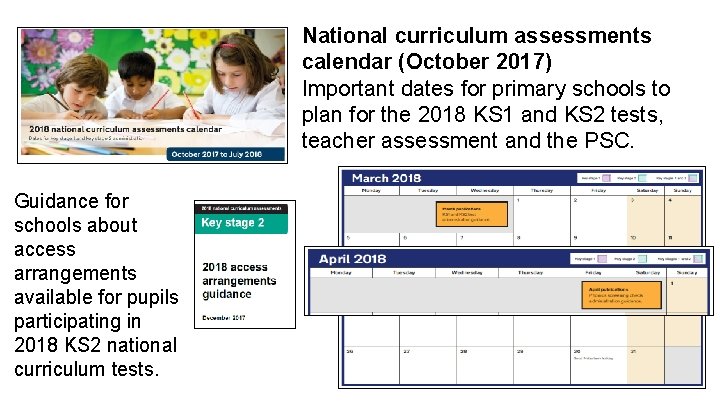
National curriculum assessments calendar (October 2017) Important dates for primary schools to plan for the 2018 KS 1 and KS 2 tests, teacher assessment and the PSC. Guidance for schools about access arrangements available for pupils participating in 2018 KS 2 national curriculum tests.
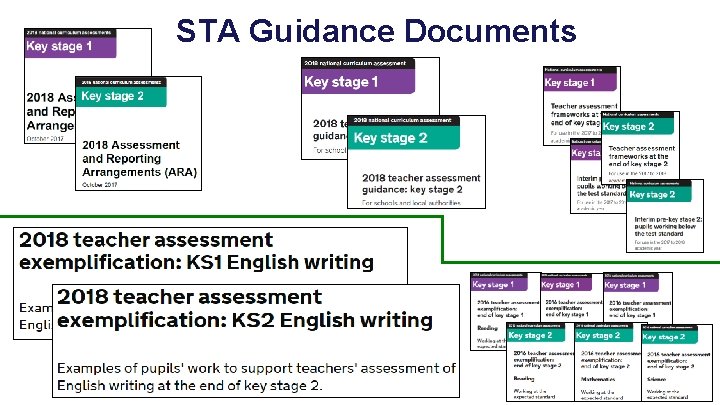
STA Guidance Documents
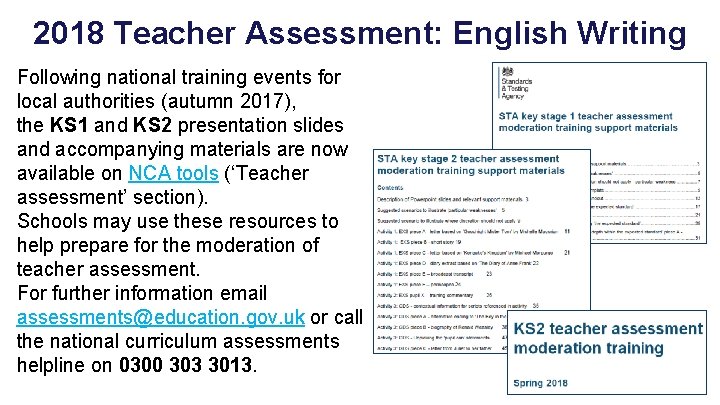
2018 Teacher Assessment: English Writing Following national training events for local authorities (autumn 2017), the KS 1 and KS 2 presentation slides and accompanying materials are now available on NCA tools (‘Teacher assessment’ section). Schools may use these resources to help prepare for the moderation of teacher assessment. For further information email assessments@education. gov. uk or call the national curriculum assessments helpline on 0300 303 3013.
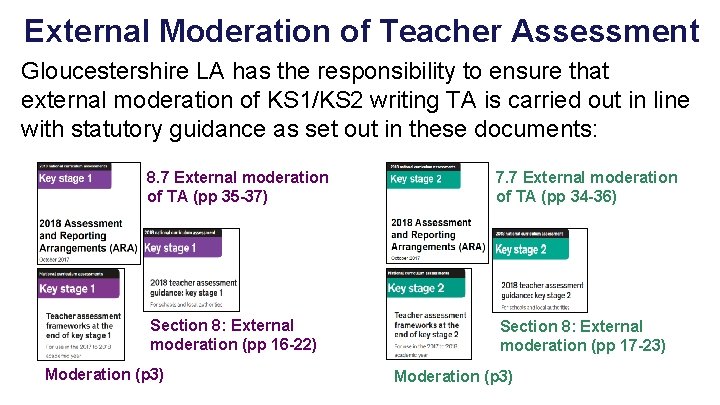
External Moderation of Teacher Assessment Gloucestershire LA has the responsibility to ensure that external moderation of KS 1/KS 2 writing TA is carried out in line with statutory guidance as set out in these documents: 8. 7 External moderation of TA (pp 35 -37) 7. 7 External moderation of TA (pp 34 -36) Section 8: External moderation (pp 16 -22) Section 8: External moderation (pp 17 -23) Moderation (p 3)
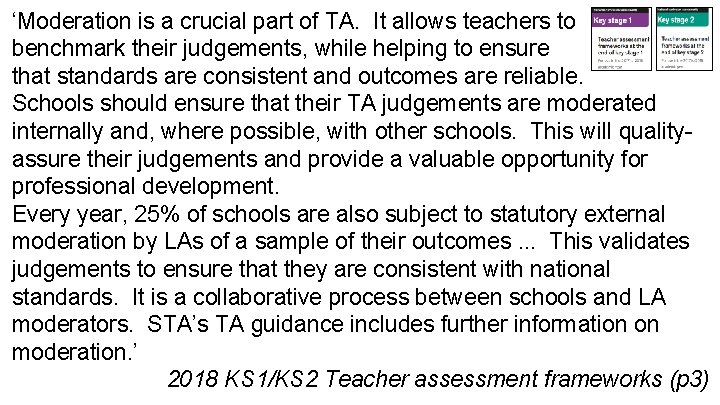
‘Moderation is a crucial part of TA. It allows teachers to benchmark their judgements, while helping to ensure that standards are consistent and outcomes are reliable. Schools should ensure that their TA judgements are moderated internally and, where possible, with other schools. This will qualityassure their judgements and provide a valuable opportunity for professional development. Every year, 25% of schools are also subject to statutory external moderation by LAs of a sample of their outcomes. . . This validates judgements to ensure that they are consistent with national standards. It is a collaborative process between schools and LA moderators. STA’s TA guidance includes further information on moderation. ’ 2018 KS 1/KS 2 Teacher assessment frameworks (p 3)
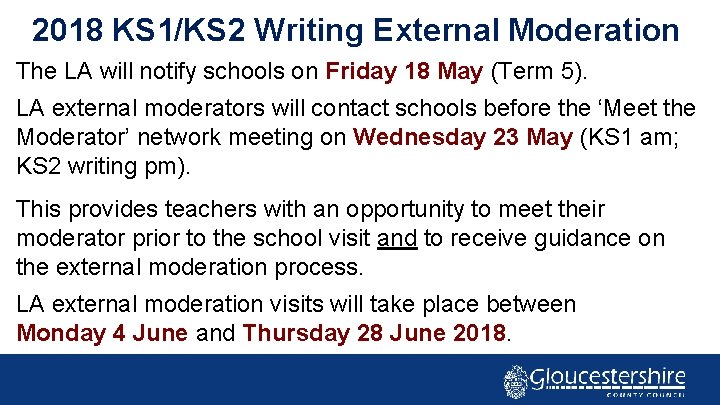
2018 KS 1/KS 2 Writing External Moderation The LA will notify schools on Friday 18 May (Term 5). LA external moderators will contact schools before the ‘Meet the Moderator’ network meeting on Wednesday 23 May (KS 1 am; KS 2 writing pm). This provides teachers with an opportunity to meet their moderator prior to the school visit and to receive guidance on the external moderation process. LA external moderation visits will take place between Monday 4 June and Thursday 28 June 2018.
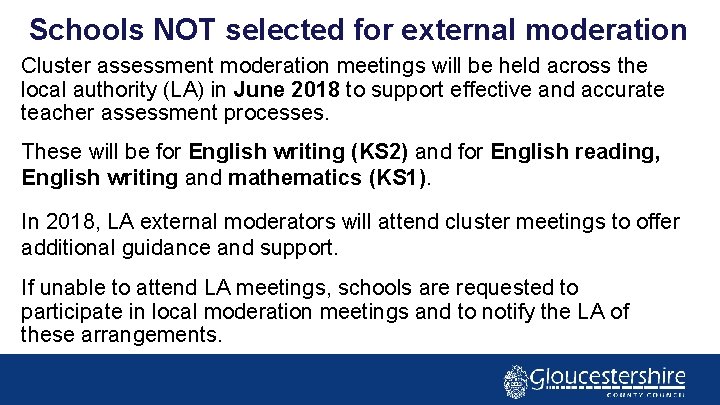
Schools NOT selected for external moderation Cluster assessment moderation meetings will be held across the local authority (LA) in June 2018 to support effective and accurate teacher assessment processes. These will be for English writing (KS 2) and for English reading, English writing and mathematics (KS 1). In 2018, LA external moderators will attend cluster meetings to offer additional guidance and support. If unable to attend LA meetings, schools are requested to participate in local moderation meetings and to notify the LA of these arrangements.
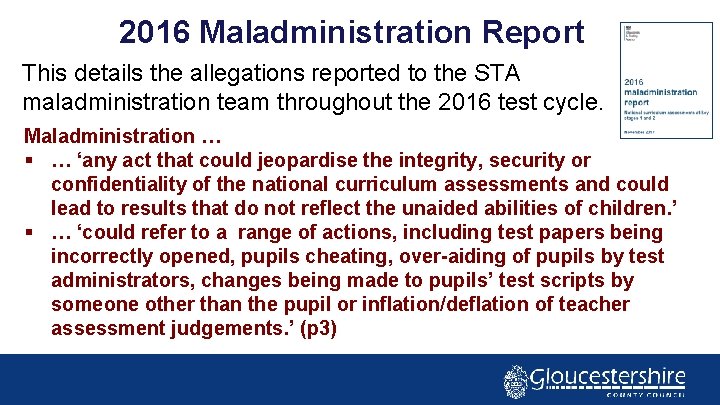
2016 Maladministration Report This details the allegations reported to the STA maladministration team throughout the 2016 test cycle. Maladministration … § … ‘any act that could jeopardise the integrity, security or confidentiality of the national curriculum assessments and could lead to results that do not reflect the unaided abilities of children. ’ § … ‘could refer to a range of actions, including test papers being incorrectly opened, pupils cheating, over-aiding of pupils by test administrators, changes being made to pupils’ test scripts by someone other than the pupil or inflation/deflation of teacher assessment judgements. ’ (p 3)
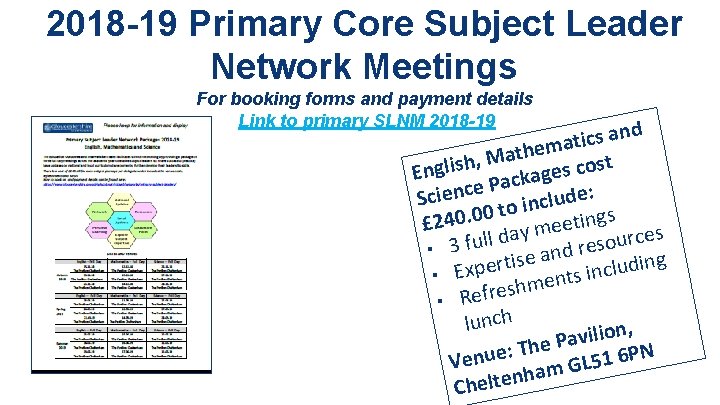
2018 -19 Primary Core Subject Leader Network Meetings For booking forms and payment details Link to primary SLNM 2018 -19 and s c i t a hem t a M , English ackages cost P e c n e i de: c S u l c n i to 0 0. gs 0 n 4 i t e £ 2 e ay m es d c r l l u u o f s • 3 d re n a e s i ng i rt d e u p l c x E n • nts i e m h s e • Refr lunch n, o i l i v a e. P h T : e PN u 6 1 5 Ven L m. G a h n e t Chel

Gloucestershire Facilitated Oxford University Press Sponsored Event Reading Comprehension 19 th April 2018 The Pavilion Cheltenham GL 51 6 PN Target Audience: Headteachers, Senior Leaders and English Subject Leaders Time: full day 9. 15 – 3. 30 Charge: £ 40 to cover administration, venue and refreshment costs including lunch Link to agenda and how to book Limited to 70 delegates and a maximum of 2 places per school.
Update: Ofsted Review of the Curriculum Association for Science Education Annual Conference January 2018 Link to speech 5. 01. 18 ‘A real science education In science specifically, the results of our study were not too dissimilar from the picture more generally. In primary, there is a continued narrowing of the curriculum where schools’ understandable desire to ace the English and maths SATs has been squeezing the science curriculum out. ’ See also: Speech 1 st February 2018 Link to speech
Ofsted Review of the Curriculum January 2018 continued ‘Knowledge-based enquiry In preparing for today, I went back to the stated aims of the national curriculum for science. I always find it surprising the number of people who haven’t read the national curriculum; I would highly recommend you do. The aims are firstly ‘to ensure that all pupils develop scientific knowledge and conceptual understanding through the specific disciplines of biology, chemistry and physics’; secondly to ‘develop understanding of the nature, processes and methods of science through different types of science enquiries that help them to answer scientific questions about the world around them’, and lastly to ensure all pupils ‘are equipped with the scientific knowledge required to understand the uses and implications of science, today and for the future’.
REMINDER: 2018 Teacher assessment frameworks: end of KS 1 and KS 2 ‘Guidance When assessing science, there is no requirement to have evidence from the classroom that pupils have met statements relating to science content taught before the final year of the key stage. ’ (Page 1 of KS 1 and KS 2 Assessment Frameworks)
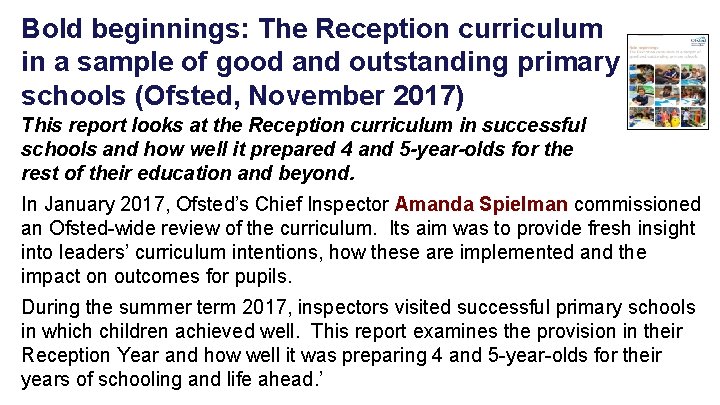
Bold beginnings: The Reception curriculum in a sample of good and outstanding primary schools (Ofsted, November 2017) This report looks at the Reception curriculum in successful schools and how well it prepared 4 and 5 -year-olds for the rest of their education and beyond. In January 2017, Ofsted’s Chief Inspector Amanda Spielman commissioned an Ofsted-wide review of the curriculum. Its aim was to provide fresh insight into leaders’ curriculum intentions, how these are implemented and the impact on outcomes for pupils. During the summer term 2017, inspectors visited successful primary schools in which children achieved well. This report examines the provision in their Reception Year and how well it was preparing 4 and 5 -year-olds for their years of schooling and life ahead. ’
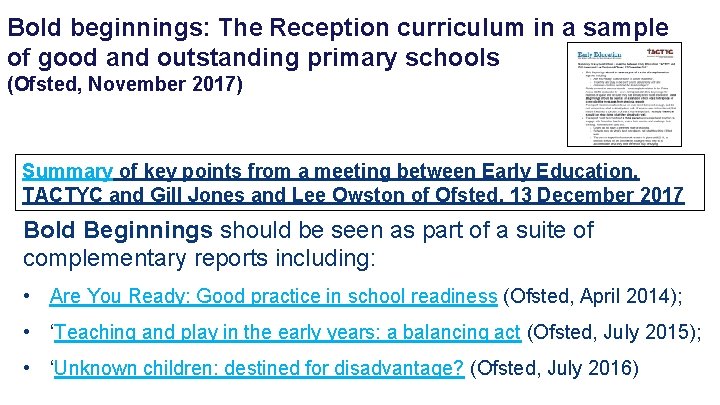
Bold beginnings: The Reception curriculum in a sample of good and outstanding primary schools (Ofsted, November 2017) Summary of key points from a meeting between Early Education, TACTYC and Gill Jones and Lee Owston of Ofsted, 13 December 2017 Bold Beginnings should be seen as part of a suite of complementary reports including: • Are You Ready: Good practice in school readiness (Ofsted, April 2014); • ‘Teaching and play in the early years: a balancing act (Ofsted, July 2015); • ‘Unknown children: destined for disadvantage? (Ofsted, July 2016)
EYFS Update
• Key updates from new Early Years Foundation Stage Profile Handbook 2018 • Preparation for LA moderation visit • Governor run pre-school settings
Evidence for the Profile • There is no requirement that evidence should be formally recorded or documented. Practitioners should keep paperwork to the minimum needed to illustrate, support and recall their knowledge of the child’s attainment. • A setting’s assessment policy should outline when it is necessary to record evidence. In developing their policies, settings should consider how to minimise practitioner workload so that practitioners can focus their efforts on teaching.
• Practitioners will build up a significant professional knowledge of each child. This professional judgement will be used to make a rounded judgement of the development of pupils against the ELGs. There is, therefore, no requirement for extensive evidence against each of the ELGs. The judgement of professionals should be trusted, freeing teachers to spend more time teaching and less time gathering and collecting evidence. P. 27 2018 EYFSP Handbook
• When evidence does need to be recorded, this should follow the principles and recommendations outlined in the independent report: Eliminating unnecessary workload associated with data management. p. 16 2018 EYFSP Handbook
EYFS Profile Training • It is recommended that practitioners responsible for the completion of the EYFS profile attend LA training. P. 34 2018 EYFSP Handbook • All practitioners responsible for the completion of the EYFS profile who are not receiving a moderation visit should take part in training. P. 44 2018 EYFSP Handbook
External Moderation visits: LA external moderators must provide the setting with: • the agreed, validated judgements for all moderated children • any concerns that require further action by the setting or LA The record must be signed by the headteacher (or representative) and LA external moderator(s). p. 42 2018 EYFSP Handbook
Schools being moderated should: • • Access the Gloucestershire Moderation Plan Send a teacher to the moderation workshops in March (all schools can attend) Ensure the email informing the school has been passed on to the teacher/s • Identify teachers new to moderation who may benefit from “Dispelling the myths of moderation training” in April • For the purpose of the moderation visit make interim judgements against each of the 17 ELGs
Governor run pre-schools • In a school with a governor run, school based pre-school group the term ‘Early Years’ refers to all of the early years provision in the school run by the governing body i. e. reception and pre-school • Improvement activity in governor run preschool settings falls under the remit of the HT • The performance adviser linked to the school will discuss all aspects of the Early Years provision including the preschool.
Inspection of Governor run pre-schools • School inspection, including inspection in academies and free schools, covers all of the early years provision run by the governing body i. e. it will take into account the early years provision in the Reception class and the preschool provision. • Pre-school settings that are governor run are inspected as part of the schools’ Ofsted inspection. • These settings no longer have a separate Early Years inspection.
• A judgement will be made on the effectiveness of early years provision. Inspectors may decide not to report separately on the provision in early years if this risks identification of pupils because numbers are so small. Typically, this will be when there are fewer than five pupils. • Where the Early Years judgement is ‘requires improvement’ or ‘inadequate’ all of the Early Years provision will be discussed by the Head Teacher and the Performance Adviser linked to the school to determine the next steps.
• Where improvement is needed in the pre-school or Reception provision the Performance Adviser may request support from a colleague with an early years specialism or from the Early Years Service. • In order to continue pre-school EY funding, the LA will require the pre-school setting to provide evidence of quality improvement activity to address the concerns raised in the inspection report that specifically relate to their provision.
Additional Information Useful websites: • www. foundationyears. org. uk • www. gloucestershire. gov. uk/earlyyearsteam Email: • earlyyearsteam@gloucestershire. gov. uk
Evaluations These briefings are facilitated by the local authority to provide national and local updates. Please complete the evaluation: your feedback is important as it is used to shape our agendas.
- Slides: 87