
Headings and Subheadings The Skeleton of Your Paper

Headings and Subheadings: The Skeleton of Your Paper
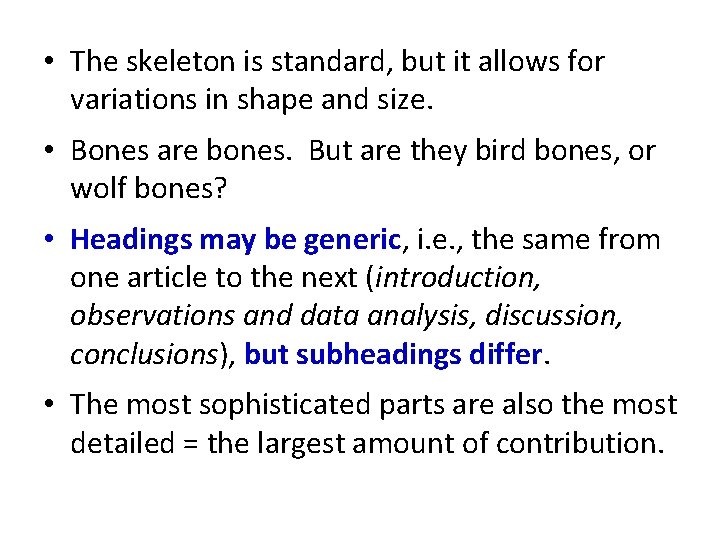
• The skeleton is standard, but it allows for variations in shape and size. • Bones are bones. But are they bird bones, or wolf bones? • Headings may be generic, i. e. , the same from one article to the next (introduction, observations and data analysis, discussion, conclusions), but subheadings differ. • The most sophisticated parts are also the most detailed = the largest amount of contribution.

Three principles for a good structure 1. The contribution guides its shape. 2. Title words are repeated in its headings and subheadings. That is, headings and subheading should be connected to the title. 3. It tells a story clearly and completely in its broad lines. Review papers may have exceptions.

• A section with only one or two short paragraphs does not deserve its own subheadings; is should be merged with other sections. • Write more informative headings and subheadings. • Use the same syntactic rules for headings – Introduction – Data analysis – Proposing a solution – Simulation studies

• It is a good practice to use structure as the framework for writing. After you come up with the title, write all the headings and subheadings in the order they appear in your paper, i. e. , a table of contents. Identify words common in the structure and in the title. Do you see any discrepancy? • Then ask someone else to read your To. C. The less this person knows of your work, the better. Is the logic clear to that person? Ask the person to explain the story of the paper to you.
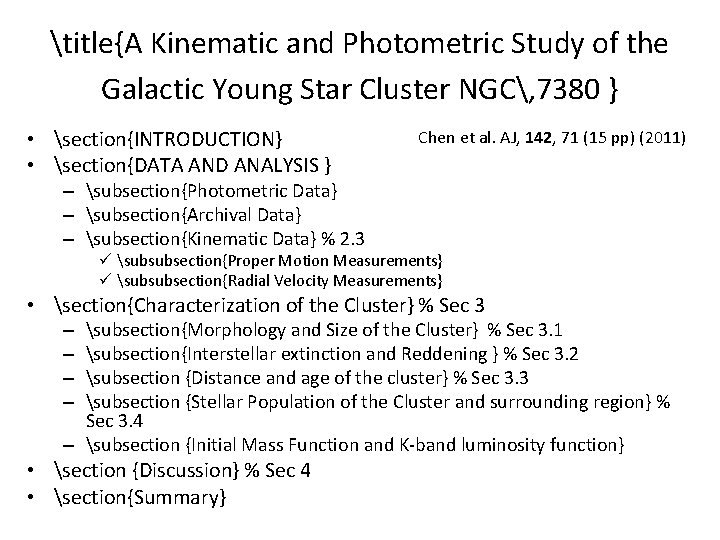
title{A Kinematic and Photometric Study of the Galactic Young Star Cluster NGC, 7380 } • section{INTRODUCTION} • section{DATA AND ANALYSIS } Chen et al. AJ, 142, 71 (15 pp) (2011) – subsection{Photometric Data} – subsection{Archival Data} – subsection{Kinematic Data} % 2. 3 ü subsubsection{Proper Motion Measurements} ü subsubsection{Radial Velocity Measurements} • section{Characterization of the Cluster} % Sec 3 subsection{Morphology and Size of the Cluster} % Sec 3. 1 subsection{Interstellar extinction and Reddening } % Sec 3. 2 subsection {Distance and age of the cluster} % Sec 3. 3 subsection {Stellar Population of the Cluster and surrounding region} % Sec 3. 4 – subsection {Initial Mass Function and K-band luminosity function} – – • section {Discussion} % Sec 4 • section{Summary}
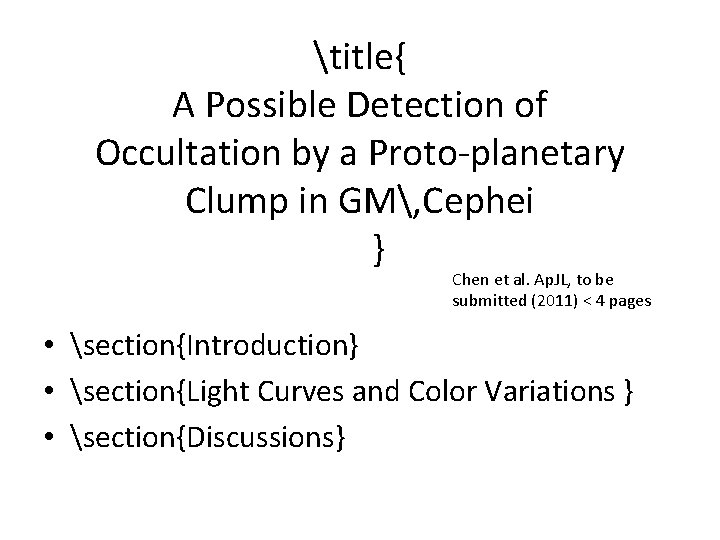
title{ A Possible Detection of Occultation by a Proto-planetary Clump in GM, Cephei } Chen et al. Ap. JL, to be submitted (2011) < 4 pages • section{Introduction} • section{Light Curves and Color Variations } • section{Discussions}
- Slides: 7