
Heading Introduction to writing Date Learning Objectives Like
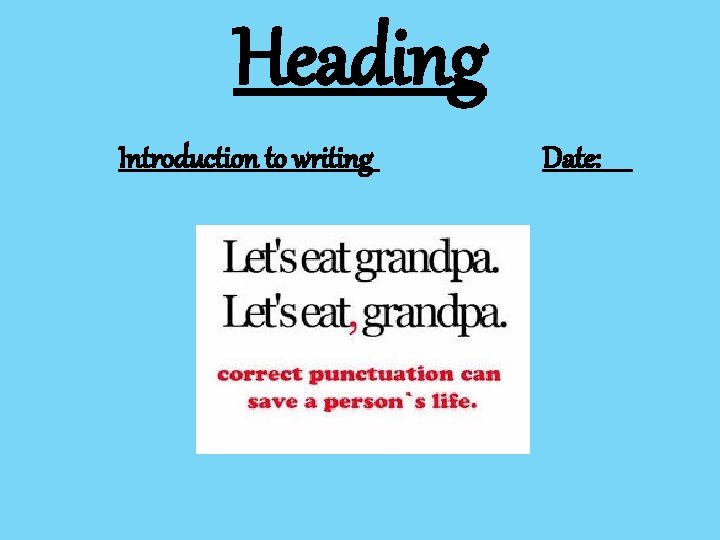
Heading Introduction to writing Date:
Learning Objectives Like some of the other presentations, this is not so much a single class but instead a list to come back to. Some books cover these basics and others don’t, so this might help. We will look at: • Nouns, verbs, adjectives, adverbs and pronouns. • Prepositions. • The stem/root, prefix and suffix of a word. • Synonyms, antonyms and homophones. • The 14 punctuation marks: the period, question mark, exclamation point, comma, semicolon, dash, hyphen, parentheses, brackets, braces, apostrophe, quotation marks, and ellipses.
Nouns versus verbs • A noun is the NAME of a person, place or thing. • A verb describes an ACTION. Which of the following is the noun and which is a verb? Try using both in a similar sentence. examine examination
Nouns versus Adjectives • An adjective is a word that DECRIBES and tells us MORE about a noun. You can change many nouns into adjectives by placing them before another noun. Try doing this with the following sentence. “The lieutenant was the leader (noun)of the squad (noun)”. “The lieutenant was. . . . . ”

Adverbs versus adjectives • An adverb is a word that tells us MORE about a verb, adjective or other adverb. (They usually end in “ly”) You can often turn an adjective into an adverb by turning the noun into a verb and adding “ly” to the adjective. Try here: “The actions of the prisoners were under tight (Adj. ) control (Noun)”. “The actions of the prisoners were “(adverb)” “(verb)”.
Pronouns versus nouns • A pronoun takes the place of a noun. (I saw him. . . ) • A relative pronoun relates to a previously named noun. (I saw the boy who did that. ) Sentences are often merged or connected using relative pronouns. Try linking these two sentences to make one: “The team plays a very defensive game. It must be altered” “The team plays a very defensive game. . . (R. P. ). . . Must be altered.
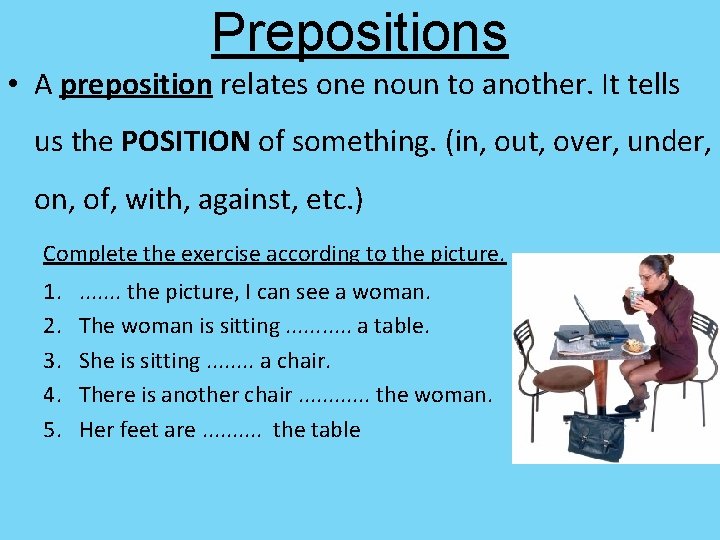
Prepositions • A preposition relates one noun to another. It tells us the POSITION of something. (in, out, over, under, on, of, with, against, etc. ) Complete the exercise according to the picture. 1. 2. 3. 4. 5. . . . the picture, I can see a woman. The woman is sitting. . . a table. She is sitting. . . . a chair. There is another chair. . . the woman. Her feet are. . the table
Super-word-ing (This is not a word but a joke and example. Do not use this word) • A stem or root is the basic part of the word. • An affix is something added to a word to change its meaning. • A prefix is something added before a word. (anti. . , auto. . . , counter. . . , trans. . . Can you name three more? ) • A suffix is something added after a word. (. . . ed, . . ment, . . ly. Try adding each of these to a noun and see is it still a noun. ) (Focus on word ‘fix’)
The word • Synonyms are words that are almost the same in meaning. – Little/small, big/large, strong/tough • Antonyms are words that have opposite meanings. – Big/small, happy/sad, hot/cold • Homophones are words that sound the same with different spelling and meanings. – Brake/break, clothes/cloths, principal/principle Can you come up with examples of synonyms and antonyms for the following words? Rich angry terrifying difficult
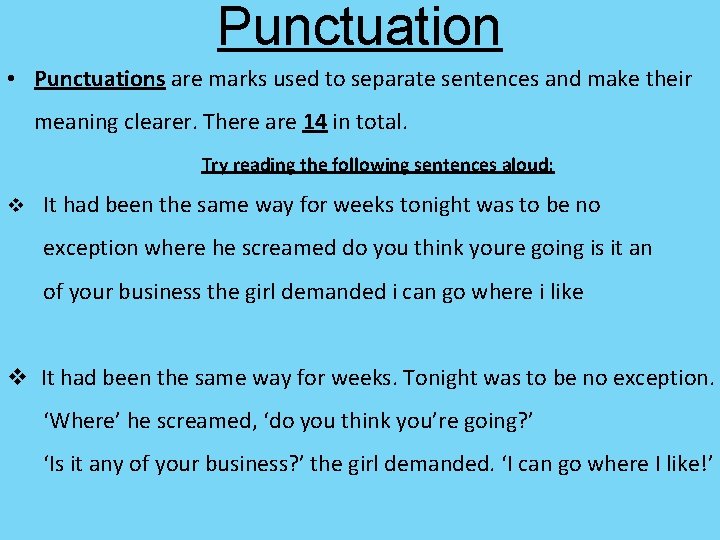
Punctuation • Punctuations are marks used to separate sentences and make their meaning clearer. There are 14 in total. Try reading the following sentences aloud: v It had been the same way for weeks tonight was to be no exception where he screamed do you think youre going is it an of your business the girl demanded i can go where i like v It had been the same way for weeks. Tonight was to be no exception. ‘Where’ he screamed, ‘do you think you’re going? ’ ‘Is it any of your business? ’ the girl demanded. ‘I can go where I like!’
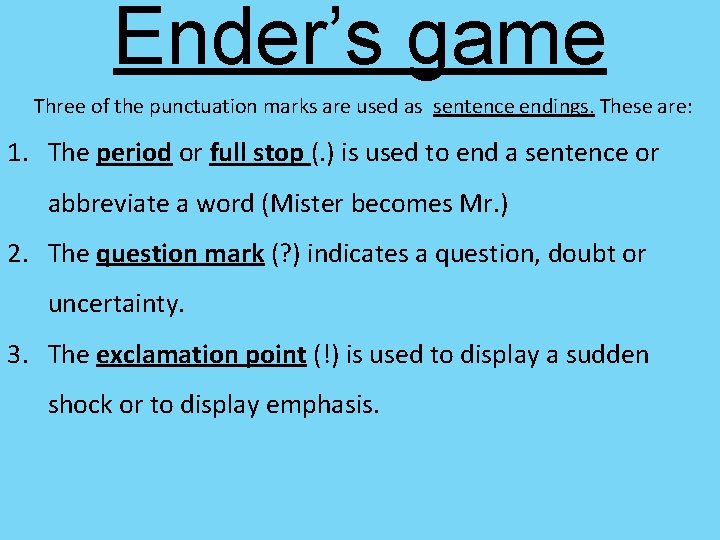
Ender’s game Three of the punctuation marks are used as sentence endings. These are: 1. The period or full stop (. ) is used to end a sentence or abbreviate a word (Mister becomes Mr. ) 2. The question mark (? ) indicates a question, doubt or uncertainty. 3. The exclamation point (!) is used to display a sudden shock or to display emphasis.
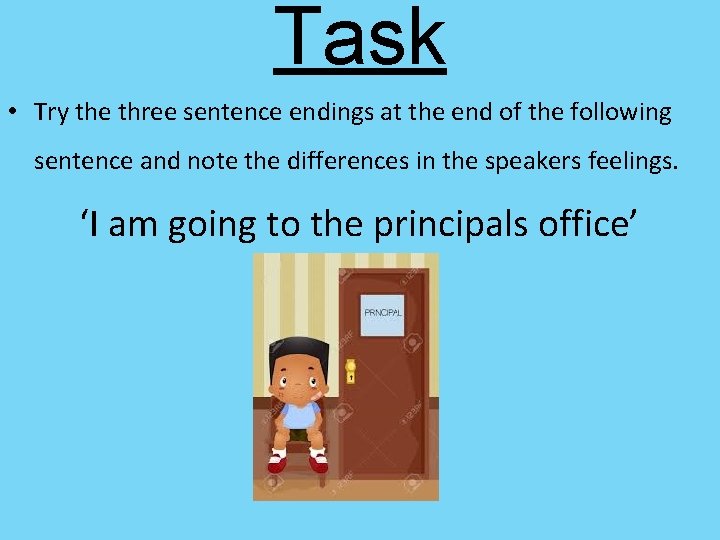
Task • Try the three sentence endings at the end of the following sentence and note the differences in the speakers feelings. ‘I am going to the principals office’
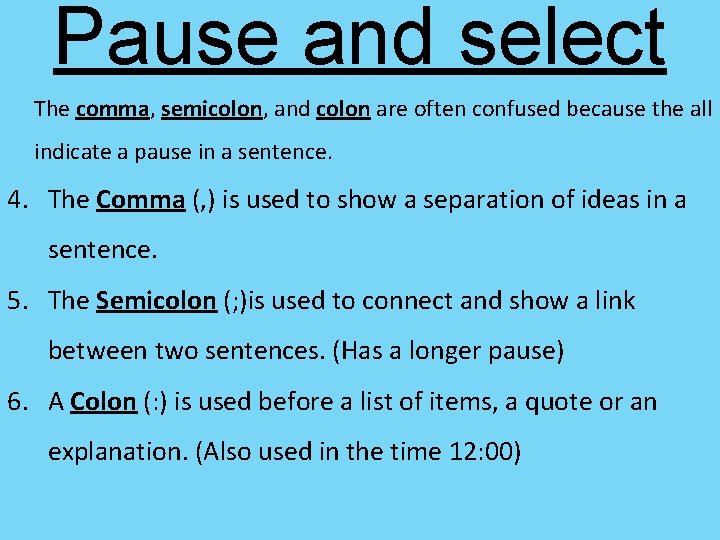
Pause and select The comma, semicolon, and colon are often confused because the all indicate a pause in a sentence. 4. The Comma (, ) is used to show a separation of ideas in a sentence. 5. The Semicolon (; )is used to connect and show a link between two sentences. (Has a longer pause) 6. A Colon (: ) is used before a list of items, a quote or an explanation. (Also used in the time 12: 00)
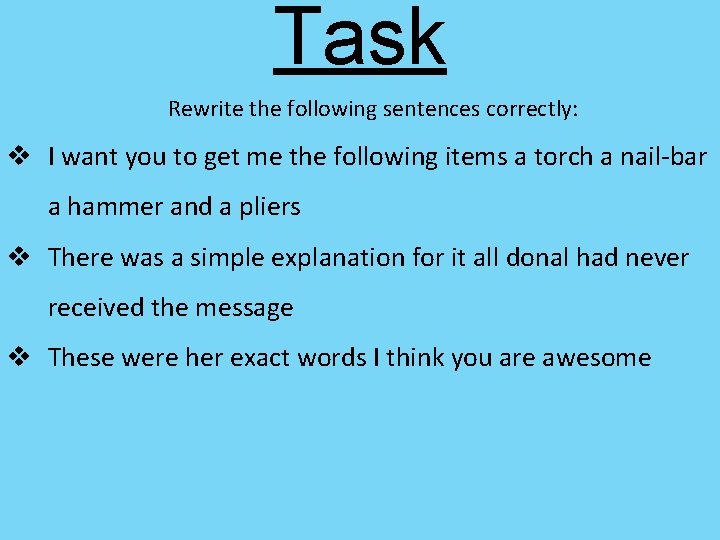
Task Rewrite the following sentences correctly: v I want you to get me the following items a torch a nail-bar a hammer and a pliers v There was a simple explanation for it all donal had never received the message v These were her exact words I think you are awesome
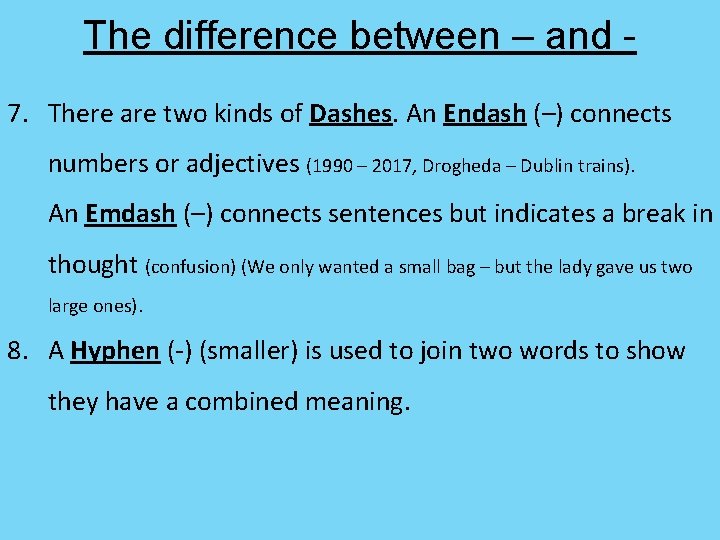
The difference between – and 7. There are two kinds of Dashes. An Endash (–) connects numbers or adjectives (1990 – 2017, Drogheda – Dublin trains). An Emdash (–) connects sentences but indicates a break in thought (confusion) (We only wanted a small bag – but the lady gave us two large ones). 8. A Hyphen (-) (smaller) is used to join two words to show they have a combined meaning.
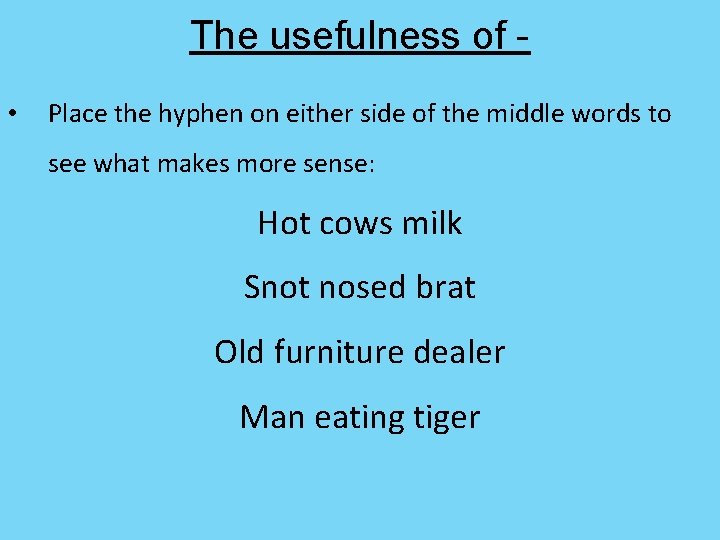
The usefulness of • Place the hyphen on either side of the middle words to see what makes more sense: Hot cows milk Snot nosed brat Old furniture dealer Man eating tiger
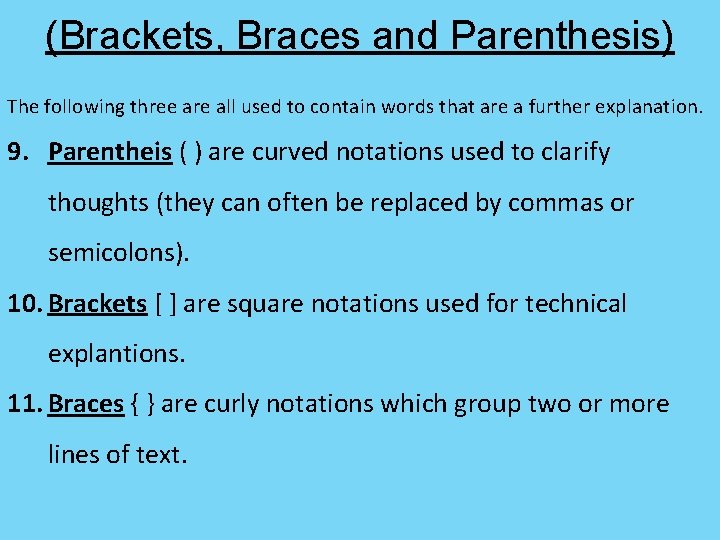
(Brackets, Braces and Parenthesis) The following three are all used to contain words that are a further explanation. 9. Parentheis ( ) are curved notations used to clarify thoughts (they can often be replaced by commas or semicolons). 10. Brackets [ ] are square notations used for technical explantions. 11. Braces { } are curly notations which group two or more lines of text.
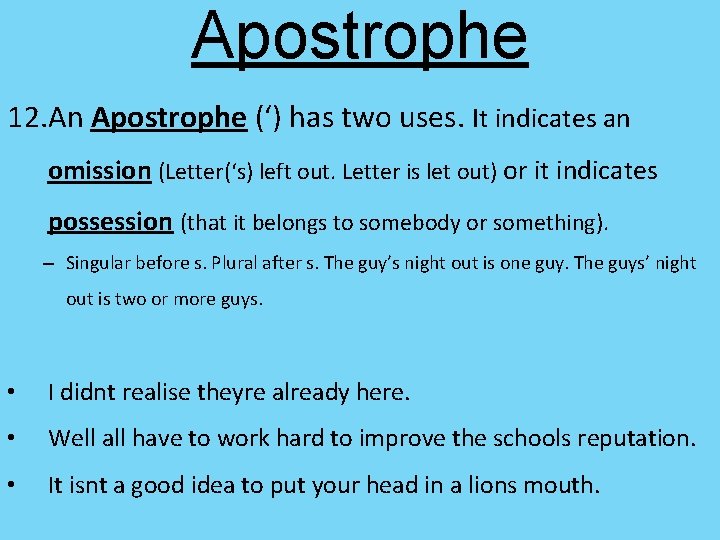
Apostrophe 12. An Apostrophe (‘) has two uses. It indicates an omission (Letter(‘s) left out. Letter is let out) or it indicates possession (that it belongs to somebody or something). – Singular before s. Plural after s. The guy’s night out is one guy. The guys’ night out is two or more guys. • I didnt realise theyre already here. • Well all have to work hard to improve the schools reputation. • It isnt a good idea to put your head in a lions mouth.
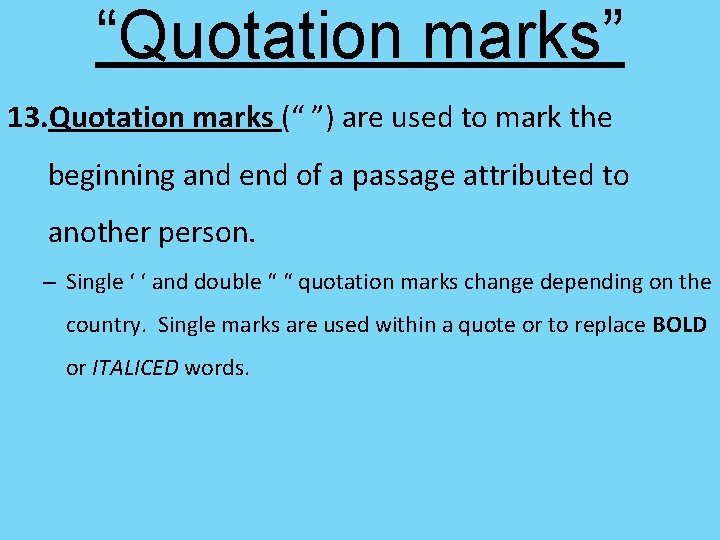
“Quotation marks” 13. Quotation marks (“ ”) are used to mark the beginning and end of a passage attributed to another person. – Single ‘ ‘ and double “ “ quotation marks change depending on the country. Single marks are used within a quote or to replace BOLD or ITALICED words.
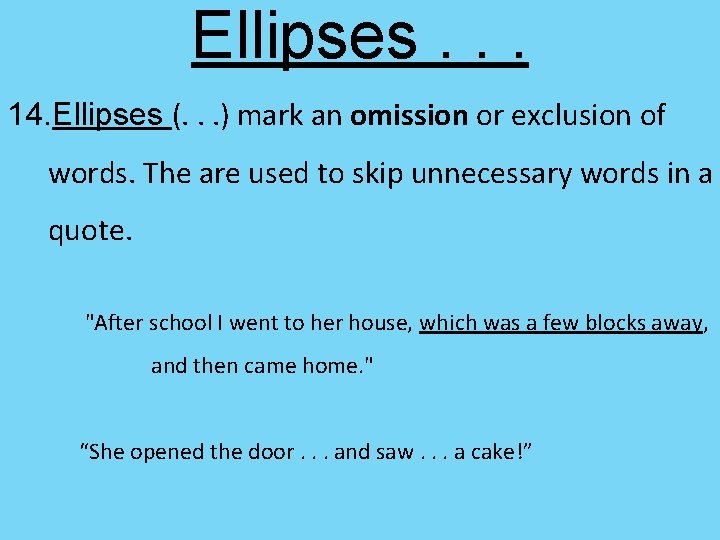
Ellipses. . . 14. Ellipses (. . . ) mark an omission or exclusion of words. The are used to skip unnecessary words in a quote. "After school I went to her house, which was a few blocks away, and then came home. " “She opened the door. . . and saw. . . a cake!”
- Slides: 20