
Head Teacher Briefing Session 26 th June 2019
Head Teacher Briefing Session 26 th June 2019 Mercure Hotel, Bingley

Welcome Yasmin Umarji Strategic Manager – Education & Learning
Children’s Services Structure Yasmin Umarji Strategic Manager – Education & Learning
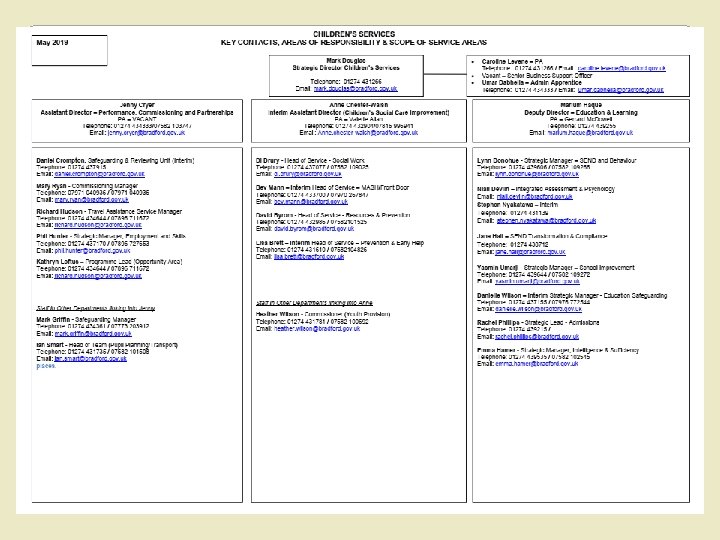
Relationships and Sex Education Guidance Jenny Fox and Bankfoot School
Relationships and Sex Education Jenny Fox Education Safeguarding
Statutory from September 2020 (and optional from 2019) • Relationships Education in primary schools • Relationships and Sex Education in secondary schools • Health Education in all schools except independents
Will primary pupils be taught about sex? • Sex education will not be compulsory in primary schools • Df. E recommends that schools continue to teach sex education appropriate to the age and understanding of their pupils • Primary schools must honour parental requests to withdraw children from the lessons • This only applies to sex education delivered as part of RSE, not science. No right to withdraw from Relationships Education.
Will secondary pupils have to learn about sex? • Parents have the right to request that their child be excused from sex education. • School should discuss the request with the parent and record the content of the meeting. It may be that the request is based on misunderstanding and school should outline the benefits of attendance. • If the request still stands, you should honour it unless exceptional circumstances apply. • This only applies to sex education delivered as part of RSE, not science. No right to withdraw from Relationships Education.
Can a young person make their own decision about sex education lessons? • It is the parents’ decision until three terms before the child turns 16 • A child can then decide for themselves at that point • In that circumstance, school should provide sex education during one of those three terms
Will parents have to be consulted on the RSE policy? Yes. You should: • consult parents in developing and reviewing the policy • Ensure it meets the needs of your pupils and parents and reflects your community • Publish it on the school website
Will the Df. E provide a detailed programme of study for RSE? • Statutory guidance tells us what must be taught be the end of each phase • The decision on when and how to deliver the content of the curriculum is up to schools • RSE will not be an exam subject
Do the regulations apply to faith schools? • Yes, but the distinctive faith perspective on relationships may be taught • In all schools, teaching should reflect the law as it applies to relationships, so that young people understand what the law allows and does not allow • In any school you must take into account the religious background of all pupils but you must still deliver the statutory curriculum to all pupils
What exactly do we have to teach about gay relationships? • Schools decide for themselves how they address LGBT specific content in the curriculum • LGBT community also protected under the Equality Act (2010) • RSE should promote inclusion and respect, and challenge discrimination and bullying
What about pupils with SEND? • RSE should be differentiated and personalised for pupils with SEND • Preparing for adulthood outcomes, as set out in the SEND code of practice • Vulnerabilities of pupils with SEND make RSE a priority for this group
SEND Changes and Update Emma Hamer Intelligence & Sufficiency Manager Stephen Nyakatawa Strategic Manager, Integrated Assessment
Sufficiency of Specialist places for Children and Young People with Special Educational Needs & Disabilities across the District Emma Hamer – Strategic Manager, Intelligence & Sufficiency Diane Cochrane – SEND Planning & Strategy Lead
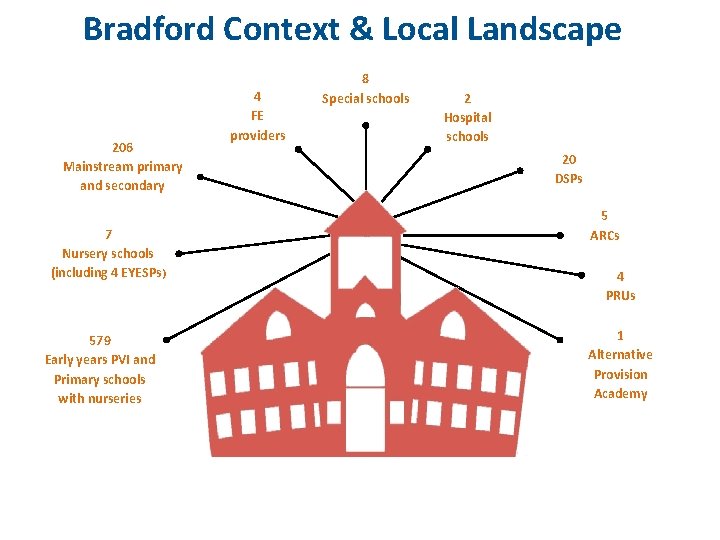
Bradford Context & Local Landscape 206 Mainstream primary and secondary 7 Nursery schools (including 4 EYESPs) 579 Early years PVI and Primary schools with nurseries 4 FE providers 8 Special schools 2 Hospital schools 20 DSPs 5 ARCs 4 PRUs 1 Alternative Provision Academy
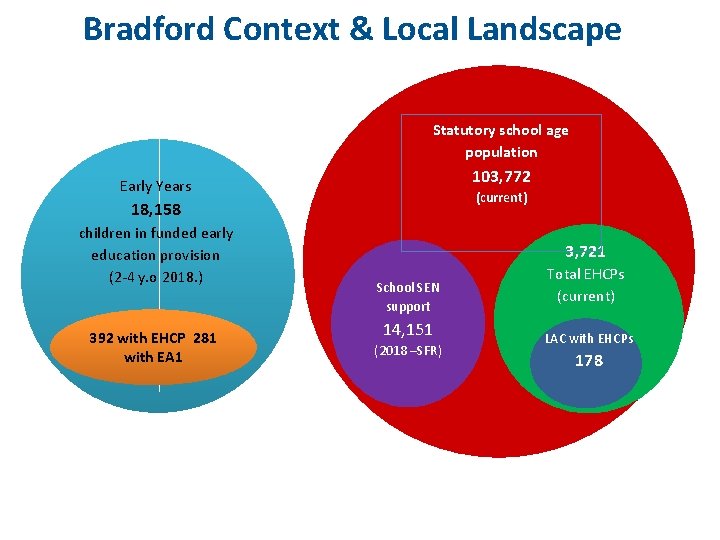
Bradford Context & Local Landscape Statutory school age population 103, 772 Early Years (current) 18, 158 children in funded early education provision (2 -4 y. o 2018. ) 392 with EHCP 281 with EA 1 3, 721 School SEN support 14, 151 (2018 –SFR) Total EHCPs (current) LAC with EHCPs 178
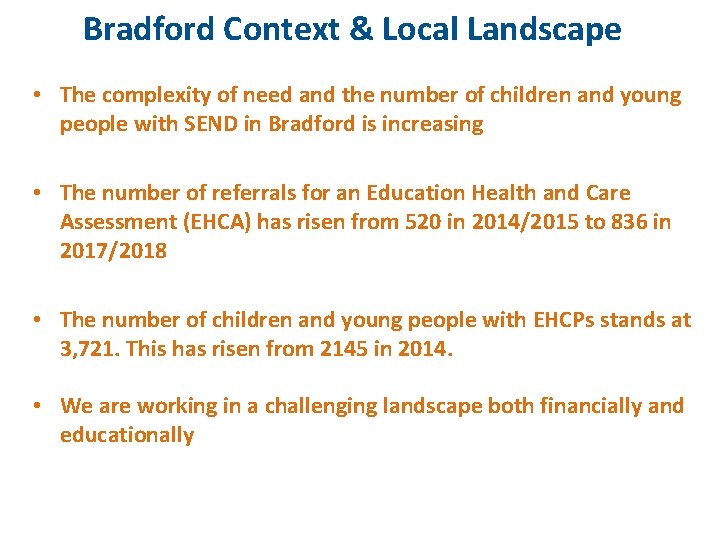
Bradford Context & Local Landscape • The complexity of need and the number of children and young people with SEND in Bradford is increasing • The number of referrals for an Education Health and Care Assessment (EHCA) has risen from 520 in 2014/2015 to 836 in 2017/2018 • The number of children and young people with EHCPs stands at 3, 721. This has risen from 2145 in 2014. • We are working in a challenging landscape both financially and educationally
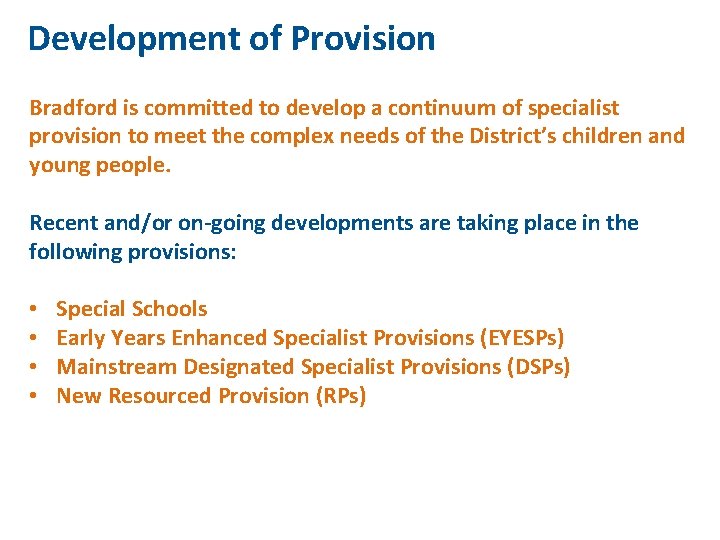
Development of Provision Bradford is committed to develop a continuum of specialist provision to meet the complex needs of the District’s children and young people. Recent and/or on-going developments are taking place in the following provisions: • • Special Schools Early Years Enhanced Specialist Provisions (EYESPs) Mainstream Designated Specialist Provisions (DSPs) New Resourced Provision (RPs)
What is Resourced Provision? • All pupils will be on roll of the school and have access to both mainstream and the Resourced Provision, dependent on individual needs. • The mainstream schools/academies will receive an amount of delegated funding to provide the Resourced Provision places • The Funding model for Resourced Provision is the de-delegation of element two and three, to the central SEND council service, who will provide the specialist staffing and resources in the host school. • The responsibility of the staff deployed to the Resourced Provision rests with the SEND & Behaviour Strategic Manager on the behalf of the LA, and the Headteacher of the school.
Consultation The Statutory Consultation period on establishing and expanding specialist provision across the district ended on Thursday 20 th June 2019. The Consultation gathered views on the below proposals, for both maintained and academies: • 34 new Resourced Provision places in primary maintained schools • 40 additional maintained special school places • 36 new Resourced Provision places in primary and secondary academy schools • 24 additional Designated Specialist Provision places in primary academy schools
Proposals in Maintained Schools The Local Authority is seeking approval from the Council Executive on 9 th July 2019, on the following proposals: Increasing Special School places for secondary aged children and young people with Social, Emotional and Mental Health needs (SEMH) at: • Oastlers Special School - 40 additional places - proposed by September 2019 taking the current number of places from 94 to 134. Development of two new Resourced Provision for primary aged children with communication and interaction needs including Autistic Spectrum disorders (ASD) at: • Princeville Primary School – 22 places • Mirium Lord Primary School – 12 places
Proposals in Academies The following Academies are is seeking approval from the Regional Schools Commissioner and Headteacher Board on the following proposals: Expanding/developing provision for primary aged children and young people with communication and interaction needs including Autistic Spectrum Disorders (ASD) and Complex SEND at: • Crossley Hall Primary School from 12 places to 24 places proposed by September 2019 for primary aged children with (ASD) • Horton Park Primary School – 12 new places proposed by September 2019 for primary aged children (key stage 1) with Complex SEND.
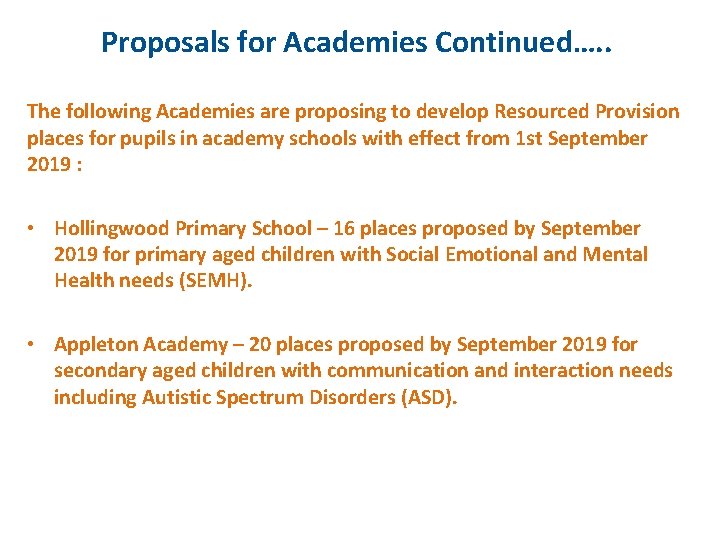
Proposals for Academies Continued…. . The following Academies are proposing to develop Resourced Provision places for pupils in academy schools with effect from 1 st September 2019 : • Hollingwood Primary School – 16 places proposed by September 2019 for primary aged children with Social Emotional and Mental Health needs (SEMH). • Appleton Academy – 20 places proposed by September 2019 for secondary aged children with communication and interaction needs including Autistic Spectrum Disorders (ASD).
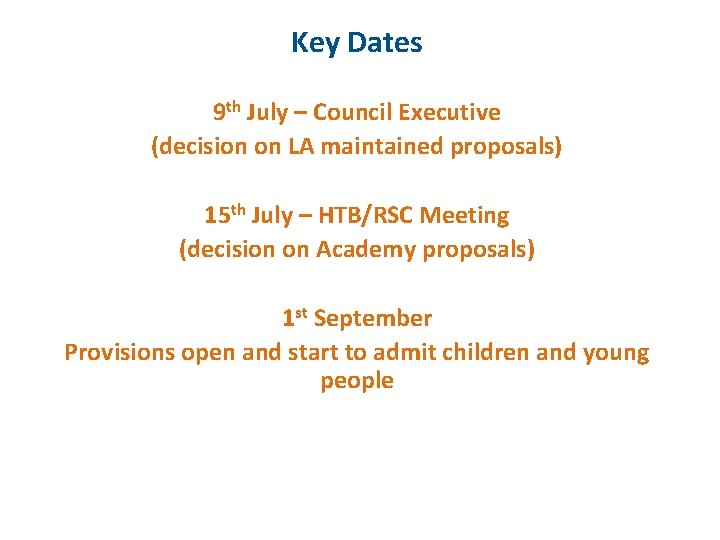
Key Dates 9 th July – Council Executive (decision on LA maintained proposals) 15 th July – HTB/RSC Meeting (decision on Academy proposals) 1 st September Provisions open and start to admit children and young people
Workload Toolkit Liz Whetham Holy Trinity School
TACKLING WORKLOAD BRADFORD PRIMARY HEADS WEDNESDAY 26 TH JUNE 2019 ELIZABETH WHETHAM, LLE, HEADTEACHER – HOLY TRINITY
WHY? Concerns over teacher mental health because of workload and leadership pressure. Three in 10 teachers say they have turned to medication over the last year to deal with the physical and mental toll their job is taking on them, a survey has found. Teachers are satisfied with their jobs and income, but not with their leisure time. Nearly four in five teachers say they are satisfied with their jobs and income levels, which is mostly higher than the other professions. However, only 47 per cent of teachers say they are satisfied with their leisure time, the lowest of the three professions. ” 75% of 1, 250 school and college staff and leaders surveyed said they had experienced psychological, physical or behavioural symptoms because of work. 45% felt they don’t achieve the right work-life balance (Education Support Partnership, 2017) Chief Inspector of Schools Amanda Spielman said that she want to look at how Ofsted can play its part in reducing workload. ‘how policies and accountability measures are translated by school leaders into day-to-day management tools such as policies for planning, assessment and marking. Endless data cuts, triple marking, 10 page lesson plans, and, worst of all, Mocksteds are a distraction from the core purpose of education. ‘
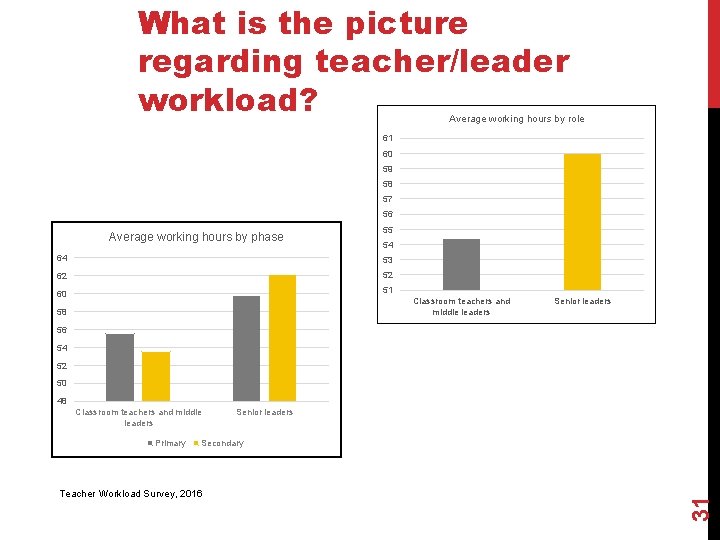
What is the picture regarding teacher/leader workload? Average working hours by role 61 60 59 58 57 56 Average working hours by phase 55 54 64 53 62 52 60 51 Classroom teachers and middle leaders 58 Senior leaders 56 54 52 50 48 Classroom teachers and middle leaders Secondary Teacher Workload Survey, 2016 31 Primary Senior leaders
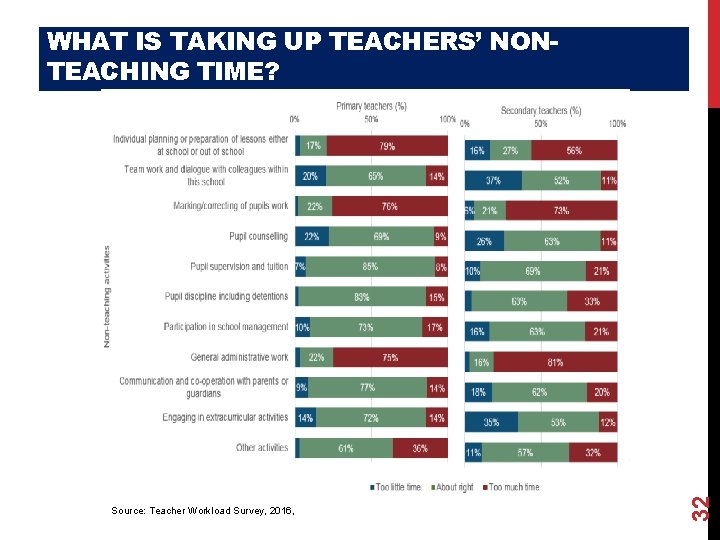
Source: Teacher Workload Survey, 2016, 32 WHAT IS TAKING UP TEACHERS’ NONTEACHING TIME?
WHAT ARE THE CURRENT WORKLOAD CHALLENGES LEADERS / TEACHERS FACE IN BRADFORD SCHOOLS?
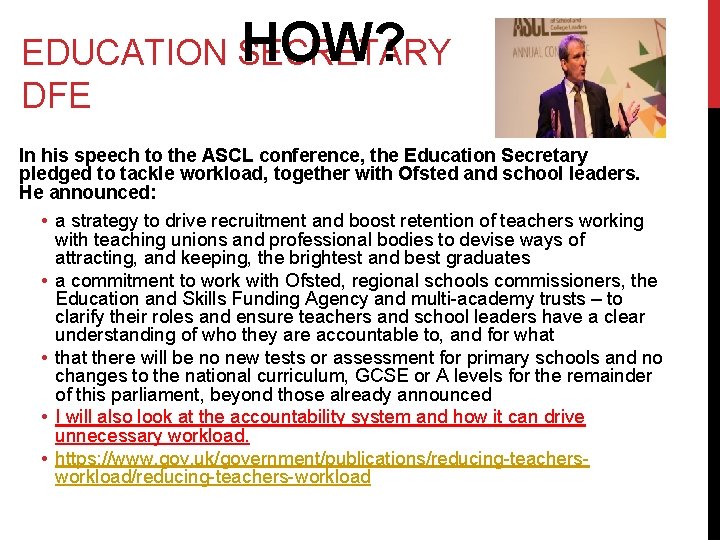
HOW? EDUCATION SECRETARY DFE In his speech to the ASCL conference, the Education Secretary pledged to tackle workload, together with Ofsted and school leaders. He announced: • a strategy to drive recruitment and boost retention of teachers working with teaching unions and professional bodies to devise ways of attracting, and keeping, the brightest and best graduates • a commitment to work with Ofsted, regional schools commissioners, the Education and Skills Funding Agency and multi-academy trusts – to clarify their roles and ensure teachers and school leaders have a clear understanding of who they are accountable to, and for what • that there will be no new tests or assessment for primary schools and no changes to the national curriculum, GCSE or A levels for the remainder of this parliament, beyond those already announced • I will also look at the accountability system and how it can drive unnecessary workload. • https: //www. gov. uk/government/publications/reducing-teachersworkload/reducing-teachers-workload
WHAT’S BEEN DONE SO FAR? • • • • Workload Challenge survey – Autumn 2014 Df. E Protocol published February 2015 and reissued February 2017 Three independent review groups (marking, planning and data management) - reports published March 2016 Teacher Workload Survey (TWS) 2016 published in February 2017 Action Plan to address issues in the TWS – February 2017 Poster and Pamphlet summarising the workload reports – February 2017 Df. E ‘Teaching Blog’ and TES Workload hub – sharing practical examples Series of 10 workload events around the country, November 2017 – March 2018 11 Research and Development projects funded– reports published March 2018 New commitments from the Secretary of State to tackle workload associated with accountability and government reforms – ASCL, NAHT and NGA conferences 2018 Workload Reduction Toolkit published – July 2018 Impact on schools tools developed and trials initiated – September 2018 Videos from So. S, Minister of State and stakeholders – March and July 2018 Advice for ITE providers on addressing trainees’ workload – November 2018 Workload Advisory Group report, government response and letter to all school leaders from So. S and stakeholders – November 2018 FROM NLE JANUARY BRIEFING PRESENTATION – Jane Hough
UPDATE SINCE THE TOOLKIT JULY 2018 Workload Advisory Group report, government response and letter to all school leaders from So. S and stakeholders – November 2018 • Develop the toolkit to include reducing workload around behaviour. • Develop the toolkit to include governance. • Further develop work around SLT workload.
THE WORKLOAD ADVISORY GROUP REPORT Principles: The purpose and use of data is clear, is relevant to the intended audience and is in line with school values and aims. The precision and limitations of data, and what can be inferred from it, are well understood. The amount of data collected and the frequency with which it is collected is proportionate. 37 School leaders review processes for both collecting data and for making use of the data once gathered.
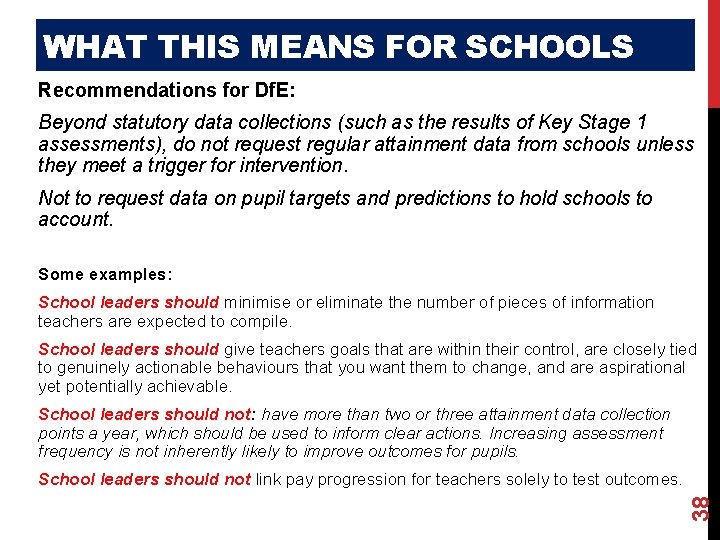
WHAT THIS MEANS FOR SCHOOLS Recommendations for Df. E: Beyond statutory data collections (such as the results of Key Stage 1 assessments), do not request regular attainment data from schools unless they meet a trigger for intervention. Not to request data on pupil targets and predictions to hold schools to account. Some examples: School leaders should minimise or eliminate the number of pieces of information teachers are expected to compile. School leaders should give teachers goals that are within their control, are closely tied to genuinely actionable behaviours that you want them to change, and are aspirational yet potentially achievable. School leaders should not: have more than two or three attainment data collection points a year, which should be used to inform clear actions. Increasing assessment frequency is not inherently likely to improve outcomes for pupils. 38 School leaders should not link pay progression for teachers solely to test outcomes.
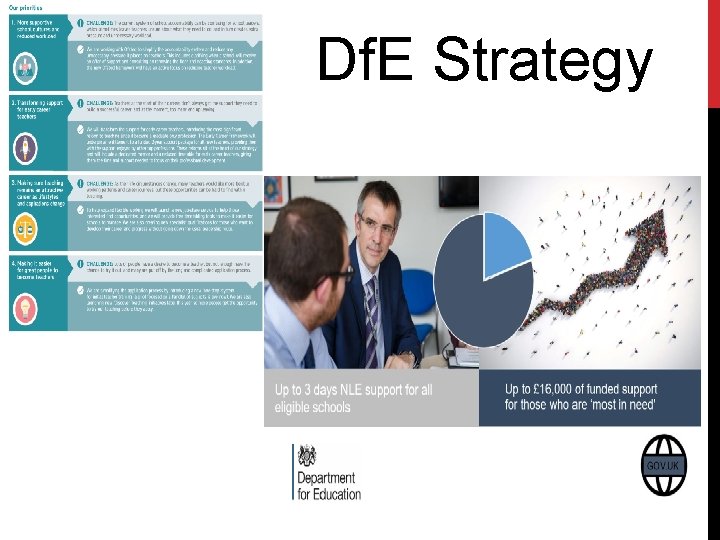
Df. E Strategy
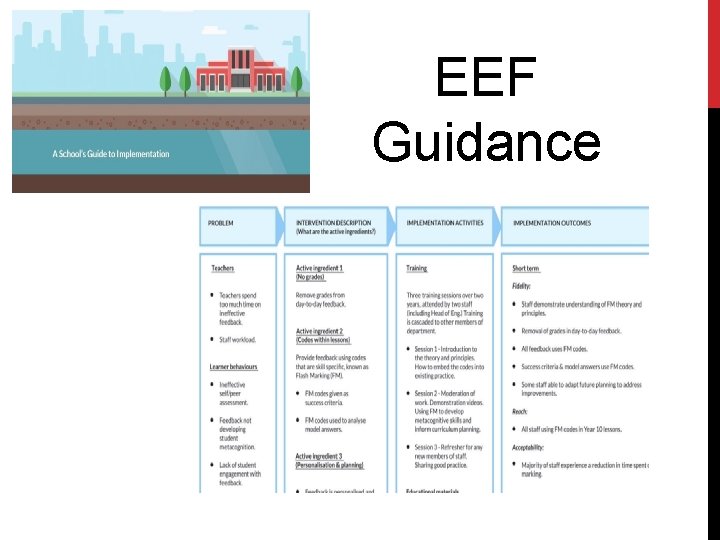
EEF Guidance
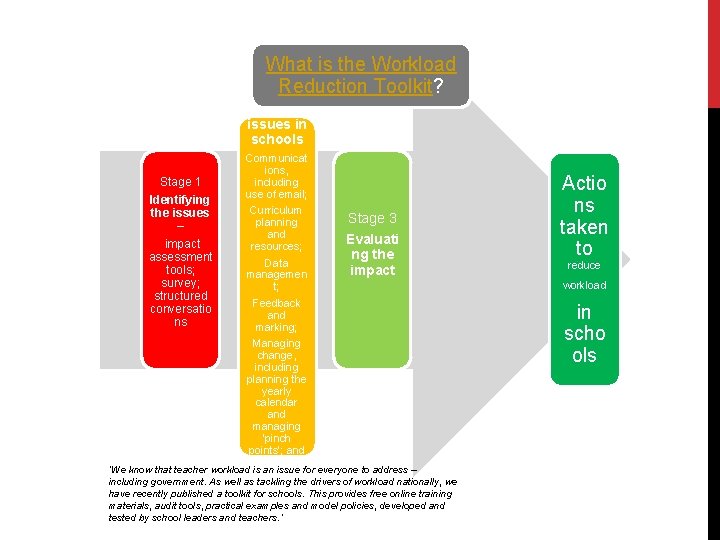
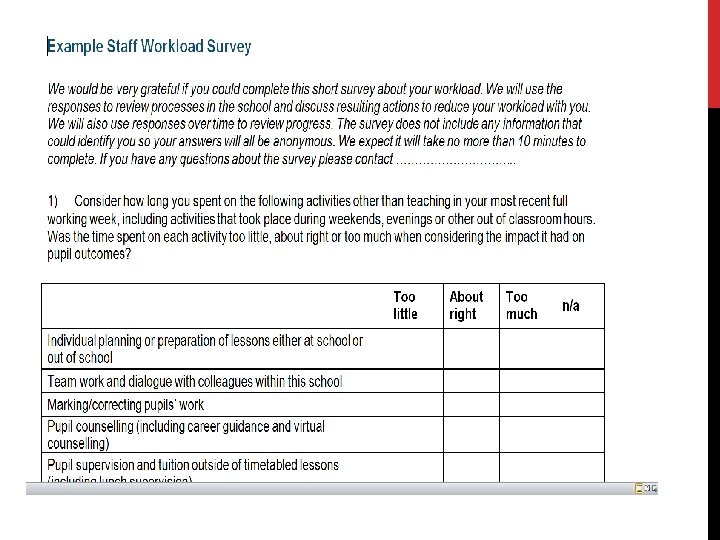
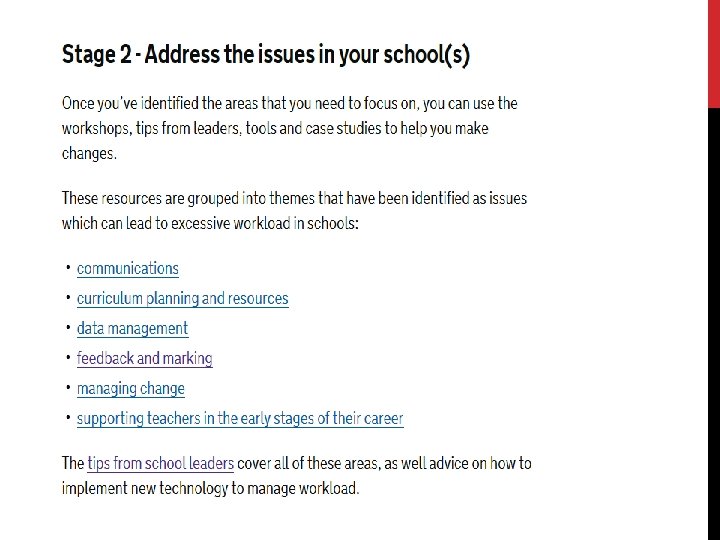
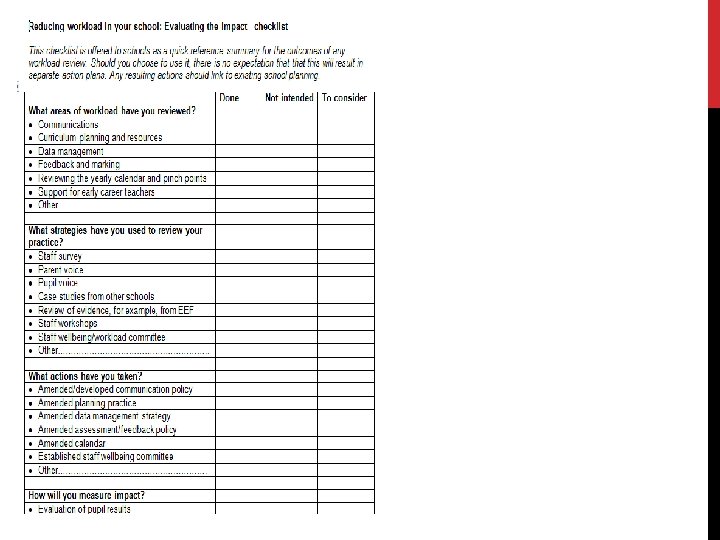
What Stage 2 is the Workload Reduction Toolkit? Addressi ng the issues in schools Communicat ions, including Stage 1 use of email; Identifying Curriculum the issues Stage 3 planning – and Evaluati impact resources; ng the assessment Data tools; impact managemen survey; t; structured Feedback conversatio and ns marking; Managing change, including planning the yearly calendar and managing ‘pinch points’; and Advice to for everyone to address – ‘We know that teacher workload is an issue support including government. As well as tackling the drivers of workload nationally, we career This provides free online training have recently published a toolkitearly for schools. teachers materials, audit tools, practical examples and model policies, developed and tested by school leaders and teachers. ’ Actio ns taken to reduce workload in scho ols
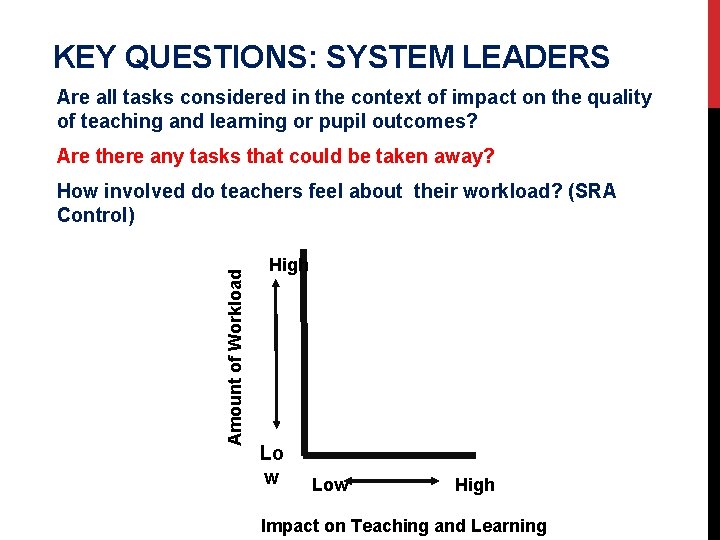
KEY QUESTIONS: SYSTEM LEADERS Are all tasks considered in the context of impact on the quality of teaching and learning or pupil outcomes? Are there any tasks that could be taken away? Amount of Workload How involved do teachers feel about their workload? (SRA Control) High Lo w Low High Impact on Teaching and Learning
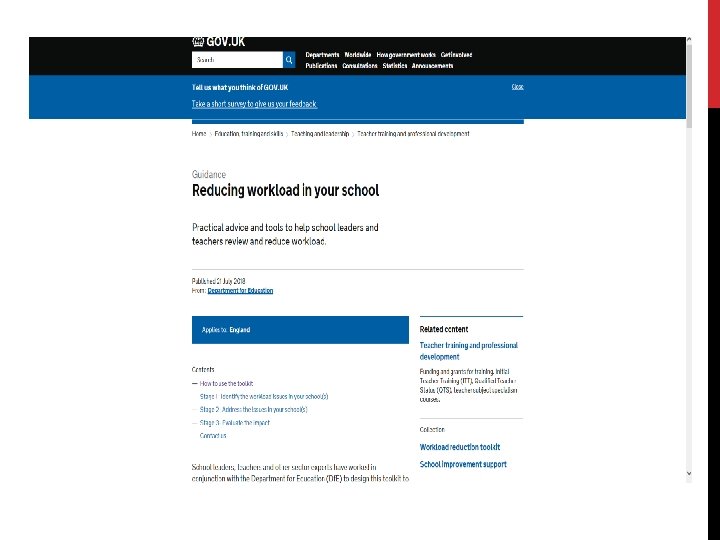
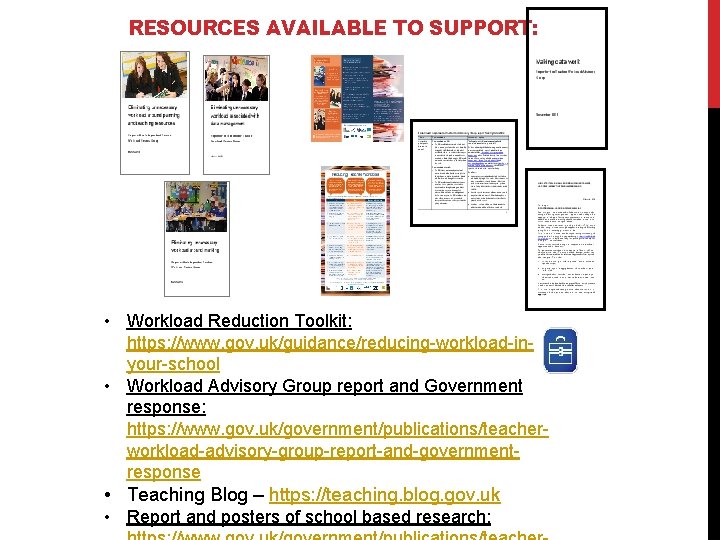
RESOURCES AVAILABLE TO SUPPORT: • Workload Reduction Toolkit: https: //www. gov. uk/guidance/reducing-workload-inyour-school • Workload Advisory Group report and Government response: https: //www. gov. uk/government/publications/teacherworkload-advisory-group-report-and-governmentresponse • Teaching Blog – https: //teaching. blog. gov. uk • Report and posters of school based research:

CONTACT Liz Whetham 07827666821 liz. whetham@holytrinitycofe. calderdale. sch. uk

New Framework Pilot Paul Urry Headteacher - St Stephens Primary School

Music Hub Offer Tony Johnson Head of Music & Arts Felicity French Assistant Head Ensemble

Skills 4 Bradford - New Website Launch Adele Baines Commercial Services Manager

Bradford Council Commercial Services for Schools

New Website

Service Groups

Service Pages
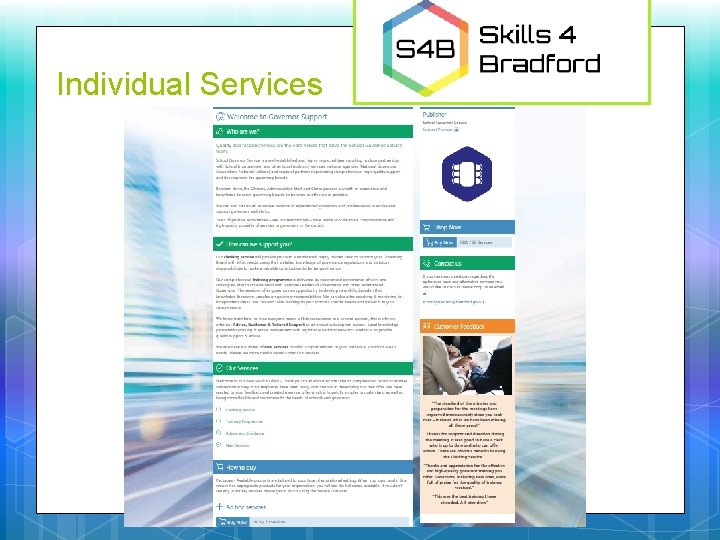
Individual Services
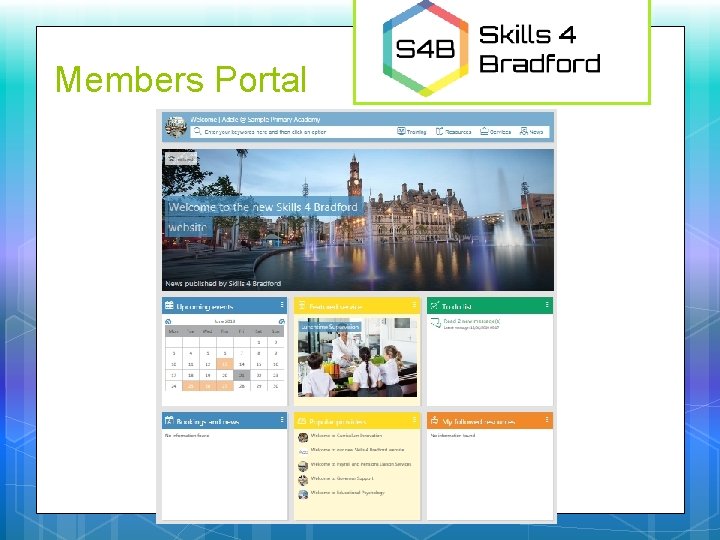
Members Portal
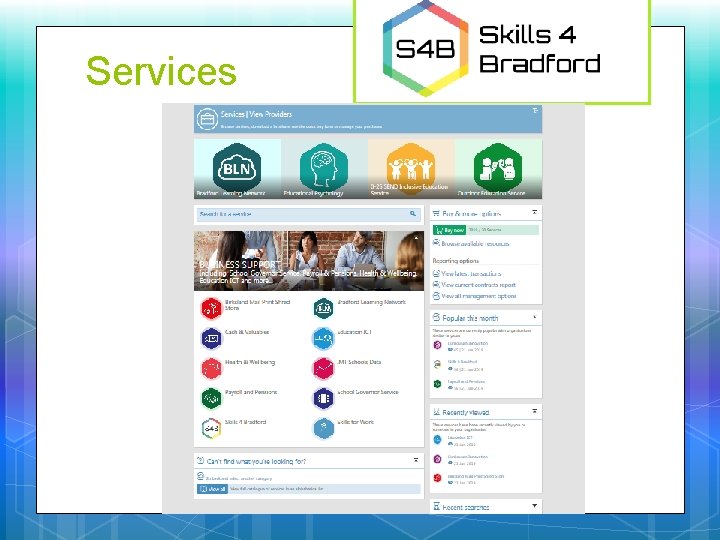
Services
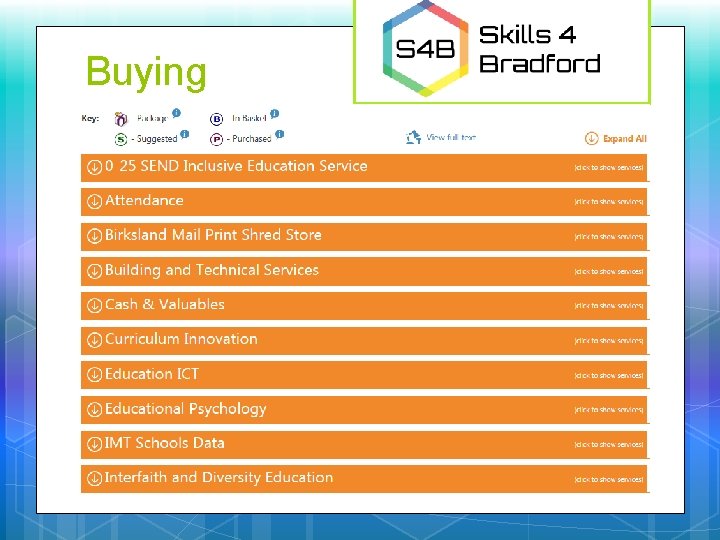
Buying
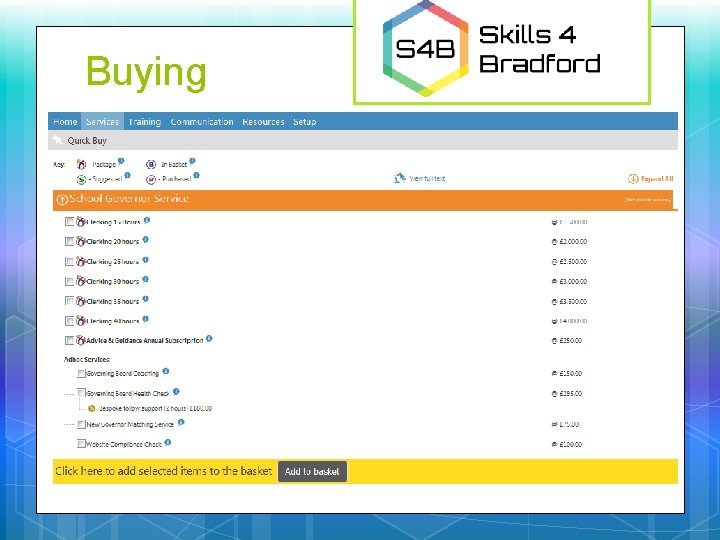
Buying
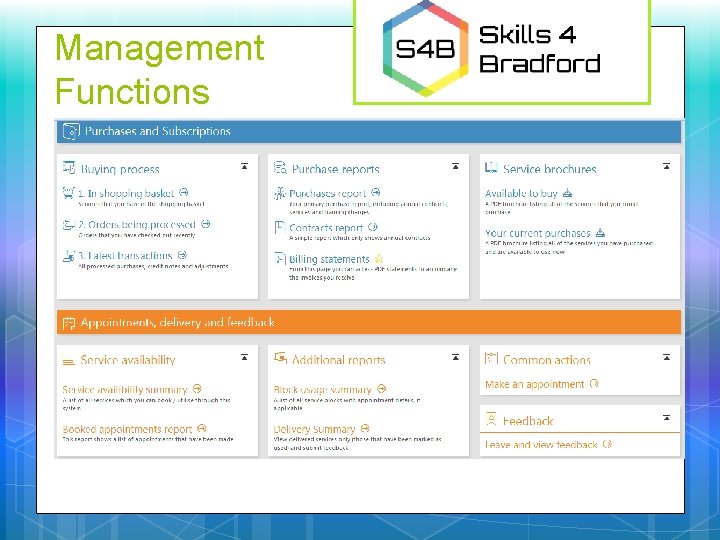
Management Functions
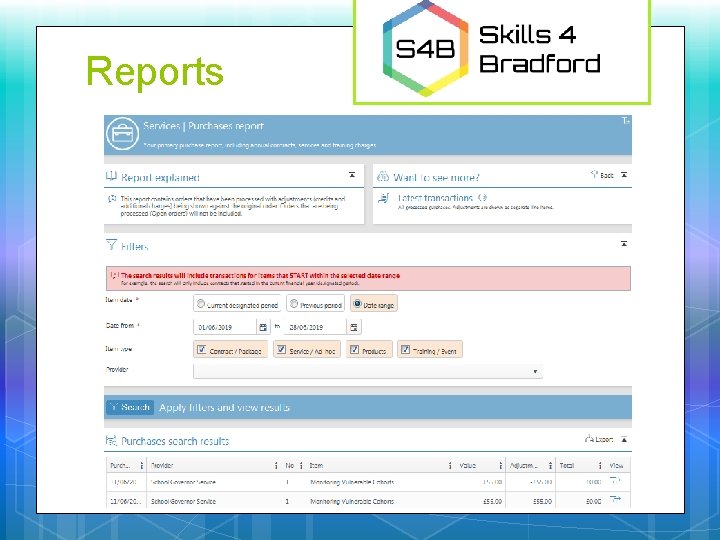
Reports
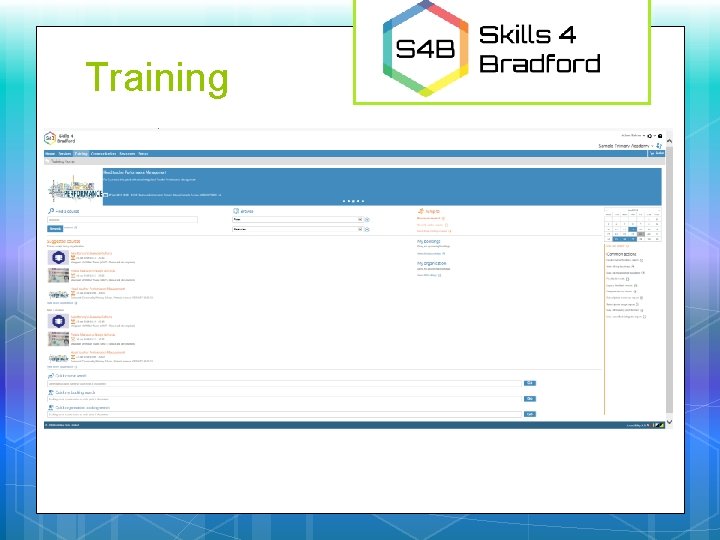
Training
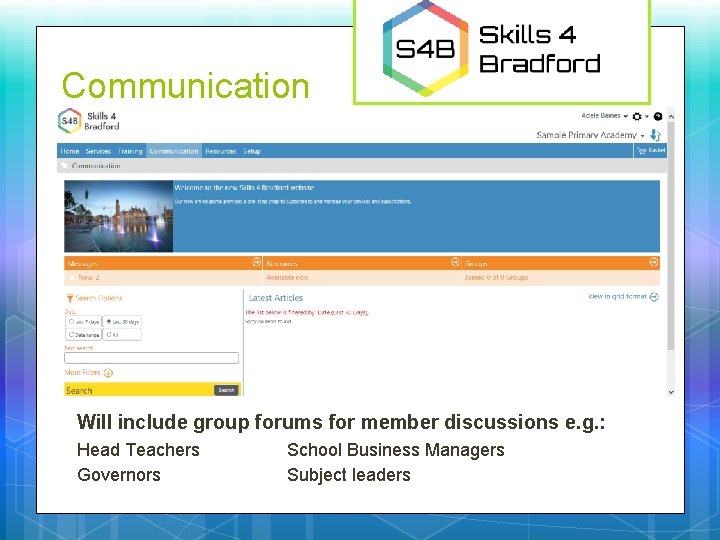
Communication Will include group forums for member discussions e. g. : Head Teachers Governors School Business Managers Subject leaders
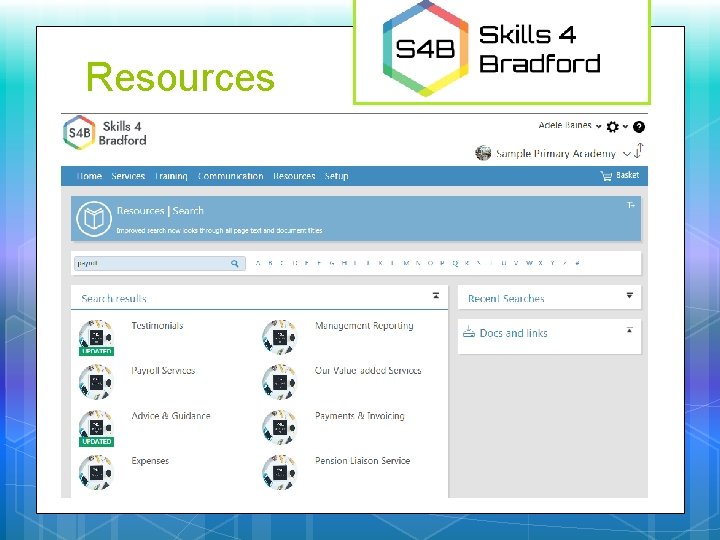
Resources
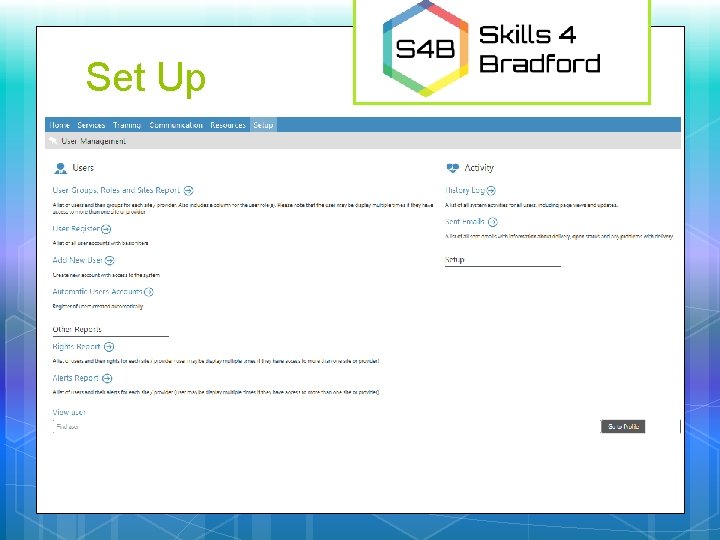
Set Up
Next Steps Majority of schools have 1 or 2 users set up if existing clients (not generic emails – accountability of buying function); New User Request Form. School user training session. Coming in the Autumn term: Governor Module Card payments

Thank you for your time Any questions?

Hate Crime Mohammed Dhalech Kate Butler

BRADFORD HATE CRIME ALLIANCE 52 Cornwall Road Manningham Bradford BD 8 7 JN Tel: 07915 119 022 Email: mohammed@bradfordhatecrimealliance. org. uk kate@bradfordhatecrimealliance. org. uk
ILACS Inspection Update Dr Marium Haque Deputy Director Education & Learning
Thank you for your support and co-operation Wishing you all a good summer
- Slides: 73